
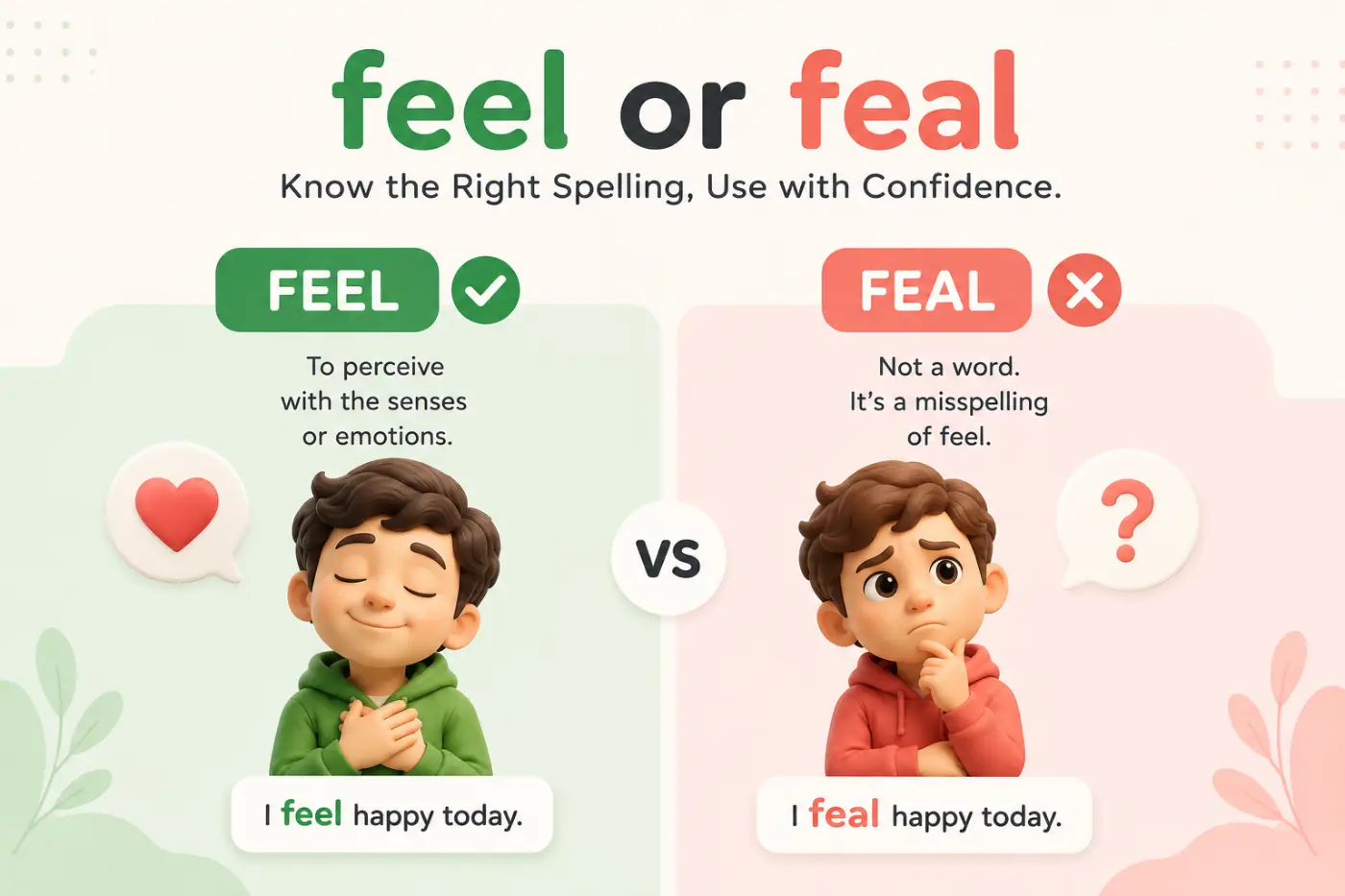
Have you ever stopped while typing and wondered if the correct spelling is feel or feal? You’re not alone. This is one of those spelling questions that catches English learners and even native speakers off guard. The two words look similar, they sound almost identical in many accents, and a simple typing mistake can turn one into the other.
The short answer is easy. Feel is the correct spelling in modern English for almost every situation. It means to experience an emotion, notice something through touch, or have an opinion or impression. Feal is not a modern alternative to feel. It is an old English word that has become extremely rare and is almost never used in everyday writing or speech.
Understanding this difference can save you from embarrassing spelling mistakes in emails, school assignments, business writing, and social media posts. It also helps you recognize the rare historical use of feal if you ever come across it in older literature.
In this guide, you’ll learn the correct spelling, meanings, grammar rules, pronunciation, common mistakes, practical examples, and simple memory tricks so you never confuse these words again.
For another common grammar confusion, see Leary Or Leery Which Word Is Correct 2026 Guide.
Quick Answer
Feel is the correct spelling for modern English. It is a verb that means to experience emotions, touch, or physical sensations. Feal is an old and uncommon English word meaning faithful or loyal. Unless you are reading historical texts or writing about medieval language, you should almost always use feel.
Feel Or Feal Comparison Table
| Feature | Feel | Feal |
|---|---|---|
| Correct modern spelling | Yes | No in modern English |
| Part of speech | Mainly verb. Also noun. | Adjective. Rarely noun. |
| Meaning | Experience emotions or physical sensations | Faithful loyal dependable |
| Modern usage | Very common | Extremely rare |
| Formal writing | Yes | Only in historical contexts |
| Everyday conversation | Yes | No |
| Dictionaries | Standard English | Archaic English |
| Example | I feel happy today. | The knight remained feal to his king. |

What Does Feel Mean
Feel is one of the most common verbs in English. It describes experiencing emotions, physical sensations, opinions, or touching something to notice its texture or temperature.
Simple Definition
Feel means to experience, sense, notice, or have an emotional or physical reaction.
Common Uses Of Feel
The word feel has several meanings depending on the situation.
Expressing Emotions
- I feel excited about the trip.
- She feels confident before the interview.
- We felt nervous during the presentation.
Describing Physical Sensations
- My hands feel cold.
- He felt pain in his shoulder.
- I can feel the warm sunshine on my face.
Using Touch
- Feel the fabric before you buy it.
- She felt the wall in the dark.
- The doctor felt the patient’s pulse.
Giving Opinions
- I feel this is the right decision.
- They feel the project will succeed.
- We all feel the meeting was productive.
What Does Feal Mean
Feal is an archaic English word. It means faithful, loyal, dependable, or true to someone, especially a ruler or leader.
You will almost never hear it in modern conversation. Most people encounter it only in historical books, medieval literature, or old poems.
Simple Definition
Feal means loyal or faithful.
Historical Examples
- The feal knight protected his king.
- Every feal servant honored the crown.
- The soldiers remained feal through difficult times.
These examples sound old fashioned because the word itself belongs to an earlier stage of English.
Today, native speakers would naturally replace feal with words such as loyal, faithful, or devoted.
Which One Is Correct
For modern English, feel is the correct spelling.
Use feel when talking about emotions, physical sensations, opinions, or touch.
Use feal only when discussing historical language, medieval literature, or older English texts.
Here are a few examples.
✔ I feel much better today.
✔ Do you feel ready for the exam?
For almost every email, essay, message, or conversation, feel is the word you need.
Why People Confuse Feel And Feal
Although the answer is simple, the confusion happens for several reasons.
Similar Pronunciation
Both words are pronounced almost the same in modern English.
Similar Spelling
The letters ea and ee appear in many English words, and English spelling does not always follow predictable patterns.
Examples include.
- Meet and meat.
- Heel and heal.
- Seen and scene.
Because English contains many vowel combinations, some learners assume feal follows the same pattern as feel.
Typing Mistakes
The letters sit close together in spelling patterns that learners often confuse. A quick typing error or autocorrect issue can easily produce feal.
Rare Historical Use
Since feal exists in dictionaries as an archaic word, some people mistakenly believe it is an accepted alternative spelling of feel.
It is not.
Key Differences Between Feel And Feal
| Feature | Feel | Feal |
|---|---|---|
| Meaning | Experience emotions or sensations | Faithful or loyal |
| Grammar | Verb and noun | Adjective |
| Modern English | Standard | Archaic |
| Daily use | Very common | Almost never |
| Best choice for writing | Yes | Only for historical writing |
The easiest way to remember the difference is simple.
If you’re talking about emotions, touch, or opinions, use feel.
If you’re reading medieval literature and see feal, understand that it means loyal or faithful.
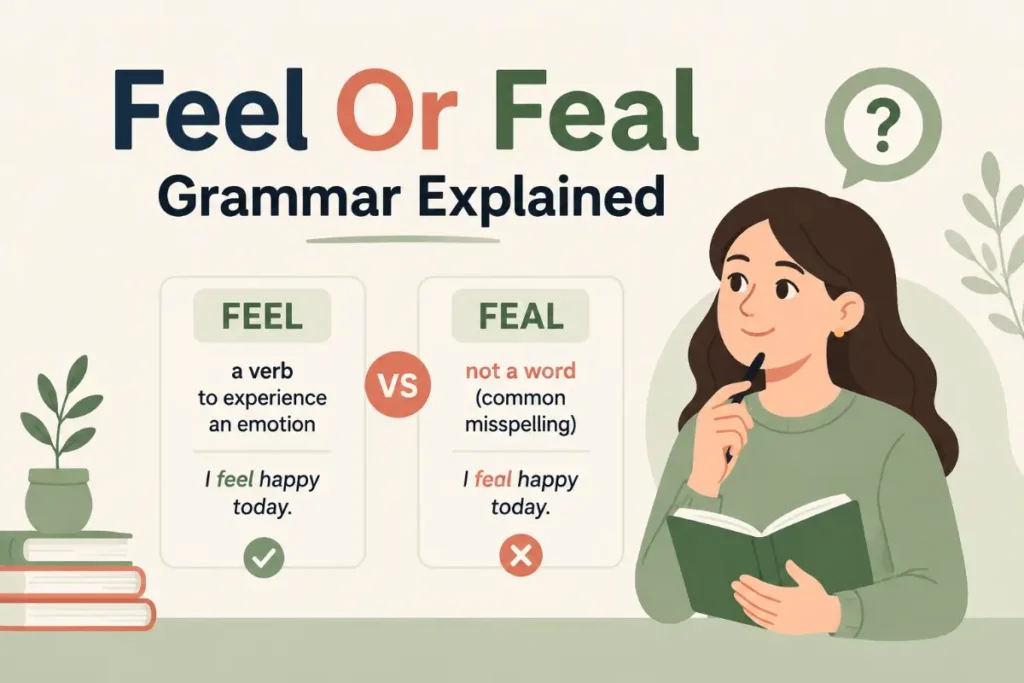
Feel Or Feal Grammar Explained
Understanding the grammar behind these words makes the difference easy to remember.
Feel Is Primarily A Verb
Most of the time, feel is a verb. It describes an action or a state of experiencing something.
Examples.
- I feel tired after work.
- She feels happy today.
- They felt disappointed by the result.
- We are feeling much better now.
As a verb, feel changes tense like other common English verbs.
| Tense | Form | Example |
|---|---|---|
| Base form | Feel | I feel confident. |
| Third person singular | Feels | She feels excited. |
| Past tense | Felt | We felt surprised. |
| Past participle | Felt | I have felt this before. |
| Present participle | Feeling | They are feeling better. |
Notice that fealed and feeling from feal do not exist in modern English.
Feel Can Also Be A Noun
Although less common, feel can also be used as a noun.
Examples.
- I like the feel of this sweater.
- The chair has a soft feel.
- The room has a warm and welcoming feel.
Here, feel refers to texture, atmosphere, or overall impression.
Feal Is An Archaic Adjective
Unlike feel, feal is not a modern verb.
It functions mainly as an adjective meaning faithful or loyal.
Examples.
- The feal knight defended the castle.
- A feal servant never abandoned the king.
This usage belongs almost entirely to historical English.
Spelling Rules Behind Feel
English spelling often feels unpredictable, but there is a simple reason why feel uses ee instead of ea.
The word developed through centuries of language change while keeping its traditional spelling.
Many common English words follow the same vowel pattern.
Examples include.
- See.
- Keep.
- Deep.
- Green.
- Sleep.
These words all use ee to represent the long E sound.
Although some words use ea for the same sound, such as sea and dream, feel has always kept its standard spelling.
There has never been a modern spelling rule that changed feel into feal.
For another common grammar confusion, see Instalments Or Installments Which Spelling Should You Use.
Pronunciation Guide
The pronunciation of these words explains why many learners confuse them.
Feel
IPA
American English.
/fiːl/
Syllables
Feel.
Stress Pattern
The single syllable receives full stress.
Feal
IPA
/fiːl/
In modern pronunciation, feal sounds almost exactly like feel.
Because they sound alike, listeners depend on context instead of pronunciation to understand the meaning.
Word Origin
The history of these words tells an interesting story.
Origin Of Feel
The verb feel comes from Old English felan, meaning to touch, perceive, or experience.
Over hundreds of years, its meaning expanded to include emotions, opinions, physical sensations, and intuition.
Today it is one of the most frequently used verbs in English.
Origin Of Feal
Feal comes from Old French feal, which meant faithful or loyal.
The word entered Middle English and appeared often in medieval literature, legal documents, and stories about knights and kings.
As English evolved, speakers gradually replaced feal with faithful and loyal.
Today, it survives mainly in historical texts.
British American Canadian And Australian English
There is no spelling difference between major English speaking countries.
American English uses feel.
British English uses feel.
Canadian English uses feel.
Australian English uses feel.
No modern English variety accepts feal as an alternative spelling for feel.
If you see feal, it almost always appears in historical writing or older dictionaries.
Real Life Examples
Seeing words in context is one of the fastest ways to remember them.
Daily Conversation
- I feel much better today.
- Do you feel hungry yet?
- She doesn’t feel well this morning.
- We all feel excited about the weekend.
Workplace
- I feel this plan has real potential.
- Our team feels ready for the presentation.
- Employees should feel comfortable asking questions.
- I feel confident about the interview.
Emails
- I feel this schedule works for everyone.
- Please let me know how you feel about the proposal.
Academic Writing
- Researchers often feel more confident after reviewing the evidence.
- Students sometimes feel nervous before exams.
Journalism
- Many residents feel the city needs more parks.
- Experts feel the economy will improve next year.
Literature
- The character begins to feel hope again.
- Readers can feel the tension in every chapter.
Social Media
- I feel so grateful today.
- Anyone else feel like it’s already Friday?
Historical Writing
- The feal warrior stood beside his king until the end.
- Every feal subject promised lifelong loyalty.
These examples show that feel belongs in modern communication, while feal belongs almost exclusively in historical settings.
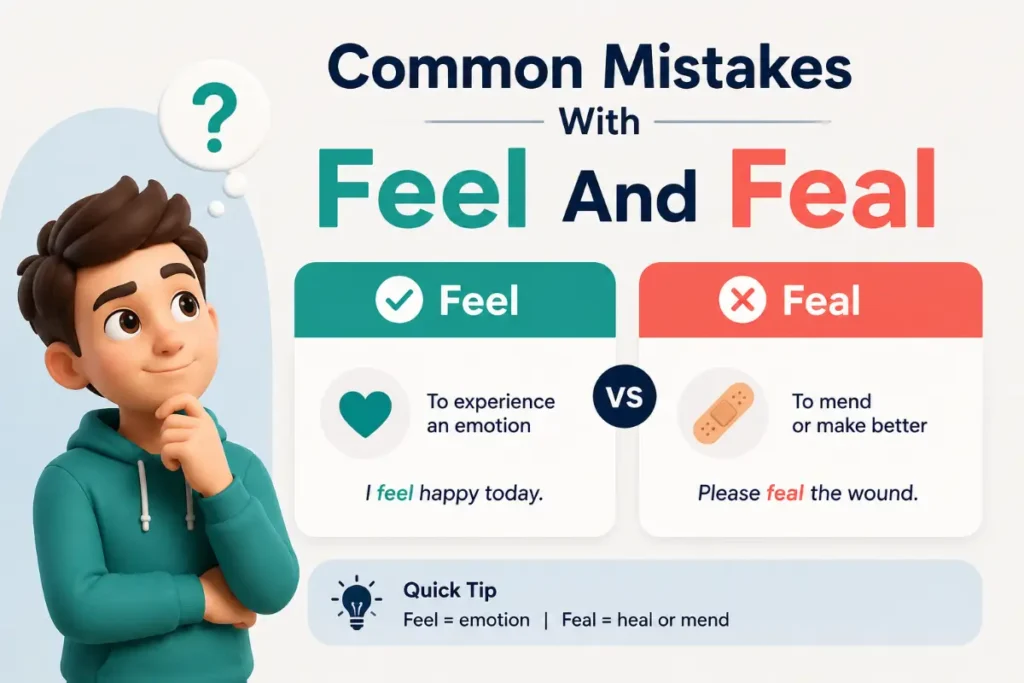
Common Mistakes With Feel And Feal
Even experienced writers occasionally make spelling mistakes, especially when two words sound alike. Here are the most common errors and the correct way to fix them.
Using Feal Instead Of Feel
Incorrect.
✘ I feal happy today.
Correct.
✔ I feel happy today.
The verb feel is always the correct choice in modern English.
Thinking Feal Is A Modern Spelling
Some people assume feal is an acceptable alternative spelling because it appears in old books or online dictionaries.
It is not.
Outside historical writing, feal looks like a spelling mistake.
Confusing Historical And Modern English
If you’re writing an essay, email, blog post, or social media caption, choose feel.
Use feal only when discussing medieval literature, historical documents, or the history of the English language.
Memory Tricks
Simple memory tricks make this spelling easy to remember.
Feel Has Two Es For Emotion
The two e letters in feel can remind you of emotion and experience.
If you’re talking about emotions or sensations, choose feel.
Think About Common Words
The spelling matches many everyday English words.
- See.
- Keep.
- Green.
- Sleep.
- Feel.
Once you remember this pattern, the correct spelling becomes automatic.
Remember Feal Means Faithful
The word feal belongs to old stories about loyal knights and faithful servants.
If your sentence has nothing to do with history, you almost certainly need feel.
Related Words
Learning related words builds a stronger vocabulary.
Words Related To Feel
- Feeling.
- Felt.
- Emotion.
- Sense.
- Experience.
- Touch.
- Perceive.
- Notice.
Synonyms For Feel
- Sense.
- Experience.
- Detect.
- Notice.
- Perceive.
Synonyms For Feal
- Faithful.
- Loyal.
- Devoted.
- Trustworthy.
- Dependable.
Frequently Confused Words
- Feel and fell.
- Feel and fill.
- Heel and heal.
- See and sea.
- Meet and meat.
Recognizing these pairs helps improve both spelling and vocabulary.
Expert Editor’s Note
Professional editors recommend using feel in every modern piece of writing unless you are intentionally quoting or discussing historical English.
Major dictionaries list feel as the standard spelling for the verb meaning to experience emotions, physical sensations, opinions, or touch.
They also recognize feal, but mark it as archaic. That label matters. It tells readers and writers the word belongs to an earlier stage of English and should not replace feel in modern communication.
If your goal is clear, natural English, choose feel every time.
Frequently Asked Questions
Is Feel Or Feal Correct?
Feel is the correct spelling in modern English. Feal is an archaic word that means faithful or loyal and appears mainly in historical texts.
Is Feal A Real Word?
Yes. Feal is a real English word, but it is archaic. Modern speakers rarely use it outside discussions of history or literature.
Why Do People Spell Feel As Feal?
The confusion comes from similar pronunciation, English vowel patterns, and simple typing mistakes. Since feal exists in older dictionaries, some writers mistakenly believe it is an accepted modern spelling.
Can I Use Feal In Everyday Writing?
No. For emails, essays, school assignments, business writing, and conversations, use feel. Most readers will assume feal is a spelling error.
What Part Of Speech Is Feel?
Feel is mainly a verb. It can also be used as a noun when referring to texture, atmosphere, or overall impression.
Do British And American English Spell Feel Differently?
No. American, British, Canadian, and Australian English all use feel. There is no regional spelling difference.
How Can I Remember The Correct Spelling?
Think of feel as the word for emotions and experiences. The double e appears in many common English words like see, keep, and green, making the spelling easier to remember.
Need another quick comparison? Read Conex Or Connex Which Spelling Is Correct 2026 Guide.
Conclusion
The answer to feel or feal is straightforward.
Feel is the correct spelling in modern English. It is the verb you use to describe emotions, physical sensations, opinions, and touch. It can also be used as a noun to describe texture or atmosphere.
Feal is an old English word meaning faithful or loyal. While dictionaries still recognize it, modern writers almost never use it outside historical or literary contexts.
The simplest rule is this.
If you’re writing for today’s readers, choose feel. Save feal for medieval stories, historical discussions, and older texts where its original meaning belongs.
Getting this one word right makes your writing clearer, more professional, and easier to understand.

Editorial Reviewer & Proofreader
Grace Mitchell reviews Gramlify’s articles for clarity, consistency, and readability. She is passionate about creating accurate, approachable content that helps English learners build confidence.