
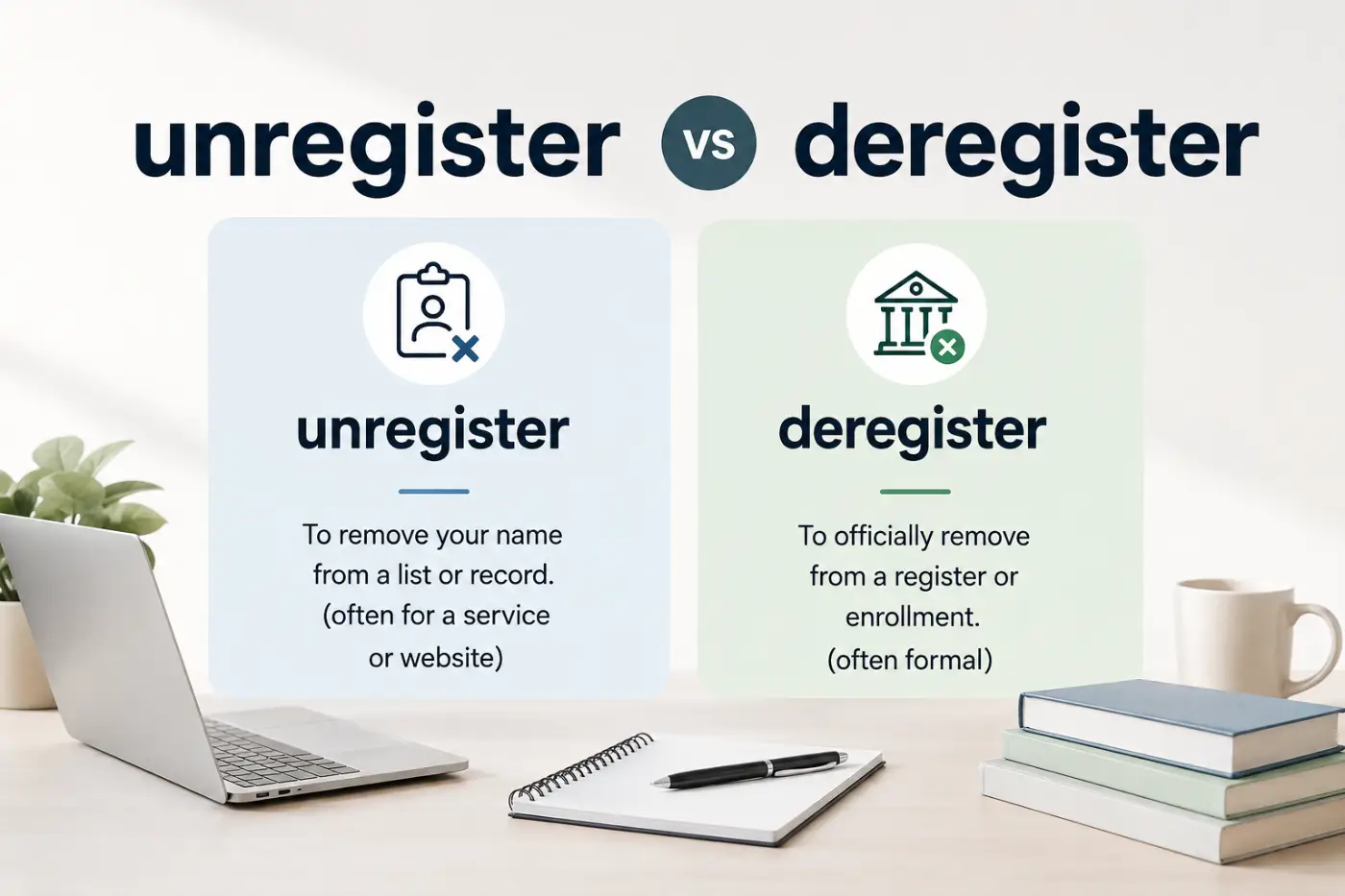
If you’ve searched for unregister vs deregister, you’re likely trying to figure out if the two words mean the same thing or if one is more correct than the other. The short answer is that both words are correct, but they are not always interchangeable.
The confusion comes from the prefixes un and de. Both can suggest removing or reversing something, so many people assume the words have identical meanings. In practice, their usage depends on the context. Unregister usually means removing a registration, account, device, or item from a system. Deregister often refers to officially removing something from a register, database, legal record, or government system.
Choosing the wrong word may not create a grammar mistake, but it can make your writing sound less natural or technically inaccurate. Software documentation, legal documents, government forms, and everyday conversations all tend to favor one term over the other depending on the situation.
This guide explains the difference between unregister vs deregister, when each word is appropriate, how native English speakers use them, and the grammar behind both terms. You’ll also find practical examples, common mistakes, and expert tips that make the distinction easy to remember.
Many readers also check Rug Vs Rag Key Differences Explained 2026 Guide.
Quick Answer
Both unregister and deregister are correct English verbs. Unregister usually means removing a person, device, account, or item from a system. Deregister often refers to officially removing something from a register, legal record, or government database. The correct choice depends on the context, not grammar.
Unregister Vs Deregister Comparison Table
| Feature | Unregister | Deregister |
|---|---|---|
| Part of speech | Verb | Verb |
| Meaning | Remove from a system or registration | Officially remove from a register or record |
| Correct English | Yes | Yes |
| Common use | Software, websites, devices, online accounts | Government, business, legal, education, vehicles |
| Formality | Neutral | More formal |
| Administrative use | Sometimes | Very common |
| Technical use | Very common | Common |
| Example | Please unregister your device before selling it. | The company must deregister before closing. |

What Does Unregister Mean
Unregister means to remove someone or something from a registration, system, service, or list.
The action usually reverses an earlier registration. In technology, it often refers to disconnecting a device, removing a user account, or taking software out of a system.
Simple Definition
Unregister means to cancel or remove an existing registration from a system or service.
Common Uses Of Unregister
People often use unregister in technology and everyday situations.
Examples.
- Please unregister your old phone before activating the new one.
- You need to unregister the software before moving it to another computer.
- I forgot to unregister my email address from the mailing list.
- The app lets you unregister your account at any time.
- Make sure you unregister the device before giving it away.
Unregister In Different Contexts
Technology.
You must unregister the printer before connecting a replacement.
Online Services.
Users can unregister from the event through the website.
Education.
Students may unregister from optional workshops before the deadline.
Healthcare.
Patients should unregister from their previous clinic after moving to another city.
What Does Deregister Mean
Deregister means to officially remove a person, business, organization, vehicle, or other item from an official register or record.
The word is common in legal, government, financial, and administrative writing. It usually involves an authorized process instead of a simple user action.
Simple Definition
Deregister means to officially cancel or remove something from an official register or legal record.
Common Uses Of Deregister
Examples.
- The business decided to deregister after it stopped trading.
- You must deregister the vehicle before exporting it.
- The organization applied to deregister its charity status.
- The company plans to deregister its shares from the stock exchange.
- Residents must deregister their address before leaving the country in some countries.
Which One Is Correct
Both unregister and deregister are correct.
The right choice depends on the type of registration involved.
Use unregister when someone removes an account, device, subscription, or service from a system.
Use deregister when an official authority removes or cancels a legal, government, financial, or administrative registration.
Compare these examples.
✔ Please unregister your smartwatch before selling it.
✔ The company chose to deregister after completing the merger.
Using the wrong word may still be understood, but it can sound unusual to native speakers or inaccurate in professional writing.
Why The Difference Matters
Although both words describe removing a registration, they carry different expectations.
Unregister usually involves a user or system performing a routine action.
Deregister often suggests an official process involving records, regulations, or legal requirements.
Understanding this difference makes your writing more precise and helps you sound more natural in professional and everyday English.
Why People Confuse Unregister And Deregister
The confusion is easy to understand. Both words begin with a prefix that suggests removing or reversing something. They also share the same root word register, so they appear to mean exactly the same thing.
In many situations, both words describe removing a registration. Still, native English speakers often choose one over the other because of the context.
Here are the main reasons people mix them up.
Similar Meaning
Both words involve removing something from a register, list, or system.
For example.
- Unregister a device.
- Deregister a company.
Both actions remove a previous registration, but the type of registration is different.
Similar Appearance
The prefixes un and de both suggest reversal. Since the words differ by only a few letters, they are easy to confuse when reading or writing quickly.
Technical And Legal Language
Software companies usually prefer unregister.
Government agencies, tax authorities, and legal organizations usually prefer deregister.
People who switch between technical and legal documents often assume the terms are interchangeable.
Different Industries Use Different Terms
A software manual might tell you to unregister a product.
A government website might tell you to deregister a business.
Both are correct because each industry has developed its own preferred wording.
Key Differences Between Unregister And Deregister
| Feature | Unregister | Deregister |
|---|---|---|
| Main purpose | Remove from a system or service | Remove from an official register |
| Typical user | Individual user or software | Government office or organization |
| Common context | Apps devices accounts events | Companies charities vehicles securities |
| Formality | Neutral | More formal |
| Legal meaning | Rare | Very common |
The easiest way to remember the difference is this.
Unregister usually happens inside a system.
Deregister usually happens inside an official record.
Grammar Explanation
Both unregister and deregister are verbs.
That means they describe an action.
Unregister As A Verb
The verb unregister means to remove an existing registration from a system or service.
Examples.
- Please unregister your account before creating a new one.
- I need to unregister my laptop from the company network.
- She forgot to unregister from the webinar.
The action is usually completed by the user or the software.
Deregister As A Verb
The verb deregister means to officially remove something from a formal register.
Examples.
- The business decided to deregister after closing.
- They must deregister the vehicle before shipping it overseas.
- The charity chose to deregister after completing its work.
The action usually involves legal or administrative approval.
Verb Forms
| Form | Unregister | Deregister |
|---|---|---|
| Base verb | unregister | deregister |
| Present tense | unregister unregisters | deregister deregisters |
| Past tense | unregistered | deregistered |
| Present participle | unregistering | deregistering |
| Past participle | unregistered | deregistered |
Both verbs follow regular English verb patterns.
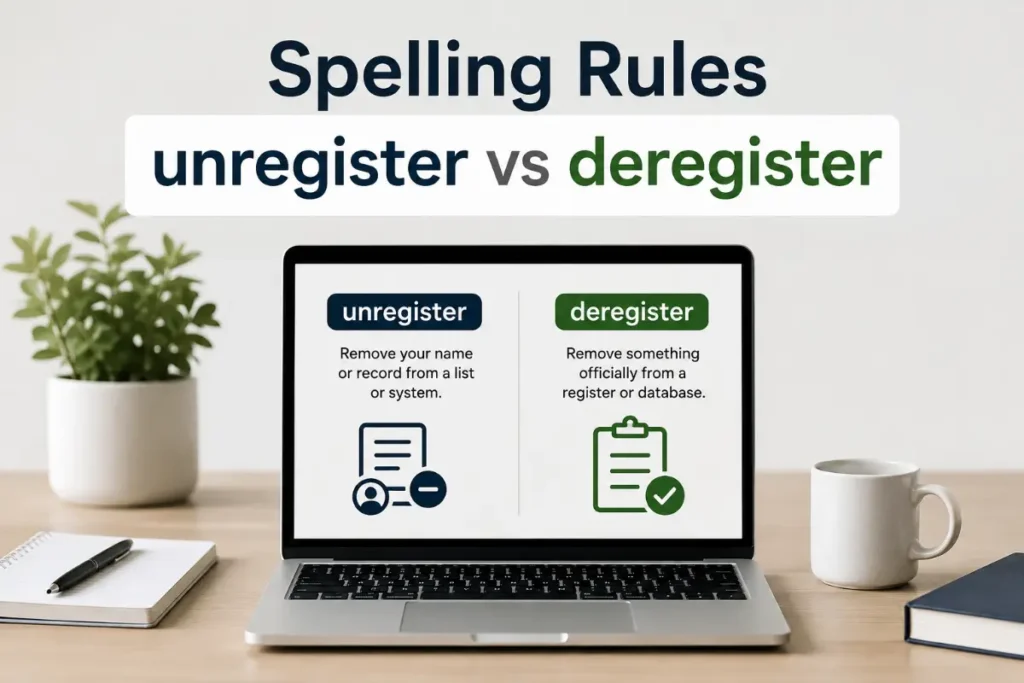
Spelling Rules
Both words are spelled correctly with one r in the prefix and the root word register.
Examples.
- Unregister.
- Deregister.
Their past tense simply adds ed.
Examples.
- Unregistered.
- Deregistered.
Their present participle adds ing.
Examples.
- Unregistering.
- Deregistering.
There are no irregular spelling changes.
Still confused? Compare Afterward Vs Afterword Which Word Is Correct 2026.
Pronunciation Guide
Unregister
IPA
American English.
/ˌʌnˈredʒɪstər/
Syllables
Un reg is ter.
Stress
The strongest stress falls on reg.
Deregister
IPA
American English.
/diːˈredʒɪstər/
Syllables
De reg is ter.
Stress
The strongest stress also falls on reg.
Common Pronunciation Mistakes
Some learners place the stress on the first syllable.
Native speakers naturally stress the middle part of both words, making the pronunciation sound smoother.
Word Origin
Understanding the history of these words explains why both exist.
Register
The word register comes from Latin through Old French and originally referred to an official written record or list.
Over time, English expanded the meaning to include signing up for services, products, schools, websites, and digital systems.
Unregister
The prefix un means to reverse an action.
Adding un to register creates the meaning remove from registration.
Deregister
The prefix de also means remove or reverse.
In administrative and legal English, de often describes officially canceling a status or removing something from an official record.
That is why legal documents frequently use deregister instead of unregister.
British American Canadian And Australian English
Both words appear in all major English varieties.
There is no strict regional rule that makes one correct and the other incorrect.
The difference comes from usage rather than geography.
American English
American companies often use unregister for software, online accounts, and electronic devices.
Government and financial organizations commonly use deregister for businesses and legal records.
British English
British English also uses both terms.
Official guidance often prefers deregister for companies, vehicles, taxes, and charities.
Canadian And Australian English
Canadian and Australian English follow a similar pattern.
Technology documents usually use unregister.
Legal and government documents usually use deregister.
Real Life Examples
The easiest way to remember the difference is to see both words in natural sentences.
Daily Conversation
- I forgot to unregister my old phone.
- You should unregister before selling your computer.
- My brother had to deregister his motorcycle after moving overseas.
- They decided to deregister the club last year.
Workplace
- Please unregister your security badge before leaving the company.
- Our IT team will unregister your device remotely.
- The finance department plans to deregister the inactive business.
- The company must deregister before closing its operations.
Emails
- Please unregister your account if you no longer need access.
- We will deregister the organization after receiving the required documents.
Academic Writing
- Researchers may unregister participants who withdraw from the study.
- Universities sometimes deregister inactive student organizations.
Journalism
- The manufacturer asked customers to unregister affected products.
- Officials announced plans to deregister several inactive companies.
Social Media
- Don’t forget to unregister your old smartwatch.
- We finally had to deregister the community group.
Technology
- Always unregister licensed software before replacing your computer.
- The application automatically unregisters inactive devices.
Government
- Every owner must deregister the vehicle before exporting it.
- The agency agreed to deregister the nonprofit organization after reviewing the application.
Common Mistakes People Make
Many writers use unregister and deregister as if they mean exactly the same thing. Although they share a similar meaning, using the wrong one can make technical, legal, or professional writing sound inaccurate.
Here are the mistakes editors see most often.
Using Unregister In Legal Contexts
Incorrect.
The company will unregister from the corporate register next month.
Better.
The company will deregister from the corporate register next month.
Why?
Legal and government records usually use deregister because the process is official.
Using Deregister For Everyday Technology
Less natural.
Please deregister your printer before replacing it.
More natural.
Please unregister your printer before replacing it.
Why?
Technology companies usually use unregister when users remove devices or accounts from a system.
Thinking One Word Is Always Better
Some people believe deregister is the formal version and should always replace unregister.
That is not true.
The correct choice depends on the situation, not on which word sounds more formal.

Assuming The Words Have Different Grammar
Both words are regular English verbs.
They follow the same grammar rules and can appear in the same verb tenses.
The difference is their preferred context.
Easy Memory Tricks
A simple memory trick can save you from choosing the wrong word.
Think About The User
If you remove something from a website, app, or device, unregister is usually the better choice.
Examples.
- Unregister a phone.
- Unregister software.
- Unregister an online account.
Think About Official Records
If a government office, legal authority, or organization removes something from an official register, use deregister.
Examples.
- Deregister a company.
- Deregister a vehicle.
- Deregister a charity.
One Easy Rule
Unregister usually belongs to systems.
Deregister usually belongs to official records.
That simple rule works in most situations.
Related Words
Learning related words helps you understand both verbs more clearly.
Synonyms For Unregister
- Remove.
- Cancel registration.
- Disconnect.
- Delete from a system.
- Opt out.
Synonyms For Deregister
- Officially remove.
- Cancel registration.
- Remove from the register.
- Revoke registration.
- Terminate registration.
Related Words
- Register.
- Registration.
- Registry.
- Enroll.
- Subscribe.
- Cancel.
- Deactivate.
- Remove.
Frequently Confused Words
- Register vs enroll.
- Subscribe vs unsubscribe.
- Activate vs deactivate.
- Register vs record.
- Registry vs register.
Understanding these related terms makes it easier to choose the correct verb in every situation.
Expert Editor’s Note
Professional editors look beyond grammar. They also consider the audience and the context.
Both unregister and deregister are correct English verbs. Dictionaries recognize both forms, but style depends on the subject.
In software documentation, help centers, and user guides, unregister sounds more natural because users remove devices, accounts, and licenses themselves.
In legal writing, government documents, financial reports, and administrative procedures, deregister is usually the preferred choice because it refers to an official action involving a formal register.
When you are unsure, ask one question.
Is this a system or an official record?
The answer will usually tell you which word fits best.
Frequently Asked Questions
Is Unregister Or Deregister Correct?
Both are correct English words. Unregister is common for systems, software, and devices. Deregister is common for official records, companies, vehicles, and legal registrations.
What Is The Difference Between Unregister And Deregister?
The main difference is context. Unregister usually means removing something from a digital system or service. Deregister usually means officially removing something from a legal or administrative register.
Can I Use Unregister And Deregister Interchangeably?
Sometimes, but not always. Native speakers often understand either word, yet one usually sounds more natural depending on the situation. Technical writing often prefers unregister, while legal writing usually prefers deregister.
Is Deregister A Formal Word?
Yes. Deregister appears more often in legal, financial, business, and government documents. It usually describes an official administrative process.
Is Unregister Common In American English?
Yes. American English frequently uses unregister for software, online services, user accounts, electronic devices, and digital platforms.
Which Word Should I Use For A Company?
In most business and legal contexts, deregister is the preferred word because companies are removed from official government registers rather than simple digital systems.
Which Word Should I Use For Software?
Use unregister when removing software, a license, or a device from a computer system. That is the wording most software companies and technical documents use.
How Can I Remember The Difference?
Think about who performs the action. If a user removes something from a system, use unregister. If an authority removes something from an official register, use deregister.
Suggested Internal Link: Register Vs Enroll Which Word Should You Use.
For another common grammar confusion, see Lacs or Lakhs Which Spelling Is Correct (2026).
Conclusion
The answer to unregister vs deregister depends on the context rather than grammar.
Both words are correct, but they serve different purposes.
Use unregister when removing an account, device, software, or service from a system.
Use deregister when removing a company, vehicle, charity, security, or another item from an official register or legal record.
The easiest way to remember the difference is simple.
Systems usually use unregister.
Official records usually use deregister.
Choosing the right word makes your writing clearer, more accurate, and more natural.

Vocabulary & Language Research Writer
Ethan Parker researches English vocabulary, word meanings, slang, idioms, and commonly confused words. His goal is to help readers understand how English is actually used in everyday conversations and writing.