
Have you ever paused while writing and wondered if it should be better than or better then? You’re not alone. This is one of the most common grammar mistakes in English because than and then look alike and sound similar. A single letter changes the meaning completely.
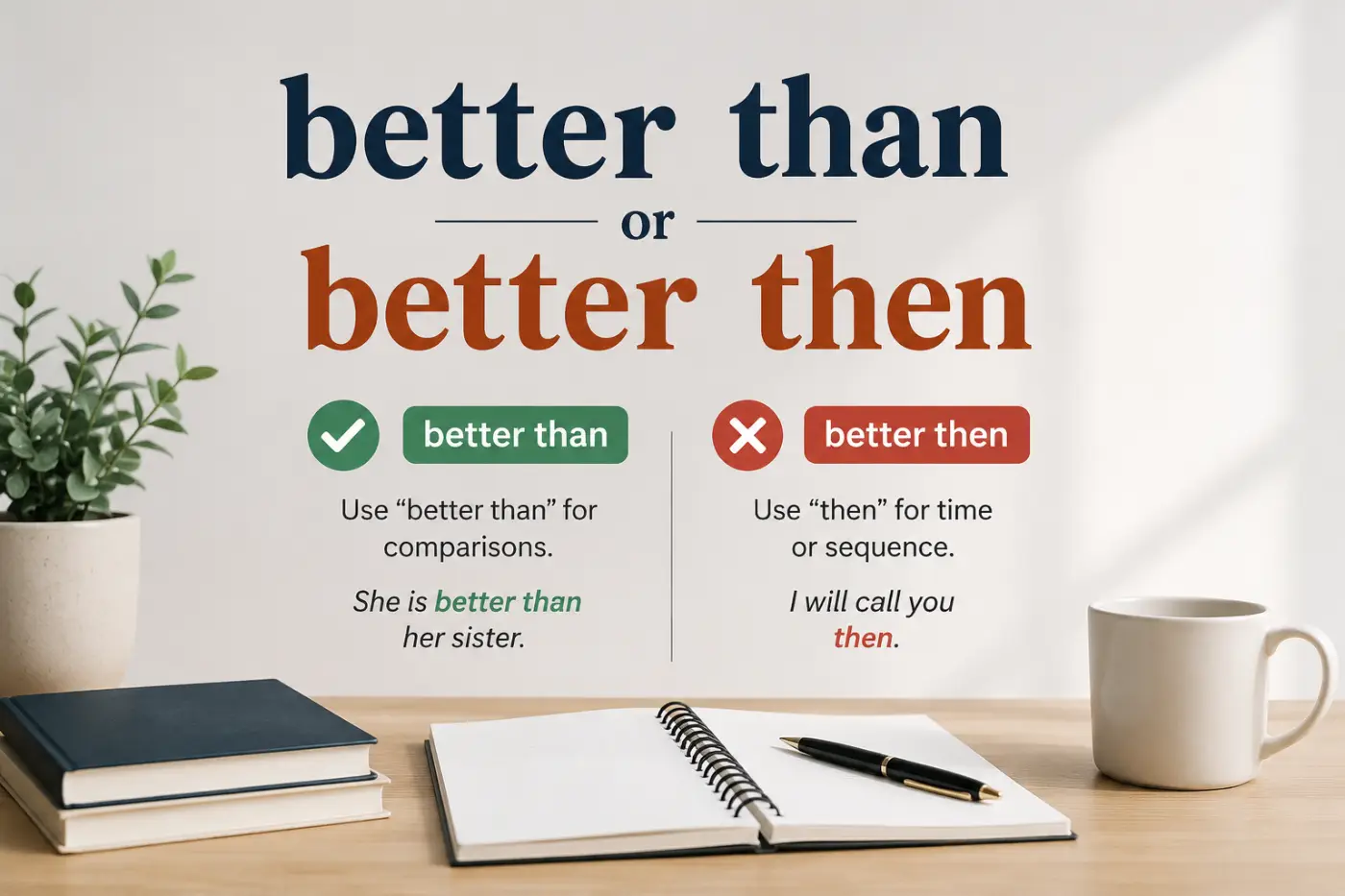
The short answer is simple. Better than is correct when you compare two people things ideas or actions. Better then is usually incorrect unless then refers to time or the next step in a sequence.
Many English learners and even native speakers type better then by mistake. Autocorrect does not always catch the error because both words are spelled correctly. The problem is grammar not spelling.
In this guide you’ll learn the difference between better than and better then with clear definitions grammar rules comparison tables real life examples common mistakes and practical memory tricks. By the end you’ll know exactly which phrase to use and why.
A related grammar guide is Footnote Before or After Period (2026 Guide).
Quick Answer
Better than is the correct phrase for making comparisons.
Better then is usually incorrect because then refers to time or the next event instead of comparison. If you are comparing two people things or ideas always use than after better.
Better Than Or Better Then Comparison Table
| Feature | Better Than | Better Then |
|---|---|---|
| Correct for comparisons | ✔ Yes | ✘ No |
| Meaning | Shows comparison | Refers to time or sequence |
| Grammar | Comparative conjunction | Adverb |
| Common use | Everyday speech writing business school | Only correct in time related sentences |
| Formal writing | ✔ Standard English | Incorrect in comparisons |
| Example | Coffee is better than tea. | Finish your work then relax. |
What Does Better Than Mean
Better than is the standard English phrase used to compare two or more people things places ideas or actions.
The word better is the comparative form of good. It needs than to introduce the second part of the comparison.
Definition
Better than means of a higher quality more suitable more effective or more enjoyable compared with something else.
Examples
- This laptop is better than my old one.
- Walking is better than sitting all day.
- Her presentation was better than mine.
- Reading before bed is better than scrolling through social media.
- Today’s weather is better than yesterday’s.
- This restaurant serves better food than the one across the street.
- He speaks English better than I do.
- Saving money is better than spending it carelessly.
Notice that every sentence compares one thing with another. That is exactly what than is designed to do.
What Does Better Then Mean
In most cases better then is a grammar mistake.
The word then relates to time or what happens next. It does not introduce comparisons.
For example.
✔ Finish your homework then watch television.
✔ We ate dinner then went for a walk.
✔ Back then life was much quieter.
In these sentences then means after that or at that time.
Now compare these examples.
✘ This phone is better then mine.
✔ This phone is better than mine.
The first sentence is incorrect because you are making a comparison not talking about time.
Which One Is Correct
The correct phrase is better than whenever you compare two things.
Examples.
✔ My new job is better than my old one.
✔ Fresh fruit is better than candy.
✔ She sings better than her brother.
Use better then only when then keeps its original meaning of after that or at that time.
For example.
✔ If you feel better then we can leave.
Here then means at that point. It is not connected to the word better as a comparison.
A quick test makes the choice easy.
If you can replace the word with compared with choose than.
If you can replace it with after that or at that time choose then.
Why People Confuse Better Than And Better Then
This mistake happens for several reasons.
They Sound Similar
In fast conversation than and then often sound almost identical. Many people write the word they hear instead of the correct one.
Only One Letter Is Different
The words differ by a single letter. Small spelling differences are easy to miss while typing quickly.
Autocorrect Misses The Error
Since both than and then are real English words spell check often leaves the sentence unchanged.
They Are Learned Early
Both words appear in basic English lessons. Learners remember the spellings but sometimes forget that each word has a completely different job.
Fast Typing
Many writers accidentally hit e instead of a without noticing. This creates one of the most common proofreading mistakes in English.
Social Media Habits
Online posts and text messages often contain grammar mistakes. Seeing better then repeatedly can make it look correct even though it is not.
The easiest way to avoid the mistake is to remember one simple rule.
Than compares. Then tells time.
Key Differences Between Better Than And Better Then
Although these phrases look almost identical they serve completely different purposes in English.
| Feature | Better Than | Better Then |
|---|---|---|
| Main purpose | Makes a comparison | Refers to time or sequence |
| Word type | Comparative conjunction | Adverb |
| Correct after better | ✔ Yes | ✘ Usually no |
| Common meaning | Compared with | After that or at that time |
| Standard English | ✔ Yes | Only in time related contexts |
The simplest way to remember the difference is this.
Than compares. Then tells time.
Grammar Explanation
Understanding the grammar behind these words makes the choice much easier.
Better Is A Comparative Adjective
The word better is the comparative form of good.
When you compare two people things or ideas the comparison normally uses than.
Examples.
- This chair is better than that one.
- Summer is better than winter for hiking.
- She writes better than her classmates.
Without than the comparison feels incomplete.
Than Is Used For Comparisons
Than is a conjunction used after comparative words.
You will often see it after words like these.
- Better.
- Bigger.
- Faster.
- Stronger.
- More.
Examples.
- This route is faster than the old one.
- Her answer was better than mine.
- Reading is more relaxing than watching television.
Then Refers To Time
Then is an adverb.
It usually means after that or at that time.
Examples.
- Finish your breakfast then brush your teeth.
- We visited the museum then walked along the river.
- Back then people wrote letters by hand.
Notice that none of these sentences compare two things.

Can Better And Then Ever Appear Together
Yes. They can appear next to each other when then keeps its time related meaning.
Examples.
- If you feel better then let’s go for a walk.
- Get some rest. If you’re better then you can return to work tomorrow.
Here better describes your condition and then means at that point. They are not working together as the phrase better than.
For another common grammar confusion, see Simpler Or More Simple Which Form Is Correct 2026.
Pronunciation Guide
Many people confuse these words because they sound very similar in everyday conversation.
Than
IPA
American English
/ðæn/
In casual speech many native speakers pronounce it as.
/ðən/
Then
IPA
American English
/ðen/
Why The Pronunciation Causes Confusion
In relaxed conversation than often sounds almost like then.
For example.
He’s taller than me.
Many speakers pronounce than with a softer vowel that resembles then.
This pronunciation difference explains why people often spell the comparison incorrectly.
Word Origin
Knowing where these words came from also explains why they have different meanings.
Than
The word than comes from Old English and has been used for centuries to compare people things and ideas.
Its role has stayed almost unchanged throughout the history of English.
Then
Then also comes from Old English but originally referred to time.
Its meaning has always been connected with sequence timing and events.
Even though the words share similar spellings they developed different grammar functions very early in the language.
British American Canadian And Australian English
There is no regional difference in this grammar rule.
American English British English Canadian English Australian English and other major varieties of English all follow the same pattern.
Every major style guide recommends better than for comparisons.
Examples.
American English.
This solution is better than the previous one.
British English.
Tea tastes better than coffee in the morning.
Canadian English.
Winter tires are better than all season tires.
Australian English.
Walking is better than driving for short trips.
No major English dialect accepts better then as the standard comparison.
Real Life Examples
The easiest way to master this grammar rule is to see it in real situations.
Daily Conversation
- Chocolate tastes better than vanilla.
- My new phone is better than the old one.
- She’s better than me at chess.
- This movie is better than I expected.
Workplace
- Our latest report is better than the previous version.
- This software performs better than the old system.
- Your presentation was better than last month’s.
- We found a better solution than we first imagined.
Emails
- The revised draft looks much better than the original.
- This schedule works better than the first proposal.
Academic Writing
- The second experiment produced better results than the first.
- Students who practiced regularly performed better than those who did not.
Journalism
- Experts say public transportation is better than driving during rush hour.
- Analysts expect this year’s sales to be better than last year’s.
Social Media
- This season is even better than the last one.
- Nothing feels better than spending time with family.
- Your new haircut looks better than ever.
- That ending was better than I imagined.
Time Related Examples With Then
These examples use then correctly because they refer to time.
- Finish your homework then call your friends.
- We had lunch then headed back to the office.
- Life was very different back then.
- If you feel better then we’ll continue tomorrow.
These examples show that then belongs to time expressions while than belongs to comparisons.
Common Mistakes To Avoid
Even experienced writers occasionally confuse than and then because both words are common and look similar. These simple mistakes can make polished writing look careless.
Using Then After Better
Incorrect.
✘ This option is better then the first one.
Correct.
✔ This option is better than the first one.
Since you are comparing two options than is the only correct choice.
Using Than For Time
Incorrect.
✘ Finish your homework than go outside.
Correct.
✔ Finish your homework then go outside.
Here the sentence describes what happens next, so then is correct.
Trusting Spell Check
Spell check often misses this mistake because than and then are both real English words. Always proofread comparison sentences carefully.
Mixing Up Meaning
Remember this simple rule.
Than compares. Then tells time.
If you remember only one grammar rule from this guide, make it this one.
Memory Tricks
These tricks make the difference easy to remember.
Think About The Letter A
The word than contains the letter A.
Associate A with A comparison.
Every time you compare two things, choose than.
Think About The Letter E
The word then contains the letter E.
Associate E with Events.
If something happens next or later, use then.
Replace The Word
Ask yourself one quick question.
Can I replace the word with compared with?
If yes, use than.
Can I replace it with after that?
If yes, use then.
This quick test works almost every time.
Related Words
Learning related grammar patterns makes this rule even easier.
Comparative Words That Use Than
- Bigger than.
- Smaller than.
- Faster than.
- Higher than.
- Lower than.
- Stronger than.
- Weaker than.
- Older than.
- Younger than.
- More than.
- Less than.
Time Words Related To Then
- Next.
- Later.
- Afterwards.
- Subsequently.
- Eventually.
- At that time.
- Afterward.
Frequently Confused Word Pairs
- Than and Then.
- Your and You’re.
- Their There and They’re.
- Affect and Effect.
- Accept and Except.
- To Too and Two.
Mastering these common pairs will make your writing much clearer.
Expert Editor’s Note
Professional editors treat better than and better then as a grammar issue rather than a spelling issue.
Major dictionaries and style guides agree that than is the standard word for comparisons. Then belongs to expressions about time or sequence.
During proofreading, editors often search specifically for better then because it is one of the easiest mistakes to overlook. A quick review of every sentence containing better can eliminate this error before publishing.
If your goal is clear, natural English, make better than your default choice for comparisons.
Frequently Asked Questions
Is Better Than Grammatically Correct?
Yes. Better than is the correct phrase when comparing two or more people, places, ideas, or things. It follows standard English grammar and is accepted in formal and informal writing.
Is Better Then Ever Correct?
Yes, but only when then keeps its meaning of after that or at that time. It is not correct as a comparison phrase.
Example.
If you feel better then we’ll continue.
Why Do People Write Better Then?
The mistake usually happens because than and then sound similar in everyday speech. Fast typing and spell check also contribute because both words are spelled correctly.
How Can I Remember The Difference?
Think of than as the comparison word and then as the time word.
A simple reminder is.
Than compares. Then tells time.
Is Better Then Accepted In Formal Writing?
No. When comparing two things, professional editors consider better then a grammar mistake. Formal writing should always use better than for comparisons.
Do British And American English Use Different Rules?
No. American English, British English, Canadian English, and Australian English all use better than for comparisons and then for time.
What Is The Difference Between Than And Then?
Than connects comparisons.
Then refers to time, order, or the next event.
Although they sound similar, their meanings and grammar functions are completely different.
You may also want to read Time Slot Vs Timeslot Which Spelling Is Correct 2026.
Conclusion
The answer to better than or better then is straightforward.
Use better than whenever you compare people, places, things, ideas, or actions.
Use then only when you are talking about time, sequence, or what happens next.
The biggest mistake is using then after better simply because the words sound alike. Remember that grammar depends on meaning, not pronunciation.
Whenever you pause while writing, ask yourself one question.
Am I making a comparison or talking about time?
If you are comparing, better than is always the right choice.

Senior Grammar Editor
Olivia Reynolds is a grammar editor and language writer who enjoys making complex English rules easy to understand. She specializes in grammar, punctuation, sentence structure, and everyday writing tips, helping readers write with greater confidence and clarity.