
Have you ever paused while writing a sentence like “She was eying the last piece of cake” and wondered if you should add another letter? The spelling choice between eying or eyeing can be confusing because both forms appear in English writing. Fortunately, you do not need to guess.
Both eying and eyeing are accepted spellings of the verb eye. They mean looking at someone or something closely, often with interest, curiosity, suspicion, or desire. However, eyeing is the more familiar choice for most American readers, so it is usually the safest option for everyday writing, school assignments, emails, and professional documents.
The confusion comes from a common spelling pattern. When you add ing to many verbs, you simply attach the ending. However, verbs that end in a silent e often drop that letter before adding ing. Since eye already has an unusual spelling, writers may wonder if they should remove the final e or keep it.
In this guide, you will learn the difference between eying and eyeing, discover which spelling works best in American English, and see how to use both forms naturally. You will also find practical examples, spelling rules, common mistakes, word origins, and answers to frequently asked questions.
Learn the difference in Instalments Or Installments Which Spelling Should You Use.
Quick Answer
Both eying and eyeing are correct spellings of the verb eye, which means to look at someone or something closely. However, eyeing is the more familiar choice in American English and is generally the best option for everyday and professional writing. Use one spelling consistently throughout your work.
Internal Linking Opportunity
Suggested article to link after the introduction: [Common English Spelling Mistakes and How to Avoid Them]. This related resource can help readers understand why certain English words have more than one accepted spelling.
Eying vs Eyeing Comparison Table
The main difference between eying and eyeing is their spelling. Both forms come from the same verb and carry the same meaning. The choice is mainly about spelling preference and reader familiarity rather than grammar.
| Feature | Eyeing | Eying |
|---|---|---|
| Correct spelling | Yes | Yes |
| Base word | Eye | Eye |
| Part of speech | Verb form | Verb form |
| Meaning | Looking closely or with interest | Looking closely or with interest |
| Pronunciation | EYE ing | EYE ing |
| Grammar | Present participle and gerund | Present participle and gerund |
| American English | Widely recognized | Recognized variant |
| British English | Standard familiar form | Also recognized in dictionaries |
| Formal writing | Recommended default | Acceptable alternative |
| Meaning difference | None | None |
Cambridge Dictionary lists eyeing as the main form and identifies eying as an American variant. Merriam Webster also recognizes both spellings. Therefore, calling eying incorrect would be misleading.
definition in the Cambridge English Dictionary
+2
What Does Eyeing Mean
Eyeing is the present participle of the verb eye. It means looking at someone or something with attention, interest, suspicion, desire, or careful consideration.
The word can describe a simple physical action. For example, a child might be eyeing a plate of cookies because the child wants one.
It can also describe a more thoughtful action. A business owner might be eyeing a new location for a store, meaning the owner is considering it as a possible opportunity.
Eyeing in everyday language
People often use eyeing when someone looks at something they want or finds interesting.
Examples include the following.
- The puppy was eyeing my sandwich.
- She kept eyeing the beautiful dress in the window.
- He was eyeing the last slice of pizza.
- The little boy was eyeing the toys on the shelf.
- My neighbor is eyeing a new car.
In each sentence, the word suggests more than simply seeing something. It often hints at interest or a possible desire to take action.
For instance, a person who sees a new car might notice it and move on. Someone who is eyeing that car may be thinking about buying it.
Eyeing can describe suspicion
The verb can also suggest that someone is watching another person carefully because they feel uncertain or suspicious.
Consider these examples.
- The security guard was eyeing the unfamiliar visitor.
- She noticed her coworker eyeing the documents on her desk.
- The cat was eyeing the dog from across the room.
- The detective kept eyeing the suspect during the interview.
The word does not always imply suspicion. The surrounding sentence determines the tone.
In a sentence about a puppy and a sandwich, eyeing sounds playful. In a sentence about a security guard and an unfamiliar visitor, it can suggest caution.
Eyeing can mean considering an opportunity
In business, sports, and journalism, eyeing often describes a goal or opportunity that someone hopes to pursue.
For example:
- The company is eyeing expansion into new markets.
- The team is eyeing another championship.
- The candidate is eyeing a leadership position.
- The retailer is eyeing a larger store in the city center.
- The young athlete is eyeing a place on the national team.
Here, the word has a figurative meaning. A company cannot literally look at an entire market in the same way a person looks at a cake. Instead, the verb suggests attention, interest, and possible future action.
This use appears frequently in news headlines because it communicates ambition in a compact way.
What Does Eying Mean
Eying is another accepted spelling of the present participle of eye. It has the same meaning as eyeing and works in the same grammatical situations.
For example, both of these sentences are correct.
- She was eyeing the new laptop.
- She was eying the new laptop.
Both sentences describe someone looking at the laptop with interest. Neither spelling changes the action, the tense, or the meaning.
Cambridge Dictionary explicitly recognizes eying as a form used in American English. Merriam Webster also lists it among the accepted forms of the verb eye.
definition in the Cambridge English Dictionary
Examples of eying in sentences
Here are several natural examples.
- The dog was eying the food on the table.
- He stood near the shop window, eying the expensive watch.
- The manager is eying a promotion.
- She caught her brother eying her dessert.
- The company is eying a chance to enter a new market.
You can replace eying with eyeing in each example without changing the meaning.
Is eying a spelling mistake
No. Eying is not automatically a spelling mistake. It is a recognized variant, even though many writers prefer eyeing.
This distinction matters when editing English content. A proofreader should not mark every instance of eying as an error simply because eyeing looks more familiar.
Instead, consider the intended audience and the publication’s spelling preferences. For general American English content, eyeing is a practical default because it is easy for readers to recognize.
Which One Is Correct
Both eying and eyeing are correct. Neither spelling changes the meaning of the sentence, and both function as forms of the verb eye.
However, if you are writing for an American audience and want the safest choice, use eyeing.
Here is a simple guide.
- For school assignments, use eyeing.
- For workplace emails, use eyeing.
- For blog posts and website content, use eyeing.
- For academic writing, use eyeing unless your style guide specifies a different preference.
- If you encounter eying in published writing, do not assume it is a typo.
The key is to separate correctness from preference. A word can have more than one accepted spelling even when one form feels more familiar to most readers.
Why eyeing is a practical default
The spelling eyeing preserves the complete visual form of the word eye. Readers can connect the verb to its base word immediately.
The shorter spelling eying follows a familiar English pattern in which a final e disappears before the ending ing. That makes it understandable, too.
Still, eyeing is a useful default when you want to avoid distracting readers or creating an unnecessary spelling question. This is an editorial recommendation, not a rule that makes the alternative incorrect.
Why People Confuse Eying and Eyeing
The confusion is understandable because both spellings follow patterns that appear in English. One preserves the base word clearly, while the other resembles the usual spelling rule for verbs ending in a silent e.
Several factors explain the uncertainty.
The silent E spelling rule
Many English verbs lose their final e when you add ing.
Consider these examples.
| Base verb | Present participle |
|---|---|
| Make | Making |
| Take | Taking |
| Write | Writing |
| Hope | Hoping |
| Use | Using |
| Eye | Eyeing or eying |
When writers apply the usual rule to eye, they may naturally choose eying. Since dictionaries also recognize that spelling, their choice is not necessarily wrong.
However, English spelling has exceptions and variations. The form eyeing remains established in modern usage, even though the final e might seem unnecessary under the usual pattern.
The unusual spelling of eye
The word eye has three letters but only one syllable. Its spelling does not follow the most common patterns that English learners expect.
When you add ing, the result can look unusual:
- Eyeing.
- Eying.
The first form preserves the original word visually. The second removes the final e and follows a familiar spelling pattern.
Because both forms look plausible, writers may wonder if one must be wrong. Dictionary evidence shows that both are accepted.
Autocorrect and spellcheck suggestions
Digital writing tools can add to the confusion. A spellchecker may accept one form more readily than another because of its dictionary settings, language variety, or software configuration.
An underline does not always prove that a word is incorrect. Likewise, the absence of an underline does not guarantee that a word is the best choice for your sentence.
When a spellchecker questions eying, check a trusted dictionary before changing it. If you are choosing the spelling for a new document, eyeing is a sensible default.
Familiarity and reading habits
Readers often trust the spelling they have seen most frequently. If someone regularly encounters eyeing in books, articles, and websites, the shorter form may look unusual.
Another reader may have learned the spelling rule for words ending in e and find eying more logical.
Neither reaction establishes a grammatical difference. The two spellings refer to the same action.
Online claims about correct spelling
Online discussions sometimes label one form correct and the other incorrect without checking dictionary entries.
That advice can spread because spelling questions invite simple answers. Yet the accurate answer here requires a small distinction: both forms are accepted, while eyeing is a sensible choice for general writing.
When a spelling question concerns two recognized variants, look for evidence from established dictionaries rather than relying on a confident claim from a random website.
Grammar Explanation for Eying and Eyeing
Both eying and eyeing follow the same grammar rules because they are forms of the same verb. The spelling does not affect the tense, sentence structure, or meaning.
The base verb is eye. It describes looking at someone or something closely. When you add the ending ing, you can use the resulting word in several grammatical structures.
Eyeing as a present participle
A present participle usually appears with a form of the verb be to describe an ongoing action.
Examples include the following.
- She is eyeing the new handbag.
- They were eyeing the empty seats.
- The cat has been eyeing the fish tank.
- He will be eyeing the competition closely.
- The manager is eying a possible promotion.
You can replace eyeing with eying in all five sentences without changing their grammatical structure.
The surrounding verb determines the tense. For instance, is eyeing describes a current action, while was eyeing places that action in the past.
Eyeing as a gerund
A gerund is a verb ending in ing that functions as a noun. Both spellings can serve this purpose.
Examples:
- Eyeing the dessert made him hungry.
- She admitted to eyeing her colleague’s new laptop.
- Eyeing every opportunity can help a business spot potential growth.
- He was caught eyeing the prize.
- The coach noticed the players eyeing the championship trophy.
In the first and third examples, the ing form acts as the subject of the sentence. In the second example, it follows the preposition to.
Remember that to eye and to be eyeing serve different grammatical functions. In She wants to eye the display, the word to introduces the infinitive. In She is eyeing the display, the verb describes an ongoing action.
Eyeing in different tenses
The verb eye can appear in several tenses. The ing form itself does not change to show past or future time. Instead, the helping verb provides that information.
| Tense or construction | Example |
|---|---|
| Present continuous | She is eyeing the new apartment. |
| Past continuous | She was eyeing the new apartment. |
| Present perfect continuous | She has been eyeing the new apartment. |
| Past perfect continuous | She had been eyeing the new apartment. |
| Future continuous | She will be eyeing the new apartment. |
Notice that the spelling remains eyeing throughout the table.
The same principle applies to eying. If you prefer that variant, the grammatical structure stays the same.
Eyeing with prepositions
Some expressions naturally place eyeing after a preposition or another verb.
For example:
- She admitted to eyeing the promotion.
- He kept eyeing the exit.
- They talked about eyeing a larger property.
- The company considered eyeing overseas markets.
These constructions are useful in everyday speech and professional writing. However, the best expression depends on the intended meaning.
For example, considering a larger property sounds more direct and precise in a formal report than eyeing a larger property. Both can work, but the first focuses on evaluation, while the second suggests interest or ambition.
Spelling Rules for Eying and Eyeing
The spelling difference comes from how English handles verbs that end in e. Many verbs drop the final e before adding ing, but eyeing is an established spelling that retains it.
The usual rule for verbs ending in E
In many cases, English drops a final silent e before adding ing.
| Base verb | Correct form |
|---|---|
| Hope | Hoping |
| Bake | Baking |
| Smile | Smiling |
| Drive | Driving |
| Write | Writing |
| Eye | Eyeing or eying |
The first five examples follow the usual spelling pattern. The final example has two accepted forms.
This is why the question can be confusing. Applying a common rule leads naturally to eying, yet established usage also supports eyeing.
Why eyeing keeps the final E
The spelling eyeing preserves the complete written form of the base word. This makes the connection between eye and eyeing easy to recognize.
English contains other words whose spelling patterns do not always fit a single simple rule. Some forms remain established because of convention and long usage.
For that reason, you should learn eyeing as an accepted form rather than assuming every verb ending in e must lose that letter.
Is eyeing an exception to the spelling rule
It is more accurate to treat eyeing as a special spelling variation than to claim that one form is the only possible result of the general rule.
The usual rule explains why eying makes sense. Dictionary usage explains why eyeing is also correct.
When a spelling pattern has recognized variants, the most useful approach is to learn the general rule and then remember the established forms that differ from it.
Do the rules change for other endings
Yes. Different verb endings follow different spelling patterns.
Consider these examples.
| Base verb | Form ending in ING | Spelling pattern |
|---|---|---|
| Run | Running | Double the final consonant |
| Sit | Sitting | Double the final consonant |
| Make | Making | Drop the final E |
| Play | Playing | Keep the final Y |
| See | Seeing | Keep both Es |
| Eye | Eyeing or eying | Both forms are accepted |
The examples show why spelling rules are helpful but cannot answer every question on their own.
You may also want to read Soo Vs So Which One Is Correct 2026 Guide.
Pronunciation Guide for Eying and Eyeing
Both spellings have the same pronunciation. The extra letter in eyeing does not create another syllable or change the vowel sound.
How to pronounce eyeing
The word eyeing is commonly pronounced as two syllables.
- IPA: /ˈaɪ.ɪŋ/
- Syllables: eye ing
- Stress: First syllable
- First sound: The long vowel sound in eye
- Ending: The sound heard at the end of sing
The word begins with the same sound as eye, buy, and sky. The second syllable sounds like the ending of looking or running.
How to pronounce eying
The spelling eying has the same pronunciation as eyeing.
Say both forms aloud and you will hear no difference. The spelling variation is written rather than spoken.
This is important for English learners. You do not need to memorize two pronunciations or change the stress depending on the spelling.
Common pronunciation mistakes
A common mistake is trying to pronounce every written letter separately. English does not work that way, and the spelling eyeing does not require a separate sound for the final e.
Another mistake is pronouncing the word as a single syllable. The standard pronunciation has two syllables, with the stress on the first.
Practice with these sentences.
- She is eyeing the cake.
- He was eying the door.
- They are eyeing a new opportunity.
The pronunciation stays the same in every sentence.
Etymology and Word Origin
The history of eyeing begins with the noun eye. English has used eye for centuries, and the noun developed into a verb meaning to look at someone or something.
The verb form eye allows speakers to describe an intentional or focused act of looking. Adding ing creates a form that can describe an ongoing action or function as a gerund.
Where does the word eye come from
The English noun eye comes from Old English ēage. It has related forms in other Germanic languages, reflecting the word’s deep historical roots.
Over time, the spelling and pronunciation developed into the modern English form eye. The verb grew from the noun because looking is the action associated with the eyes.
This process is an example of conversion, a common feature of English word formation. Conversion happens when a word shifts from one grammatical role to another without changing its basic form.
For example, email can function as a noun or a verb. In the same way, eye can refer to the organ of sight or the act of looking closely at something.
How eye became a verb
The verb eye can describe more than simply directing your vision toward something. It often suggests attention, evaluation, suspicion, or interest.
Over time, figurative uses became common.
For example, a sports journalist might write that a team is eyeing the playoffs. The team is not literally looking at a set of games. Instead, it is aiming to reach that stage of the competition.
Similarly, a company might be eyeing a merger. This means the company is considering or pursuing that possibility.
Why do both spellings exist
The two forms reflect different ways of applying English spelling conventions to the same base word.
The spelling eying drops the final e before adding ing. The spelling eyeing keeps the original written form intact.
Both patterns are understandable, and both forms have gained recognition in modern English. The existence of the two variants does not indicate two separate historical meanings.
British vs American English
The spelling choice is not a simple case of British English using one form and American English using the other. Both eying and eyeing are recognized in English dictionaries, including dictionaries that document American usage.
For writers, the more important question is which form will be clearest to the intended audience.
American English
For a general American audience, eyeing is a practical editorial choice.
It is widely recognized and preserves the familiar base word eye. You can use it in schoolwork, news articles, blogs, workplace messages, and other everyday writing.
The shorter form eying is also acceptable. If you encounter it in an American publication, there is no need to assume the writer has made a spelling error.
British English
British English also uses eyeing. The shorter form eying is recognized as a variant in major dictionary records.
British writers should follow the spelling preferences of their publisher or organization when a house style exists. If no specific preference applies, eyeing is a clear and familiar option.
Canadian English
Canadian English often draws on both British and American spelling traditions. However, that does not mean every word has two fixed regional forms.
For eyeing and eying, both variants are understandable. A Canadian writer can use eyeing as a straightforward default, particularly in general audience content.
Australian English
Australian English also recognizes the familiar spelling eyeing. The shorter form may appear as a variant, so it should not automatically be treated as an error.
As with Canadian and British English, local editorial guidance matters more than assumptions based on broad regional spelling patterns.
Which spelling should international writers use
If your content targets readers in several English speaking countries, choose eyeing and use it consistently.
This approach keeps your spelling clear without suggesting that eying is wrong. It also avoids distracting readers who may be less familiar with the shorter variant.
Real Life Examples of Eying and Eyeing
The easiest way to understand these words is to see how they work in different settings. In every example below, the two spellings can be exchanged without changing the meaning.
Everyday conversation examples
- I caught my brother eyeing the last cookie.
- The dog was eying my sandwich from under the table.
- Are you eyeing that new jacket?
- She kept eying the clock during the long meeting.
- He was eyeing the empty seat near the window.
- The children were eyeing the gifts beneath the tree.
These examples show the word in familiar situations. It often suggests that someone wants something or is paying close attention.
Workplace examples
- The manager is eyeing a promotion.
- Our company is eying a larger office.
- The team has been eying ways to reduce costs.
- She was eying the open position in another department.
- The business is eying a move into a new market.
- He kept eying the presentation slides before his turn to speak.
In workplace writing, the word can suggest ambition or careful attention. For formal reports, a more precise verb such as considering, evaluating, or planning may sometimes work better.
Email examples
- I noticed that you are eyeing the vacant role on our team.
- We are eying a few possible locations for the new office.
- The department is eyeing several options for next year’s budget.
- I have been eyeing the training course you recommended.
These sentences are natural in informal professional communication. In a formal proposal, you might replace eyeing with considering to make the intended action more specific.
Academic writing examples
- The researchers were eyeing a new approach to the problem.
- The study examines how investors are eyeing emerging markets.
- The committee is eying possible changes to the existing policy.
- Several institutions are eying opportunities for further collaboration.
The word can appear in academic writing, especially when describing interest or future plans. However, it is not always the most precise option for scholarly prose.
For example, The researchers are evaluating a new approach communicates a clearer process than The researchers are eyeing a new approach.
News and journalism examples
- The team is eyeing a place in the championship final.
- The retailer is eying expansion into smaller cities.
- The candidate is eyeing a possible run for office.
- The company is eyeing a deal with an overseas partner.
- Local officials are eyeing new ways to improve public transport.
Journalists often use eyeing in headlines because it conveys interest and ambition in a single word.
Social media examples
- Me eyeing the last slice of pizza.
- She is eying that concert ticket like it is the last one on Earth.
- Everyone was eyeing the birthday cake before the candles were lit.
- My wallet is nervous because I am eyeing another pair of shoes.
- The cat has been eying the Christmas tree all morning.
These examples use the word in a playful or informal way. Social media often favors short, expressive language, which makes eyeing a natural fit.
Literary examples
- The stranger stood by the doorway, eyeing the room with suspicion.
- She sat quietly, eying the letter she had been afraid to open.
- The old dog lay near the fire, eying the children as they played.
- He walked past the shop window, eying the watch he could not afford.
- The traveler paused at the hilltop, eyeing the road ahead.
In fiction, eyeing can help reveal a character’s feelings without explaining them directly. A character who eyes a locked door may be curious, worried, or planning an escape. The surrounding details help the reader understand the intention.
Choosing Between Eyeing and More Precise Alternatives
Although eyeing is useful, it does not fit every sentence. The word often combines looking with interest or intention, but it can be vague if the reader needs to know exactly what someone is doing.
Consider these alternatives.
| Word or phrase | Best use | Example |
|---|---|---|
| Looking at | General visual attention | She is looking at the painting. |
| Watching | Following an action over time | He is watching the game. |
| Staring at | Looking for a long time | The child is staring at the moon. |
| Glancing at | Looking briefly | She glanced at the clock. |
| Considering | Thinking about a choice | They are considering a move. |
| Evaluating | Judging carefully | The team is evaluating the proposal. |
| Coveting | Strongly wanting something another person has | He was coveting his neighbor’s new car. |
| Eyeing | Looking with interest or considering a possibility | She is eyeing the new position. |
These words overlap in some contexts, but they are not perfect synonyms.
For instance, watching describes sustained attention. Eyeing often adds a sense of interest or intention. Considering focuses on thought rather than physical looking.
Choosing the right word helps your writing communicate the exact meaning rather than merely sounding natural.
Common Mistakes With Eying and Eyeing
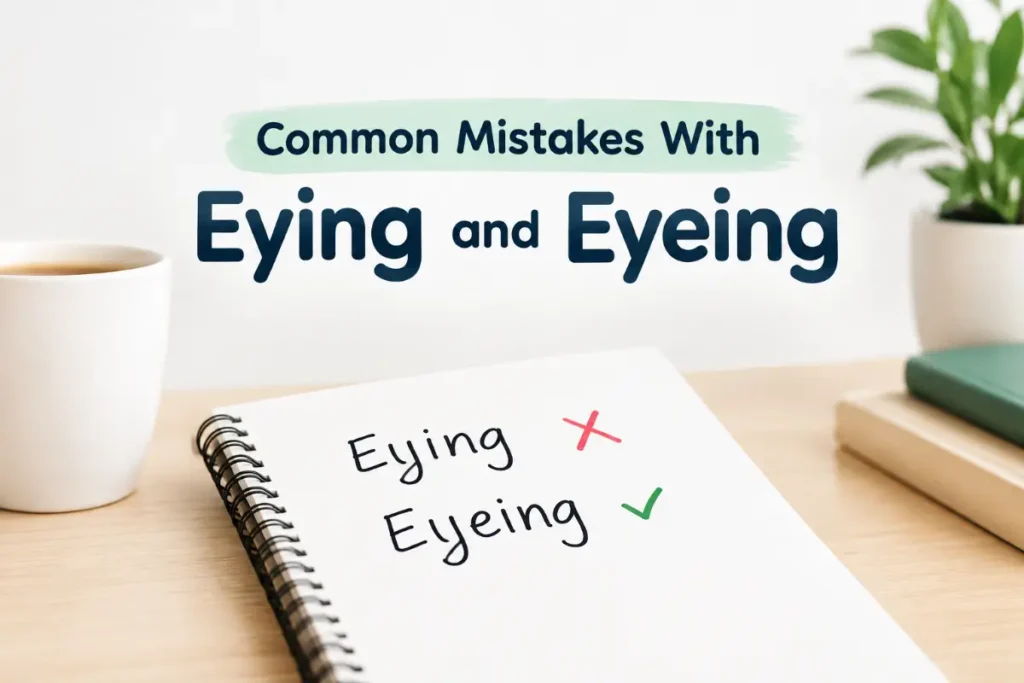
Although both spellings are correct, writers can still make mistakes when using the word in a sentence. Most errors involve misunderstanding the spelling rule, confusing the word with a similar expression, or choosing a word that does not match the intended meaning.
Mistake 1 Treating eying as incorrect
Some writers assume that eying must be wrong because eyeing looks more familiar.
That assumption is inaccurate. Both forms are accepted, so you should not automatically correct eying in someone else’s writing.
Incorrect assumption: Eying is always a spelling mistake.
Correct understanding: Both spellings are valid. Eyeing is a practical default for general American English writing.
Mistake 2 Thinking the spellings have different meanings
Another common mistake is assuming that the two forms describe different actions.
For example:
- She was eyeing the cake.
- She was eying the cake.
Both sentences mean that she was looking at the cake with interest. Neither spelling suggests a stronger desire or a different type of gaze.
Mistake 3 Writing eye-ing
Some writers add a hyphen to make the word easier to read.
However, the standard forms are eyeing and eying. You do not need a hyphen between the base word and the ing ending.
Incorrect: She was eye-ing the new car.
Correct: She was eyeing the new car.
Mistake 4 Confusing eyeing with looking
Although eyeing is related to looking, the two words do not always communicate the same idea.
Consider these sentences.
- She was looking at the painting.
- She was eyeing the painting.
The first sentence describes visual attention. The second can suggest interest, curiosity, or a desire to own the painting.
Use eyeing when you want to suggest focused attention or interest. Use looking at when you simply mean seeing or directing your eyes toward something.
Mistake 5 Using eyeing when a more precise word is needed
The word can sound vague in technical or academic writing.
For example, The researchers are eyeing a new method suggests interest in the method. It does not tell readers if they are testing it, comparing it, or planning to use it.
A clearer sentence would be:
The researchers are evaluating a new method.
The revised version tells readers exactly what the researchers are doing.
Mistake 6 Assuming the final E rule has no exceptions
The general rule says that many verbs ending in a silent e drop that letter before adding ing.
For example, make becomes making, and write becomes writing.
However, the accepted spelling eyeing retains the final e. The existence of eying does not make eyeing incorrect. Both forms are established in English.
Mistake 7 Changing spelling without checking the dictionary
If you see eying in a book, article, or email, do not change it automatically.
First, check a reliable dictionary. Then consider the audience and any editorial style requirements.
A proofreader’s job is to correct genuine errors while preserving valid language choices. Changing an accepted spelling simply because it looks unfamiliar can introduce unnecessary edits.
Memory Tricks to Remember Eyeing and Eying
Remembering two accepted spellings can seem harder than learning one. Fortunately, a few simple tricks can help you choose the form that works best for your writing.
Trick 1 Remember the word eye
The easiest way to remember eyeing is to connect it directly to the base word eye.
Think of the word as:
Eye + ing = Eyeing.
This visual trick keeps the original word intact. It also helps you recognize the relationship between the noun eye and the verb eye.
Trick 2 Think of someone looking closely
Imagine a child eyeing a chocolate cake on the kitchen counter.
The child looks at the cake because it seems tempting. The action helps you connect eyeing with focused attention and desire.
Picture the scene whenever you need to remember the meaning.
Trick 3 Use one default spelling
Since both forms are correct, you do not need to memorize a rule that declares one wrong.
Instead, remember this simple editorial preference:
When in doubt, use eyeing.
This choice works well for general American English writing and is easy for readers to recognize.
Trick 4 Separate correctness from preference
A spelling can be correct even when another form is more common in your writing environment.
Keep these two ideas separate.
- Correctness tells you if a form is accepted.
- Preference tells you which form to choose for a particular audience or publication.
This distinction helps with many English spelling questions, not just eying and eyeing.
Related Words and Expressions
Learning related vocabulary can help you understand the meaning of eyeing more precisely. Some words describe the physical act of looking, while others suggest interest, suspicion, or desire.
Synonyms for eyeing
The best synonym depends on the context.
| Synonym | Meaning | Example |
|---|---|---|
| Watching | Paying attention to something over time | She was watching the players. |
| Observing | Looking carefully to notice details | The scientist was observing the birds. |
| Inspecting | Examining something closely | He was inspecting the damaged door. |
| Studying | Looking at something with care | She was studying the map. |
| Staring | Looking for a long time | The child was staring at the stars. |
| Glancing | Looking briefly | He was glancing at his phone. |
| Considering | Thinking about a possibility | They were considering a new location. |
| Coveting | Strongly wanting something | She was coveting her friend’s designer bag. |
These words do not all mean exactly the same thing. For example, inspecting suggests a careful examination, while coveting expresses a strong desire to possess something.
Use eyeing when the sentence needs a general sense of focused interest.
Opposites of eyeing
There is no single perfect opposite for eyeing. The best choice depends on the intended meaning.
Possible alternatives include:
- Ignoring.
- Overlooking.
- Avoiding.
- Disregarding.
- Looking away from.
For example, She was eyeing the cake suggests interest. She was ignoring the cake communicates the opposite behavior.
However, looking away describes the direction of someone’s gaze rather than their level of interest. Context determines the most accurate choice.
Common expressions with eyeing
The verb appears in several familiar expressions.
Eyeing the prize. This means focusing on a desired result or reward.
Example: The team is eyeing the championship trophy.
Eyeing an opportunity. This means considering a chance to achieve something.
Example: The company is eyeing an opportunity to expand overseas.
Eyeing someone suspiciously. This means looking at someone with doubt or caution.
Example: The guard was eyeing the visitor suspiciously.
Eyeing something up. This informal expression means looking at something with interest, often because you want it or are considering it.
Example: He was eyeing up a new bicycle at the store.
The last expression is more informal and may sound more natural in some varieties of English than others. In formal writing, examining, considering, or simply eyeing may be a better choice.
Expert Editor’s Note
As an editor, I would treat eying and eyeing as accepted spelling variants rather than correct and incorrect forms.
The choice depends on the publication’s preferred spelling, the intended readers, and the need for consistency. For general American English content, I recommend eyeing because it preserves the base word visually and offers a familiar spelling for a broad audience.
That recommendation should not be confused with a strict grammar rule. Writers who use eying are not automatically making a mistake.
When proofreading an article, I would check three things.
- Spelling accuracy. Confirm that the writer has used one of the accepted forms.
- Consistency. Keep the same spelling throughout the document unless a quotation or source requires otherwise.
- Word choice. Make sure eyeing communicates the intended idea. If the sentence needs to describe a careful assessment, evaluating may be more precise.
Dictionary evidence is especially useful in cases like this. A spellchecker’s preference alone cannot establish that one accepted variant is wrong.
The best editorial decision is the one that preserves accuracy, matches the audience, and makes the sentence easy to understand.
Frequently Asked Questions
Is eying or eyeing correct?
Both eying and eyeing are correct spellings of the verb eye. They mean looking at someone or something with interest, attention, suspicion, or desire. However, eyeing is a practical default for general American English writing because it preserves the complete spelling of the base word.
Is eying a real word?
Yes. Eying is a recognized spelling variant of eyeing. It is not automatically a typo or a grammatical error. You can use it in the same grammatical situations as eyeing, although your preferred dictionary or publication style may favor one spelling over the other.
Why is eyeing spelled with an E?
The spelling eyeing keeps the final e from the base word eye. English often drops a final silent e before adding ing, as in making and writing. However, eyeing is an established form that retains the original letter, while eying is also accepted.
Do eying and eyeing mean the same thing?
Yes. Both spellings have the same meaning and pronunciation. They describe looking closely at someone or something, often with interest, suspicion, or desire. The choice between them affects only the written form, not the action being described.
Which spelling should I use in American English?
Use eyeing if you want a straightforward choice for a general American audience. It is familiar, easy to recognize, and suitable for everyday and professional writing. You can still encounter eying in published American English because dictionaries recognize it as a valid variant.
Is eyeing a verb or a noun?
Eyeing is a verb form that can also function as a gerund. In She is eyeing the cake, it forms part of the verb phrase. In Eyeing the cake made him hungry, the ing form functions as a noun phrase serving as the subject of the sentence.
How do you pronounce eyeing?
Eyeing is pronounced /ˈaɪ.ɪŋ/ and has two syllables. The stress falls on the first syllable, which sounds like the word eye. The shorter spelling eying has the same pronunciation. Neither spelling requires a different sound or stress pattern.
Is eyeing formal or informal?
Eyeing works in both formal and informal writing, but its suitability depends on the sentence. It is common in journalism and general prose, especially when describing ambition or interest. In academic reports, words such as evaluating, considering, or examining may communicate a more precise action.
What is the past tense of eyeing?
The simple past tense of eye is eyed. For example, you can write, She eyed the painting carefully. The past participle is also eyed, as in He has eyed that property for years. Both eying and eyeing describe an ongoing action or function as a gerund.
Is eyeing the same as staring?
No. Eyeing often suggests looking at something with interest, suspicion, or desire. Staring emphasizes looking for a prolonged period and can sometimes sound rude or intense. Someone can eye a new car briefly without staring at it, so the words are related but not interchangeable in every sentence.
Need another quick comparison? Read Cryer Vs Crier Which Spelling Is Correct 2026.
Conclusion
Both eying and eyeing are correct spellings of the verb eye. They have the same meaning, pronunciation, and grammatical function.
For general American English writing, eyeing is the recommended default because it is familiar and keeps the base word visually clear. Still, you should not mark eying as incorrect when you encounter it in reliable published writing.
Remember the main point. English spelling rules provide useful guidance, but established usage sometimes allows more than one form.
When both spellings are accepted, choose the one that suits your audience and use it consistently. Good writing is not about forcing every word into a single pattern. It is about making the right choice for the reader.

Editorial Reviewer & Proofreader
Grace Mitchell reviews Gramlify’s articles for clarity, consistency, and readability. She is passionate about creating accurate, approachable content that helps English learners build confidence.