
Happiness is one of the easiest emotions to feel but one of the hardest to describe. Saying someone is happy works, but it does not always capture the warmth, excitement, peace, or joy behind the feeling. That is why writers, speakers, teachers, and storytellers often turn to metaphors. A good metaphor paints a picture that people can instantly understand and remember.
If you are searching for the best metaphor for happy, you are probably looking for fresh ways to make your writing more vivid. Maybe you are writing a story, poem, speech, essay, greeting card, or social media post. You might also be learning English and want expressions that sound more natural. A well chosen metaphor can make ordinary sentences come alive and help readers feel the emotion instead of simply reading about it.
The best metaphors for happiness compare joy to things that naturally shine, grow, rise, or spread. Sunshine, blooming flowers, fireworks, birds in flight, and warm fires all create clear mental images of happiness. Each metaphor carries its own shade of meaning, so choosing the right one depends on the feeling you want to express.
In this guide, you will discover the most powerful metaphors for happiness, learn what each one means, see natural examples, understand when to use them, and pick the perfect expression for every situation.
Still confused? Compare Metaphor For Love Complete Guide With Meaning And Examples.
Quick Answer
A metaphor for happy compares happiness to another object or experience without using like or as. Popular examples include a ray of sunshine, a blooming flower, a soaring bird, a glowing ember, and a rainbow after the rain. These metaphors make writing more emotional, memorable, and engaging.
What Is A Metaphor For Happy
A metaphor for happy is a figure of speech that describes happiness by saying it is something else. Instead of directly stating that someone feels happy, a metaphor creates a vivid image that helps readers experience the emotion.
For example.
- Her heart was a sunrise.
The sentence does not mean her heart literally became the morning sun. It means happiness filled her with warmth, hope, and new energy.
Metaphors make writing stronger because they appeal to the imagination. Instead of telling readers how someone feels, they show it through pictures and ideas.
Why Writers Use Metaphors For Happiness
A single metaphor can express emotions that would take several ordinary sentences to explain.
Here are some reasons writers use them.
- They create memorable images.
- They help readers connect emotionally.
- They make stories and poems more vivid.
- They avoid repeating the word happy.
- They add personality and creativity to writing.
Good metaphors also help speakers sound more natural in conversations, speeches, and creative writing.
Best Metaphor For Happy
Here are some of the strongest metaphors for happiness along with their meanings and examples.
A Ray Of Sunshine
Meaning.
Someone who brings warmth, hope, and positivity wherever they go.
Examples.
- Emma is a ray of sunshine in every classroom.
- His smile became a ray of sunshine after a difficult week.
- My grandmother has always been a ray of sunshine for our family.
Best used for kind, cheerful, and uplifting people.
A Blooming Flower
Meaning.
Happiness growing naturally and beautifully over time.
Examples.
- Her confidence became a blooming flower after graduation.
- Their friendship was a blooming flower that brightened every day.
- His happiness opened like a blooming flower in spring.
Best used for personal growth, healing, and new beginnings.
A Bird In Flight
Meaning.
Freedom, excitement, and joyful energy.
Examples.
- After hearing the good news, she became a bird in flight.
- His spirit was a bird soaring above every worry.
- The children were birds in flight on the last day of school.
Best used for celebration, freedom, and adventure.
A Rainbow After The Rain
Meaning.
Joy arriving after hardship or sadness.
Examples.
- Their new home became a rainbow after the rain.
- Her recovery felt like a rainbow after the rain.
- Graduation was a rainbow after years of hard work.
Best used for hope, recovery, and fresh starts.
A Sparkling Star
Meaning.
Someone shining with happiness and confidence.
Examples.
- She walked into the room as a sparkling star.
- The birthday boy was the sparkling star of the celebration.
- Her eyes became sparkling stars when she saw the surprise.
Best used for special occasions and joyful moments.
A Warm Fireplace
Meaning.
Comfort, peace, safety, and quiet happiness.
Examples.
- Home became a warm fireplace after months away.
- Their friendship is a warm fireplace during difficult times.
- Family dinners feel like a warm fireplace on cold evenings.
Best used for peaceful and comforting happiness.
A Balloon Floating Into The Sky
Meaning.
Lighthearted joy and carefree excitement.
Examples.
- His heart became a balloon floating into the sky.
- Winning the contest sent her spirits floating upward.
- Every compliment lifted her like a balloon on a windy day.
Best used for excitement, success, and celebration.
A Garden In Full Bloom
Meaning.
Life filled with happiness, love, and positive experiences.
Examples.
- Their marriage became a garden in full bloom.
- Her career grew into a beautiful garden.
- Their community turned into a garden filled with hope.
Best used for long lasting happiness and personal success.
How To Choose The Right Metaphor
Not every metaphor fits every situation. The strongest writing matches the image to the emotion.
Pick a ray of sunshine for cheerful personalities.
Go with a rainbow after the rain when happiness follows hardship.
Select a blooming flower for personal growth.
Opt for a bird in flight for freedom and excitement.
Try a warm fireplace for peaceful happiness.
Use a sparkling star for confidence and celebration.
A carefully chosen metaphor feels natural and helps readers picture exactly what you mean.
Metaphor For Happy In Different Types Of Writing
The same metaphor does not fit every situation. A school essay needs a different tone than a poem or a birthday message. Choosing the right image makes your writing feel natural and memorable.
Creative Writing
Creative writing gives you room to use imaginative language.
Examples.
- Happiness was a kite dancing across the summer sky.
- Her laughter became a waterfall that washed every worry away.
- His heart was a campfire glowing through the darkest night.
- Joy spread through the village like the first light of dawn.
- Their friendship was a tree covered with fresh spring leaves.
Poetry
Poetry often uses short and emotional metaphors.
Examples.
- My soul is a sunrise.
- Hope is a singing bird.
- Joy is an endless river.
- My heart is a field of wildflowers.
- Happiness is a sky without storms.
Everyday Conversation
Metaphors also make daily conversations more colorful.
Examples.
- She’s our family’s sunshine.
- He walked in like a beam of light.
- You’re the spark that keeps this team going.
- My kids are little fireworks today.
- She’s a breath of fresh air.
Speeches
Public speakers use metaphors to connect with their audience.
Examples.
- Every challenge became another stepping stone toward happiness.
- Your dreams are seeds waiting to bloom.
- Happiness is the fuel that keeps hope alive.
- Together we can become the sunrise after every storm.
Social Media Captions
Short metaphors work especially well online.
Examples.
- Living my sunshine season.
- Today feels like pure sunshine.
- My heart is dancing.
- Happiness is blooming everywhere.
- Smiling brighter than the morning sky.
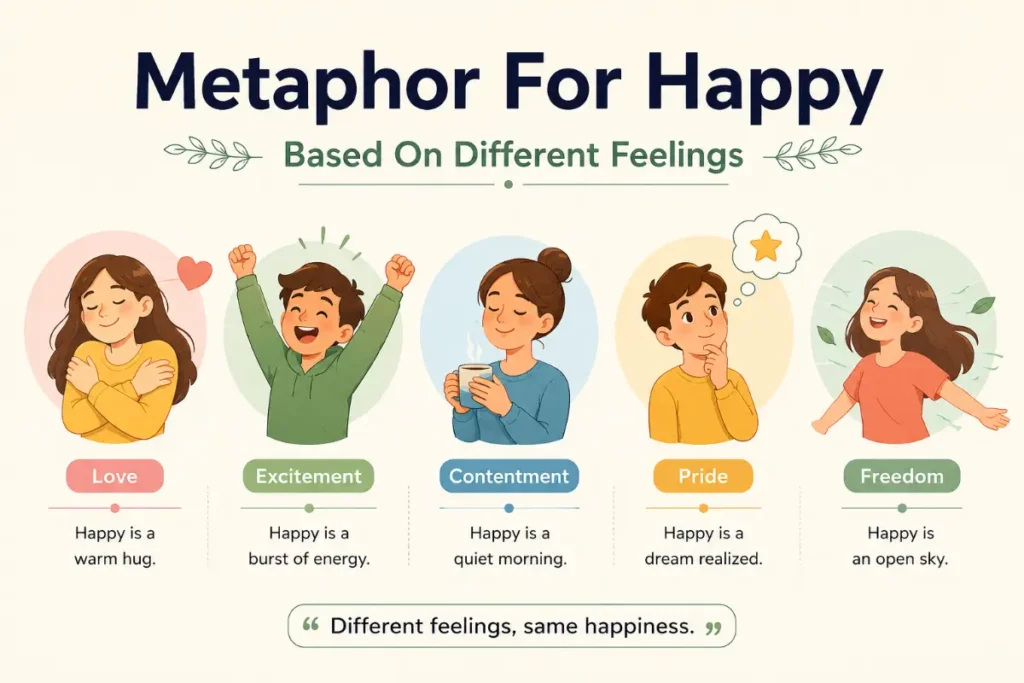
Metaphor For Happy Based On Different Feelings
Happiness comes in many forms. Some moments feel peaceful while others burst with excitement. Matching the metaphor to the emotion creates stronger writing.
Quiet Happiness
Use these metaphors for calm contentment.
- A calm lake.
- A gentle breeze.
- A warm blanket.
- A glowing candle.
- A peaceful garden.
Example.
After retiring, his life became a calm lake.
Excited Happiness
These metaphors show energy and celebration.
- Fireworks.
- A racing river.
- A soaring eagle.
- A rocket lifting into the sky.
- A marching band.
Example.
The team’s victory turned the stadium into a fireworks display.
Hopeful Happiness
These metaphors express optimism and fresh beginnings.
- A new sunrise.
- Spring after winter.
- A rainbow.
- Fresh green leaves.
- A seed becoming a tree.
Example.
Getting the new job felt like spring after a long winter.
Loving Happiness
These metaphors highlight warmth and close relationships.
- A glowing hearth.
- A cozy home.
- A strong oak tree.
- A shared campfire.
- A favorite song.
Example.
Their home became a glowing hearth filled with laughter.
Real Life Examples Of Metaphors For Happy
Here are natural examples from different situations.
Daily Conversation
- Her smile is sunshine on a cloudy day.
- His heart became a balloon after hearing the news.
- My daughter is the spark in our family.
- Their laughter filled the room like music.
- His joy was contagious.
Workplace
- The promotion was fuel for her confidence.
- Our new teammate is a ray of sunshine.
- Success became the wind beneath our wings.
- The project turned into a blooming garden of ideas.
- Everyone left the meeting with hearts full of light.
Emails
- Your message was a bright light during a busy week.
- Your support has been the anchor keeping our spirits high.
Academic Writing
- The author describes hope as a rising sun.
- The novel uses flowers as a metaphor for emotional growth.
Literature
- Shakespeare often compared joyful emotions to light and music.
- Modern novels frequently use gardens as symbols of happiness.
Journalism
- The community became a beacon of hope after the disaster.
- The celebration lit up the city like a sunrise.
Social Media
- Happiness is my favorite playlist.
- My heart is floating above the clouds today.
Learn the difference in Metaphor For Death.
Famous Metaphors For Happiness In Literature
Many great writers have described happiness through images instead of direct statements.
Light often represents hope and joy.
Flowers symbolize emotional growth and new beginnings.
Birds represent freedom and cheerful spirits.
Gardens suggest peace, beauty, and a life filled with good things.
Music stands for celebration, harmony, and shared happiness.
These timeless images continue to appear in novels, poems, speeches, and films because readers instantly understand them.
How To Create Your Own Metaphor For Happy
Creating your own metaphor is easier than most people think.
Follow these simple steps.
- Think about how happiness feels.
- Picture an object or scene that creates the same feeling.
- Connect the emotion to the image without using like or as.
For example.
Feeling warm.
Her heart became a cozy fireplace.
Feeling free.
His spirit was an eagle above the mountains.
Feeling hopeful.
Her smile was the first sunrise of spring.
The strongest metaphors come from everyday experiences people can easily picture.
Common Mistakes When Using A Metaphor For Happy
Metaphors make writing stronger, but they lose their impact when used carelessly. Here are some mistakes to avoid.
Mixing Metaphors
Combining unrelated images can confuse readers.
Incorrect.
Her happiness was a blazing sun sailing across a river of music.
Correct.
Her happiness was a blazing sun brightening every corner of the day.
Choosing A Metaphor That Does Not Match The Mood
A metaphor should match the feeling you want to express.For peaceful happiness, choose images like a calm lake or a warm fireplace.For exciting happiness, choose fireworks, sunshine, or soaring birds.
Overusing Metaphors
Using a metaphor in every sentence makes writing feel forced.
Instead, use one strong metaphor and let it carry the emotion naturally.
Using Clichés Too Often
Some metaphors are popular because they work well, but repeating them can make writing feel predictable.
Instead of always using ray of sunshine, try fresh images such as.
- A window filled with morning light.
- A tree bursting with blossoms.
- A sky painted with dawn.
- A river flowing freely.
Memory Tricks
These simple tricks make it easier to remember and use metaphors for happiness.
Think About Light
Happiness often reminds people of brightness.
Words like sunshine, sunrise, stars, candles, and glowing light naturally suggest joy.
Think About Nature
Nature offers countless images of growth and beauty.
Flowers blooming.
Birds flying.
Rainbows appearing.
Gardens growing.
These all represent different kinds of happiness.
Think About Movement
Happy people often move with energy.
That is why metaphors involving flight, dancing, flowing water, or floating balloons feel natural.
Related Figures Of Speech
Metaphors are only one way to describe happiness.
Similes
A simile compares two things using like or as.
Example.
She was as cheerful as the morning sun.
Personification
Personification gives human qualities to objects or ideas.
Example.
Joy knocked on the front door.
Hyperbole
Hyperbole uses exaggeration for emphasis.
Example.
I smiled so much my face could light the whole city.
Symbolism
Symbols represent ideas without directly stating them.
A white dove may symbolize peace.
A rainbow often symbolizes hope and happiness.
Knowing the difference helps you choose the right style for every piece of writing.
Expert Editor’s Note
Professional editors encourage writers to use metaphors with purpose instead of decoration.
The strongest metaphor feels effortless because it matches the tone, audience, and message. A simple image often creates more impact than a complicated comparison.
For academic or business writing, subtle metaphors usually work best.
Creative writing, poetry, speeches, and personal stories allow more imaginative language, but every metaphor should make the meaning clearer instead of distracting the reader.
When revising your work, read each metaphor aloud. If it sounds natural and creates a clear picture, keep it. If it feels confusing or forced, replace it with a simpler image.
Frequently Asked Questions
What Is The Best Metaphor For Happy?
There is no single best metaphor because each one expresses a different kind of happiness. Popular choices include a ray of sunshine, a blooming flower, a rainbow after the rain, and a bird in flight. Pick the image that best matches the emotion you want readers to picture.
What Is A Strong Metaphor For Joy?
A strong metaphor for joy creates an immediate mental image. Examples include a heart full of sunshine, a sky filled with stars, a garden in full bloom, and a river flowing freely. These comparisons make emotions feel vivid and memorable.
What Is The Difference Between A Metaphor And A Simile?
A metaphor says one thing is another.
Example.
Her heart is a sunrise.
A simile compares two things using like or as.
Example.
Her heart shines like the sunrise.
Both create imagery, but metaphors usually feel more direct and powerful.
Can I Use Metaphors In Academic Writing?
Yes, but use them carefully. A simple metaphor can explain an idea or make a point easier to understand. Avoid overly dramatic comparisons in formal essays or research papers.
Are Metaphors For Happy Suitable For Children?
Yes. Children often understand simple images better than abstract descriptions. Sunshine, rainbows, balloons, birds, flowers, and smiling stars are easy to picture and make learning more enjoyable.
Why Do Writers Use Nature To Describe Happiness?
Nature is familiar across cultures. Images such as sunshine, blooming flowers, birds, rivers, and gardens naturally suggest life, growth, hope, and peace. Readers instantly connect these scenes with positive emotions.
Can I Create My Own Metaphor?
Absolutely. The best metaphors often come from personal experiences. Think about what happiness feels like to you, then compare it to something that creates the same emotion. Original metaphors make your writing more memorable and authentic.
For another common grammar confusion, see Metaphor For Life Meaning And Best Examples.
Conclusion
Finding the right metaphor for happy can transform ordinary writing into something readers remember. Instead of simply saying someone feels happy, you can paint a picture that shows warmth, hope, excitement, comfort, or celebration.
The most effective metaphors are simple, natural, and easy to imagine. Sunshine, blooming flowers, soaring birds, rainbows, glowing fires, and peaceful gardens each express a different shade of happiness.
Choose a metaphor that matches your message, audience, and tone. A thoughtful comparison creates stronger emotions and leaves a lasting impression.
The next time you want to describe happiness, skip the ordinary word and let your imagery tell the story.

Vocabulary & Language Research Writer
Ethan Parker researches English vocabulary, word meanings, slang, idioms, and commonly confused words. His goal is to help readers understand how English is actually used in everyday conversations and writing.