
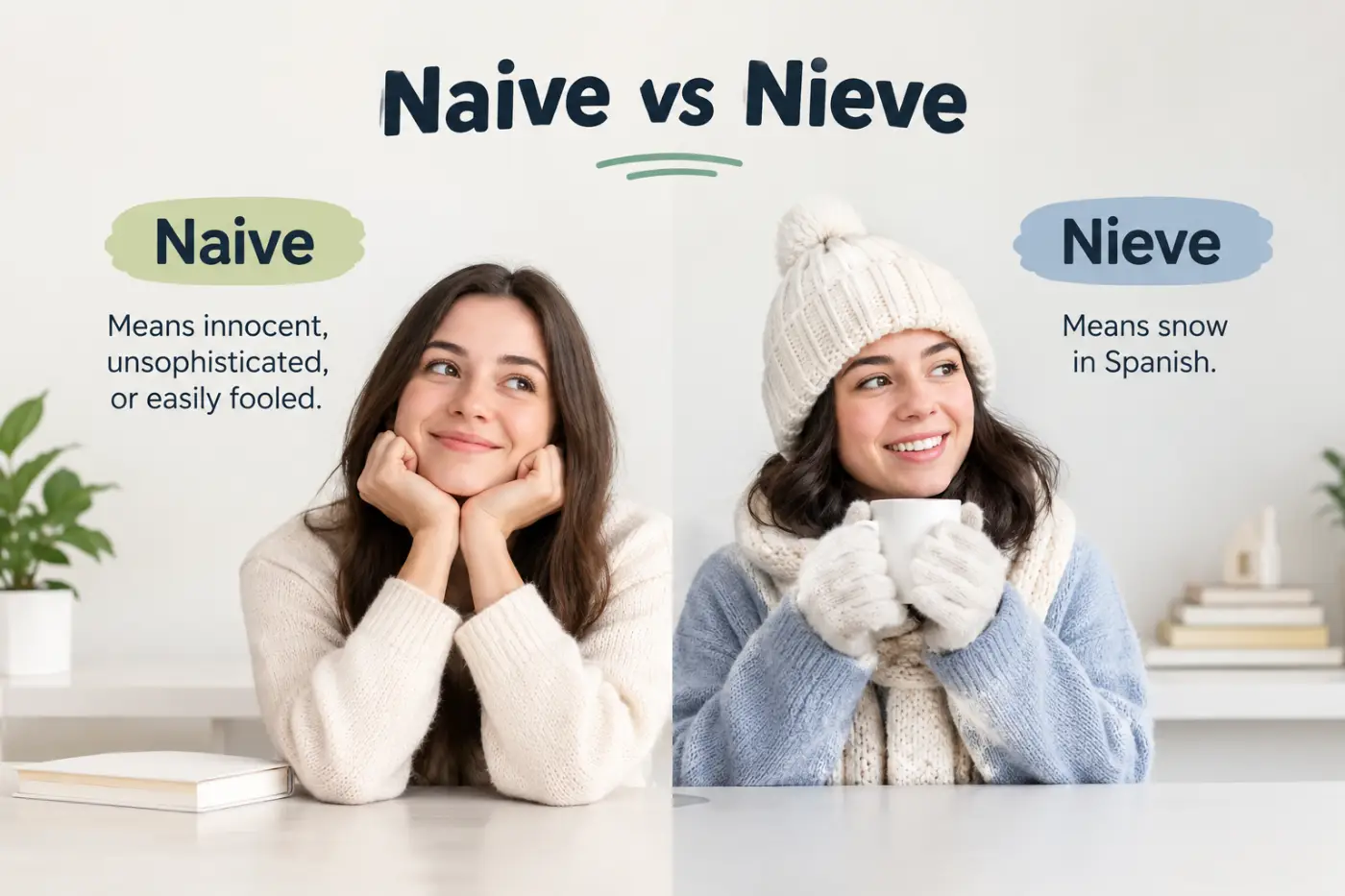
When you compare naive vs nieve you’re dealing with a spelling question that has one clear answer in standard English. Naive is the correct English spelling. Nieve is not the standard spelling of this English adjective. The confusion often comes from the similar letters and the way naive is pronounced.
If you’ve ever paused while writing naive because nieve looked possible, you’re not alone. The two forms are visually close, especially when you’re typing quickly or remembering the word from speech rather than print.
This guide explains the difference clearly. You’ll learn what naive means, why nieve is incorrect in standard English, how to pronounce naive, where the word comes from, how native speakers use it, and which mistakes to avoid in formal and informal writing.
Need another quick comparison? Read Brite vs Bright The Correct Spelling and Meaning.
Quick Answer
Naive is the correct English spelling. Nieve is not the standard English spelling of this word. Naive means lacking experience or showing too much trust because you have not learned how the world works. For example: It was naive to believe that everyone would keep the promise.
Naive vs Nieve Comparison
| Feature | Naive | Nieve |
|---|---|---|
| Correct English spelling | Yes | No |
| Part of speech | Adjective | Not standard English |
| Meaning | Lacking experience or worldly knowledge | No standard English meaning |
| Pronunciation | Usually /naɪˈiːv/ | Not a standard English pronunciation |
| Common use | Describing a person, idea, belief, or action | Usually a spelling mistake |
| Formal writing | Correct | Avoid |
| Informal writing | Correct | Avoid |
| Example | She was naive about the risks. | She was nieve about the risks. |
| Standard dictionaries | Listed | Not listed as the standard form |
The key point is simple: write naive, not nieve.
What Does Naive Mean
Naive is an adjective that describes someone who lacks experience, judgment, or knowledge about how people or situations usually work.
It can also describe an idea, expectation, plan, or belief that shows a lack of experience.
For example:
She was naive about how difficult the job would be.
The sentence means that she did not fully understand the challenges because she lacked experience.
The word can also suggest excessive trust.
He was naive enough to believe the stranger’s story.
Here, naive means that he trusted someone too easily because he did not recognize the possibility of deception.
A person can be intelligent and still be naive about something they have never experienced.
For example:
Maya is highly intelligent but naive about office politics.
The sentence says that Maya is smart but lacks experience in a particular area.
That is a common and useful way to understand the word.
Is Naive the Correct Spelling
Yes. Naive is the standard English spelling.
You may also see the spelling naïve. The two spellings represent the same word.
The version with the diaeresis is closer to the original French spelling and can help readers see that the two vowels should be pronounced separately. Modern English commonly uses naive without the two dots.
So you can write:
He was naive about the situation.
You can also write:
He was naïve about the situation.
Both forms are recognized in English.
By contrast:
He was nieve about the situation.
is not the standard spelling.
Why Is Nieve Incorrect
Nieve is not the normal English spelling of the adjective meaning inexperienced or overly trusting.
The most likely reason for the mistake is visual and phonetic confusion. When people hear naive rather than see it written, they may try to reconstruct the spelling from its pronunciation.
English spelling can make this difficult because English words do not always follow simple sound to letter patterns.
The vowel sequence in naive can also look unusual to learners. Someone who has encountered the word mainly in conversation may remember its sound but not its written form.
Typing can add another layer of confusion. A person may accidentally type nieve because the letters feel more familiar or because they are writing quickly.
Still, the solution is straightforward.
Naive is the standard English form.

Why People Confuse Naive and Nieve
Several factors can make these two forms easy to mix up.
The Letters Look Similar
Both forms contain five letters and begin with n.
They also contain the letters i and e. That visual overlap can make nieve look plausible to someone who has not memorized the spelling.
Yet similar-looking words do not necessarily follow the same spelling pattern.
The Pronunciation Does Not Clearly Reveal the Spelling
The standard pronunciation of naive does not sound like a simple letter by letter reading.
This creates a common problem for learners. You may know exactly what the word means and how to say it while still hesitating over the spelling.
That is why spelling memory matters here.
English Has Unusual Vowel Patterns
English contains many words with vowel combinations that do not behave in predictable ways.
Consider words such as:
- naive
- receive
- deceive
- believe
- foreign
These words don’t all follow one simple spelling rule.
As a result, learners often need to remember specific spellings rather than rely entirely on pronunciation.
Speech Can Come Before Reading
Someone who learns vocabulary mainly through conversation may know naive for years without knowing its written form.
Once they need to write it, a form such as nieve may appear reasonable.
This is especially common among language learners and people who encounter a word frequently in speech but rarely in print.
Autocorrect Can Reinforce Errors
Typing tools don’t always solve spelling problems.
An unusual mistake can survive if the software doesn’t flag it or if a writer accepts a suggested correction without checking the word.
For important writing, a dictionary remains more reliable than guesswork.
Naive Meaning and Usage
The meaning of naive depends slightly on context.
At its core, the word describes a lack of experience or worldly knowledge.
Here are the main uses.
Naive Person
A person can be naive because they don’t have enough experience to recognize how a situation works.
The new employee was naive about office politics.
This does not necessarily criticize the employee’s intelligence.
Instead, it points to limited experience.
Naive Belief
A belief can be naive when it ignores important realities.
It is naive to think that success comes without effort.
The writer is saying that the belief is overly simple.
Naive Expectation
An expectation can be naive when someone assumes an outcome without considering realistic difficulties.
We had a naive expectation that the project would be finished in one week.
The expectation was unrealistic because it overlooked the work involved.
Naive Approach
A plan or approach can be naive if it seems too simple for a complicated problem.
The proposal takes a naive approach to a complex social issue.
Here, naive suggests that the writer has underestimated the problem.
Naive vs Nieve in a Sentence
Seeing the correct word in context is one of the easiest ways to remember it.
Here are natural examples.
- She was naive to trust a stranger with her money.
- I was naive when I first started working in business.
- His naive assumption caused several problems.
- It would be naive to ignore the warning signs.
- The young student had a naive view of adult life.
- Her question wasn’t foolish. It simply reflected her naive understanding of the subject.
- He was too naive to recognize the scam.
- The plan sounds naive because it ignores the cost.
- I used to be naive about how difficult publishing could be.
- Their naive expectations quickly changed after the first week.
- The article presents a somewhat naive view of human behavior.
- She admitted that her earlier opinion had been naive.
- His naive confidence disappeared after he faced the real challenge.
- It would be naive to assume that every online review is genuine.
- The manager thought the proposal was promising but somewhat naive.
- As a teenager, I was naive about money.
- Her naive question actually started an important discussion.
- The character begins the novel with a naive view of the world.
- He gave a naive answer because he had never dealt with the problem before.
- The researcher rejected the naive assumption that one factor explained everything.
- Don’t confuse being naive with being unintelligent.
- His first business idea was ambitious but naive.
- She became less naive after several years of experience.
- The teacher explained why the student’s conclusion was naive.
- It may sound naive but I still believe people can change.
Notice how naturally naive works before nouns such as assumption, expectation, view, approach, and idea.
Naive Pronunciation Guide
The usual pronunciation of naive is:
/naɪˈiːv/
It has two syllables:
naive → na ive
The main stress falls on the second syllable.
It sounds roughly like:
nye EEV
The pronunciation can vary slightly across accents. However, the standard English pronunciation clearly has two syllables.
The spelling naïve can make the pronunciation easier to understand because the diaeresis signals that the vowels should be pronounced separately.
Common Pronunciation Mistakes
Some speakers may try to pronounce naive as one syllable. That pronunciation does not match the standard pronunciation used in most English dictionaries.
Another mistake is to pronounce the first part like the word nay. The beginning is closer to the sound in night.
If you’re learning English, listening to native speakers use the word in full sentences can help more than memorizing the individual sounds.
Naive or Naïve
Both naive and naïve are accepted English spellings.
The version naïve keeps the diaeresis from French. The two dots show that the vowels should be pronounced separately.
The simpler spelling naive is very common in modern English and is usually the easiest choice for general writing.
For a US audience, naive is a perfectly natural choice.
For example:
It would be naive to ignore the evidence.
You don’t need to add the diaeresis.
Is Naïve More Correct Than Naive
No.
Naive and naïve are both correct spellings.
The difference is typographic rather than a difference in meaning.
That said, style preferences can vary. Some publications retain diacritics in borrowed words while others remove them when English has adopted the word fully.
If you’re writing for a general American audience, naive is simple and familiar.
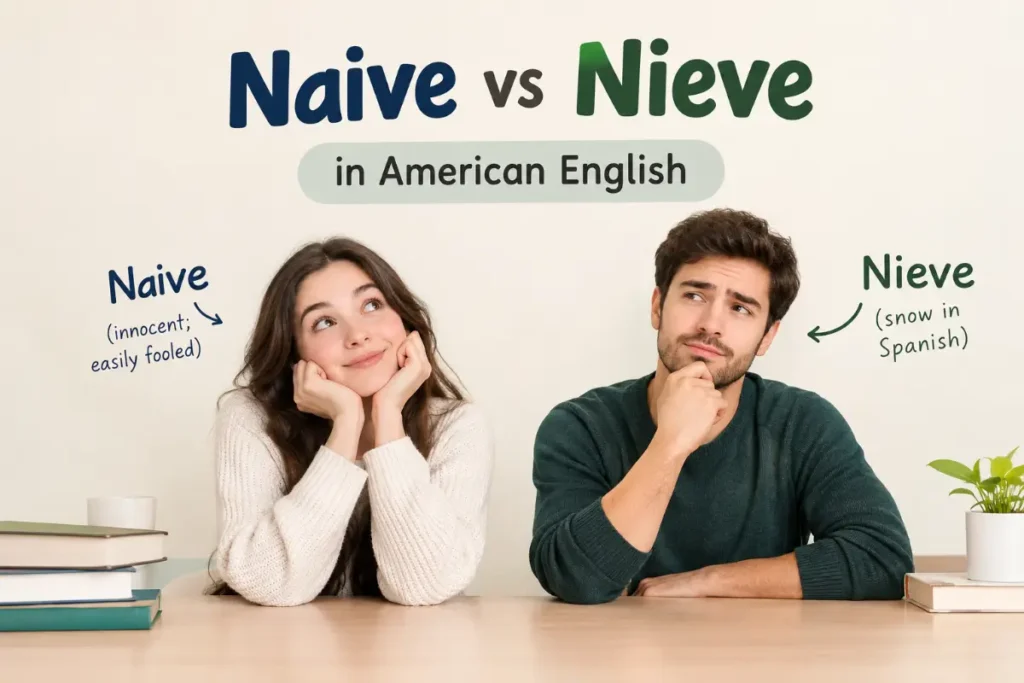
Naive vs Nieve in American English
American English uses naive as the standard spelling.
The alternative spelling naïve is also understood and accepted.
Nieve is not an American spelling variant of naive.
So there is no US versus UK spelling difference that makes nieve correct.
This is important because learners sometimes assume that a strange spelling must belong to another English variety.
That isn’t the case here.
Naive in British English
British English also uses naive and naïve.
Again, nieve is not the standard British spelling of this word.
The meaning is essentially the same across major English varieties.
Canadian and Australian English also use naive and naïve.
Therefore, you don’t need to memorize a regional spelling rule for this comparison.
The safe standard form is naive.
Naive Word Origin
The history of naive explains some of its unusual spelling.
The word entered English from French naïf for a male person and naïve for a female person. French itself traces the word to Latin nativus, meaning natural or native.
Over time, English adopted the word and developed the modern adjective naive.
The original French connection also explains the familiar diaeresis in naïve.
In modern English, the word no longer carries the original French grammatical distinction between masculine and feminine forms. English simply uses naive as an adjective.
The meaning also developed over time.
The modern English sense focuses on innocence, lack of experience, and excessive trust or simplicity.
Is Naive a Negative Word
Naive can be negative, but it isn’t always harsh.
Context determines the tone.
Calling someone naive can suggest that they are inexperienced or too trusting.
For example:
You were naive to trust him.
That sentence sounds critical.
However, naive can also describe innocent thinking without attacking someone’s intelligence.
Her naive enthusiasm made everyone smile.
Here, the word has a softer tone.
It can even carry a sympathetic meaning.
I was naive when I was younger.
The speaker is simply acknowledging a lack of experience.
Professional writers should therefore consider the surrounding language before using naive to describe a person.
No.
This is one of the most important meaning differences to understand.
Naive usually refers to a lack of experience or worldly knowledge.
Those ideas can overlap in some situations, but they are not synonyms.
An intelligent person can be naive about a subject they have never encountered.
For example:
She’s an excellent lawyer but naive about investing.
The sentence does not suggest that she lacks intelligence. It says she has limited experience with investing.
That distinction matters in professional and academic writing.
Naive Synonyms
Depending on the context, several words can have a similar meaning.
Possible synonyms include:
- inexperienced
- innocent
- trusting
- unsophisticated
- unworldly
- gullible
- credulous
- unsuspecting
- simplistic
- idealistic
These words aren’t perfect substitutes.
For example, gullible strongly suggests that someone is easily deceived.
Inexperienced focuses on limited experience.
Idealistic can describe someone who has high hopes or strong principles without necessarily being inexperienced.
Naive sits somewhere among these ideas.
That’s why choosing the exact word matters.
Still confused? Compare stich vs stitch Which Word Is Correct 2026 Guide.
Opposites of Naive
Common opposites include:
- experienced
- worldly
- sophisticated
- knowledgeable
- discerning
- cautious
- realistic
- perceptive
- savvy
Again, context matters.
A person can become less naive by gaining experience. Another person may become less trusting because they learn to recognize warning signs.
The best opposite depends on the specific meaning.
Common Phrases With Naive
Native speakers frequently use naive with certain nouns and structures.
Naive About
He was naive about the risks.
This structure means someone lacks knowledge or experience in a particular area.
Naive Belief
It was a naive belief that everything would work out immediately.
Naive Assumption
That conclusion is based on a naive assumption.
Naive Approach
The plan takes a naive approach to a complicated problem.
Naive View
She had a naive view of how the industry worked.
Naive Question
It may be a naive question but why can’t we try again?
This last expression is interesting because speakers sometimes use naive question politely before asking something basic.
Common Mistakes With Naive
Knowing the correct spelling is only part of using the word well.
Writing Nieve Instead of Naive
This is the main spelling mistake.
Incorrect:
He was nieve about the situation.
Correct:
He was naive about the situation.
Treating Naive as a Noun
Naive is normally an adjective.
You can say:
She is naive.
You can also say:
She has a naive attitude.
You wouldn’t normally use naive alone as the noun for an inexperienced person.
Instead, use a noun such as beginner, novice, or inexperienced person, depending on the meaning.
Assuming Naive Means Unintelligent
As explained earlier, this is a meaning mistake.
Someone can be intelligent and naive at the same time.
Using Naive When Inexperienced Is More Precise
Sometimes inexperienced is a better choice.
Compare:
He was inexperienced in managing a large team.
This is neutral and specific.
He was naive about managing a large team.
This suggests that he misunderstood the realities or challenges of managing a large team.
The second sentence carries more judgment.
Naive in Formal Writing
Naive is perfectly acceptable in formal writing.
You may see it in:
- academic papers
- journalism
- business writing
- literary criticism
- research
- professional reports
- essays
However, the word should be precise.
In academic writing, writers often use it to describe a simplified assumption or model.
For example:
The study challenges the naive assumption that consumer behavior is always rational.
Here, naive does useful analytical work.
Still, if you mean simply inexperienced, then inexperienced may be more precise.
Good editing isn’t about choosing complicated words. It’s about choosing the word that says exactly what you mean.
Naive in Academic Writing
The word is common in academic contexts where researchers contrast simple assumptions with more developed models.
For example:
A naive interpretation of the results might overlook the role of social factors.
The adjective signals that the interpretation lacks depth.
Another example:
The model is based on a naive assumption about human behavior.
In technical fields, naive can sometimes have a more specialized meaning. It may describe an uncomplicated method or approach that does not account for more advanced factors.
So the meaning can shift slightly by field.
Always read the surrounding context.
Naive in Everyday Conversation
In everyday speech, naive often describes someone who trusts too easily.
For example:
I was naive enough to think the repair would be cheap.
Or:
Don’t be naive. They probably have another reason for making that offer.
The word can sound blunt in direct conversation.
If you want a softer tone, you could say:
You may not have had enough experience with this.
That sounds less judgmental.
Naive vs Innocent
These words overlap but aren’t identical.
Innocent often suggests a lack of guilt, knowledge, or harmful intent.
Naive focuses more strongly on limited experience or judgment.
Compare:
The child was innocent.
This can mean the child had done nothing wrong.
The child was naive.
This suggests that the child did not understand how something worked.
Someone can be innocent without being naive.
Someone can also be naive without being innocent.
Naive vs Gullible
Gullible means easily persuaded or deceived.
Naive is broader.
A naive person may be inexperienced without being easily fooled.
For example:
He was naive about the industry.
This doesn’t necessarily mean someone tricked him.
But:
He was gullible and believed every sales pitch.
clearly suggests that he was easily deceived.
This distinction is useful when editing professional writing.
Naive vs Idealistic
These words can also overlap.
An idealistic person tends to believe in positive outcomes or high principles.
A naive person may lack the experience needed to recognize practical problems.
For example:
Her idealistic goal was to make education available to everyone.
That goal isn’t necessarily naive.
But:
Her naive plan ignored the cost of providing the service.
The second sentence focuses on unrealistic assumptions.
Memory Tricks for Naive
A simple spelling trick can help you remember naive.
Think:
NAIVE has AI in the middle.
The spelling is:
N A I V E
If you remember the sequence AI, you’re less likely to switch the letters and create nieve.
Another useful trick is to connect the spelling with the alternative form:
naive = naïve
The two dots in naïve remind you that the word has two vowel sounds.
You can also remember this sentence:
A naive person may trust too easily.
The correct spelling starts with nai.
Related Words to Naive
Understanding related vocabulary can make your word choice more precise.
Novice
A novice is someone who is new to a particular activity or field.
She’s a novice programmer.
This is usually neutral.
Inexperienced
Inexperienced means lacking practical experience.
He’s inexperienced in management.
This is also fairly neutral.
Gullible
Gullible means easily deceived.
He was gullible enough to believe the fake offer.
This is more negative.
Unsophisticated
Unsophisticated can describe someone or something that lacks refinement, complexity, or worldly knowledge.
His understanding of the market was unsophisticated.
Credulous
Credulous means too ready to believe things.
It’s more formal than gullible.
Savvy
Savvy is a useful opposite in many contexts.
She’s very savvy about online scams.
A savvy person understands how things work and can make practical judgments.

What Dictionaries Say About Naive
Major English dictionaries recognize naive as a standard English adjective.
Dictionary definitions generally center on a lack of experience or wisdom and a tendency to trust people or situations too readily.
They also recognize naïve as a spelling variant.
The important editorial point is that dictionaries treat naive as an established English word. Nieve is not an accepted alternative spelling of the same adjective in standard English.
That gives writers a clear rule:
Use naive in normal English writing.
Expert Editor’s Note
If I were proofreading an article, email, essay, or website page, I would correct nieve to naive.
I wouldn’t treat nieve as a regional variation. It isn’t a US versus UK spelling issue. It is simply not the standard English form of the adjective.
I’d also keep naive rather than naïve in most general American writing unless the publication has a style preference for retaining diacritics.
More importantly, I’d check the meaning before making the correction. If the writer actually means inexperienced, gullible, innocent, or idealistic, I might recommend a different word.
Good editing goes beyond spelling. The goal is to make the sentence accurate, natural, and precise.
For general readers, naive is the safest and most familiar spelling.
Internal Linking Opportunity
A natural internal link could appear here to an article about another commonly confused spelling pair.
Suggested anchor text: Commonly confused English words and spellings.
A second useful internal link can appear before the conclusion.
Suggested anchor text: How to choose the correct spelling in English.
These links would support readers who are comparing several confusing English words rather than only naive and nieve.
Frequently Asked Questions About Naive vs Nieve
Is naive the correct spelling
Yes. Naive is the standard English spelling of the adjective meaning inexperienced, overly trusting, or lacking worldly knowledge. You may also see naïve, which is an accepted spelling variant. Nieve is not the standard spelling of this word.
Is nieve a word in English
Nieve is not the standard English spelling of the adjective naive. If you want to describe someone as inexperienced or overly trusting, use naive. A dictionary or spelling checker may sometimes recognize nieve in another context or language, but that doesn’t make it the correct English spelling for this meaning.
Should I write naive or naïve
Both naive and naïve are correct. The form with the diaeresis preserves the traditional French spelling and shows that the vowels are pronounced separately. The spelling naive is common in modern English and is especially convenient for general American writing.
How do you pronounce naive
The standard pronunciation is usually /naɪˈiːv/. It has two syllables with the main stress on the second syllable. It sounds roughly like nye EEV. The spelling naïve can make the two syllables easier to recognize visually.
What is the difference between naive and gullible
Naive describes a broader lack of experience or worldly understanding. Gullible specifically means too easy to deceive or persuade. A person can be naive without being gullible. For example, someone may be naive about business practices without believing every dishonest claim they hear.
Is naive formal or informal
Naive works in both formal and informal English. You can use it in conversation as well as academic writing, journalism, business documents, and professional reports. The tone depends on context. When describing a person, it can sound critical, so writers should choose it carefully.
Is naive used in American English
Yes. Naive is standard in American English. American writers also understand naïve as a spelling variant. Nieve is not a standard American spelling of the word. The same basic spelling applies in British, Canadian, and Australian English.
What is the opposite of naive
Common opposites include experienced, worldly, sophisticated, savvy, knowledgeable, and realistic. The best opposite depends on context. For example, experienced focuses on practical knowledge, while savvy suggests an ability to understand situations and make smart judgments.
Why do people spell naive as nieve
The mistake usually comes from the unusual vowel sequence in naive, combined with pronunciation and visual similarity. Someone who has mainly heard the word spoken may try to spell it from memory and choose nieve. However, nieve is not the standard English spelling.
Many readers also check Attornies or Attorneys Which Spelling Is Correct (2026).
Final Takeaway
When choosing between naive vs nieve, the answer is clear: naive is the correct English spelling.
You may also write naïve. Both forms are accepted. However, nieve should be treated as a spelling mistake when you mean someone who lacks experience or is too trusting.
Remember the key letters: NAI comes before VE.
So write:
naive
Not:
nieve
The biggest lesson is simple. When a word sounds easier than it looks, don’t let pronunciation dictate the spelling. Check the standard form and use the word that matches your exact meaning.

Editorial Reviewer & Proofreader
Grace Mitchell reviews Gramlify’s articles for clarity, consistency, and readability. She is passionate about creating accurate, approachable content that helps English learners build confidence.