
If you’re wondering about puddy or putty you’re probably trying to describe a soft material used for repairs or filling small holes. In that case the correct word is putty. It’s the standard English spelling for a soft substance traditionally made with materials such as chalk and linseed oil and used to secure window glass or fill gaps in wood. Modern putties can also contain synthetic materials.
The confusion makes sense because puddy looks like a simple spelling variation of putty. Both words contain the same first and final letters and have a similar sound. However they aren’t interchangeable. Puddy is a rare adjective meaning short and podgy according to Collins English Dictionary. Putty is the familiar word used for the repair material.
This guide explains the difference clearly. You’ll learn what each word means how to pronounce them when to use them why the spellings get confused and which form belongs in formal writing. You’ll also see practical examples that show how native English speakers use putty in everyday speech technical writing workplace communication and descriptive language.
Need another quick comparison? Read Enrol Or Enroll Which Spelling Is Correct 2026.
Quick Answer
Putty is the correct word when you mean a soft material used to fix glass fill small holes or seal gaps. Puddy is a rare English adjective meaning short and podgy. So if you’re writing about home repairs windows woodwork or a flexible repair material choose putty.
Puddy or Putty Comparison
| Feature | Puddy | Putty |
|---|---|---|
| Standard English word | Yes but rare | Yes |
| Main meaning | Short and podgy | A soft repair or sealing material |
| Part of speech | Adjective | Noun and verb |
| Common in US English | Very rare | Common |
| Common in British English | Rare | Common |
| Used for repairs | No | Yes |
| Used for windows | No | Yes |
| Used for filling holes | No | Yes |
| Pronunciation | /ˈpʊdi/ | /ˈpʌti/ |
| Formal writing | Rare | Common and appropriate |
| Plural form | Not normally used as a noun | Putties |
| Verb form | Not normally used as a verb | Puttied and puttying |
The important difference is meaning rather than spelling. Putty is the word most readers expect when the context involves construction repair glass wood filling sealing or a soft material. Cambridge defines putty as a soft substance similar to clay that can hold glass in window frames or fill small holes in wood.
What Does Putty Mean
Putty is a noun for a soft material that can be shaped or pressed into gaps. Traditional window putty was made from finely powdered chalk and linseed oil. It was commonly used to secure glass panes in window frames and to fill defects in woodwork.
The word has expanded beyond traditional window repair. Today putty can refer to various materials with a similar soft consistency or a similar function. Different types are made for different jobs.
For example:
- Window putty can help secure glass in a frame.
- Wood putty can fill small holes and surface defects in wood.
- Plastering materials can use putty like substances.
- Some modern synthetic putties are designed for specific repair or sealing tasks.
Cambridge describes putty as a thick soft material that becomes hard as it dries. It also notes its use for fixing glass and filling small holes in wood.
The word can also have a figurative meaning. If someone is putty in your hands they are easily influenced or persuaded by you. Collins lists this as an established meaning of putty.
For example:
She was putty in his hands.
This sentence doesn’t mean she was made of repair material. It means she was easily influenced by him.
What Does Puddy Mean
Puddy is a real English word but it is uncommon. Collins lists it as a rare British English adjective meaning short and podgy. The comparative and superlative forms are puddier and puddiest.
The word therefore describes physical build or shape. It does not normally refer to a substance used for repairs.
For example:
The little dog had a puddy build.
That use is rare and may sound unfamiliar to many modern readers.
For most American readers puddy will not be the natural choice in ordinary writing. If you mean the material used for repairing windows or filling holes you should use putty.
This distinction matters because a spelling that looks like a simple typo can sometimes be a genuine word. Puddy is one of those cases. It exists in English but its meaning is very different from the common meaning of putty.
Which One Is Correct
Putty is correct when you mean the repair material.
Use puddy only when you specifically need the rare adjective meaning short and podgy.
For example:
I need some putty to repair the window.
Correct.
The carpenter used putty to fill the hole.
Correct.
The old frame needs more putty.
true:
If you wrote puddy in these sentences most readers would assume you made a spelling mistake.
So the safest rule is simple:
Repair material means putty.
Short and podgy means puddy.
That small distinction solves most cases of this spelling question.
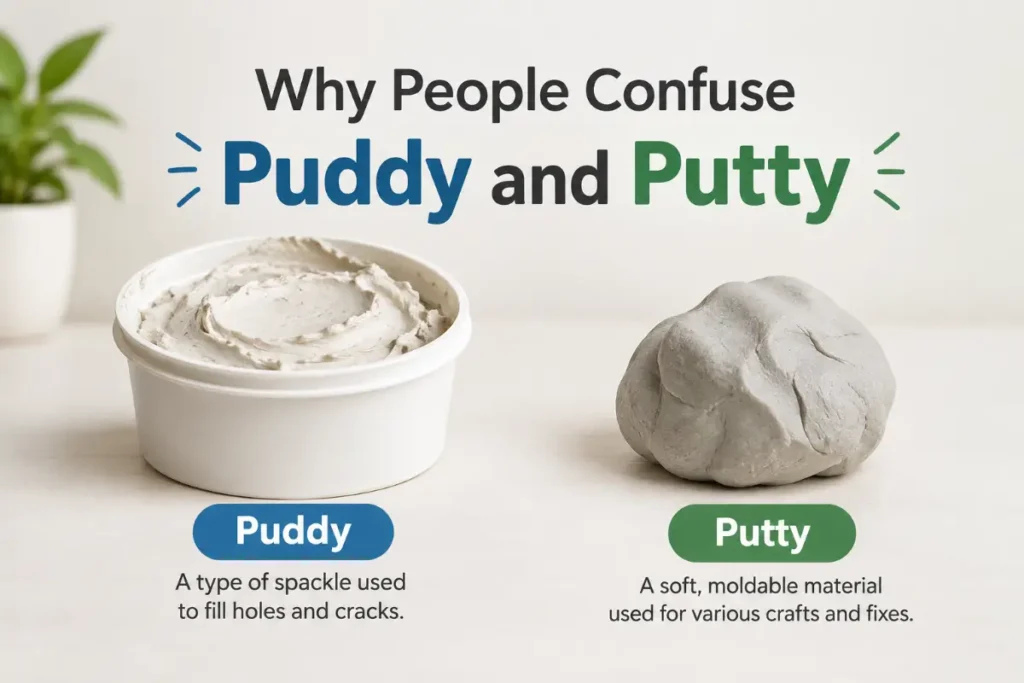
Why People Confuse Puddy and Putty
The two words are easy to mix up because they are visually close. A single letter separates them. That small difference can be easy to miss when you’re typing quickly.
Pronunciation can also contribute to the confusion. Cambridge gives putty as /ˈpʌt.i/ in British English and /ˈpʌt̬.i/ in American English. Collins gives puddy as /ˈpʊdɪ/ in British English.
The vowel sounds aren’t exactly the same but they can sound close to learners who haven’t heard the words often.
Another reason is simple familiarity. Putty is a much more familiar word in ordinary English. A person who encounters puddy may reasonably assume it is an unusual spelling of putty.
Online writing can add to the problem. Informal posts often contain spelling mistakes and users may repeat an incorrect form after seeing it several times. Autocorrect can also fail to make the intended correction when an uncommon word is involved.
There is an important lesson here for English learners. A word can exist in a dictionary and still be the wrong choice for your sentence. Dictionaries tell us what words mean. Context tells us which word belongs in a particular sentence.
Key Differences Between Puddy and Putty
The biggest difference is meaning.
Putty names a substance. It can also function as a verb when someone uses putty to fix cover or fill something. Collins lists putty as both a noun and a transitive verb.
Puddy is an adjective. It describes something or someone as short and podgy. Collins labels this sense rare.
Their roles in a sentence are therefore different.
Compare these examples:
The worker applied putty around the glass.
Here putty is a noun.
The worker puttied the damaged frame.
Here puttied is a verb.
Now compare:
The puddy little figure looked unusually compact.
Here puddy is an adjective.
The words don’t simply represent two spellings of one idea. They belong to different vocabulary sets.
Putty As a Noun
The noun putty is normally uncountable when you mean the material in general.
You can say:
We need some putty.
There isn’t enough putty to finish the repair.
The window frame needs more putty.
You can also use the plural putties when referring to different types or quantities as countable units in an appropriate context. Collins lists the plural form as putties.
For everyday repair instructions however the singular uncountable form is usually the natural choice.
Many readers also check Developed Vs Developped Which Spelling Is Correct 2026.
Putty As a Verb
Putty can also work as a verb.
It means to fix cover or fill something with putty. Collins records this transitive use.
The common verb forms are:
| Form | Example |
|---|---|
| Base form | putty |
| Third person singular | putties |
| Present participle | puttying |
| Past tense | puttied |
| Past participle | puttied |
For example:
They putty the cracks before painting.
She putties the damaged areas carefully.
He is puttying the gaps around the frame.
We puttied the holes yesterday.
The spelling changes in the past tense because putty ends in a consonant followed by y. The final y changes to i before ed.
So:
putty → puttied
The present participle is different:
putty → puttying
You keep the y and add ing.
This is a useful spelling pattern to remember.
Pronunciation Guide
The pronunciation of putty can vary slightly between British and American English.
Cambridge lists these pronunciations:
British English: /ˈpʌt.i/
American English: /ˈpʌt̬.i/
The word has two syllables:
PUT tee
The main stress falls on the first syllable.
The American pronunciation often has a flap sound for the t. That can make the middle sound resemble a quick d to learners. This is one reason an English learner might hear something close to puddy even though the written word is putty.
That distinction between spelling and pronunciation matters. English spelling doesn’t always show every sound in an obvious way.
Collins gives puddy as /ˈpʊdɪ/ in British English.
So don’t rely only on sound to decide the spelling. Look at the meaning and context too.
The Word Origin Of Putty
The history of putty helps explain why the word has such a specific connection with repair materials.
Collins traces the word to French potée, meaning a potful. The English word developed into the name of a material used for practical repair and finishing work.
The traditional substance was associated with chalk and linseed oil. Over time the word became established as the general name for this type of soft repair material. Modern products can use different ingredients while still being described as putty.
This is a useful example of how vocabulary develops. A word can begin with a specific historical meaning and later become a broader label for related materials.
Is Puddy A Misspelling Of Putty
Sometimes puddy is simply a misspelling of putty.
If someone writes:
The carpenter used puddy to fill the hole.
they almost certainly mean putty.
However puddy isn’t always a spelling error. It has a dictionary meaning of its own. Collins identifies it as a rare adjective meaning short and podgy.
That distinction is important for accurate editing.
A professional editor shouldn’t automatically declare every unusual spelling incorrect. First look at the context. If the writer is describing a person’s build then puddy may be intentional. If the writer is discussing windows woodwork or repairs then putty is almost certainly intended.
Real Life Examples Of Putty
The fastest way to understand a word is to see it doing real work in sentences. These examples cover common situations and different writing contexts.
Daily Conversation
- I need some putty to fix this small hole.
- The old window needs fresh putty around the glass.
- Can you pick up a tube of putty from the hardware store?
- This putty is still soft so don’t touch it yet.
- Let the putty dry before you paint the frame.
Home Repair
- Apply the putty evenly around the edge of the glass.
- The wood putty filled the small dents in the cabinet.
- We used putty to cover the screw holes.
- The repair looked much better after the putty dried.
- Remove the loose material before applying new putty.
Workplace Writing
- The technician applied putty around the damaged section.
- The frame requires additional putty before installation.
- Please allow the putty to dry fully before inspection.
- The contractor used a suitable putty for the repair.
- The maintenance team replaced the damaged putty around the window.
Academic Or Technical Writing
- Traditional window putty commonly contained chalk and linseed oil.
- Modern putties may contain synthetic materials designed for specific applications.
- The material was pressed into the gap and allowed to harden.
- Putty can provide a temporary or permanent repair depending on the product.
- The study examined the physical properties of several putty formulations.
Figurative Language
- He was putty in her hands.
- The manager seemed like putty in the hands of the persuasive salesperson.
- After hearing the proposal she was practically putty in his hands.
These examples show why context matters. Putty can describe a physical material or appear in an established figurative expression.
Internal Link Opportunity
After explaining the difference between these two forms you could naturally link to an article about commonly confused English words and spelling mistakes. This gives readers a useful next step without interrupting the explanation.
A second useful internal link could point to a guide explaining how English spelling changes when words take different endings. That topic connects directly with forms such as puttied and puttying.
Expert Editor’s Note
If I were proofreading a general article for an American audience, I would choose putty whenever the writer means the soft repair material. Therefore, putty is the clearest choice for standard usage.
I wouldn’t replace puddy simply because it looks unusual. I’d check the sentence first. If the writer is using the rare adjective meaning short and podgy then puddy can be correct. Collins specifically records that meaning and labels it rare.
For most practical writing however putty is the word readers expect.
This is especially true in instructions, product descriptions, home improvement articles, workplace documents, and educational material. In addition, Cambridge and Collins both support the standard meaning of putty as a soft material used for tasks such as securing glass and filling holes.
The editorial rule is simple.
Choose the spelling based on meaning.
If you’re talking about repairing something use putty.
If you’re deliberately using the rare adjective meaning short and podgy use puddy.
Don’t treat the two forms as interchangeable.
Frequently Asked Questions
Is puddy a correct word
Yes. Puddy is a real but rare English adjective. Collins defines it as meaning short and podgy. It isn’t the standard spelling of the repair material used for windows and filling holes. For that meaning the correct word is putty.
Is putty the correct spelling
Yes. Putty is the standard spelling for the soft material used to secure glass fill small holes and perform certain repair or sealing tasks. Cambridge and Collins both list the word with these meanings.
Is puddy an alternative spelling of putty
No. Puddy isn’t simply an alternative spelling of putty. It is a separate rare adjective meaning short and podgy. If you’re describing a repair material then putty is the appropriate spelling.
How do you pronounce putty
Cambridge gives putty as /ˈpʌt.i/ in British English and /ˈpʌt̬.i/ in American English. It has two syllables with the main stress on the first syllable. The American pronunciation can make the middle consonant sound somewhat like a quick d.
How do you pronounce puddy
Collins gives puddy as /ˈpʊdɪ/ in British English. The first vowel differs from the vowel in the standard pronunciation of putty. Because the words are short and similar in sound they can still be confused by learners.
Is putty a noun or a verb
Putty can be both a noun and a verb. As a noun it names the repair material. As a verb it means to fill cover or fix something with putty. Collins records both uses.
What is the plural of putty
The ordinary material use of putty is usually uncountable. Dictionaries also record putties as a plural form when different types or units are treated as countable. However, in everyday repair writing, you will normally say some putty or more putty instead of using the plural form.
What is the past tense of putty
The past tense is puttied. The final y changes to i before ed. For example: The worker puttied the holes before painting the wall. The present participle is puttying. These forms follow common English spelling patterns.
Is putty the same in British and American English
Yes. Putty has the same standard spelling and basic meaning in British and American English. Cambridge lists the word in both varieties, and Collins also provides British and American entries. Although the pronunciation can differ slightly, the spelling remains putty.
What does putty in your hands mean
Putty in your hands is a figurative expression meaning someone is very easy to influence or persuade. The image comes from the soft and moldable nature of putty. Collins lists this figurative meaning alongside the physical material sense.
Can I use puddy in formal writing
You can use puddy if you genuinely need its rare adjective meaning. However, most readers aren’t familiar with the word. Therefore, if clarity matters, you may want to use a more familiar phrase such as short and stocky. For the repair material always use putty.
Learn the difference in Provider Vs Providor Which Word Is Correct 2026 Guide.
The Biggest Takeaway
The difference between puddy and putty comes down to meaning.
Putty is the standard word for the soft material used to repair fill seal or secure things. It can also function as a verb and, in addition, appears in the figurative expression putty in someone’s hands.
Puddy is a rare adjective meaning short and podgy. It isn’t the normal spelling for the repair material.
So if you’re writing about a window frame a hole in wood a repair job or a soft sealing material choose putty.
The easiest memory trick is this:
Putty goes into a repair. Puddy describes a build.
Once you connect each spelling with its meaning the confusion disappears.

Editorial Reviewer & Proofreader
Grace Mitchell reviews Gramlify’s articles for clarity, consistency, and readability. She is passionate about creating accurate, approachable content that helps English learners build confidence.