
If you’ve searched for scarey or scary, you’re not alone. This is one of the most common English spelling questions because both words look believable. Many people naturally assume scarey follows the same pattern as words like care or rare. In reality, only one spelling is accepted in standard English.
The correct spelling is scary. The word scarey is a misspelling and does not appear as the standard form in major English dictionaries. You’ll sometimes spot it in old writing, online posts, or typing mistakes, but it isn’t considered correct in modern English.
The confusion comes from the base word scare. Many learners expect the final e to stay when adding y, but English spelling follows a different rule. Once you understand that rule, you’ll never have to guess again.
In this guide, you’ll learn the correct spelling, the grammar behind it, why people make this mistake, real life examples, pronunciation tips, common errors, memory tricks, and expert editing advice. By the end, you’ll know exactly when and why to use scary with confidence.
For another common grammar confusion, see Imbed Vs Embed Which Spelling Is Correct 2026.
Quick Answer
If you’re deciding between scarey or scary, the correct spelling is scary. The spelling scarey is incorrect in modern English. Use scary every time you describe something that causes fear, feels frightening, or makes people nervous in both formal and informal writing.
Scarey Or Scary Comparison Table
| Feature | Scary | Scarey |
|---|---|---|
| Correct spelling | ✔ Yes | ✘ No |
| Part of speech | Adjective | Misspelling |
| Meaning | Causing fear or fright | No accepted meaning |
| Dictionary status | Standard English | Not recognized as the standard spelling |
| Formal writing | Correct | Incorrect |
| Everyday use | Very common | Typing or spelling mistake |
| Example | The movie was scary. | The movie was scarey. ✘ |
Which One Is Correct
The correct spelling is scary.
The spelling scarey is considered incorrect in modern English. Professional editors, teachers, dictionaries, and style guides all recommend using scary.
Correct examples.
✔ The haunted house looked scary.
✔ I heard a scary noise outside.
Incorrect examples.
✘ The haunted house looked scarey.
✘ I heard a scarey noise outside.
If you’re writing an email, school paper, article, social media post, or business document, always choose scary.
What Does Scary Mean
Scary is an adjective that describes something that causes fear, surprise, or anxiety.
Simple Definition
Scary means frightening, frightening enough to make someone feel afraid, nervous, or uncomfortable.
When To Use Scary
Use scary to describe people, animals, situations, places, stories, sounds, movies, or experiences that create fear.
Examples.
- The thunderstorm sounded scary.
- That movie was scary from beginning to end.
- Walking through the empty building felt scary.
- The dog looked scary but turned out to be friendly.
- She told a scary ghost story around the campfire.
Why Scarey Is Incorrect
Many people think scarey should be correct because the base word is scare.
That seems logical, but English spelling doesn’t work that way.
When y is added to the noun or verb scare, the final e is dropped.
Scare becomes scary.
The same pattern appears in several English words where the silent e disappears before adding a suffix.
This spelling has been the accepted standard for generations.
Although you may occasionally see scarey online, it is almost always a spelling mistake rather than an accepted variation.
The Spelling Rule Behind Scary
The easiest way to remember the correct spelling is to learn the rule instead of memorizing the word.
Drop The Silent E Before Adding Y
Many English words ending in a silent e lose that e before another ending is added.
Examples include.
- Scare becomes scary.
- Taste becomes tasty.
- Ice becomes icy.
- Shine becomes shiny.
Notice the silent e disappears each time.
The same spelling pattern explains why scary is correct.
Why People Add The Extra E
Many writers instinctively keep the e because they connect the word with scare.
This is a natural mistake, especially for children and English learners.
Once you know the spelling rule, the confusion disappears.
Grammar Explanation
Scary is an adjective.
An adjective describes a noun by giving more information about it.
Examples.
- The scary movie kept everyone awake.
- We heard a scary sound upstairs.
- It was a scary moment for the entire family.
The adjective answers questions like these.
- What kind of movie?
- What kind of sound?
- What kind of moment?
The answer is scary.
Can Scary Be Compared
Yes.
Like many short adjectives, scary has comparative and superlative forms.
| Form | Example |
|---|---|
| Scary | This movie is scary. |
| Scarier | This movie is scarier than the last one. |
| Scariest | That was the scariest movie I’ve ever seen. |
Notice that every form keeps the spelling scar and never changes to scare.
That pattern confirms the correct spelling throughout the word family.
Pronunciation Guide
Understanding pronunciation also helps reinforce the correct spelling.
IPA
American English
/ˈsker.i/
Syllables
Scar y.
Stress Pattern
The first syllable receives the main stress.
Common Pronunciation Mistakes
Some learners pronounce scary with two separate vowel sounds because they focus on the spelling.
Native speakers usually pronounce it smoothly as two syllables.
Although pronunciation may vary slightly across English speaking regions, the spelling remains scary everywhere.
Why People Confuse Scarey And Scary
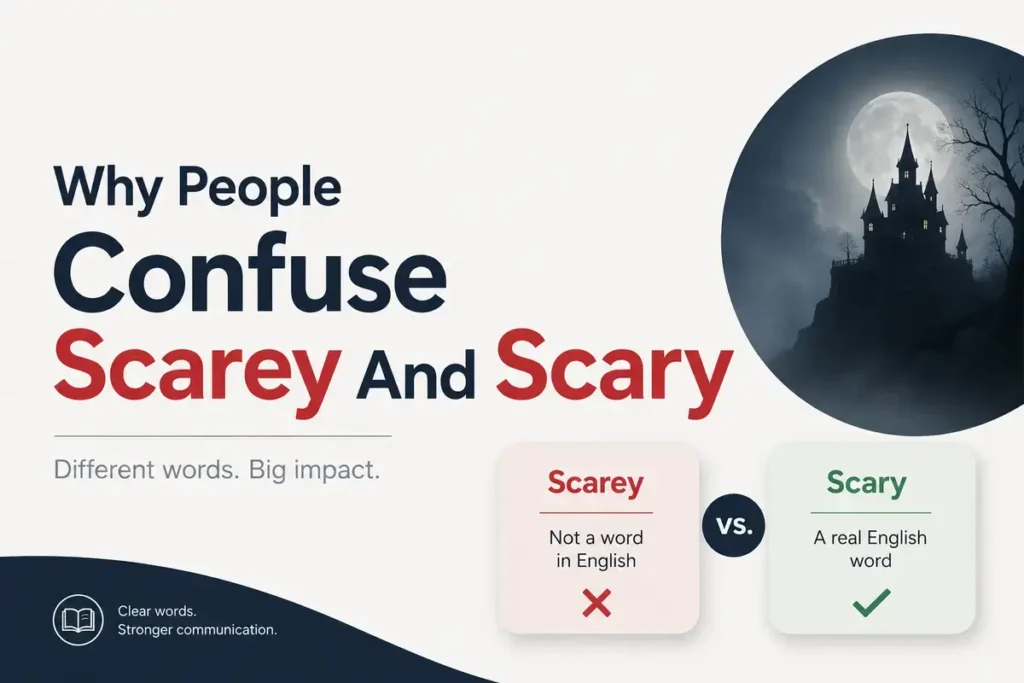
The confusion between scarey and scary is easy to understand. The mistake isn’t caused by pronunciation. It comes from spelling patterns that seem logical at first glance.
Here are the main reasons people get it wrong.
The Base Word Ends With E
People know the word scare, so they naturally expect the e to stay when another ending is added.
English doesn’t follow that pattern here.
The silent e is dropped, giving us scary.
Both Spellings Look Plausible
If you’ve never checked a dictionary, scarey looks believable.
Many English learners write it because it appears to match the spelling of the root word.
Typing Mistakes
Fast typing is another reason.
Adding the extra e is a common keyboard mistake, especially on phones and tablets.
Social Media
Social media posts often contain spelling mistakes that spread quickly.
Seeing scarey online doesn’t make it correct.
Internet Myths
Some websites claim scarey is an accepted alternative.
Modern dictionaries and professional style guides recognize scary as the standard spelling.
Still confused? Compare Choosing or Chosing Which Spelling Is Correct 2026.
Key Differences Between Scarey And Scary
| Feature | Scary | Scarey |
|---|---|---|
| Spelling | Correct | Incorrect |
| Dictionary status | Standard English | Misspelling |
| Grammar | Adjective | Not a standard English word |
| Formal writing | Accepted | Not accepted |
| School writing | Correct | Incorrect |
| Professional writing | Correct | Incorrect |
| Everyday English | Common | Usually a typo |
The difference is simple.
Only scary belongs in modern English writing.
Word Origin And History
Understanding where scary comes from makes the spelling easier to remember.
The word comes from the verb scare, which has been part of English for hundreds of years.
As English developed, speakers created the adjective scary to describe something that causes fear.
Over time, scary became the accepted spelling across dictionaries, books, newspapers, and schools.
Although scarey appeared occasionally in older publications, it never became the standard form.
Today, professional editors treat scarey as a spelling error.
British American Canadian And Australian English
This is one spelling question with a simple answer.
All major English speaking countries use scary.
That includes.
- American English.
- British English.
- Canadian English.
- Australian English.
- New Zealand English.
No regional variety treats scarey as the preferred spelling.
If you’re writing for an international audience, scary is always the correct choice.
Real Life Examples
Seeing the word in everyday situations helps it become second nature.
Daily Conversation
- That thunderstorm was scary.
- The haunted house looked scary from outside.
- Don’t tell such scary stories before bedtime.
- The roller coaster looked scary at first.
Workplace
- Losing all the project files would be scary.
- The manager handled the scary situation calmly.
- It was a scary week for the entire team.
Emails
- That sounds scary, but we’ll solve it together.
- The system failure looked scary at first, but the backup worked.
School And Academic Writing
- The novel includes several scary scenes.
- Students described the experiment as scary but exciting.
- The character faced a scary challenge with courage.
Journalism
- Residents reported a scary explosion during the storm.
- Witnesses described the accident as scary.
Social Media
- That was the scariest prank I’ve ever seen.
- This movie is so scary I couldn’t finish it.
- Your ghost story was seriously scary.
Literature
- A scary shadow moved across the wall.
- The forest became scary after sunset.
- Every chapter ended with a scary surprise.
These examples show that scary works naturally in both casual and formal English.
Common Mistakes
Professional editors notice the same mistakes again and again.
Keeping The Extra E
Incorrect.
✘ The movie was scarey.
Correct.
✔ The movie was scary.
Thinking Both Spellings Are Accepted
Some writers believe both spellings are correct.
Only scary is accepted in standard English.
Mixing Up Scary And Scared
These words have different meanings.
Scary describes something that causes fear.
Scared describes how someone feels.
Correct examples.
✔ The clown looked scary.
✔ The child felt scared.
Incorrect example.
✘ The child felt scary.
Using Scarey In Formal Writing
Using scarey in school papers, business emails, articles, or professional documents creates a spelling error.
Always proofread for this mistake before publishing.
Easy Memory Tricks
A simple trick can save you from making this mistake again.
Think About Similar Words
Notice how these words lose the silent e.
- Scare becomes scary.
- Taste becomes tasty.
- Ice becomes icy.
The pattern stays consistent.
Remember The Family Of Words
Think of the complete word family.
Scare.
Scary.
Scarier.
Scariest.
None of these words bring the extra e back.
One Simple Question
Before writing, ask yourself this.
Does the word describe something that causes fear?
If the answer is yes, write scary without the extra e.
Related Words
Expanding your vocabulary helps you choose more precise words.
Synonyms
- Frightening.
- Terrifying.
- Creepy.
- Eerie.
- Chilling.
- Alarming.
- Spooky.
- Horrifying.
Opposites
- Safe.
- Calm.
- Comforting.
- Pleasant.
- Peaceful.
Related Words
- Scare.
- Scared.
- Scaring.
- Fear.
- Fright.
- Terror.
- Horror.
- Panic.
Expert Editor’s Note
Professional editors, dictionary publishers, and English teachers agree on one point. Scary is the only correct spelling in modern English.
Major dictionaries list scary as the standard adjective that means causing fear or making someone feel frightened. The spelling scarey is treated as a spelling mistake rather than an accepted variation.
When proofreading, editors automatically replace scarey with scary. This applies to academic papers, business documents, blog posts, books, and everyday writing.
If your goal is clear, polished English, always choose scary.
Frequently Asked Questions
Is Scarey Or Scary Correct?
Scary is the correct spelling. Scarey is a misspelling and should not be used in standard English. Every major dictionary and style guide recommends scary.
Why Do People Spell Scary As Scarey?
Most people keep the extra e because the base word is scare. English spelling drops the silent e before adding y, which creates the correct form scary.
Is Scarey Ever Correct?
No. Modern English does not recognize scarey as the standard spelling. You might find it in old texts or online typing mistakes, but professional writing always uses scary.
Is Scary A Noun Or An Adjective?
Scary is an adjective. It describes a person, place, thing, or situation that causes fear.
Example.
The abandoned house looked scary.
What Is The Comparative Form Of Scary?
The comparative form is scarier, and the superlative form is scariest.
Examples.
This movie is scarier than the first one.
That was the scariest experience of my life.
Is Scary Used In American And British English?
Yes. Scary is the correct spelling in American English, British English, Canadian English, Australian English, and other major varieties of English.
What Is Another Word For Scary?
Several words have a similar meaning, including frightening, terrifying, creepy, eerie, spooky, alarming, chilling, and horrifying. Choose the word that best matches the level of fear you want to express.
Many readers also check Until Or Untill Which Spelling Is Correct 2026 Guide.
Conclusion
The answer to scarey or scary is straightforward.
Scary is the correct spelling. Scarey is a common misspelling that should be avoided in every type of writing.
The confusion happens because the base word scare ends with e, but English spelling rules drop the silent e before adding y.
If you remember that simple rule, you’ll never hesitate again.
The next time you describe a frightening movie, a spooky story, or a creepy place, write scary with confidence. It’s the spelling native speakers, dictionaries, and professional editors expect every time.

Editorial Reviewer & Proofreader
Grace Mitchell reviews Gramlify’s articles for clarity, consistency, and readability. She is passionate about creating accurate, approachable content that helps English learners build confidence.
1 thought on “Scarey Or Scary Which Spelling Is Correct 2026 Guide”