
Have you ever paused while writing because you couldn’t decide between wack or whack? You’re not alone. These two words look similar and sound exactly alike, which makes them easy to confuse. On top of that, both appear in everyday conversations, music, movies, and social media. Still, they don’t always mean the same thing.
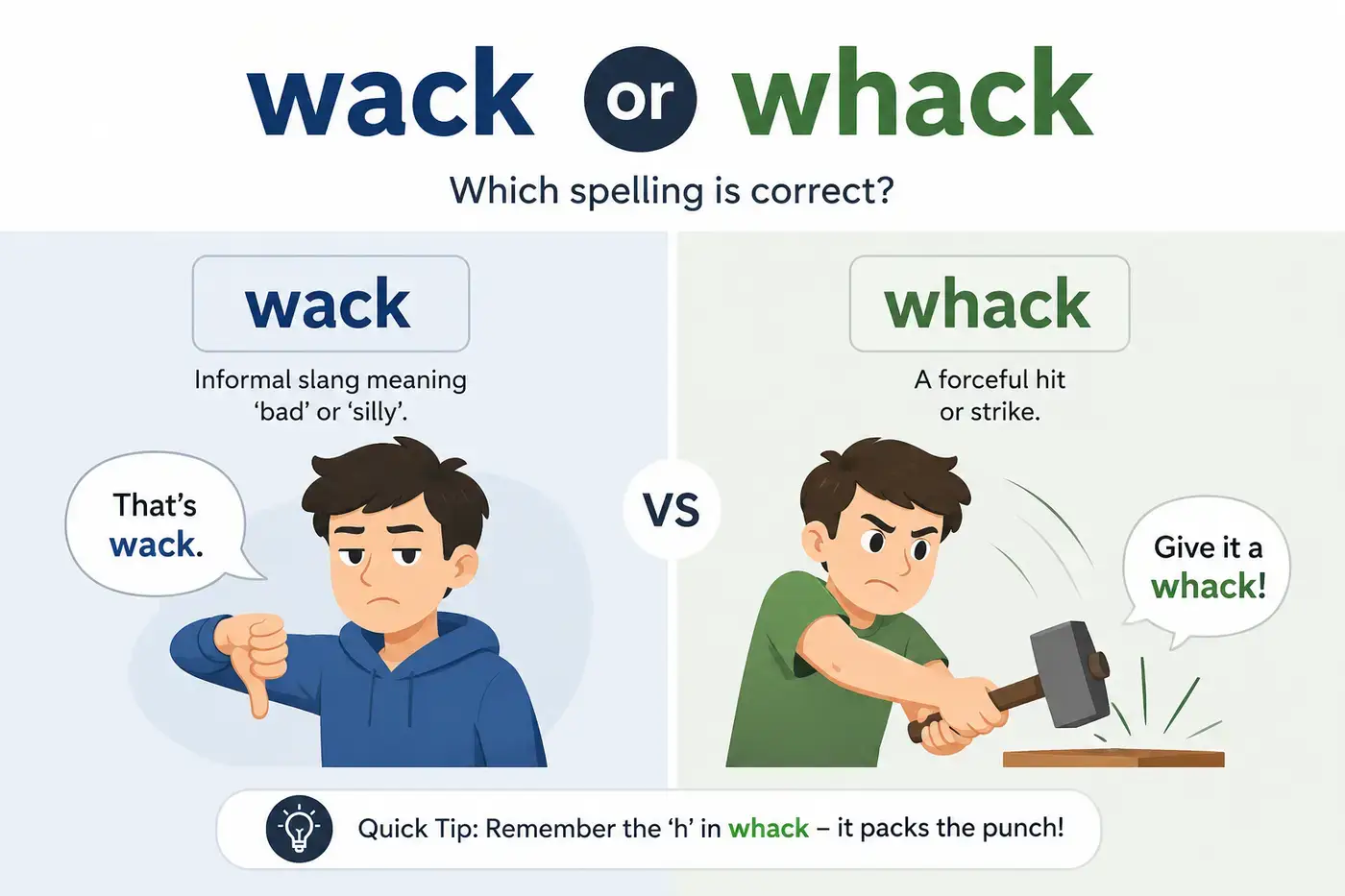
The short answer is simple. Whack is the standard English spelling recognized by dictionaries. It can work as a verb, noun, adjective, or interjection, depending on the sentence. Wack is an informal slang spelling that usually means bad, boring, strange, or poor in quality. It became popular through hip hop culture and internet slang, but it is not the preferred spelling in formal writing.
Knowing the difference helps you choose the right word for emails, school assignments, professional writing, and casual conversations. In this guide, you’ll learn the meaning of each word, when to use them, why people confuse them, and how native English speakers use both naturally.
Still confused? Compare Bougie Or Boujee Which Spelling Is Correct(2026 Guide).
Quick Answer
Whack is the standard English word and the correct choice in formal writing. It commonly means to hit something or describes something unusual or unfair. Wack is an informal slang spelling that usually means bad, uncool, disappointing, or low quality. Use whack in professional writing and wack only in casual contexts where slang fits.
Wack Or Whack Comparison Table
| Feature | Wack | Whack |
|---|---|---|
| Standard dictionary spelling | No | Yes |
| Part of speech | Informal adjective | Verb noun adjective interjection |
| Meaning | Bad uncool poor quality | Hit strike unusual unfair |
| Formal writing | Not recommended | Recommended |
| Informal conversation | Common | Very common |
| Social media | Very common | Common |
| Grammar status | Slang | Standard English |
| Example | That movie was wack. | He gave the ball a whack. |
What Does Wack Mean
Wack is an informal slang word used to describe something as bad, disappointing, boring, ridiculous, or low quality.
It became popular through hip hop culture during the late twentieth century and is now widely used in casual American English. Although many people recognize it, wack is still considered slang. Most dictionaries label it as informal, so it should not appear in professional or academic writing unless you are quoting someone.
Simple Definition
Wack means bad, uncool, disappointing, or not impressive.
When People Use Wack
People often use wack to criticize a person, event, idea, performance, or product.
Examples.
- That game was wack.
- His excuse sounds wack.
- The restaurant served a wack meal.
- That joke was wack and nobody laughed.
- The ending of the movie felt wack.
Wack In Different Contexts
Daily conversation.
That party was wack.
Social media.
This update is wack.
Text messages.
Your internet connection is wack today.
Because wack is slang, avoid using it in business emails, reports, academic papers, or other formal documents.
What Does Whack Mean
Whack is a standard English word with several meanings. Depending on the sentence, it can function as a verb, noun, adjective, or interjection.
Its oldest and most common meaning is to hit something with force. Over time, native speakers also began using it to describe something odd, unfair, or unusual.
Whack As A Verb
As a verb, whack means to hit or strike something hard.
Examples.
- He whacked the baseball over the fence.
- She whacked the pillow to remove the dust.
- The golfer whacked the ball across the fairway.
- Don’t whack the table.
- He accidentally whacked his head on the shelf.
Whack As A Noun
As a noun, whack means a strong hit or blow.
Examples.
- He gave the door a whack.
- One whack broke the branch.
- The mechanic fixed it with a careful whack.
Whack As An Adjective
In informal English, whack can describe something strange, unfair, or unreasonable.
Examples.
- That’s a whack rule.
- The referee made a whack decision.
- Their explanation sounded whack.
This informal adjective overlaps with the slang meaning of wack, but whack remains the standard spelling accepted by dictionaries.
Which One Is Correct
The correct answer depends on what you mean.
Choose whack if you’re writing standard English. It is the accepted dictionary spelling and works in both formal and informal writing.
Choose wack only when you intentionally want to use slang to describe something as bad, uncool, or disappointing.
A quick test makes the choice easier.
Use whack if you mean hit, strike, blow, odd, or unfair.
Use wack if you mean bad, boring, poor quality, or uncool in casual speech.
Compare these examples.
✔ He whacked the ball into the yard.
✔ Your excuse sounds wack.
✘ He wacked the ball across the field.
✘ She gave the table a wack.
Those last two examples are incorrect because the standard English word for hitting something is whack, not wack.
Why People Confuse Wack And Whack
It is easy to see why wack or whack creates confusion. The words sound exactly the same, share similar spellings, and often appear in casual conversations. Many people also see both spellings online without realizing they have different meanings and different levels of acceptance.
Here are the main reasons people mix them up.
They Sound Identical
Both words are pronounced the same way.
When you hear them in conversation, you cannot tell which spelling the speaker intends. Only the surrounding sentence reveals the meaning.
Similar Spelling
The only visible difference is the letter h.
That single letter changes the word from a standard English spelling to an informal slang spelling.
Social Media Influence
Social media has made wack much more common than it was years ago.
People regularly post comments like these.
- That update is wack.
- This movie is wack.
- Your excuse is wack.
Seeing the slang spelling repeatedly leads many writers to believe it is always the correct choice.
Music And Hip Hop Culture
The slang word wack became popular through hip hop culture during the nineteen eighties and nineteen nineties.
Many songs and interviews use wack to describe something disappointing or low quality. That popularity helped spread the spelling far beyond its original audience.
Autocorrect And Spell Check
Most spell checkers recognize whack as the standard spelling.
Some also recognize wack because modern dictionaries include it as slang. As a result, writers may assume both words are interchangeable even though they are not.
Key Differences Between Wack And Whack
| Feature | Wack | Whack |
|---|---|---|
| Meaning | Bad boring poor quality | Hit strike odd unfair |
| Grammar | Informal adjective | Verb noun adjective interjection |
| Formal writing | Avoid | Recommended |
| Slang | Yes | Sometimes |
| Dictionary status | Slang entry | Standard English |
| Common use | Casual speech social media | Everyday English formal and informal writing |
The easiest way to remember the difference is this.
Use whack when talking about hitting something or writing standard English.
Use wack when describing something as bad or uncool in casual conversation.
Grammar Explanation
The grammar difference becomes much clearer once you see how each word functions.
Wack Is Usually An Adjective
An adjective describes a person place thing or idea.
Examples.
- That concert was wack.
- His explanation sounds wack.
- The game became wack after halftime.
Because wack is slang, it rarely appears in professional writing.
Whack Can Be Several Parts Of Speech
Unlike wack, whack is much more flexible.
As A Verb
It means to hit something.
Examples.
- She whacked the ball into the garden.
- He whacked the mosquito.
- Don’t whack the keyboard.
As A Noun
It means a hit or blow.
Examples.
- One whack knocked the branch loose.
- The carpenter gave it another whack.
As An Adjective
It can describe something unusual, unreasonable, or unfair.
Examples.
- That’s a whack excuse.
- Their decision seems whack.
Professional editors still recommend using words like unfair, odd, or strange in formal writing because they sound more precise.
Spelling Rule
There is no spelling rule that turns whack into wack.
The missing h is not a British spelling, an American spelling, or a grammar variation.
Instead, wack developed as a slang spelling with its own meaning.
Think of it this way.
Whack belongs in dictionaries as standard English.
Wack belongs in informal speech and slang.
Still confused? Compare Camisole Meaning Slang Explained Clearly(2026 Guide).
Pronunciation Guide
One reason people confuse these words is that they share exactly the same pronunciation.
Wack
IPA
American English
/wæk/
Syllables
One.
Whack
IPA
American English
/wæk/
Syllables
One.
Stress Pattern
Both words receive full stress because each has only one syllable.
Common Pronunciation Mistake
There is no pronunciation difference between wack and whack.
Native speakers rely on context to understand which word is intended.
Word Origin
The two words have different histories.
Origin Of Whack
Whack appeared in English several centuries ago.
It originally referred to a sharp blow or strike. Over time, English speakers expanded its meaning to include ideas such as something unusual, unfair, or ridiculous.
Origin Of Wack
Wack developed much later as American slang.
It gained popularity through hip hop culture, where it described something poor, fake, disappointing, or lacking skill.
Today many dictionaries recognize wack as slang, but they still identify whack as the standard English spelling.
British American Canadian And Australian English
The distinction remains almost the same across major English speaking countries.
American English
Both whack and wack appear in everyday speech.
Whack is standard English.
Wack is slang.
British English
British speakers commonly use whack.
The slang spelling wack appears much less often and is usually influenced by American media.
Canadian English
Canadian English follows the same pattern as American English.
Australian English
Australians recognize whack as the standard spelling.
You may also hear wack among younger speakers who use American slang online.
Real Life Examples
These examples show how native speakers naturally use both words.
Daily Conversation
- That pizza was wack.
- He whacked the baseball over the fence.
- Your excuse sounds wack.
- Give the rug a good whack.
Workplace
- The proposal was not wack. It simply needed more detail.
- Someone accidentally whacked the office printer.
- The meeting felt wack after the presentation ended early.
- Be careful not to whack the monitor.
Emails
- Please avoid using slang like wack in client emails.
- Someone whacked the package during shipping.
Academic Writing
- Formal writing should avoid slang terms like wack.
- The article explained how whack developed several meanings over time.
Journalism
- Critics called the performance wack on social media.
- Witnesses reported hearing a loud whack before the glass shattered.
Social Media
- That challenge is wack.
- This update is totally wack.
- The bat gave the ball one clean whack.
- His latest video is anything but wack.
Everyday Writing
- Don’t whack the keyboard when you’re frustrated.
- Calling every bad movie wack gets repetitive. Use more specific words when you can.
Common Mistakes
Many writers understand the meanings of wack and whack but still use the wrong spelling. Here are the mistakes editors notice most often.
Using Wack Instead Of Whack
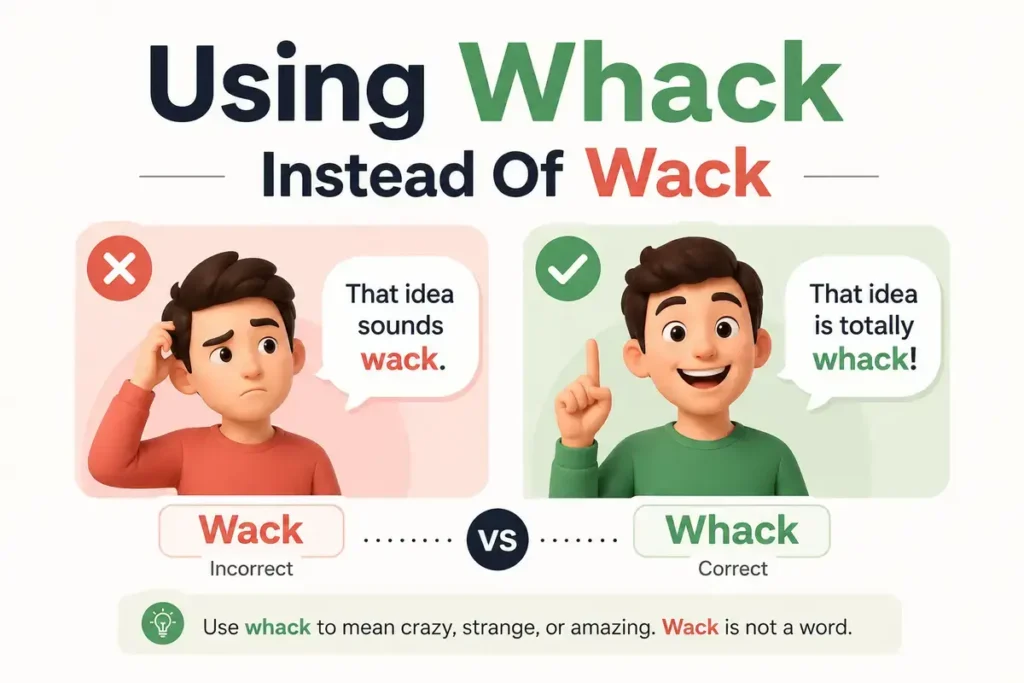
Incorrect.
He wacked the ball into the yard.
Correct.
He whacked the ball into the yard.
Why?
The standard English verb is whack. The past tense is whacked.
Using Whack Instead Of Wack
Incorrect.
That movie was whack.
Correct.
That movie was wack.
Why?
When you mean bad, disappointing, or uncool in slang, wack is the usual spelling. Even though some dictionaries accept whack as an informal adjective, wack is far more common for this meaning.
Using Wack In Professional Writing
Avoid sentences like these.
The proposal was wack.
The presentation looked wack.
Instead write.
The proposal was weak.
The presentation was disappointing.
Choosing precise words makes your writing stronger and more professional.
Thinking Wack Is A Standard Spelling
Many people assume wack is simply another spelling of whack.
It is not.
Whack is standard English.
Wack is informal slang.
Memory Tricks
These simple tricks make the difference easy to remember.
Remember The Letter H
The H in whack reminds you of hit.
If someone hits something, choose whack.
Think About Slang
If you are describing something as bad or uncool in casual conversation, wack is probably the word you want.
Ask Yourself One Question
Are you talking about hitting something?
Use whack.
Are you criticizing something in slang?
Use wack.
That quick check solves almost every mistake.
Related Words
Learning related words helps you expand your vocabulary.
Synonyms For Wack
- Bad.
- Weak.
- Boring.
- Disappointing.
- Lame.
- Poor.
Synonyms For Whack
As A Verb.
- Hit.
- Strike.
- Smack.
- Knock.
- Slam.
As An Adjective.
- Odd.
- Strange.
- Unfair.
- Ridiculous.
- Absurd.
Related Words
- Smack.
- Punch.
- Strike.
- Beat.
- Hit.
- Weak.
- Awful.
- Terrible.
- Strange.
- Weird.
Expert Editor’s Note
Professional editors almost always choose whack in standard English because it is the accepted dictionary spelling.
Use wack only when writing dialogue, quoting someone, or creating casual content where slang sounds natural.
If your audience includes students, clients, teachers, or business professionals, replacing wack with a more specific adjective usually improves clarity.
Good writing is not about using trendy words. It is about choosing the right word for the situation.
Frequently Asked Questions
Is It Wack Or Whack?
Both words exist, but they are not interchangeable. Whack is the standard English spelling. Wack is informal slang that usually means bad, boring, or low quality.
Is Wack A Real Word?
Yes. Modern dictionaries recognize wack as an informal slang word. It is common in casual American English but is not recommended for formal writing.
Can I Use Wack In School Essays?
It is better to avoid it. Teachers and editors usually expect standard English in academic writing. Choose words like poor, weak, disappointing, or unsatisfactory instead.
Why Do Wack And Whack Sound The Same?
They are homophones, which means they share the same pronunciation but have different spellings and meanings. Context tells readers which word is intended.
Is Whack Only A Verb?
No. Whack can be a verb, noun, adjective, or interjection. It is one of the reasons the word appears in many different types of sentences.
Which Spelling Is More Common?
Whack is more common in dictionaries, books, newspapers, and professional writing. Wack appears mostly in slang, music, online conversations, and social media.
Is Wack Used Outside The United States?
Yes. People in Canada, Australia, and the United Kingdom recognize it, mainly through American music, movies, and social media. It is still considered informal slang.
You may also want to read Blankie Or Blanky Which Spelling Is Correct 2026.
Conclusion
The answer to wack or whack depends on your meaning and your audience.
Use whack when you mean to hit something or when writing standard English. It is the correct spelling for formal and everyday writing.
Use wack only as informal slang to describe something as bad, disappointing, or uncool.
The biggest mistake is treating the two words as interchangeable. They are related in sound but different in spelling, meaning, and usage.
When in doubt, choose whack. It is the safer option and the one professional editors recommend most often.

Vocabulary & Language Research Writer
Ethan Parker researches English vocabulary, word meanings, slang, idioms, and commonly confused words. His goal is to help readers understand how English is actually used in everyday conversations and writing.
1 thought on “Wack Or Whack Which Word Is Correct 2026 Guide”