
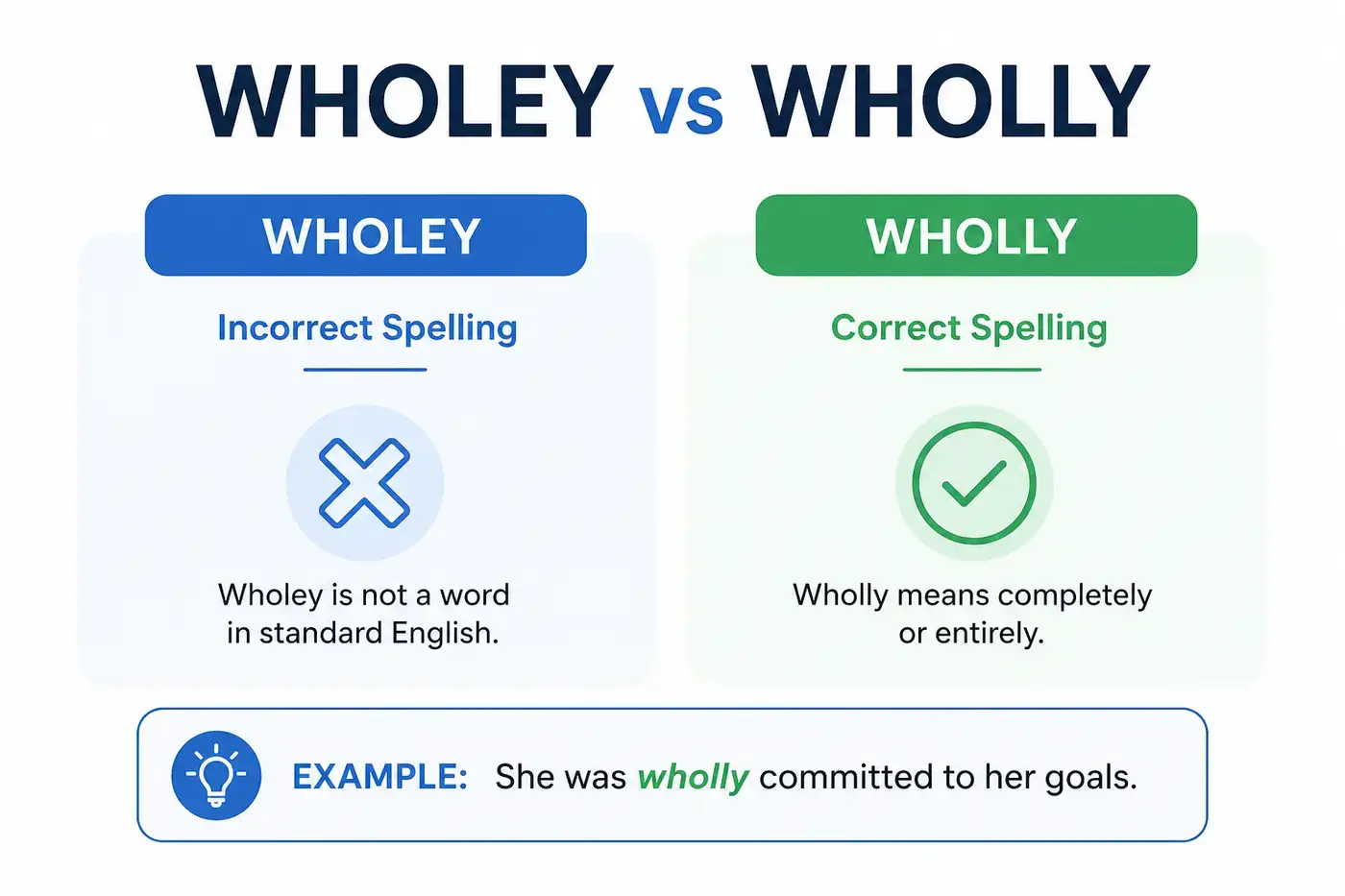
If you’ve searched for wholey vs wholly, you’re probably trying to figure out which spelling is correct. The good news is that the answer is simple. Wholly is the standard English spelling. Wholey is almost always a misspelling unless it appears as part of a proper name, brand, or surname.
The confusion is understandable. Both words look similar, and spellcheck tools do not always explain why one form is correct. Some people also assume that wholey comes from the word whole, so it must be acceptable. In standard English, that is not the case.
Understanding the difference matters because wholly appears in academic writing, business emails, journalism, books, and everyday conversation. Using the wrong spelling can make your writing look less polished.
In this guide, you’ll learn the meaning of wholly, why wholey is usually incorrect, the grammar behind the spelling, real world examples, common mistakes, pronunciation tips, and practical memory tricks. By the end, you’ll know exactly which spelling to use with confidence.
For another common grammar confusion, see Enrol Or Enroll Which Spelling Is Correct 2026.
Quick Answer
Wholly is the correct spelling in standard English. It means completely, entirely, or fully. Wholey is not a standard English word and is generally considered a spelling mistake unless it is part of a proper noun such as a company name or family name.
Wholey Vs Wholly Comparison Table
| Feature | Wholey | Wholly |
|---|---|---|
| Standard English word | No | Yes |
| Correct spelling | No | Yes |
| Part of speech | Not applicable | Adverb |
| Meaning | None in standard English | Completely entirely fully |
| Common use | Proper names only | Everyday and formal English |
| Dictionary entry | No | Yes |
| Formal writing | Incorrect | Correct |
| Informal writing | Usually incorrect | Correct |
| Example | Wholey Foods Company. Proper name. | I wholly agree with your decision. |
What Does Wholly Mean
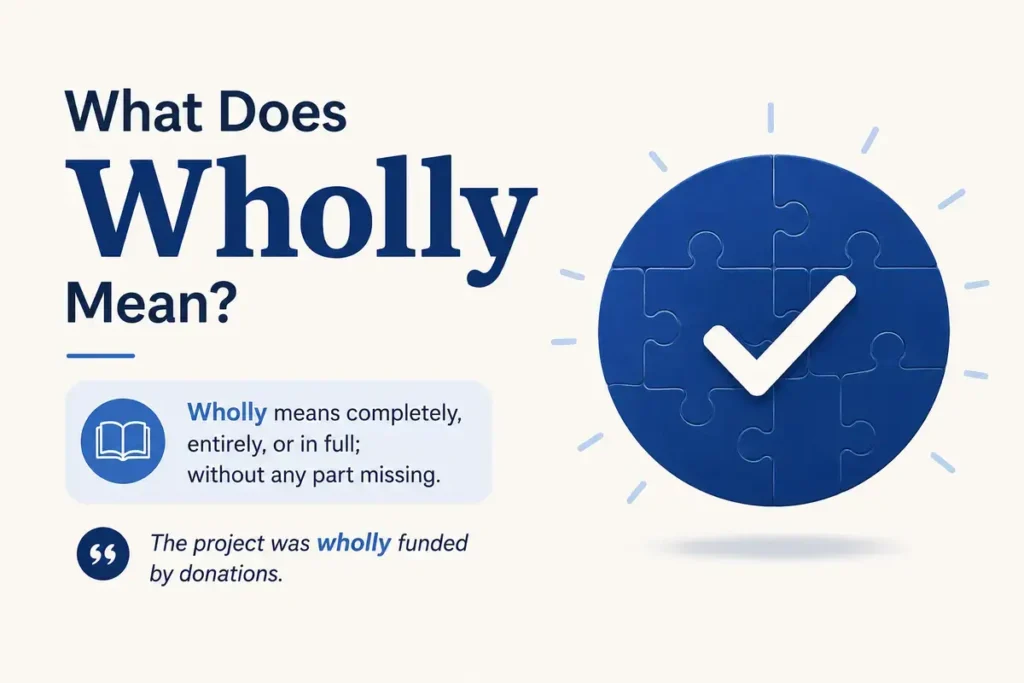
Wholly is an adverb that means completely, entirely, or fully.
Writers use it to show that something is complete without exceptions.
Simple Definition
Wholly means completely or to the fullest extent.
How Wholly Is Used
You can use wholly to describe agreement, responsibility, ownership, support, commitment, or completeness.
Examples.
- I wholly agree with your decision.
- She was wholly responsible for the project.
- The report is wholly accurate.
- They are wholly committed to customer service.
- His explanation was wholly convincing.
Wholly In Different Contexts
Daily conversation.
I’m wholly satisfied with the results.
Workplace.
The proposal is wholly based on customer feedback.
Business email.
We wholly support your recommendation.
Academic writing.
The evidence does not wholly support the theory.
Journalism.
The organization is wholly owned by the parent company.
What Does Wholey Mean
In standard English, wholey is not a recognized dictionary word.
If you use wholey when you mean completely, your spelling is incorrect.
There are a few exceptions.
Proper Names
You may see Wholey used as part of a business name, product name, or surname.
Examples.
- Wholey is the family’s last name.
- The company chose Wholey as its brand name.
These are proper nouns, so the spelling is intentional.
Outside those situations, you should choose wholly.
Which One Is Correct
The correct spelling is wholly.
Use wholly any time you want to say completely, entirely, or fully.
Examples.
✔ I wholly understand your concern.
✔ The report is wholly accurate.
✔ The building is wholly owned by the university.
Do not replace wholly with wholey in normal writing.
Incorrect examples.
✘ I wholey agree with your opinion.
✘ The project was wholey successful.
✘ We are wholey prepared for the meeting.
Each sentence becomes correct by changing wholey to wholly.
Why People Confuse Wholey And Wholly
The mistake is surprisingly common because the words look almost identical.
Several factors contribute to the confusion.
The Word Whole
Many writers connect wholly with whole and naturally expect the spelling to stay the same.
English does not follow that pattern here.
Similar Pronunciation
Both spellings would sound almost identical if spoken aloud.
Because of that, many people spell the word from memory instead of remembering the standard spelling.
Fast Typing
The letters e and l sit close together on a keyboard. Fast typing often leads to accidental spelling mistakes.
Autocorrect And Search Habits
People frequently search for wholey vs wholly after seeing the incorrect spelling online or noticing that spellcheck marked it as an error.
The internet has also spread the mistake through blogs, comments, and social media posts, making it appear more common than it really is.
Key Differences Between Wholey And Wholly
| Feature | Wholey | Wholly |
|---|---|---|
| English dictionary word | No | Yes |
| Meaning | None in standard English | Completely entirely fully |
| Part of speech | Not applicable | Adverb |
| Appropriate for writing | No | Yes |
| Found in proper names | Yes | Rarely |
| Recommended by editors | No | Yes |
The easiest way to remember the difference is simple.
If you mean completely, always write wholly.
If you see Wholey, check if it is a person’s name or a business name. In almost every other situation, it is a spelling mistake.
Grammar Explanation
Understanding the grammar behind wholly makes the correct spelling much easier to remember.
Wholly Is An Adverb
Wholly is an adverb. An adverb modifies a verb, adjective, or another adverb.
It tells us the degree or extent of something.
Examples.
- I wholly agree with your opinion.
- She was wholly responsible for the mistake.
- The explanation was wholly convincing.
- They were wholly unaware of the changes.
In each sentence, wholly strengthens the meaning by showing something is complete or total.
Wholey Is Not A Standard Part Of Speech
Since wholey is not a standard English word, it has no accepted grammatical role.
If you use it in a sentence, the spelling is incorrect unless it is part of a proper name.
Incorrect.
I wholey support your decision.
Correct.
I wholly support your decision.
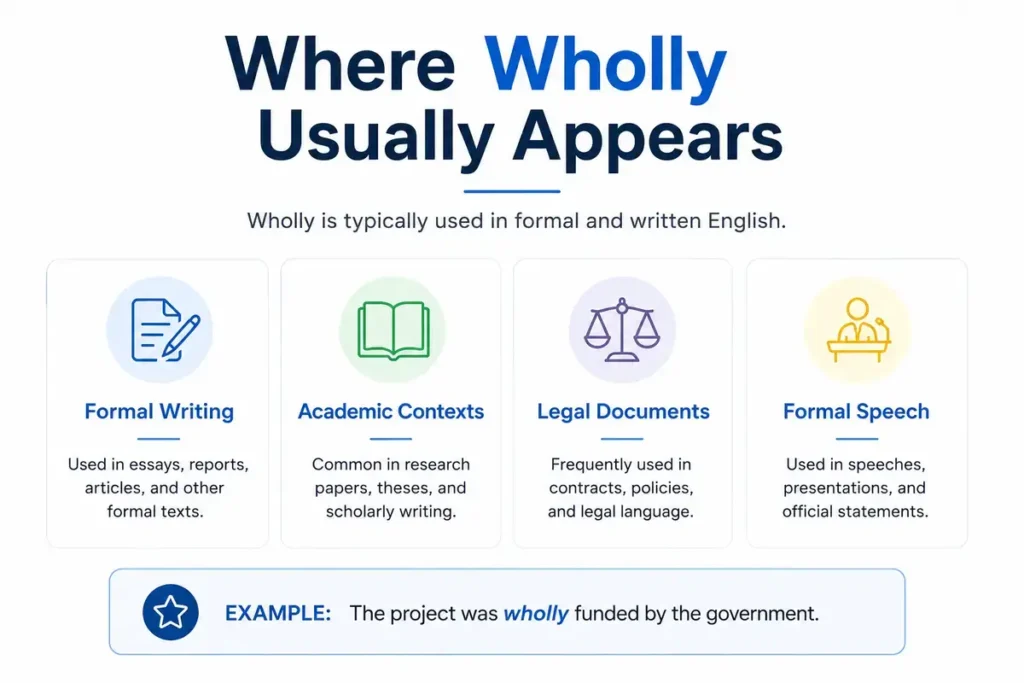
Where Wholly Usually Appears
You’ll often find wholly before adjectives and past participles.
Examples.
- Wholly different.
- Wholly owned.
- Wholly independent.
- Wholly unacceptable.
- Wholly unexpected.
These combinations are common in both everyday and professional writing.
Spelling Rule Behind Wholly
Many learners wonder why the spelling changes from whole to wholly.
The answer comes from English spelling patterns.
The adjective is whole.
When it becomes the adverb wholly, the final e is dropped before adding ly.
Examples.
- Whole becomes wholly.
- True becomes truly.
- Due becomes duly.
English often removes the silent e before adding ly to create an adverb.
This spelling has been standard for centuries.
Many readers also check Transferred Or Transfered Which Spelling Is Correct 2026 Guide.
Pronunciation Guide
Even though the spellings look different, pronunciation does not explain the confusion.
Wholly
IPA
American English.
/ˈhoʊl.li/
Syllables
Whol ly.
Stress
The first syllable receives the primary stress.
Wholey
If someone reads wholey aloud, it would usually sound almost the same as wholly.
Because both spellings sound alike, many people accidentally choose the wrong one while writing.
The mistake comes from spelling, not pronunciation.
Word Origin And History
The history of wholly explains why its spelling seems unusual today.
The adjective whole comes from Old English and originally meant healthy, complete, or entire.
Later, English added the ly ending to create the adverb wholly, meaning completely or entirely.
Over hundreds of years, the spelling settled into its modern form.
Although whole kept the silent e, wholly dropped it before adding ly.
This spelling is now accepted by every major English dictionary and style guide.
British American Canadian And Australian English
There is no regional difference between wholly and wholey.
English speakers in the United States, the United Kingdom, Canada, Australia, and New Zealand all use wholly as the correct spelling.
The meaning also stays the same across these countries.
Examples.
- The company is wholly owned by the government.
- I wholly appreciate your help.
- The proposal is wholly original.
No major English variety accepts wholey as the standard spelling.
Real Life Examples
Seeing the word in different situations helps it become natural.
Daily Conversation
- I wholly understand your point.
- She is wholly committed to her family.
- We are wholly prepared for the trip.
- He was wholly surprised by the news.
Workplace
- The team is wholly focused on customer satisfaction.
- This decision is wholly supported by management.
- The report is wholly accurate.
- We are wholly responsible for meeting the deadline.
Business Emails
- We wholly appreciate your patience.
- Our company wholly supports this initiative.
- I wholly agree with your recommendation.
- The proposal is wholly consistent with company policy.
Academic Writing
- The evidence does not wholly explain the results.
- The findings are not wholly unexpected.
- The conclusion is wholly supported by the research.
Journalism
- The factory is wholly owned by a local company.
- Officials were not wholly satisfied with the outcome.
- Experts were wholly united in their recommendation.
Social Media
- I’m wholly obsessed with this book.
- That movie was wholly worth watching.
- I’m not wholly convinced yet.
- She’s wholly dedicated to helping others.
These examples show that wholly fits naturally in both formal and informal English.
Common Mistakes People Make
Many spelling mistakes happen because whole is such a familiar word. People naturally expect the adverb to keep the same spelling, but English follows a different pattern.
Here are the mistakes editors see most often.
Writing Wholey Instead Of Wholly
Incorrect.
I wholey support your decision.
Correct.
I wholly support your decision.
The word wholey is not accepted in standard English.
Confusing Whole With Wholly
Some writers use whole when they need the adverb.
Incorrect.
I whole agree with your idea.
Correct.
I wholly agree with your idea.
Remember that whole is usually an adjective, while wholly is an adverb.
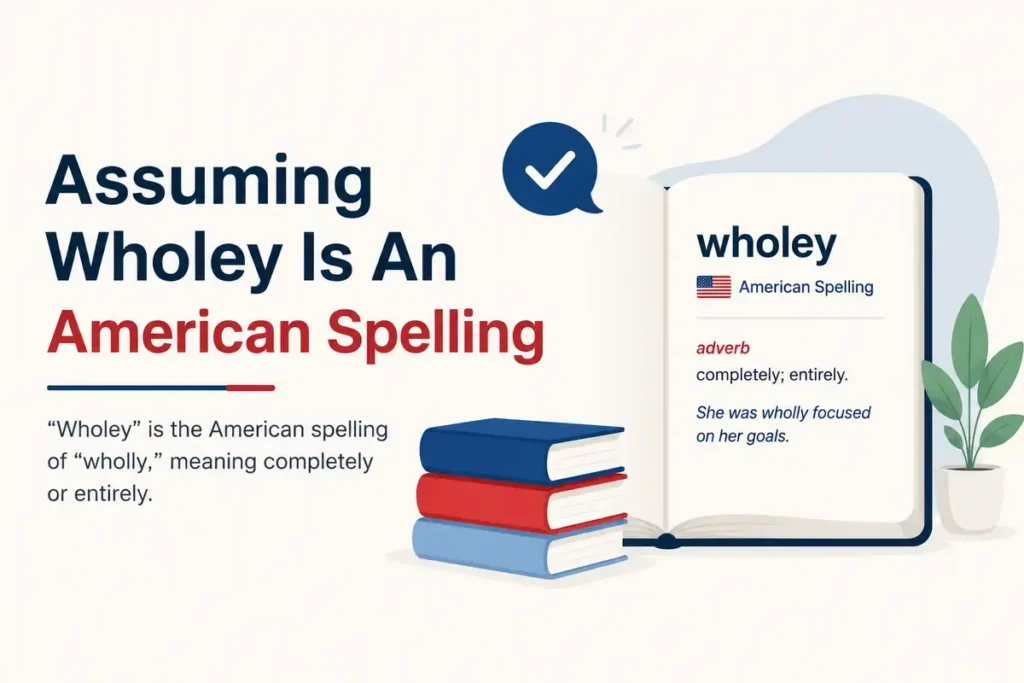
Assuming Wholey Is An American Spelling
This is another common myth.
American English, British English, Canadian English, and Australian English all use wholly. There is no regional spelling called wholey.
Forgetting To Drop The Silent E
Many learners simply add ly to whole and end up with wholely or wholey.
English drops the silent e before adding ly, giving us wholly.
Easy Memory Tricks
A simple memory trick can save you from making this mistake.
Think Of Fully
Both fully and wholly end with lly.
They also have similar meanings.
If you remember fully, you’ll find it easier to remember wholly.
Remember The Silent E Rule
The word whole loses its final e before ly is added.
Whole becomes wholly.
True becomes truly.
Due becomes duly.
The same spelling pattern appears in several common English words.
Replace It With Completely
If completely fits your sentence, wholly is almost certainly the correct choice.
Example.
I completely agree.
I wholly agree.
Both sentences have nearly the same meaning.
Related Words And Similar Expressions
Learning related vocabulary makes your writing stronger.
Synonyms For Wholly
- Completely.
- Entirely.
- Fully.
- Totally.
- Absolutely.
- Entirely.
- Perfectly.
Related Words
- Whole.
- Entire.
- Complete.
- Total.
- Entirely.
- Fully.
- Completely.
- Altogether.
Opposites
- Partly.
- Partially.
- Somewhat.
- Incompletely.
- Moderately.
Frequently Confused Words
- Whole and hole.
- Whole and wholly.
- Entire and entirely.
- Total and totally.
- Complete and completely.
Understanding these word pairs helps you avoid several common writing mistakes at once.
Expert Editor’s Note
Professional editors consistently recommend wholly in every type of standard writing.
Major dictionaries, grammar references, and style guides recognize wholly as the only correct spelling when you mean completely or entirely.
If an editor sees wholey in an article, email, report, or assignment, it will almost always be corrected to wholly unless it refers to a person’s name or a brand.
When proofreading, always check words ending in ly because they are among the most common spelling errors in English.
Frequently Asked Questions
Is Wholey A Real Word?
Not in standard English. Wholey is generally considered a misspelling. You may see it as a surname or business name, but it should not replace wholly in normal writing.
Is Wholly Correct In American English?
Yes. Wholly is the standard spelling in American English. The same spelling is also used in British, Canadian, Australian, and New Zealand English.
What Does Wholly Mean?
Wholly means completely, entirely, or fully. It describes something that is total or without exception.
Why Is Wholly Spelled With Double L?
The spelling developed over time as English formed the adverb from whole. Although the silent e disappears, the accepted spelling became wholly, and dictionaries continue to recognize this form.
Can I Use Completely Instead Of Wholly?
Yes. In many sentences, completely and wholly have similar meanings. The best choice depends on your writing style and the sentence.
Is Wholely Correct?
No. Wholely is also a misspelling in standard English. The correct adverb is wholly.
Many readers also check Passtime Or Pastime Which Spelling Is Correct 2026.
Conclusion
The answer to wholey vs wholly is straightforward.Wholly is the correct spelling when you mean completely, entirely, or fully. It is the form accepted by dictionaries, grammar experts, and professional editors.Wholey is not a standard English word. Outside of proper names, it should be treated as a spelling mistake.The easiest way to remember the difference is to think of fully. Both words end with lly and both describe something that is complete.Using wholly every time will make your writing clearer, more accurate, and more professional.

Editorial Reviewer & Proofreader
Grace Mitchell reviews Gramlify’s articles for clarity, consistency, and readability. She is passionate about creating accurate, approachable content that helps English learners build confidence.