
If you’re searching for witnesss or witness you’re probably checking a spelling mistake that looks almost right. The correct spelling is witness. Witnesss is incorrect because the word ends with only one s after the final s sound.
The confusion usually comes from the way English handles words that already end in s. When you type quickly it can feel natural to add another s. Autocorrect and repeated exposure to misspelled forms online can make the mistake harder to notice.
The word witness is common in everyday English. It can work as both a noun and a verb. You can be a witness to an event. You can also witness an event yourself.
This guide explains the correct spelling and the grammar behind it. You’ll learn how to pronounce witness how its plural and verb forms work why witnesss is wrong and how to avoid the mistake in formal writing casual messages and academic work.
Many readers also check Spicey Vs Spicy Which Spelling Is Correct 2026 Guide.
Quick Answer
The correct spelling is witness. Witnesss is a misspelling and isn’t a standard English word. Witness can be a noun meaning someone who sees an event or a verb meaning to see or experience something. Its plural form is witnesses and its third person verb form is also witnesses.
Witnesss Or Witness Comparison
| Feature | Witness | Witnesss |
|---|---|---|
| Correct spelling | Yes | No |
| Standard English word | Yes | No |
| Part of speech | Noun and verb | None |
| Singular noun | Witness | Incorrect |
| Plural noun | Witnesses | Incorrect |
| Present verb | Witness | Incorrect |
| Third person verb | Witnesses | Incorrect |
| Meaning | A person who sees something or the act of seeing something | No standard meaning |
| Formal writing | Correct | Incorrect |
| Informal writing | Correct | Incorrect |
What Does Witness Mean
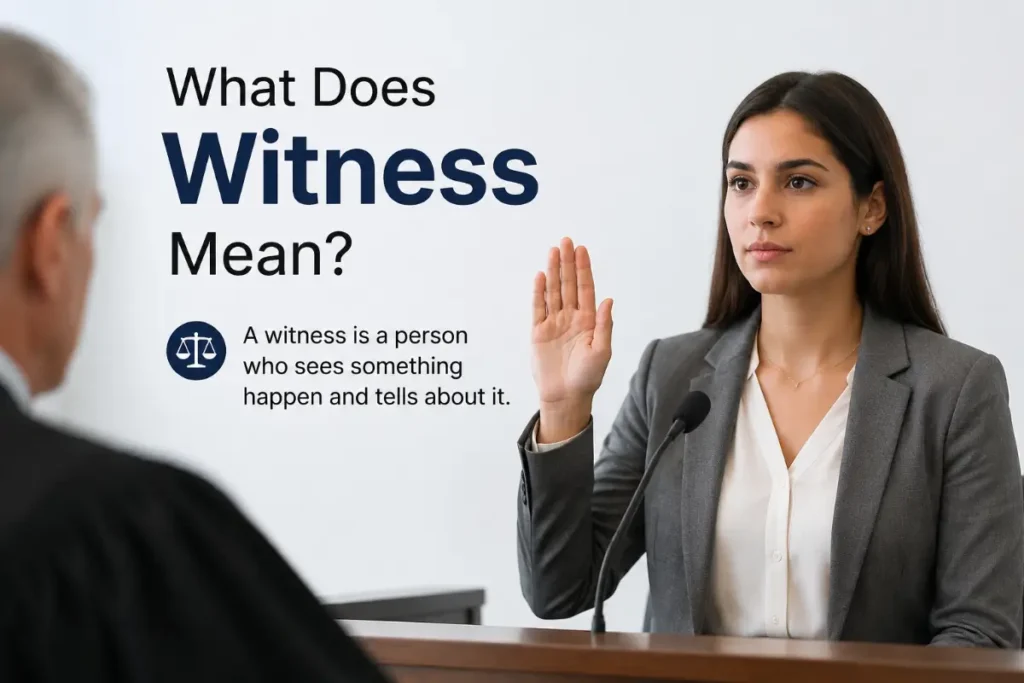
Witness has two main grammatical roles. It can be a noun and it can be a verb.
As a noun it usually means a person who sees an event happen. It can also refer to someone who gives evidence about something they saw or experienced.
As a verb it means to see something happen. It can also mean to experience or observe an important event.
Witness As A Noun
A witness is someone who sees an event or has direct knowledge of something.
For example.
- The witness called the police after the accident.
- Three witnesses described what happened.
- The witness gave evidence in court.
- She was the only witness to the argument.
The word can describe an ordinary observer or someone involved in a legal case.
Witness As A Verb
As a verb witness means to see or observe something.
For example.
- We witnessed a beautiful sunset.
- Thousands of people witnessed the final match.
- She witnessed the accident from her office window.
- The town witnessed major changes over the next decade.
The verb can also describe experiencing something significant.
For example.
The company witnessed rapid growth after launching its new service.
Here witnessed doesn’t mean someone literally watched the company grow. It means the company experienced a period of growth.
Why Witnesss Is Incorrect
Witnesss is incorrect because standard English spells the word witness.
The word already ends with ss.
Look carefully.
witness
The final two letters are ss.
Adding another s creates this form.
witnesss
That produces three consecutive s letters at the end. English doesn’t use that spelling for the standard word.
The correct form remains witness.
The Spelling Pattern
The word can be separated visually like this.
wit + ness
The final part is ness.
That means the spelling already contains the two letters needed at the end.
You don’t add another s simply because the final sound can make you expect one.
This is an important lesson for English learners. Spelling often follows established word patterns rather than the exact way a word sounds.
Witness Grammar Explained
Understanding the grammar of witness makes the spelling easier to remember.
Witness As A Singular Noun
Use witness when you are talking about one person.
Examples.
- The witness arrived early.
- A witness reported the incident.
- The witness gave a clear statement.
- The lawyer questioned the witness.
You can use articles before the singular noun.
a witness
the witness
For example.
A witness saw the vehicle leave the area.
The witness later spoke to the police.
Witness As A Plural Noun
The plural form is witnesses.
This is important because the plural doesn’t become witnesss.
Correct.
witnesses
Incorrect.
witnesss
Examples.
- Several witnesses gave statements.
- The police interviewed two witnesses.
- The witnesses described the same event.
- Four witnesses appeared in court.
The spelling witnesses follows the normal English plural pattern for many nouns ending in s.
Witness As A Verb
The base verb is witness.
Examples.
- I witnessed the event.
- They witnessed the accident.
- We may witness another change soon.
- She wants to witness the ceremony.
The verb changes form depending on the tense and sentence structure.
Witness Verb Forms
The main forms of the verb are easy to learn.
| Verb form | Correct spelling | Example |
|---|---|---|
| Base form | Witness | We may witness the event. |
| Present tense | Witness | They witness the ceremony. |
| Third person singular | Witnesses | She witnesses the ceremony. |
| Past tense | Witnessed | We witnessed the event. |
| Present participle | Witnessing | They are witnessing the event. |
| Past participle | Witnessed | She has witnessed many changes. |
Notice something important.
The third person singular form is witnesses.
It isn’t witnesss.
The past tense is witnessed.
The present participle is witnessing.
Once you learn these forms you can avoid several common spelling errors at once.
Why The Extra S Appears
The mistake often comes from pronunciation.
The word witness ends with a sound that can feel like another s should appear in writing. When people type quickly they may hear the ending and accidentally write witnesss.
Another reason is simple visual uncertainty. A person may know the word contains two s letters at the end but forget exactly where they belong.
Compare the forms.
witness
witnesss
The first has the standard spelling.
The second adds an unnecessary letter.
Keyboard Mistakes.
Typing quickly creates another common problem.
When someone types witness they may accidentally press the s key twice. A quick spell check should catch this in many writing programs but you shouldn’t rely entirely on software.
A dictionary or trusted spell checker can help confirm unfamiliar words. Still the strongest habit is learning the word pattern itself.
Witness Pronunciation Guide
The pronunciation of witness can also cause confusion because the spelling doesn’t perfectly represent every sound.
American English Pronunciation
The common American English pronunciation is approximately.
/ˈwɪtnəs/
The word has two syllables.
wit ness
The stress falls on the first syllable.
WIT ness
The final sound is closer to nuhs than a strong separate s sound.
Common Pronunciation Mistake
Some learners pronounce every letter too strongly. The middle t may sound less noticeable in natural speech.
Native speakers commonly pronounce the word smoothly rather than giving each written letter equal weight.
Don’t try to force every letter into a separate sound. Learn the natural pronunciation as a complete word.
Witness Spelling Rules
The spelling of witness becomes easier when you look at related forms.
Singular Form
witness
Example.
The witness arrived at noon.
Plural Form
witnesses
Example.
The witnesses arrived at noon.
Past Tense
witnessed
Example.
They witnessed the accident.
Present Participle
witnessing
Example.
They are witnessing an important moment.
The spelling changes according to grammar but the base word remains witness.
Real Life Examples With Witness
Seeing the word in different settings helps you understand how native speakers use it.
Daily Conversation.
- Did you witness what happened outside?
- I was there and witnessed the whole thing.
- She was a witness to the accident.
- Nobody else witnessed the argument.
Workplace Writing
- We witnessed a major increase in customer demand.
- The team witnessed several changes after the merger.
- Employees who witnessed the incident should report it.
Emails
- I witnessed the issue during yesterday’s meeting.
- Two employees witnessed the equipment failure.
- Please contact anyone who witnessed the incident.
Academic Writing
- The researchers witnessed significant changes during the study.
- The period witnessed a dramatic shift in public opinion.
- Historical records show that the region witnessed several major conflicts.
Journalism
- Several witnesses described the scene to reporters.
- Residents witnessed heavy flooding after the storm.
- The city witnessed a sharp rise in housing prices.
Literature
- The narrator witnesses the character’s transformation.
- The novel follows a young man who witnesses a turning point in his community.
Social Media
- We just witnessed one of the best performances of the year.
- I can’t believe we witnessed that live.
These examples show why witness is such a useful word. It can describe a person who saw something or the act of seeing and experiencing something.

Witness In Formal And Informal Writing
Witness works comfortably in both formal and informal English.
In legal writing you may see it used for someone who gives evidence.
In journalism it can describe someone who saw an event.
For example.
I witnessed the accident.
You could also say.
I saw the accident.
The two sentences are close in meaning but witnessed often sounds slightly more deliberate or formal.
Witness Compared With See
These words are related but they aren’t always interchangeable.
See is the more general word.
Witness often suggests direct observation of something important notable or significant.
Compare these examples.
I saw a bird in the garden.
I witnessed a serious accident.
The first sentence simply reports something you noticed.
The second suggests a significant event that you personally observed.
This distinction matters in formal writing. Witness can sound more precise when the writer wants to emphasize direct observation.
Witness Compared With Observer
A witness and an observer can both refer to someone who sees something. Their uses differ slightly.
An observer often watches something deliberately or studies it.
A witness usually has direct knowledge of an event.
For example.
The scientist observed the experiment.
The witness saw the accident.
The difference becomes especially important in legal contexts. A witness may provide evidence because they directly saw or experienced something.
Expert Editor’s Preview
From an editing perspective the spelling issue is straightforward.
Witness is the standard form. Witnesss should be corrected wherever it appears as an attempted spelling of the word.
The most useful rule is simple. Don’t treat the final sound as a signal to add another letter. Memorize the base form witness and build its grammatical forms from that base.
The plural witnesses and the verb form witnesses are especially useful forms to remember because they show how English handles words that already end in s.
A professional editor would correct witnesss rather than treat it as an alternate spelling.
Why People Confuse Witnesss And Witness
The spelling mistake witnesss usually comes from adding one extra letter to a word that already ends with ss. At first glance the extra s can look harmless. It isn’t.
The correct spelling is witness.
English learners often make this mistake because the final sound in witness can make the ending feel longer than it looks on the page. Fast typing can make the problem worse.
Another source of confusion is the plural form witnesses. Once learners know that the plural adds es they sometimes assume the singular should contain three s letters.
It doesn’t.
The spelling pattern is easier to remember when you separate the forms.
witness
witnesses
witnessed
witnessing
The base word always begins with wit and ends with ness.
The Correct Spelling Is Witness
The standard English spelling is witness.
Witnesss is not an accepted alternative spelling.
You should use witness in school assignments professional documents emails legal writing articles academic work and everyday communication.
Examples include:
- She was a witness to the accident.
- I witnessed the entire event.
- The witness spoke with the police.
- Several witnesses gave statements.
- We witnessed a major change in the market.
The same basic spelling works as both a noun and a verb.
What Witness Means As A Noun
As a noun witness usually means a person who sees an event happen.
The person may simply observe something or may later provide information about it.
For example:
The witness saw the car leave the parking lot.
Here witness identifies the person who saw the event.
The word is especially common in legal situations. A witness may give evidence in court or provide a statement to investigators.
It also appears in ordinary conversation.
I was a witness to the argument.
In this sentence the speaker says they personally saw the argument.
Witness In Legal English
Legal English uses witness frequently.
A witness can be someone who saw a crime or accident. It can also be someone who provides evidence about a matter under investigation.
Common expressions include:
- Eyewitness
- Witness statement
- Witness testimony
- Witness stand
- Expert witness
- Character witness
An eyewitness personally saw an event.
An expert witness gives specialized knowledge or professional opinion in a legal case.
A character witness provides information about another person’s character.
What Witness Means As A Verb
As a verb witness means to see observe or experience something.
Examples include:
I witnessed the accident.
They witnessed the ceremony.
We witnessed a dramatic change.
She witnessed the entire conversation.
The verb can describe direct observation. It can also describe experiencing a period or change.
For example:
The city witnessed rapid growth.
The city didn’t literally watch its own growth. The sentence means the city experienced a period of rapid growth.
This use appears often in journalism academic writing and formal reports.
Witness And Witnesses
One of the most important spelling points is the difference between the singular and plural forms.
The singular is:
witness
The plural is:
witnesses
You don’t write:
witnesss
You also don’t write:
witnesses when you mean one person.
Examples make the difference clear.
One witness arrived.
Two witnesses arrived.
The witness gave a statement.
The witnesses gave statements.
The plural ending es creates an additional syllable in pronunciation.
Why The Plural Is Witnesses
English commonly uses es to form the plural of words that end in certain sounds.
The word witness ends with an s sound. Adding es gives us:
witness + es = witnesses
This isn’t the same as adding another s to the singular.
That’s why the correct forms look like this:
witness
witnesses
The spelling witnesss doesn’t follow the standard plural rule.
Witness As A Verb In Different Tenses
The word also changes form when you use it as a verb.
Present Tense
Use witness with I you we and they.
Examples:
- I witness the ceremony every year.
- We witness many changes in our community.
- They witness the event from a nearby building.
With he she and it use witnesses.
Examples:
- She witnesses the ceremony every year.
- He witnesses the changes firsthand.
- The camera witnesses everything that happens in the room.
Past Tense
The past tense is witnessed.
Examples:
- We witnessed the accident.
- She witnessed the entire event.
- They witnessed a major transformation.
Notice that you don’t add an extra s.
The correct form is:
witnessed
Not:
witnesssed
Present Participle
The present participle is witnessing.
Examples:
- We are witnessing a major change.
- She is witnessing the ceremony.
- They were witnessing history in the making.
Again the base spelling stays clear.
witness + ing = witnessing
The Difference Between Witness And Witnessed
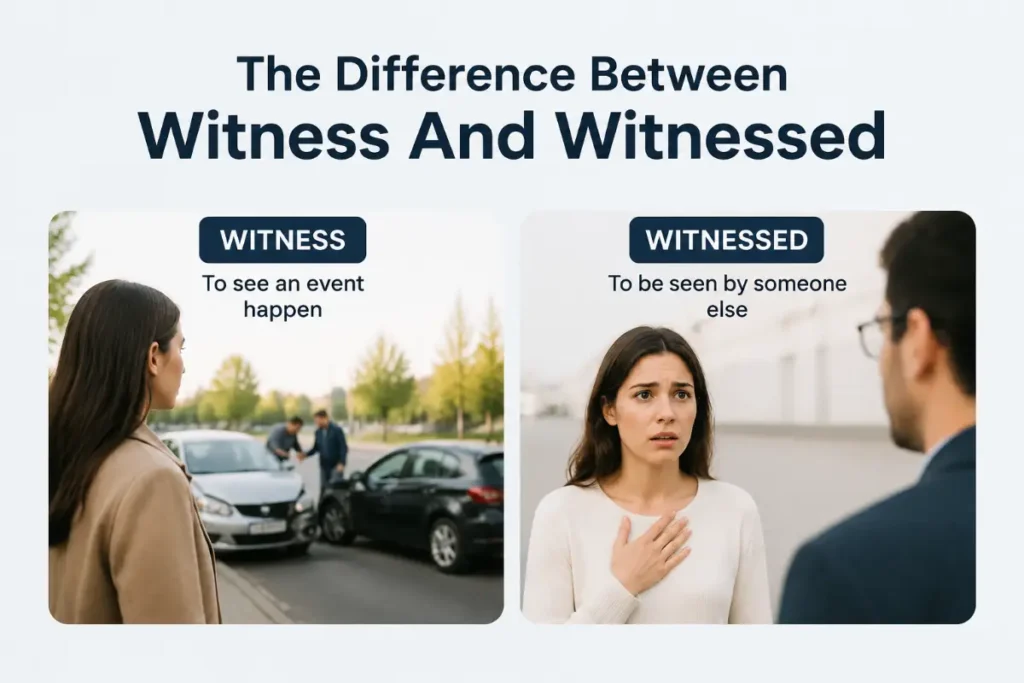
These forms are easy to confuse when you’re writing quickly.
Witness is the base form.
Witnessed is the past tense and past participle.
Compare:
I witness the event every year.
I witnessed the event yesterday.
The first sentence describes a present or repeated action.
The second sentence describes something that already happened.
The Difference Between Witness And Witnesses
This distinction matters in both grammar and spelling.
Witness can be a singular noun or a base verb.
Witnesses can be a plural noun or the third person singular present form of the verb.
Compare these sentences.
The witness arrived early.
The witnesses arrived early.
She witnesses the event every year.
They witness the event every year.
The meaning changes because the grammar changes.
Common Spelling Mistakes With Witness
The extra s isn’t the only mistake people make with this word.
Here are several forms to avoid.
- Witnesss is incorrect.
- Witnes is incorrect.
- Witneses is incorrect.
- Witnesssed is incorrect.
- Witnessing is correct.
- Witnessed is correct.
- Witnesses is correct.
- Witness is correct.
The safest approach is to remember the base spelling first.
Once you know witness the other forms become easier to build.
Witness And Other Words Ending In Ness
The ending ness appears in many English words.
Examples include:
kindness
darkness
happiness
business
illness
witness
This pattern can help you remember the final letters in witness.
The word ends with ness rather than a single s.
That means the final part is:
n e s s
Not:
n e s s s
Spelling Patterns That Help
English spelling becomes easier when you notice repeated patterns.
The word witness contains two s letters at the end.
Similar endings appear in many words.
For example:
- Fitness
- Illness
- Kindness
- Weakness
- Darkness
- Business
- Witness
The exact origins of these words differ but the visual pattern can help learners remember the spelling.
Think of witness as ending in ness.
That single memory cue prevents the extra s.
Learn the difference in Carrer Or Career Which Spelling Is Correct 2026 Guide.
British And American English
There is no spelling difference between American English and British English for witness.
American English uses:
witness
British English uses:
witness
Canadian English uses:
witness
Australian English uses:
witness
The plural is also consistent:
witnesses
The past tense remains:
witnessed
So you don’t need to worry about regional spelling when choosing between witnesss and witness.
The correct choice is the same across major English varieties.
Witness In Formal Writing
Witness is completely suitable for formal writing.
You can use it in:
- Academic papers
- Legal documents
- Business reports
- News articles
- Historical writing
- Government documents
- Professional emails
- Research papers
Examples:
The study witnessed a significant increase in participation.
The court heard testimony from an eyewitness.
The region witnessed substantial economic growth.
The period witnessed major changes in social policy.
In formal writing witness can sometimes sound more precise than see because it emphasizes direct observation or experience.
Witness In Informal Writing
The word also works naturally in casual conversation.
Examples include:
Did you witness that?
I can’t believe we just witnessed that.
We witnessed the whole thing.
You should’ve seen what we witnessed yesterday.
In casual speech people often use see instead.
I saw the accident.
I saw the whole thing.
Witness sounds slightly more deliberate but it isn’t overly formal.
Witness And See
These words are close in meaning but they don’t always carry the same tone.
See is the everyday choice.
Witness often emphasizes direct observation of something important or unusual.
Compare:
I saw a dog outside.
I witnessed a serious accident.
The first sentence is ordinary.
The second highlights an event that the speaker directly observed.
You could say:
I saw a serious accident.
That is completely natural.
Using witnessed simply gives the sentence a more formal or serious tone.
Witness And Observe
Observe is another related word.
To observe something means to watch it carefully or notice it.
To witness something usually means you personally saw it happen.
Compare:
The scientist observed the reaction.
The driver witnessed the accident.
A scientist may observe something as part of a planned study.
A witness may see an unexpected event.
The words overlap but they aren’t perfect substitutes.
Witness And Eyewitness
An eyewitness is a person who personally saw an event.
The word is especially common in news reports and legal contexts.
For example:
Police are looking for eyewitnesses.
The eyewitness described the suspect.
Several eyewitnesses reported seeing the same vehicle.
An eyewitness is always a type of witness but a witness doesn’t always have to be an eyewitness.
Someone may provide information without personally seeing the event.
Witness And Testimony
Testimony refers to evidence or statements given by a witness.
For example:
The witness gave testimony in court.
The testimony helped investigators understand what happened.
These words are connected but they don’t mean the same thing.
A witness is a person.
Testimony is the information or evidence that person provides.
This distinction is useful in legal writing.
Witness In Academic Writing
Academic writers sometimes use witness to describe major changes across a period.
Examples include:
The twentieth century witnessed significant technological advances.
The region witnessed rapid population growth.
The study witnessed a sharp increase in participation.
The final example can sound slightly formal. In some academic contexts the study recorded or the researchers observed may be more precise.
This is an important editorial point. A word can be grammatically correct and still not be the strongest choice for every sentence.
Good editing considers meaning and context rather than grammar alone.
Witness In Journalism
Journalists often use witness because news writing frequently describes events observed by people.
Examples include:
Several witnesses reported hearing a loud explosion.
Residents witnessed flooding across the neighborhood.
Eyewitnesses described the scene as chaotic.
The city witnessed a major increase in tourism.
The word works well because it connects an event with direct observation.
Witness In Literature
Authors can use witness to give a story a sense of direct observation.
For example:
The young boy witnessed the fall of the old building.
She had witnessed the family’s struggles for years.
The narrator witnesses the character’s transformation.
Literary writers may also use the word metaphorically.
The ancient walls have witnessed centuries of history.
Walls cannot literally watch events. The sentence gives them a human quality and suggests they have existed through many historical periods.
Witness As A Metaphor
The word can carry a powerful figurative meaning.
When someone says:
The old house witnessed generations of family life.
They mean the house existed throughout those events.
This use appears in literature journalism speeches and historical writing.
It gives the sentence a stronger image than simply saying:
The old house existed for generations.
The verb witnessed makes the house feel like a silent observer.
Memory Tricks For Witness
A good memory trick should be short enough to recall when you’re writing.
Remember Ness
Think:
Witness ends with ness.
The final part is ness.
So:
wit + ness = witness
Don’t add another s.
Remember The Three Main Forms
Keep these three forms together:
witness
witnesses
witnessed
Once these forms become familiar the incorrect spelling witnesss starts to look obviously wrong.
Think Of Fitness
The word fitness has the same ness ending.
You wouldn’t normally write fitnesss.
Use the same idea with witness.
witness ends with ness
That is the simplest spelling rule to remember.
Expert Editor’s Note
A professional editor would mark witnesss as a spelling error and replace it with witness.
There is no need to treat the extra s as a regional variation or an alternative form. Standard dictionaries and established English usage recognize witness as the correct form.
Editors also pay attention to the grammatical form being used.
Use witness for the base verb or singular noun.
Use witnesses for the plural noun or third person singular present verb.
This approach is better than memorizing isolated spellings because it gives you a complete working system.

The Most Natural Way To Use Witness
Native speakers use witness in several ways.
For a person:
She was a witness.
For direct observation:
I witnessed the accident.
For experience:
The city witnessed rapid growth.
For legal contexts:
The witness gave evidence.
For historical writing:
The period witnessed dramatic changes.
For casual conversation:
Did you witness that?
The word is flexible but its spelling never changes to witnesss.
A Quick Test For Writers
Before you finish a sentence containing this word ask yourself what form you need.
If you’re talking about one person:
witness
If you’re talking about several people:
witnesses
If you’re describing something that happened in the past:
witnessed
If you’re describing an ongoing action:
witnessing
If you see witnesss in your draft as a spelling of the standard word correct it.
This quick check works in emails essays reports and everyday messages.
Internal Link Opportunity
A useful related article could target commonly confused English words and spelling mistakes. Place that link after the spelling discussion to help readers explore similar problems.
A second useful internal link could target witness vs eyewitness. Place it near the conclusion because readers who understand the spelling often want to learn the difference between these related terms.
Key Takeaway
The spelling question has a clear answer.
Witness is correct.
Witnesss is incorrect.
The word witness can function as both a noun and a verb. Its plural form is witnesses. Its past tense is witnessed and its present participle is witnessing.
The easiest way to remember the spelling is to focus on the ending.
Witness ends with ness.
Once that pattern sticks the extra s has nowhere to go.
Frequently Asked Questions About Witness
Is Witness The Correct Spelling
Yes. Witness is the correct spelling in standard English. Witnesss is a misspelling and shouldn’t be used in formal or informal writing.
The word can function as both a noun and a verb. As a noun it refers to someone who sees an event. As a verb it means to see observe or experience something.
Is Witnesss Ever Correct
No. Witnesss isn’t a standard spelling of the English word. If you’re trying to write the noun or verb witness then the extra s should be removed.
The correct forms include witness witnesses witnessed and witnessing. None of these forms contains three consecutive s letters.
What Is The Plural Of Witness
The plural of witness is witnesses.
For example:
The witness gave a statement.
The witnesses gave statements.
The ending es creates the plural form. Don’t write witnesss when you mean more than one witness.
Is Witness A Noun Or A Verb
Witness can be both a noun and a verb.
As a noun it means a person who sees an event or has direct knowledge of something.
As a verb it means to see observe or experience something.
For example:
She was a witness to the accident.
She witnessed the accident.
How Do You Spell Witness In The Past Tense
The past tense is witnessed.
For example:
We witnessed the accident yesterday.
The word is formed by adding ed to the base form witness. You don’t add another s before the past tense ending.
How Do You Spell Witnessing
The correct spelling is witnessing.
For example:
They are witnessing an important moment.
The spelling comes from witness plus ing. The base word keeps its existing letters and doesn’t gain an extra s.
Why Does Witness Have Two S Letters
The word witness ends with the letters ness. The two s letters are part of the established spelling of the word.
The easiest way to remember this is to see the word as wit plus ness. Adding another s would create the incorrect form witnesss.
Common Expressions With Witness
Knowing common expressions can help reinforce the correct spelling.
Bear Witness
Bear witness is a formal expression meaning to give evidence about something or confirm that something is true.
Example:
The documents bear witness to the changes that occurred.
This expression appears often in formal writing literature and historical discussion.
Witness To Something
The phrase witness to means someone who saw or experienced an event.
Example:
She was a witness to the accident.
It can also have a figurative use.
The old building was a witness to decades of change.
Eyewitness
An eyewitness is someone who personally saw an event.
Example:
Police interviewed several eyewitnesses.
The word is especially common in news reports legal discussions and historical accounts.
Expert Witness
An expert witness is a person with specialized knowledge who provides professional evidence or opinion in a legal case.
Examples include medical experts engineers accountants and other specialists.
Witness Statement
A witness statement is a written account describing information known by a witness.
The phrase is especially common in legal and investigative contexts.
Witness And Related Forms At A Glance
| Form | Word | Function | Example |
|---|---|---|---|
| Singular noun | Witness | One person | The witness arrived. |
| Plural noun | Witnesses | More than one person | The witnesses arrived. |
| Base verb | Witness | Basic verb form | They witness the event. |
| Third person verb | Witnesses | He she or it | She witnesses the event. |
| Past tense | Witnessed | Completed action | They witnessed the event. |
| Present participle | Witnessing | Ongoing action | They are witnessing the event. |
This table gives you the complete basic pattern.
If you’re ever unsure which form to use check the subject and the time of the action first.
Witness And Similar Words
English has several words that overlap with witness but carry slightly different meanings.
See
See is the most general word.
I saw the accident.
Observe
Observe often suggests careful attention.
The researcher observed the participants.
Notice
Notice means becoming aware of something.
She noticed smoke coming from the building.
Experience
Experience focuses on personally going through something.
The community experienced severe flooding.
Witness
Witness often emphasizes direct observation of an event.
She witnessed the accident.
Choosing the right word depends on the point you want to emphasize.
Common Misconceptions About Witness
Some spelling beliefs sound reasonable but don’t hold up.
The Extra S Makes The Pronunciation More Accurate
It doesn’t.
English spelling doesn’t require writers to add letters simply because a sound feels longer.
The standard spelling is witness.
Witnesss Is A British Spelling
It isn’t.
American British Canadian and Australian English all use witness.
There is no major regional spelling variation that changes the word to witnesss.
Autocorrect Sometimes Accepts It So It Must Be Correct
Not necessarily.
Spell checkers can miss unusual typing errors. They also rely on dictionaries and context. A word passing through software doesn’t prove that it is standard English.
Witness Is Only Used In Legal Situations
No.
The word is common in everyday conversation journalism history literature academic writing and business communication.
For example:
The town witnessed rapid growth.
You don’t need a courtroom for witness to be correct.
When To Use Witness Instead Of See
Both words can describe direct observation but they create different impressions.
Use see for simple everyday observations.
I saw your message.
I saw a bird outside.
Use witness when the event feels important unusual or significant.
I witnessed a serious accident.
We witnessed a historic moment.
This isn’t an absolute grammar rule. Native speakers can use see for major events too. The distinction is mainly about tone and emphasis.
When Witness Sounds More Natural
Witness works especially well when the writer wants to highlight direct experience.
For example:
The generation witnessed enormous changes in technology.
The sentence presents a group as people who lived through those changes.
You could write:
The generation saw enormous changes in technology.
That is grammatical but slightly less formal.
The choice depends on the tone of the writing.
When Another Word Is Better
Good writing isn’t just about finding a correct word. It’s also about choosing the most precise word.
Instead of:
The experiment witnessed a reaction.
You might write:
The researchers observed a reaction.
Instead of:
The company witnessed a decline in sales.
You could write:
The company experienced a decline in sales.
The original versions aren’t automatically wrong. The alternatives can simply be more precise in some contexts.
This is the kind of distinction professional editors look for.
Final Grammar Checklist
Before publishing a sentence with witness check these points.
- Use witness for one person.
- Use witnesses for multiple people.
- Use witness as the base verb.
- Use witnesses after he she or it in the present tense.
- Use witnessed for the past tense.
- Use witnessing for the present participle.
- Never use witnesss as the standard spelling.
- Remember that the word ends in ness.
This short checklist covers nearly every everyday spelling and grammar problem connected with the word.
Need another quick comparison? Read Laid Or Layed Which One Is Correct 2026 Guide.
Conclusion
The correct answer to witnesss or witness is clear.
Witness is the correct spelling.
Witnesss is a misspelling caused by adding an unnecessary third s.
The word witness has several useful forms. The singular noun and base verb are witness. The plural noun and third person singular verb are witnesses. The past tense is witnessed and the present participle is witnessing.
The easiest memory trick is to focus on the ending ness. Think of the word as wit plus ness. Once you remember that pattern you won’t need to guess at the spelling.
For everyday writing professional documents academic work and formal communication always choose witness.
When the extra s sneaks into your draft remember one simple rule.
Witness ends with ness and that’s enough s.

Editorial Reviewer & Proofreader
Grace Mitchell reviews Gramlify’s articles for clarity, consistency, and readability. She is passionate about creating accurate, approachable content that helps English learners build confidence.