
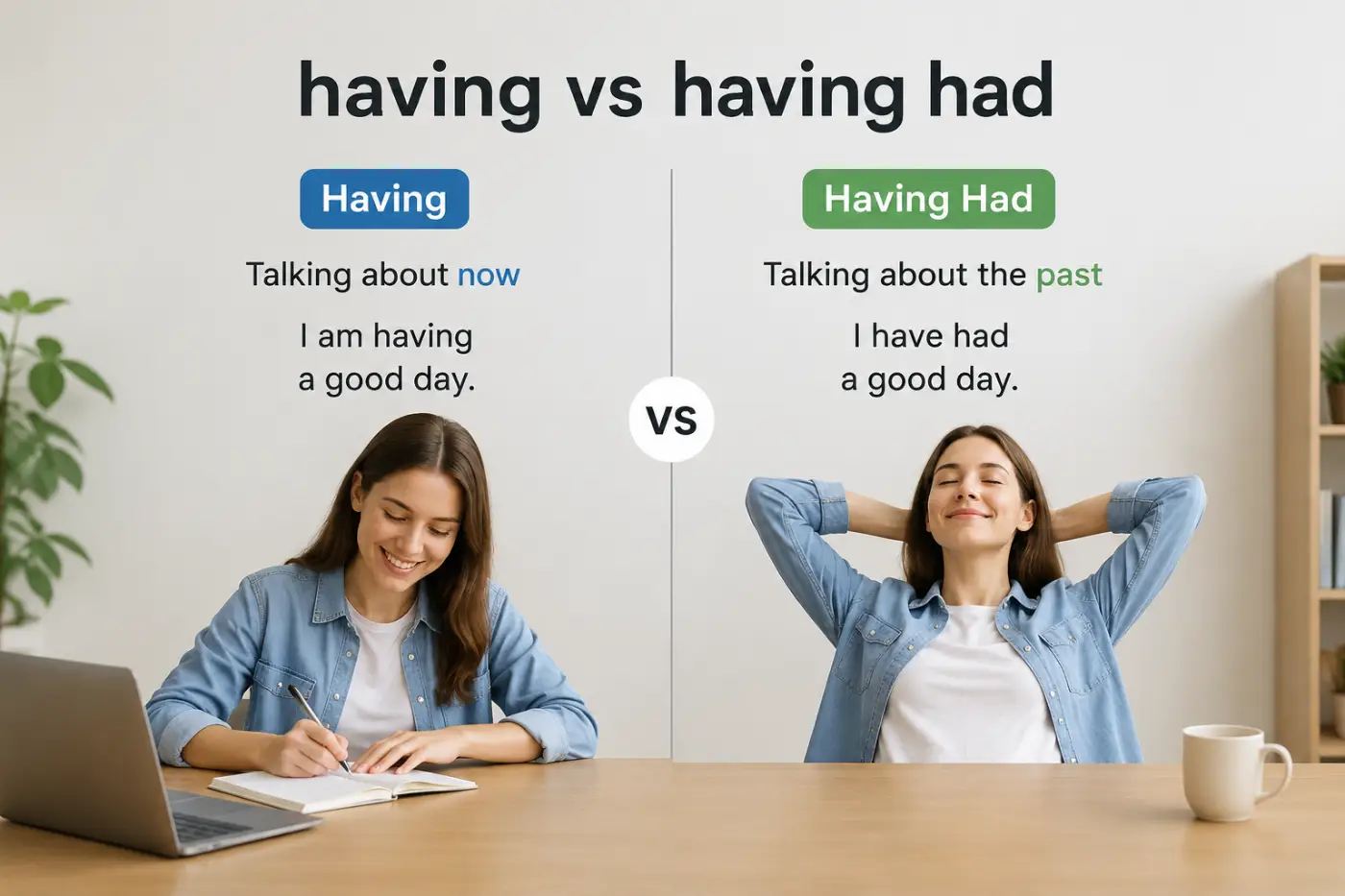
English verb forms can look deceptively simple. Having vs having had is a good example because both forms contain having but they express different relationships between actions.
The main difference is time and meaning. Having is the present participle of have and can describe an action or situation that is happening at the same time as another action. Having had is a perfect participle construction. It shows that one action happened before another action.
Compare these sentences.
Having a coffee, I checked my email.
Having had a coffee, I felt ready for the meeting.
The first sentence focuses on the situation of having coffee while another action happens. The second tells us that the coffee came first and the feeling came afterward.
This difference matters in everyday conversation as well as formal writing. English learners often use the two forms interchangeably because both begin with having. Native speakers usually understand the intended meaning from context but choosing the right form makes your writing clearer and more precise.
This guide explains the grammar behind both forms in plain English. You’ll learn what having means, what having had means, how the perfect participle works, when each form sounds natural and which common mistakes you should avoid.
Still confused? Compare Its Called Vs It Called Which One Is Correct 2026 Guide.
Quick Answer
Having describes an action or state connected to another action. Having had shows that the experience or action happened first. Use having for a simultaneous or general situation. Use having had when you need to make the earlier action clear. Both forms are grammatically correct but they serve different purposes.
Having Vs Having Had Comparison
| Feature | Having | Having had |
|---|---|---|
| Basic form | Present participle | Perfect participle |
| Main idea | An action or state connected to another action | An earlier completed action |
| Grammar | Having + noun or participle structure | Having + past participle |
| Time relationship | Often simultaneous or general | Earlier than the main action |
| Example | Having lunch I called Sarah. | Having had lunch I returned to work. |
| Common use | Conversation and writing | Formal and careful writing |
| Main function | Links an ongoing or related situation | Shows sequence between actions |
What Does Having Mean
Having is the present participle form of have. It can appear in several grammatical structures.
The meaning changes slightly depending on what follows it.
Having As A Present Participle
When having works as a participle it can connect one situation with another action.
For example.
Having dinner I watched television.
The two activities are closely connected. The sentence presents dinner as the situation surrounding the main action.
Another example is.
Having a car makes commuting easier.
Here having a car works as a gerund phrase. It acts like a noun and serves as the subject of the sentence.
So having doesn’t always describe something happening at this exact moment. Grammar determines its role.
Having With A Noun
One common pattern is:
having + noun
Examples include.
- Having breakfast.
- Having lunch.
- Having a meeting.
- Having a conversation.
- Having a problem.
- Having enough time.
These expressions can describe an activity or state.
For example.
Having lunch with my manager gave me a chance to discuss the project.
Having With Another Verb
Having can also appear in a participle structure.
For example.
Having finished the report I sent it to my manager.
In this structure having finished already shows that the report was completed before it was sent.
This point is important because having can appear in a perfect participle structure when followed by a past participle.
The word having itself does not always mean that the action happens at the same time.
What Does Having Had Mean
Having had is a perfect participle construction.
It consists of:
having + had
The first having is the present participle of have. The second had is the past participle of have.
Together they show that the experience or action connected with have happened before the main verb.
Consider this example.
Having had breakfast I went to work.
The order is clear.
First I had breakfast.
Then I went to work.
The construction gives the reader a clear time relationship without needing a separate sentence.
Why Are There Two Forms Of Have
This often confuses learners.
In having had the first word is the auxiliary participle having. The second word is the past participle had.
The structure works like this.
Having + past participle
Examples.
Having finished the work.
Having seen the movie.
Having eaten dinner.
Having had breakfast.
Having heard the news.
The last example looks unusual only because the main verb itself is have.
When To Use Having
Use having when you want to describe a situation or activity that connects naturally with the main action.
For example.
Having lunch with coworkers can improve team communication.
Here having lunch refers to the activity in general.
Another example is.
Having enough time makes the trip much easier.
This doesn’t describe a particular completed event. It describes a condition.
You can also use having in participle clauses.
Having no money with me I walked home.
Having a clear plan helped us finish early.
Having extra time allowed me to review the document.
In these examples the having phrase gives background information for the main clause.
When To Use Having Had
Use having had when the earlier experience matters to the action that follows.
For example.
Having had breakfast I wasn’t hungry at noon.
The breakfast happened first. The lack of hunger came later.
Another example is.
Having had several years of experience she knew exactly what to do.
Her experience came before her ability to handle the situation.
This form works especially well when the sequence of events needs to be clear.
The Time Relationship
Think of having had as a small arrow pointing backward.
It tells the reader:
This happened first.
Then the main action happened.
For example.
Having had enough rest he returned to work.
The meaning is:
He had enough rest first.
Then he returned to work.
This relationship is the central reason to choose having had instead of simply having.
Having And Having Had In Real Sentences
The difference becomes much easier when you compare similar sentences.
Example One
Having dinner I watched a movie.
This presents dinner and watching the movie as connected activities.
Now compare:
Having had dinner I watched a movie.
This clearly means dinner happened first and the movie came afterward.
Example Two
Having a meeting with the client I took notes.
The phrase focuses on the meeting as an activity.
Now compare:
Having had a meeting with the client I understood the problem better.
The meeting happened before the improved understanding.
Example Three
Having enough experience she applied for the position.
Her experience is a condition or background fact.
Now compare:
Having had enough experience she felt ready for the position.
The experience had already accumulated before she reached the point of feeling ready.
The Most Important Grammar Rule
The easiest rule to remember is this.
Having can describe an activity a condition or a situation.
Having had places a completed experience before another action or result.
This doesn’t mean every sentence with having describes something happening at the same time. English participle clauses are flexible and context matters.
A good writer looks at the intended time relationship first.
Ask yourself:
Did the experience happen before the main action?
If yes then having had may be the clearest choice.
If you’re describing a general condition an activity or a closely connected situation then having may be enough.
Having Vs Having Had With Time Meaning
English does not always mark time through verb tense alone. Participial structures can also show relationships between events.
Compare:
Having dinner I called my sister.
Having had dinner I called my sister.
The first sentence can suggest that dinner and the phone call happened around the same time.
The second sentence clearly places dinner before the phone call.
That small grammatical change can remove ambiguity.
Having In Everyday English
Native speakers use having constantly in everyday expressions.
Examples include.
- I’m having breakfast.
- We’re having dinner.
- She’s having a meeting.
- They’re having a great time.
- I’m having trouble with the printer.
- He’s having a bad day.
- We’re having a conversation.
- She’s having second thoughts.
In these examples having is part of the present progressive construction.
The structure is:
am is are + having
For example:
I am having lunch.
She is having a meeting.
They are having fun.
This is different from the participle clause discussed earlier.
Understanding this distinction prevents another common grammar mistake.
Having Had In Everyday English
People use the idea behind having had often but may choose a different structure in casual speech.
For example:
Having had breakfast I wasn’t hungry.
A speaker might instead say:
I wasn’t hungry because I’d already had breakfast.
Both sentences express the same basic time relationship. The second version often sounds more natural in casual conversation.
This gives us an important style lesson.
Having had is grammatically correct but it can sound more formal or compressed. It works especially well in writing when you want to connect two actions without using a full subordinate clause.
Formal Writing And Academic English
Having had can be useful in academic and professional writing when the sequence of events matters.
For example:
Having had several opportunities to review the data the researchers revised their conclusion.
This structure keeps the sentence compact.
However clarity should always come first. If the sentence becomes difficult to follow then use a full clause.
For example:
After the researchers had reviewed the data several times they revised their conclusion.
This version is longer but extremely clear.
Professional editors generally prefer the clearest construction rather than the most complicated one.
A Common Misunderstanding About Having Had
Some learners think having had always refers to the distant past.
It doesn’t.
The construction only tells us that the first event happened before the main event. The time could be seconds minutes days or years earlier.
For example:
Having had breakfast I left the house.
Breakfast may have happened ten minutes earlier.
Having had years of training she handled the emergency calmly.
The training may have happened over many years.
The grammar shows sequence rather than a specific amount of elapsed time.
What Happens In The Main Clause
A participle clause such as having had breakfast normally needs a clear subject connection.
Consider:
Having had breakfast I went to work.
The person who had breakfast is also the person who went to work.
This creates a logical connection.
A dangling modifier can cause trouble.
Having had breakfast the office looked much brighter.
The office cannot logically have eaten breakfast.
A better version is:
Having had breakfast I thought the office looked much brighter.
This is an important editing point. Participial clauses should clearly connect to the person or thing performing the implied action.
Internal Link Opportunity
For a related grammar resource consider linking to Present Participle Vs Past Participle here. It gives readers a useful next step after learning how having and having had work.
Key Takeaway From Section One
Having and having had are both correct. The choice depends on the relationship between the actions.
Use having for an activity a state or a condition.
Use having had when one completed experience happened before another action or result.
The simplest mental picture is a timeline. Having connects you to the situation. Having had points back to an earlier experience.
In the next section we’ll examine the grammar in greater depth and compare these structures across everyday conversation workplace writing academic English and other real world contexts.
The Grammar Behind Having And Having Had
The most useful way to understand having vs having had is to look at how each structure connects one action to another.
Having is the present participle form of have. It can function as part of a progressive verb phrase or as a gerund or participial clause.
Having had is a perfect participle. It combines having with the past participle had and normally shows that the first experience happened before the main action.
This distinction becomes much clearer when you put both forms on a timeline.
Having dinner → calling my friend.
The actions can overlap or occur close together.
Having had dinner → calling my friend.
Dinner happened first. The phone call came afterward.
That small difference can change the meaning of the sentence.
Having As A Gerund
One important use of having is as a gerund.
A gerund looks like a verb ending in ing but functions as a noun.
For example:
Having breakfast early helps me concentrate.
Here having breakfast early acts as the subject of the sentence.
You can replace the whole phrase with a noun.
Breakfast helps me concentrate.
Other examples include:
- Having enough sleep improves your focus.
- Having a reliable computer saves time.
- Having good friends makes life easier.
- Having extra money can reduce stress.
- Having a clear goal gives you direction.
In these examples there is no need for having had because the sentence discusses a general condition rather than a completed earlier event.
Having In The Progressive Form
Having also appears in the present progressive.
The structure is:
am is or are + having
Examples include:
I am having lunch.
She is having a meeting.
They are having dinner.
We are having trouble with the software.
He is having a great time.
In these sentences having is part of the verb phrase.
The action or situation is happening around the present time.
This is completely different from the participial structure in:
Having finished lunch I returned to work.
The first sentence uses having as part of a progressive verb. The second uses it to introduce a participial clause.
Having Had As A Perfect Participle
The structure having had belongs to the perfect participle.
The basic pattern is:
having + past participle
Because the past participle of have is had the result is:
having had
For example:
Having had enough time to prepare she felt confident.
The preparation happened before the feeling of confidence.
Another example:
Having had several difficult conversations with the client the manager understood the situation better.
The conversations came first. The understanding developed afterward.
This structure is especially useful when you want to show sequence without writing two complete clauses.
Why Having Had Shows An Earlier Action
English has several ways to show that one event happened before another.
You can use a time word.
After I had eaten I left.
You can use a subordinate clause.
Because I had eaten I wasn’t hungry.
You can also use a perfect participle.
Having eaten I wasn’t hungry.
The third option is more compact.
The same principle applies to having had.
After I had several years of experience I felt ready.
Having had several years of experience I felt ready.
The second version compresses the earlier information into a participial phrase.
Having Vs Having Had With Clear Timelines
A timeline makes the difference easy to see.
Having.
Having lunch → talking with my coworker.
The lunch and conversation may overlap.
Having Had
Having had lunch → returning to work.
The lunch is complete before the return to work.
Another Example
Having a car → making travel easier.
This describes possession as a condition.
Having had a car for ten years → I knew how expensive maintenance could be.
The ten year experience came before the knowledge being discussed.
The second sentence places emphasis on accumulated past experience.
When Having Can Also Refer To The Past
This is where learners sometimes get stuck.
They may think having always means present time.
It doesn’t.
A participle itself doesn’t always carry a complete tense meaning. Context determines the time relationship.
Consider:
Having dinner with my parents last night I heard some surprising news.
The dinner happened in the past because last night establishes the time.
The form remains having dinner because the sentence presents the dinner as the background activity surrounding the main event.
Now compare:
Having had dinner with my parents I went straight home.
The perfect participle makes the sequence clearer. Dinner was completed before going home.
So the difference isn’t simply present versus past.
It is mainly about how the writer presents the relationship between the two actions.
Having Had Compared With After Having
These two structures can express very similar meanings.
Compare:
Having had breakfast I went to work.
After having breakfast I went to work.
Both tell us breakfast came before going to work.
The first sounds more compact and can feel more formal.
The second makes the time relationship very obvious.
In everyday conversation a native speaker might simply say:
After I had breakfast I went to work.
Good writing doesn’t require the most advanced structure. It requires the clearest structure for the audience.
Having Had Compared With Because I Had
Sometimes having had can replace a clause beginning with because.
Compare:
Because I had several years of experience I understood the problem.
Having had several years of experience I understood the problem.
The meanings are related but not always identical.
The because version directly states a cause.
The participial version presents the experience as background information.
This difference matters in professional writing. If the relationship is causal and important use because. If the earlier experience simply provides context a participial clause may be more elegant.
Having Had Compared With Since I Had
A similar comparison works with since.
Since she had worked in the industry for years she knew the rules.
Having worked in the industry for years she knew the rules.
Both sentences establish prior experience.
The participial version is shorter and often smoother in formal prose.
However the longer version can be clearer for beginners or when the sentence contains several ideas.
Common Sentence Patterns
Learning a few reliable patterns can make these structures much easier to use.
Pattern One
Having + noun + main clause
Example:
Having enough time allowed us to finish the project.
Pattern Two
Having + past participle + main clause
Example:
Having finished the report I sent it to my supervisor.
Pattern Three
Having had + noun + main clause
Example:
Having had enough rest I felt ready for the trip.
Pattern Four
Having had + noun + for + period + main clause
Example:
Having had the car for five years we decided to replace it.
Pattern Five
Having had + experience + main clause
Example:
Having had previous experience with the software she learned the new system quickly.
These patterns cover many real world uses.
Many readers also check Arised Or Arose Which Word Is Correct 2026 Guide.
Real Life Examples Of Having
Daily Conversation
- Having coffee with you was the best part of my morning.
- Having enough time makes everything less stressful.
- Having a good neighbor can make a big difference.
- Having dinner together gives us time to talk.
- Having a backup plan is always smart.
Workplace English
- Having clear instructions helps employees avoid mistakes.
- Having a meeting tomorrow should give us time to prepare.
- Having enough staff will make the event easier to manage.
- Having access to the latest records helps the team work faster.
- Having a reliable process reduces unnecessary errors.
Academic English
- Having access to primary sources improves the quality of the research.
- Having a clear research question makes the study easier to organize.
- Having sufficient evidence strengthens the argument.
- Having multiple sources allows researchers to compare different views.
Real Life Examples Of Having Had
Daily Conversation
- Having had breakfast I wasn’t hungry during the drive.
- Having had enough sleep I felt much better.
- Having had a long day I went straight home.
- Having had plenty of time to think I changed my mind.
Workplace English
- Having had several meetings with the client we understood their priorities.
- Having had previous experience with the software she solved the issue quickly.
- Having had enough time to review the contract the lawyer approved it.
- Having had several delays the team changed the delivery schedule.
Academic English
- Having had access to the original documents the researcher reached a different conclusion.
- Having had little previous research on the subject the team began with a broad review.
- Having had several opportunities to test the theory the researchers revised their model.
Common Mistakes With Having And Having Had
Several errors appear again and again in learner writing.
Mistake One
Using having when the earlier completed experience needs emphasis.
Less clear:
Having breakfast I wasn’t hungry at noon.
Clearer:
Having had breakfast I wasn’t hungry at noon.
The second version clearly shows that breakfast was completed before noon.
Mistake Two
Using having had for a general condition.
Awkward:
Having had a car is useful for commuting.
Better:
Having a car is useful for commuting.
The first sentence suggests a completed past experience. The second expresses a general condition.
Mistake Three
Using Having Had When A Normal Clause Is Better.
Overcomplicated:
Having had a difficult morning having dealt with several problems having missed breakfast I was exhausted.
Clearer:
I was exhausted because I’d had a difficult morning dealt with several problems and missed breakfast.
Not every sentence needs a participial construction. When several ideas pile up clarity suffers.
Mistake Four
Creating A Dangling Modifier.
Incorrect:
Having had breakfast the office seemed quiet.
The office didn’t have breakfast.
Better:
Having had breakfast I noticed that the office seemed quiet.
The person who had breakfast must be clear from the main clause.

Punctuation With Having And Having Had
A participial phrase at the beginning of a sentence is usually followed by a comma.
For example:
Having finished the report I sent it to my manager.
A comma after report helps separate the introductory phrase from the main clause.
The same applies to having had.
Having had enough time to prepare I felt confident.
In longer sentences the comma becomes especially useful because it helps readers identify the main clause.
However punctuation should serve clarity rather than act as a decoration. The exact punctuation can depend on sentence structure and style.
Having Had In Formal Writing
The perfect participle is common in formal prose because it lets writers express relationships efficiently.
For example:
Having had several years of experience in the field the researcher approached the problem from a practical perspective.
This sentence could be rewritten as:
The researcher had several years of experience in the field. As a result the researcher approached the problem from a practical perspective.
The first version is more compact.
Still compact writing isn’t automatically better writing. If a reader has to stop and untangle the grammar use a clearer structure.
Having And Having Had In Academic Writing
Academic writers often use participial clauses to avoid repeating subjects.
For example:
After reviewing the evidence the researchers changed their conclusion.
Having reviewed the evidence the researchers changed their conclusion.
Both are acceptable.
The perfect participle becomes especially useful when the earlier action needs emphasis.
Having completed three rounds of testing the researchers approved the final version.
This tells readers that completion happened before approval.
Having And Having Had In Business Writing
Business writing benefits from directness.
You might write:
Having reviewed your proposal we can approve the next stage.
This is concise and professional.
You could also write:
After reviewing your proposal we can approve the next stage.
Both work.
For less formal communication the second version often feels more natural.
For example:
After reviewing your proposal we can move forward.
This sounds direct without making the sentence unnecessarily complex.
Having And Having Had In Emails
Email writing should prioritize clarity.
Instead of:
Having had an opportunity to carefully consider all of the information provided we have decided to proceed with the proposed arrangement.
Try:
After reviewing the information we decided to move forward.
The second sentence is easier to read.
This is an important editorial lesson. Having had is useful but it shouldn’t become a way to make simple ideas sound formal.
Having And Having Had In Literature
Literary writing has more freedom.
Authors may use participial clauses to control rhythm compress events or create a reflective tone.
For example:
Having had enough of the noise she stepped outside.
The construction moves quickly from the earlier experience to the action.
It can also create a sense of cause and effect without stating the relationship directly.
Having had years to consider the decision he finally understood what he had lost.
The earlier experience becomes part of the emotional background.
Having Had And Perfect Infinitives
Don’t confuse having had with to have had.
Compare:
Having had breakfast I left.
To have had breakfast before the meeting would have been helpful.
The first is a perfect participle.
The second contains a perfect infinitive.
Another example:
She seems to have had a difficult day.
Here to have had refers to a past experience connected with the present judgment.
These structures look similar but perform different grammatical jobs.
Having Had And Had Had
Another form that confuses learners is had had.
For example:
I had had breakfast before the meeting started.
The first had is the auxiliary used to form the past perfect.
The second had is the past participle of have.
So:
had had = past perfect
having had = perfect participle
Compare them.
I had had breakfast before work.
Having had breakfast I went to work.
The first is a complete verb phrase.
The second introduces a participial clause.
A Quick Comparison Of Related Forms
| Form | Grammar role | Example | Main idea |
|---|---|---|---|
| Have | Base form | I have breakfast at seven. | Present or general |
| Has | Present form | She has breakfast at seven. | Present or general |
| Had | Past form | I had breakfast early. | Past event |
| Had had | Past perfect | I had had breakfast before noon. | Earlier past event |
| Having | Present participle or gerund | Having breakfast helps me focus. | Activity or condition |
| Having had | Perfect participle | Having had breakfast I wasn’t hungry. | Earlier completed experience |
This table shows why having had should not be treated as a strange version of having. It has its own grammatical function.
Editor’s Tip For Choosing The Natural Form
When you’re unsure which structure to use read the sentence aloud.
If you’re describing a general condition use having.
If you’re showing that something was already completed use having had.
If the sentence still sounds stiff try replacing the participial phrase with after or because.
For example:
Having had a long day I went home.
Could become:
After a long day I went home.
Or:
Because I’d had a long day I went home.
Choose the version that communicates the relationship most naturally.
Key Takeaway From Section Two
The central difference between having and having had is not simply present time versus past time.
Having can function as a gerund a present participle or part of a progressive verb phrase. Having had is a perfect participle that normally highlights an experience completed before another action or result.
When you need to show sequence use having had. When you describe an activity a state or a general condition having is often the better choice.
The final section will cover common learner errors memory tricks related expressions regional usage frequently asked questions and the final editorial guidance for choosing the natural form.
Common Mistakes With Having And Having Had
Even experienced English learners can hesitate between having and having had because both structures begin with the same word. The safest approach is to focus on the relationship between the actions instead of the appearance of the words.
Mistake One
Using having when you need to show that an experience was already completed.
Less precise:
Having breakfast I wasn’t hungry at lunchtime.
Clearer:
Having had breakfast I wasn’t hungry at lunchtime.
The second sentence makes the sequence easier to understand. Breakfast happened first and the lack of hunger came later.
Mistake Two
Using having had for a general condition.
Less natural:
Having had a car makes commuting easier.
Better:
Having a car makes commuting easier.
The first sentence suggests an earlier experience of owning a car. The second expresses a general condition.
Mistake Three
Assuming Having Always Means Present Time.
It doesn’t.
A participle can describe a past situation when the surrounding context makes the timing clear.
For example:
Having dinner with my parents last night I heard some surprising news.
The phrase refers to a past event because last night establishes the time.
Mistake Four
Using Having Had When A Simpler Form Works Better.
You can write:
Having had a chance to review the report I agree with the recommendation.
But this may sound more formal than necessary.
A simpler version is:
After reviewing the report I agree with the recommendation.
The second version is often more natural in everyday professional writing.
Mistake Five
Creating A Dangling Modifier.
Incorrect:
Having had breakfast the office seemed unusually quiet.
The office didn’t eat breakfast. The opening phrase has no logical subject.
Correct:
Having had breakfast I noticed that the office seemed unusually quiet.
The person who had breakfast is now clear.
This is one of the most important editing rules for participial clauses. The implied subject of the opening phrase should normally match the subject of the main clause.
How To Choose The Right Form Quickly
You don’t need to analyze every grammar rule each time you write.
Ask these questions.
- Am I talking about a general activity or condition?
Use having.
- Did the experience happen before the main action?
Consider having had.
- Am I talking about something happening now?
Use am having, is having, or are having when the progressive form is appropriate.
- Does the sentence feel unnecessarily formal?
Try after, because, or a normal past perfect clause.
This quick check handles most situations.
Memory Tricks For Having And Having Had
A good memory trick should be simple enough to use while writing.
Remember The Extra Had
Think of having had as carrying an extra step backward in time.
Having gives you the situation.
Having had gives you an earlier completed experience.
For example:
Having lunch I talked with Sarah.
Having had lunch I returned to work.
The extra had signals that lunch is already finished.
Think In Timelines
Imagine two points.
Having
Action or situation → Main action.
Having had
Earlier completed experience → Main action.
This visual difference is often easier to remember than a grammar definition.
Use The After Test
Replace the opening phrase with after.
If the meaning stays clear you may be dealing with a perfect participle.
For example:
Having had breakfast I went to work.
After having breakfast I went to work.
The meaning remains almost the same.
Now try:
Having a car makes life easier.
After having a car makes life easier.
The second version doesn’t express the intended meaning. That tells you the original having is functioning differently.
Related Words And Structures.
Understanding nearby grammar forms can help you build a stronger mental map.
Having.
Related forms include:
- Have.
- Has.
- Had.
- Having.
- Had had.
- Have had.
- Has had.
Having Had.
Related structures include:
- Having finished.
- Having eaten.
- Having seen.
- Having heard.
- Having completed.
- Having experienced.
These all follow the same basic perfect participle pattern.
Having + past participle.
For example:
Having finished the project we celebrated.
Having seen the results she changed her opinion.
Having heard the announcement everyone left the room.
The grammar is the same even though the main verbs differ.
Having Had And Similar Expressions.
English offers several ways to express an earlier action.
After
After I had finished the work I went home.
This is very clear and natural.
Once
Once I had finished the work I went home.
This emphasizes completion before the next event.
Because
Because I had finished the work I could relax.
This focuses on cause rather than simple sequence.
Having
Having finished the work I went home.
This is compact and works well in many written contexts.
Having Had
Having had enough time to prepare I felt confident.
This is useful when the earlier experience involves have itself.
The best choice depends on the relationship you want to emphasize.
British And American English
There is no major grammatical difference between American and British English in the use of having and having had.
Both varieties use these structures.
American English may favor a more direct conversational style in everyday communication.
For example:
After I had breakfast I went to work.
British English uses the same structure:
After I had breakfast I went to work.
Formal writing in both varieties can use:
Having had breakfast I went to work.
The main difference is style and register rather than grammar.
Canadian and Australian English also follow the same basic patterns.
Formal And Informal Usage
Having is extremely common across all levels of English.
Having had is also standard but can sound more formal when it introduces a participial clause.
Compare:
After we’d talked about it we made a decision.
Having discussed the issue we made a decision.
The second version is more compact and formal.
For everyday conversation the first version may feel more natural.
For reports academic writing and carefully edited prose the second version can work well.
Still you shouldn’t choose a complicated construction simply to sound educated. Clear English usually beats impressive sounding English.
Pronunciation Guide
The pronunciation of these forms is straightforward.
Having.
A common American English pronunciation is:
/ˈhævɪŋ/
It has two syllables.
HAV ing
The stress falls on the first syllable.
Having Had
A common pronunciation is:
/ˈhævɪŋ hæd/
The phrase contains four syllables when pronounced carefully.
HAV ing HAD
In natural conversation the words may run together slightly.
Common Pronunciation Mistake
Some learners pronounce having as though it were written have ing with an overly strong final consonant.
In natural American English the ending sounds like ing.
The pronunciation should flow naturally:
having
Not:
have ing
Spelling And Word Formation
There is no unusual spelling rule in having had.
The form comes from two separate words.
having + had
The spelling of having follows the normal formation of the present participle of have.
The spelling of had does not change because it is already the past participle of have.
Do not combine the words into one form.
Incorrect:
Havinghad breakfast I left.
Correct:
Having had breakfast I left.
Also remember that having had does not need a hyphen.
Word Origin
The word have has very old Germanic roots. It is related to words in other Germanic languages that express possession or ownership.
Over time English expanded have beyond simple possession.
Today it can describe experiences states events relationships and activities.
Examples include:
Have a car.
Have a meeting.
Have experience.
The form having developed as the present participle of have.
The past participle is had.
That gives English structures such as:
Having.
Had.
Having had.
Had had.
These forms may look repetitive but each has a distinct grammatical role.
Real Life Examples You Can Model
Here are natural examples that show the difference clearly.
Conversation
- Having a good friend nearby makes difficult days easier.
- Having enough time means we don’t need to rush.
- Having had enough sleep I feel ready for the day.
- Having had breakfast I can wait until lunch.
- Having a quiet place to work helps me focus.
Workplace
- Having clear instructions prevents unnecessary mistakes.
- Having a reliable system saves the company time.
- Having had several discussions with the client we understand their concerns.
- Having had previous experience with the software she solved the problem quickly.
- Having enough staff will make the event easier to manage.
Academic Writing
- Having access to reliable sources improves the quality of the study.
- Having reviewed the evidence the researchers changed their conclusion.
- Having had limited data the researchers avoided making a broad claim.
- Having completed the first experiment the team began the second phase.
Email Writing
- Having reviewed your proposal we are ready to discuss the next step.
- Having had an opportunity to consider your suggestion I think we should proceed.
- After having reviewed the attached document I noticed two small errors.
Journalism
- Having spoken with several residents the reporter described the situation as difficult but manageable.
- Having had years of experience covering local politics the journalist recognized the warning signs.
Literature
- Having lost everything he began rebuilding his life.
- Having had years to reflect on the decision she finally understood its consequences.
These examples show how flexible the structures can be.
Expert Editor’s Note
A professional editor doesn’t choose having or having had simply because one sounds more advanced.
The first question is always meaning.
If the sentence describes an activity a condition or a general state then having may be appropriate.
If the sentence needs to show that a completed experience happened before the main event then having had can provide that relationship.
The second question is clarity.
A sentence like:
Having had several opportunities to reconsider the decision the committee decided to proceed.
is grammatically sound.
But if the sentence continues with several more clauses it can become difficult to follow.
In that situation an editor might write:
The committee had several opportunities to reconsider the decision. It decided to proceed.
Good editing isn’t about making every sentence sophisticated. It’s about making every sentence easy to understand.
Frequently Asked Questions.
Is Having Had Grammatically Correct.
Yes. Having had is a grammatically correct perfect participle construction. It consists of the present participle having followed by the past participle had. It normally shows that an experience or action happened before the action in the main clause.
What Is The Difference Between Having And Having Had.
Having can describe an activity a state or a general condition. Having had normally refers to a completed earlier experience. For example having breakfast can describe the activity while having had breakfast tells us breakfast was already completed before another event.
Can I Use Having Had In Formal Writing.
Yes. It is common in formal and academic writing when the writer wants to show that one action happened before another. However it shouldn’t be used simply to make a sentence sound formal. A clear structure using after or because may be better when the sentence becomes difficult to follow.
Is Having Had The Same As Had Had.
No. Having had is a perfect participle. Had had is the past perfect form of have. For example having had breakfast I left uses a participial clause. I had had breakfast before I left uses a complete past perfect verb phrase.
Can Having Refer To The Past.
Yes. Having does not automatically mean present time. Context can place the action in the past. For example Having dinner with my parents last night I heard the news clearly refers to a past event because last night establishes the time.
Should I Use Having Had Or After.
Both can be correct. Having had creates a compact participial structure while after often sounds more natural in everyday conversation. Choose the form that makes the time relationship easiest for your reader to understand.
Why Does Having Had Have Two Different Forms Of Have.
The first having is the present participle used to build the perfect participle. The second had is the past participle of have. Together they create the structure having + past participle which shows an earlier completed action.
Can Having Had Create A Dangling Modifier.
Yes. The implied subject of the participial phrase should normally match the subject of the main clause. Having had breakfast the office looked quiet is illogical because the office didn’t eat breakfast. A better sentence is Having had breakfast I noticed that the office looked quiet.
For another common grammar confusion, see Simpler Or More Simple Which Form Is Correct 2026.
Conclusion.
The difference between having and having had comes down to how you present an action or experience.
Use having for an activity a condition or a situation.
Use having had when you want to show that an experience was already completed before another action or result.
Remember the extra had as a signal of an earlier experience. If the sentence feels too formal or complicated replace the participial structure with a simpler expression such as after I had or because I had.
Most importantly don’t choose grammar because it looks sophisticated. Choose the form that makes your meaning clear.
Clear English isn’t about using more complicated grammar. It’s about making the relationship between your ideas impossible to miss.

Senior Grammar Editor
Olivia Reynolds is a grammar editor and language writer who enjoys making complex English rules easy to understand. She specializes in grammar, punctuation, sentence structure, and everyday writing tips, helping readers write with greater confidence and clarity.