
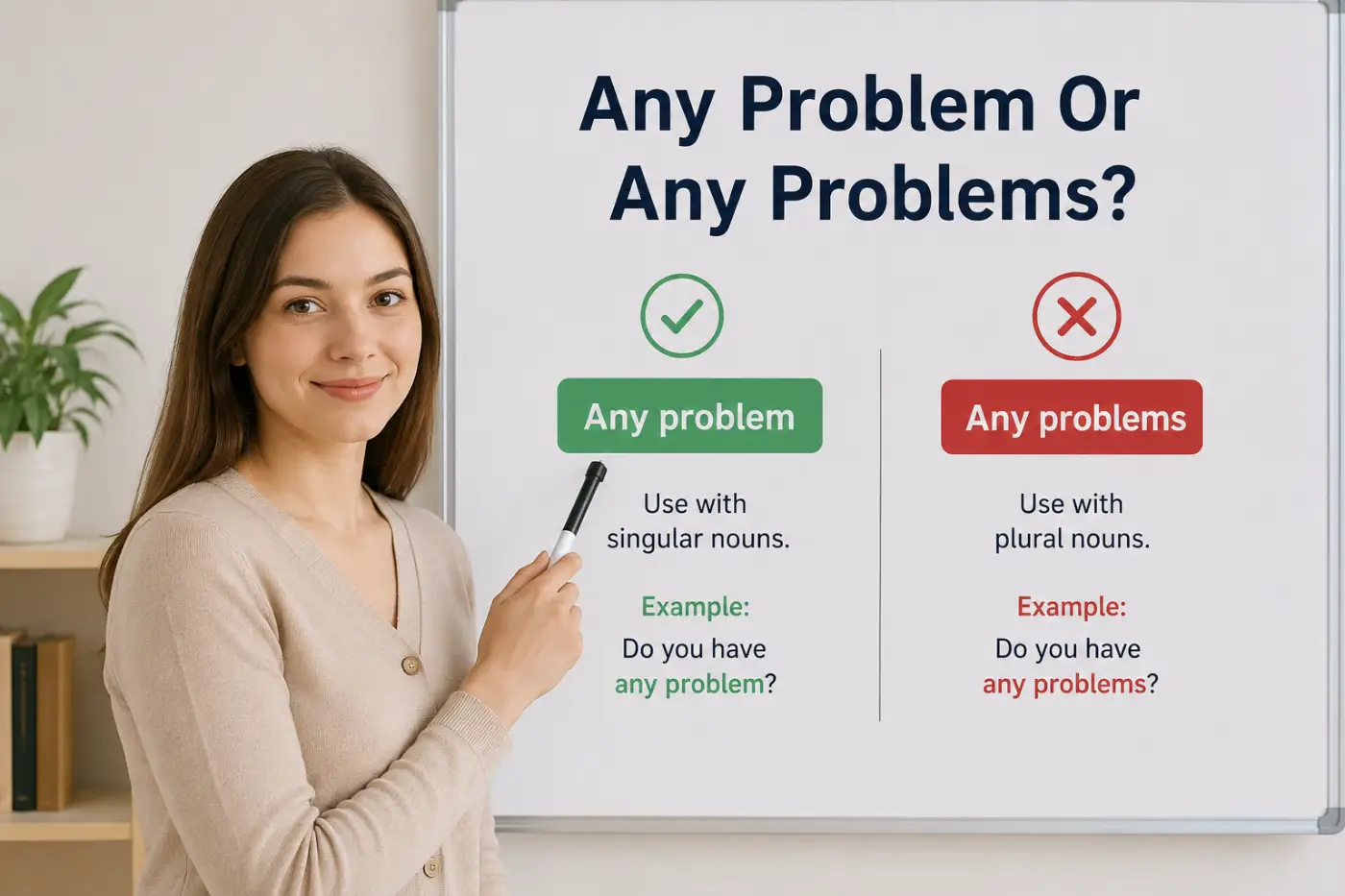
The choice between any problem or any problems looks small but it can change the meaning and grammar of a sentence. English learners often wonder if any should be followed by a singular noun or a plural noun. The answer depends on what you mean and how the sentence is structured.
Both any problem and any problems can be correct. They aren’t interchangeable in every sentence. Any problem usually refers to one problem at a time or to a problem as a general possibility. Any problems usually refers to one or more problems when the speaker is thinking about possible issues in a broader sense.
This distinction becomes especially useful in questions and negative sentences. Native speakers also use different patterns depending on the noun and the meaning they want to express.
In this guide you’ll learn the difference between any problem or any problems with clear grammar rules and natural examples. You’ll also see when singular nouns work after any when plural nouns sound more natural and how professional editors approach these sentences.
Need another quick comparison? Read On To Vs Onto Which One Is Correct (2026).
Quick Answer
Both any problem and any problems are grammatically correct. Use any problem when you mean one possible problem or treat the noun as a general concept. Use any problems when you mean one or more possible problems. In everyday questions such as “Did you have any problems?” the plural form often sounds more natural.
Any Problem Or Any Problems Comparison
| Feature | Any problem | Any problems |
|---|---|---|
| Grammar | Any + singular count noun | Any + plural count noun |
| Meaning | One possible problem or a general problem | One or more possible problems |
| Common use | Specific possibility | General or open possibility |
| Questions | Correct | Very common |
| Negative sentences | Correct | Very common |
| Formal writing | Correct | Correct |
| Everyday English | Natural in specific contexts | Often more natural for general questions |
| Example | Is there any problem with the plan? | Are there any problems with the plan? |
The most important point is simple.
Any can be used with singular count nouns and plural count nouns. The choice depends on meaning and sentence structure.

What Does Any Problem Mean
Any problem uses any with a singular count noun.
Here any usually points to one problem or to a problem considered as an individual possibility.
For example:
- Is there any problem with this plan?
- If you have any problem using the software please contact me.
- We can fix any problem that appears during testing.
- Did you notice any problem with the machine?
- Don’t hesitate to tell me if you see any problem.
In these examples the speaker focuses on a problem as a single possible issue.
Any Problem In Questions
A question can use any problem when the speaker is asking about one possible issue.
For example:
Is there any problem with my application?
The speaker wants to know if there is a problem with the application.
The question doesn’t necessarily suggest several problems. It treats problem as one possible issue.
Another example is:
Did you find any problem with the report?
This can sound natural when the speaker is reviewing one particular issue or asking about the report as a whole.
What Does Any Problems Mean
Any problems uses any with a plural count noun.
The plural form usually opens the question to multiple possible problems. The speaker isn’t limiting the discussion to one issue.
For example:
- Are there any problems with the report?
- Did you have any problems finding the address?
- Are you having any problems with the new system?
- Let me know if you have any problems.
- We didn’t find any problems during the inspection.
Here the speaker allows for the possibility of one problem or several problems.
That makes the plural form especially common in everyday questions.
Which One Is Correct
Both forms are correct.
The better choice depends on the meaning you want.
Use any problem when you have one possible issue in mind or when you treat the idea of a problem as a general possibility.
Use any problems when you want to allow for several possible issues.
Compare these sentences.
Is there any problem with the design?
This can focus on the existence of a problem with the design.
Are there any problems with the design?
This asks about possible problems in general and allows for multiple issues.
Neither sentence is automatically wrong.
The difference is mainly about how the speaker frames the possibility.
Why People Confuse Any Problem And Any Problems
The confusion comes from a common English rule that learners often memorize too simply.
Many grammar lessons teach that any goes with plural nouns in questions and negative sentences.
That rule is useful but incomplete.
English also allows any + singular count noun in many situations.
For example:
If you have any question please ask me.
This pattern is common in professional and instructional English.
At the same time:
If you have any questions please ask me.
This plural version is also extremely common and often sounds more natural when the speaker expects several possible questions.
The key isn’t simply counting the noun. Meaning matters.
The Visual Similarity Of The Expressions
The phrases differ by only one letter.
Any problem
Any problems
That small difference makes them easy to confuse while typing or proofreading.
Grammar Rules Can Be Too Simplified
Learners sometimes remember rules such as:
Any must be followed by a plural noun.
That isn’t correct.
Any can occur with singular count nouns plural count nouns and uncountable nouns.
Examples include:
Any problem
Any problems
The noun determines which structure makes sense.
Everyday Speech Adds More Variation
Native speakers often choose the form that best fits the situation rather than following a simple classroom rule.
Someone might say:
Do you have any problem with that?
But in many everyday situations a native speaker would more naturally say:
Do you have any problems with that?
The plural form often feels more open and conversational.
The Grammar Rule Behind Any
The word any is a determiner.
It can modify different kinds of nouns.
Any With Singular Count Nouns
A singular count noun refers to one item that can be counted.
Examples include:
- Problem.
- Question.
- Idea.
- Reason.
- Solution.
- Student.
- Book.
You can use any with these nouns in specific grammatical contexts.
Examples:
Is there any problem?
Do you have any question?
Can you think of any reason?
However, natural usage matters. Some of these singular forms sound formal or less common than their plural alternatives.
For example:
Do you have any questions?
is generally more natural than:
Do you have any question?
Any With Plural Count Nouns
Plural count nouns work very naturally with any.
Examples:
Are there any problems?
Do you have any questions?
Did you notice any mistakes?
Are there any reasons to worry?
This is one of the most common patterns in English.
Any With Uncountable Nouns
Any can also modify uncountable nouns.
Examples include:
Do you have any advice?
Is there any information available?
Do we have any evidence?
You cannot normally make these nouns plural in standard English.
That gives us three useful patterns.
Any + singular count noun
Any + plural count noun
Any Problem In Questions
Questions often determine which form sounds most natural.
Singular Questions
Use any problem when the question focuses on a single issue or treats the problem as one general possibility.
Examples:
- Is there any problem with the contract?
- Did you notice any problem with the engine?
- Would any problem prevent you from attending?
- Could any problem affect the schedule?
- Is any problem causing the delay?
The structure is grammatical.
Plural Questions
Use any problems when you are asking about possible issues generally.
Examples:
- Are there any problems with the contract?
- Did you notice any problems with the engine?
- Are you having any problems with the website?
- Could any problems affect the schedule?
- Did the team encounter any problems?
The plural form often sounds more natural when the speaker doesn’t know how many issues might exist.
Any Problem In Negative Sentences
Negative sentences can use either form.
For example:
I don’t have any problem with the decision.
This can mean the speaker has no objection to the decision. Here problem can express a general issue or objection.
The plural form is also possible:
I don’t have any problems with the decision.
This often sounds more conversational and can suggest that the speaker has no issues at all.
There is a small difference in tone.
I don’t have any problem with it.
This often sounds like a statement of acceptance.
I don’t have any problems with it.
This often sounds like a broader statement that nothing is wrong.
Both can be correct.
Any Problem In Conditional Sentences
Conditional sentences often use any problem when the writer means any single possible issue.
Examples:
- If you notice any problem please tell the supervisor.
- If any problem occurs stop the machine.
- Contact us if you experience any problem.
- If any problem arises we will investigate it.
- Tell me if any problem comes up.
This structure is common in instructions and formal communication.
Plural forms are also possible.
- If you notice any problems please tell the supervisor.
- Contact us if you experience any problems.
- Let me know if any problems come up.
The plural version creates a broader sense of possible issues.
Any Problem In Formal Writing
Formal writing often uses singular any problem when the writer is describing a possible event or condition.
For example:
If any problem arises during the procedure the supervisor must be notified.
This sentence treats problem as one possible event.
Another example:
The system can detect any problem before it affects production.
The sentence isn’t saying that only one problem can exist. It presents each possible problem as an individual case.
This is common in technical writing instructions policies and academic prose.
Any Problems In Everyday English
The plural form is especially common in conversation.
A teacher might ask:
Are there any problems with the homework?
A doctor might ask:
Are you having any problems with the medication?
A manager might ask:
Are there any problems with the project?
A friend might ask:
Are you having any problems at home?
The plural form feels natural because the speaker is giving the listener room to mention one issue several issues or no issues at all.
Real Life Examples Of Any Problem And Any Problems
Seeing the difference across real situations makes the grammar much easier to understand.
Daily Conversation
- Is there any problem with the restaurant?
- Are there any problems with your new apartment?
- Let me know if you have any problem getting there.
- Did you have any problems finding parking?
Workplace Communication
- If any problem occurs please contact the support team.
- Are there any problems with the latest report?
- The technician can handle any problem that appears.
- Did the staff encounter any problems during the installation?
Email Writing
- Please contact me if you have any problem accessing the document.
- Please let me know if you have any problems accessing the document.
Both versions work. The plural form often sounds warmer and more natural in general customer communication.
Academic Writing
- The method should prevent any problem caused by inconsistent data.
- The researchers did not report any problems during the experiment.
Academic writers often choose the singular form when describing a particular possible condition and the plural form when reporting several possible issues.
Customer Service
- If you experience any problem with your order please contact us.
- If you experience any problems with your order please contact us.
The plural version is extremely common in customer support because it covers all possible issues.
Technical Writing
- If any problem occurs during installation shut down the device.
- If you encounter any problems during installation contact technical support.
The first sentence treats a problem as an individual event. The second invites the user to report any issues they encounter.
Social Media
- Message me if you have any problem with the link.
- Let me know if you have any problems with the link.
The second sounds more natural for casual online communication.
Journalism
- The agency said it could address any problem affecting the service.
- Officials said they had not identified any problems with the system.
These examples show how both forms work naturally in published English.
A Practical Rule For English Learners
If you’re unsure which form to choose ask yourself what you’re trying to communicate.
If you’re asking about possible issues in general use any problems.
When speaking casually and asking someone if something is wrong the plural form will often sound more natural.
For example:
Are there any problems?
This is a very natural way to ask if everything is okay.
Still don’t treat the plural form as an absolute rule. Context decides the best choice.
When Any Problem Sounds More Natural
Grammar tells you what is possible. Natural usage tells you what people actually tend to say.
Both any problem and any problems are correct. However, the plural form often sounds more natural when you’re asking someone about difficulties or issues.
Compare these sentences.
Are you having any problems with the computer?
This sounds completely natural in everyday American English.
Are you having any problem with the computer?
This is grammatical but can sound less natural in ordinary conversation.
The reason is simple. When someone asks about difficulties they usually aren’t thinking about one specific difficulty. They are asking about the situation as a whole.
That’s why any problems is so common in questions such as:
Are there any problems?
Did you have any problems?
Are you having any problems?
Did anything cause any problems?

When Any Problem Is The Better Choice
The singular form becomes especially useful when you focus on a particular possible issue.
Consider this sentence.
If any problem occurs during the test stop the machine.
Here the writer treats each possible problem as an individual event. The sentence works well because the focus is on what should happen if one problem occurs.
You can also say:
The software can identify any problem in the system.
This means the software can identify each possible problem.
Another example:
We need a solution for any problem that may arise.
The singular form works because the sentence considers each problem individually.
Any Problem With A Specific Issue
The singular form can also work when the context points toward one specific matter.
For example:
Is there any problem with my application?
The speaker wants to know if something is wrong with one particular application.
Similarly:
Is there any problem with this sentence?
The speaker isn’t asking about several sentences. The focus is one sentence and one possible issue with it.
When Any Problems Is The Better Choice
Use the plural form when you’re asking about several possible issues or leaving the number completely open.
For example:
Are there any problems with the proposal?
The speaker may expect one issue or several.
Did you have any problems during the trip?
The question invites the listener to mention any difficulties they experienced.
Are there any problems we should know about?
This is broad. The speaker wants to know about all relevant issues.
The plural form is especially common after verbs connected with difficulties.
These include:
have
experience
encounter
notice
find
run into
For example:
Did you experience any problems?
Did you run into any problems?
These sound natural because problems refers to possible difficulties in general.
Any Problem Or Any Problems In Questions
Questions are one of the places where the difference matters most.
Is There Any Problem
Is there any problem with the plan?
This is correct.
It can sound slightly formal or specific depending on context.
You might use it when reviewing one proposal or asking about one possible objection.
Are There Any Problems
Are there any problems with the plan?
This is also correct and often more natural in everyday conversation.
The plural form allows the listener to report one problem several problems or none.
Which Sounds More Natural
If you’re casually asking someone if something is wrong use the plural form in many situations.
Are there any problems?
That sounds very natural.
If you’re discussing a specific possible issue use the singular form.
Is there any problem with the payment?
Both structures belong in normal English. The context decides which one fits best.
Any Problem In Expressions And Phrases
Some expressions naturally favor the singular form.
If Any Problem Arises
If any problem arises please contact the office.
This is common in formal instructions.
The phrase treats a problem as an individual event.
In Case Of Any Problem
In case of any problem contact the manager.
This structure is understandable and grammatically sound. In polished American English you may also see:
If you have any problems contact the manager.
The second version sounds more conversational.
Without Any Problem
She completed the task without any problem.
This is possible but the plural form is often more natural:
She completed the task without any problems.
The plural version can mean without experiencing any difficulties.
Solve Any Problem
This tool can solve any problem.
Here the singular is natural because the statement means the tool can handle any individual problem that might occur.
The meaning is broad even though the noun is singular.
Any Problems With Countable Nouns
The noun problem is countable.
You can say:
one problem
two problems
several problems
many problems
Because it is countable you can use both singular and plural forms after any.
Compare:
Any problem can become serious if ignored.
Any problems can become serious if ignored.
The first sentence sounds more natural because the writer means each individual problem.
The second sentence is possible in some contexts but often needs a different structure.
For example:
Any problems found during the inspection must be reported.
Here the plural form works because the sentence refers to problems that may be found.
Any Problem And Any Problems With Verbs
The verb also affects the sentence.
Singular Problem With Is
When problem is singular use is.
Is there any problem with the order?
There isn’t any problem with the order.
Don’t write:
Are there any problem with the order?
That creates a subject verb agreement error.
Plural Problems With Are
When problems is plural use are.
Are there any problems with the order?
There aren’t any problems with the order.
Don’t write:
Is there any problems with the order?
The noun and verb must agree.
This is one of the most common mistakes English learners make with these expressions.
Any Problem And Any Problems With Do And Does
The same principle applies when do or does appears.
With a singular subject:
Does any problem affect the system?
With a plural subject:
Do any problems affect the system?
The important point is that problem and problems aren’t interchangeable.
The auxiliary verb must match the grammatical subject.
Any Problem And Any Problems In Negative Statements
Negative statements often use any naturally.
Singular
I don’t have any problem with your decision.
This can mean I don’t object to your decision.
Plural
I don’t have any problems with your decision.
This usually means I have no issues or objections.
In American English the plural version often sounds more conversational.
Compare:
I have no problem with that.
I don’t have any problems with that.
All three can work, but they can carry slightly different shades of tone.
I have no problem with that often sounds direct and confident.
I don’t have any problems with that can sound broader and more conversational.
Any Problem Versus A Problem
Another useful comparison is any problem versus a problem.
These forms don’t mean the same thing.
Is there a problem?
The speaker suspects there may be a problem.
Is there any problem?
The speaker asks if there is even one possible problem.
There is a problem.
The speaker states that a problem exists.
There isn’t any problem.
The speaker says no problem exists.
The word any changes the scope of the question or statement.
Any Problems Versus Some Problems
English learners sometimes confuse any and some.
Compare:
Are there any problems?
This asks if problems exist.
There are some problems.
This says that problems exist.
In many questions any is the natural choice because the speaker doesn’t know if problems exist.
For example:
Did you have any problems?
You don’t yet know the answer.
If you already know problems exist you might say:
What problems did you have?
The choice depends on what information the speaker already has.
Any Problem Versus Every Problem
These words also have different meanings.
Any problem can refer to any individual problem without naming one specific problem.
Every problem refers to all problems individually.
Compare:
We can solve any problem.
This means no individual problem is beyond our ability to solve it.
We must examine every problem.
This means we need to examine all of them.
The words may appear similar but they express different ideas.
Any Problem In Professional Communication
Professional writing often uses both forms.
The singular form can sound precise and procedural.
If any problem occurs during the inspection the equipment must be shut down.
The plural form can sound more conversational.
If you have any problems during the inspection please contact your supervisor.
Both sentences are useful.
For customer service messages the plural form often feels friendlier.
If you have any problems please contact our support team.
For a technical instruction the singular form can feel more direct.
If any problem occurs restart the device.
Good professional writing isn’t about always choosing singular or always choosing plural. It is about matching the form to the intended meaning and tone.
Any Problem In Academic Writing
Academic writers should choose the form that expresses the intended scope clearly.
Consider:
The model can identify any problem in the dataset.
This suggests that the model can identify each individual problem.
Now consider:
The researchers did not identify any problems in the dataset.
This reports the absence of problems in general.
The distinction can be useful when writing research papers because singular and plural forms can subtly affect the scope of a claim.

You may also want to read More Than Vs More Then Which One Is Correct (2026).
Any Problem In Technical Instructions
Technical instructions frequently use singular any problem because procedures often describe one possible event at a time.
For example:
If any problem occurs during startup press the reset button.
The instruction doesn’t mean only one problem can happen. It gives the same instruction for each possible problem.
Plural any problems is also common when the instruction asks users to report difficulties.
If you experience any problems during startup contact technical support.
The first focuses on an event.
The second focuses on user experience.
Any Problem Or Any Problems In American English
American English uses both forms.
There is no American spelling rule that requires problem or problems after any.
The difference is grammatical and semantic rather than regional.
Canadian English British English and Australian English also use both structures.
You may notice differences in preferred phrasing because formal styles and local speech habits vary. However the basic grammar remains the same.
Common Mistakes With Any Problem And Any Problems
Mistake One
Are there any problem?
Incorrect.
Use:
Is there any problem?
Or:
Are there any problems?
The first uses a singular noun with a singular verb. The second uses a plural noun with a plural verb.
Mistake Two
Is there any problems?
Incorrect.
Use:
Is there any problem?
Or:
Are there any problems?
Don’t mix the singular verb with the plural noun.
Mistake Three
I don’t have any problems with this.
This is correct.
Some learners incorrectly think any must always be followed by a singular noun because any can mean one.
It doesn’t work that way. Any problems is completely standard.
Mistake Four
Do you have any problem?
This isn’t automatically wrong. However in ordinary conversation many speakers would prefer:
Do you have any problems?
The plural form usually sounds more natural when asking about difficulties generally.
Mistake Five
Assuming one form is always correct.
This is the biggest misconception.
There is no universal rule saying any problem is correct or any problems is correct.
Both work in the right context.
Memory Tricks For Choosing The Right Form
A good memory trick should help you understand the grammar rather than force you to memorize a rigid rule.
Think One At A Time
Use any problem when you can mentally replace it with:
any single problem
Example:
If any problem occurs call me.
Think:
If any single problem occurs call me.
The meaning still works.
Think Possible Issues
Use any problems when you mean:
any issues you might have
Example:
Let me know if you have any problems.
Think:
Let me know if you have any issues.
The plural meaning feels natural.
Watch The Verb
Is there any problem?
Are there any problems?
The verb gives you a quick clue.
Singular noun equals is.
Plural noun equals are.
That simple pattern prevents many grammar errors.
Related Expressions
The same idea appears in several common English expressions.
Any Issue Or Any Issues
Is there any issue with the plan?
Are there any issues with the plan?
Both are correct.
The plural form is common when asking about possible concerns.
Any Question Or Any Questions
If you have any question please ask.
If you have any questions please ask.
The plural version is much more common in general instructions.
Any Concern Or Any Concerns
Do you have any concern about the proposal?
Do you have any concerns about the proposal?
The plural form often sounds more natural when inviting broad feedback.
Any Difficulty Or Any Difficulties
If you experience any difficulty please contact us.
If you experience any difficulties please contact us.
Both are grammatical.
The plural form is common when talking about possible challenges in general.
The Role Of Context
Context often matters more than the word any itself.
Imagine a doctor asking a patient:
Are you having any problems?
The doctor wants to know about possible symptoms or difficulties.
Now imagine a technician inspecting one specific machine:
Is there any problem with this connection?
The technician focuses on one possible fault.
The grammatical difference reflects the situation.
That is why trying to memorize one fixed rule can lead you astray. Good English depends on meaning as much as form.
A Native Speaker’s Perspective
Native speakers rarely stop to analyze the grammar before choosing between these forms.
They hear the context and select the expression that fits naturally.
If someone asks:
Are you having any problems?
It feels like a broad invitation to describe difficulties.
If someone asks:
Is there any problem with this?
It feels more focused.
Both are easy for native speakers to understand. The difference becomes noticeable mainly when the wrong singular or plural verb appears with the noun.
That is why learners should focus first on meaning and agreement.
A Simple Decision Guide
Use this quick guide when you’re writing.
Choose any problem when:
- You mean one possible issue.
- You describe each possible issue individually.
- You are writing a formal instruction.
- You use a structure such as if any problem occurs.
- You focus on a specific thing that might be wrong.
Choose any problems when:
- You mean possible issues in general.
- You are asking someone about difficulties.
- You want to allow for several issues.
- You are talking about someone’s experience.
- You want a natural conversational tone.
Neither form is automatically better.
The meaning decides the choice.
Internal Linking Opportunity
A useful related article would be Any Vs Some With Clear Grammar Examples. It could explain how any and some behave in questions affirmative sentences offers requests and negative statements.
Another strong internal link would be Any Vs Every With Simple English Examples. That article could help readers understand the difference between an unrestricted choice and a complete group.
Expert Editor’s Note
From an editorial perspective the safest approach is to avoid treating any as a word that always requires a plural noun.
That rule is too broad.
Professional editing looks at the complete sentence. The editor asks what the writer means what noun follows any and how the surrounding verb agrees with that noun.
In Is there any problem with the report? the singular noun is perfectly grammatical.
In Are there any problems with the report? the plural noun is equally grammatical and may sound more natural when the question is broad.
The difference becomes especially important in polished writing because native speakers notice agreement errors immediately.
A sentence such as Are there any problem sounds wrong because are requires a plural subject in this structure.
Likewise Is there any problems creates the opposite mismatch.
The most useful editorial rule is simple.
Don’t ask whether any takes a singular or plural noun. Ask what meaning the sentence needs.
Then check the verb.
That approach produces writing that sounds natural instead of mechanically following a grammar shortcut.
Common Mistakes You Should Avoid
The biggest mistake with any problem or any problems is assuming one form must always be correct.
English doesn’t work that way here. Both forms are grammatical. The important question is what you mean and how the sentence is built.
Using A Plural Noun With A Singular Verb
Incorrect.
Is there any problems with the website?
The noun problems is plural so the verb should be plural.
Correct.
Are there any problems with the website?
Using A Singular Noun With A Plural Verb
Incorrect.
Are there any problem with the website?
Correct.
Is there any problem with the website?
Treating Any As A Plural Only Word
Some learners learn a simplified rule such as any always takes plural nouns. That rule doesn’t cover actual English usage.
You can say:
Any problem can be solved.
You can also say:
Any problems should be reported immediately.
The correct form depends on the sentence.
Assuming Plural Always Sounds Better
The plural form is often natural in everyday questions but that doesn’t make it universally better.
Compare:
If any problem occurs stop the machine.
If any problems occur stop the machine.
Both can work but the singular form fits especially well when the writer describes each possible event.
Assuming Singular Always Means Only One
This is another common misunderstanding.
In:
This system can handle any problem.
The speaker isn’t necessarily saying only one problem exists. The sentence means the system can handle any individual problem that might arise.
The singular form can express a broad general rule.
Any Problem And Any Problems In Meaning
The distinction becomes clearer when you think about scope.
Any Problem Has An Individual Focus
Any problem can affect the results.
This means each possible problem can affect the results.
The sentence considers problems one at a time.
Any Problems Has A Broader Focus
Are there any problems that could affect the results?
This asks about possible problems as a group.
The speaker doesn’t know how many issues might exist.
This difference is small but useful in careful writing.
Any Problem And Any Problems In Formal Writing
Both forms appear in formal English.
The singular form often appears in rules policies procedures and instructions.
Examples:
If any problem occurs during testing the process must stop.
Any problem affecting patient safety must be reported.
The plural form is common in reports surveys and discussions of multiple issues.
Examples:
The researchers found no problems with the method.
The report identifies several problems with the existing system.
Formal writing doesn’t require one form. Precision matters more than the number itself.
Any Problem And Any Problems In Informal Writing
Conversation often favors the plural form when people talk about difficulties.
For example:
Are you having any problems?
Did you have any problems getting here?
Let me know if you have any problems.
These sentences sound natural and friendly.
The singular form still appears in casual speech.
Do you have any problem with that?
This sentence can have a different tone. It may sound more like asking for an objection or asking if someone objects.
For example:
Do you have any problem with me opening the window?
Here the singular form is especially natural because the question means something close to:
Do you object to me opening the window?
Any Problem As A General Concept
Sometimes any problem refers to a problem as a general category.
Consider:
Technology can create any problem if it isn’t managed properly.
This sentence is possible but not the most natural phrasing for many contexts. A better version might be:
Technology can create all kinds of problems if it isn’t managed properly.
This shows why meaning and natural usage matter.
Another example is:
We need a system that can handle any problem.
Here the singular works very well because the writer means any individual problem.
When Most Natural Speakers Choose Problems
If you’re asking someone about difficulties the plural form is usually the safest conversational choice.
Use:
Are you having any problems?
instead of:
Are you having any problem?
Use:
Did you have any problems?
instead of:
Did you have any problem?
Use:
Let me know if you have any problems.
instead of:
Let me know if you have any problem.
The singular version isn’t always wrong. It simply has narrower or more specific uses.
Any Problem In Common Expressions
Some phrases strongly favor one form because of established usage.
No Problem
No problem.
This is one of the most common expressions in American English.
It can mean:
That’s fine.
You’re welcome.
I don’t object.
It’s not difficult.
Any Problem With That
Do you have any problem with that?
This often means:
Do you object to that?
It can sound more direct than:
Do you have any problems with that?
The plural form can suggest several concerns.
Any Problems
Any problems?
This is a very natural short question.
A manager might ask an employee:
Any problems with the new system?
A friend might ask:
Any problems getting home?
The plural form works well because the question is broad.
Any Problem And Any Problems In Questions With Have
The verb have appears frequently with these expressions.
Singular
Do you have any problem with this decision?
This often asks about objection or disagreement.
Plural
Do you have any problems with this decision?
This usually asks about concerns or difficulties more generally.
The difference can be subtle.
If someone says:
Do you have any problem with me sitting here?
they are asking about permission or objection.
If someone says:
Are you having any problems with your chair?
they are asking about difficulties.
Context gives each form its natural meaning.
Any Problem And Any Problems In Customer Service
Customer service writing commonly uses the plural form.
For example:
Please contact us if you have any problems with your order.
This sounds friendly and broad.
A more formal procedural version could say:
Please contact us if any problem occurs with your order.
Both are correct.
The first focuses on the customer’s experience.
The second focuses on the event itself.
For most customer facing writing the first version will sound more natural.
Any Problem And Any Problems In Business Writing
Business writers should avoid unnecessary complexity.
Instead of writing:
Should you encounter any problem during the process please contact our representative.
you can write:
If you have any problems during the process please contact our representative.
The second sentence is easier to read and sounds more conversational.
For a policy document however the singular version may fit better:
If any problem occurs during the process the employee must notify the supervisor.
The style depends on the document’s purpose.
Any Problem And Any Problems In Academic Writing
Academic writing values precise meaning.
Consider:
The researchers did not identify any problems with the experiment.
This reports that no issues were found.
Now consider:
Any problem with the measurement could affect the results.
This presents a general condition. Each possible problem could have an effect.
The singular form is especially useful when writing about a hypothetical case.
The plural form is useful when reporting a collection of actual or possible issues.
Any Problem And Any Problems In Literature
Writers can use both forms for different effects.
Any problem seemed impossible to solve.
This gives the sentence a general or individual focus.
They refused to discuss any problems in the family.
This suggests several difficulties.
Authors may also choose one form for rhythm and tone. In creative writing grammar still matters but style gives writers more freedom.
Any Problem And Any Problems In Journalism
News writing often uses the plural form when discussing several reported issues.
Officials said they had not found any problems with the bridge.
The singular form appears when describing a specific possible failure.
The inspection was designed to detect any problem before the bridge opened.
Both are standard.
Any Problem And Any Problems On Social Media
Informal online writing tends to favor short natural expressions.
Common examples include:
Any problems?
Having any problems?
Let me know if you have any problems.
You may also see:
Any problem with that?
This often means:
Do you object?
The intended meaning matters more than the number alone.
How To Proofread Any Problem Or Any Problems
When editing a sentence containing any problem or any problems check three things.
Check The Meaning
Ask if the sentence refers to one possible issue or possible issues generally.
Check The Verb
Make sure the verb agrees with the noun.
Is there any problem?
Are there any problems?
Check Natural Usage
Read the sentence aloud.
If you’re asking someone about difficulties the plural form will often sound more natural.
If you’re describing a general rule or one possible event the singular form may work better.
Memory Trick For Fast Decisions
Remember this simple pattern.
One possible issue = any problem.
Possible issues in general = any problems.
Then check the verb.
Any problem is.
Any problems are.
You don’t need to memorize dozens of complicated rules. Focus on meaning and agreement.
Related Grammar Questions
Understanding this topic can help with several other common English questions.
Any Question Or Any Questions
Both forms are possible but any questions is much more common when inviting people to ask questions.
Do you have any questions?
This is the natural choice in most situations.
Any Reason Or Any Reasons
Both can work.
Is there any reason for the delay?
This often sounds natural when asking for one explanation.
Are there any reasons for the delay?
This asks about possible explanations more broadly.
Any Chance Or Any Chances
Both occur but they can carry different meanings.
Is there any chance of rain?
This treats chance as a general possibility.
Are there any chances of success?
This can suggest multiple opportunities or possibilities and is less common in some contexts.
Any Issue Or Any Issues
Both are correct.
Is there any issue with the contract?
Are there any issues with the contract?
The plural form often sounds more natural when asking for general concerns.
Expert Editor’s Final Advice
If you’re writing for a general American audience the safest conversational pattern is usually any problems when you’re asking about difficulties.
For example:
Are you having any problems?
Did you have any problems?
Let me know if you have any problems.
Use any problem when the context focuses on an individual possible issue or a general rule.
For example:
If any problem occurs stop the machine.
Any problem with the device should be reported immediately.
Don’t label one form as correct and the other as incorrect. That would oversimplify the grammar.
A strong editor looks at meaning sentence structure verb agreement tone and context together.
Frequently Asked Questions
Is Any Problem Grammatically Correct
Yes. Any problem is grammatically correct when problem is being used as a singular count noun. It often appears in questions about a specific possible issue and in conditional or formal expressions such as if any problem occurs.
Is Any Problems Grammatically Correct
Yes. Any problems is also grammatically correct. The plural form is especially common when asking about possible difficulties generally. Expressions such as Are there any problems? and Did you have any problems? are completely standard.
Should I Say Any Problem Or Any Problems
Choose based on meaning. Use any problem for one possible issue or an individual hypothetical problem. Use any problems for possible difficulties in general. In everyday questions about someone’s experience the plural form often sounds more natural.
Is Are There Any Problem Correct
No. The standard forms are Is there any problem? or Are there any problems? The first uses a singular noun with is. The second uses a plural noun with are. The incorrect combination mixes a plural verb with a singular noun.
Is Are There Any Problems Correct
Yes. Are there any problems? is completely correct and very natural. It asks if one or more problems exist. The question is common in everyday conversation at work in customer service and in technical discussions.
Can Any Be Used With A Singular Noun
Yes. Any can modify singular count nouns in many grammatical structures. Examples include any problem, any reason, any person, and any solution. It can also modify plural count nouns and uncountable nouns.
Why Does Any Problems Sound More Natural
The plural form often sounds more natural because questions about difficulties usually leave the number open. Are you having any problems? allows the listener to mention one problem several problems or no problems at all.
Is Any Problem More Formal Than Any Problems
Not always. The singular form can sound more formal in instructions and procedural writing but context matters. The plural form is also completely acceptable in formal English. In conversation any problems is often the more natural choice when discussing difficulties.
A related grammar guide is Footnote Before or After Period (2026 Guide).
Conclusion
The difference between any problem or any problems isn’t a simple matter of one being right and the other being wrong.
Any problem works when you mean one possible issue or when you consider each problem individually.
Any problems works when you mean possible difficulties generally and is especially common in everyday questions.
The most useful rule is to think about meaning first.
Ask yourself if you’re discussing one possible issue or opening the door to any number of issues. Then check the verb.
Is there any problem?
Are there any problems?
Once you understand that pattern you won’t need to guess.
Good grammar isn’t about memorizing rigid rules. It’s about choosing the form that makes your meaning clear.

Senior Grammar Editor
Olivia Reynolds is a grammar editor and language writer who enjoys making complex English rules easy to understand. She specializes in grammar, punctuation, sentence structure, and everyday writing tips, helping readers write with greater confidence and clarity.