
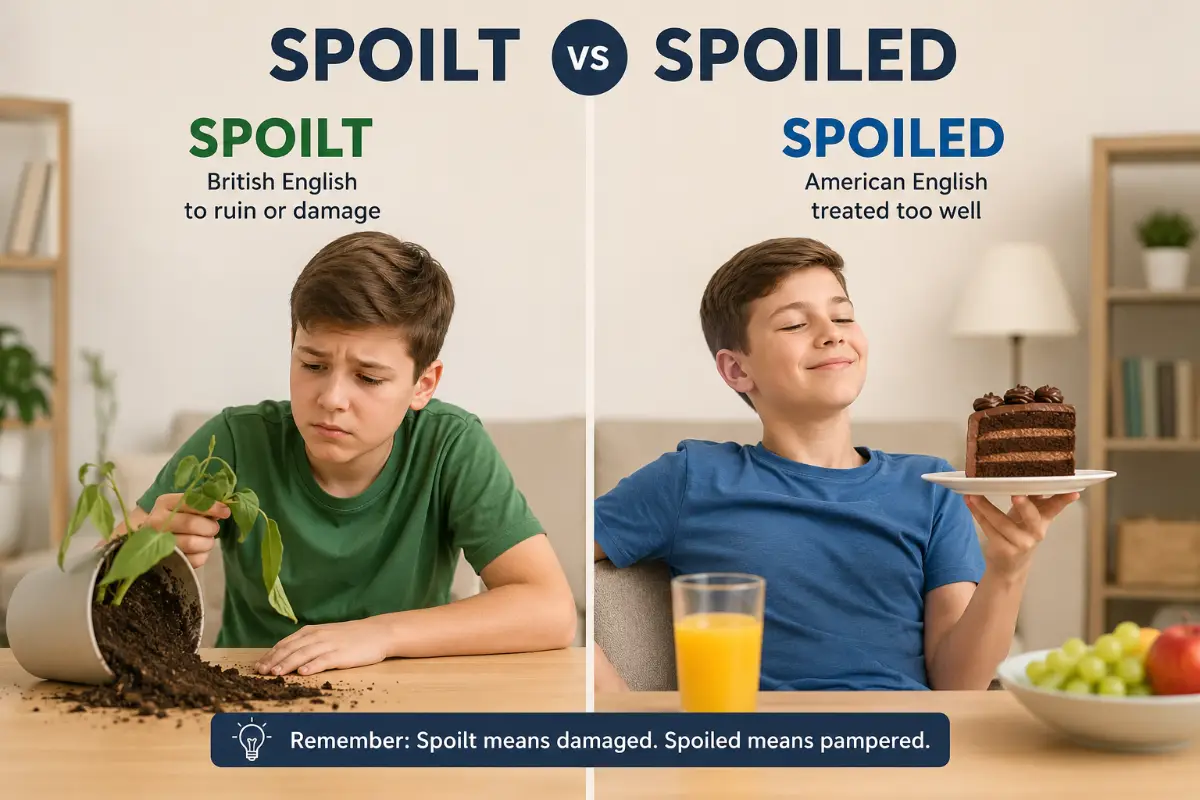
Spoilt vs spoiled is a common English spelling and usage question because both forms are correct. The main difference is regional. Spoiled is the standard form in American English while spoilt is especially common in British English.
The two forms can describe food that has gone bad. They can also describe a child who has received too much attention or too many gifts. In addition spoiled can describe something damaged by poor treatment. The meaning usually comes from the context.
The confusion often starts when readers see one form in a book from another country. A British writer may use spoilt while an American writer naturally chooses spoiled. Both writers can be following the spelling conventions of their variety of English.
There is also a grammar issue behind the comparison. Spoiled and spoilt can function as past forms and past participles of spoil. In some contexts spoilt also works as an adjective.
This guide explains the difference in plain English. You’ll learn which spelling to use in American writing how British English uses the other form and how to avoid common mistakes.
For another common grammar confusion, see Meantime Or Mean Time Which One Is Correct 2026.
Quick Answer
Spoiled is the preferred spelling in American English. Spoilt is also correct and is especially common in British English. Both forms are related to the verb spoil and can mean damaged ruined or given too much attention. For American readers and formal US writing choose spoiled.
Spoilt Vs Spoiled Comparison Table
| Feature | Spoiled | Spoilt |
|---|---|---|
| Correct spelling | Yes | Yes |
| Common in American English | Very common | Less common |
| Common in British English | Common | Very common |
| Part of speech | Verb form or adjective | Verb form or adjective |
| Base verb | Spoil | Spoil |
| Past tense | Yes | Yes |
| Past participle | Yes | Yes |
| Common meaning | Damaged ruined or overindulged | Damaged ruined or overindulged |
| Formal writing | Preferred in US English | Preferred in UK English |
| Pronunciation | Usually pronounced the same | Usually pronounced the same |
| Example | The milk has spoiled. | The milk has spoilt. |
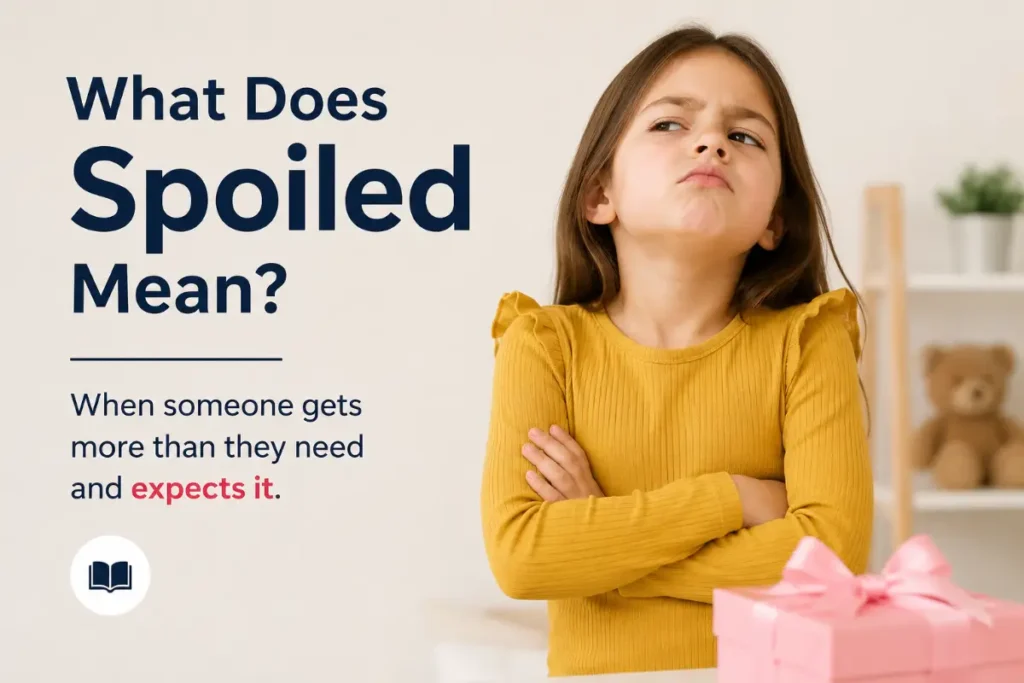
What Does Spoiled Mean
Spoiled is the regular past form and past participle of the verb spoil. It can also work as an adjective.
The word has several related meanings.
Spoiled Means Ruined Or Damaged
When food spoils it becomes unsafe or unpleasant to eat.
Examples include:
The milk has spoiled.
The meat spoiled after the refrigerator stopped working.
The hot weather spoiled the fruit.
The same idea can apply to something that has lost its quality.
The rain spoiled our picnic.
The broken equipment spoiled the presentation.
Spoiled Means Given Too Much
A person can also be spoiled when they receive so many gifts privileges or special favors that they become demanding or ungrateful.
For example:
The child is spoiled by his grandparents.
She grew up spoiled and expected everyone to help her.
The coach doesn’t want to create spoiled athletes who expect special treatment.
This meaning often appears in conversations about children. It can also describe adults who have become used to getting everything they want.
Spoiled Means Affected In A Negative Way
The word can describe something that has been made less enjoyable or less valuable.
The surprise was spoiled when someone revealed the ending.
His rude comment spoiled the mood.
The leak spoiled the announcement.
In these examples the thing wasn’t physically damaged. Something caused the experience or result to lose its value.
What Does Spoilt Mean
Spoilt has the same basic meanings as spoiled. The main distinction is regional preference.
British English commonly uses spoilt alongside spoiled. American English strongly favors spoiled.
Examples from British style include:
The milk has spoilt.
The children have been spoilt by their parents.
The ending was spoilt by an online post.
A British writer can use spoiled too. The form isn’t wrong in British English. However spoilt has a long established place in British usage.
Which One Is Correct
Both spoilt and spoiled are correct.
For an American audience spoiled is the safest and most natural choice.
For British English spoilt is common and familiar. Spoiled is also accepted.
The practical rule is simple.
Use spoiled for American English.
Use spoilt when following a British English style.
If you’re writing a school paper for a US audience a business document for an American company or website content aimed at American readers spoiled should usually be your first choice.
If you’re writing for a British publication or following British spelling conventions spoilt can be the better choice.
Why People Confuse Spoilt And Spoiled
The confusion comes from more than one source. The words have the same base verb and the same basic meaning. The biggest difference is the spelling convention used by different English speaking regions.
Regional Spelling Creates Confusion
English has many regional differences.
American English often prefers one spelling while British English keeps another. This happens with several verbs.
For example:
American English uses learned more often.
British English also uses learnt.
American English commonly uses spelled.
British English commonly uses spelt.
The same pattern helps explain spoiled and spoilt.
Both Forms Appear In Books And On Websites
Someone who normally reads American English may encounter spoilt in a British novel. A British reader may see spoiled in an American article.
Neither spelling automatically signals a mistake.
The surrounding style usually tells you which variety of English the writer follows.
The Base Verb Makes Both Forms Look Natural
The verb spoil has been used in English for centuries. English developed more than one past form for this verb.
That history helps explain why both forms remain in modern use.
Online Content Mixes English Varieties
The internet brings American British Canadian Australian and other forms of English together.
A reader can see spoilt in one post and spoiled in another within seconds. Search engines don’t separate every result by regional variety. That makes regional spelling differences easy to mistake for spelling errors.
Key Differences Between Spoilt And Spoiled
The meaning is almost identical. The important difference is regional preference and style.
American English Prefers Spoiled
In the United States spoiled is the normal choice.
Americans commonly write:
The food has spoiled.
He was spoiled as a child.
The ending was spoiled for me.
The weather spoiled our plans.
British English Often Uses Spoilt
British English commonly uses:
The food has spoilt.
He was spoilt as a child.
The surprise was spoilt.
The rain spoilt our plans.
British writers also use spoiled. The two forms can coexist in British English.
The Difference Is Not A Difference In Meaning
This point matters.
Spoiled does not mean one thing while spoilt means something completely different.
In most ordinary contexts they express the same idea.
Compare:
The milk has spoiled.
The milk has spoilt.
Both sentences say the milk has gone bad.
The difference lies mainly in the English variety being used.
Grammar Explanation
Understanding the grammar behind the words makes the spelling easier to remember.
The base verb is spoil.
Its common forms include:
Base form: spoil.
Third person singular: spoils.
Present participle: spoiling.
Past tense: spoiled or spoilt.
Past participle: spoiled or spoilt.
The past tense describes an action that happened in the past.
The past participle appears in perfect constructions and passive structures.
Spoiled As A Past Tense Verb
American English commonly uses spoiled for a completed past action.
The heat spoiled the food.
The storm spoiled our plans.
The child spoiled the surprise.
British English can use either spoiled or spoilt.
The heat spoilt the food.
The storm spoiled our plans.
Both structures are grammatically sound.
Spoiled As A Past Participle
The past participle appears with forms of have.
American English:
The fruit has spoiled.
The children have spoiled the surprise.
British English:
The fruit has spoilt.
The children have spoilt the surprise.
The choice again depends on regional style.
Spoiled As An Adjective
Spoiled can describe a condition or characteristic.
The spoiled milk smelled terrible.
He is a spoiled child.
The spoiled teenager expected expensive gifts.
The adjective can also describe something damaged.
The spoiled surprise ruined the moment.
Spoilt As An Adjective
British English frequently uses spoilt in the same way.
The spoiled child and the spoilt child have the same basic meaning.
The difference is stylistic and regional rather than semantic.
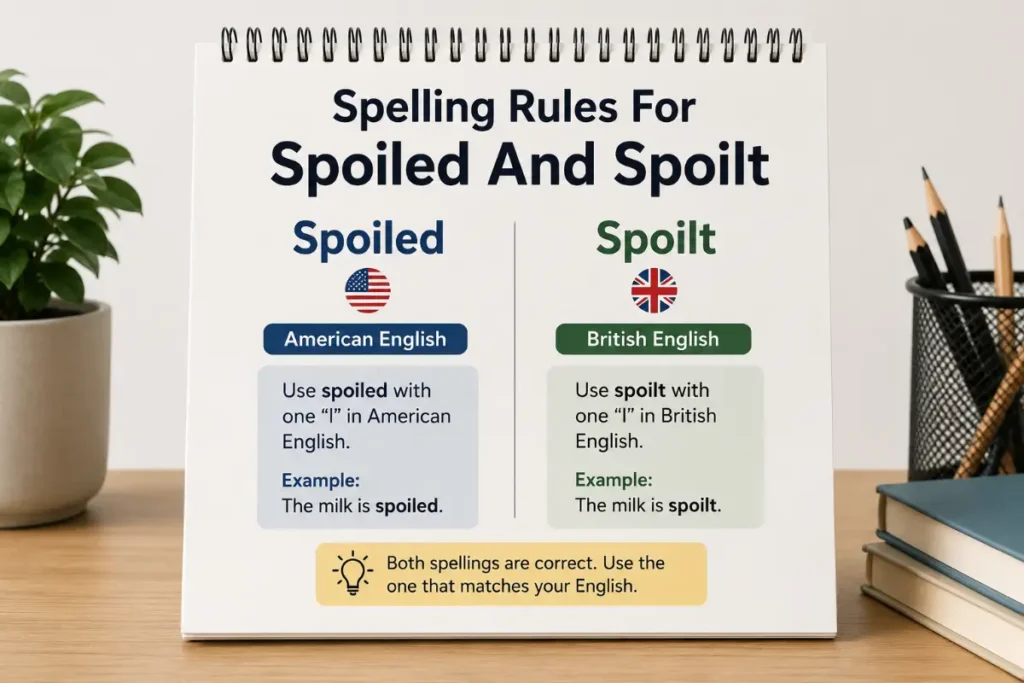
Spelling Rules For Spoiled And Spoilt
The spelling difference comes from the way English forms past tense and past participle forms for certain verbs.
Spoiled follows the regular pattern of adding ed.
Spoil becomes spoiled.
Spoilt is an irregular form.
Spoil becomes spoilt.
Both forms developed in English and both remain in modern dictionaries.
Why Is There No Extra Letter In Spoiled
The base verb ends with the letter l.
You simply add ed.
Spoil becomes spoiled.
There is no need to double the final consonant.
Compare this with words where English spelling rules require a consonant change before adding an ending.
Spoil doesn’t follow that pattern.
Why Does Spoilt Look So Different
The form spoilt doesn’t use the regular ed ending. Instead it keeps an older irregular pattern.
This is similar to other pairs found in English.
Learn becomes learnt.
Spell becomes spelt.
Dream becomes dreamt.
Spoil becomes spoilt.
These forms are particularly familiar in British English.
Spoiled Vs Spoilt In American English
If your target audience lives in the United States the answer is straightforward.
Choose spoiled.
American dictionaries and American style generally favor the ed form.
Here are natural American examples.
My milk has spoiled.
The child was spoiled by his parents.
The surprise was spoiled before dinner.
Too much rain spoiled the game.
The vacation wasn’t spoiled by the delay.
The ending was spoiled by a social media post.
American readers will understand spoilt when they encounter it. It may simply look British or unusual rather than incorrect.
You may also want to read Less Than And Greater Than Made Simple.
Spoilt Vs Spoiled In British English
British English gives writers more flexibility.
Both forms occur but spoilt is especially familiar in everyday British usage.
A British speaker might naturally say:
You’ve spoilt the surprise.
The food has spoilt.
He was a spoilt child.
The weather spoilt our plans.
British writers can also use spoiled.
You’ve spoiled the surprise.
The food has spoiled.
He was a spoiled child.
The choice can depend on personal preference publication style and the type of English being followed.
Canadian English And Australian English
Canadian English sits between several traditions because Canadian writing contains both British and American influences.
Both spoiled and spoilt can appear in Canadian English. The ed form is widely understood and often preferred in modern usage.
Australian English also recognizes both forms. Spoilt remains familiar in Australian writing and speech while spoiled is also used.
If you’re writing for a specific publication the safest approach is to follow that publication’s established spelling style.
Consistency matters more than trying to force one form into every English speaking region.
Pronunciation Guide
The pronunciation of spoiled and spoilt is close enough that the regional spelling difference may not be obvious when spoken.
Spoiled Pronunciation
A common American pronunciation is:
IPA: /spɔɪld/
The word has one syllable.
The main sound is similar to the vowel sound in boy.
Spoilt Pronunciation
A common pronunciation is:
IPA: /spɔɪlt/
It also has one syllable.
The main difference is the final consonant sound.
Spoiled ends with a d sound.
Spoilt ends with a t sound.
In natural speech the difference can become subtle because speakers connect sounds quickly.
Common Pronunciation Mistake
Some learners try to pronounce spoiled as two syllables.
That isn’t the normal pronunciation.
Say it as one syllable:
spoiled
Likewise:
spoilt
Both are short one syllable words.
Word Origin And Etymology
The history of spoil helps explain why English has both spoiled and spoilt.
The verb traces back through French to Latin. The Latin word spoliare referred to stripping or taking away. Over time related forms developed meanings connected with damaging something or depriving it of its original condition.
English later expanded the verb into several modern meanings.
To spoil food means to cause it to decay or become unfit for use.
To spoil a child means to give the child so much attention or material comfort that the child becomes demanding.
To spoil a surprise means to destroy the intended effect by revealing information too soon.
To spoil an occasion means to make an otherwise enjoyable event less pleasant.
The different meanings may look unrelated at first. They all share the broader idea of damaging or diminishing something.
The two past forms developed alongside different English patterns. Spoiled follows the regular ed pattern while spoilt preserves an older irregular form.
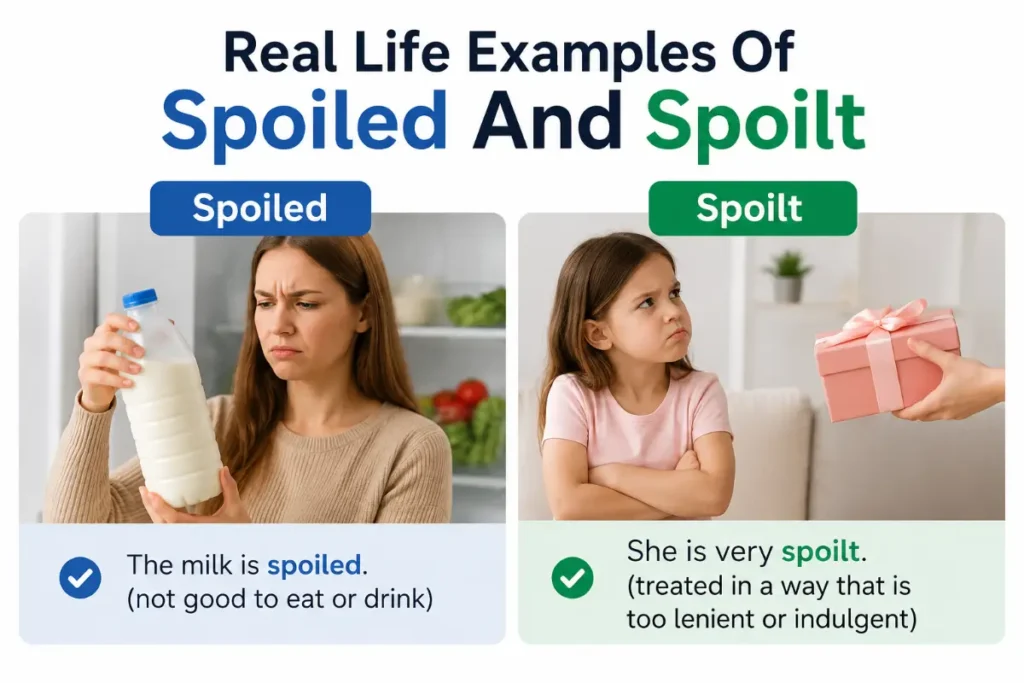
Real Life Examples Of Spoiled And Spoilt
Context is one of the best ways to understand regional usage. The following examples show how the words work naturally.
Daily Conversation
- The milk has spoiled because the refrigerator stopped working.
- Don’t eat that yogurt. It smells spoiled.
- His parents spoiled him when he was young.
- You spoiled the ending for me.
- The rain spoiled our plans for the afternoon.
- She doesn’t want her kids to grow up spoiled.
- The hot weather spoiled the fruit.
- I accidentally spoiled the surprise.
Workplace Examples
- The delay spoiled our original schedule.
- The food in the office refrigerator had spoiled.
- Someone spoiled the announcement before the meeting.
- Poor communication spoiled an otherwise successful project.
- The manager didn’t want to create a spoiled workplace culture.
- A last minute change spoiled the presentation.
Email Examples
- I’m sorry if my message spoiled the surprise.
- The damaged shipment spoiled several products.
- We discovered that some of the items had spoiled during transport.
- The weather spoiled the outdoor event.
Academic Writing
- The author explores how privilege can create spoiled behavior.
- The study examines how environmental conditions can cause food to spoil.
- The novelist uses the spoiled character to criticize excessive privilege.
- The historical account describes how poor storage caused the supplies to spoil.
Journalism
- The unexpected leak spoiled the planned announcement.
- Extreme heat spoiled large quantities of fresh produce.
- Critics argued that the early revelation spoiled the film’s central mystery.
Social Media
- Someone spoiled the ending before I had time to watch the episode.
- The rain spoiled our beach day.
- This dessert looks amazing but mine has already spoiled.
- Parents joked that their youngest child was completely spoiled.
The same meanings work with spoilt when the writer follows British or another variety of English where that form is preferred.
Common Mistakes With Spoilt And Spoiled
Several mistakes appear again and again.
Mistake One
Writing spoilt in American English when the goal is consistent US spelling.
This isn’t a serious grammar error. It simply creates a regional style mismatch.
For an American audience write:
The food has spoiled.
Mistake Two
Assuming spoilt is incorrect.
It isn’t.
British English has used spoilt for a long time. Major English dictionaries recognize it.
Mistake Three
Assuming spoiled is only American.
It isn’t.
British English also uses spoiled. The ed form can be perfectly acceptable in British writing.
Mistake Four
Thinking the words have different meanings.
In ordinary use they generally don’t.
The difference is primarily the preferred verb form used in different varieties of English.
Mistake Five
Changing spelling randomly within one piece.
A document should follow a consistent style.
If you’re writing American English use spoiled throughout unless you are directly quoting a source that uses another form.
If you’re following British English choose the form that matches your chosen house style.
Memory Tricks For Choosing The Right Form
A simple memory trick can save you from second guessing the spelling.
Think American Ed
For American English think:
America uses spoiled.
The familiar ed ending makes the choice easy.
Think British Irregular Forms
British English often keeps irregular past forms that American English tends to replace with regular forms.
Think of this group:
Learned and learnt.
Spelled and spelt.
Dreamed and dreamt.
Spoiled and spoilt.
This isn’t an absolute rule for every verb but it gives you a useful pattern.
Use Your Audience As The Final Check
Don’t ask only which form is correct.
Ask who you’re writing for.
For a US website:
spoiled
For a UK publication:
spoilt or spoiled depending on its style guide.
That approach is more useful than memorizing a rigid rule.
Expert Editor’s Note
A professional editor wouldn’t mark spoilt as an error simply because the document uses British English. The editor would first identify the publication’s language variety and style guide.
For American English spoiled is the natural default.
For British English spoilt has strong traditional usage and remains common. Spoiled is also valid.
The most important editorial principle is consistency. A US article that uses spoiled in one paragraph and suddenly switches to spoilt without a reason can look poorly edited. The same applies in reverse.
Another useful point is tone. Spoilt can sometimes feel more distinctly British to American readers. Spoiled generally feels neutral to American readers.
Professional writing doesn’t require you to avoid regional forms. It requires you to understand them and use them intentionally.
Related Words And Expressions
The verb spoil has a broad family of related forms.
Spoil
This is the base verb.
Don’t let the heat spoil the food.
Spoils
This is the third person singular present form.
Heat spoils fresh food quickly.
Spoiling
This is the present participle.
The food is spoiling in the refrigerator.
Spoiled
This is the regular past form and past participle.
The food has spoiled.
Spoilt
This is an alternative past form and past participle.
The food has spoilt.
Spoilage
Spoilage refers to the process or result of something becoming damaged or unusable.
Food spoilage can happen when food isn’t stored properly.
Spoiler
A spoiler is information that reveals an important part of a story before someone experiences it.
Please don’t post spoilers.
Spoil For Something
The expression spoil for a fight means to be eager or ready to fight.
He seemed to be spoiling for a fight.
This expression has a different meaning from spoiled food or a spoiled child.
You may also want to read On To Vs Onto Which One Is Correct (2026).
Conclusion
Spoilt and spoiled are both correct forms of the verb spoil. The main difference is regional preference.
For American English spoiled is the clear everyday choice. British English commonly uses spoilt and also accepts spoiled.
Both forms can describe food that has gone bad a child who receives too much attention or something that has been ruined. Their meanings don’t change simply because the spelling changes.
If you’re writing for an American audience use spoiled. If you’re writing for a British audience follow the publication’s preferred style and use spoilt or spoiled consistently.
The mistake to avoid is assuming one spelling is universally right and the other is universally wrong.
English has room for both. Good writing comes from knowing where each form belongs.

Senior Grammar Editor
Olivia Reynolds is a grammar editor and language writer who enjoys making complex English rules easy to understand. She specializes in grammar, punctuation, sentence structure, and everyday writing tips, helping readers write with greater confidence and clarity.