

The difference between on to vs onto looks small on the page but it can change the meaning and grammar of a sentence. Both forms are correct. The trick is knowing what job on is doing in the sentence.
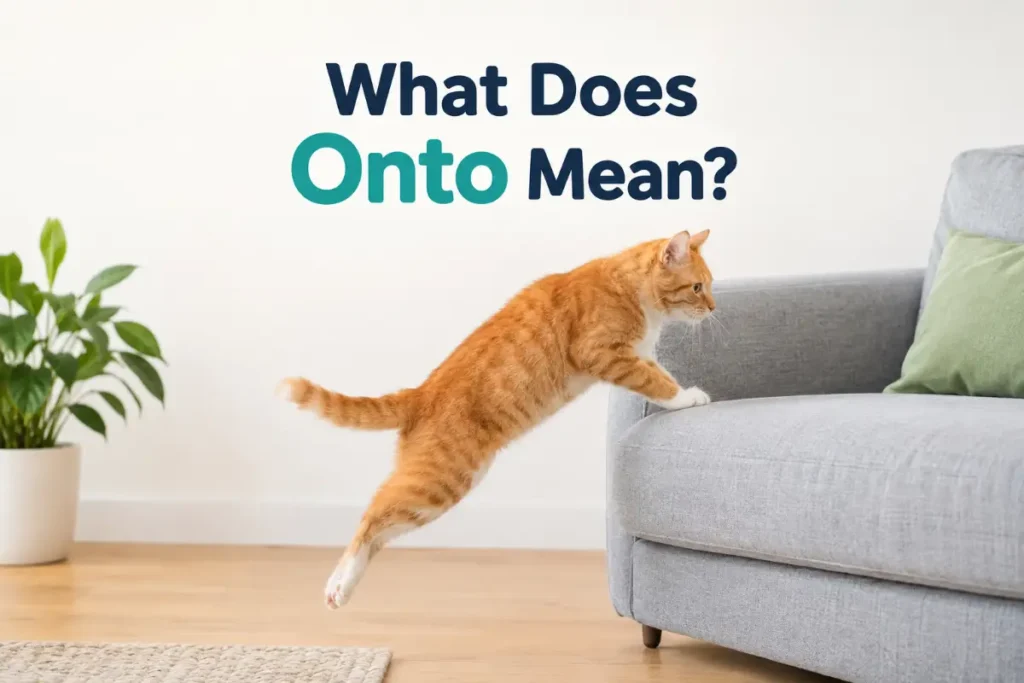
Use onto when you mean movement to a position on a surface or place. For example: The cat jumped onto the table. Use on to when on belongs to the verb or phrase before it and to introduces what comes next. For example: She went on to explain the problem.
This distinction causes trouble because onto and on to often sound exactly the same in ordinary speech. Writers also see onto used widely and may assume it should always be written as one word. It doesn’t work that way.
In this guide you’ll learn the difference between the two forms with clear grammar rules and natural examples. You’ll also see how native speakers use them in everyday English and formal writing. By the end you’ll have a simple test you can use whenever you’re unsure.
A related grammar guide is Footnote Before or After Period (2026 Guide).
Quick Answer
Onto is usually one word when it means movement to a position on something. The child climbed onto the bed. On to is two words when on belongs to the preceding verb or expression and to starts the next phrase. She went on to become a doctor. Both forms are correct.
On To Vs Onto Comparison Table
| Feature | On to | Onto |
|---|---|---|
| Spelling | Two words | One word |
| Main function | Preposition or adverb plus to | Preposition |
| Main meaning | Continuing an action or moving forward to something | Movement to a position on or onto a surface |
| Common example | She went on to win. | She climbed onto the roof. |
| Can describe physical movement | Sometimes | Yes |
| Can describe continuing an action | Yes | No |
| Formal writing | Correct | Correct |
| American English | Common | Common |
| British English | Common | Common |
| Pronunciation | Usually the same | Usually the same |
| Main test | Can on stay with the verb? | Does it mean movement to a position on something? |
What Does Onto Mean
Onto is a preposition. It usually shows movement toward and then to a position on a surface or object.
Think of onto as showing a change of position.
Something starts in one place and ends up on another thing.
For example:
The dog jumped onto the sofa.
The dog was somewhere else before the jump. After the movement the dog was on the sofa.
That movement is why onto works.
Simple Definition Of Onto
Onto means moving to a position on something.
Examples include:
She stepped onto the bus.
The bird flew onto the roof.
He put the keys onto the table.
The child climbed onto the chair.
In each sentence something moves toward a new position.
Onto In Physical Movement
This is the most common use.
Consider these examples.
- The boy climbed onto the wall.
- She stepped onto the stage.
- The puppy jumped onto my lap.
- We loaded the boxes onto the truck.
- The bird landed onto the branch.
The last example needs a small editorial note. Landed on the branch sounds more natural to most native speakers. Although onto can express movement toward a surface, English does not always require it after every movement verb.
That distinction matters because good English depends on natural usage as well as grammar.
Onto In A More Abstract Sense
Onto can also describe movement toward a new subject or stage in some expressions.
For example:
Let’s move onto the next topic.
Here the movement isn’t physical. The speaker is moving from one subject to another.
Another example is:
The company moved onto a new stage of development.
This use is less concrete but still carries the idea of moving toward a new position or stage.
What Does On To Mean
On to contains two separate words.
The word on often belongs to the verb or verbal expression that comes before it. The word to then introduces another part of the sentence.
Consider this sentence:
She went on to become a successful writer.
Here went on means continued. The word to introduces the next action.
You aren’t saying that she physically moved onto something.
You’re saying that she continued and eventually became a successful writer.
Simple Definition Of On To
On to usually means continuing from one action subject stage or idea to another.
Examples include:
He went on to study medicine.
After lunch we moved on to the next lesson.
She went on to explain her decision.
The team moved on to a new project.
The exact meaning depends on the verb and the context.
Which One Is Correct
Both on to and onto are correct.
The right form depends on the meaning of the sentence.
Use onto when the phrase expresses movement to a position on something.
The cat jumped onto the bed.
Use on to when on belongs with the preceding verb or expression.
The cat went on to explore the house.
A useful editing question is this:
Does the sentence describe movement onto a surface or continued movement toward another action or idea?
If it describes movement to a position on something, onto is usually the natural choice.
If on means something like continue or forms part of the verb phrase, keep on and to separate.
How To Tell The Difference
There is a simple test that works in many sentences.
Test One
Replace onto with to a position on.
If the sentence still makes sense, onto is probably right.
The child climbed onto the bed.
Becomes:
The child climbed to a position on the bed.
The meaning remains clear.
Test Two
Try removing on from the sentence.
If on clearly belongs to the verb and removing it changes the meaning, write on to.
She went on to become a teacher.
Remove on:
She went to become a teacher.
The meaning changes. Went on means continued.
So the two word form is correct.
Test Three
Ask what on means.
If on describes a position or surface, onto may be appropriate.
If on means continue or forms part of a phrasal verb, keep it separate from to.
This test isn’t perfect in every sentence because English has flexible structures. Still, it works extremely well for everyday writing.
On To Vs Onto In Everyday English
Native speakers often use both forms without thinking about the grammar behind them.
That’s because pronunciation doesn’t usually help.
Compare these sentences.
She moved onto the next page.
She moved on to the next page.
Both can be acceptable depending on the intended structure and style. The distinction becomes clearer when the role of on is obvious.
Now compare:
He went onto the stage.
He went on to become famous.
The first sentence describes physical movement to the stage.
The second describes what happened next in his life or career.
That difference is much easier to see once you focus on meaning instead of spelling.
Grammar Explanation
Understanding the grammar behind these forms gives you a reliable way to make the right choice.
Onto Is A Preposition
A preposition connects a noun or pronoun with another part of the sentence.
In:
The rabbit jumped onto the box.
Onto connects the verb jumped with the noun box.
It tells us where the rabbit moved.
Other examples include:
The athlete stepped onto the track.
The child climbed onto the roof.
The phone fell onto the floor.
On Can Be An Adverb
In some sentences on works as an adverb rather than part of the preposition onto.
Consider:
She carried on to the next room.
Here carried on means continued.
The to phrase tells us what came next.
Another example:
He read on to discover the answer.
Here read on means continued reading.
The phrase to discover the answer explains what happened as a result.
Writing read onto discover would be incorrect.
On Can Be Part Of A Phrasal Verb
This is one of the most important points.
English contains many phrasal verbs with on.
Examples include:
- Carry on.
- Go on.
- Move on.
- Read on.
- Hold on.
- Keep on.
- Press on.
When one of these expressions is followed by to, the words often remain separate.
For example:
She carried on to the next chapter.
He went on to discuss the results.
We moved on to another question.
She went on to win the competition.
The on belongs to the preceding verbal expression.
When Onto Is The Better Choice
Choose onto when the sentence clearly shows movement toward a position on something.
Onto A Surface
The glass fell onto the floor.
She placed the book onto the desk.
The child climbed onto the bed.
Onto A Vehicle
They got onto the bus.
The passengers stepped onto the train.
He jumped onto the bicycle.
In everyday American English some speakers prefer on instead of onto in certain vehicle expressions.
For example:
She got on the bus.
That sentence sounds completely natural.
Onto adds a stronger sense of movement toward the position.
Onto A Stage Or Platform
The actor walked onto the stage.
The speaker stepped onto the platform.
The singer ran onto the field.
These sentences describe movement from one location to another.
When On To Is The Better Choice
Choose on to when on belongs to the preceding verb or expression.
Go On To
This is one of the most common structures.
After college she went on to study law.
The phrase went on means continued.
The sentence means she continued her journey and later studied law.
Move On To
Let’s move on to the next question.
Here move on means continue.
The word to introduces the next subject.
Go On To Describe Something
The article goes on to describe the causes of the problem.
The article continues by describing the causes.
Read On To Discover Something
Read on to discover how the process works.
Read on means continue reading.
The word to introduces the purpose or next action.

On To Vs Onto With Verbs Of Movement
Movement verbs create some of the most confusing examples.
Words such as jump climb step walk move and get can appear with onto.
For example:
The cat jumped onto the counter.
This clearly describes physical movement.
But a sentence such as:
She moved on to another department.
has a different structure.
Here move on means continue or progress.
The noun phrase another department follows to.
This gives us a useful contrast.
She moved onto the platform.
She physically moved to a position on the platform.
She moved on to another project.
She continued from one project to another.
The difference isn’t simply about physical versus abstract meaning. It comes from the grammatical role of on.
On To Vs Onto With Abstract Ideas
English often uses movement language to describe ideas and stages.
This creates another area of confusion.
Consider:
Let’s move on to the next topic.
Most writers use on to here because move on is a familiar expression meaning continue.
Now consider:
The discussion moved onto a new topic.
This form also appears in English and can be understood as movement toward a new subject.
In practical writing the two forms can sometimes overlap. When the distinction becomes unclear, rewrite the sentence for clarity.
For example:
Let’s move on to the next topic.
This is simple natural and unmistakable.
Good editing isn’t about forcing one spelling pattern into every sentence. It’s about choosing the construction that communicates the meaning cleanly.
On To Vs Onto In Formal Writing
Both forms appear in professional and academic writing.
The important issue is clarity.
Formal writers should not automatically choose onto simply because it looks cleaner. They should first identify the grammatical structure.
Consider:
The researcher went on to examine the second group.
This is correct.
Changing it to:
The researcher went onto examine the second group.
is incorrect.
The phrase went on means continued. The infinitive to examine follows it.
Now consider:
The researcher placed the samples onto the tray.
Here onto works because the samples moved to a position on the tray.
In formal writing these small distinctions matter because grammatical precision affects credibility.
On To Vs Onto In American English
American English uses both forms regularly.
Onto is especially common when writers want to emphasize movement toward a surface.
Examples include:
The child climbed onto the roof.
The bird flew onto the fence.
The player stepped onto the field.
At the same time American English often uses on rather than onto after certain verbs.
For example:
She got on the bus.
He jumped on the bed.
They climbed on the roof.
The choice can depend on the verb and the exact meaning.
American writers should also recognize on to as a separate grammatical structure.
He went on to become a judge.
That construction is extremely common in American English.
British English And Other Varieties
British English also uses onto and on to.
The basic distinction remains the same.
British writers commonly use onto for movement to a position.
The cat jumped onto the chair.
They also use on to when on belongs with the preceding verb.
She went on to explain her decision.
Canadian Australian and New Zealand English follow much the same pattern.
The main difference you’ll notice across English varieties is often stylistic rather than grammatical.
A Note About Style Guides
Some style traditions have treated onto cautiously because English has long allowed both on to and onto.
That can make older grammar advice seem stricter than modern usage.
Contemporary English accepts onto as a standard preposition. It also accepts on to when the grammatical structure requires two separate words.
The safest editorial approach is simple.
Don’t decide based on appearance.
Look at the function of on in the sentence.
If on belongs to a verb phrase such as go on or move on, keep it separate.
If onto functions as the preposition showing movement to a position on something, use the single word.
A Quick Editor’s Test
When proofreading your sentence ask these three questions.
- Does onto mean movement to a position on something?
- Does on belong to a phrasal verb such as go on or move on?
- Would changing onto to to a position on preserve the meaning?
If the first and third answers are yes, onto is probably right.
If on clearly belongs with the verb, use on to.
This small habit can prevent most mistakes.
Suggested Internal Link: On vs Upon Difference Explained.
Real Life Examples Of On To And Onto
Examples make this distinction much easier because the difference often depends on what on is doing in the sentence.
The examples below cover common speech as well as workplace writing academic English journalism and informal communication.
Everyday Examples With Onto
- The cat jumped onto the kitchen counter.
- She stepped onto the sidewalk.
- The child climbed onto the bed.
- He threw the ball onto the roof.
- The bird flew onto the fence.
- She placed the phone onto the table.
- The actor walked onto the stage.
- The dog jumped onto my lap.
- The player ran onto the field.
- The box fell onto the floor.
Each sentence presents onto as a preposition that shows movement toward a position on something.
Everyday Examples With On To
Now look at sentences where on stays connected to the preceding verb or expression.
- She went on to explain what happened.
- He went on to become a famous chef.
- We moved on to the next question.
- She carried on to the next chapter.
- He read on to find out what happened.
- The speaker went on to discuss the results.
- After finishing the first task we moved on to the second.
- The story goes on to describe the family’s journey.
- She went on to earn a degree in biology.
- The team moved on to a more difficult stage of the competition.
Here on isn’t telling us that something moved onto a physical surface. It works with the verb to express continuation or progression.
On To Vs Onto In The Workplace
Workplace writing gives you plenty of examples because people frequently talk about moving from one task project or stage to another.
Consider this sentence.
Let’s move on to the next item on the agenda.
Move on means continue. The word to introduces the next item.
Now compare it with:
The technician moved the equipment onto the platform.
The equipment physically changed position and ended up on the platform.
The difference is easy to miss when you read quickly. A professional editor looks at the function of the words rather than simply counting how many letters appear between them.
Workplace Examples
- After reviewing the budget we moved on to the hiring plan.
- The employee went on to discuss the new policy.
- The workers lifted the machine onto the platform.
- Please place the documents onto the conference table.
- Once we’ve finished this section we’ll move on to the next one.
- The engineer climbed onto the inspection platform.
- The presentation went on to cover the company’s future plans.
- The team moved on to a new phase of the project.
On To Vs Onto In Academic Writing
Academic writing often uses on to in expressions describing a sequence of ideas actions or stages.
For example:
The study went on to examine the effects of sleep deprivation.
The researchers continued their work and examined another subject.
You wouldn’t normally write:
The study went onto examine the effects of sleep deprivation.
The single word onto doesn’t fit because went on is the relevant expression.
Academic writing also uses onto for literal movement.
The researcher transferred the samples onto a glass plate.
The samples moved to a position on the plate.
This distinction becomes especially important in technical writing where small grammatical choices can affect clarity.
On To Vs Onto In Emails
Emails tend to use simple constructions. You don’t need complicated grammar to get this right.
Correct examples include:
Let’s move on to the next issue.
I’ll go on to explain the remaining steps.
Please place the signed form onto the scanner.
The technician moved the equipment onto the table.
A useful habit is to read the sentence aloud and identify the verb phrase.
In:
Let’s move on to the next issue.
the expression is move on.
In:
Move the file onto the desktop.
the word onto shows where the file should go.
On To Vs Onto In Journalism
Journalists often use on to when describing someone’s next achievement or stage of life.
For example:
After leaving the company she went on to launch her own business.
The person continued to a new stage.
Journalists use onto when reporting physical movement.
The protesters climbed onto the steps outside the building.
The protesters physically moved to a position on the steps.
This distinction appears frequently in biographies sports reports interviews and feature writing.

On To Vs Onto In Social Media
Informal writing creates even more confusion because people often type quickly.
You may see:
She went onto talk about her childhood.
In standard edited English this should usually be:
She went on to talk about her childhood.
The phrase went on means continued.
Now consider:
She jumped onto the stage.
That form is correct because onto describes physical movement.
Social media doesn’t always follow edited English conventions. A common online form isn’t automatically the best form for professional or academic writing.
On To Vs Onto With Go
The verb go appears frequently with both forms.
Compare these sentences carefully.
He went onto the stage.
He physically moved to a position on the stage.
He went on to become an actor.
He continued to another stage in his life and career.
The difference is dramatic even though the sentences look almost identical.
Another pair makes the point even clearer.
She went onto the field.
She physically entered the field.
She went on to win the championship.
She continued and eventually won.
This is one of the most useful pairs to memorize.
Learn the difference in Meantime Or Mean Time Which One Is Correct 2026.
On To Vs Onto With Move
The verb move can also produce both constructions.
The child moved onto the chair.
The child changed physical position and ended up on the chair.
The teacher moved on to the next lesson.
The teacher continued to another lesson.
Again the key is the meaning of on.
In the first sentence onto works as a single preposition.
In the second sentence move on works as an expression meaning continue.
On To Vs Onto With Jump
The same pattern appears with jump.
The dog jumped onto the couch.
This describes physical movement.
But jump on to can appear in a different structure when on and to have separate roles.
For example:
The speaker jumped on to the next point.
This is less common and can sound awkward. A clearer version would usually be:
The speaker moved on to the next point.
Good writing isn’t just about finding a technically possible construction. It also means choosing the version that native speakers find clear and natural.
Common Mistakes With On To And Onto
Mistake One
She went onto explain the situation.
Correct:
She went on to explain the situation.
The problem is that went on means continued.
Mistake Two
The dog jumped on to the sofa.
This can appear in English and isn’t always impossible. Still jumped onto the sofa is the clearer single preposition when the intended meaning is movement to a position on the sofa.
Mistake Three
He moved onto the next question.
This sentence can be found in published English and may be understood. However he moved on to the next question is often the cleaner choice when move on means continue.
Mistake Four
Assuming onto is always wrong in formal writing.
It isn’t.
The data were transferred onto a secure server.
Onto is perfectly acceptable because it expresses movement to a new position.
Mistake Five
Assuming on to is always two words after a movement verb.
It isn’t.
The dog jumped onto the couch.
The meaning determines the form.
Does Onto Always Mean Physical Movement
No.
Onto can have abstract uses as well.
For example:
The discussion moved onto a different subject.
Here the movement is conceptual rather than physical.
Still the construction expresses a shift toward a new position or topic.
Because English allows some overlap between on to and onto in abstract contexts, writers shouldn’t rely on one rigid rule.
When the sentence involves a phrasal verb such as move on the two word form often gives the clearest structure.
When onto functions naturally as a preposition meaning movement to a position on something the single word is appropriate.
Can On To And Onto Ever Both Work
Yes.
Some sentences allow both forms depending on the intended structure or style.
For example:
The discussion moved on to another topic.
This clearly treats move on as the phrasal verb.
You may also encounter:
The discussion moved onto another topic.
Many readers accept this because onto can function as a preposition introducing the new topic.
The meanings overlap so closely that the distinction can become a matter of style.
For careful writing the safest approach is to choose the form that makes the structure easiest to understand.
When you mean continue to another subject the phrase move on to is especially clear.
A Practical Editing Rule
Don’t memorize dozens of isolated examples.
Instead learn the structure.
Verb + on + to + next action or subject
Examples:
go on to explain
go on to become
move on to discuss
move on to the next stage
read on to learn
Movement + onto + destination or surface
Examples:
jump onto the bed
step onto the stage
climb onto the roof
place it onto the table
This pattern handles most everyday cases.
Memory Trick For On To Vs Onto
Think of onto as an arrow.
Something moves from one place to another.
Floor → onto table.
Ground → onto stage.
Road → onto bridge.
Think of on to as a bridge between two actions.
Continue → to explain.
Continue → to learn.
Continue → to the next topic.
The visual difference is simple.
Onto points to a destination.
On to points forward to what happens next.
Related Words And Expressions
Understanding nearby expressions can prevent other common mistakes.
On
On can show position.
The book is on the table.
It can also express continuation.
Please read on.
Onto
Onto normally shows movement toward a position.
The child climbed onto the chair.
Into
Into shows movement toward the inside of something.
She walked into the room.
Compare:
She stepped onto the stage.
She moved to a position on the stage.
She walked into the theater.
She moved inside the theater.
Toward
Toward shows movement in the direction of something.
He walked toward the door.
It doesn’t necessarily mean he reached the door.
Onward
Onward means continuing forward.
The hikers continued onward.
This word can help explain the broader idea behind go on and move on.
On To Vs Onto In Pronunciation
The pronunciation is one reason this pair causes so many mistakes.
In normal American speech on to and onto can sound nearly identical.
On to is commonly pronounced something like:
/ɑn tuː/
Onto is commonly pronounced:
/ˈɑn tuː/
The main difference is grammatical stress and sentence rhythm rather than a dramatic difference in sound.
Syllables
Both forms usually sound like two syllables.
on to
on to
The spelling doesn’t give listeners much help.
That’s why context matters so much in spoken English.
Word Origin
The word on has very old Germanic roots. It has been part of English vocabulary since the earliest stages of the language.
The preposition to also has Old English and Germanic roots.
Onto developed from the combination of on and to and gradually became established as a single preposition.
The two word structure on to remained useful because English also uses on as part of verbal expressions.
This explains why modern English has both forms. The language didn’t simply choose one spelling and discard the other.
The two structures developed different grammatical functions and continue to coexist.
Why Autocorrect Can Make The Problem Worse
Modern writing tools don’t always understand the intended structure.
A spelling checker may recognize both onto and on to as valid. It can’t always determine the meaning you intended.
For example:
She went on to explain the results.
and
She went onto the platform.
Both are grammatically legitimate.
An automated checker can confirm spelling but it may not understand the relationship between go on and to explain.
This is why human proofreading still matters in polished writing. Grammar depends on meaning and structure rather than spelling alone.
What Native Speakers Usually Choose
Native speakers don’t usually stop to analyze the rule.
They choose based on the construction they have learned through years of exposure.
You’ll frequently hear:
go on to explain
go on to become
move on to the next step
jump onto the table
step onto the stage
climb onto the roof
These patterns are worth learning as complete phrases.
Once you’ve seen them often enough the correct form starts to feel natural.
A Short Practice Test
Choose on to or onto in each sentence.
- The puppy jumped ___ the bed.
- She went ___ become a doctor.
- Let’s move ___ the next question.
- He stepped ___ the stage.
- The researcher went ___ discuss the findings.
- The child climbed ___ the chair.
- We moved ___ a new phase of the project.
- She placed the folder ___ the desk.
Answers
- onto
- on to
- on to
- onto
- on to
- onto
- on to
- onto
The pattern becomes clear when you focus on the meaning rather than the spelling.
Expert Editor’s Note
A professional editor won’t treat on to and onto as interchangeable spellings.
The first step is always to identify the grammatical structure.
If on forms part of a phrasal verb such as go on, move on, carry on, or read on, it generally remains separate from to when to introduces the next action or destination.
If onto acts as a preposition showing movement to a position on something, the single word is appropriate.
There is also an important style point.
Real English has gray areas. Some sentences can reasonably be written in more than one way. Good editors consider meaning, clarity, rhythm, and established usage instead of applying a mechanical rule to every sentence.
For learners the most useful rule remains straightforward.
Onto usually describes movement to a position.
On to often describes continuation to the next action or idea.
That rule won’t solve every unusual sentence in English but it will solve the vast majority of cases you’ll encounter in normal writing.
Common Mistakes With On To And Onto
The most common mistakes happen when writers focus on spelling instead of sentence structure. Both on to and onto are valid. The question is what each word is doing in the sentence.
Writing Onto After Go On
Incorrect.
She went onto explain the results.
Correct.
She went on to explain the results.
Here went on means continued. The word to introduces the next action.
Writing Onto After Move On
Incorrect for the intended phrasal verb structure.
We moved onto discuss the problem.
Correct.
We moved on to discuss the problem.
The expression move on means continue. It isn’t describing movement onto a physical surface.
Separating Onto When It Acts As One Preposition
Less natural.
The dog jumped on to the couch.
Clearer.
The dog jumped onto the couch.
The first version can occur in English. Still the single word onto makes the physical movement easier to understand.
Assuming Onto Is Always About A Physical Surface
Not necessarily.
You can use onto in some abstract contexts.
The conversation moved onto a different subject.
The conversation isn’t physically moving. The sentence presents the subject as a new position or stage.
Still move on to is often the cleaner choice when you mean continue.
How To Avoid The Most Common Errors
Use these practical checks when proofreading.
- Look for a phrasal verb such as go on or move on. If on belongs to the verb then keep to separate.
- Look for physical movement toward a position on something. Onto will often be the natural choice.
- Replace onto with to a position on. If the meaning remains clear then onto probably works.
- Read the entire sentence instead of checking the two words in isolation.
- Don’t rely entirely on spell check. Both forms are correctly spelled so software may not catch a grammatical mistake.
On To And Onto In Common Expressions
Some phrases are so common that learning them as complete units is useful.
Go On To
Use go on to when someone continues and then does something else.
She went on to write three bestselling novels.
He went on to become a professor.
The company went on to develop several new products.
Move On To
Use move on to when someone progresses to another subject task stage or activity.
Let’s move on to the next question.
The class moved on to chapter five.
After finishing the first project we moved on to another one.
Carry On To
This construction can mean continuing toward another point.
The hikers carried on to the next village.
The exact meaning depends on the sentence. If the structure feels awkward, rewriting it can often make the meaning clearer.
Step Onto
Use step onto for physical movement.
She stepped onto the platform.
He stepped onto the bus.
Jump Onto
Use jump onto when someone or something jumps to a position on another object.
The puppy jumped onto the sofa.
The child jumped onto the mattress.
Climb Onto
Use climb onto for movement toward a position on something.
The boy climbed onto the roof.
She climbed onto the horse.
On To Vs Onto In Different Sentence Patterns
The position of the words can help you recognize the structure.
Verb Plus Onto Plus Noun
The cat jumped onto the table.
The noun table is the destination.
Phrasal Verb Plus To Plus Noun
We moved on to the next topic.
The expression moved on means continued. The noun phrase the next topic follows to.
Phrasal Verb Plus To Plus Verb
She went on to explain the issue.
The expression went on means continued. The infinitive to explain follows it.
This last pattern is especially important because onto cannot replace on to.
You must write:
He went on to describe the process.
Not:
He went onto describe the process.
When The Meaning Changes
Sometimes changing the spacing changes the meaning.
Compare:
She went onto the stage.
She physically went to the stage.
She went on to become an actress.
She continued to another stage in her life and eventually became an actress.
Now compare:
He climbed onto the roof.
He physically climbed to the roof.
He went on to discuss the roof design.
He continued his discussion and then talked about the roof design.
The spelling difference reflects a difference in grammar and meaning.
On To Vs Onto And Punctuation
Neither on to nor onto requires special punctuation simply because of the form.
The normal punctuation rules of the sentence still apply.
For example:
After lunch we moved on to the next lesson.
No special punctuation is needed.
The children ran onto the playground.
Again no special punctuation is required.
If the sentence begins with an introductory phrase then normal punctuation applies.
After the meeting ended we moved on to the next topic.
The punctuation has nothing to do with on to itself.
Does Onto Need A Hyphen
No.
Onto is normally written as one word.
Don’t write:
on-to
or
on to when you specifically need the preposition onto.
At the same time don’t combine on and to when they perform separate grammatical jobs.
This is one of those cases where adding or removing a space isn’t a cosmetic choice. The space can reflect the structure of the sentence.
On To Vs Onto For English Learners
If English isn’t your first language this pair can feel frustrating because spoken English gives you almost no clue.
The best strategy is to learn common patterns rather than memorize a long grammar rule.
Remember these examples.
Go on to explain.
Go on to become.
Move on to the next step.
Jump onto the table.
Step onto the stage.
Climb onto the roof.
Once these patterns become familiar you’ll start choosing the right form automatically.
More Natural Examples For Everyday Writing
Here are additional examples that show how the distinction works naturally.
- After the interview she went on to answer questions from the audience.
- The toddler climbed onto the chair.
- We moved on to the final part of the lesson.
- The player stepped onto the court.
- He went on to build a successful career.
- The squirrel jumped onto the fence.
- Let’s move on to something more interesting.
- She placed the package onto the counter.
- The book goes on to explain the theory in greater detail.
- The actor walked onto the stage.
- After finishing the first experiment the students went on to the second.
- The child crawled onto the blanket.
- The article goes on to discuss several possible solutions.
- The cyclist jumped onto the path.
- We moved on to the next item.
- The dog climbed onto the couch.
- She went on to earn a master’s degree.
- The performer ran onto the field.
- The teacher went on to explain the final rule.
- He stepped onto the platform.
These examples cover the patterns you’re most likely to encounter in real writing.
A Better Way To Think About The Difference
Don’t think of on to and onto as two competing spellings.
Think of them as two different grammatical structures.
On to is often:
continue + to something.
Onto is often:
move + to a position on something.
That distinction is much more useful than memorizing a dictionary definition.
Imagine a person walking across a room and stepping onto a table.
That’s onto.
Now imagine someone finishing one chapter and continuing to the next.
That’s on to.
The first describes a change in physical position. The second describes progression.
FAQs About On To And Onto
Is Onto One Word Or Two Words
Onto is normally one word when it functions as a preposition showing movement to a position on something. For example: The cat jumped onto the bed. However on to remains two words when on belongs to a preceding verb or expression. For example: She went on to explain the answer.
Should I Write Move On To Or Move Onto
Move on to is usually the clearest choice when you mean continue to another subject task or stage. For example: Let’s move on to the next question. Move onto can also appear in English when onto functions as a preposition. Context determines the best construction.
Is It Go Onto Or Go On To
Use go onto for movement to a position on something. Use go on to when go on means continue and to introduces the next action. Compare She went onto the stage with She went on to become a doctor.
Is Onto More Formal Than On To
Neither form is automatically more formal. They perform different grammatical functions. Onto is the standard single word when it acts as a preposition. On to is necessary when on belongs to a verb phrase such as go on or move on.
Can Onto Be Used For Abstract Ideas
Yes. English sometimes uses onto for abstract movement or changes of subject. For example: The discussion moved onto a new topic. Still move on to is often clearer when you simply mean continue to another subject.
Do American And British English Use Onto Differently
Both American and British English use onto and on to. The basic grammatical distinction is shared across major varieties of English. Canadian and Australian English follow the same general pattern. Differences usually involve style and individual word choice rather than a separate regional rule.
Why Do On To And Onto Sound The Same
The two forms often have almost identical pronunciation in normal speech. Because listeners can’t depend on a clear sound difference they rely on context. This explains why the confusion is more noticeable in writing than in conversation.
What Is The Easiest Rule For Remembering On To And Onto
Think about onto as movement to a position and on to as continuation. If something moves onto a surface use onto. If someone goes on to do something or moves on to the next subject keep the words separate.
For another common grammar confusion, see Arised Or Arose Which Word Is Correct 2026 Guide.
Final Takeaway
The difference between on to vs onto comes down to grammar and meaning rather than spelling preference.
Use onto when it works as a preposition showing movement to a position on something.
The cat jumped onto the table.
Use on to when on belongs to a preceding verb or expression and to introduces what comes next.
She went on to explain the problem.
The most useful phrases to remember are go on to move on to jump onto step onto and climb onto.
Don’t let the missing space trip you up. Find the role of on first and the correct form usually becomes clear.

Senior Grammar Editor
Olivia Reynolds is a grammar editor and language writer who enjoys making complex English rules easy to understand. She specializes in grammar, punctuation, sentence structure, and everyday writing tips, helping readers write with greater confidence and clarity.