
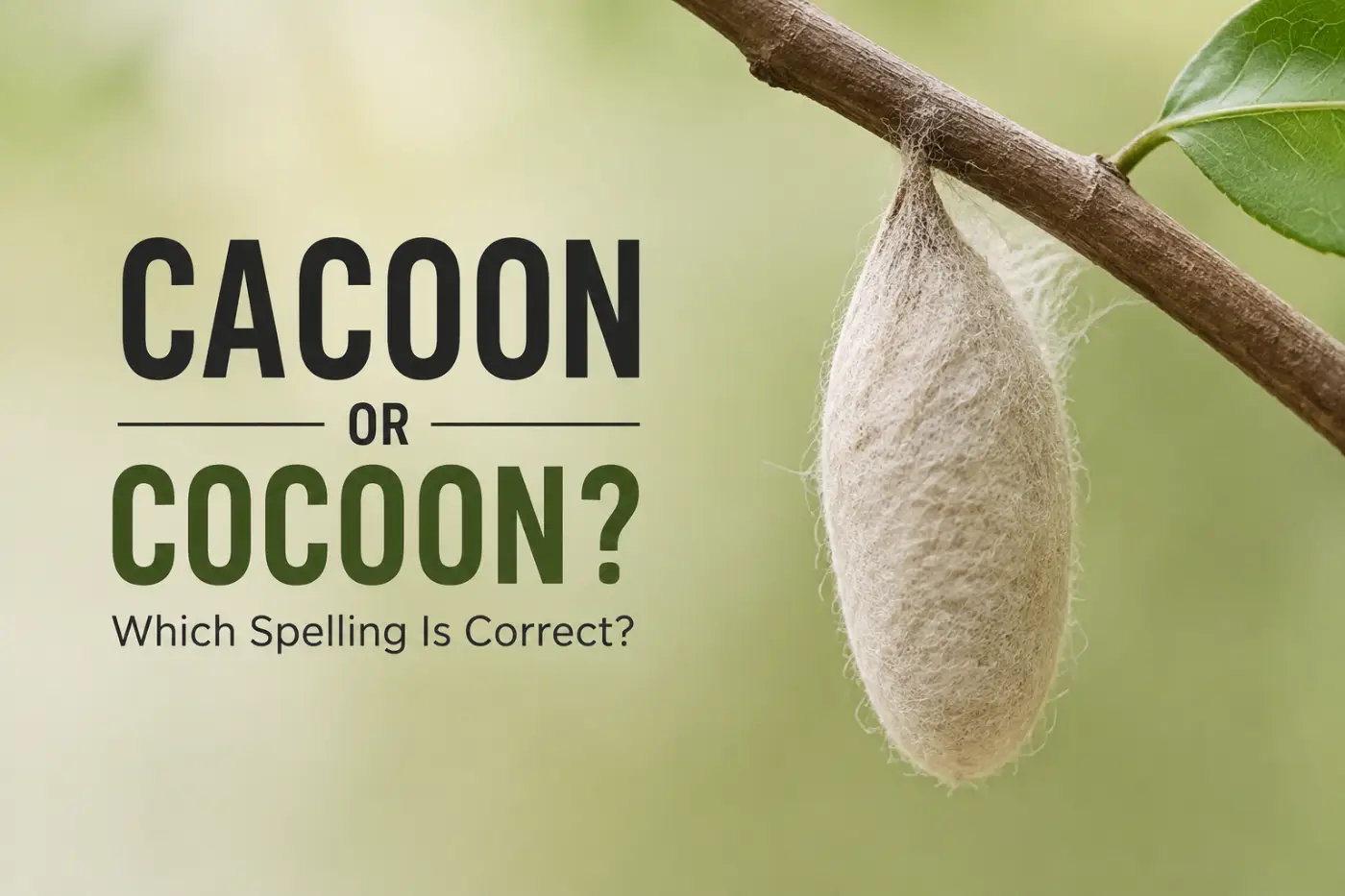
If you’ve searched for cacoon or cocoon you’re likely trying to figure out which spelling belongs in your sentence. The correct spelling is cocoon. Cacoon is a common misspelling and isn’t the standard English spelling for the protective covering made by certain insects.
The confusion is understandable. Both versions look almost identical and they sound similar when spoken quickly. The unusual vowel pattern in cocoon can also make the word harder to spell from memory. People may hear the word first and then write it the way they think it sounds.
The good news is that the difference is simple once you connect the spelling with the meaning. A cocoon is a protective covering made by some insects during a stage of development. The word also has a broader figurative meaning. It can describe a person or place that provides protection from the outside world.
This guide explains the correct spelling meaning pronunciation grammar word origin common mistakes and natural examples. You’ll also learn an easy memory trick that can help you stop writing cacoon for good.
Need another quick comparison? Read Cheff or Chef Which Spelling Is Correct 2026 Guide.
Quick Answer
Cocoon is the correct spelling. Cacoon is a misspelling when you mean the protective covering made by an insect. A cocoon can also describe a safe or sheltered environment. The word is pronounced roughly like kuh KOON in American English and comes into English through French from an older word connected with silk.
Cacoon Or Cocoon Comparison
| Feature | Cacoon | Cocoon |
|---|---|---|
| Correct spelling | No | Yes |
| Standard English word | No for this meaning | Yes |
| Part of speech | Not standard | Noun and verb |
| Main meaning | Misspelling of cocoon | Protective covering or sheltered state |
| Pronunciation | Usually intended to mean cocoon | Kuh KOON |
| Common context | Spelling mistake | Insects science nature writing and everyday speech |
| Formal writing | Avoid | Correct |
| Plural | Not applicable | Cocoons |
| Verb form | Not standard | Cocoon |
| Example | Incorrect spelling | The caterpillar formed a cocoon. |
What Does Cocoon Mean
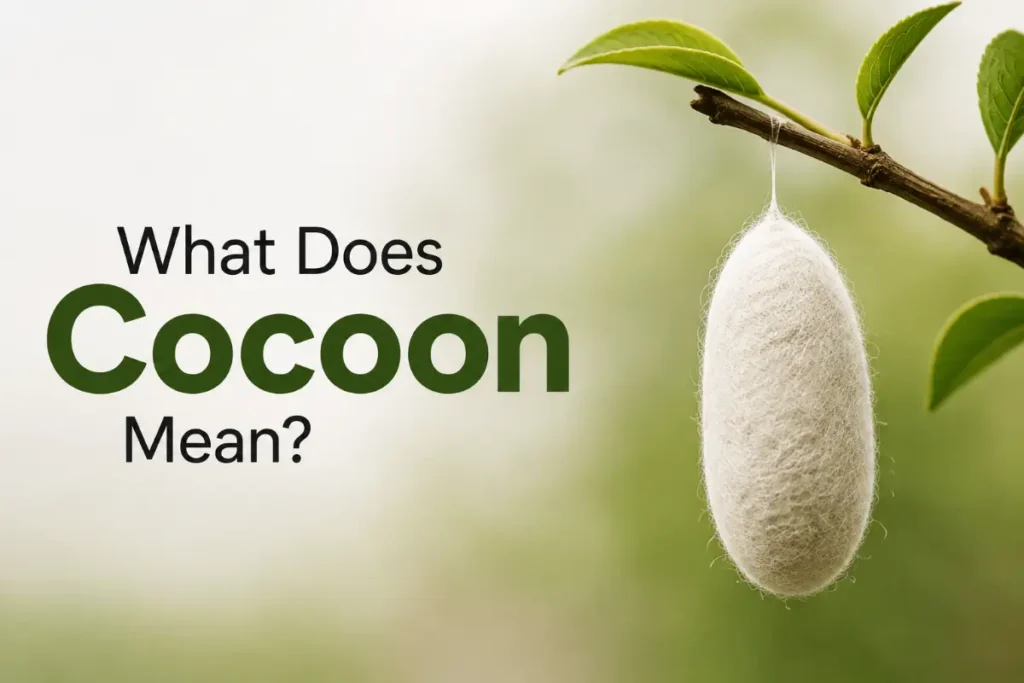
A cocoon is a protective covering made by certain insects while they develop into their adult form.
The classic example is a silkworm. It produces a silk covering around itself while it changes during its life cycle.
The word has a second meaning in everyday English. A person can also cocoon themselves by staying in a comfortable protected space and avoiding outside activity.
Cocoon As A Noun
As a noun cocoon names the protective covering itself.
For example.
- The caterpillar disappeared inside its cocoon.
- We found a small cocoon attached to the branch.
- The moth emerged from its cocoon.
- The children watched the cocoon carefully during science class.
- The silk cocoon had a delicate outer layer.
The noun can describe something physical in nature or something used as a metaphor for safety and isolation.
Cocoon As A Verb
Cocoon can also function as a verb.
It means to surround someone or something with protection. It can also mean to stay inside a comfortable protected environment.
For example.
- The thick blanket cocooned the baby.
- She cocooned herself in a quiet room after a long day.
- The warm jacket cocooned him against the cold.
- The curtains cocooned the room in darkness.
The verb is less common than the noun but it is completely standard English.
What Does Cacoon Mean
Cacoon is not the standard spelling of the English word cocoon.
If you’re writing about an insect’s protective covering then cocoon is the correct form.
For example.
Incorrect.
The caterpillar made a cacoon.
Correct.
The caterpillar made a cocoon.
This distinction matters in school assignments professional writing articles scientific explanations and any other situation where spelling accuracy matters.
You may still encounter cacoon online. Seeing a spelling repeatedly doesn’t make it standard. Search engines social media posts comments and user generated websites often contain ordinary spelling mistakes.
A good editor checks the word against a reliable dictionary rather than using online frequency as proof of correctness.
Which One Is Correct
Cocoon is the correct spelling.
Use cocoon when you mean the protective covering made by an insect or a protected and sheltered state.
Do not use cacoon in standard English when you mean this word.
The easiest example is.
The butterfly emerged from its cocoon.
Not.
The butterfly emerged from its cacoon.
The second version contains a spelling error.
Why People Spell Cocoon As Cacoon
The mistake usually comes from pronunciation rather than grammar.
When people hear cocoon they may not immediately know which vowel belongs in the first syllable. The first part sounds like kuh in many American English pronunciations. That sound doesn’t clearly tell you to write the letter o.
The First Vowel Causes The Problem
The correct spelling begins with co.
C O C O O N.
The incorrect form begins with ca.
C A C O O N.
Because the first vowel has a weak sound in normal speech some writers choose a when spelling the word from memory.
Visual Similarity Adds To The Confusion
The two forms differ by only one letter.
Cocoon.
Cacoon.
When you’re typing quickly it’s easy to hit the wrong vowel without noticing. Spellcheck can catch some instances but it won’t always help if the misspelled form appears in a context where the software doesn’t flag it immediately.
Pronunciation Can Mislead Spellers
English spelling doesn’t always match pronunciation perfectly. The word cocoon is a good example of why listening carefully isn’t enough.
If you know the word from reading rather than speech you’re more likely to remember the correct spelling.
The Meaning Of Cocoon In Nature
A cocoon plays an important role in the life cycle of certain insects.
A caterpillar may create a protective structure before changing into its adult form. Inside this protected space the insect goes through major physical changes.
The term is often associated with butterflies and moths. However there is an important science detail worth knowing.
Not every butterfly or moth forms a true cocoon.
Many moth caterpillars spin silk cocoons. Butterflies generally form a chrysalis rather than a silk cocoon.
That distinction matters in scientific or educational writing.
Cocoon And Chrysalis Are Not Always The Same
People often use the two words as if they mean exactly the same thing. They don’t.
A cocoon is generally a protective silk covering spun by an insect.
A chrysalis is the hardened pupal case formed by a butterfly.
For example.
The moth developed inside a cocoon.
The butterfly remained inside its chrysalis.
In casual conversation people sometimes call a butterfly’s chrysalis a cocoon. In precise science writing it’s better to use the correct term.
Cocoon In Everyday English
English speakers also use cocoon as a metaphor.
A person might create a cocoon around themselves by staying home reading a book watching movies or spending quiet time away from other people.
The metaphor comes from the physical idea of protection.
Examples Of The Figurative Meaning
- After a stressful week I wanted to cocoon myself at home.
- Her bedroom became a peaceful cocoon away from the noise outside.
- The small cabin felt like a warm cocoon during the winter storm.
- He spent the weekend cocooned under a blanket with a good book.
- The hotel room gave us a quiet cocoon after a busy day.
This figurative use is common in lifestyle writing journalism fiction and everyday conversation.
Cocoon As A Noun And Verb
Understanding the grammar makes the word easier to use correctly.
Cocoon As A Noun
When cocoon names a thing it is a noun.
Example.
The insect built a cocoon.
Here cocoon is the object of the verb built.
Another example.
The cocoon hung from a branch.
Here cocoon is the subject of the sentence.
Cocoon As A Verb
When cocoon describes an action it becomes a verb.
Example.
She cocooned herself in a blanket.
The base verb is cocoon.
Its common forms include.
- Cocoon.
- Cocoons.
- Cocooned.
- Cocooning.
The spelling remains clear because the word keeps its original oo pattern.
Cocoon Plural Form
The plural of cocoon is cocoons.
Example.
The researcher collected several cocoons for observation.
The plural simply adds s.
There is no special spelling change.
Singular.
One cocoon.
Plural.
Two cocoons.
This is another useful detail for students who are learning English vocabulary and spelling patterns.
Cocoon Pronunciation Guide
The pronunciation of cocoon is straightforward once you hear the stress pattern.
American English Pronunciation
IPA:
/kəˈkuːn/
The word has two syllables.
kuh KOON
The main stress falls on the second syllable.
The first vowel has a weak sound. The second syllable contains the long oo sound.
Common Pronunciation Mistake
Some learners pronounce the first syllable too strongly. In natural American English the first syllable is usually reduced.
A useful approximation is.
kuh KOON
The second syllable receives the strongest stress.
Knowing the pronunciation can help you recognize the word when listening. Still, spelling must be learned separately because English pronunciation doesn’t always give you every letter.
Cocoon Spelling Rules
The spelling becomes easier when you divide the word into parts.
C O C O O N
The key pattern is the double o near the end.
co coon
The word contains two o letters together in the final syllable.
You can think of the spelling as.
CO + COON
That visual pattern is more useful than trying to spell the word only from its sound.
Why The Double O Matters
The double o creates the long vowel sound in the final syllable.
Similar words include.
- Moon.
- Spoon.
- Soon.
- Noon.
- Balloon.
The spelling pattern doesn’t work exactly the same way in every English word but it provides a helpful visual connection.
Word Origin Of Cocoon
The history of cocoon helps explain why its spelling looks unusual.
English borrowed the word through French cocon. The word is ultimately connected with a Greek term associated with a cocoon or seed pod.
The word entered English in the eighteenth century and became closely associated with silkworms and silk production.
Over time the meaning expanded beyond insects.
Today cocoon can refer to physical protection as well as emotional or social shelter.
That shift is common in English. A concrete word from nature often develops a figurative meaning based on the original image.
Why Cocoon Became A Metaphor
The physical cocoon protects an insect during a major stage of development.
English speakers later used the image to describe people who surround themselves with comfort or protection.
For example.
She cocooned herself at home after a difficult week.
The sentence doesn’t suggest that she literally became an insect. It creates a picture of someone withdrawing into a safe private space.
This kind of metaphor gives English much of its everyday color.
Cocoon In American English
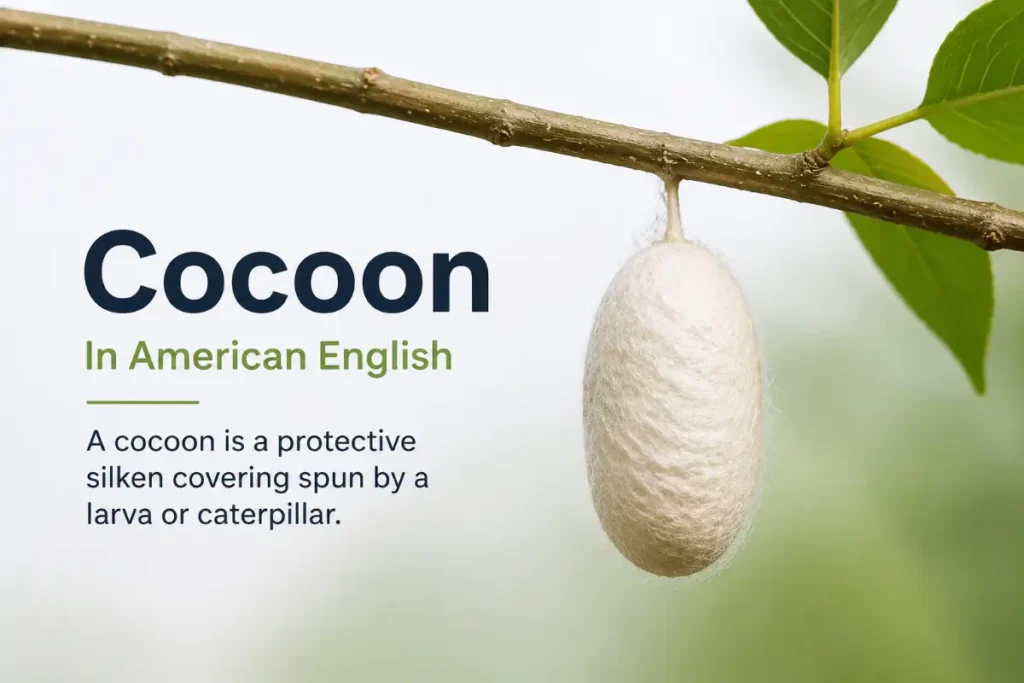
Cocoon is standard in American English.
American speakers use the noun in science education and nature writing. They also use the verb and metaphorical meaning in casual conversation.
Examples include.
The moth formed a cocoon.
I just want to cocoon at home tonight.
The blanket made a warm cocoon around the child.
There is no American spelling variation that changes cocoon into cacoon.
British English And Other Varieties
British English also uses cocoon.
Canadian English uses cocoon.
Australian English uses cocoon.
There is no standard regional spelling such as cacoon.
This point is important because learners sometimes assume an unfamiliar spelling must belong to another variety of English. In this case it doesn’t.
Cocoon is the standard form across major English varieties.
Real Life Examples With Cocoon
The word appears in many different settings.
Daily Conversation
- I want to cocoon myself at home tonight.
- The blanket feels like a warm cocoon.
- We stayed inside our little cocoon while the rain poured outside.
- She turned her bedroom into a cozy cocoon.
Workplace
- The quiet office became a cocoon where he could focus.
- Remote work can sometimes feel like a comfortable cocoon.
- The small team created a supportive cocoon for new employees.
Academic Writing
- The researcher examined how the insect developed inside its cocoon.
- The study describes the cocoon as a protective structure during development.
- Students observed several cocoons during the experiment.
Nature Writing
- A moth emerged from its cocoon after several weeks.
- The tiny cocoon was attached to the underside of a leaf.
- The insect remained protected inside the cocoon.
Journalism
- The quiet neighborhood became a cocoon of calm during the storm.
- The writer described the bookstore as a cocoon for readers.
Social Media
- Some weekends I just want to cocoon at home with coffee and a book.
- My room is my little cocoon after a long day.
- Rainy days make me want to disappear into a cozy cocoon.
Literature And Creative Writing
- The cottage felt like a cocoon hidden from the outside world.
- She spent the winter in a quiet cocoon before returning to city life.
The common thread in these examples is simple. The physical meaning involves protection. The figurative meaning carries that same idea into human life.
Suggested Internal Link
Common English Spelling Mistakes And How To Avoid Them.
Section One Takeaway
If you’re deciding between cacoon or cocoon the answer is clear.
Cocoon is the correct spelling.
Cacoon is a misspelling.
Remember the spelling as CO COON. The word can describe an insect’s protective covering or a sheltered environment. Once you connect the spelling with the image of protection it becomes much easier to remember.
Common Mistakes With Cocoon
Once you know that cocoon is the correct spelling the next step is understanding how people misuse the word. Most errors come from spelling the word by sound or confusing a cocoon with another stage of an insect’s life cycle.
Writing Cacoon Instead Of Cocoon
The most common spelling mistake is replacing the first o with a.
Incorrect.
The moth stayed inside a cacoon.
Correct.
The moth stayed inside a cocoon.
The correct spelling contains three o letters.
C O C O O N
A useful visual pattern is co + coon. Remembering the word in these two parts makes the spelling much easier.
Adding An Extra Letter
Another mistake is adding letters because the word looks unfamiliar.
Common incorrect forms may include attempts such as cocoonn or other variations. Standard English uses only six letters.
Cocoon.
If you’re unsure while writing quickly pause and picture the word as co + coon.
Treating Cacoon As A Regional Spelling
Cacoon isn’t an American British Canadian or Australian spelling of cocoon.
English varieties can differ in spelling. For example American English uses color while British English often uses colour. No comparable regional difference exists for cocoon.
The standard spelling remains cocoon across major varieties of English.
Cocoon Vs Chrysalis
One of the most useful distinctions for English learners is the difference between cocoon and chrysalis.
The words are related but they don’t always describe the same thing.
A cocoon is generally a protective covering spun by an insect such as a moth.
A chrysalis is the pupal stage of a butterfly.
For precise scientific writing this difference matters.
Cocoon
A moth caterpillar may spin silk around itself before entering the pupal stage.
Example.
The moth formed a silk cocoon on the branch.
Chrysalis
A butterfly forms a chrysalis rather than spinning a traditional silk cocoon.
Example.
The butterfly developed inside its chrysalis.
In casual speech people sometimes call any insect’s protective covering a cocoon. That’s understandable but scientific writing benefits from the more exact term.
Cocoon Vs Chrysalis Vs Pupa
These three terms can create even more confusion.
A pupa is the developmental stage between the larval stage and adulthood in insects that undergo complete metamorphosis.
A cocoon is a protective covering around the pupa in some insects.
A chrysalis is the hardened pupal case of butterflies.
Think of the terms as describing different things.
- Pupa describes a life stage.
- Cocoon describes a protective covering.
- Chrysalis describes the pupal case of a butterfly.
This distinction helps you avoid scientific inaccuracies.
Cocoon And Metamorphosis
The word cocoon often appears in explanations of metamorphosis.
Metamorphosis is a major physical change during an animal’s life cycle. Butterflies and moths experience complete metamorphosis.
Their life cycle includes four main stages.
- Egg.
- Larva.
- Pupa.
- Adult.
A cocoon may protect the pupa during part of this process in species that create cocoons.
This is why the word appears so often in children’s science books and educational material.
Cocoon In Figurative English
The physical meaning of cocoon led to several useful figurative expressions.
When someone says they are cocooning they may mean they are staying home and creating a private comfortable space.
For example.
I spent the weekend cocooning with a book and a cup of coffee.
No insect is involved. The speaker is comparing their comfortable isolation with the protection of an insect inside a cocoon.
Cocoon Yourself
The phrase cocoon yourself is common in informal English.
It means to surround yourself with comfort or protection.
Examples.
- She cocooned herself in a soft blanket.
- I just want to cocoon myself at home tonight.
- He cocooned himself away from the noise of the city.
- They cocooned themselves in the quiet cabin.
This phrase works well in conversational writing and lifestyle content.
Many readers also check Damnit Or Dammit Which Spelling Is Correct 2026.
Cocooned Meaning
Cocooned is the past tense and past participle of cocoon.
It can have a literal or figurative meaning.
Literal.
The insect was cocooned inside a protective covering.
Figurative.
She felt cocooned by the warm blankets.
The figurative meaning often suggests safety comfort privacy or protection.
It can also suggest isolation. Context determines the feeling.
Cocooning Meaning
Cocooning is the present participle or gerund form of cocoon.
It can describe the act of staying in a comfortable private environment.
Example.
Cocooning at home can be a relaxing way to recover from a busy week.
The word can also appear in discussions about lifestyle behavior and social habits.
For example.
The trend toward cocooning became popular as people looked for more comfort and privacy at home.
Is Cocoon A Noun Or A Verb
It can be both.
As a noun it names a protective covering or sheltered environment.
The cocoon hung from the branch.
As a verb it describes the act of surrounding someone or something with protection.
The blanket cocooned the child.
This makes cocoon a useful example of English conversion. English often turns nouns into verbs without changing their basic form.
Other examples include.
- Email.
- Bottle.
- Chair.
- Shelter.
- Cocoon.
The exact meaning depends on how the word functions in the sentence.
Is Cocoon Countable Or Uncountable
Cocoon is normally a countable noun when you mean an individual insect covering.
You can say.
One cocoon.
Two cocoons.
Several cocoons.
Example.
The students found three cocoons in the garden.
When used figuratively the noun can also be countable.
The room became a cocoon of comfort.
You can use articles such as a and the naturally.
A cocoon covered the insect.
The cocoon was attached to a leaf.
Common Phrases With Cocoon
Several natural expressions use the word cocoon.
Cocoon Yourself
This means to surround yourself with comfort or protection.
She cocooned herself in blankets and watched a movie.
A Cocoon Of Comfort
This describes a place or situation that feels safe and comfortable.
The cabin became a cocoon of comfort during the storm.
A Cocoon Of Silence
This describes a quiet environment that feels separate from outside noise.
The library offered a cocoon of silence for students.
Cocooned From The Outside World
This phrase describes someone who feels protected or separated from external activity.
The quiet house left her cocooned from the outside world.
These expressions are especially useful in creative writing because the image is easy for readers to understand.
Cocoon In Formal Writing
Cocoon is perfectly acceptable in formal writing when the meaning is accurate.
For scientific writing use it carefully and don’t confuse it with chrysalis or pupa.
For academic writing the word works naturally when discussing insect development.
Example.
The species constructs a silk cocoon before entering the pupal stage.
For business or professional writing the figurative meaning can work but should have a clear purpose.
Example.
The small team initially operated as a cocoon of specialists before expanding its services.
That sentence is grammatically correct but a more direct phrase may be better if the metaphor doesn’t add meaning.
Professional editors generally prefer clarity over decorative language.
Cocoon In Informal Writing
The figurative meaning becomes more natural in casual writing.
Examples include.
I want to cocoon at home this weekend.
My bedroom is my little cocoon.
Rainy weather makes me want to cocoon under a blanket.
These sentences sound relaxed and conversational.
The word often creates a warm mental picture without needing a long explanation.

Common Search And Spelling Questions
People often search for phrases such as cacoon meaning, cacoon spelling, cacoon or cocoon correct spelling, and how to spell cocoon.
The answer remains the same.
Cocoon is the standard spelling.
If you encounter cacoon online don’t assume it represents another accepted English form. In most ordinary contexts it is simply a misspelling.
Search results can contain errors because the internet is filled with user generated content. Frequency alone doesn’t establish correctness.
How To Remember The Correct Spelling
A good memory trick should be short enough to use when you’re writing.
Use The CO COON Trick
Break the word into two visual parts.
CO + COON
The first part begins with co.
The second part begins with coo.
Put them together.
CO COON
COCOON
Picture A Cozy Cocoon
Imagine a caterpillar wrapped safely in a soft covering.
Think.
A cocoon is cozy.
Both words begin with co.
This isn’t a spelling rule. It’s simply a memory hook. A strong mental image can make an unusual word easier to recall.
Remember The Double O
The final part contains oo.
Think of familiar words such as.
- Moon.
- Soon.
- Spoon.
- Noon.
- Cocoon.
The shared oo pattern can help reinforce the spelling.
Expert Editor’s Note
A professional editor would make one correction immediately.
Use cocoon.
Don’t treat cacoon as an alternate spelling. It isn’t the standard form for the insect covering or the related figurative meanings.
Editors also recommend paying attention to context. If you’re writing about butterflies and moths the difference between cocoon and chrysalis matters. If you’re writing about personal comfort the figurative meaning of cocoon is perfectly natural.
Another useful editorial point concerns tone. Cocoon works well in descriptive and creative writing because the word creates a strong image. Still you shouldn’t use it simply to make a sentence sound sophisticated. If protected space says exactly what you mean then that direct phrase may be better.
Good editing isn’t about choosing the fanciest word. It’s about choosing the most accurate word.
Related Words
Understanding related vocabulary can make the word easier to remember.
Words Related To Cocoon
- Caterpillar.
- Moth.
- Butterfly.
- Pupa.
- Chrysalis.
- Metamorphosis.
- Larva.
- Silk.
- Insect.
- Development.
Words Related To The Figurative Meaning
- Shelter.
- Protection.
- Comfort.
- Privacy.
- Isolation.
- Retreat.
- Security.
- Refuge.
- Sanctuary.
- Seclusion.
These words don’t all mean the same thing. They simply belong to the same semantic field and can help you understand how cocoon works in different contexts.
Common Mistakes To Avoid
Keep these points in mind when using the word.
- Don’t write cacoon when you mean cocoon.
- Don’t assume cacoon is a British or American variant.
- Don’t automatically call a butterfly’s chrysalis a cocoon in scientific writing.
- Don’t confuse a cocoon with the pupa itself.
- Don’t add an extra n to the end.
- Don’t forget the double o in the final syllable.
- Don’t assume an unusual spelling found online must be correct.
- Don’t use the figurative meaning in formal writing if a direct term would communicate the idea more clearly.
Section Two Takeaway
The spelling problem is only one part of the story.
Cocoon is the correct English word. It can function as a noun or a verb and can describe both physical protection and figurative comfort.
The science also matters. A cocoon is not simply another name for every insect’s pupal stage. A chrysalis and a pupa have more specific meanings.
For everyday writing remember one image.
A caterpillar rests inside a cocoon.
Once you picture the word correctly the spelling becomes much harder to forget.
More Natural Examples With Cocoon
Seeing cocoon in different types of sentences helps you understand how native English speakers use it. The word can describe something physical in nature or something emotional and figurative.
Examples About Insects
- The moth built a silk cocoon beneath the leaf.
- We discovered a tiny cocoon attached to the garden fence.
- The caterpillar disappeared into its cocoon.
- The cocoon protected the developing insect.
- Scientists studied how the insect formed its cocoon.
Comfort Examples
- She wrapped herself in a blanket and created a cozy cocoon.
- The small apartment became a peaceful cocoon during the storm.
- I love turning my bedroom into a quiet cocoon on rainy evenings.
- The cabin felt like a warm cocoon surrounded by snow.
- He spent the weekend cocooned in his favorite chair.
Examples About Protection
- The thick walls made the house feel like a cocoon.
- Her family created a cocoon of support during a difficult time.
- The quiet room provided a protective cocoon from the noise outside.
- The retreat gave the students a cocoon where they could focus.
- The garden felt like a natural cocoon away from the busy street.
Examples In Creative Writing
- Winter wrapped the village in a silent cocoon.
- The old bookstore was a cocoon of warmth and stories.
- She entered the new season of her life like a butterfly leaving its cocoon.
- The cabin became a cocoon beneath the falling snow.
- He had spent years inside a comfortable cocoon and finally decided to explore the world.
These examples show why cocoon has become such a useful metaphor. The original image is simple. Something is protected while change happens inside.
Cocoon As A Metaphor For Personal Growth
The word often appears in writing about change because of the insect life cycle.
A caterpillar enters a protected stage before emerging as an adult. Writers use this process as a comparison for human growth.
For example.
She spent a year in a quiet cocoon before beginning a new chapter in her life.
The sentence doesn’t mean she literally lived inside a cocoon. It suggests a period of privacy reflection preparation and change.
This metaphor works particularly well in personal essays biographies inspirational writing and fiction.
Still it shouldn’t become a cliché. A strong writer uses the image when it adds something meaningful to the sentence.
Cocoon In Psychology And Lifestyle Writing
The figurative idea of cocooning can also describe a desire for privacy and comfort.
Someone may choose to stay home instead of going out. They may create a comfortable environment with familiar routines food books movies or music.
For example.
After a demanding week she wanted to cocoon at home and recharge.
This use became especially common in lifestyle discussions about home centered living.
The meaning is usually positive but context can change it.
If someone chooses privacy for relaxation the word suggests comfort.
If someone avoids the outside world for a long time the same word can suggest isolation.
Cocoon Vs Shelter
These words overlap but they aren’t identical.
A shelter is a place or structure that protects someone from danger weather or hardship.
A cocoon suggests more than physical protection. It often creates an image of comfort privacy and separation from the outside world.
Compare these sentences.
The shelter protected the family from the storm.
The cabin felt like a cocoon during the storm.
The first sentence is direct and practical. The second creates a softer emotional picture.
Cocoon Vs Sanctuary
A sanctuary is a safe or peaceful place.
A cocoon can also suggest safety but usually carries a stronger sense of being wrapped or enclosed.
Example.
The library became a sanctuary for students.
The library became a cocoon where students could escape the noise outside.
Both work. The second creates a more vivid image.
Cocoon Vs Refuge
A refuge is a place where someone goes for safety or protection.
A cocoon usually sounds warmer and more personal.
You might describe a quiet bedroom as a cocoon.
You would more naturally call a place a refuge when someone needs protection from danger or hardship.
This difference is useful for writers because choosing the right word changes the emotional tone.
Is Cacoon Ever Correct
For standard modern English cacoon isn’t the correct spelling for the word discussed in this article.
If you’re writing an English sentence about an insect’s protective covering use cocoon.
The fact that a misspelling appears on websites or in search queries doesn’t turn it into an accepted spelling.
The same principle applies to many English spelling mistakes. Online frequency isn’t the same as dictionary recognition.
Is Cocoon A Difficult Word To Spell
For many learners it is.
The pronunciation doesn’t clearly reveal every letter. The first syllable has a weak vowel sound and the second syllable contains the familiar oo sound.
The word also looks unusual because the letters co appear twice.
A useful spelling strategy is to avoid sounding out every letter.
Instead remember the visual form.
COCOON.
Then connect it to the image of a caterpillar wrapped in protection.
How To Spell Cocoon Correctly
Write it in six letters.
C O C O O N
A simple memory sequence is.
CO + COON = COCOON.
The most common error changes the first o to a.
CACOON is not the standard spelling.
The correct form is.
COCOON.
If you’re typing quickly and aren’t sure pause and check the first syllable. The word begins with co.
Dictionary And Editorial Guidance
Standard dictionaries list cocoon as the established English form. They recognize its noun and verb uses and its literal and figurative meanings.
A professional editor would also consider the context before choosing the word.
In scientific writing the literal meaning should be accurate.
In general writing the figurative meaning can add personality.
The misspelling cacoon should be corrected in edited content.
FAQs About Cacoon Or Cocoon
Is Cocoon The Correct Spelling
Yes. Cocoon is the standard spelling. Cacoon is a misspelling when you mean the protective covering made by certain insects. The correct word contains three o letters and six letters in total.
How Do You Spell Cocoon
The correct spelling is cocoon.
Spell it as C O C O O N.
A useful way to remember it is co plus coon. The first part begins with co and the final part contains the double oo pattern.
What Is The Difference Between A Cocoon And A Chrysalis
A cocoon is generally a protective covering spun by an insect such as a moth. A chrysalis is the pupal case formed by a butterfly. Both relate to insect development but they aren’t interchangeable terms in precise scientific writing.
Is Cacoon A Word
Cacoon isn’t the standard English spelling for the insect covering called a cocoon. You may see the misspelled version online because people often write words based on how they sound. For standard writing use cocoon.
What Is The Plural Of Cocoon
The plural is cocoons.
For example.
The researcher observed several cocoons in the garden.
The word simply takes the regular plural ending s.
Can Cocoon Be Used As A Verb
Yes. Cocoon can work as a verb meaning to surround someone or something with protection. It can also describe staying inside a comfortable private environment.
Example.
She cocooned herself in a warm blanket.
Do Butterflies Have Cocoons
Butterflies generally form a chrysalis rather than a silk cocoon. Many moths form cocoons. In casual conversation people sometimes use cocoon broadly but scientific writing should distinguish the terms.
What Does Cocoon Mean Figuratively
Figuratively cocoon can describe a safe comfortable private environment. Someone might say they want to cocoon at home after a stressful week. The metaphor suggests protection from outside noise activity or pressure.
Still confused? Compare Totalling Vs Totaling Which Spelling Is Correct 2026.
Conclusion
When you’re choosing between cacoon or cocoon the correct answer is cocoon.
Cacoon is a common misspelling. It isn’t a standard regional spelling and it shouldn’t appear in polished English writing.
Cocoon can be a noun or a verb. As a noun it can describe an insect’s protective covering or a sheltered environment. As a verb it can mean to surround someone with comfort or protection.
The most important spelling detail is simple.
Cocoon begins with co and ends with coon.
If you’re writing about insect development remember the science too. A cocoon is not automatically the same thing as a chrysalis or a pupa. Using the right term makes your writing more precise.
For everyday English the memory trick is even easier. Picture a caterpillar safely wrapped inside a cocoon. The spelling will follow the image.
When in doubt remember the cocoon and you’ll never need the cacoon.

Editorial Reviewer & Proofreader
Grace Mitchell reviews Gramlify’s articles for clarity, consistency, and readability. She is passionate about creating accurate, approachable content that helps English learners build confidence.