
If you’ve searched for damnit or dammit, you’re probably trying to figure out which spelling is correct. You may have seen both in text messages, novels, movies, social media, or even subtitles. Since they sound almost identical, it’s easy to assume both spellings are standard English.
The short answer is simple. Dammit is the standard and widely accepted spelling. Damnit is a common variant that appears in informal writing, but most dictionaries and professional editors prefer dammit.
The confusion comes from pronunciation. Many English speakers pronounce the word with a clear n sound, making damnit look reasonable when written. Still, pronunciation does not always match standard spelling in English.
This guide explains the difference between damnit and dammit, why the confusion exists, how dictionaries treat both forms, and which spelling you should choose in formal and informal writing. You’ll also learn the word’s history, grammar, pronunciation, common mistakes, and plenty of natural examples so you can use it with confidence.
For another common grammar confusion, see Imbed Vs Embed Which Spelling Is Correct 2026.
Quick Answer
Dammit is the standard English spelling recognized by major dictionaries. Damnit is an informal spelling variant based on pronunciation. For professional writing, schoolwork, publishing, and edited content, choose dammit. In casual texts and social media, you may see damnit, but it is much less common.
Damnit Or Dammit Comparison Table
| Feature | Dammit | Damnit |
|---|---|---|
| Standard spelling | Yes | No in most style guides |
| Dictionary recognition | Yes | Limited or listed as a variant |
| Meaning | Mild expression of anger or frustration | Same meaning |
| Part of speech | Interjection | Interjection |
| Formal writing | Acceptable when appropriate | Usually avoided |
| Informal writing | Very common | Occasionally used |
| Pronunciation | Same | Same |
| Meaning difference | None | None |
| Preferred spelling | Yes | No |
| Example | Dammit I forgot my keys. | Damnit I forgot my keys. |
Which One Is Correct
Dammit is the correct spelling in standard English.
Major dictionaries, editors, publishers, and style guides consistently recognize dammit as the preferred form. If you’re writing an article, story, email, screenplay, or any piece that follows standard English, this is the spelling you should use.
Damnit is not completely made up. It appears in online conversations, text messages, and social media because many people spell the word exactly as they hear it. Even so, it remains a nonstandard spelling.
If your goal is accurate English, choose dammit.

What Does Dammit Mean
Dammit is an interjection. People say it to express frustration, annoyance, disappointment, surprise, or anger.
It comes from the phrase damn it, which gradually became a single word in informal English.
Simple Definition
Dammit is a mild exclamation people use when something goes wrong or when they become irritated.
Examples include.
- Dammit I missed the bus.
- Dammit I forgot my wallet again.
- Dammit that really hurt.
Although the word expresses emotion, its strength depends on the speaker and the situation. Some people see it as mild profanity, while others consider it less offensive than stronger swear words.
What Does Damnit Mean
Damnit has the same meaning as dammit.
The difference is spelling, not definition.
Many people naturally write damnit because they hear an n sound before the final it. English pronunciation often blends sounds together, making this spelling seem logical.
Examples include.
- Damnit I left my phone at home.
- Damnit we were so close to winning.
These sentences communicate the intended emotion, but editors would normally change damnit to dammit before publication.
Why People Confuse Damnit And Dammit
The confusion is surprisingly common because several factors work together.
The Words Sound Almost Identical
In everyday conversation, many speakers pronounce dammit so quickly that it sounds like damnit.
People often spell words the way they hear them.
The Original Phrase Contains An N
The expression began as damn it.
When spoken naturally, the ending of damn blends into it.
Many writers assume the written form should keep the n.
Social Media Reinforces The Variant
Casual writing rarely follows dictionary rules.
Millions of posts, comments, and text messages use damnit, which makes the spelling appear more common than it actually is.
English Does Not Always Match Pronunciation
English contains many words whose spelling differs from pronunciation.
Examples include.
- Could.
- Would.
- Wednesday.
- Colonel.
Dammit follows the accepted spelling even though many speakers pronounce it differently.
Grammar Explanation
Both dammit and damnit function as an interjection.
An interjection expresses sudden emotion rather than adding grammatical information to a sentence.
Examples include.
- Ouch.
- Wow.
- Oh.
- Dammit.
Interjections often stand alone.
Dammit.
They can also appear at the beginning of a sentence.
Dammit I forgot the tickets.
Or at the end.
I forgot the tickets dammit.
Since the word expresses emotion instead of describing or naming something, it does not change for tense, number, or person.
It always stays the same.
Pronunciation Guide
Dammit
IPA
American English
/ˈdæmɪt/
Syllables
Dam mit.
Primary Stress
The first syllable receives the stress.
Damnit
People pronounce damnit exactly the same way.
Because the pronunciation is nearly identical, listeners usually cannot tell which spelling the writer intended.
That is why context and standard spelling matter more than pronunciation alone.
In the next section, I’ll cover word origin, spelling rules, British and American English, key differences, more than 20 real life examples, and expert usage guidance.
Key Differences Between Damnit And Dammit
Although damnit and dammit express the same emotion, they are not equal in standard English.
| Feature | Dammit | Damnit |
|---|---|---|
| Standard English spelling | Yes | No |
| Dictionary preference | Yes | Rarely |
| Meaning | Expression of frustration | Same meaning |
| Pronunciation | Same | Same |
| Professional writing | Recommended | Not recommended |
| Text messages and social media | Common | Also seen |
| Published books | Very common | Rare |
The biggest difference is spelling. Their meaning, pronunciation, and usage are almost identical.
Spelling Rules
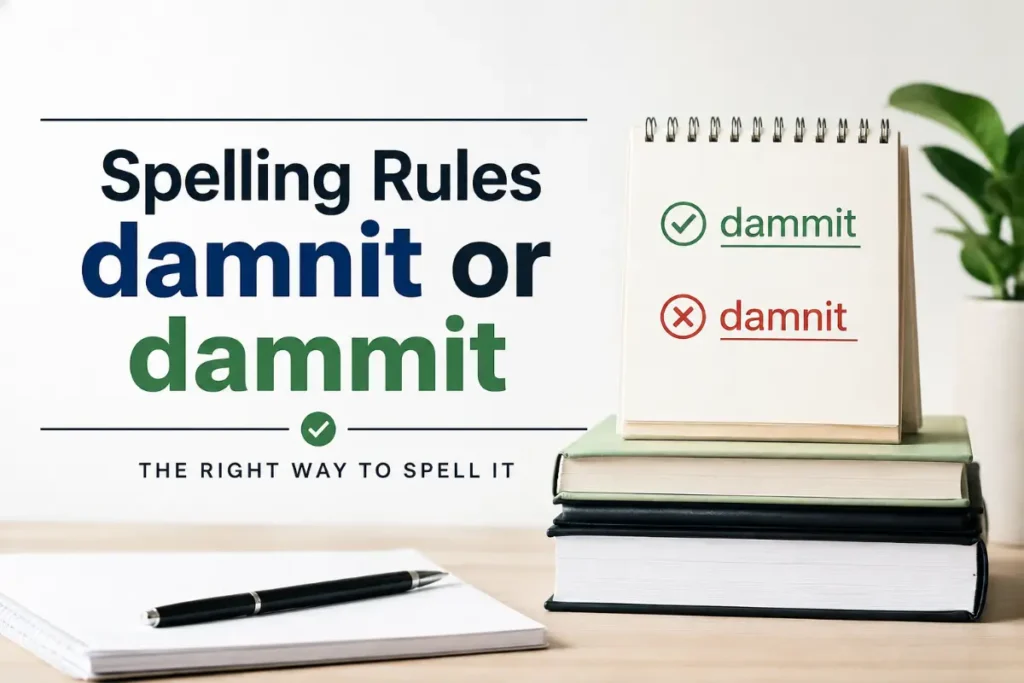
The preferred spelling dammit comes from the expression damn it.
Over time, English speakers combined the two words into a single interjection.
Many English contractions and shortened expressions change slightly when they become common words. This is why dammit does not keep the n from damn.
The spelling became standardized through dictionaries and published writing.
Although damnit looks logical because of its pronunciation, it never became the accepted standard.
Need another quick comparison? Read Puddy or Putty Which Spelling Is Correct 2026 Guide.
Word Origin And History
The story behind dammit explains why the spelling seems unusual.
The word began as the phrase damn it.
Damn comes from the Latin word damnare, meaning to condemn or judge guilty. It entered English through Old French and Middle English many centuries ago.
As English became more conversational, people started saying damn it so quickly that it sounded like a single word.
Writers eventually began spelling the expression as dammit.
Today, dictionaries recognize dammit as the standard written form of that spoken expression.
British American Canadian And Australian English
There is almost no regional difference.
American English, British English, Canadian English, and Australian English all prefer dammit in edited writing.
You may occasionally find damnit in online conversations across every English speaking country, but publishers and editors still favor dammit.
This is one of those cases where the standard spelling remains consistent around the English speaking world.
Tone And Formality
Because dammit comes from damn, it still carries mild profanity.
Its appropriateness depends on your audience.
Casual Conversation
Using dammit is generally acceptable among friends who are comfortable with mild swear words.
Example.
Dammit I dropped my coffee.
Fiction
Novelists often use dammit to create realistic dialogue.
Example.
Dammit we were almost there.
Workplace
Most workplaces discourage profanity in emails, meetings, and official communication.
Instead, writers often choose softer alternatives.
Examples include.
- Darn.
- Shoot.
- Oh no.
- Good grief.
Academic Writing
Academic papers almost never include dammit unless the author is quoting dialogue or analyzing language.
Real Life Examples
The examples below show how native speakers naturally use dammit.
Daily Conversation
- Dammit I forgot my keys.
- Dammit we’re running late again.
- Dammit I knew that would happen.
- Dammit the store already closed.
Workplace
- Dammit the presentation didn’t save.
- Dammit the printer stopped working again.
- He whispered dammit after the meeting ended.
Emails
- I accidentally deleted the file. Dammit.
- The attachment didn’t upload. Dammit.
Literature
- Dammit he muttered as the rain ruined the map.
- She slammed the door and shouted dammit.
Journalism
- The reporter quoted the player’s exact words including dammit.
- The article censored the expression as d****t.
Movies And Television
- The detective muttered dammit after losing the suspect.
- The audience laughed when the character yelled dammit.
Social Media
- Dammit I missed the concert tickets.
- Dammit Monday arrived too quickly.
- Dammit my phone battery died again.
- Dammit why is traffic so bad today.
- Dammit I almost had the perfect photo.
Examples Using Damnit
These examples reflect common online usage, but they do not follow the preferred standard spelling.
- Damnit I forgot my password.
- Damnit that game was difficult.
- Damnit my internet stopped working.
Editors would normally change each of these to dammit before publication.
Common Mistakes
These mistakes appear often in everyday writing.
Assuming Both Spellings Are Equally Correct
They are not.
Only dammit is the standard spelling accepted by major dictionaries.
Choosing Damnit Because It Matches Pronunciation
English spelling often differs from pronunciation.
Many words follow historical spelling instead of spoken sounds.
Using Dammit In Formal Documents
Even though dammit is the correct spelling, it remains an informal expression.
Avoid it in business reports, academic papers, legal documents, and professional emails unless you are quoting someone directly.

Confusing Damn It With Dammit
Both are correct.
Damn it is the original two word expression.
Dammit is the accepted single word version.
Choose the form that matches your writing style and tone.
Memory Tricks
A simple memory trick can help you remember the correct spelling every time.
Think Of The Original Phrase
The word comes from damn it.
Editors combine the words into dammit, not damnit.
If you remember the accepted combined form, you’ll avoid the most common spelling mistake.
Remember Published Writing
Books, newspapers, magazines, and dictionaries almost always use dammit.
If you want your writing to look polished, follow their example.
Think About Standard English
Many words sound different from the way they are spelled.
Just because damnit sounds right does not make it the preferred spelling.
Related Words And Expressions
If you want to avoid profanity or simply add variety to your writing, these words and expressions can work depending on the situation.
Similar Expressions
- Damn.
- Damn it.
- Darn.
- Shoot.
- Drat.
- Blast.
- Good grief.
- Oh no.
Stronger Alternatives
Some expressions carry much stronger language. They should be used carefully because they may offend readers or listeners.
Choose the level of formality that fits your audience.
Expert Editor’s Note
Professional editors almost always change damnit to dammit unless they are preserving a character’s original dialogue, quoting a social media post, or reproducing historical text exactly as written.
Major dictionaries recognize dammit as the standard spelling. It appears consistently in published books, newspapers, magazines, and professionally edited websites.
If you’re writing for school, work, blogging, publishing, or SEO, dammit is the safer and more professional choice.
If authenticity matters in dialogue, you may occasionally see damnit because writers sometimes spell words the way characters naturally speak. Even then, many editors still prefer dammit for consistency.
Frequently Asked Questions
Is Damnit A Real Word?
Damnit appears in informal writing and online conversations, but it is not the preferred standard spelling. Most dictionaries and editors recommend dammit instead.
Why Is Dammit Spelled With Two M Letters?
The accepted spelling developed as the expression damn it became a single informal interjection. English spelling does not always follow pronunciation, so the standard written form became dammit.
Do Damnit And Dammit Mean Different Things?
No. Both express frustration, annoyance, disappointment, or anger. The only real difference is that dammit is the accepted standard spelling.
Can I Use Dammit In Professional Writing?
Usually no. Even though dammit is the correct spelling, it is still considered mild profanity. In professional or academic writing, choose a more neutral expression unless you are quoting someone directly.
Which Spelling Do Dictionaries Prefer?
Major English dictionaries list dammit as the standard spelling. Some may mention damnit as a variant, but it is far less common in edited writing.
Is Dammit Offensive?
It depends on the audience. Many people consider it mild profanity, while others see it as a relatively soft expression of frustration. When writing for a broad audience, it is best to use it carefully.
Is Damn It Also Correct?
Yes. Damn it is the original two word expression. Dammit is the accepted single word version. Both are correct, but the choice depends on your writing style.
For another common grammar confusion, see Comprable Vs Comparable Which Spelling Is Correct 2026.
Conclusion
The answer to damnit or dammit is straightforward.
Dammit is the standard English spelling recognized by dictionaries, editors, and style guides. Damnit is a common informal variant that appears because many people spell the word the way they hear it.
If you’re writing for school, work, publishing, or any professional setting, choose dammit. It follows standard English and looks more polished.
The next time you pause before typing this expression, remember one simple rule.
If you want the spelling trusted by editors and dictionaries, write dammit.
A small spelling choice can make your writing look more accurate and more professional.

Editorial Reviewer & Proofreader
Grace Mitchell reviews Gramlify’s articles for clarity, consistency, and readability. She is passionate about creating accurate, approachable content that helps English learners build confidence.