

If you’ve ever paused while writing and wondered about simpler or more simple you’re not alone. Both forms can appear in English and both can be grammatically correct. The real question isn’t simply which one is allowed. It’s which form sounds natural and fits the sentence best.
In most everyday American English simpler is the better choice. We normally say something is simpler than something else. For example we say this explanation is simpler than the first one. We don’t usually need to say this explanation is more simple than the first one.
Still more simple isn’t automatically wrong. Major learner dictionaries recognize both forms. Oxford specifically lists simpler as the usual comparative form while also noting that more simple can be used.
The choice can depend on meaning rhythm emphasis and the structure of the sentence. In this guide you’ll learn why simpler usually wins how more simple works when it sounds natural and which form professional editors tend to choose.
Still confused? Compare Better Than Or Better Then Which One Is Correct 2026.
Quick Answer.
Simpler is usually the most natural comparative form of simple. Use it when comparing two things and saying one has less complexity than the other. More simple is also grammatically possible and appears in reputable dictionaries. However it often sounds more formal awkward or deliberate in ordinary American English.
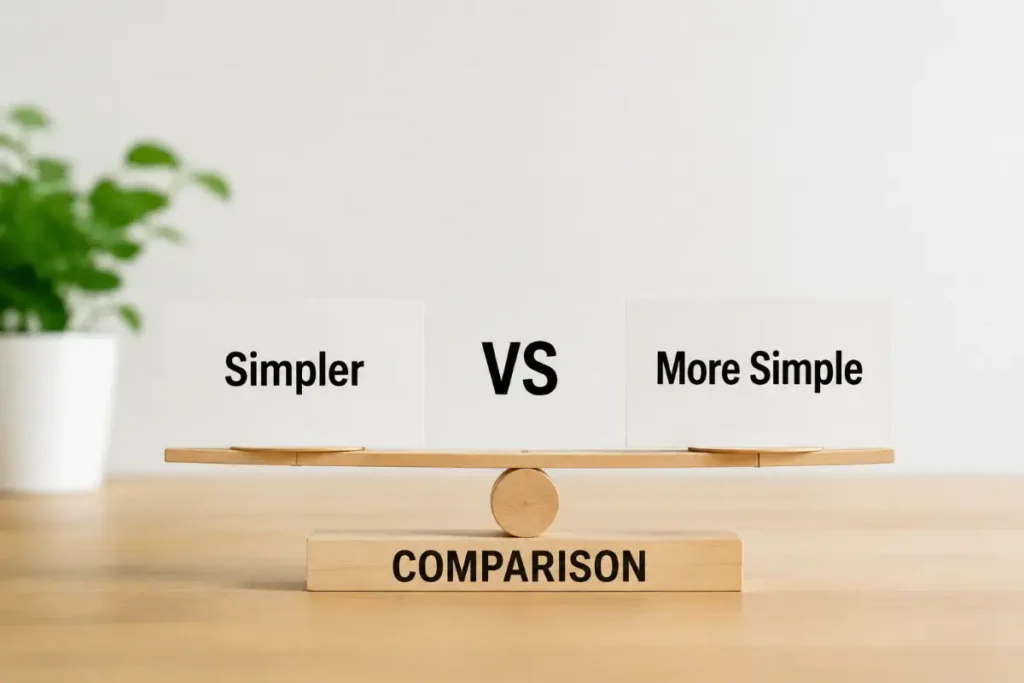
Simpler Or More Simple Comparison
The key point is easy to remember. Simpler and more simple can both express comparison but simpler is normally the cleaner choice.
What Does Simpler Mean
Simpler is the comparative form of the adjective simple.
It means less complicated less difficult less elaborate or easier to understand than another person or thing.
For example.
This explanation is simpler than the previous one.
The word simpler tells the reader that two explanations are being compared. The new explanation has a lower level of complexity.
The meaning can change slightly depending on context.
A simpler plan can mean a plan with fewer steps.
A simpler explanation can mean an explanation that is easier to understand.
A simpler design can mean a design with fewer visual elements.
A simpler lifestyle can mean a lifestyle with fewer demands or possessions.
A simpler sentence can mean a sentence with less complicated grammar.
What Does More Simple Mean.
More simple also expresses a comparative meaning. It uses the adverb more before the adjective simple.
For example.
This version is more simple than the original.
The basic meaning is similar to this.
This version is simpler than the original.
The difference is mainly one of form and style rather than basic meaning.
Oxford lists simpler and simplest as the regular comparative and superlative forms but also says that more simple and most simple can be used.
That matters because you may see more simple in published English and assume it must be a mistake. It isn’t. The form is legitimate. It simply isn’t the form most speakers reach for first.
Which One Is Correct.
If you need one practical answer use simpler in most situations.
For example.
This explanation is simpler than the other one.
The new system is simpler to use.
Her instructions are simpler than mine.
This design looks simpler and cleaner.
These sentences sound natural and effortless.
You can also write more simple in some contexts.
This design is more simple than decorative.
The issue became more simple once we removed the unnecessary steps.
Still the second version can sound less natural to many American English speakers. In most cases an editor would probably change it to simpler.
So the safest rule is this.
Use simpler as your default comparative form.
Use more simple when you have a clear stylistic reason or when the sentence naturally benefits from the longer construction.
Why People Confuse Simpler And More Simple.
The confusion comes from a real feature of English grammar. English has more than one way to form comparative adjectives.
Short adjectives often take er.
Examples include.
- Small becomes smaller.
- Fast becomes faster.
- Bright becomes brighter.
- Quiet becomes quieter.
- Simple becomes simpler.
Longer adjectives often use more.
Examples include.
- Careful becomes more careful.
- Useful becomes more useful.
- Important becomes more important.
- Interesting becomes more interesting.
The problem appears because simple has two syllables. Learners often learn a rough rule that two syllable adjectives should use more. English doesn’t work that neatly.
Cambridge explains that some two syllable adjectives can take er and est endings. It specifically includes simple in this group.
That gives us the normal pattern.
Simple.
Simpler.
Simplest.
At the same time reputable dictionaries recognize more simple as an alternative.
So the confusion isn’t caused by one form being secretly wrong. It comes from two possible grammatical patterns with different levels of naturalness.
Key Difference Between Simpler And More Simple.
The biggest difference is usage preference.
Both forms can compare two things.
The important distinction is that simpler is the standard everyday choice for most situations.
Consider these examples.
The new instructions are simpler.
The new instructions are more simple.
Both communicate a comparison. The first sounds more direct and natural.
A professional editor usually doesn’t add words without a reason. If simpler communicates the idea clearly the shorter form normally wins.
Grammar Explanation.
Understanding the grammar makes the choice much easier.
Simple Is An Adjective.
The word simple is an adjective.
It can describe something that lacks complexity.
Examples include.
The instructions are simple.
The design is simple.
The question is simple.
The solution is simple.
The sentence is simple.
It can also describe something plain basic or uncomplicated. Dictionaries list several senses of the word including easy to understand or perform and free from unnecessary complexity.
Simpler Is A Comparative Adjective.
Simpler compares two things.
For example.
This explanation is simpler than yours.
The new process is simpler than the old one.
My first draft was simpler than my final draft.
The word than often appears after a comparative adjective when the second item is stated.
More Simple Is Also Comparative.
More simple uses more to create the comparison.
For example.
The second method is more simple than the first.
The meaning is clear. The construction simply feels heavier.
In normal American English the sentence would usually become.
The second method is simpler than the first.
The Superlative Form
The superlative compares one item with a larger group.
The normal form is simplest.
For example.
This is the simplest solution.
That was the simplest explanation.
This remains the simplest way to solve the problem.
Most simple is also possible but is less common in ordinary usage. Oxford recognizes it as an alternative form.

Why Simpler Usually Sounds Better
English often favors economy. When two structures communicate the same idea the shorter structure frequently sounds more natural.
Compare these sentences.
The new method is simpler.
The new method is more simple.
The first sentence gets to the point immediately.
That doesn’t make more simple grammatically bad. It simply makes simpler the stronger default.
Think of it like choosing between two roads that reach the same destination. One road is shorter and more familiar. Unless you have a reason to take the longer route most speakers choose the shorter one.
Still confused? Compare What Kind Of Vs What Kinds Of Made Simple 2026.
When More Simple Can Work
There are situations where more simple can sound reasonable.
When You Want A Deliberate Contrast
Consider this sentence.
The new design is more simple than minimalist.
This is unusual but the writer may be contrasting two concepts rather than simply saying the design has become simpler.
Another example is.
The language is more simple than elegant.
Here more simple can help create a balanced contrast between two qualities.
Still this style is context dependent. In many ordinary sentences simpler remains better.
When The Adjective Carries Special Emphasis
A writer may use more simple to emphasize the adjective itself
For example.
The goal isn’t to make the process easier. The goal is to make it more simple.
Even here many editors would prefer simpler.
The goal isn’t to make the process easier. The goal is to make it simpler.
The second version sounds more natural to most readers.
When Rhythm Matters
Writers sometimes choose more simple because the surrounding words create a particular rhythm.
This happens more often in creative prose than in everyday business writing.
Good editing doesn’t mean changing every instance automatically. Context matters.
Spelling Rules For Simpler
The spelling of simpler is straightforward.
Start with simple.
Remove the final e.
Add er.
The result is simpler.
Simple.
Simpler.
Simplest.
Don’t write simpleer.
Don’t write simpler with a second p.
Don’t write simpliar.
The correct spelling is simpler.
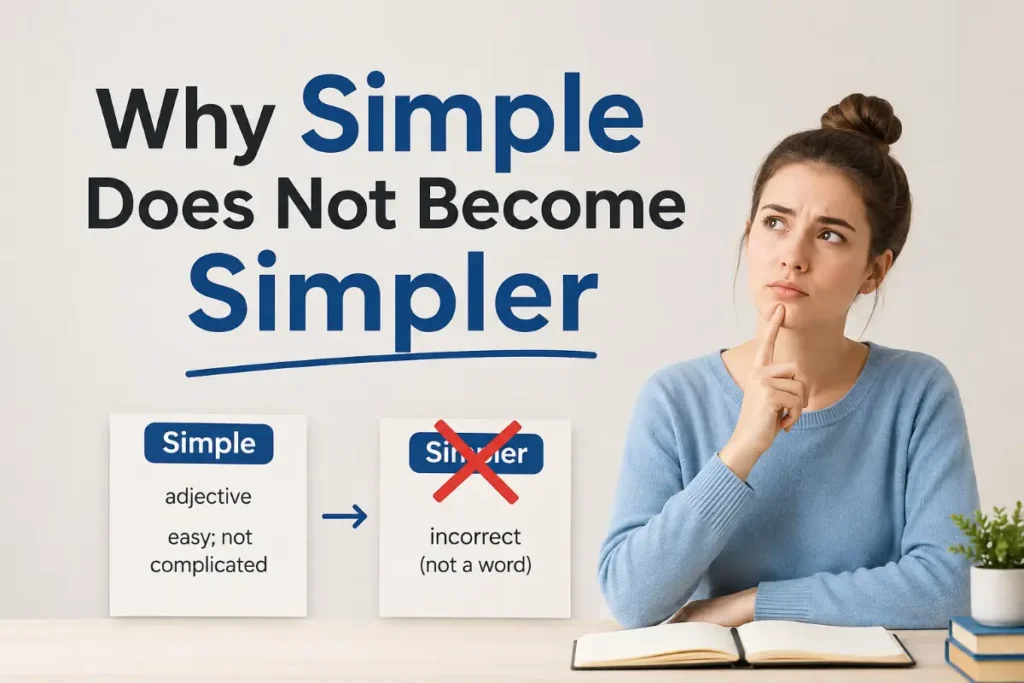
Why Simple Does Not Become Simppler
A common spelling mistake is doubling the final consonant.
English does double some final consonants before er.
For example.
Big becomes bigger.
Hot becomes hotter.
Thin becomes thinner.
But simple doesn’t follow that pattern.
The final e is dropped and r is added.
Simple becomes simpler.
The spelling reflects the structure of the word rather than a general rule that every short adjective must double its final consonant.
Pronunciation Guide
The American English pronunciation of simple is commonly represented as /ˈsɪmpəl/. Merriam Webster gives simpler as /ˈsɪmpələr/.
Simple
The word has two syllables.
SIM pul.
The first syllable carries the main stress.
Simpler
The word has two syllables.
SIM plər.
The first syllable carries the main stress.
More Simple.
This phrase contains three spoken syllables in normal speech.
MORE SIM pul.
The main stress generally falls on more and the adjective keeps its ordinary pronunciation.
Pronunciation isn’t usually the source of the confusion. The real issue is grammatical choice.
Word Origin Of Simple
The history of simple helps explain why the word has such a broad range of meanings.
Merriam Webster traces the adjective to Middle English through Anglo French and Medieval Latin simplus. The Latin root relates to the idea of being single or having one part.
Over time the word developed several connected meanings.
Something with one part could be called simple.
Something without unnecessary complexity could be called simple.
Something easy to understand could be called simple.
Something plain or uncomplicated could also be called simple.
The modern comparative simpler follows naturally from this adjective.
British And American English
There is no major regional spelling difference between simpler and more simple.
American English uses simpler frequently.
British English also uses simpler frequently.
Oxford’s American English dictionary lists simpler and simplest while also recognizing more simple and most simple.
The same general pattern applies in Canadian and Australian English.
So you don’t need to switch forms based on nationality.
The main question is style.
Real Life Examples
Here are natural examples showing how native speakers use the two forms.
Daily Conversation
- This recipe is simpler than the one we used last week.
- Can you explain it in a simpler way.
- The second route is simpler.
- Life feels simpler when you stop worrying about things you can’t control.
Workplace Writing
- We need a simpler process for handling customer requests.
- The new form is simpler to complete.
- Her explanation was simpler than the manager’s explanation.
- We created a simpler system for tracking orders.
Email Writing
- I’ve attached a simpler version of the instructions.
- The revised process should be simpler for everyone.
- Could you send me a simpler explanation of the problem.
Academic Writing
- The second model provides a simpler explanation of the observed results.
- The researchers developed a simpler method for collecting the data.
- The theory becomes simpler when the unnecessary assumptions are removed.
Technical Writing
- This setting gives users a simpler way to manage their files.
- The updated interface is simpler to navigate.
- A simpler algorithm may be easier to maintain.
Informal Writing
- I just need a simpler answer.
- Can you make this simpler.
- The new version is much simpler.
Examples With More Simple
- The revised design is more simple in appearance.
- The explanation is more simple than the original wording suggests.
- The author presents the idea in a more simple form.
- The process became more simple after several unnecessary stages were removed.
These examples show an important point. More simple can work. It simply isn’t the form most writers would choose when simpler fits naturally.
Common Questions About Simpler And More Simple.
Is Simpler Always Better Than More Simple.
No. Simpler is usually the more natural choice but more simple isn’t automatically incorrect. The context matters. If you’re making an ordinary comparison such as saying one process has fewer steps then simpler is normally the best option. Use more simple only when its wording serves a clear purpose.
Can I Say More Simple In Formal Writing.
Yes. The phrase is grammatically possible in formal writing. Still professional editors usually prefer simpler when both versions express the same idea. It is shorter and more natural. A writer might keep more simple when creating a deliberate contrast or when the sentence has a specific rhythm that works better with the longer form.
Is Simpler The Correct Comparative Form.
Yes. Simpler is the regular and widely preferred comparative form of simple. The usual sequence is simple, simpler, and simplest. Major dictionaries also recognize more simple and most simple as alternative constructions.
Is More Simple Bad English.
No. Calling more simple bad English is too strong. It is a legitimate construction. The issue is mainly natural usage. In many everyday sentences American English speakers are more likely to choose simpler. A good editor looks at the sentence as a whole rather than applying a blanket rule.
Should I Use Simpler Or More Simple In An Essay.
Use simpler in most essays. For example you could write The revised theory provides a simpler explanation. It is concise and clear. More simple can appear in academic writing but it may sound less natural when no special contrast or emphasis requires it.
What Is The Superlative Of Simple.
The usual superlative is simplest. For example This is the simplest solution. Most simple is also possible in some contexts but it is much less common. If you’re writing ordinary American English then simplest is normally the strongest choice.
Why Do Some People Say More Simple.
English allows different comparative patterns. Some adjectives use more while others use er. Since simple has two syllables learners sometimes apply the more pattern automatically. However simple commonly takes er so simpler is the form most speakers naturally use.
Is Simpler More Natural Than More Simple.
Yes. In most ordinary sentences simpler sounds more natural. Compare This method is simpler with This method is more simple. Both can communicate the same idea but the first is more concise and familiar. That’s why editors generally choose simpler unless the longer construction adds a useful distinction.
Final Verdict On Simpler Or More Simple
The answer doesn’t require a complicated grammar rule.
Simpler is the preferred comparative form of simple for most situations.
More simple is also grammatically acceptable but less common. It can work when the writer wants a particular contrast emphasis or rhythm.
Use this pattern as your default.
Simple → Simpler → Simplest.
For example.
The instructions are simple.
The revised instructions are simpler.
This is the simplest version.
If you need a quick rule for everyday writing remember one thing.
When you mean less complicated choose simpler.
Don’t waste time worrying that more simple is forbidden. It isn’t. Just remember that natural English often favors simpler.
Many readers also check Having vs Having: Same word, same spelling, same meaning.
Conclusion
The choice between simpler or more simple is mainly a matter of normal comparative usage.
Simpler is the standard choice and the form most readers expect. It works naturally in conversation academic writing professional documents instructions and general web content.
More simple is also correct in suitable contexts. It isn’t a spelling mistake or a grammar error simply because it appears less often.
The most useful pattern to remember is simple, simpler, simplest.
If you’re describing something as less complicated use simpler.
If you’re comparing two methods you can say This method is simpler than the old one.
If you’re describing the easiest option in a larger group say This is the simplest method.
The common mistake is treating English grammar as a collection of rigid formulas. Real English has patterns preferences and exceptions. Learning those patterns helps you write naturally instead of simply memorizing rules.
When both forms are possible and you have no special reason to choose the longer one keep your sentence simpler.

Editorial Reviewer & Proofreader
Grace Mitchell reviews Gramlify’s articles for clarity, consistency, and readability. She is passionate about creating accurate, approachable content that helps English learners build confidence.