
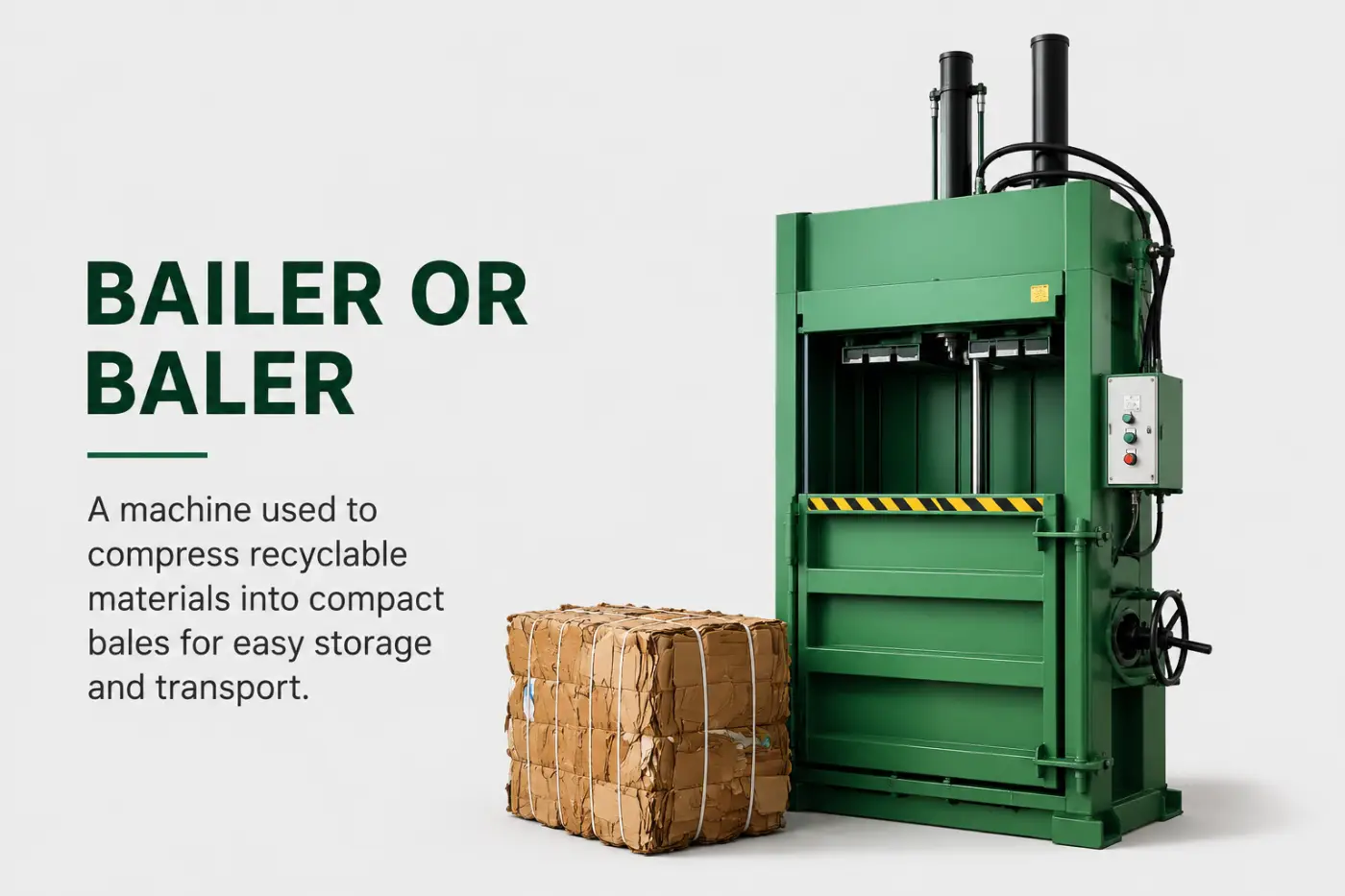
When you search for bailer or baler you’re usually trying to solve one simple spelling problem. Both words are real English words. The correct choice depends entirely on what you mean. A baler makes bales from materials such as hay or cardboard. A bailer is a tool used to remove water or liquid. Merriam Webster lists both as nouns with separate meanings.
The confusion is easy to understand. The words differ by only one letter and they have the same or nearly identical pronunciation in common American English. That makes them especially easy to mix up when writing from memory.
The distinction becomes much clearer once you connect each spelling with its root word. Baler comes from bale and relates to making bundles. Bailer comes from bail and relates to removing water or liquid. The two words can appear in very different settings such as farming recycling boating environmental work and legal writing.
This guide explains the bailer or baler difference in plain English. You’ll learn what each word means how to pronounce them how their grammar works where they came from and how native speakers use them in real situations.
Need another quick comparison? Read Naive vs Nieve Which Spelling Is Correct (2026 Guide).
Quick Answer
Use baler for a machine or person that makes bales from hay straw paper cardboard or similar material. Use bailer for a tool used to remove water or liquid. Bailer can also be a variant of bailor in legal language. Both spellings are correct but they have different meanings.
Bailer Or Baler Comparison Table
| Feature | Bailer | Baler |
|---|---|---|
| Correct spelling | Yes | Yes |
| Main meaning | A tool used to remove water or liquid | A machine or person that makes bales |
| Part of speech | Noun | Noun |
| Root word | Bail | Bale |
| Common setting | Boating and water removal | Farming recycling and waste management |
| Typical object | Water or liquid | Hay straw paper cardboard or similar material |
| Pronunciation | Usually /ˈbeɪlər/ | Usually /ˈbeɪlər/ |
| Plural | Bailers | Balers |
| Formal use | Technical and legal contexts | Agricultural and industrial contexts |
| Common phrase | Boat bailer | Hay baler |
| Another meaning | Variant of bailor | One that bales |
| Common mistake | Using bailer for a hay machine | Using baler for a water removal tool |
The most useful distinction is simple.
Bail removes liquid. Baler makes bales.
That small connection can save you from a surprisingly common spelling mistake.
What Does Baler Mean
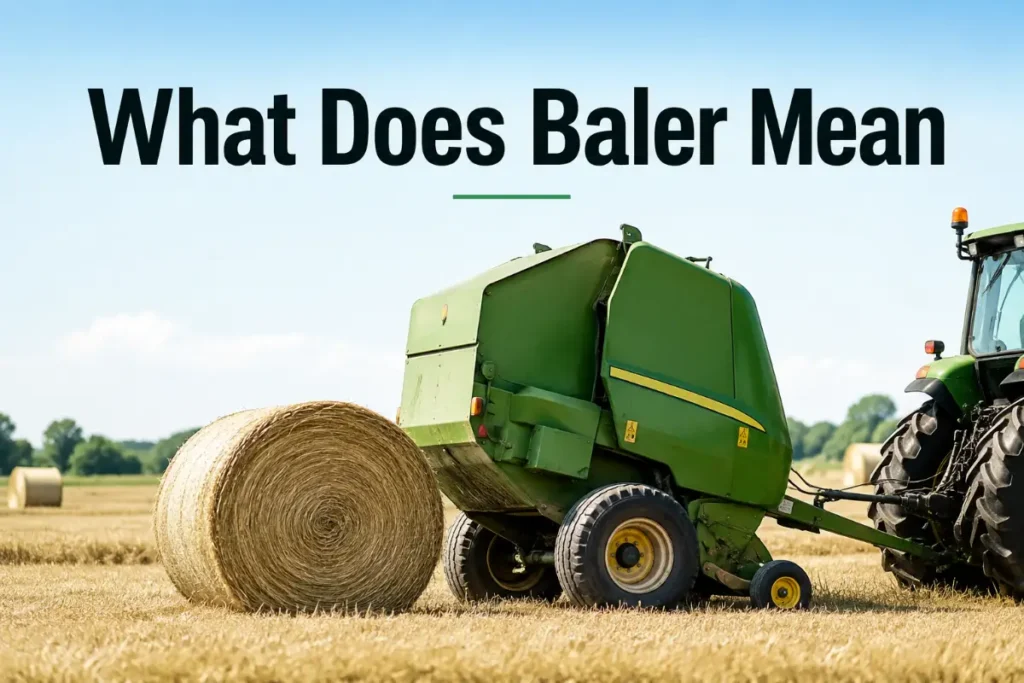
A baler is a machine or person that makes bales. In agriculture a baler gathers loose material such as hay or straw and compresses it into a compact bundle that can be stored transported or handled more easily.
The word also appears outside farming. Recycling centers use balers to compress cardboard paper plastic and other recyclable materials. Merriam Webster defines a baler as something that bales and specifically includes machinery used for hay straw cotton and similar products.
Baler Definition
A baler is one that bales material into compact bundles.
The noun comes directly from the verb bale.
Bale means to gather and compress material into a bundle or bale.
Baler means the person or machine that performs that job.
Baler In Agriculture
Agriculture is probably the most familiar context for the word.
A farmer might use a hay baler after cutting and drying a field. The machine collects the loose hay and forms it into bales that can be stored for later use.
For example.
- The farmer bought a new hay baler.
- Our old baler broke during harvest.
- The tractor pulled the baler across the field.
- The crew finished baling the hay before the rain arrived.
- The farm needs a larger baler for next season.
Baler In Recycling
The word baler also has an important role in recycling and waste management.
A recycling facility may use a cardboard baler to compress large amounts of loose cardboard into manageable bundles.
Examples include.
- The recycling center installed a new cardboard baler.
- Workers loaded the flattened boxes into the baler.
- The plastic baler reduced the volume of waste.
- The facility uses an industrial baler every day.
- The operator checked the baler before starting the shift.
This use matters in professional writing because a wrong spelling can make a product description confusing. If you’re writing about recycling equipment the correct word is baler.
What Does Bailer Mean
A bailer is generally a tool used to remove water or another liquid. The word is especially associated with boats and other situations where water needs to be removed manually.
Merriam Webster defines bailer as a device used to bail out a boat. It also lists another noun meaning a variant spelling of bailor.
Bailer Definition
A bailer is a container or device used for removing water or liquid.
The word comes from the verb bail in the sense of removing water.
A simple example would be a small bucket used to scoop water out of a canoe.
Bailer In Boating
Boating is one of the clearest contexts for bailer.
If water enters a small boat you may need a bailer to remove it.
Examples include.
- Keep the bailer inside the canoe.
- The sailor grabbed the bailer after water entered the boat.
- We used a plastic container as an emergency bailer.
- The boat came with a small bailer.
- Check the bailer before heading onto the water.
The important idea is liquid removal.
Bailer In Other Technical Contexts.
The word can also appear in technical settings involving liquid removal or collection.
A bailer may refer to equipment used to collect fluid from a particular location. Specialized environmental and industrial equipment can use the term in this sense.
The exact meaning depends on the field. Still the connection to bail remains the useful clue.
Bailer Can Also Mean Bailor
There is one detail that many quick grammar articles miss.
Bailer has another dictionary meaning. Merriam Webster lists it as a variant spelling of bailor. A bailor is a person who delivers personal property to another person in trust under a legal arrangement known as bailment.
This meaning has nothing to do with farming machinery.
For example.
The bailor delivered the equipment to the warehouse for safekeeping.
In modern legal writing bailor is generally the clearer choice because it separates the legal meaning from the water removal meaning of bailer.
If you’re writing a contract legal agreement or academic paper about bailment use the established legal term bailor unless your source or jurisdiction specifically uses bailer.
Which One Is Correct
Both bailer and baler are correct spellings.
The right word depends on the meaning.
Use baler when something makes bales.
Use bailer when something removes water or liquid.
Use bailor when you’re discussing the person who transfers property under a bailment.
Compare these sentences.
Correct.
The farmer repaired the hay baler.
Correct.
The sailor reached for the bailer.
Correct.
The bailor transferred the equipment to the bailee.
The spelling changes because the underlying words and meanings change.
A useful test is to look at the action.
If something is bundling material you’re probably looking for baler.
If something is removing water you’re looking for bailer.
If someone is transferring property under bailment you’re looking for bailor.
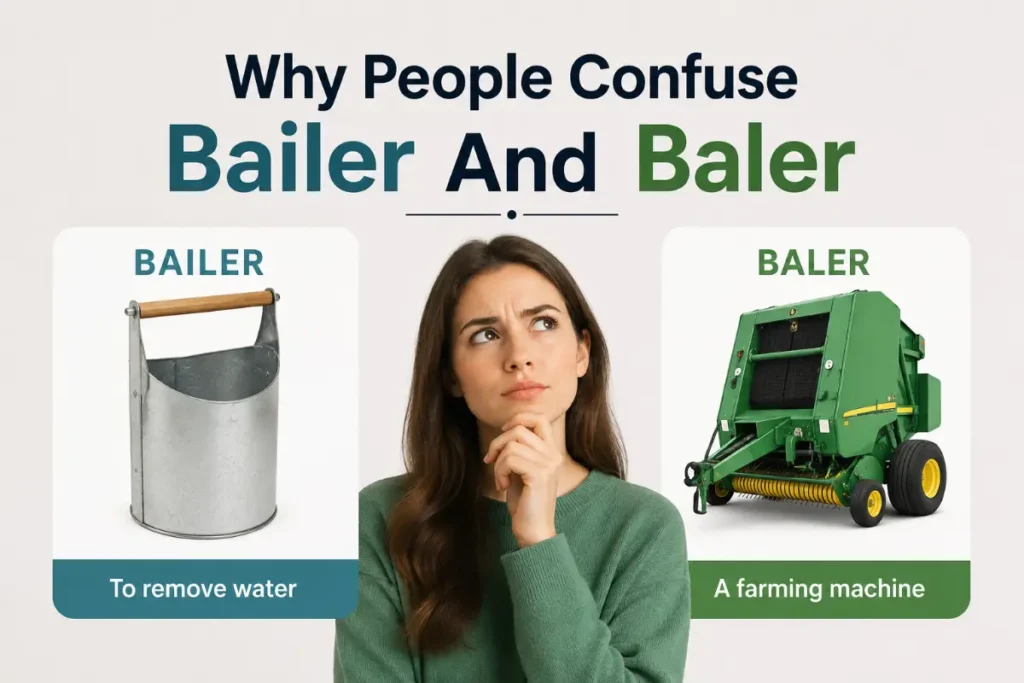
Why People Confuse Bailer And Baler
The confusion isn’t caused by complicated grammar. It comes from spelling pronunciation and overlapping contexts.
The Words Sound The Same
In common American pronunciation bailer and baler are pronounced essentially the same.
Both are commonly pronounced like BAY ler.
That creates a classic spelling problem. You can hear the correct word but still have no clue which spelling belongs on the page.
English has many words like this. Their sounds don’t provide enough information to determine their spelling.
The Words Look Almost Identical
The difference is just one letter.
Bailer
Baler
That extra i changes the connection from bail to bale.
When someone types quickly it’s easy to leave out the letter or add it by mistake.
Farming And Boating Use Different Vocabulary
A person who works with agricultural equipment may know baler very well but rarely encounter bailer.
Someone who spends time around boats may have the opposite experience.
When the words appear outside their usual context the unfamiliar spelling can feel wrong even though both are legitimate.
Search Results Can Reinforce Mistakes
Online product listings can contain spelling errors. A person searching for a hay baler might see an incorrectly labeled product and assume bailer is an accepted alternative.
It isn’t an alternative spelling for the farming machine.
The dictionary distinction is clear. Baler is the word for something that bales. Bailer has its own separate meanings.
Autocorrect Doesn’t Always Help
Spellcheckers may recognize both words as valid. That means they can’t always tell you which one matches your intended meaning.
This is an important lesson for writers.
A word can be spelled correctly and still be the wrong word for the sentence.
Key Difference Between Bailer And Baler
The easiest way to understand the difference is to focus on the root word.
Baler Comes From Bale
A bale is a compact bundle of material.
Hay can be formed into bales.
Straw can be formed into bales.
Cardboard can be formed into bales.
A machine that creates those bundles is a baler.
Bailer Comes From Bail
To bail water means to remove water from a boat or other space.
A tool used for that job can be called a bailer.
So the relationship looks like this.
Bale → baler
Bail → bailer
This is more useful than trying to memorize the spellings separately.
Grammar And Word Formation
Both words are nouns. They follow a familiar English pattern in which er can identify a person or thing that performs an action.
Baler As A Noun
The verb is bale.
Add er.
bale + er = baler
The result refers to someone or something that bales.
Examples.
The baler is ready.
We need a new baler.
Three balers are operating today.
Bailer As A Noun
The verb is bail in the water removal sense.
Add er.
bail + er = bailer
The result refers to something or someone that bails.
Examples.
The bailer is in the boat.
We need a larger bailer.
The crew used two bailers.
Why The Extra I Matters
The letter i isn’t decorative.
It connects the word to bail.
Remove the i and you get bale.
That changes the meaning.
Bail relates to removing water.
Bale relates to forming a bundle.
This is one of those spelling details where a single letter carries a lot of meaning.
Pronunciation Guide
The pronunciation adds another layer to the confusion because bailer and baler are commonly pronounced alike.
Bailer Pronunciation
A common American pronunciation is:
/ˈbeɪlər/
You can think of it as:
BAY ler
The first syllable receives the main stress.
Baler Pronunciation
A common American pronunciation is also:
/ˈbeɪlər/
Again you can think of it as:
BAY ler
The first syllable carries the main stress.
Pronunciation Mistake To Avoid
Don’t try to create an extra sound for the i in bailer.
The spelling difference doesn’t normally create a separate spoken syllable.
That explains why listening alone won’t reliably tell you which word someone means. Context does the heavy lifting.
A Useful Listening Strategy
When you hear BAY ler ask yourself what the speaker is discussing.
Are they talking about hay or cardboard?
Think baler.
Are they talking about water or a boat?
Think bailer.
Are they discussing property and bailment?
Think bailor.
That context based approach works far better than trying to hear the missing letter.
Word Origins And Etymology
The words look like close relatives but their histories lead in different directions.
The Origin Of Baler
Baler comes from bale with the agent ending er.
The noun bale has a long history in English and refers to a bundle or package of material. The modern baler developed naturally from the idea of a person or machine that makes such bundles.
Merriam Webster gives the etymology of baler as bale plus er.
The Origin Of Bailer
Bailer comes from bail in the sense of removing water.
Merriam Webster records the first known use of bailer in this sense as 1877.
The word therefore has a direct relationship with the action of bailing water rather than with making bundles.
The Legal Bailer
The legal use has a different history.
Merriam Webster lists bailer as a variant of bailor. The legal noun bailor refers to a person who delivers personal property to another person in trust. Its first known use is recorded as 1602.
This is another reason context matters so much.
The same spelling bailer can point to different meanings depending on the field.
British And American English
There isn’t a major spelling difference between American and British English for baler and bailer.
The same basic distinction applies in both varieties.
Baler refers to something that makes bales.
Bailer refers to a tool or device associated with bailing water and can also appear as a legal variant of bailor.
Canadian and Australian English follow the same basic distinction as well.
The issue isn’t mainly regional spelling. It’s a matter of meaning.
For professional writing the safest approach is to choose the spelling that matches the root word and the technical context.
Real Life Examples Of Baler
Here are natural examples showing how baler works across different settings.
- The farmer started the baler before sunrise.
- We need to replace the belt on the hay baler.
- The new baler produces tightly packed straw bundles.
- The mechanic inspected the baler before harvest.
- Our recycling plant uses a cardboard baler.
- The operator loaded the cardboard into the baler.
- The company purchased an industrial baler for its warehouse.
- The baler reduced the amount of space needed for recyclable materials.
- The cotton baler stopped working during the afternoon shift.
- The farm rented a baler instead of buying one.
These examples all involve baling or making compact bundles.
Real Life Examples Of Bailer
Now compare those sentences with situations involving water removal.
- The canoe had a small bailer under the seat.
- Grab the bailer before the boat takes on more water.
- We used a bucket as a temporary bailer.
- The sailor reached for the bailer after the storm.
- Keep the bailer somewhere easy to reach.
- The emergency kit included a simple bailer.
- Water collected in the boat faster than we could remove it with the bailer.
- The guide showed us how to use the bailer.
- The old bailer cracked during the trip.
- The crew replaced the damaged bailer before leaving the dock.
These examples all connect bailer with removing liquid.
The pattern stays consistent even when the setting changes.
Baler bundles. Bailer removes water.
Why People Confuse Bailer And Baler
The confusion between bailer or baler comes down to one tiny spelling difference. Both words sound the same in standard American English and both describe something that performs an action. The real difference appears in their root words and meanings.
A baler comes from bale. A bailer comes from bail. Once you connect each word to its root the spelling becomes much easier to remember.
Similar Spelling
Look closely at the two words.
Baler.
Bailer.
The only visible difference is the letter i. That small difference can cause trouble because both words contain the same letters in almost the same order.
When people write quickly they often spell the word based on sound. Since both words commonly sound like BAY ler the ear doesn’t provide enough information to choose the spelling.
Similar Pronunciation
Both words are commonly pronounced /ˈbeɪlər/ in American English.
That means someone can say the word correctly without knowing how to spell it.
For example if someone says:
The farmer needs a new baler.
You hear the same basic sound as:
The sailor needs a new bailer.
Only the context tells you which spelling belongs on the page.
Different Root Words
The root words solve the mystery.
Bale means to make material into a compact bundle.
Bail can mean to remove water from a boat or other place.
So:
Bale becomes baler.
Bail becomes bailer.
This is the most reliable memory trick because you’re not memorizing two unrelated spellings. You’re connecting each noun to the action it represents.
Keyboard Mistakes
Typing can make the confusion worse.
A person may know the correct word but type bailer when they mean baler. Spellcheck may not catch the error because both words exist in English.
This is an important point for writers. A spellchecker can identify an incorrectly spelled word but it can’t always identify a correctly spelled word used in the wrong context.
Bailer Or Baler For Farming
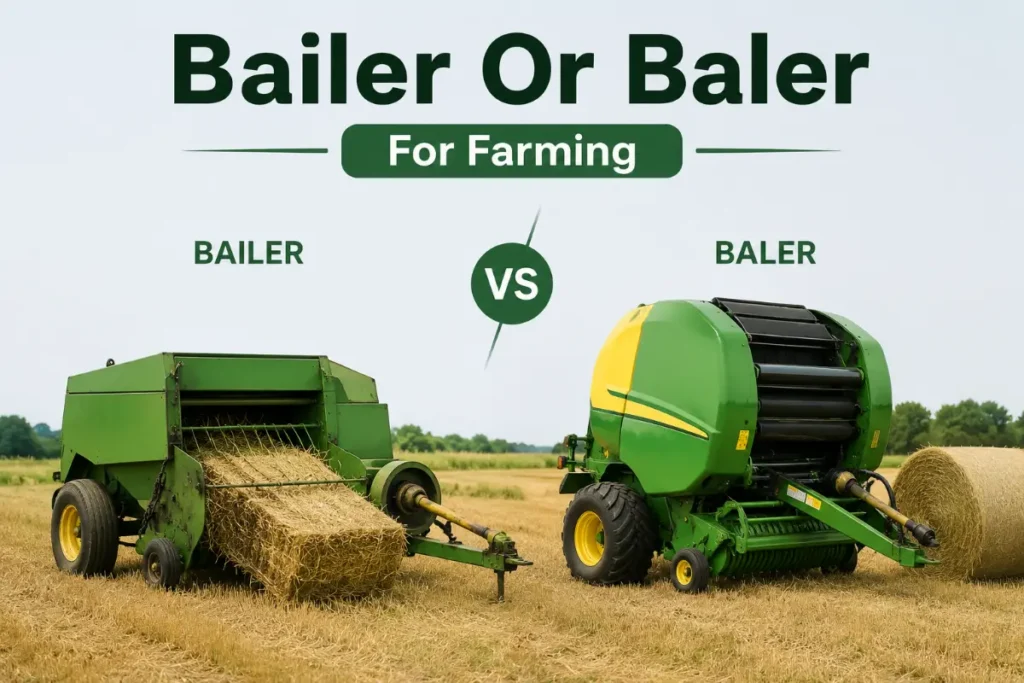
If you’re talking about farming equipment the correct word is almost always baler.
A hay baler gathers loose hay and compresses it into a bale. Similar machines can handle straw grass cotton and other agricultural materials.
Common Farming Expressions
You’ll often see phrases such as:
- Hay baler.
- Round baler.
- Square baler.
- Large baler.
- Small baler.
- Baler machine.
- Baler equipment.
- Baler attachment.
- Baler operator.
- Baler maintenance.
Notice the connection to bale.
A farmer doesn’t use a machine to bail hay. The farmer uses a machine to bale hay.
That gives you the correct noun.
Example Sentences
The farmer bought a new baler before harvest.
The tractor pulled the baler through the field.
The old baler needs a replacement belt.
We rented a baler for the weekend.
The baler produced tightly packed hay bales.
Every example involves turning loose agricultural material into bales.
Bailer Or Baler For Boats
If you’re talking about removing water from a boat the correct word is bailer.
A bailer can be a bucket container or other device used to remove unwanted water.
Common Boating Expressions
You might encounter phrases such as:
- Boat bailer.
- Emergency bailer.
- Manual bailer.
- Canoe bailer.
- Kayak bailer.
- Bailer bucket.
- Bailer container.
- Bilge bailer.
The exact equipment can vary but the basic purpose stays the same.
It helps get water out.
Example Sentences
Keep the bailer inside the canoe.
The sailor grabbed the bailer when water entered the boat.
We used a plastic container as a bailer.
The emergency kit included a small bailer.
The crew emptied the boat with a bailer.
The word makes sense once you connect it with the verb bail.
Bailer Or Baler In Recycling
Recycling creates another common area of confusion.
Recycling facilities often compress cardboard paper plastic and other materials into dense bundles. The machine used for this job is a baler.
For example:
The warehouse installed a cardboard baler.
The recycling center uses an industrial baler.
Workers placed flattened boxes into the baler.
The baler compressed the cardboard into large bundles.
Again the root word is bale.
The machine creates bales. Therefore the correct spelling is baler.
Calling it a bailer changes the meaning and can make the sentence sound like you’re talking about equipment that removes water.
Need another quick comparison? Read Focussing Or Focusing Which Spelling Is Correct 2026 Guide.
Bailer In Legal English
There is another meaning of bailer that deserves attention because it can surprise readers.
Bailer can appear as a variant of bailor in legal language.
A bailor is a person who gives personal property to another person under a legal arrangement called bailment. The person who receives the property is called a bailee.
This meaning has nothing to do with farming or removing water.
For example:
The bailor delivered the equipment to the warehouse.
The bailee agreed to protect the property.
In formal legal writing bailor is generally the clearer term. It avoids confusion with the water removal meaning of bailer.
The Difference Between Bail And Bale
Understanding bail and bale is the fastest way to master bailer or baler.
Bail.
As a verb bail can mean to remove water from a boat.
Example:
We had to bail water from the canoe.
From this verb we get:
bail + er = bailer.
Bale.
As a verb bale means to gather and compress material into a bale.
Example:
The farmer will bale the hay tomorrow.
From this verb we get:
bale + er = baler.
The difference is only one letter but the meaning changes completely.
Grammar Explanation
Both bailer and baler are nouns.
They usually refer to a person machine tool or device that performs an action.
Baler As A Noun
A baler can be singular.
The baler is ready.
It can also be plural.
The balers are ready.
The plural form simply adds s.
Baler becomes balers.
Bailer As A Noun
A bailer can also be singular.
The bailer is in the boat.
Its plural form is:
Bailers.
For example:
The crew carried two bailers.
Possessive Forms
The possessive form follows normal English rules.
The farmer repaired the baler’s belt.
The sailor checked the bailer’s handle.
For plural nouns ending in s you normally add an apostrophe.
The balers’ maintenance schedule was updated.
The bailers’ handles were replaced.
These forms are straightforward once you know which noun you need.
Baler As A Person
The word baler doesn’t always refer to a machine.
It can also describe a person who bales something.
For example:
The worker is an experienced baler.
The farm hired several balers for harvest.
Still the machine meaning is much more common in many modern contexts.
The exact meaning comes from the surrounding sentence.
Bailer As A Person
Similarly bailer can refer to a person who bails.
For example:
The first bailer removed water from the boat while the second checked the leak.
This use is grammatically possible but less common than using bailer for a tool or container.
English often uses the same er ending for both people and things that perform an action.
Consider these examples:
- Teacher.
- Driver.
- Cleaner.
- Farmer.
- Baler.
- Bailer.
The ending alone doesn’t tell you the exact meaning. The root word does.
Spelling Rules You Can Use
There isn’t a complicated spelling rule separating these words. The safest method is to identify the root.
If The Root Is Bale Use Baler
Think:
Bale → baler.
Examples:
Hay baler.
Straw baler.
Cardboard baler.
Cotton baler.
Recycling baler.
If The Root Is Bail Use Bailer
Think:
Bail → bailer.
Examples:
Boat bailer.
Canoe bailer.
Emergency bailer.
Water bailer.
Don’t Remove The Wrong Letter
A common mistake is treating bailer as the normal spelling for all equipment.
It isn’t.
The letter i belongs to the root bail. If the action involves baling material into bundles the word loses the i.
That’s why:
Baler is correct for hay.
Bailer is correct for removing water.
Bailer Or Baler In Formal Writing
Both words are acceptable in formal writing when used correctly.
The key is precision.
In an agricultural report write:
The farm purchased a new hay baler.
In an equipment manual write:
The baler requires routine maintenance.
In a boating guide write:
Keep a bailer within easy reach.
In a safety guide write:
Use the bailer to remove water from the vessel.
The words are short and simple but they carry specific technical meanings. Professional writing benefits from choosing the exact term rather than relying on a spellchecker.
Bailer Or Baler In Informal Writing
Informal writing follows the same basic distinction.
You might text a friend:
The hay baler broke again.
Or:
Grab the bailer. We’ve got water in the boat.
The tone can change but the spelling doesn’t.
Informal English doesn’t turn baler into bailer or the other way around.
Real Life Examples You Can Copy
Seeing both words side by side makes the difference easier to recognize.
Farming Examples
- The farmer checked the baler before starting work.
- We need a stronger baler for the large hay bales.
- The tractor pulled the baler across the field.
- The old baler stopped working halfway through harvest.
- The operator cleaned the baler after finishing the job.
Recycling Examples
- The warehouse uses a cardboard baler.
- The recycling center bought an industrial baler.
- Workers loaded flattened boxes into the baler.
- The baler reduced the volume of cardboard.
- The company trained employees to operate the baler safely.
Boating Examples
- The canoe came with a small bailer.
- Keep the bailer close during the trip.
- We used a bucket as an emergency bailer.
- The sailor grabbed the bailer after the boat took on water.
- The bailer helped us remove water quickly.
General Examples
- The equipment dealer sells several types of balers.
- The crew carried two bailers onto the boat.
- The new baler can process large quantities of material.
- The damaged bailer was replaced before the next trip.
- The mechanic inspected the baler before returning it to the farm.
A Simple Decision Test
When you’re unsure about the spelling ask yourself what the object does.
If it makes a bale choose baler.
If it removes water choose bailer.
If it refers to a person involved in a legal bailment choose bailor in most formal legal contexts.
This three word distinction covers nearly every situation you’ll encounter.
Bale means bundle.
Bail means remove water.
Bailor means the person who gives property under bailment.
Once you remember those three connections the spelling stops being a guessing game.
Common Mistakes With Bailer And Baler
The most common mistake is treating bailer and baler as alternative spellings. They aren’t. Both words are correct but they describe different things.
A second mistake is choosing the spelling based only on pronunciation. Since the two words commonly sound alike you need to look at the meaning and the root word instead.
Mistake One Using Bailer For Farming Equipment
Incorrect.
The farmer bought a new bailer for the hay.
Correct.
The farmer bought a new baler for the hay.
The machine makes bales so baler comes from bale.
Mistake Two Using Baler For A Boat Tool
Incorrect.
Keep the baler inside the canoe.
Correct.
Keep the bailer inside the canoe.
The tool removes water so bailer comes from bail.
Mistake Three Thinking The Words Have Different Pronunciations
The spelling difference doesn’t normally create a major pronunciation difference.
Both are commonly pronounced /ˈbeɪlər/ in American English.
Don’t try to pronounce the i in bailer as a separate sound. The difference appears in writing and meaning rather than in ordinary pronunciation.
Mistake Four Trusting Spellcheck Too Much
A spellchecker may accept both bailer and baler because both are legitimate words.
That doesn’t mean either word works in every sentence.
For example:
The farm bought a new bailer.
The spelling isn’t necessarily wrong from a dictionary perspective. The problem is the meaning. If the machine makes hay bales the intended word is baler.
This is a classic example of a wrong word rather than a misspelled word.
Memory Tricks For Bailer Or Baler
You don’t need a complicated mnemonic. The roots give you everything you need.
Think Bale And Baler
Imagine a large bundle of hay.
That’s a bale.
The machine that makes it is a baler.
Remember:
Bale has no i. Baler has no i.
Think Bail And Bailer
Imagine water collecting inside a boat.
You bail the water out.
The tool you use can be a bailer.
Remember:
Bail has an i. Bailer has an i.
Use The Action Test
Ask:
Does it make a bundle?
Use baler.
Does it remove water?
Use bailer.
This method is faster than trying to remember the spelling by sight.
Use The Visual Test.
Picture the two root words.
BALE → BALER
BAIL → BAILER
The letter i stays with bail.
The letter e stays with bale.
That tiny visual connection is enough to prevent most spelling mistakes.
Related Words You Should Know
The words surrounding bailer or baler can help reinforce the distinction.
Words Related To Baler
Bale.
A compact bundle of material.
Bale.
The action of gathering and compressing material into a bundle.
Baling.
The process of making bales.
Baler.
A person or machine that makes bales.
Baled.
The past tense and past participle of bale.
Example:
The farmer baled the hay before the storm.
Words Related To Bailer
Bail.
To remove water or another liquid.
Bailing.
The process of removing water.
Bailed.
The past tense and past participle of bail.
Example:
We bailed water from the boat.
Bailer.
A person or device that removes water.
These word families make the spelling much easier to understand.
Bailer Baler And Bailor Compared
There are actually three words worth keeping apart.
| Word | Root | Main Meaning | Example |
|---|---|---|---|
| Baler | Bale | A person or machine that makes bales | The farm bought a new baler. |
| Bailer | Bail | A person or tool that removes water | The sailor grabbed the bailer. |
| Bailor | Bail | A person who gives property under bailment | The bailor transferred the equipment. |
The three words sound similar enough to cause trouble but their meanings are quite different.
If you’re writing about agriculture use baler.
If you’re writing about removing water use bailer.
If you’re writing about bailment use bailor.
Synonyms And Related Expressions
There isn’t always a perfect synonym for these technical nouns but several related terms can help.
Alternatives For Baler
Depending on the context you might use:
- Hay baling machine.
- Baling machine.
- Agricultural baler.
- Recycling baler.
- Compactor.
Be careful with compactor. It can describe equipment that compresses material but it isn’t always a direct synonym for baler.
Alternatives For Bailer
Depending on the context you might use:
- Scoop.
- Bucket.
- Water removal tool.
- Pump.
Again context matters. A pump can remove water but it isn’t automatically a bailer.
How Native Speakers Use These Words
Native speakers generally don’t stop to think about the spelling when they hear these words. The subject gives them the meaning.
If someone says:
The baler needs repairs.
A listener expects a farming or recycling context.
If someone says:
The bailer is under the seat.
A listener expects a boat or another situation involving water.
This is why context is more important than pronunciation.
English has many words that sound alike but have different spellings. Speakers learn to identify them through meaning.
What Dictionaries Say
Major English dictionaries treat baler and bailer as separate words.
A baler is connected with the verb bale and refers to something that makes bales.
A bailer is connected with the verb bail and refers to something used for removing water. The word can also appear as a variant of bailor in legal terminology.
This distinction is consistent with standard English usage.
Professional editors therefore don’t treat one spelling as a more correct version of the other. They first identify the intended meaning and then select the matching word.
Expert Editor’s Note
From an editing perspective the most important point is simple.
Don’t edit by sound alone. Edit by meaning.
If a sentence describes agricultural machinery then baler is the natural choice.
If it describes a tool for removing water then bailer is the natural choice.
If it describes a party in a bailment agreement then bailor is normally the clearest legal term.
This distinction matters in technical writing because one incorrect letter can change the meaning of an equipment name.
It also matters in SEO writing product descriptions manuals and educational content. Search engines can often understand context but readers shouldn’t have to guess what you mean.
A good editor checks three things:
- The root word.
- The intended meaning.
- The surrounding context.
If all three agree you’ve probably chosen the right form.
Frequently Asked Questions
Is Bailer Or Baler Correct
Both are correct English words. Baler refers to something that makes bales such as hay cardboard or straw. Bailer usually refers to a tool or device used to remove water or liquid. The correct spelling depends on the action you’re describing.
What Is The Difference Between A Baler And A Bailer
A baler makes compact bundles called bales. A bailer removes water or another liquid. The words come from different roots. Baler comes from bale while bailer comes from bail.
Is A Hay Baler Or Hay Bailer Correct
Hay baler is correct. A hay baler is agricultural equipment that gathers and compresses hay into bales. Hay bailer is a common spelling mistake because the two words sound alike. Remember that hay is baled so the machine is a baler.
Is A Boat Bailer Or Boat Baler Correct
Boat bailer is correct when you mean a tool used to remove water from a boat. The word comes from the verb bail. A baler would suggest equipment that makes bales and doesn’t fit the normal boating meaning.
How Do You Remember Bailer And Baler
Connect each word with its root. Baler comes from bale and makes bundles. Bailer comes from bail and removes water. If you can remember bale equals bundle and bail equals water removal the spelling becomes much easier.
Are Bailer And Baler Pronounced The Same
In common American English they are usually pronounced the same or almost the same. Both are commonly represented as /ˈbeɪlər/. Because pronunciation doesn’t reliably show the spelling difference you need to use context and meaning to choose the correct word.
Is Bailer A Word In Legal English
Yes. Bailer can appear as a variant of bailor. In legal English a bailor is the person who delivers personal property to another person under a bailment arrangement. For contracts and formal legal documents bailor is usually the clearer form.
What Is The Easiest Way To Tell Bailer And Baler Apart
Look at the root word. Bale becomes baler and relates to bundles. Bail becomes bailer and relates to removing water. If you’re talking about a farm or recycling machine choose baler. If you’re talking about a boat water removal tool choose bailer.
A related grammar guide is Coachs Or Coaches Which Spelling Is Correct 2026.
Conclusion
The answer to bailer or baler depends on what you mean.
Use baler for a person or machine that makes bales. Think hay straw cardboard or other compressed bundles.
Use bailer for a tool or device used to remove water or liquid. Think boats canoes and emergency water removal.
Also remember bailor when you’re dealing with the legal concept of bailment.
The most common mistake is choosing the word from its sound. Since bailer and baler are commonly pronounced alike that approach won’t help much.
Instead go back to the root.
Bale makes a baler. Bail makes a bailer.
Once you connect the spelling to the action the difference is easy to remember and even easier to use correctly.

Editorial Reviewer & Proofreader
Grace Mitchell reviews Gramlify’s articles for clarity, consistency, and readability. She is passionate about creating accurate, approachable content that helps English learners build confidence.