
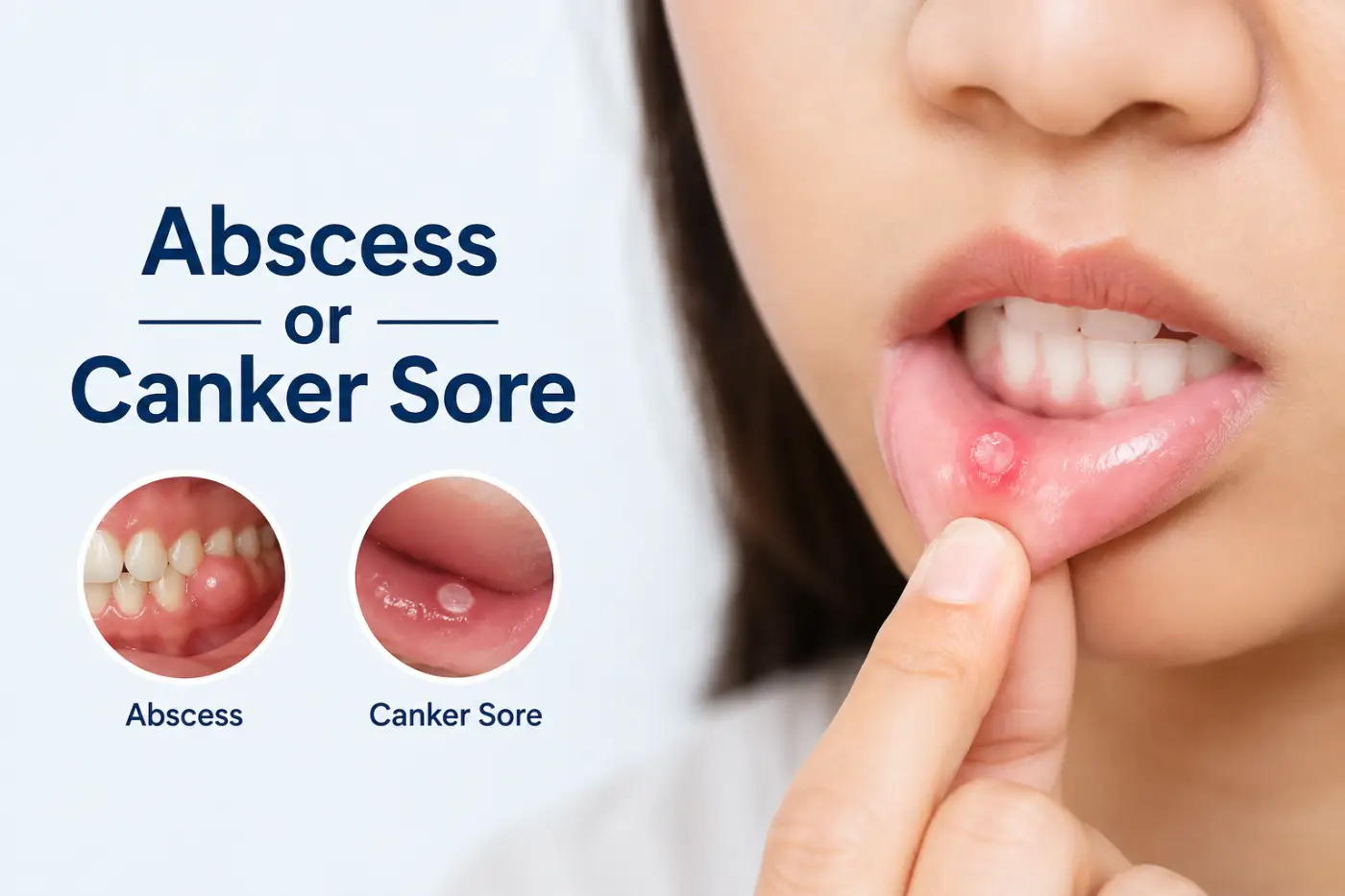
A painful spot in your mouth can be hard to identify when you first notice it. Abscess or canker sore is a common search because both can cause pain swelling and tenderness. Yet they aren’t the same problem and they usually need very different care.
A canker sore is a small ulcer that develops in the soft tissue inside your mouth. It often has a white or yellow center with a red border and usually heals on its own within one to two weeks. A dental abscess is a pocket of pus caused by a bacterial infection. It can develop around the root of a tooth or along the gum and needs prompt dental treatment.
The tricky part is that location and appearance can overlap. A sore near the gums might look like a simple mouth ulcer at first. An abscess can also cause a bump or swelling that makes you wonder if you’ve bitten your mouth.
This guide will help you compare the two based on location symptoms appearance causes pain and treatment. It will also explain the warning signs that mean you shouldn’t wait for the problem to disappear.
You may also want to read Channel Vs Chanel Which Spelling Is Correct 2026.
Quick Answer
A canker sore is a shallow mouth ulcer that usually appears inside the lips cheeks or on the tongue and heals within one to two weeks. A dental abscess is an infection that creates a pocket of pus around a tooth or gum. An abscess often causes tooth pain swelling fever or a bad taste and needs dental care. (Mayo Clinic)
Abscess Or Canker Sore Comparison
| Feature | Abscess | Canker Sore |
|---|---|---|
| Main cause | Bacterial infection | Mouth ulcer with several possible triggers |
| What it is | A pocket of pus caused by infection | A shallow ulcer in the mouth lining |
| Typical location | Around a tooth or in the gum | Inside lips cheeks tongue gums or soft palate |
| Appearance | Swelling or tender bump sometimes with drainage | White yellow or gray center with a red border |
| Tooth pain | Common with a dental abscess | Usually not linked to tooth pain |
| Swelling | Can be significant | Usually limited around the sore |
| Fever | Can occur | Not typical |
| Bad taste | Can occur if pus drains | Not a typical feature |
| Contagious | The abscess itself isn’t considered contagious | No |
| Typical healing | Usually needs dental treatment | Often heals within one to two weeks |
| Main treatment | Dental treatment to control the infection | Pain relief and treatment of the sore when needed |
| Urgency | Prompt dental assessment is important | Usually less urgent unless severe or persistent |
The table gives you the broad distinction. The symptoms matter more than any single visual feature.
What Is A Dental Abscess
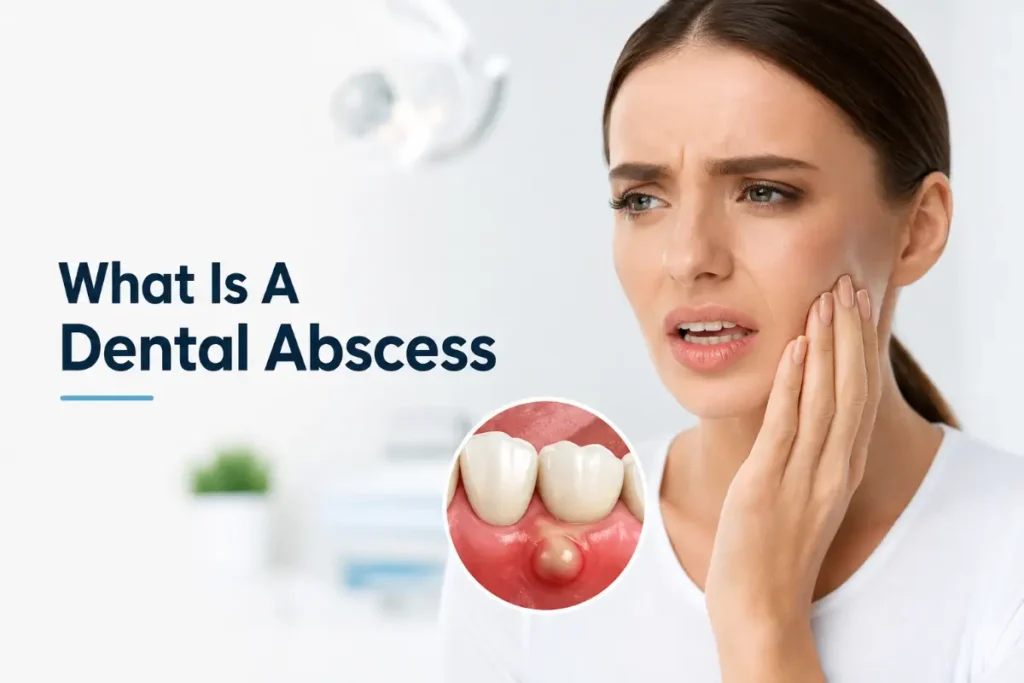
A dental abscess is a pocket of pus caused by a bacterial infection. It can develop in different places around a tooth.
A periapical abscess forms at the tip of a tooth’s root. A periodontal abscess develops in the gum beside the tooth. Dental abscesses can result from an untreated cavity an injury to a tooth or problems affecting the gums.
An abscess isn’t simply a sore that happens to be painful. It represents an infection that your body is trying to contain.
What An Abscess Can Look Like
A dental abscess can cause a swollen tender area around a tooth. You might notice a bump on the gum that looks like a small pimple.
Some people notice pus or a sudden unpleasant taste if the abscess drains. Pain can sometimes improve after drainage. That doesn’t mean the infection has disappeared. The underlying dental problem still needs attention.
Other signs can include:
- A severe or throbbing toothache.
- Pain when biting or chewing.
- Sensitivity to hot or cold temperatures.
- Swelling around the tooth.
- Swelling of the cheek face or neck.
- Tender lymph nodes under the jaw or in the neck.
- Fever.
- A foul smell or unpleasant taste in the mouth.
- Difficulty swallowing or breathing in serious cases.
These symptoms are much more concerning for an abscess than an ordinary canker sore.
What Is A Canker Sore
A canker sore is a small ulcer that develops on the soft tissues inside your mouth. Its medical name is an aphthous ulcer.
Canker sores commonly appear inside the lips or cheeks. They can also occur on or under the tongue at the base of the gums or on the soft palate. A typical sore has a white yellow or gray center surrounded by a red border.
Canker sores can hurt quite a bit even though they’re usually small.
Eating talking brushing your teeth or drinking something acidic can make the pain worse.
What A Canker Sore Usually Feels Like
A canker sore may begin with burning or tingling before the visible ulcer appears.
Then a small round or oval sore develops. It may feel sharp or irritated when food touches it.
Most minor canker sores heal within one to two weeks without special treatment. Larger sores can last much longer and may leave scars.
Canker sores aren’t the same as cold sores. Canker sores aren’t caused by herpes viruses and aren’t spread from person to person.
Abscess Or Canker Sore Symptoms
The symptoms can overlap enough to cause confusion. The pattern of symptoms can still provide useful clues.
Pain From An Abscess
Abscess pain often centers around a tooth.
You might feel a deep throbbing ache that becomes worse when you bite down. Hot and cold foods can also trigger pain or discomfort. The pain may spread toward your jaw ear or neck.
That deep tooth centered pain is an important clue.
Pain From A Canker Sore
Canker sore pain usually centers on the ulcer itself.
You can often point to the exact spot with your tongue. Touching it with food your toothbrush or your finger can make it sting.
The tooth underneath usually isn’t the source of the problem.
Swelling Makes The Difference
A small amount of local irritation can occur around many mouth sores. More noticeable swelling deserves closer attention.
An abscess can cause swelling in the gum cheek face or neck. Severe swelling can become an emergency if it affects breathing swallowing or other nearby structures.
A typical canker sore usually doesn’t cause major facial swelling.
Where Abscesses And Canker Sores Appear
Location can offer one of the most useful clues.
Typical Abscess Location
A dental abscess usually develops near a tooth.
You might see swelling beside a tooth or notice tenderness when you press on the gum. A periapical abscess occurs at the root tip and may not be visible as a simple surface sore.
This matters because you can’t always diagnose an abscess just by looking in a mirror.
A dentist may need to examine the tooth and sometimes take an X ray to determine what’s happening below the surface.
Typical Canker Sore Location
Canker sores commonly occur on movable soft tissue.
Typical locations include:
- Inside the lips.
- Inside the cheeks.
- On or under the tongue.
- At the base of the gums.
- On the soft palate.
A sore inside your cheek after accidentally biting it is much more consistent with a canker sore than a tooth abscess.
Location alone can’t confirm the diagnosis. It simply gives you another useful piece of the puzzle.
How The Appearance Differs
Appearance can help but don’t rely on appearance alone.
An Abscess Often Looks Like A Swollen Bump
A gum abscess may look like a raised swollen area. Some people describe it as a pimple on the gum.
You may also notice pus or drainage. The surrounding gum can look red and feel tender.
The key feature is the connection to an infection around a tooth or gum.
A Canker Sore Usually Looks Like An Ulcer
A classic canker sore looks more like a small crater or shallow break in the surface tissue.
The center is often white yellow or gray. A red border commonly surrounds it.
That appearance is different from a pus filled swelling.
Still don’t try to diagnose yourself from color alone. Several mouth conditions can create white red or swollen areas.
What Causes A Dental Abscess
Dental abscesses happen because bacteria enter an area where they shouldn’t be.
A deep cavity can allow bacteria to reach the inner part of a tooth. Cracks injuries and previous dental work can also create a pathway for infection. The infection can then spread into surrounding tissue and produce pus.
Gum disease can also contribute to dental abscesses.
The important point is simple. An abscess has an infectious cause and usually needs treatment aimed at the infection itself.
Pain medication may reduce discomfort but it doesn’t remove the source of the infection.
What Causes A Canker Sore
Canker sores have a different story.
Experts don’t have one single cause for all canker sores. Several factors may contribute to them or trigger an outbreak.
Possible triggers include:
- Minor injuries inside the mouth.
- Stress.
- Certain acidic or spicy foods.
- Hormonal changes.
- Some nutritional deficiencies.
- Certain medications.
- Family tendency.
- Some underlying medical conditions.
For example a sharp piece of food or an accidental cheek bite can irritate the tissue. Some people also notice that certain foods repeatedly trigger sores.
The American Dental Association notes that hard acidic and salty foods as well as some drinks have been reported as dietary triggers for recurrent aphthous ulcers.
Is An Abscess More Serious Than A Canker Sore
Generally yes.
A typical canker sore is painful but usually harmless and temporary. Most heal without treatment within one to two weeks.
A dental abscess is different because it involves a bacterial infection.
An untreated dental abscess can spread into surrounding tissues and cause serious complications. That’s why Mayo Clinic recommends seeing a dentist promptly when you have signs or symptoms of a tooth abscess.
Think of the difference this way.
A canker sore is usually a surface problem.
A dental abscess can be a deeper infection.
That distinction is more useful than simply asking which one hurts more.
When A Mouth Sore Needs Urgent Attention
Most small mouth sores aren’t emergencies. Some symptoms deserve faster medical or dental attention.
Seek prompt dental care if you have signs of a dental abscess such as significant tooth pain swelling fever or pus.
Get emergency help if severe swelling makes it difficult to breathe or swallow. Facial or neck swelling can become dangerous when an infection affects the airway.
A mouth ulcer also deserves professional assessment if it lasts two weeks or longer keeps returning becomes unusually large or makes eating and drinking difficult.
Don’t wait simply because a sore looks small. Duration and other symptoms matter.
Abscess Or Canker Sore And Tooth Pain
Tooth pain is one of the strongest clues that you may be dealing with an abscess rather than a simple canker sore.
An abscess can cause a persistent toothache that may feel deep or throbbing. Biting or chewing can make it worse. Hot and cold temperatures may also trigger discomfort.
A canker sore can make eating painful but usually because food rubs directly against the ulcer.
For example if you have a sore on the inside of your cheek and it hurts when that spot touches a tortilla chip that’s different from a tooth that throbs every time you bite down.
That distinction isn’t a diagnosis but it can help you understand why the symptoms feel different.
Can An Abscess Look Like A Canker Sore
Yes. A swollen infected area near the gum can initially confuse someone who expects every mouth problem to look like a classic toothache.
The reverse can happen too. A painful ulcer near the gum may make someone worry about an abscess.
The safest approach is to look at the whole pattern rather than one visual detail.
Consider these clues.
More suggestive of a canker sore
- Small shallow ulcer.
- White or yellow center.
- Red border.
- Located inside the mouth.
- No significant toothache.
- No facial swelling.
- Usually improves and heals within one to two weeks.
More suggestive of an abscess
- Tooth centered pain.
- Throbbing or severe pain.
- Pain when biting.
- Swollen gum near a tooth.
- Pus or foul tasting drainage.
- Fever.
- Facial or neck swelling.
If you’re still unsure after looking at these signs a dentist or healthcare professional can examine the area and determine the cause.
Medical note: This comparison is for general education and can’t diagnose a mouth lesion. A new severe sore persistent ulcer significant swelling fever or difficulty breathing or swallowing deserves professional evaluation.
How Abscess Treatment Differs From Canker Sore Treatment
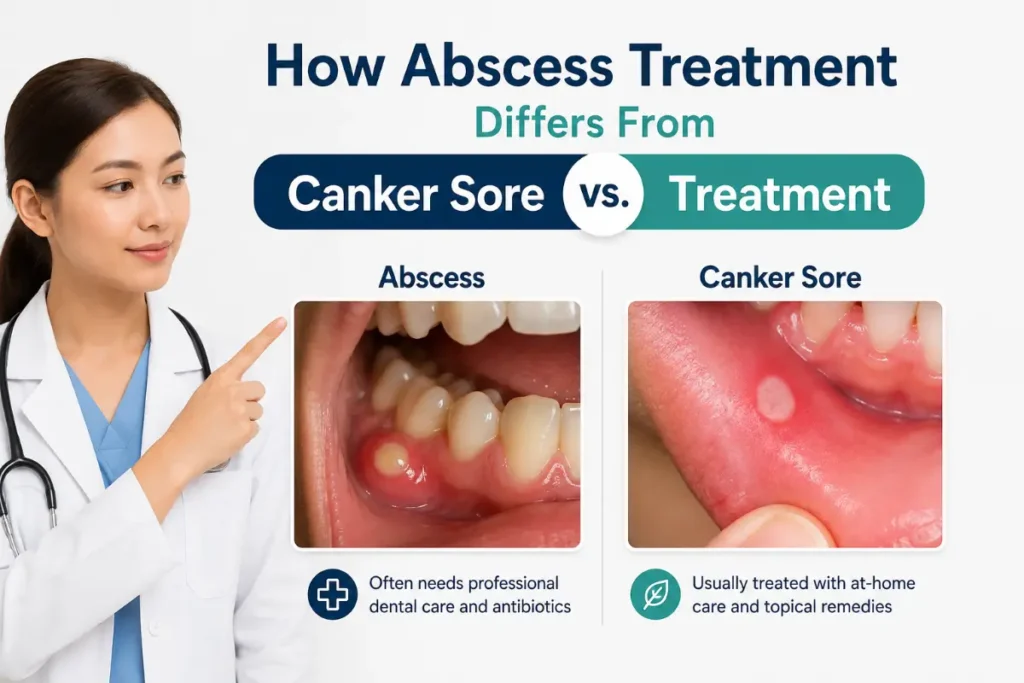
The biggest treatment difference is simple. A dental abscess needs treatment for an infection. A typical canker sore usually needs comfort measures while the ulcer heals.
Trying to treat one like the other can waste time and sometimes delay proper care.
How Dentists Treat An Abscess
A dentist’s main goal is to remove the source of infection and protect the surrounding tissue.
Depending on the tooth and the extent of the infection treatment can include:
- Draining the abscess.
- Performing root canal treatment to clean and save the tooth.
- Removing the tooth when it can’t be saved.
- Prescribing antibiotics when the infection has spread or caused systemic symptoms.
Mayo Clinic explains that drainage root canal treatment and extraction are among the treatments used for a tooth abscess.
Antibiotics aren’t automatically the answer for every dental infection. The American Dental Association recommends prioritizing definitive dental treatment for many localized dental conditions and reserving antibiotics for situations where they’re clinically indicated such as systemic involvement or spreading infection.
That distinction matters. An antibiotic can help control certain infections but it doesn’t repair a badly decayed tooth or remove infected tissue by itself.
How Canker Sores Are Managed
Most ordinary canker sores don’t require a procedure.
The goal is usually to reduce pain and avoid irritating the ulcer while your mouth heals.
Helpful measures can include:
- Avoiding foods that sting the sore.
- Choosing softer foods for a few days.
- Keeping your mouth clean with gentle brushing.
- Using appropriate over the counter pain relief when needed.
- Asking a dentist or doctor about a medicated mouth treatment if the sore is severe or keeps returning.
Some prescription treatments can reduce pain and speed healing in selected cases. The right treatment depends on the cause and severity of the ulcer.
Can You Treat An Abscess At Home
Home care can make you more comfortable while you arrange dental care. It doesn’t eliminate a dental abscess.
You can gently rinse your mouth with warm salt water and use appropriate nonprescription pain medicine if it’s safe for you. Mayo Clinic lists warm salt water rinses and over the counter pain relievers among measures that may help with discomfort while the area heals.
Don’t try to squeeze or puncture a swollen gum.
You also shouldn’t assume the infection is gone if the abscess suddenly drains. The pressure may disappear and the pain may improve but the underlying infection can remain.
That’s one of the most important differences between an abscess and a canker sore.
A canker sore can naturally disappear as the tissue heals.
An abscess usually needs the infected source treated.
Can You Treat A Canker Sore At Home
Most minor canker sores can be managed at home while they heal.
Start with simple measures.
Protect The Sore
Avoid foods that scrape or burn the ulcer.
Spicy acidic salty or very crunchy foods can make the area feel much worse. Choose softer foods if chewing becomes uncomfortable.
Keep Brushing
Don’t stop cleaning your teeth just because you have a sore.
Use a soft toothbrush and brush gently around the affected area. Good oral hygiene helps keep your mouth clean while the tissue heals.
Reduce Irritation
Try not to keep touching the sore with your tongue.
It can be tempting to check it every few minutes. Unfortunately that constant irritation can make an already sensitive spot feel even worse.
Ask About Medication
A pharmacist dentist or doctor can help you choose an appropriate mouth ulcer treatment.
Don’t put random household chemicals or concentrated substances directly on the sore. A painful ulcer doesn’t need a chemistry experiment.
Do Abscesses And Canker Sores Heal On Their Own
This is one of the most important questions in the entire comparison.
Canker Sores Often Heal On Their Own
Most minor canker sores heal without medical treatment within one to two weeks.
You may notice the pain improving before the sore completely disappears.
If a sore keeps returning or doesn’t heal within the expected period it deserves professional evaluation.
Dental Abscesses Usually Need Treatment
A dental abscess shouldn’t be treated as a wait and see problem.
Mayo Clinic notes that an untreated tooth abscess can spread and cause serious complications. Even if an abscess ruptures and the pain improves the infection can remain.
So if you notice a swollen bump near a painful tooth don’t assume it will behave like an ordinary mouth ulcer.
What Happens If An Abscess Bursts
An abscess can sometimes rupture and release fluid into your mouth.
You may suddenly notice a foul tasting or foul smelling salty liquid. The pressure and pain may decrease afterward.
That sudden improvement can be misleading.
The source of the infection still needs dental treatment. An abscess doesn’t become harmless simply because it has drained.
Think of it like a leak in a pipe. Getting the water out of one spot doesn’t necessarily fix the damaged pipe.
What Happens If A Canker Sore Bursts
A typical canker sore isn’t a pus filled abscess waiting to burst.
It’s an ulcer in the lining of the mouth. As the tissue heals the sore gradually becomes less painful and eventually closes.
Trying to pop or cut it can cause more irritation and potentially introduce bacteria into damaged tissue.
If you see a fluid filled bump rather than a shallow ulcer especially near a painful tooth it’s better to have a dental professional evaluate it instead of trying to drain it yourself.
Abscess Or Canker Sore And Pus
Pus is a particularly useful clue.
A dental abscess contains pus because it results from an infection. A swollen gum area may release pus when it drains.
A typical canker sore isn’t a pocket of pus.
Its white or yellow appearance can cause confusion. The pale center of a canker sore is part of the ulcer and isn’t the same thing as a pus filled abscess.
This is why color alone isn’t enough.
A white spot doesn’t automatically mean infection.
Abscess Or Canker Sore And Fever
Fever changes the picture.
A simple canker sore doesn’t usually cause fever.
A dental abscess can cause fever because the body is responding to an infection. Other signs such as facial swelling swollen lymph nodes and feeling generally unwell make an abscess more concerning.
If you have a painful mouth problem plus fever don’t assume it’s just a canker sore.
Contact a dentist or healthcare professional for appropriate evaluation.
Abscess Or Canker Sore And Bad Taste
A sudden unpleasant taste can occur when an abscess drains.
You may notice a salty foul tasting fluid in your mouth followed by some relief from pressure. This pattern is associated with a ruptured tooth abscess.
A typical canker sore doesn’t normally produce this kind of drainage.
So if you have a painful gum bump plus a sudden bad taste pay attention to the combination rather than focusing only on the appearance of the sore.
Abscess Or Canker Sore And Swollen Gums
Swollen gums can occur with an abscess but they can also have many other causes.
A localized swollen bump beside a tooth is more concerning for a dental infection especially if you also have tooth pain pressure sensitivity or drainage.
A canker sore can irritate nearby tissue but it usually appears as an ulcer rather than a deep swollen pocket.
If swelling is spreading into your cheek jaw or neck the situation becomes more urgent. Facial or neck swelling combined with trouble breathing or swallowing requires emergency care.
Need another quick comparison? Read Tapping Vs Taping Which Word Should You Use.
How A Dentist Tells The Difference
You don’t have to solve the mystery by looking in the mirror.
A dentist can examine the tooth gums and surrounding tissues and look for signs of infection.
For a suspected dental abscess the dentist may tap on the tooth to check sensitivity and may use dental X rays to identify an infection below the surface. More advanced imaging may be needed if the infection appears to have spread.
This is important because some abscesses aren’t obvious from the outside.
A small surface bump doesn’t tell the whole story.
Why A Dental X Ray May Be Needed
A canker sore usually affects the visible soft tissue.
A dental abscess can exist deeper around the tooth root.
That means a dentist may need an X ray to see what’s happening beneath the gum. An X ray can help identify an abscess and show how far an infection may have extended.
This is one reason online image comparisons can only take you so far.
Two mouth problems can look similar from the outside while having completely different causes underneath.
Abscess Or Canker Sore In Children
Children can develop mouth ulcers and dental infections too.
The same basic distinction applies. A small ulcer inside the cheek or lip may be a canker sore while swelling around a painful tooth can point toward a dental infection.
Parents should pay close attention to symptoms that a child can’t describe clearly.
Look for:
- Refusing food or drinks.
- Crying while chewing.
- Holding the cheek or jaw.
- Swelling around the face.
- Fever.
- Bad breath or unusual drainage.
- Difficulty swallowing.
- Difficulty breathing.
A child with significant facial swelling or trouble breathing or swallowing needs urgent medical attention.
Don’t rely on an internet photo to diagnose a child’s mouth problem.

Abscess Or Canker Sore During Pregnancy
Pregnancy can change oral health and can make dental problems more complicated to manage.
A suspected dental infection shouldn’t simply be ignored because you’re pregnant.
Tell your dentist that you’re pregnant and provide information about medications you’re taking. Your dental professional can choose an appropriate evaluation and treatment plan.
The same basic warning signs remain important. Significant swelling fever or trouble breathing or swallowing needs prompt professional attention.
Avoid taking leftover antibiotics or someone else’s medication. The right medicine depends on the diagnosis and your individual circumstances.
Can Stress Cause An Abscess Or Canker Sore
Stress is more closely associated with canker sores than dental abscesses.
Canker sores can have several triggers and some people notice that outbreaks happen during stressful periods.
An abscess has a different mechanism.
It results from a bacterial infection involving a tooth or surrounding tissue. Stress may affect general health and habits but it doesn’t turn an ordinary mouth sore into a dental abscess.
This distinction is useful because people sometimes blame stress for every painful spot in the mouth.
Stress may be part of the story for recurrent ulcers. It doesn’t explain away a swollen painful tooth.
Can Poor Oral Hygiene Cause An Abscess
Poor oral hygiene can increase the risk of dental problems.
Plaque contributes to tooth decay and gum disease. Untreated decay can eventually allow bacteria to reach the inner part of a tooth and contribute to an abscess.
Regular brushing flossing and dental care help reduce the risk.
Still don’t assume that every abscess means someone has poor hygiene. Tooth injuries cracks previous dental work and other problems can also create a route for infection.
Can A Canker Sore Become An Abscess
A typical canker sore doesn’t simply turn into a dental abscess.
They are different conditions with different causes.
A canker sore is an ulcer in the mouth lining. A dental abscess is an infection involving a tooth or surrounding tissue.
An ulcer can become irritated and in some situations damaged tissue can become infected. But that doesn’t mean a normal canker sore naturally progresses into a dental abscess.
If a sore changes dramatically develops significant swelling or becomes associated with tooth pain fever or pus it’s time to get professional advice instead of assuming it’s the same sore behaving differently.
Abscess Or Canker Sore And Bad Breath
Bad breath can have many causes so it isn’t enough to diagnose an abscess on its own.
Still a foul odor or unpleasant taste combined with tooth pain swelling or drainage can be a useful warning sign of a dental infection.
A simple canker sore usually doesn’t produce persistent foul smelling drainage.
Pay attention to combinations of symptoms.
One symptom can mislead you.
Several matching symptoms create a much clearer picture.
When A Canker Sore Needs A Dental Or Medical Check
Most minor canker sores are temporary.
You should seek professional advice if a mouth ulcer:
- Lasts longer than expected.
- Keeps coming back frequently.
- Becomes unusually large.
- Makes eating or drinking difficult.
- Is accompanied by other unexplained symptoms.
- Looks unusual or changes in a way that concerns you.
Persistent mouth ulcers shouldn’t automatically be labeled canker sores. A professional can determine if another condition needs attention.
Internal Link Opportunity
A useful related article could link here with anchor text such as common causes of mouth sores and ulcers.
Another natural internal link could cover toothache causes and when to see a dentist.
These topics help readers move from basic symptom recognition to broader oral health information without forcing unrelated links into the article.
The Most Useful Clues To Remember
If you forget everything else in this guide remember the pattern.
Canker sore
Small ulcer.
Usually inside the mouth.
White yellow or gray center.
Red border.
Pain focused on the sore.
Usually heals within one to two weeks.
Dental abscess
Swelling near a tooth or gum.
Toothache or pressure pain.
Possible pus or foul tasting drainage.
Possible fever.
Possible facial swelling.
Needs prompt dental assessment.
Neither list provides a diagnosis by itself.
The goal is to recognize when the pattern looks more concerning and when professional care makes sense.
Pro Editor Insight
When people search abscess or canker sore they often want a visual answer. But experienced clinicians don’t rely on appearance alone.
The better approach is to consider location plus pain pattern plus swelling plus drainage plus duration plus systemic symptoms.
That combination is far more informative than asking if a spot looks white or red.
A small white sore inside the cheek with no fever and no tooth pain is a very different situation from a swollen gum beside a throbbing tooth with foul tasting drainage.
The mouth can be deceptive. The smartest approach is to look at the whole pattern rather than one isolated symptom.
Common Mistakes When Comparing Abscess And Canker Sore
One of the biggest mistakes is assuming every painful spot inside the mouth is the same kind of problem.
A canker sore and a dental abscess can both hurt. They can both make eating uncomfortable. They can even occur close to the gums. The important difference is the underlying cause.
Mistake One Is Calling Every White Spot A Canker Sore
A classic canker sore often has a pale center and a red border. But many other mouth conditions can produce white or pale areas.
A white patch isn’t enough to identify the problem.
Look at the complete picture instead. Location symptoms duration and swelling all matter.
Mistake Two Is Assuming Every Gum Bump Is A Canker Sore
A raised bump on the gum near a tooth is more concerning for a dental abscess than a typical canker sore.
A canker sore is generally an ulcer rather than a pus filled bump.
If the bump is painful and you also have toothache swelling or drainage don’t wait for it to behave like an ordinary ulcer.
Mistake Three Is Ignoring Tooth Pain
A painful tooth can provide an important clue.
If one specific tooth hurts when you bite or reacts strongly to temperature and you also have gum swelling the problem may involve the tooth rather than the surface of the mouth.
That’s a good reason to contact a dentist.
Mistake Four Is Assuming Pain Relief Means The Infection Is Gone
Pain can decrease for several reasons.
An abscess may drain and release pressure. Pain may temporarily improve even though the infection remains.
Never use temporary relief as proof that a dental infection has disappeared. A dentist still needs to address the source.
Mistake Five Is Trying To Pop An Abscess
Don’t squeeze or puncture a swollen area yourself.
You could damage surrounding tissue and make the situation worse. A dental professional can determine the safest way to manage an infection.
Mistake Six Is Treating A Persistent Ulcer As A Normal Canker Sore
Most minor canker sores heal within one to two weeks. A sore that doesn’t heal or repeatedly returns deserves professional evaluation.
Don’t keep treating a persistent mouth lesion at home simply because the first few days looked like a canker sore.
Memory Tricks For Abscess And Canker Sore
You don’t need a complicated medical mnemonic.
Think tooth versus tissue.
An abscess usually points you toward a problem involving a tooth or the tissue around it.
A canker sore is an ulcer affecting the lining of the mouth.
You can also remember the pattern this way.
Abscess equals infection and swelling.
Canker sore equals ulcer and irritation.
This isn’t a diagnostic rule. It’s simply a useful mental shortcut.
Another helpful clue is the word pus. If you have a swollen area producing pus or foul tasting drainage especially near a painful tooth an abscess becomes more likely.
Abscess Or Canker Sore In Everyday Language
People don’t always use medical terms precisely.
Someone might call a painful gum bump a sore. Another person might call a canker sore an infection. Someone else might use abscess for almost any swollen spot.
That casual language can create confusion online.
In medical language the terms have more specific meanings.
A canker sore is an aphthous ulcer.
A dental abscess is a localized collection of pus caused by infection.
Those definitions matter because the treatment isn’t interchangeable.
Related Mouth Problems That Can Look Similar
Not every mouth lesion is an abscess or canker sore.
Several other conditions can cause pain swelling ulcers or unusual patches.
Cold Sores
Cold sores are different from canker sores.
Cold sores commonly develop on or around the lips and are associated with herpes simplex virus infection. Canker sores occur inside the mouth and aren’t caused by herpes viruses.
This distinction is especially useful because people often use the two names as if they mean the same thing.
They don’t.
Gum Disease
Gum disease can cause swollen tender or bleeding gums.
It doesn’t automatically mean you have an abscess.
Persistent gum changes deserve dental attention because gum disease can progress if left untreated.
Tooth Decay
A cavity can cause tooth sensitivity and pain.
Advanced tooth decay can eventually lead to infection and an abscess.
That means a cavity and an abscess can be connected even though they aren’t the same condition.
Mouth Injuries
Biting your cheek burning your mouth with hot food or irritation from dental appliances can create painful sores.
These injuries can sometimes resemble canker sores.
The history of what happened before the sore appeared can provide an important clue.
Twenty Natural Examples Of The Difference
These examples show how people might describe the two conditions in real life.
- I have a small sore inside my cheek that hurts when I eat.
- My tooth has been throbbing all night and my gum is swollen.
- She noticed a white canker sore after biting her cheek.
- He went to the dentist after finding a painful bump beside his tooth.
- The canker sore became less painful after several days.
- The dentist found an abscess near the root of the tooth.
- Spicy food makes my mouth ulcer sting.
- Biting down makes the pain in my tooth much worse.
- The ulcer has a red border around a pale center.
- The swollen gum released fluid with an unpleasant taste.
- I usually get canker sores when I’m stressed.
- The dentist said the tooth needed treatment because of an infection.
- Her canker sore healed without a dental procedure.
- His cheek became swollen because the dental infection had spread.
- The sore is inside my lip and isn’t connected to a tooth.
- The gum around the tooth is swollen and extremely tender.
- I don’t have a fever or facial swelling and the ulcer is getting better.
- The toothache came with fever and swelling so he sought urgent dental care.
- The mouth ulcer makes brushing uncomfortable.
- The infected tooth causes pain when she bites down.
These examples show why context matters. The word sore alone doesn’t tell you what’s happening.
What Dictionaries And Medical Sources Say
From a language perspective abscess and canker sore are established terms with distinct meanings.
An abscess refers to a collection of pus associated with infection. A canker sore refers to a painful ulcer of the mouth. Major medical references maintain this distinction rather than treating the terms as interchangeable.
That distinction is worth preserving in clear writing.
If you’re writing for patients readers or students use the specific term you mean.
Say dental abscess when you’re talking about an infected collection of pus associated with a tooth or surrounding tissue.
Say canker sore when you’re talking about an aphthous ulcer.
Precision makes health information easier to understand.
What Sounds More Natural In American English
American speakers commonly say canker sore for an aphthous ulcer.
You may also hear mouth ulcer. That term is especially common outside the United States.
For a dental infection people often say tooth abscess or dental abscess.
Examples sound natural like this.
I think I have a canker sore.
I think I have a tooth abscess.
My gum is swollen around one of my teeth.
I have a painful mouth ulcer.
Regional vocabulary can vary but the medical distinction remains important.
Canadian And Australian English
Canadian and Australian English speakers understand canker sore and dental abscess.
The phrase mouth ulcer may be more familiar in many varieties of English outside the United States. The underlying condition doesn’t change simply because the preferred everyday term changes.
For readers from different countries a clear article can mention both terms.
For example:
A canker sore also called an aphthous ulcer is a small ulcer inside the mouth.
That gives readers a familiar term without sacrificing accuracy.
When To Contact A Dentist
Contact a dentist promptly if you have symptoms that suggest a dental abscess.
These include significant tooth pain swelling around a tooth pus fever or an unpleasant taste associated with drainage.
Don’t wait for severe pain before taking a suspected dental infection seriously.
Seek emergency medical attention if swelling makes breathing or swallowing difficult. Severe infection in the mouth or jaw can become dangerous when it threatens the airway.
For a canker sore seek professional advice if it doesn’t heal as expected or keeps coming back.
A dentist or doctor can also investigate recurrent ulcers and decide if another cause needs attention.
Frequently Asked Questions
How Can I Tell If I Have An Abscess Or Canker Sore
A canker sore usually appears as a small shallow ulcer with a pale center and red border inside the mouth. An abscess more often causes swelling around a tooth or gum and may cause tooth pain pus fever or a bad taste. These signs can overlap so a dentist should assess symptoms that are severe or persistent.
Can A Canker Sore Cause A Swollen Gum
A canker sore can irritate nearby tissue but significant swelling isn’t typical of a simple canker sore. A swollen bump near a tooth is more concerning for an abscess or another dental problem. If swelling is increasing or accompanied by tooth pain fever pus or facial swelling arrange a dental assessment promptly.
Does An Abscess Always Hurt
No. An abscess can sometimes cause mild symptoms or even little pain. A tooth may have an infection despite limited discomfort. A draining abscess can also feel better after pressure decreases. Don’t assume an infection is gone simply because the pain disappears. A suspected dental abscess still needs professional evaluation.
How Long Does A Canker Sore Last
Most minor canker sores heal within one to two weeks. Larger or more severe ulcers can take longer. If a sore doesn’t heal within the expected period keeps returning or becomes unusually painful you should have it evaluated. Persistent mouth ulcers shouldn’t automatically be assumed to be ordinary canker sores.
Can An Abscess Go Away Without Antibiotics
Some dental infections can require dental treatment without antibiotics while others need antibiotics because the infection has spread or caused systemic symptoms. Antibiotics aren’t a substitute for treating the dental source. A dentist can determine the appropriate treatment based on the infection and your symptoms.
Is A White Spot In My Mouth An Abscess
Not necessarily. A white or pale area can occur with a canker sore and many other mouth conditions. An abscess is associated with infection and pus and often involves swelling around a tooth or gum. Color alone can’t distinguish the two. Consider the location pain swelling drainage and other symptoms.
Can A Canker Sore Turn Into A Tooth Abscess
A typical canker sore doesn’t naturally turn into a tooth abscess. They are different conditions. A canker sore is an ulcer of the mouth lining while a dental abscess is an infection involving a tooth or surrounding tissue. If a sore develops major swelling tooth pain fever or pus it needs professional assessment.
Should I See A Doctor Or Dentist For A Mouth Abscess
A dentist is usually the appropriate professional for a suspected dental abscess because the source often involves a tooth or surrounding oral tissue. If you develop severe facial or neck swelling or difficulty breathing or swallowing seek emergency medical care instead of waiting for a routine dental appointment.
Many readers also check Scrapped Or Scraped Which Word Is Correct 2026 Guide.
Conclusion
The difference between an abscess or canker sore comes down to cause location and symptoms.
A canker sore is usually a small painful ulcer inside the mouth. Most minor cases heal on their own within one to two weeks.
A dental abscess is an infection that creates a pocket of pus around a tooth or in nearby gum tissue. Tooth pain swelling fever pus and foul tasting drainage are important warning signs.
The most common mistake is judging the problem by appearance alone. A pale center doesn’t automatically mean you have an abscess and a painful spot doesn’t automatically mean you have a canker sore.
Pay attention to the full pattern. A simple ulcer usually heals. An abscess needs the infection addressed.
If you’re unsure and the pain is severe the swelling is growing or you have fever or facial swelling it’s better to get professional help than to guess.
When it comes to mouth problems a little attention early can save you a much bigger headache later.

Vocabulary & Language Research Writer
Ethan Parker researches English vocabulary, word meanings, slang, idioms, and commonly confused words. His goal is to help readers understand how English is actually used in everyday conversations and writing.