
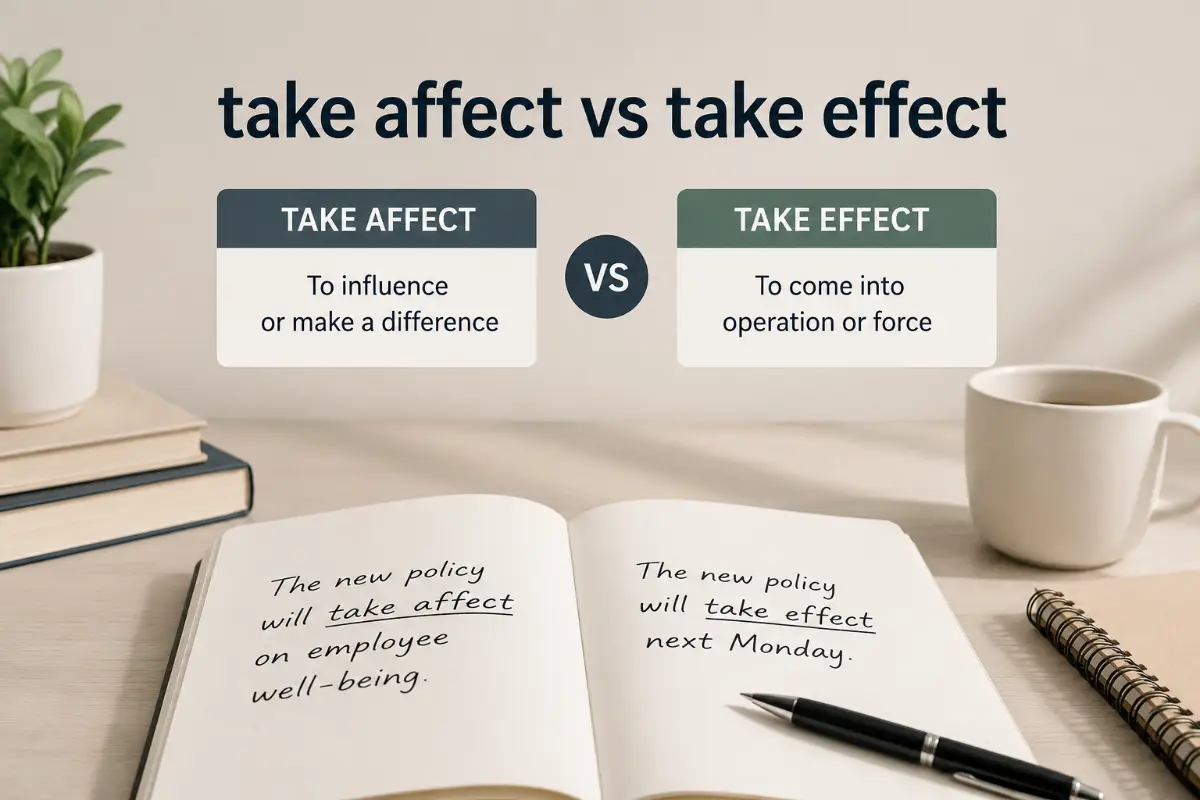
If you’ve ever stopped while writing a sentence such as The new policy will take affect next month you’re not alone. Take affect vs take effect is a common word choice problem because affect and effect look almost identical and both relate to change and influence. Yet only one form belongs in this standard expression.
The correct phrase is take effect. It means to begin working, become active, become legally valid, or start producing a result. The phrase take affect is not the standard expression and should be corrected in edited English.
The confusion becomes easier to solve once you understand the grammar behind the phrase. Affect usually works as a verb meaning to influence something. Effect commonly works as a noun meaning a result or outcome. In take effect, effect is the noun used in an established expression.
This guide explains the difference in plain English. You’ll learn how to recognize the correct phrase, understand the role of each word, avoid common mistakes, and choose the right form in everyday conversation, professional writing, academic work, and formal documents.
For another common grammar confusion, see Apposed Vs Opposed Which Word Is Correct 2026.
Quick Answer
Take effect is the correct phrase. It means to begin working, become active, become applicable, or start producing a result. Take affect is normally incorrect in standard English. Use affect as a verb when you mean influence, as in The new rule may affect employees. Use effect after take in the expression take effect.
Take Affect Vs Take Effect Comparison
| Feature | Take affect | Take effect |
|---|---|---|
| Correct standard phrase | No | Yes |
| Meaning | Not a standard expression | Become active or start working |
| Main grammar issue | Affect is usually a verb | Effect functions as a noun here |
| Common contexts | Avoid | Laws, rules, policies, medicine, contracts, changes |
| Formal writing | Incorrect | Correct |
| Informal writing | Usually a mistake | Correct |
| Example | The rule will take affect tomorrow. | The rule will take effect tomorrow. |
The important point is simple. Take effect is the phrase you want when something starts operating or begins producing a result.
What Does Take Effect Mean
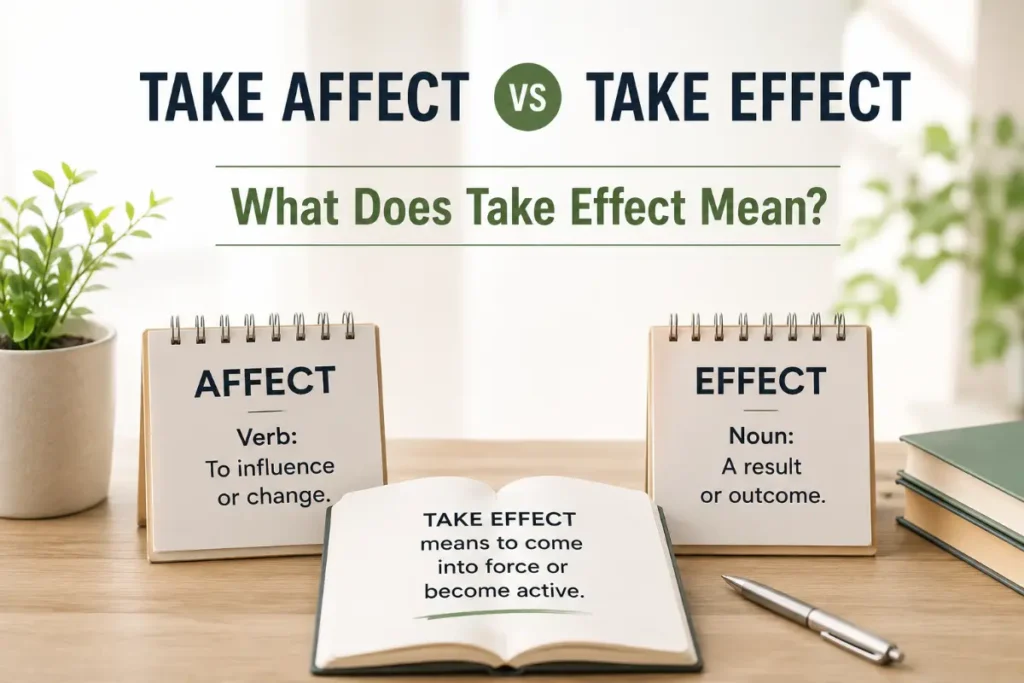
Take effect means to begin to operate, become active, become applicable, or begin producing a noticeable result.
It can describe a physical result, such as medicine beginning to work. It can also describe an official change, such as a new law becoming enforceable.
For example:
- The new policy will take effect on Monday.
- The discount takes effect at midnight.
- The medication began to take effect after an hour.
- The contract will take effect once both parties sign it.
- The new schedule takes effect next week.
The phrase has a broad range of uses, but the central idea stays the same.
Something moves from a planned, inactive, or pending state into an active state.
Dictionaries define effect as a noun that can mean a result or outcome. They also recognize effect as a verb with other meanings, but that does not change the standard expression take effect.
What Does Take Affect Mean
Take affect is not the standard phrase used to mean become active or start working.
If you write:
The new rule will take affect tomorrow.
you should change it to:
The new rule will take effect tomorrow.
The problem comes from confusing the words affect and effect. Both are real English words, but they usually perform different grammatical jobs.
Affect is most commonly a verb meaning to influence.
Effect is most commonly a noun meaning a result.
That basic distinction explains why take effect works and take affect does not in standard usage.
Why Take Effect Is Correct
The phrase take effect is an established English expression.
Here take is the main verb and effect is a noun. The expression means that something begins to produce its intended result or becomes operative.
Consider this sentence:
The new rule will take effect tomorrow.
The rule is not influencing something in the grammatical sense of affect. Instead, the rule itself is becoming active.
Now compare it with:
The new rule will affect employees tomorrow.
Here affect is a verb. The employees receive the influence of the rule.
These sentences can describe the same event from two different angles.
The rule will take effect tomorrow.
This focuses on the rule becoming active.
The rule will affect employees tomorrow.
This focuses on the people influenced by the rule.
That distinction is one of the most useful ways to understand the difference.
Affect Vs Effect Has The Real Answer
To master take affect vs take effect, you need to understand the larger affect vs effect distinction.
Affect As A Verb
In ordinary English affect is most often a verb meaning to influence or change something.
Examples:
- Heavy rain can affect traffic.
- The price increase may affect customers.
- Lack of sleep can affect concentration.
- The decision will affect thousands of workers.
- Noise can affect your ability to focus.
The word comes before the thing receiving the influence.
The weather affected the flight.
The weather influenced the flight.
The new schedule affected employees.
The new schedule influenced employees.
Effect As A Noun
Effect is most commonly a noun meaning result, outcome, or consequence.
Examples:
- The medicine had a strong effect.
- The policy had little effect on sales.
- The decision produced an unexpected effect.
- The change had a positive effect.
- We studied the effects of the new policy.
This noun is the same word used in take effect.
So you can connect the grammar like this:
Affect means influence.
Effect means result.
Take effect means begin producing a result or become active.
That rule handles most everyday cases. Merriam Webster also notes that effect can function as a verb in the specialized sense of bringing something about or putting something into operation.
The Grammar Behind Take Effect
Grammar gives you an even stronger reason to choose effect.
Effect Is A Noun Here.
Look at the structure:
The policy will take effect.
The verb is take.
The noun is effect.
Together they form a standard expression.
You can change the tense without changing the basic relationship.
Present
The policy takes effect today.
Past
The policy took effect yesterday.
Future
The policy will take effect tomorrow.
Present perfect
The policy has taken effect.
Past perfect
The policy had taken effect before the meeting.
The word effect stays the same because it is the noun in the expression.
Affect Does A Different Job
Now consider:
The policy affects workers.
Here affects is the verb.
The structure is:
Subject + affect + object.
The policy affects workers.
The weather affects traffic.
The decision affects prices.
That is completely different from:
Subject + take effect.
The policy takes effect.
The rule takes effect.
The change takes effect.
Once you see the sentence structures side by side, the difference becomes much harder to miss.
When Should You Use Take Effect
Use take effect when something begins to operate, apply, or produce a result.
Several situations appear again and again in real English.
Laws And Regulations
Legal writing frequently uses take effect to describe the point when a law or regulation becomes active.
Examples:
- The new law will take effect on January 1.
- The regulation takes effect immediately.
- The revised tax rules will take effect next year.
- The ban took effect after the required approval.
- The new safety standards will take effect in June.
In this context, take effect can mean that the rule becomes legally operative or enforceable.
Company Policies
Businesses use the expression when announcing changes to workplace rules.
Examples:
- The updated vacation policy will take effect next month.
- The new attendance policy takes effect Monday.
- The revised benefits plan will take effect after enrollment.
- The salary adjustment will take effect with the next pay period.
This is why the phrase appears frequently in workplace emails and official notices.
Contracts And Agreements
Legal and business documents often specify an effective date.
Examples:
- The agreement will take effect once both parties sign it.
- The revised contract takes effect on September 1.
- The new terms will take effect after approval.
- The agreement took effect immediately after execution.
Here the phrase signals the moment an agreement becomes operational.
Medicine And Treatment
People also use take effect when talking about something beginning to produce a result.
Examples:
- The medicine should take effect soon.
- The treatment began to take effect after several days.
- The medication hasn’t taken effect yet.
- The pain relief took effect quickly.
The meaning here is slightly different from a law becoming active. The central idea is still the same.
Something starts producing its intended result.
Technology And Software
The expression works naturally when a technical change becomes active.
Examples:
- The update won’t take effect until you restart the computer.
- The new settings will take effect after you log out.
- The security changes took effect overnight.
- The configuration will take effect after the system restarts.
Prices And Discounts
Businesses often use the phrase when prices change at a specific time.
Examples:
- The new prices will take effect Friday.
- The discount takes effect at checkout.
- The membership fee increase will take effect next month.
- The promotional rate took effect at midnight.
Take Effect Vs Affect In Real Sentences
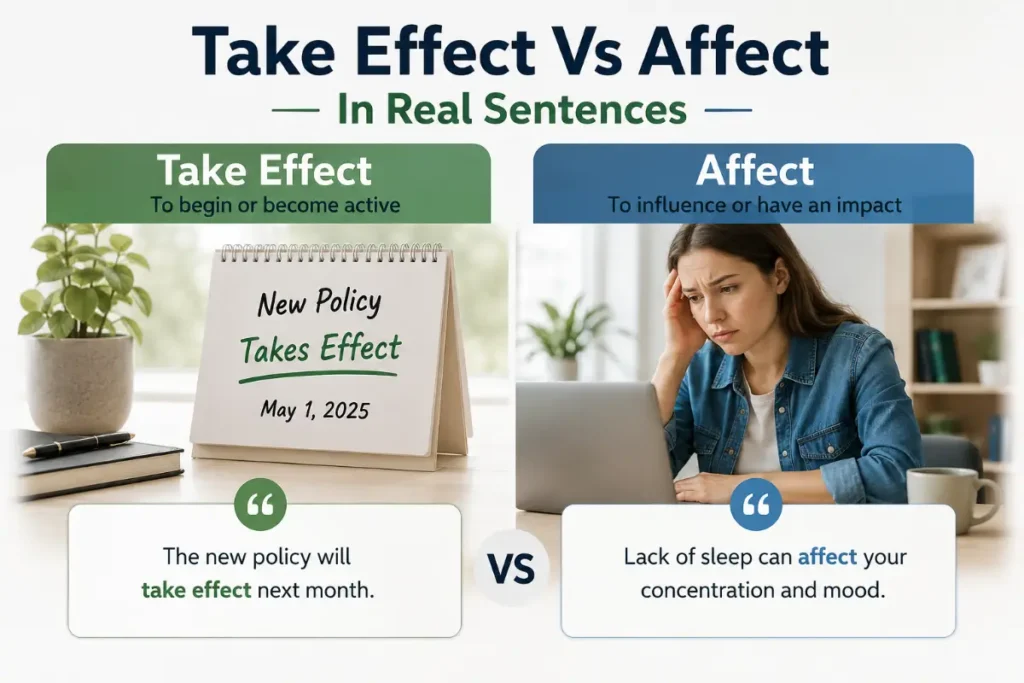
One of the best ways to understand the difference is to place both words in related sentences.
Example One
The new policy will take effect Monday.
The policy becomes active Monday.
The new policy will affect employees Monday.
The policy will influence employees Monday.
Example Two
The medicine has taken effect.
The medicine has started producing its intended result.
The medicine may affect your sleep.
The medicine may influence your sleep.
Example Three
The price increase takes effect next week.
The new price becomes active next week.
The price increase will affect customers.
Customers will experience the impact of the increase.
Notice how both words can appear naturally in the same topic.
That is why knowing the individual meanings matters more than memorizing a single spelling rule.
A Simple Test For Take Effect
When you’re unsure which word belongs after take, replace the phrase with one of these ideas:
start working
become active
begin to apply
start producing results
If the replacement makes sense, take effect is almost certainly the phrase you need.
For example:
The new policy will take effect tomorrow.
Replace it:
The new policy will become active tomorrow.
The meaning stays intact.
Now try the incorrect version:
The new policy will take affect tomorrow.
You cannot give affect the same role in this established expression.
The practical answer is clear.
When you mean become active or start working, use take effect.
Common Sentence Patterns With Take Effect
Learning common patterns can make correct usage automatic.
Take Effect On A Date
This pattern is common for laws, rules, policies, contracts, and prices.
The new policy will take effect on July 1.
Take Effect At A Time
Use this when the change starts at a specific time.
The new rate takes effect at midnight.
Take Effect Immediately
This means something becomes active without a delay.
The new rule takes effect immediately.
Take Effect After An Event
Use this when one event must happen first.
The agreement takes effect after both parties sign.
Take Effect Once Something Happens
This pattern is useful in technical and business writing.
The changes will take effect once the system restarts.
These patterns are useful because they show how native speakers naturally build sentences around the expression.

Why People Confuse Take Affect And Take Effect
The mistake isn’t random. English has several features that make this pair unusually easy to confuse.
The Words Differ By One Letter
The visual difference is tiny.
affect
effect
Only the first vowel changes.
When you’re typing quickly, that single letter can easily slip through.
They Sound Very Similar
In common American pronunciation, the two words can sound close enough to cause confusion, especially in fast conversation.
That means someone may know the correct phrase when reading but still type the wrong spelling when writing from memory.
Both Words Relate To Change
This is the deeper problem.
Affect means to influence or change something.
Effect often refers to the result of a change.
Because the meanings live in the same semantic neighborhood, learners sometimes treat the words as interchangeable.
They aren’t.
The Common Memory Rule Can Be Too Simple
Many English learners are taught:
Affect is a verb.
Effect is a noun.
That rule works most of the time, but it isn’t the whole story.
Affect can also function as a noun in a specialized psychological sense. Effect can function as a verb meaning to bring about or accomplish something. Merriam Webster documents these less common uses.
For take effect, however, the standard noun use of effect gives you the answer.
Autocorrect Can Reinforce The Mistake
Spell checkers often recognize both affect and effect as correctly spelled words.
That creates a problem.
A sentence containing take affect may not trigger a spelling warning because affect itself is spelled correctly. The issue is word choice rather than spelling.
This is an important distinction for professional writers.
A word can be spelled correctly and still be the wrong word for the sentence.
Social Media Spreads Common Errors
Online writing moves quickly. A phrase can appear thousands of times with the wrong word and start to look familiar.
Familiarity isn’t proof of correctness.
Professional editors look at grammar, meaning, context, and established usage rather than counting how often a phrase appears online.
Pro Insight
If you remember only one rule from this section, remember this:
Rules laws policies medicine and changes take effect. People and things are affected.
That single contrast will solve most take affect vs take effect questions before they reach your final draft.
Need another quick comparison? Read Symptomatology Vs Symptomology Which Spelling Is Correct 2026.
Spelling Rules For Take Effect
The spelling becomes much easier once you connect effect with the idea of a result or outcome.
The expression take effect uses effect because something begins to produce a result or becomes active. The spelling doesn’t change based on American or British English.
There isn’t a British spelling such as take affect and an American spelling such as take effect. Take effect is the standard form across major varieties of English.
Take Effect Is Always Written As Two Words
The expression contains the verb take and the noun effect.
Correct.
The new rule will take effect tomorrow.
Incorrect.
The new rule will takeaffect tomorrow.
Incorrect.
The new rule will take affect tomorrow.
Don’t combine the words or replace effect with affect.
Pronunciation Guide
Pronunciation can make this pair tricky because affect and effect can sound very similar.
Take Effect
In American English the phrase is commonly pronounced roughly like:
tayk ih FEKT
The stress falls strongly on fect in effect.
The final sound is important because effect ends with the consonant sound represented by ct.
Affect
When affect is used as a verb it is commonly pronounced:
uh FEKT
The first syllable is weak and the second syllable receives the main stress.
So these phrases can sound similar in quick speech.
take effect
affect
Context usually makes the intended meaning clear.
For writers the better strategy is simple. Don’t rely on sound alone. Look at the grammatical role and meaning.
Take Effect In Different Tenses
The phrase take effect can appear in several verb tenses.
The word effect stays unchanged. The verb take carries the tense.
Present Tense
The new rules take effect today.
This can describe a scheduled change or something that regularly becomes active.
Past Tense
The new rules took effect yesterday.
The change already became active.
Future Tense
The new rules will take effect tomorrow.
The change will become active later.
Present Perfect
The new rules have taken effect.
The rules became active and remain relevant now.
Past Perfect
The new rules had taken effect before the meeting began.
The change had already become active before another past event.
With Modal Verbs
The change may take effect next month.
The change could take effect sooner.
The same spelling remains correct in every case.
Take Effect Vs Come Into Effect
Take effect and come into effect often express the same basic idea.
Both can mean that a rule law policy agreement or change becomes active.
For example.
The new regulation will take effect next month.
The new regulation will come into effect next month.
Both sentences are correct.
There is a small difference in style. Take effect is shorter and extremely common. Come into effect can sound slightly more formal and is especially common in legal and administrative writing.
You can also use go into effect.
The new policy goes into effect Monday.
This form is especially common in American English.
Take Effect Vs Go Into Effect
These expressions are closely related.
Take effect means become active or begin producing a result.
Go into effect means become active or officially begin applying.
Examples.
The new law takes effect in January.
The new law goes into effect in January.
Both sound natural.
In American workplace and government communication go into effect is common.
For concise writing take effect is often the cleaner choice.
Take Effect Vs Effective
Another common source of confusion is effective.
These words are related but they don’t work in the same grammatical structure.
The new policy takes effect Monday.
The new policy is effective Monday.
Both can communicate the beginning of a policy’s operation.
However effective can also mean successful.
For example.
The treatment was effective.
This means the treatment worked.
That meaning is different from:
The treatment took effect.
This means the treatment began producing its intended result.
The distinction matters in medical workplace academic and technical writing.
Take Effect Vs Affect
These two structures are worth memorizing.
The policy will take effect next week.
The policy will affect employees next week.
You can even put both into one sentence.
The new policy will take effect Monday and affect all full time employees.
The first part tells us when the policy becomes active. The second tells us who experiences its influence.
This is a useful pattern because it shows the relationship between the two words without treating them as interchangeable.
Twenty Natural Examples Of Take Effect
Real examples are often more useful than another grammar rule. These sentences show how the expression works across different settings.
Everyday Conversation
- The new parking rules take effect tomorrow.
- My new work schedule takes effect next week.
- The discount will take effect at checkout.
- The change won’t take effect until Monday.
- The medicine should take effect soon.
Workplace Writing
- The updated vacation policy will take effect on October 1.
- The new office hours take effect next month.
- The salary adjustment will take effect with the next pay period.
- The revised procedure will take effect after management approval.
- The changes have already taken effect.
Formal Notices
- The new regulations will take effect immediately.
- The revised terms take effect upon acceptance.
- The fee increase will take effect on January 1.
- The agreement will take effect once both parties sign it.
Academic Writing
- The policy change took effect during the second phase of the study.
- The intervention began to take effect after several weeks.
- The reform took effect gradually across the region.
Journalism
- The new law is expected to take effect later this year.
- The agreement took effect after months of negotiations.
- The changes will take effect following final approval.
Notice how naturally take effect works with dates events approvals policies treatments and other changes.
Common Mistakes With Take Effect
Mistake One
The new rule will take affect tomorrow.
Correction.
The new rule will take effect tomorrow.
Mistake Two
The medicine hasn’t taken affect yet.
Correction.
The medicine hasn’t taken effect yet.
Mistake Three
The policy will take affect employees.
Correction.
The policy will affect employees.
This example needs affect because the meaning is influence. You don’t need take.
Mistake Four
The new policy will effect employees.
In ordinary writing this should usually be:
The new policy will affect employees.
Here affect means influence.
Mistake Five
The new rule will take effect on effect.
This type of sentence shows how repeating related words can create confusion. Rewrite the sentence around the intended meaning instead of forcing similar words into the same construction.
Memory Tricks That Actually Work
A good memory trick should help you understand the words rather than simply memorize letters.
Effect Is The Result
Think:
Effect equals result.
When something takes effect it begins producing a result.
The new medicine takes effect.
The new law takes effect.
Affect Is Action
Think:
Affect acts on something.
The weather affects traffic.
The decision affects workers.
The noise affects concentration.
This isn’t a perfect rule for every specialized use of the words. It is an excellent shortcut for everyday writing.
Use The Change Test
Ask yourself:
Is something becoming active?
Use take effect.
Is something influencing another thing?
Use affect.
For example.
The rule becomes active.
The rule takes effect.
That two question test is faster and more reliable than trying to remember a long grammar explanation.
Related Words You Should Know
Understanding nearby words can prevent new mistakes.
Effect
A result or outcome.
The change had a positive effect.
Affect
To influence or change something.
The change affected sales.
Effective
Producing the desired result or officially active from a stated time.
The new policy is effective Monday.
Effective Date
The date when an agreement policy law or other change officially begins to apply.
The effective date is October 1.
Effectively
In a successful or practical manner. It can also mean in actual operation depending on context.
The new system effectively reduced delays.
Affecting
The present participle of affect.
The issue is affecting customers.
Affected
The past tense or past participle of affect.
Several employees were affected by the change.
These related forms show why learning the root distinction is more useful than memorizing one phrase.
Expert Editor’s Note
A professional editor would make one correction immediately if a manuscript contained take affect where the writer meant become active.
Change it to take effect.
This isn’t a matter of personal preference or regional style. Take effect is the established English expression.
Editors also pay attention to the difference between take effect and affect. If the sentence describes something becoming active then take effect is appropriate. If it describes influence then affect is usually the correct verb.
There’s another useful editorial point here.
Don’t automatically replace every instance of take effect with become effective. Both expressions are correct but they aren’t always identical in tone or rhythm.
Compare:
The law takes effect July 1.
The law becomes effective July 1.
Both work. The first is direct and familiar. The second can sound more formal.
Good editing isn’t about making every sentence sound more complicated. It’s about choosing the clearest expression for the context.
Frequently Asked Questions
Is Take Affect Ever Correct
Take affect isn’t the standard English expression for becoming active or beginning to work. If you’re trying to say that a law policy rule medicine or change starts operating then use take effect. Affect normally functions as a verb meaning to influence something. It needs a different sentence structure.
What Does Take Effect Mean
Take effect means to become active or begin producing a result. You can use it for laws policies rules contracts medicines treatments prices and other changes. For example The new policy will take effect Monday means the policy will begin operating on Monday.
Is It Take Effect Or Take Affect
The correct phrase is take effect. Use it when something becomes active or begins producing a result. Use affect when you mean influence. For example The new law will take effect Monday and The new law will affect thousands of workers use the words correctly.
Is Take Effect Formal English
Yes. Take effect is standard English and works well in professional academic legal and everyday writing. It frequently appears in policies contracts government notices and journalism. In some contexts you can use become effective or go into effect instead but take effect remains a natural and precise choice.
What Is The Difference Between Take Effect And Affect
Take effect means become active or start producing a result. Affect usually means influence. Compare The new rule will take effect next month with The new rule will affect employees next month. The first sentence focuses on the rule becoming active. The second focuses on its influence.
Can I Say The Medicine Takes Effect
Yes. The medicine takes effect means the medicine begins producing its intended result. You can also say The medicine has taken effect when the result has already begun or The medicine hasn’t taken effect yet when you haven’t noticed the expected result.
Is Take Effect One Word
No. Take effect is written as two separate words. Take is the verb and effect is the noun. Don’t combine them into one word. The phrase can appear in different tenses such as takes effect took effect will take effect and has taken effect.
How Can I Remember Take Effect
Remember effect equals result. When something takes effect it begins producing its result or becomes active. Remember affect equals influence for the common verb use. If you’re talking about a rule becoming active choose take effect. If you’re talking about something influencing people or things choose affect.
Many readers also check Busyness Vs Business Which Word Should You Use.
Conclusion
The correct phrase is take effect.
Use it when a law policy rule contract medicine treatment price change or other development becomes active or begins producing a result.
Take affect is not the standard form for this meaning.
The easiest way to remember the distinction is to connect effect with a result. Something takes effect when it starts producing that result. By contrast affect usually works as a verb meaning influence.
Compare these two sentences one final time.
The new policy will take effect Monday.
The new policy will affect employees Monday.
The first tells you when the policy becomes active. The second tells you who feels its influence.
Once you see that difference you won’t need to guess at take affect vs take effect again. When a change becomes active let effect do the job.

Vocabulary & Language Research Writer
Ethan Parker researches English vocabulary, word meanings, slang, idioms, and commonly confused words. His goal is to help readers understand how English is actually used in everyday conversations and writing.