
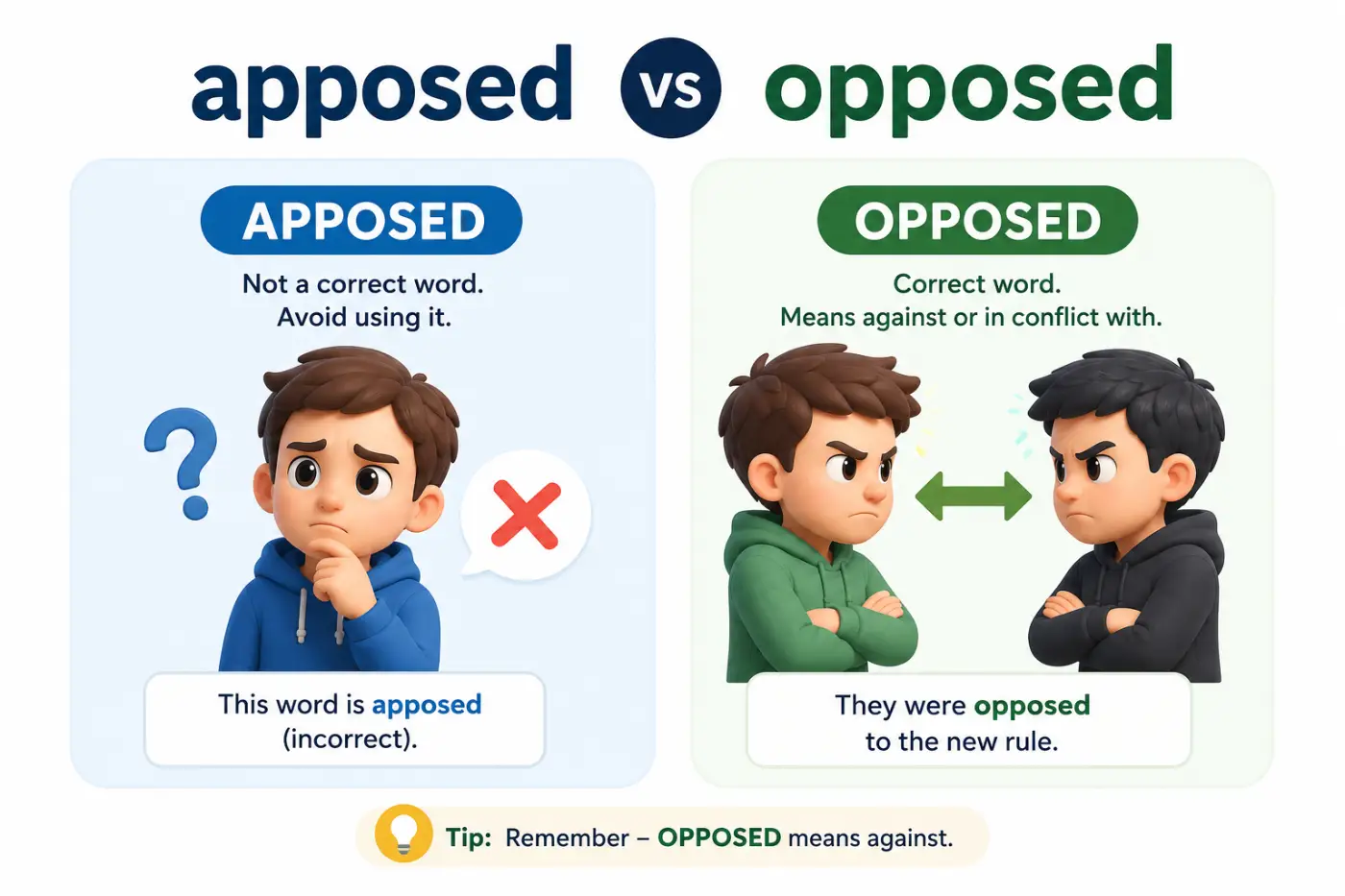
At first glance, apposed and opposed look almost identical. Just one extra letter separates them, yet they have completely different meanings. That small spelling difference can change the entire meaning of a sentence.
Many English learners and even native speakers accidentally use apposed when they mean opposed. The mistake usually happens because the words share similar letters, have related Latin roots, and sound somewhat alike in fast speech. Spell check does not always catch the error because both are legitimate English words.
The good news is that the distinction is straightforward once you know what each word means. Opposed is common in everyday English and describes disagreement, resistance, or conflict. Apposed is a specialized term used mainly in grammar, medicine, anatomy, and technical writing to describe things placed next to or against each other.
In this guide, you’ll learn the meaning of both words, discover the key differences, understand why people confuse them, and see plenty of real life examples. By the end, you’ll know exactly which word fits your sentence and avoid one of the most common vocabulary mix ups in English.
Suggested Internal Link: Affect Vs Effect Difference Explained.
You may also want to read Prescribe vs Proscribe: The Difference Explained (2026 Guide).
Quick Answer
Opposed means against something or in disagreement. It is the word most people need in everyday writing and conversation.
Apposed means placed next to, beside, or against something else. It is a technical term used mainly in grammar, anatomy, medicine, and other specialized fields. Both words are correct, but they cannot replace each other.
Apposed Vs Opposed Comparison Table
| Feature | Apposed | Opposed |
|---|---|---|
| Correct spelling | Yes | Yes |
| Part of speech | Verb adjective | Verb adjective |
| Meaning | Placed next to or against | Against or in disagreement |
| Common use | Grammar medicine anatomy linguistics | Everyday English politics debates opinions |
| Formal writing | Technical writing | General and formal writing |
| Everyday conversation | Rare | Very common |
| Example | The tissues were apposed during surgery. | She opposed the proposal. |
What Does Apposed Mean
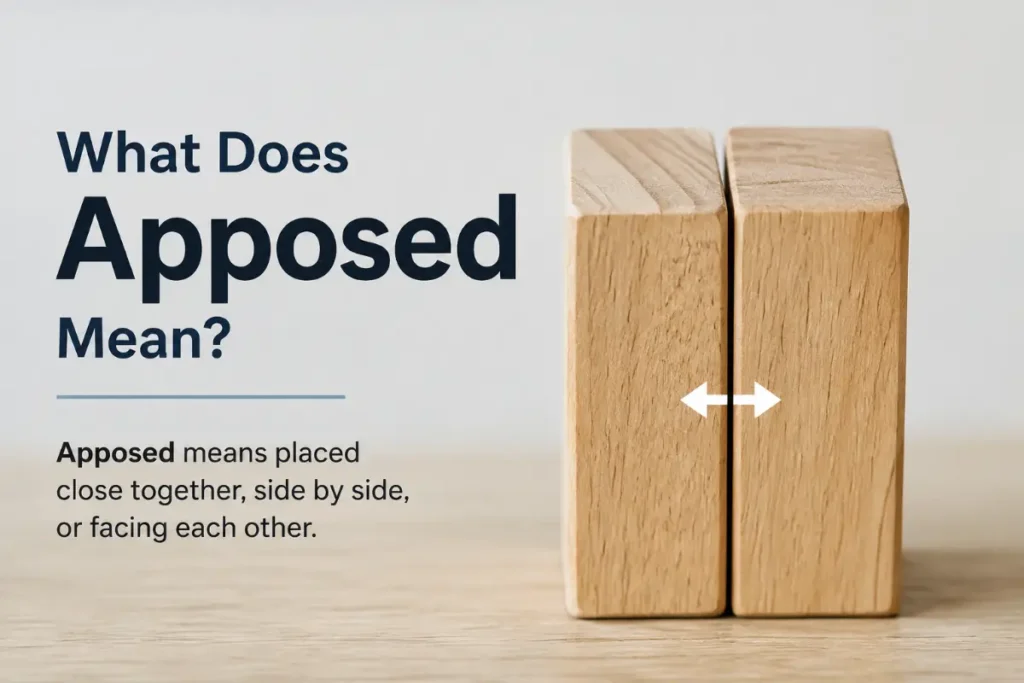
Apposed comes from the verb appose, which means to place one thing next to another or directly against it.
It is not a word you hear often in daily conversation. Instead, it appears in technical subjects where precise placement matters.
Simple Definition
Apposed means positioned beside or in contact with something else.
Common Uses Of Apposed
The word appears most often in these fields.
- Grammar.
- Medicine.
- Anatomy.
- Biology.
- Linguistics.
Apposed In Grammar
In grammar, an apposed word or phrase sits next to another word to explain or identify it.
Example.
My brother, a firefighter, lives in Chicago.
The phrase a firefighter is apposed to my brother because it identifies who he is.
Apposed In Medicine
Doctors often use apposed when describing tissues, bones, or wound edges that have been brought together correctly.
Examples.
- The surgeon carefully apposed the edges of the wound.
- The skin remained well apposed after the operation.
- The fractured bones were properly apposed before healing began.
More Examples Of Apposed
- The leaves were apposed along the stem.
- Two surfaces remained closely apposed.
- The scientist observed apposed cells under the microscope.
- The architect designed two apposed walls for extra support.
Although these examples are correct, most people rarely use apposed outside technical or academic contexts.
What Does Opposed Mean
Opposed comes from the verb oppose, which means to disagree with, resist, prevent, or fight against something.
Unlike apposed, this word appears every day in conversations, news stories, workplaces, classrooms, and legal writing.
Simple Definition
Opposed means against someone or something.
Common Uses Of Opposed
People use opposed to express disagreement, resistance, or conflicting opinions.
Examples include.
- She opposed the new policy.
- Many residents opposed the construction project.
- I’m opposed to wasting food.
- The committee opposed the proposal.
- They remained strongly opposed throughout the discussion.
Opposed In Different Contexts
Everyday Conversation.
I’m opposed to raising prices right now.
Workplace.
Several employees opposed the proposed schedule changes.
Politics.
The senator opposed the new tax bill.
Education.
Many parents opposed the decision to shorten the school year.
Journalism.
Local business owners opposed the city’s redevelopment plan.
Which One Is Correct
Both apposed and opposed are correct English words.
The correct choice depends entirely on your meaning.
Use apposed when something is placed next to or directly against something else.
Use opposed when talking about disagreement, resistance, or conflict.
Here is a quick test.
If you can replace the word with against, choose opposed.
If you can replace it with placed beside, choose apposed.
Examples.
✔ She opposed the new rules.
✔ The surgeon apposed the wound edges carefully.
✘ She apposed the new rules.
✘ The doctor opposed the wound edges.
Those last two sentences are incorrect because the meanings do not match the context.
Why People Confuse Apposed And Opposed
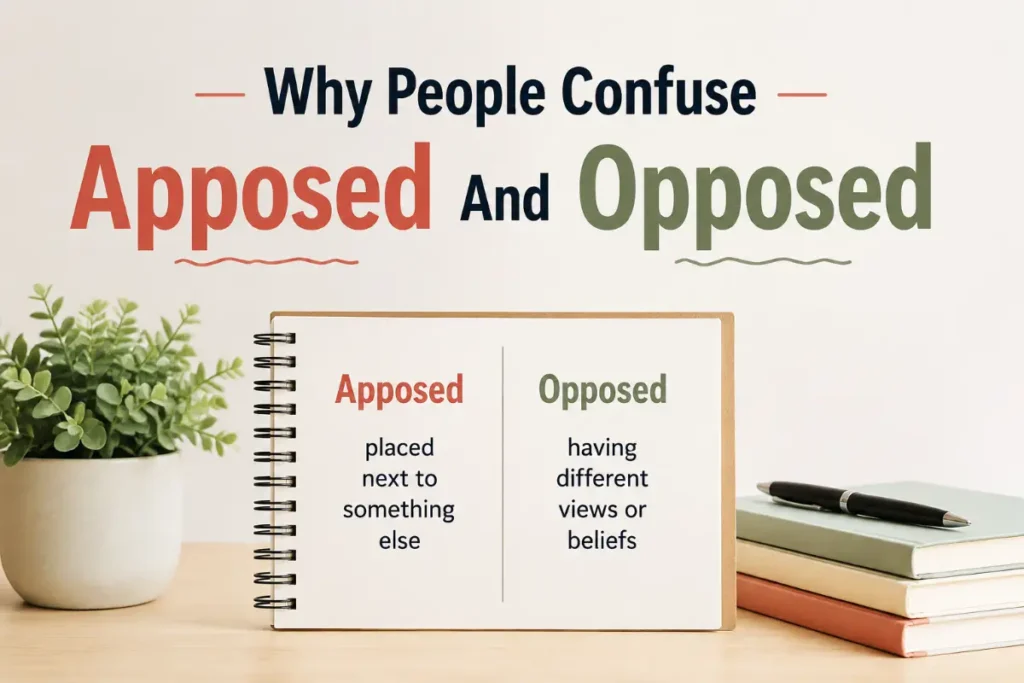
The confusion comes from more than just similar spelling. These words share several characteristics that make mistakes easy, especially for English learners.
Similar Spelling
The words differ by only one letter.
Apposed
Opposed
When reading or typing quickly, many people overlook the extra a.
Similar Pronunciation
The words begin with similar sounds and have the same ending. In everyday speech, the difference can be subtle, especially if someone speaks quickly.
Shared Latin Roots
Both words trace back to the Latin verb ponere, meaning to place.
Over time, different prefixes changed the meaning.
The prefix ap means to or toward.
The prefix op means against.
Knowing the prefixes makes the meanings much easier to remember.
Opposed Is Much More Common
Most English speakers use opposed regularly.
Apposed appears mainly in technical writing.
Because opposed is so familiar, some people assume apposed is simply a misspelling. It is not.
Spell Check Does Not Always Help
Most grammar tools accept both words because they are legitimate dictionary entries.
That means you must choose the correct word based on the meaning of your sentence.
Key Differences Between Apposed And Opposed
| Feature | Apposed | Opposed |
|---|---|---|
| Main meaning | Placed beside or against | Against or in disagreement |
| Common field | Grammar medicine anatomy biology | Everyday English politics business education |
| Frequency | Rare | Very common |
| Describes | Physical position | Opinion attitude or resistance |
| Typical replacement | Positioned beside | Against |
The easiest way to remember the difference is simple.
Apposed describes position.
Opposed describes disagreement.
Grammar Explanation
Although these words share a similar ending, they perform different jobs depending on how they are used.
Apposed As A Verb
The verb appose means to place something beside something else.
Examples.
- The doctor apposed the tissue before closing the incision.
- The researcher carefully apposed the samples.
Apposed As An Adjective
The adjective describes things that have already been placed together.
Examples.
- The apposed surfaces healed well.
- The apposed structures remained stable.
Opposed As A Verb
The verb oppose means to resist, challenge, or disagree with something.
Examples.
- Several members opposed the motion.
- The organization opposed the new law.
Opposed As An Adjective
The adjective describes someone who disagrees.
Examples.
- She is opposed to smoking indoors.
- They remained strongly opposed throughout the negotiations.
A Simple Grammar Test
Ask yourself this question.
Am I talking about location or disagreement?
If the answer is location, choose apposed.
If the answer is disagreement, choose opposed.
Spelling Rules
No special English spelling rule creates this confusion. The mistake happens because both words begin with similar prefixes.
Understanding those prefixes makes everything easier.
Ap suggests moving toward or placing beside.
Op suggests resistance or opposition.
Think of these related words.
- Apposition.
- Opponent.
- Opposition.
- Opposing.
Seeing these word families helps reinforce the difference.
Many readers also check Abscess Or Canker Sore Which One Is It 2026 Guide.
Pronunciation Guide
Apposed
IPA
American English.
/əˈpoʊzd/
Syllables
Ap posed.
Stress
The second syllable receives the primary stress.
Opposed
IPA
American English.
/əˈpoʊzd/
Syllables
Op posed.
Stress
The second syllable also carries the strongest stress.
Why Pronunciation Causes Confusion
Both words sound almost identical in natural conversation.
Native speakers depend on context instead of pronunciation to understand which word is intended.
For example.
The surgeon apposed the tissue.
The senator opposed the bill.
Even though the words sound nearly the same, the surrounding words make the meaning clear.
Word Origin And History
Understanding where these words came from explains why they look alike but mean different things.
Origin Of Apposed
Apposed comes from the Latin apponere, meaning to place near or to put beside.
The English verb appose appeared in scholarly and scientific writing and later became common in medicine, anatomy, and grammar.
Origin Of Opposed
Opposed comes from the Latin opponere, meaning to set against.
English has used this word for centuries to describe conflict, disagreement, and resistance.
Today it remains one of the most common verbs for expressing disagreement.
British American Canadian And Australian English
There is almost no regional difference between these words.
English speakers in the United States, the United Kingdom, Canada, Australia, and New Zealand recognize both forms.
The difference is based on meaning, not geography.
Everyday English
People almost always use opposed.
Examples.
- I’m opposed to the idea.
- They’re opposed to higher taxes.
Technical Writing
Medical professionals, linguists, scientists, and anatomists commonly use apposed.
Examples.
- The wound edges were well apposed.
- The two structures remained apposed throughout the procedure.
Real Life Examples
Seeing both words in context makes the distinction much easier.
Daily Conversation
- I’m opposed to canceling our vacation.
- My parents opposed the decision at first.
- Nobody opposed the idea during the meeting.
Workplace
- Several employees opposed the new attendance policy.
- The board opposed the proposal after reviewing the budget.
- No manager opposed the recommendation.
Emails
- I’m opposed to changing the deadline without discussing it first.
- Nobody on our team opposed your suggestion.
Academic Writing
- The scholar opposed the earlier theory.
- Researchers observed two closely apposed membranes.
- The report described several apposed structures.
Medicine
- The surgeon apposed the wound edges carefully.
- The tissues remained well apposed after surgery.
- Properly apposed bones heal more effectively.
Journalism
- Community leaders opposed the development project.
- Several environmental groups opposed the expansion plan.
Social Media
- I’m totally opposed to online bullying.
- Thousands of users opposed the platform update.
Science
- The microscope revealed apposed cell walls.
- The apposed surfaces showed no signs of damage.
Common Mistakes
Even experienced writers occasionally mix up apposed and opposed because the words look and sound similar. Here are the mistakes that appear most often.
Using Apposed Instead Of Opposed
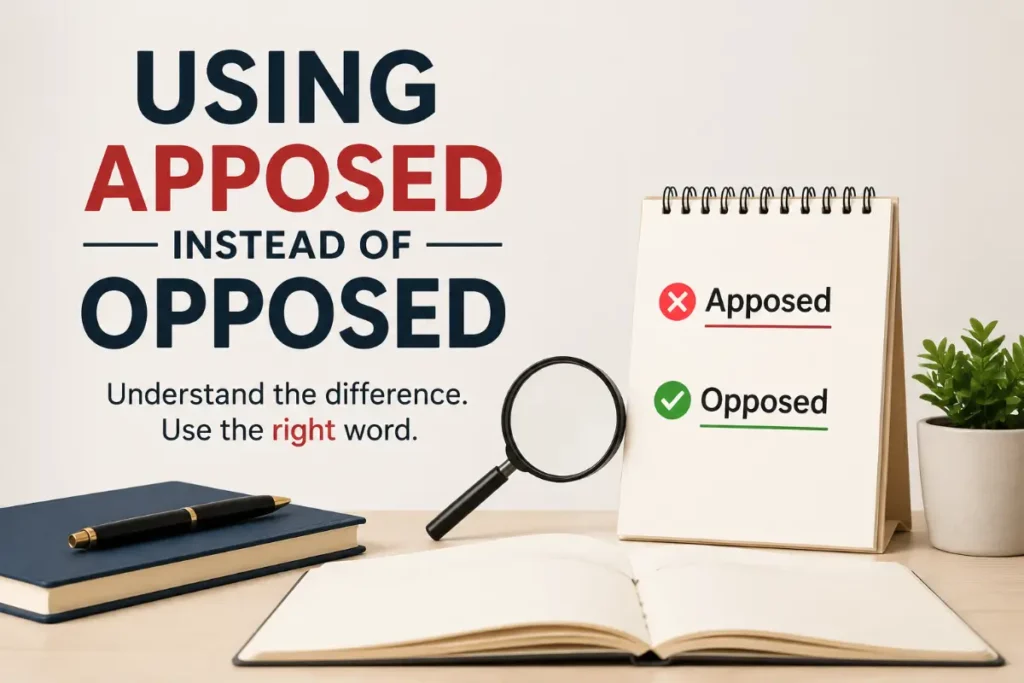
Incorrect.
She apposed the new policy.
Correct.
She opposed the new policy.
Why?
The sentence is about disagreement, not physical placement.
Using Opposed Instead Of Apposed
Incorrect.
The surgeon opposed the edges of the wound.
Correct.
The surgeon apposed the edges of the wound.
Why?
The surgeon is bringing the wound edges together, not disagreeing with them.
Assuming Apposed Is A Misspelling
Many people think apposed is an incorrect spelling because they rarely see it.
It is a legitimate English word found in dictionaries and widely used in medicine, anatomy, biology, and grammar.
Confusing Apposed With Appositive
These words are related but not identical.
An appositive is a noun or noun phrase that renames another noun.
Apposed simply means placed beside or next to something.
Example.
My teacher, Mrs. Carter, retired last year.
The phrase Mrs. Carter is an appositive because it identifies my teacher.
Memory Tricks
These simple tricks make the difference easy to remember.
Remember The Prefixes
Think about the beginning of each word.
Ap reminds you of approaching or placing something beside another object.
Op reminds you of opposition or being against something.
Think Position Versus Opinion
Apposed is about position.
Opposed is about opinion.
That simple contrast solves most mistakes.
Replace The Word
If you can replace it with against, choose opposed.
If you can replace it with placed beside, choose apposed.
Related Words
Expanding your vocabulary helps you recognize the correct word more quickly.
Related To Apposed
- Appose.
- Apposition.
- Appositive.
- Adjacent.
- Attached.
- Joined.
Related To Opposed
- Oppose.
- Opposition.
- Opponent.
- Opposing.
- Resist.
- Object.
Synonyms For Apposed
- Adjacent.
- Joined.
- Connected.
- Aligned.
- Positioned.
Synonyms For Opposed
- Against.
- Resistant.
- Contrary.
- Objecting.
- Disagreeing.
Expert Editor’s Note
Professional editors rarely encounter apposed outside technical writing. When they do, they check the context carefully because many writers accidentally type apposed instead of opposed.
Every major English dictionary recognizes both words as correct. The important point is choosing the one that matches your meaning.
Use opposed whenever you mean disagreement, resistance, or conflict.
Use apposed only when something is physically placed beside another thing or when writing about grammar, medicine, anatomy, biology, or linguistics.
If your sentence is intended for a general audience, opposed will almost always be the word you need.
Frequently Asked Questions
Is Apposed Or Opposed Correct?
Both words are correct. Apposed means placed next to or against something. Opposed means against, resistant to, or in disagreement with something.
Is Apposed A Real English Word?
Yes. Apposed is a legitimate English word. It appears mainly in medicine, anatomy, biology, grammar, and other technical fields, so many people rarely encounter it in everyday conversation.
Which Word Is More Common?
Opposed is far more common. It appears in daily conversations, news articles, business writing, academic papers, and political discussions. Apposed is mostly limited to specialized subjects.
Can Apposed Mean Against?
No. This is one of the most common misunderstandings. Apposed refers to physical placement beside something. It never means disagreement or opposition.
How Do Doctors Use Apposed?
Medical professionals use apposed to describe tissues, wound edges, bones, or other body structures that have been brought together correctly to support healing.
Is Opposed Always Negative?
Not necessarily. Opposed simply expresses disagreement or resistance. A person can respectfully oppose an idea without creating conflict or hostility.
How Can I Remember The Difference?
Think of apposed as physical placement and opposed as disagreement. If the sentence involves opinions, debates, or resistance, opposed is almost always the correct choice.
You may also want to read Deep Seated Vs Deep Seeded: Which One Is Correct (2026 Guide).
Conclusion
The difference between apposed vs opposed comes down to meaning, not spelling.
Apposed means placed beside or against something else. It is a technical word used mainly in medicine, anatomy, grammar, and linguistics.
Opposed means against, resistant to, or in disagreement with something. It is the word you’ll use in most everyday situations.
The easiest way to avoid mistakes is to ask one simple question.
Are you describing physical placement or disagreement?
If it is about placement, choose apposed.
If it is about disagreement, choose opposed.
Once you remember that simple distinction, you’ll choose the correct word with confidence every time.

Vocabulary & Language Research Writer
Ethan Parker researches English vocabulary, word meanings, slang, idioms, and commonly confused words. His goal is to help readers understand how English is actually used in everyday conversations and writing.