
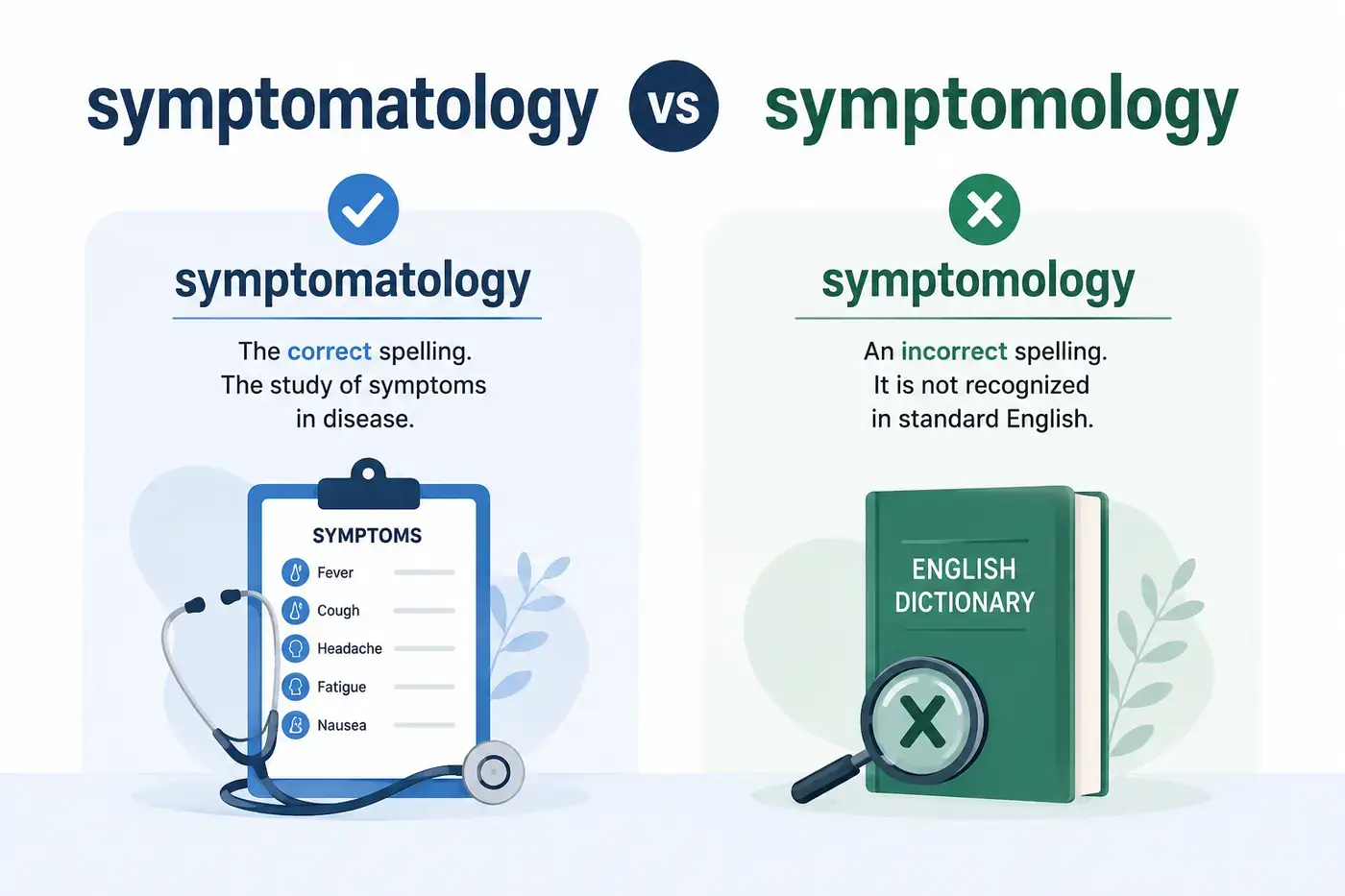
If you’ve searched for symptomatology vs symptomology you’re probably trying to figure out which spelling belongs in your writing. The two words look nearly identical, and both appear in medical papers, websites, and online discussions. That makes the choice confusing, even for experienced writers.
The short answer is simple. Symptomatology is the standard and preferred term in medical English. It appears in medical dictionaries, textbooks, research journals, and healthcare writing. Symptomology also exists and is widely understood, but most professional editors, healthcare organizations, and academic publishers recommend symptomatology because it is the established technical term.
The confusion comes from the shared root word symptom. Since English contains many words ending in ology, people naturally assume symptomology follows the same pattern. In reality, the accepted medical term developed differently, and that historical difference still influences modern usage.
This guide explains the meaning of each word, their origins, pronunciation, grammar, usage, and the subtle differences between them. You’ll also learn why one spelling dominates professional writing, where the other appears, and how to avoid one of the most common vocabulary mistakes in medical English.
Suggested Internal Link: Medical Terminology Commonly Confused Words.
For another common grammar confusion, see Take Affect Vs Take Effect Which One Is Correct 2026.
Quick Answer
Symptomatology is the preferred and standard medical term. It refers to the collection, study, and description of symptoms associated with a disease or condition. Symptomology is a recognized variant that appears occasionally, but most medical dictionaries, journals, and style guides recommend symptomatology for formal and academic writing.
Symptomatology Vs Symptomology Comparison Table
| Feature | Symptomatology | Symptomology |
|---|---|---|
| Correct spelling | Yes | Yes but less preferred |
| Preferred in medicine | Yes | Rarely |
| Meaning | The study or collection of symptoms | Same meaning in most contexts |
| Part of speech | Noun | Noun |
| Formal writing | Strongly preferred | Usually avoided |
| Medical journals | Very common | Uncommon |
| Dictionaries | Widely listed | Listed by some dictionaries as a variant |
| Everyday usage | Common among healthcare professionals | Occasionally used |
| Example | The symptomatology of influenza includes fever and cough. | The symptomology of influenza was discussed. |

What Does Symptomatology Mean
Symptomatology is the branch of medical knowledge that deals with symptoms. It can also describe the complete set of symptoms linked to a disease, disorder, or medical condition.
Doctors, researchers, nurses, psychologists, and other healthcare professionals use the word when discussing diagnosis, disease patterns, or clinical findings.
Simple Definition
Symptomatology means the study, description, or collection of symptoms connected with a disease or health condition.
Common Uses
Healthcare professionals use symptomatology to explain how illnesses appear and develop.
Examples include.
- The symptomatology of pneumonia varies from one patient to another.
- Researchers examined the symptomatology of seasonal allergies.
- The doctor reviewed the patient’s symptomatology before making a diagnosis.
- Early symptomatology often helps physicians identify rare diseases.
- The report describes the symptomatology associated with long term viral infections.
Symptomatology In Different Contexts
Medical practice.
The physician carefully documented the patient’s symptomatology.
Medical research.
Scientists compared the symptomatology of several respiratory illnesses.
Psychology.
The psychologist evaluated the symptomatology of anxiety disorders.
Academic writing.
The paper provides a detailed review of migraine symptomatology.
Healthcare education.
Medical students study symptomatology before learning advanced diagnosis.
What Does Symptomology Mean
Symptomology has the same general meaning as symptomatology. It refers to symptoms or the study of symptoms. However, it is much less common in professional medical writing.
Some dictionaries recognize symptomology as a variant spelling, while others label it as less common or nonstandard in scientific usage.
Simple Definition
Symptomology is an alternative form that refers to the symptoms of a disease or the study of those symptoms.
Where It Appears
You are more likely to see symptomology in informal writing, blogs, websites, student papers, or general conversations than in peer reviewed medical literature.
Examples include.
- The article discussed the symptomology of the condition.
- We reviewed the symptomology before visiting the doctor.
- Her presentation covered the symptomology of common childhood illnesses.
- The website explained the symptomology of food allergies.
- Some readers mistakenly assume symptomology is the official medical term.
Although these examples are understandable, many editors would replace symptomology with symptomatology in professional documents.
Which One Is Correct
Both symptomatology and symptomology appear in English, but they are not treated equally.
If you are writing for a medical journal, university assignment, healthcare organization, or professional publication, choose symptomatology.
If you encounter symptomology, readers will usually understand your meaning. Still, many editors consider it a less preferred variant because symptomatology has been the established medical term for generations.
A simple rule can help.
Use symptomatology anytime accuracy and professional writing matter.
Use symptomology only when following a source that intentionally uses that variant or when consistency with existing material is more important than editorial preference.
For almost every writer, symptomatology is the safer and more widely accepted choice.
Why People Confuse Symptomatology And Symptomology
The confusion between symptomatology and symptomology is easy to understand. Both words begin with symptom, both refer to medical symptoms, and both appear online. Since their meanings overlap, many people assume they are equally acceptable in every situation.
Several factors contribute to the confusion.
Similar Spelling
The only visible difference is the extra ata in symptomatology.
When reading quickly, many people overlook those letters and assume both spellings are interchangeable.
Similar Pronunciation
The words sound very similar in everyday speech.
Most listeners cannot immediately tell which spelling a speaker intends, especially during casual conversation.
The Influence Of Other Ology Words
English contains thousands of words ending in ology.
Examples include.
- Biology.
- Psychology.
- Sociology.
- Cardiology.
- Dermatology.
Because of this familiar pattern, many writers naturally create symptomology, believing it follows the same structure.
Medical Terminology
Medical vocabulary often contains long and complex words. Students and new healthcare professionals sometimes shorten unfamiliar terms without realizing the standard medical spelling is different.
Internet And Autocorrect
Blogs, online forums, and even some healthcare websites occasionally use symptomology.
Search engines recognize both spellings, so readers continue seeing each version. Modern spellcheckers may also fail to flag symptomology because several dictionaries recognize it as a variant.
Key Differences Between Symptomatology And Symptomology
Although the meanings are nearly identical, their usage is not.
| Feature | Symptomatology | Symptomology |
|---|---|---|
| Preferred medical term | Yes | No |
| Meaning | Study or collection of symptoms | Same general meaning |
| Medical journals | Standard choice | Rare |
| Academic writing | Strongly recommended | Usually avoided |
| Professional reports | Preferred | Less common |
| Dictionaries | Universally recognized | Often listed as a variant |
| Editorial preference | Recommended | Usually replaced with symptomatology |
The practical difference is simple.
Choose symptomatology for professional, educational, scientific, and healthcare writing.
Use symptomology only if you are following an existing source that intentionally uses that spelling.
Grammar Explanation
The grammar behind these words is straightforward because both function as nouns.

Symptomatology Is A Noun
It names either the study of symptoms or the complete set of symptoms connected with a disease.
Examples.
- The symptomatology of asthma has been well documented.
- Physicians reviewed the patient’s symptomatology before treatment.
- Researchers compared the symptomatology of two rare disorders.
In every sentence, the word acts as a noun.
Symptomology Is Also A Noun
Its grammatical role is exactly the same.
Examples.
- The article discussed the symptomology of migraines.
- Students reviewed the symptomology before class.
Although the grammar is correct, many editors would substitute symptomatology because it is the preferred medical term.
Can They Replace Each Other?
From a grammatical standpoint, yes.
From an editorial standpoint, not always.
Professional publications almost always choose symptomatology because it reflects accepted medical terminology.
Spelling Pattern And Formation
Understanding how the word developed explains why the longer spelling became standard.
The base word is symptom, which comes from Greek.
The ending ology normally means the study of something.
However, symptomatology does not come directly from symptom plus ology.
Instead, it developed from symptomatologic and related Greek forms before becoming the accepted English medical term.
Because of that historical development, the extra letters in symptomatology are not accidental. They are part of the traditional word.
This explains why professional dictionaries and medical references continue to prefer the longer spelling.
You may also want to read Baloney Vs Bologna Which Word Is Correct 2026.
Pronunciation Guide
Both words are pronounced very similarly.
Symptomatology
IPA
American English.
/ˌsɪmp tə məˈtɑː lə dʒi/
Syllables
Symp to ma tol o gy.
Primary Stress
The strongest stress falls on tol.
Symptomology
IPA
American English.
/ˌsɪmp təˈmɑː lə dʒi/
or
/ˌsɪmp təˈmɒ lə dʒi/
depending on the speaker.
Common Pronunciation Mistakes
Many speakers accidentally drop the middle syllable when saying symptomatology, making it sound like symptomology.
This spoken shortcut likely contributed to the popularity of the shorter spelling.
Word Origin And History
The history of these words explains why one became the standard medical term.
Origin Of Symptom
The word symptom comes from the ancient Greek word symptōma, meaning an occurrence, event, or sign.
It entered English through Latin and French before becoming an important medical term.
Origin Of Symptomatology
The word symptomatology developed during the nineteenth century as medicine became more scientific.
Doctors needed a precise term describing both the study of symptoms and the complete symptom pattern of diseases.
Medical schools, textbooks, and research publications quickly adopted symptomatology, making it the established professional term.
Origin Of Symptomology
The shorter form appeared later through simplification.
Because English contains so many words ending in ology, speakers naturally shortened the longer term.
Although many dictionaries acknowledge symptomology, it never replaced symptomatology in formal medical writing.
British American Canadian And Australian English
There is very little regional variation.
Medical professionals in the United States, the United Kingdom, Canada, Australia, and New Zealand overwhelmingly prefer symptomatology.
The shorter variant appears occasionally in general writing, but no major English speaking country treats it as the preferred medical spelling.
If you are writing for an international audience, symptomatology remains the safest and most widely accepted choice.
Real Life Examples
Seeing these words in context makes the difference much easier to remember.
Medical Practice
- The physician carefully reviewed the patient’s symptomatology.
- The nurse documented the changing symptomatology throughout the week.
- Accurate symptomatology improved the diagnosis.
- Specialists compared the symptomatology of several autoimmune diseases.
Research
- Researchers studied the symptomatology of Parkinson disease.
- The paper examined symptomatology across different age groups.
- Scientists found similarities in the symptomatology of two viral infections.
- Clinical trials relied on detailed symptomatology reports.
Medical Education
- Students learned the symptomatology of cardiovascular disorders.
- Understanding symptomatology is essential before making a diagnosis.
- Professors explained how symptomatology guides treatment decisions.
- The textbook devoted an entire chapter to respiratory symptomatology.
Workplace
- The healthcare team discussed the patient’s symptomatology during morning rounds.
- The report summarized the symptomatology observed over six months.
Academic Writing
- The article presents a detailed symptomatology of childhood epilepsy.
- The review compares the symptomatology of anxiety and depression.
Everyday Conversation
- I searched the symptomatology before making an appointment.
- The doctor explained the symptomatology in simple language.
Online Articles
- Many websites incorrectly replace symptomatology with symptomology.
- Professional medical resources almost always use symptomatology.
Common Mistakes
Even experienced writers sometimes choose the wrong term because both spellings look believable. Most mistakes happen when people assume every medical word ending in ology follows the same spelling pattern.
Here are the errors editors see most often.
Treating Both Words As Equal
Many writers believe symptomatology and symptomology are interchangeable in every situation.
While both may be understood, professional medical writing strongly favors symptomatology.
Using Symptomology In Academic Papers
Incorrect.
The symptomology of the disease was examined.
Preferred.
The symptomatology of the disease was examined.
Medical journals, university publications, and healthcare organizations almost always choose the longer form.

Assuming Symptomology Is The Official Medical Term
Some people think symptomology is the standard spelling because it resembles words like biology and psychology.
In reality, symptomatology has been the accepted medical term for many years.
Misspelling Symptomatology
Because it is a long word, writers often leave out letters or rearrange syllables.
Common misspellings include.
- Symtomatology.
- Symptomatolgy.
- Symptamatology.
Proofreading carefully helps prevent these mistakes.
Easy Memory Tricks
Long medical words become much easier to remember with a few simple techniques.
Remember The Extra Letters
Think of symptomatology as a word that needs extra detail because it describes the detailed study of symptoms.
The longer spelling matches the more technical meaning.
Think Of Medical Textbooks
If you imagine reading a medical textbook, the word you are most likely to see is symptomatology.
Professional writing almost always uses this form.
Use A Simple Phrase
Remember this sentence.
Medical experts study symptomatology.
Repeating that phrase a few times makes the preferred spelling stick.
Associate It With Diagnosis
Doctors use symptomatology to understand diseases.
Connecting the word with diagnosis makes it easier to recall.
Related Words
Learning related vocabulary strengthens your understanding of medical English.
Related Medical Terms
- Symptom.
- Sign.
- Diagnosis.
- Syndrome.
- Pathology.
- Etiology.
- Prognosis.
- Clinical findings.
Synonyms
Depending on the context, you may also see.
- Symptom profile.
- Clinical presentation.
- Symptom pattern.
- Disease presentation.
- Clinical features.
Frequently Confused Medical Words
- Etiology and pathology.
- Symptom and sign.
- Diagnosis and prognosis.
- Acute and chronic.
- Syndrome and disease.
Learning these related terms makes medical writing clearer and more precise.
Expert Editor’s Note
Professional editors value consistency, precision, and accepted terminology.
Medical dictionaries, healthcare publications, and peer reviewed journals overwhelmingly prefer symptomatology. It has long been the standard term for describing the study or collection of symptoms linked to a disease.
Some modern dictionaries acknowledge symptomology as a variant. Even so, most editors replace it with symptomatology unless they are quoting a source or preserving the original wording.
If your audience includes healthcare professionals, researchers, students, or educators, symptomatology is almost always the better choice.
When accuracy matters, following established medical terminology builds credibility and helps readers trust your writing.
Frequently Asked Questions
Is Symptomatology Or Symptomology Correct?
Both words exist, but symptomatology is the preferred medical term. It appears in medical textbooks, dictionaries, research papers, and healthcare publications. Symptomology is usually treated as a less common variant.
Why Is Symptomatology Preferred?
Medical terminology developed around symptomatology, and professional organizations have continued using it for decades. It has become the accepted standard in scientific and academic writing.
Is Symptomology Wrong?
Not entirely. Some dictionaries list it as a variant spelling. However, most editors recommend avoiding it in formal writing because symptomatology is far more common and widely accepted.
Do Doctors Use Symptomology?
Doctors, researchers, and medical educators almost always use symptomatology in professional communication, patient records, textbooks, and journal articles.
What Does Symptomatology Mean?
Symptomatology refers to the study, description, or complete collection of symptoms associated with a disease, disorder, or medical condition.
Is There A Difference In Meaning?
Very little. Both words generally refer to the same concept. The main difference is usage. Symptomatology is the standard medical term, while symptomology is an uncommon variant.
Which Spelling Should Students Use?
Students should use symptomatology for assignments, research papers, presentations, and examinations. It matches the terminology used in professional healthcare education.
Is Symptomatology Used Outside Medicine?
Yes. Psychology, psychiatry, nursing, veterinary medicine, and other health sciences also use symptomatology when describing symptom patterns or clinical presentations.
Still confused? Compare Loot Vs Lute Which Word Should You Use 2026.
Conclusion
The answer to symptomatology vs symptomology is clear.
Both spellings exist, but symptomatology is the established and preferred term in medicine, healthcare, psychology, and academic writing. It appears consistently in dictionaries, textbooks, research journals, and professional publications.
Symptomology carries the same general meaning, but it is much less common and is usually treated as a variant spelling rather than the standard choice.
If you want your writing to sound accurate, professional, and trustworthy, choose symptomatology. It meets the expectations of editors, educators, and healthcare professionals.
A single extra group of letters may seem small, but choosing the accepted spelling shows attention to detail and strengthens every piece of medical writing.

Vocabulary & Language Research Writer
Ethan Parker researches English vocabulary, word meanings, slang, idioms, and commonly confused words. His goal is to help readers understand how English is actually used in everyday conversations and writing.
1 thought on “Symptomatology Vs Symptomology Which Spelling Is Correct 2026”