
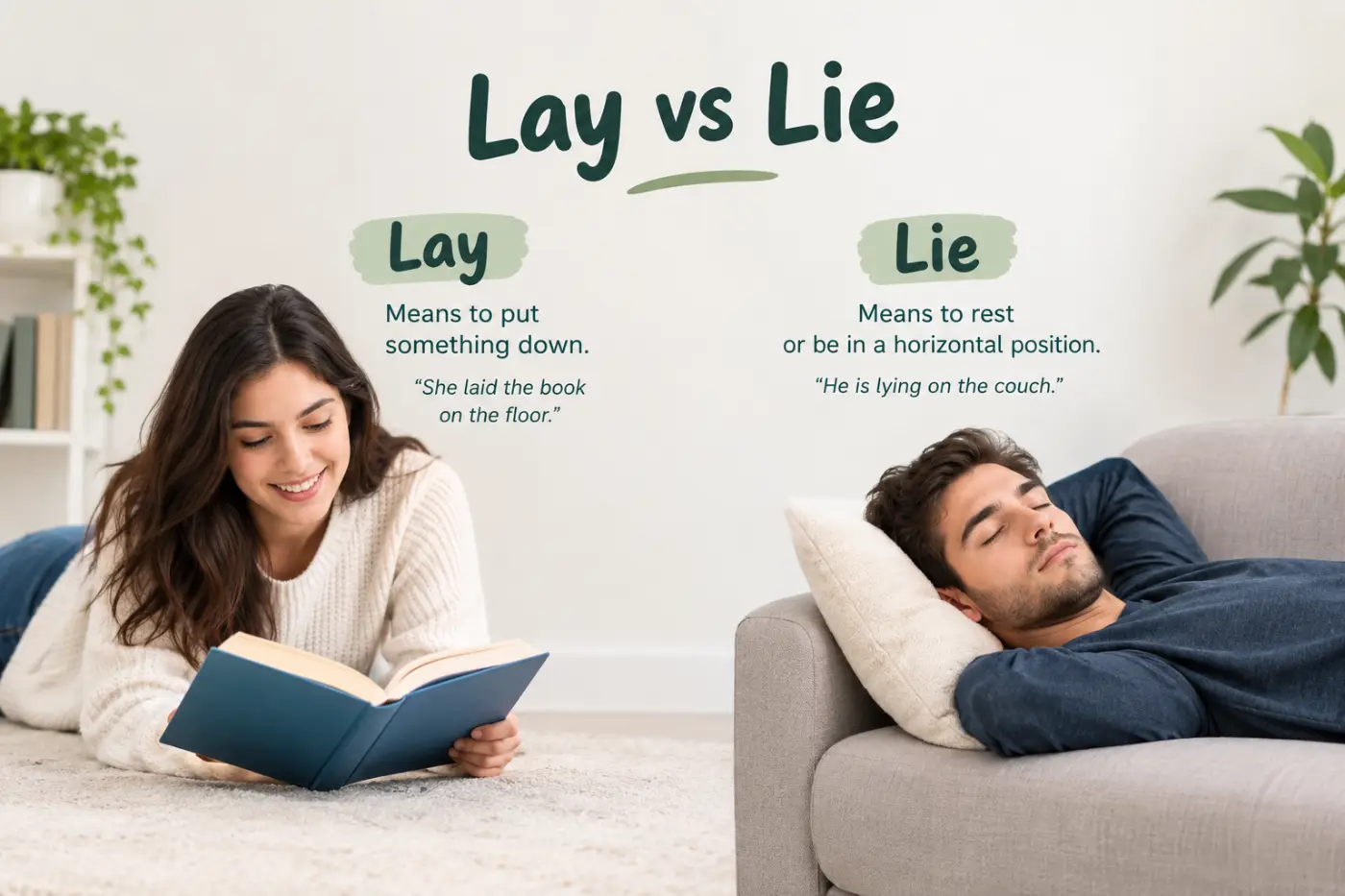
Lay vs lie is one of the most confusing word pairs in English. Even native speakers sometimes stop mid sentence and wonder which verb belongs there. The problem isn’t that the words are unusually difficult. The real trouble comes from their changing forms.
The basic rule is simple. Lay needs a direct object. Lie does not.
You lay something down. You lie down yourself.
For example.
You lay the book on the table.
You lie on the couch.
The confusion grows because the past tense of lie is lay. Its past participle is lain. Meanwhile the past tense of lay is laid and its past participle is also laid. That small shift creates a surprisingly large grammar problem.
This guide will show you exactly how these verbs work. You’ll learn their meanings, forms, pronunciation, sentence patterns, common mistakes, memory tricks, and real life usage. By the end you’ll have a practical system for choosing the correct word without stopping to second guess yourself.
Learn the difference in Village Vs Subdivision Differences Explained Clearly 2026.
Quick Answer
Use lay when you put something somewhere because it takes a direct object. Use lie when a person or thing rests or stays in a position without a direct object. The tricky part is the past tense. Lay is the past tense of lie. Laid is the past tense of lay.
Lay Vs Lie Comparison Table
| Feature | Lay | Lie |
|---|---|---|
| Main meaning | To put something somewhere | To rest or recline |
| Part of speech | Verb | Verb |
| Needs a direct object | Yes | No |
| Present tense | Lay | Lie |
| Simple past | Laid | Lay |
| Past participle | Laid | Lain |
| Present participle | Laying | Lying |
| Example | I lay the book here. | I lie on the bed. |
| Past example | I laid the book here. | I lay on the bed yesterday. |
| Common mistake | I lay down yesterday | I laid down yesterday |
The table reveals the central problem. The present tense lay and the past tense lay belong to two different verbs.
That sounds strange at first. Once you separate the verbs by meaning and grammar the pattern becomes much easier.
What Does Lay Mean
Lay means to put or place someone or something in a particular position.
It is a transitive verb. In simple terms that means it normally needs an object.
You lay what?
You lay the book.
You lay the baby in the crib.
lay the keys on the counter.
The object receives the action.
Lay In Simple Sentences
Consider these examples.
- Please lay the papers on my desk.
- She laid the blanket across the chair.
- He is laying the dishes on the table.
- I have laid the documents beside the printer.
- They laid the foundation for the new building.
In each sentence someone places something somewhere.
Lay Can Describe More Than Physical Placement
The meaning of lay can extend beyond putting an object down.
You can lay a foundation.
You can lay a plan before a team.
You can lay blame on someone.
You can lay an egg.
You can lay the groundwork for a project.
These expressions still involve the idea of putting something into a position or establishing something.
For example.
The committee laid the groundwork for future changes.
The hen laid an egg.
The lawyer laid the evidence before the jury.
What Does Lie Mean
Lie means to rest or remain in a horizontal or resting position.
Unlike lay it doesn’t normally take a direct object.
You don’t lie something somewhere.
You simply lie down or lie in a particular place.
Examples include.
- I need to lie down.
- She is lying on the sofa.
- The dog lies beside the door.
- He lay on the beach all afternoon.
- We have lain awake for hours.
The subject performs the action itself. Nothing receives the action directly.
Lie Can Describe Location
Lie can also mean to be situated or located in a particular place.
For example.
The town lies near the river.
The house lies beyond the hill.
The problem lies in the final paragraph.
In these examples lie doesn’t mean telling the truth or resting in bed. It means to exist or be situated in a particular position.
Which One Is Correct
Both lay and lie are correct words. The right choice depends on what you mean and how the verb functions in the sentence.
Use lay when you put something somewhere.
Use lie when someone or something rests or remains in a position.
Compare these sentences.
I lay the book on the table.
You are putting the book on the table.
I lie on the table.
You are resting on the table.
Now look at the past tense.
I laid the book on the table yesterday.
You placed the book there.
I lay on the table yesterday.
You rested there yesterday.
This is where many writers get caught. The word lay can mean present tense placement or past tense resting.
The surrounding sentence tells you which meaning applies.
Why People Confuse Lay And Lie
The confusion has a clear grammatical cause. English uses the same word lay in two different roles.
In one sentence it is the present form of lay.
In another it is the past form of lie.
That overlap makes the pair much harder than most ordinary verb choices.
The Present Forms Cause Trouble
The present forms are.
Lay means put something down.
Lie means rest yourself.
Examples.
I lay the phone on the desk.
I lie on the couch.
So far the distinction is easy.
The Past Forms Create The Real Problem
The past tense of lay is laid.
The past tense of lie is lay.
Examples.
Today I lay the book on the desk.
Yesterday I laid the book on the desk.
Today I lie on the couch.
Yesterday I lay on the couch.
This is the point where memory alone often fails. You need to look at the sentence structure.
The Participles Add Another Layer
The past participle of lay is laid.
The past participle of lie is lain.
Examples.
I have laid the book on the desk.
I have lain on this sofa for hours.
The present participles also differ.
Laying comes from lay.
Lying comes from lie.
Examples.
She is laying the clothes on the bed.
She is lying on the bed.
These forms may look intimidating but they follow a consistent pattern once you connect each form to its verb.
The Most Important Difference Between Lay And Lie
The easiest expert test is to look for a direct object.
Ask yourself.
Am I putting something somewhere?
If yes use lay.
Am I describing someone or something resting or remaining somewhere?
If yes use lie.
Compare these pairs.
Lay the baby in the crib.
The baby is the object.
Lie in the crib.
There is no direct object.
Lay the towel on the floor.
The towel receives the action.
Lie on the floor.
The subject rests on the floor.
Lay your coat on the chair.
The coat receives the action.
Lie on the chair.
The subject rests on the chair.
This object test is more reliable than trying to remember a catchy rhyme.
Grammar Explanation For Lay
The verb lay is transitive. It takes an object.
The basic structure is.
Subject + lay + object + place
Examples.
I lay the keys on the counter.
She lays the clothes on the bed.
They lay the papers beside the computer.
In the past tense the pattern becomes.
Subject + laid + object + place
Examples.
I laid the keys on the counter.
She laid the clothes on the bed.
They laid the papers beside the computer.
Present Tense Of Lay
The present tense forms are.
I lay.
You lay.
He lays.
She lays.
It lays.
We lay.
They lay.
Notice the third person singular form lays.
Examples.
She lays the baby in the crib every night.
The hen lays an egg each morning.
The worker lays the tiles carefully.
Past Tense Of Lay
The past tense is laid for every subject.
I laid.
You laid.
He laid.
She laid.
We laid.
They laid.
Examples.
She laid the folder on my desk.
We laid the cards on the table.
They laid the foundation last year.
Past Participle Of Lay
The past participle is also laid.
It usually appears with helping verbs such as have has or had.
Examples.
I have laid the papers on the desk.
She has laid the blanket on the bed.
They had laid the foundation before winter.
Present Participle Of Lay
The present participle is laying.
Examples.
She is laying the plates on the table.
They are laying new flooring.
He was laying the clothes across the bed.
Notice that laying does not contain an extra letter between the verb and the ending.
Grammar Explanation For Lie
The verb lie is intransitive when it means to rest or recline. It does not take a direct object.
The basic structure is.
Subject + lie + place
Examples.
I lie on the sofa.
She lies in bed.
The dog lies beside the fireplace.
Present Tense Of Lie
The present tense forms are.
I lie.
You lie.
He lies.
She lies.
It lies.
We lie.
They lie.
The third person singular form is lies.
Examples.
She lies on the couch every afternoon.
The dog lies near the door.
The village lies beside the river.
Past Tense Of Lie
The past tense of lie is lay.
This is the form that causes most confusion.
Examples.
I lay on the sofa yesterday.
She lay in bed all morning.
The dog lay beside the fireplace.
Notice that lay doesn’t mean putting something somewhere in these sentences. It means rested or remained in a position.
Past Participle Of Lie
The past participle is lain.
It normally appears with have has or had.
Examples.
I have lain awake for hours.
She has lain in bed since noon.
They had lain on the beach all afternoon.
Lain may sound old fashioned in casual American conversation but it remains a standard grammatical form.
Present Participle Of Lie
The present participle is lying.
Examples.
I am lying on the couch.
She is lying in bed.
The dog is lying under the table.
This creates another common spelling issue because lying is not spelled lieing.
The final e changes before the ing ending.
Lay Vs Lie In Everyday American English
American speakers use both verbs constantly. The confusion doesn’t come from one word being rare. It comes from the unusual verb forms.
In ordinary conversation people commonly say.
I need to lie down.
Go lie down.
I laid the book over there.
I was lying on the couch.
She lay down for a few minutes.
The sentence I need to lay down appears frequently in informal American speech. Many style guides and grammar references still consider it incorrect when the speaker means resting.
The standard form is.
I need to lie down.
However the confusion is so widespread that professional editors often pay special attention to this construction.
Lay Down And Lie Down
This pair deserves special attention because it causes more mistakes than almost any other use.
Lie Down
Use lie down when the subject is going to rest.
Correct.
I need to lie down.
Go lie down for a few minutes.
She decided to lie down after lunch.
Lay Something Down
Use lay down when you put an object somewhere.
Correct.
Lay the book down.
Please lay the keys down.
He laid the package down beside the door.
The difference is the object.
Lie down.
No object.
Lay the book down.
The book is the object.
Why I Lay Down Sounds Confusing
The sentence I lay down yesterday is correct if you mean you rested yesterday.
The sentence I lay down every afternoon is also grammatically correct if you mean you rest every afternoon.
But I lay down now is not standard when you mean you are about to rest.
The present tense requires lie.
I lie down now.
More naturally.
I’m going to lie down now.
That small change in tense completely changes the correct verb.
A Practical Decision Test
When you’re unsure about lay vs lie use this three step test.
- Find the subject.
- Ask if the subject is putting something somewhere.
- Look for the object receiving the action.
If an object receives the action use lay.
If the subject simply rests or remains somewhere use lie.
Try the test with these sentences.
I ___ the phone on the desk.
The phone receives the action. Use lay.
I ___ on the couch.
There is no direct object. Use lie.
Yesterday I ___ the phone on the desk.
The phone receives the action and the sentence is in the past. Use laid.
Yesterday I ___ on the couch.
The sentence describes resting in the past. Use lay.
Once you learn to inspect the sentence instead of guessing from sound the distinction becomes much easier.
Lay Vs Lie In Different Tenses
The fastest way to master lay vs lie is to stop treating them as isolated words. Think of each verb as a small family with its own forms.
The trouble starts because one member of the lie family is spelled lay. Once you see the full pattern the confusion becomes far less mysterious.
| Tense or form | Lay | Lie |
|---|---|---|
| Present | lay | lie |
| Third person present | lays | lies |
| Simple past | laid | lay |
| Past participle | laid | lain |
| Present participle | laying | lying |
Now compare the two families.
The Lay Family
Lay → laid → laid → laying.
Example.
I lay the book on the desk.
Yesterday I laid the book on the desk.
I have laid the book on the desk.
I am laying the book on the desk.
The Lie Family
Lie → lay → lain → lying.
Example.
I lie on the couch.
Yesterday I lay on the couch.
I have lain on the couch.
I am lying on the couch.
The forms look unusual because the two verbs overlap. But the meaning stays consistent.
Lay Vs Lie With Time Words
Time words can help you identify the correct form.
With Today
Use lay when you put something somewhere.
I lay the newspaper on the table every morning.
Use lie when you rest.
I lie on the sofa after work.
With Yesterday
Use laid when you placed something somewhere.
I laid the newspaper on the table yesterday.
Use lay when you rested.
I lay on the sofa yesterday.
With Have Or Has
Use laid when lay means put.
She has laid the book beside the lamp.
Use lain when lie means rest.
She has lain on the sofa all afternoon.
This is one of the best tests for advanced writers. If you see have has or had before the verb check the past participle.
Have laid means someone has put something somewhere.
Have lain means someone has rested or remained somewhere.
Lay Vs Lie In Continuous Forms
Continuous forms are easier because the endings make the distinction more visible.
Laying
Laying comes from lay.
It means putting something somewhere.
Examples.
- She is laying the books on the shelf.
- They are laying new carpet in the office.
- He was laying the documents across the table.
- We were laying the foundation for the project.
Lying
Lying comes from lie.
It means resting or remaining in a position.
Examples.
- She is lying on the bed.
- The cat is lying under the chair.
- He was lying on the grass.
- The papers were lying on the floor.
The spelling difference matters.
Laying means putting.
Lying means resting.
Lay Vs Lie With Objects
The direct object test works especially well in longer sentences.
Consider this example.
She laid the baby in the crib.
The baby is the direct object. She placed the baby somewhere.
Now compare it with this.
The baby lay in the crib.
The baby was resting there. There is no direct object.
Another pair makes the difference even clearer.
He laid his jacket on the chair.
His jacket receives the action.
He lay on the chair.
He performs the action and rests there.
What Counts As An Object
A direct object answers the question what or whom after the verb.
She laid what?
The blanket.
He laid what?
The keys.
They laid what?
The foundation.
With lie this test doesn’t work because nothing receives the action.
She lay on the bed.
You can’t ask she lay what and get a direct object.
That distinction is the heart of the grammar.
Common Expressions With Lay
English contains many fixed expressions built around lay.
Lay The Foundation
This means to establish the basic structure for something.
The training program laid the foundation for her career.
Lay The Groundwork
This means to prepare the conditions needed for something to happen.
The early research laid the groundwork for the discovery.
Lay Blame
This means to assign responsibility.
The report laid the blame on poor planning.
Lay An Egg
This means for a bird or another egg producing animal to produce an egg.
The hen laid an egg this morning.
Lay Something Aside
This means to put something away or stop dealing with it for a while.
She laid the report aside until Monday.
These expressions show why lay isn’t limited to physically putting an object down. The core idea remains placement or establishment.
Common Expressions With Lie
Lie also appears in several useful expressions.
Lie Down
This means to move into a resting position.
I need to lie down for a few minutes.
Lie Still
This means to remain without moving.
Please lie still while I check your shoulder.
Lie Ahead
This means to be located or situated in the future or in front of someone.
A difficult decision lies ahead.
Lie Within
This means to exist or be contained inside something.
The answer lies within the final chapter.
Lie Behind
This means to be the cause or reason for something.
Several factors lie behind the decision.
These uses don’t involve physical resting. They use the broader meaning of lie as remain or be situated.
Real Life Examples Of Lay Vs Lie
Natural examples make grammar rules easier to remember because you can see how native speakers actually use the verbs.
Daily Conversation
- I’m going to lie down for a few minutes.
- Please lay your phone on the counter.
- She lay on the couch until dinner.
- He laid his wallet beside the keys.
- The dog is lying near the front door.
- The children laid their coats on the floor.
Workplace English
- Please lay the documents on my desk before the meeting.
- The manager laid out the new plan for the team.
- The report has lain untouched for several weeks.
- Several issues lie behind the delay.
- The company laid the groundwork for the new project last year.
- The responsibility lies with the department manager.
Email Writing
- I’ve laid the signed forms on your desk.
- The solution may lie in the data from last quarter.
- I’ve been lying low while I finish the report.
- Please lay the completed forms in the shared folder.
Academic Writing
- The study lays the foundation for further research.
- The main challenge lies in defining the central term.
- The evidence laid out in the article supports the argument.
- The answer lies in the relationship between the two variables.
Journalism
- The town lies near the state border.
- Investigators laid out the evidence during the hearing.
- The report found that several factors lay behind the decision.
- The remains lay beneath several feet of soil.
Informal English
- I’m just going to lie on the couch and watch a movie.
- Lay your bag over here.
- I lay there for an hour trying to fall asleep.
- She laid everything on the table and walked away.
Lay Vs Lie In Literature And Formal Writing
Both verbs appear frequently in serious writing.
Writers use lay when they describe placement.
The author laid the scene before the reader with careful detail.
They use lie when describing location or a resting state.
The village lies between two mountains.
The distinction also matters in figurative writing.
The real problem lies beneath the surface.
The answer lies in understanding the historical context.
The evidence laid before the court was difficult to dismiss.
Notice how the verbs preserve their basic grammar even in abstract expressions.
Lay still places something.
Lie still describes something existing or remaining in a position.
You may also want to read Apposed Vs Opposed Which Word Is Correct 2026.
Lay Vs Lie In Passive Voice
Passive constructions can make the distinction harder because the original object may move into subject position.
Consider this active sentence.
The worker laid the tiles on the floor.
The tiles receive the action.
Now make it passive.
The tiles were laid on the floor.
The word laid remains because the sentence still comes from the verb lay.
Compare that with.
The tiles lay on the floor.
Here the tiles simply remained there. No one is described as placing them.
This difference is subtle but important.
The tiles were laid on the floor.
Someone placed them there.
The tiles lay on the floor.
They were simply there.
Lay Vs Lie With People And Animals
People often assume lay must always refer to objects and lie must always refer to people. That’s too simple.
You can lay a person or animal down because the person or animal can serve as the object.
The nurse laid the patient on the bed.
The mother laid the baby in the crib.
The owner laid the injured dog on a blanket.
You can also use lie with people animals and things.
The patient lay on the bed.
The baby lay in the crib.
The dog lay on the blanket.
The real distinction isn’t human versus object.
It’s action with an object versus resting without an object.
Lay Vs Lie In Commands
Commands make the difference especially easy to see.
Use Lie For Resting
Lie down.
Lie still.
Lie on your back.
Lie beside me.
These commands tell the subject to rest or remain in a position.
Use Lay For Placement
Lay the book down.
Lay the blanket here.
Lay your clothes on the chair.
Lay the baby in the crib.
These commands tell someone to place something somewhere.
The presence of an object is the giveaway.
Why Lay Down Is Such A Common Mistake
Many Americans say I need to lay down in casual conversation. You’ll hear it often enough that it may sound completely natural.
Standard edited English uses I need to lie down when the speaker means resting.
The reason people choose lay is easy to understand. English speakers hear phrases such as lay the baby down and lay the book down so often that the pattern gets extended to the speaker’s own body.
But grammar still makes a distinction.
I need to lie down.
No object.
I need to lay the baby down.
The baby is the object.
In informal speech you’ll encounter the nonstandard version frequently. In professional writing academic work and carefully edited prose use lie down for your own resting position.
Why Lay Down Can Be Correct
Don’t assume every use of lay down is wrong.
It is correct when something receives the action.
Examples.
- Lay the book down.
- Lay your jacket down.
- Lay the baby down.
- Lay the cards down.
- Lay the papers down before you leave.
The problem appears when the speaker removes the object but keeps lay.
Incorrect in standard English.
I need to lay down.
Correct.
I need to lie down.
That one missing object changes the verb.
A Note About Lie Meaning To Tell A Falsehood
There is another verb lie that means to say something untrue.
It is spelled exactly the same as the verb lie meaning to rest but it belongs to a different verb family.
This creates another layer of confusion.
Lie Meaning Rest
Present.
I lie on the couch.
Past.
I lay on the couch.
Past participle.
I have lain on the couch.
Lie Meaning Tell An Untruth
Present.
I lie when I’m nervous.
Past.
I lied yesterday.
Past participle.
I have lied before.
Present participle.
I am lying.
So the two meanings of lie have different past forms.
Lie meaning rest → lay → lain.
Lie meaning tell an untruth → lied → lied.
Context makes the meaning clear.
She lay on the sofa.
She lied to her friend.
The first sentence describes resting.
The second describes dishonesty.
This distinction is worth learning because it explains why lain belongs to one meaning of lie while lied belongs to another.
Lay Vs Lie And Regional English
The basic grammar is shared across major varieties of English.
American English uses lay and lie in the same standard patterns as British English.
Canadian Australian and other major English varieties also maintain the distinction in formal writing.
The biggest regional difference appears in everyday speech. Some speakers use lay in places where traditional grammar expects lie especially in phrases such as lay down.
That doesn’t mean the standard rule has changed everywhere.
For edited writing the safest approach remains simple.
Use lie when the subject rests.
Use lay when the subject places an object.
Use laid for the past tense of lay.
Use lain for the past participle of lie when it means rest.
A Better Way To Learn The Forms
Memorizing a long verb chart isn’t enough. Connect each form with a meaning.
Think of lay as an action performed on something.
Lay → laid → laid.
Think of lie as a position or state.
Lie → lay → lain.
Then attach the continuous forms.
Lay → laying.
Lie → lying.
Say the two families aloud.
Lay laid laid laying.
Lie lay lain lying.
After a few repetitions the pattern becomes much easier to retrieve when you’re writing.
Common Mistakes With Lay Vs Lie
Even strong writers can stumble over these verbs. The problem usually appears when the sentence moves from present tense to past tense or when the object disappears.
Mistake One
I laid down for an hour.
If you mean you rested for an hour this isn’t standard English.
Use:
I lay down for an hour.
The past tense of lie is lay.
Mistake Two
I lay the book on the table yesterday.
If you’re talking about a completed action in the past the correct form is:
I laid the book on the table yesterday.
The past tense of lay is laid.
Mistake Three
She has laid in bed all morning.
If you mean she rested in bed use:
She has lain in bed all morning.
The past participle of lie is lain.
Mistake Four
He is lieing on the couch.
The correct spelling is:
He is lying on the couch.
When lie takes the ing ending the final e changes to y before the ending is added.
Mistake Five
She is laying on the bed.
If she is resting on the bed the standard form is:
She is lying on the bed.
Use laying when she is placing something.
She is laying the blanket on the bed.
The blanket is the direct object.
Spelling Rules For Lay And Lie
The spelling becomes easier once you connect each form with its verb.
Lay Forms
Lay.
Present tense.
Laid.
Past tense.
Laid.
Past participle.
Laying.
Present participle.
Examples.
I lay the folder here.
I laid the folder here yesterday.
I have laid the folder here before.
I am laying the folder on the desk.
Lie Forms
Lie.
Present tense.
Lay.
Past tense.
Lain.
Past participle.
Lying.
Present participle.
Examples.
I lie on the sofa.
I lay on the sofa yesterday.
I have lain on the sofa all afternoon.
I am lying on the sofa now.
The unusual part is the past tense lay. That’s the form worth memorizing.
Pronunciation Of Lay And Lie
The two present tense verbs sound different even though they look similar.
Lay
IPA: /leɪ/
It rhymes with words such as day say and play.
Lie
IPA: /laɪ/
It rhymes with words such as my try and fly.
Laid
IPA: /leɪd/
It sounds like made and paid.
Lain
IPA: /leɪn/
It rhymes with main and train.
Lying
IPA: /ˈlaɪɪŋ/
It has two syllables.
LYE ing.
A common spelling mistake is lieing. Standard English uses lying.
Lay Vs Lie In American Pronunciation
American speakers usually pronounce lay and lie clearly differently.
Lay has the long A sound.
Lie has the long I sound.
The past tense creates the confusing part because lay can sound like the present tense word lay even though it comes from lie.
For example.
I lay on the beach yesterday.
Here lay is pronounced /leɪ/ and means rested.
I lay the towel on the beach.
Here lay is pronounced exactly the same way but means placed.
Only context tells you which verb is being used.
Etymology And Word Origin
The history of these verbs helps explain why their forms seem so irregular.
Origin Of Lay
Lay comes from Old English lecgan which meant to put or place. The modern form developed through centuries of changes in English pronunciation and spelling.
The basic meaning has remained remarkably stable.
To lay something is to put it down or place it somewhere.
Origin Of Lie
The resting verb lie comes from Old English licgan which meant to lie down or remain in a resting position.
Notice the historical similarity between the Old English forms. They developed as separate verbs even though their meanings are closely connected.
English later inherited the irregular forms that cause trouble today.
Why The Past Tense Is Lay
The modern lay as the past tense of lie comes from the older verb system. It isn’t a random spelling accident or a modern shortcut.
The form has been part of English for centuries.
That’s why sentences such as She lay on the bed are grammatically correct even though modern speakers may find the pattern confusing.
Lay Vs Lie In Formal Writing
Formal writing rewards precision.
If you’re writing an academic paper a business report an application essay or a professional email choose the verb based on its grammatical function.
Use lay for placement.
The researcher laid the documents on the table.
Use lie for resting or location.
The documents lie on the table.
These sentences differ by only one letter but the meaning changes.
The first tells us that someone placed the documents there.
The second simply tells us where the documents are.
Formal Alternatives
In some situations you can avoid the confusing verbs completely.
Instead of:
The answer lies in the data.
You could write:
The answer can be found in the data.
Instead of:
She lay on the sofa for hours.
You could write:
She rested on the sofa for hours.
You don’t need to avoid lay and lie. They are useful standard English verbs. But choosing a clearer alternative can help if the sentence becomes difficult to follow.
Lay Vs Lie In Informal Writing
Informal writing gives you more freedom but the standard distinction still helps.
Text messages social posts and casual notes often contain lay where formal grammar would use lie.
For example.
I’m gonna lay down.
You’ll see this frequently online.
For polished writing use:
I’m going to lie down.
The informal version reflects common speech. It doesn’t change the traditional grammar rule.
An editor working on published content would normally correct I’m going to lay down to I’m going to lie down unless the wording intentionally represents a speaker’s dialect or casual speech.
A Simple Memory Trick That Works
Try this.
Lay needs a place for something.
Think:
Lay the book.
Lay the phone.
Lay the blanket.
Lay the baby.
Now remember:
Lie means you rest.
Think:
Lie down.
Lie on the couch.
Lie in bed.
For the past tense remember this small chain.
Today I lie.
Yesterday I lay.
I have lain.
For the other verb use:
Today I lay.
Yesterday I laid.
I have laid.
If you can remember those two lines you’re ahead of most people who struggle with this pair.
Related Words You Should Know
Understanding nearby words can prevent new confusion.
Layover
A layover is a period spent waiting between parts of a journey.
I have a two hour layover in Chicago.
This word comes from the idea of something being laid over or placed temporarily.
Layout
A layout is the arrangement of elements on a page space or design.
The magazine has a clean layout.
Laying
Laying means placing something.
She is laying the clothes on the bed.
Lying
Lying can mean resting.
The dog is lying under the table.
It can also mean telling an untruth.
He is lying to his parents.
Context determines the meaning.
Recline
Recline means to lean back or rest in a comfortable position.
She reclined in the chair.
This can sometimes replace lie when you want a more formal or precise word.
Rest
Rest means to relax or stop physical activity.
I need to rest after work.
It’s often a useful alternative to lie in everyday writing.
Expert Editor’s Note
A professional editor doesn’t rely on sound alone when checking lay vs lie. The editor looks at the verb’s grammatical role and asks what the sentence actually means.
The most useful rule is simple.
Lay takes an object. Lie does not.
Then check the tense.
Lay → laid → laid.
Lie → lay → lain.
That distinction handles most cases.
Editors also watch closely for lay down. When someone means resting their own body the standard form is lie down.
So an edited sentence would read:
I need to lie down.
A sentence involving placement would read:
I need to lay the package down.
The difference isn’t about sounding formal or old fashioned. It’s about grammar and meaning.
Lay Vs Lie At A Glance
| If you mean | Use | Example |
|---|---|---|
| Put something somewhere | Lay | Lay the book on the desk. |
| Put something somewhere in the past | Laid | I laid the book on the desk. |
| Rest now | Lie | I need to lie down. |
| Rest in the past | Lay | I lay down yesterday. |
| Have rested | Lain | I have lain here for an hour. |
| Be putting something somewhere | Laying | She is laying the books down. |
| Be resting | Lying | She is lying on the couch. |
FAQs About Lay Vs Lie
Is It Correct To Say I Am Going To Lay Down?
In standard edited English no. If you mean that you are going to rest your body the standard expression is I am going to lie down. Use lay when you have an object such as I am going to lay the baby down or I am going to lay the book down.
Is It Lay Down Or Lie Down?
Use lie down when you mean rest or recline.
Use lay down when you mean put something down.
For example:
Please lie down and relax.
Please lay the blanket down.
The presence of an object usually gives you the answer.
Is It I Laid Down Or I Lay Down?
If you mean you rested in the past use I lay down.
If you mean you placed something down use I laid down only when the object is understood from context. More commonly you’ll see I laid the book down or I laid my coat down.
What Is The Past Tense Of Lie?
When lie means to rest or recline the past tense is lay.
For example:
I lie on the couch every evening.
Yesterday I lay on the couch for two hours.
The past participle is lain.
I have lain on this couch all afternoon.
What Is The Past Tense Of Lay?
The past tense of lay is laid.
For example:
I lay the keys on the table every morning.
Yesterday I laid the keys on the table.
The past participle is also laid.
I have laid the keys on the table.
Why Is Lay The Past Tense Of Lie?
English inherited lay as the past tense of the resting verb lie. The two verbs developed separately but their forms became closely connected over the history of English. That’s why the modern pattern is lie → lay → lain rather than a more predictable form such as lied.
How Can I Remember Lay And Lie Easily?
Use the object test.
If you put something somewhere use lay.
If you rest somewhere use lie.
Then memorize the two short patterns.
Lay → laid → laid.
Lie → lay → lain.
This gives you a reliable system instead of forcing you to guess.
Need another quick comparison? Read Impatient Vs Inpatient Differences Meanings And Correct 2026.
Conclusion
The difference between lay vs lie becomes much easier once you focus on the object.
Lay means to put or place something. It needs a direct object.
Lie means to rest or remain in a position. It doesn’t need a direct object.
The past forms create the biggest trap.
Lay → laid → laid.
Lie → lay → lain.
So you lay a book on the table but you lie on the couch. Yesterday you laid the book on the table but you lay on the couch.
When you aren’t sure which word to use don’t rely on what sounds familiar. Ask yourself what the subject is doing and look for the object receiving the action.
Once you make that habit the confusion starts to disappear.
Lay puts something somewhere. Lie rests somewhere. Remember the action and the object and the right verb will usually fall into place.

Vocabulary & Language Research Writer
Ethan Parker researches English vocabulary, word meanings, slang, idioms, and commonly confused words. His goal is to help readers understand how English is actually used in everyday conversations and writing.