
Have you ever paused while writing because you couldn’t remember if the correct word was impatient or inpatient? You’re not alone. These two words look almost identical, yet they have completely different meanings. Mixing them up can change the entire message of a sentence, especially in healthcare, business, school, or everyday conversations.
The confusion usually comes from their similar spelling and pronunciation. The only visible difference is one letter, but that small change creates two unrelated words. One describes a person’s behavior, while the other refers to someone receiving medical care in a hospital.
The good news is the distinction is simple once you understand how each word works. You do not have to memorize complicated grammar rules. Instead, you only need to know what each word means and the situations where native English speakers naturally use it.
In this guide, you’ll learn the difference between impatient vs inpatient, discover which word fits different situations, explore grammar tips, compare real examples, and pick up easy memory tricks so you can use both words with confidence.
Many readers also check Afterward Vs Afterword Which Word Is Correct 2026.
Quick Answer
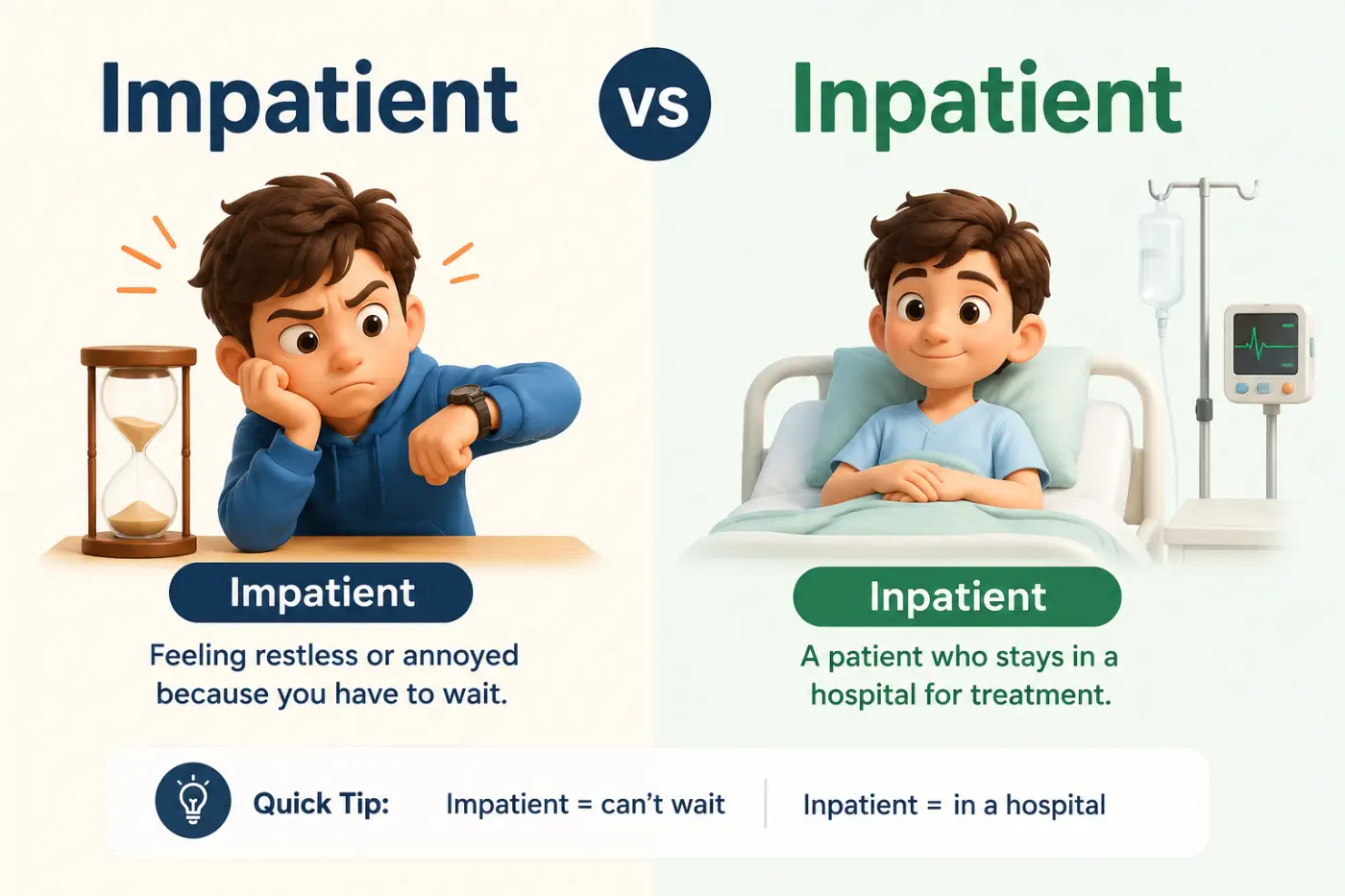
Impatient is an adjective that describes someone who becomes restless or annoyed because something is taking too long. Inpatient is a noun or adjective used in healthcare to describe a person who stays in a hospital for treatment. Both words are correct, but they have completely different meanings and should never replace each other.
Impatient Vs Inpatient Comparison Table
| Feature | Impatient | Inpatient |
|---|---|---|
| Part of speech | Adjective | Noun and adjective |
| Meaning | Not willing to wait | A patient admitted to a hospital |
| Common context | Everyday conversation | Medical and healthcare settings |
| Correct English | Yes | Yes |
| Formal writing | Common | Common in healthcare writing |
| Describes | A person’s attitude | A hospital patient or hospital care |
| Example | She became impatient during the meeting. | The inpatient stayed overnight for observation. |
| Can replace the other | No | No |

What Does Impatient Mean
Impatient describes someone who does not like waiting. An impatient person wants something to happen quickly and may become frustrated if it takes too long.
The word is often used to describe emotions, attitudes, or behavior.
Simple Definition
Impatient means unwilling to wait calmly because something is taking longer than expected.
Common Uses
People use impatient in many everyday situations.
- Waiting in long lines.
- Delayed flights.
- Slow internet.
- Late replies to messages.
- Traffic jams.
- Long meetings.
Examples Of Impatient
- She became impatient while waiting for the bus.
- The children grew impatient before dinner.
- I’m getting impatient because the website won’t load.
- His impatient attitude made the discussion more difficult.
- We were impatient to hear the final results.
Notice that impatient always describes feelings, emotions, or behavior. It never refers to a person receiving medical treatment.
What Does Inpatient Mean
Inpatient refers to a person who is admitted to a hospital and stays there for treatment, observation, or recovery.
Doctors, nurses, insurance companies, and hospitals use this term every day.
Simple Definition
An inpatient is a patient who remains in a hospital for at least one night or for ongoing medical care.
Common Uses
The word commonly appears in healthcare.
- Hospitals.
- Medical records.
- Insurance documents.
- Doctor’s reports.
- Healthcare websites.
Examples Of Inpatient
- The inpatient stayed in the hospital for three days.
- The doctor checked every inpatient before morning rounds.
- She received excellent inpatient care after surgery.
- The hospital expanded its inpatient services.
- Insurance covered the inpatient treatment.
In healthcare writing, inpatient can work as both a noun and an adjective.
Noun example.
The inpatient recovered quickly.
Adjective example.
The hospital offers inpatient rehabilitation.
Which One Is Correct
Both impatient and inpatient are correct English words.
The right choice depends entirely on your meaning.
Use impatient when talking about someone’s emotions, attitude, or inability to wait.
Use inpatient when talking about hospital care or a patient admitted to a medical facility.
For example.
✔ She became impatient after waiting an hour.
✔ The inpatient remained in the hospital overnight.
These are also useful comparisons.
✔ The child became impatient during the doctor’s visit.
✔ The child became an inpatient after the doctor admitted him to the hospital.
The first sentence describes a feeling.
The second describes a medical status.
Why People Confuse Impatient And Inpatient
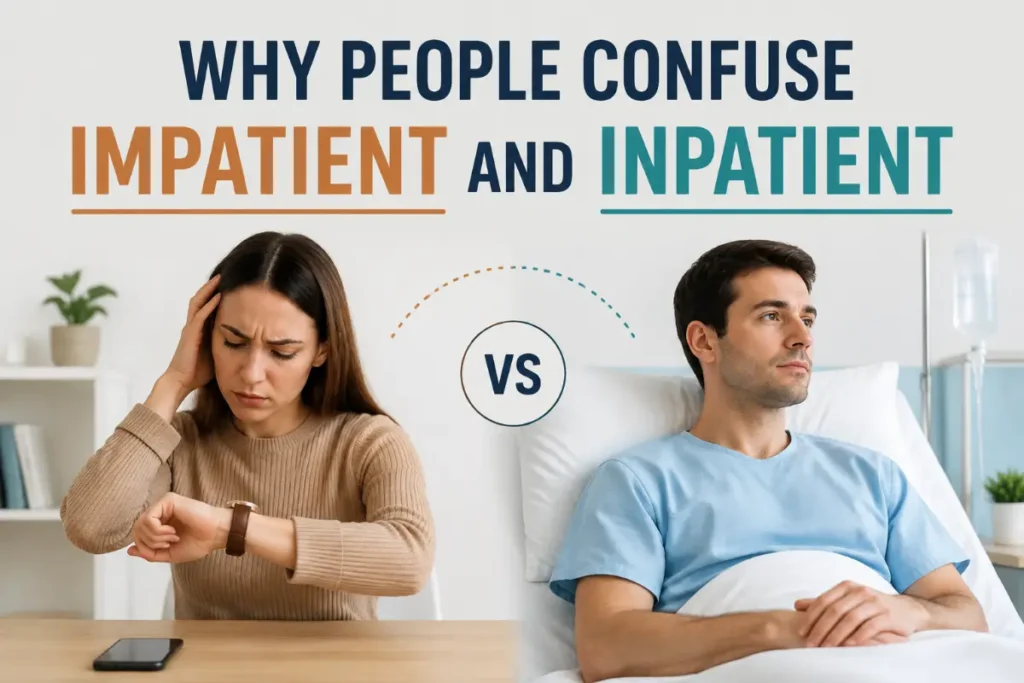
These words cause confusion for several reasons.
Nearly Identical Spelling
Only one letter separates the two words.
Impatient
Inpatient
When reading quickly, many people overlook the difference.
Similar Pronunciation
The words sound very similar in everyday speech. Native speakers usually understand the intended meaning from the surrounding sentence.
Typing Mistakes
The letters m and n sit next to each other on many keyboards. A simple typing slip can produce the wrong word.
Spell Check Limitations
Spell check often misses this mistake because both words are correctly spelled English words.
Different Subjects
The meanings belong to completely different topics.
Impatient belongs to emotions and behavior.
Inpatient belongs to medicine and healthcare.
That makes the mistake harder to notice unless you understand the context.
Key Differences Between Impatient And Inpatient
| Feature | Impatient | Inpatient |
|---|---|---|
| Meaning | Restless or unwilling to wait | A person admitted to a hospital |
| Grammar | Adjective | Noun and adjective |
| Topic | Emotions and behavior | Healthcare and medicine |
| Used for | Feelings | Medical treatment |
| Opposite | Patient | Outpatient in medical context |
| Example | He became impatient. | He became an inpatient. |
The easiest way to remember the difference is this.
If you’re talking about waiting, choose impatient.
If you’re talking about a hospital stay, choose inpatient.
Grammar Explanation
Understanding the grammar makes the difference even clearer.
Impatient Is An Adjective
An adjective describes a noun.
Examples.
- She felt impatient.
- They became impatient.
- The impatient customer complained.
In every example, impatient describes a person’s attitude or emotional state.
Inpatient Is Usually A Noun
As a noun, inpatient names a person receiving treatment in a hospital.
Examples.
- Every inpatient received breakfast.
- The nurse visited each inpatient.
Inpatient Can Also Be An Adjective
In healthcare, inpatient can describe medical services, procedures, or care.
Examples.
- Inpatient surgery.
- Inpatient treatment.
- Inpatient rehabilitation.
- Inpatient services.
This is why you may see phrases like inpatient care in hospitals and insurance documents.
Unlike impatient, inpatient has a specialized medical meaning and rarely appears outside healthcare.
Spelling Rules Behind Impatient And Inpatient
Learning how these words are built makes them much easier to remember.
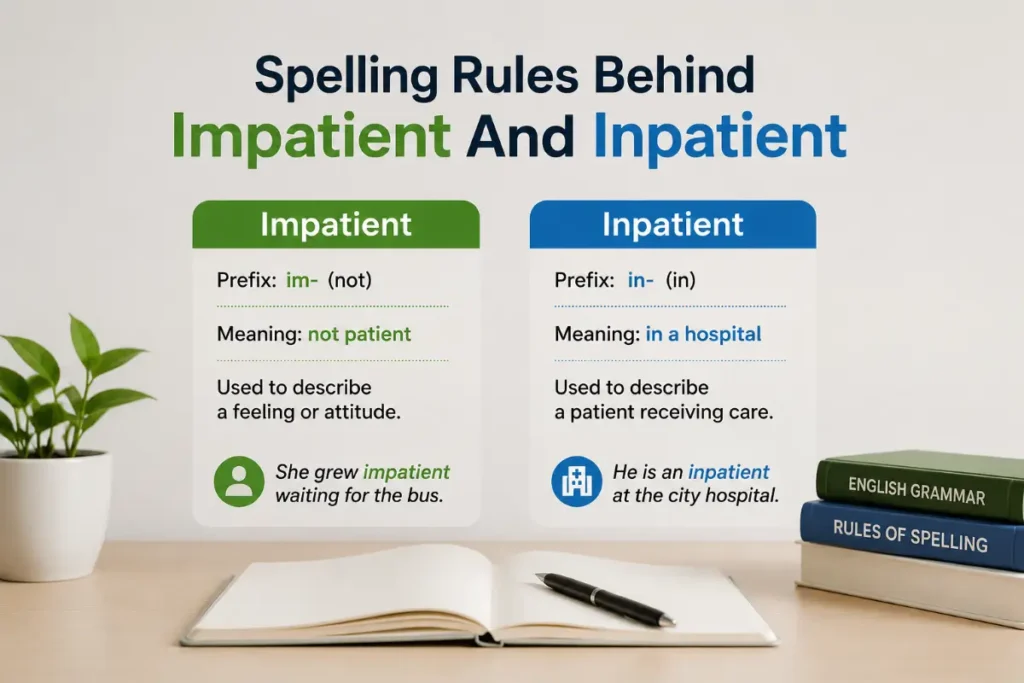
The Prefix Im
The prefix im means not. It changes the meaning of the word patient.
Patient means able to wait calmly.
Impatient means not patient or unable to wait calmly.
Examples.
- Patient.
- Impatient.
The Prefix In
In inpatient, the prefix in does not mean not. Instead, it means inside or within.
An inpatient is someone who stays inside a hospital for treatment.
This is why inpatient has a completely different meaning from impatient, even though the words look similar.
For another common grammar confusion, see Apposed Vs Opposed Which Word Is Correct 2026.
Pronunciation Guide
Although these words look alike, their meanings are very different.
Impatient
IPA
American English.
/ɪmˈpeɪʃənt/
Syllables
Im pa tient.
Stress
The main stress falls on the second syllable.
Inpatient
IPA
American English.
/ˈɪnˌpeɪʃənt/
Syllables
In pa tient.
Stress
The strongest stress falls on the first syllable.
Common Pronunciation Mistakes
Many English learners pronounce both words exactly the same.
Native speakers usually understand the intended meaning from the surrounding sentence, but paying attention to the stress pattern makes your speech clearer.
Word Origin And History
The history behind these words explains why they are unrelated.
Origin Of Impatient
Impatient comes from the Latin word impatiens, which means unable to endure or unable to bear something calmly.
Over time, English speakers began using it to describe someone who dislikes waiting or becomes frustrated easily.
Origin Of Inpatient
Inpatient is a modern medical term that became common during the twentieth century.
It combines in, meaning inside, with patient, referring to someone receiving medical care.
The word literally means a patient staying inside a hospital.
Although both words contain patient, they developed for different reasons and belong to different areas of English.
British American Canadian And Australian English
There is almost no regional difference between impatient and inpatient.
Writers and speakers in the United States, the United Kingdom, Canada, Australia, and New Zealand use both words with the same meanings.
The only noticeable difference appears in healthcare terminology.
Some hospitals outside the United States may also use expressions such as hospitalized patient or admitted patient, but inpatient remains widely understood across all major English speaking countries.
Real Life Examples
Seeing these words in everyday situations is the fastest way to remember them.
Daily Conversation
- I became impatient after waiting for an hour.
- She looked impatient while standing in line.
- Don’t be impatient. The food will be ready soon.
- He gets impatient during long phone calls.
Workplace
- The client grew impatient after several delays.
- Our manager reminded everyone not to become impatient during the project.
- The hospital hired more nurses for the inpatient unit.
- The new wing provides additional inpatient rooms.
Emails
- Thank you for your patience. We understand you may feel impatient while waiting for an update.
- Your family member has been admitted as an inpatient for further observation.
Healthcare
- The inpatient received medication every four hours.
- Doctors monitored each inpatient carefully.
- The hospital expanded its inpatient rehabilitation program.
- Insurance approved the inpatient procedure.
Academic Writing
- Researchers compared inpatient and outpatient recovery rates.
- The study examined impatient behavior among young children.
Journalism
- Long delays left travelers impatient at the airport.
- The hospital announced plans to increase inpatient capacity.
Social Media
- I’m too impatient to wait until tomorrow.
- My grandmother is finally coming home after being an inpatient for a week.
These examples show that impatient almost always describes emotions, while inpatient belongs almost exclusively to medical situations.
Common Mistakes
Many writers confuse these words because the spelling difference is so small.
Here are the mistakes editors see most often.
Using Impatient Instead Of Inpatient
Incorrect.
The impatient stayed in the hospital overnight.
Correct.
The inpatient stayed in the hospital overnight.
Why?
The sentence is talking about a hospital patient, not someone’s personality.
Using Inpatient Instead Of Impatient
Incorrect.
She became inpatient while waiting for the interview.
Correct.
She became impatient while waiting for the interview.
Why?
The sentence describes frustration from waiting, not medical care.
Assuming Inpatient Means Patient
Some learners believe inpatient simply means a patient.
Not exactly.
An inpatient stays in a hospital.
A patient can receive treatment almost anywhere.
Someone visiting a clinic for a short appointment is still a patient but is not necessarily an inpatient.

Confusing Inpatient With Outpatient
These terms have opposite meanings in healthcare.
An inpatient stays in the hospital.
An outpatient receives treatment without staying overnight.
Understanding this difference makes medical English much easier.
Memory Tricks To Remember The Difference
You do not need to memorize complicated grammar rules. These simple tricks make the difference easy to remember.
Think About The First Letter
The M in impatient can remind you of mood.
An impatient person is in a frustrated mood because waiting feels too long.
The N in inpatient can remind you of night.
An inpatient usually stays in the hospital overnight.
Remember The Meaning
Impatient is about feelings.
Inpatient is about hospitals.
If the sentence mentions doctors, nurses, surgery, recovery, or a hospital room, inpatient is almost always the correct choice.
If it describes someone’s attitude while waiting, impatient is the right word.
Ask Yourself One Question
Is the sentence talking about an emotion or medical care?
If it is an emotion, choose impatient.
If it is medical care, choose inpatient.
Related Words
Expanding your vocabulary helps you avoid similar mistakes.
Synonyms For Impatient
- Restless.
- Eager.
- Irritable.
- Agitated.
- Frustrated.
Synonyms For Inpatient
- Hospital patient.
- Admitted patient.
- Resident patient.
Opposites
Impatient
- Patient.
- Calm.
- Relaxed.
Inpatient
- Outpatient.
Related Medical Terms
- Outpatient.
- Admission.
- Discharge.
- Hospitalization.
- Emergency care.
- Rehabilitation.
Frequently Confused Words
- Patient and patience.
- Impatient and patient.
- Inpatient and outpatient.
- Affect and effect.
- Advice and advise.
Learning these words together makes them easier to remember.
Expert Editor’s Note
Professional editors pay close attention to context because both impatient and inpatient are correctly spelled words.
Spell check usually cannot catch this mistake. If you accidentally write inpatient instead of impatient, your writing software may accept it because the spelling is correct.
The best way to avoid the error is to read the sentence carefully.
If the sentence talks about emotions, waiting, frustration, or eagerness, use impatient.
If it talks about hospitals, treatment, surgery, recovery, or healthcare, use inpatient.
Editors also recommend reading your sentence aloud. The surrounding words usually make the correct choice obvious.
Frequently Asked Questions
What Is The Difference Between Impatient And Inpatient?
Impatient describes someone who becomes restless or frustrated while waiting. Inpatient refers to a person admitted to a hospital for treatment or observation. The words have different meanings and belong in completely different contexts.
Is Inpatient One Word Or Two?
Inpatient is one word in modern American and British English. It appears this way in dictionaries, hospitals, insurance documents, and healthcare publications.
Is Impatient An Adjective?
Yes. Impatient is an adjective because it describes a person’s feelings or behavior.
Example.
She became impatient after waiting for thirty minutes.
Can Inpatient Be An Adjective?
Yes. In healthcare, inpatient works as both a noun and an adjective.
Examples include inpatient care, inpatient treatment, and inpatient rehabilitation.
What Is The Opposite Of Inpatient?
The opposite is outpatient.
An inpatient stays in the hospital for treatment.
An outpatient receives treatment without staying overnight.
Why Do People Mix Up Impatient And Inpatient?
The words differ by only one letter and sound very similar. Many typing mistakes happen because both words are valid English words, so spell check often misses the error.
How Can I Remember The Difference Quickly?
Think about the topic.
Waiting and emotions point to impatient.
Hospitals and medical care point to inpatient.
That simple rule works almost every time.
Need another quick comparison? Read It Is Must vs It Is a Must: Which One Is Correct in 2026?.
Conclusion
Understanding impatient vs inpatient becomes easy once you know what each word represents.
Impatient describes a feeling. It means someone is restless, eager, or unwilling to wait.
Inpatient belongs to healthcare. It refers to a person admitted to a hospital or to services provided during a hospital stay.
Although the words differ by only one letter, they are never interchangeable. Choosing the correct one depends entirely on the meaning of your sentence.
The next time you hesitate, remember one simple rule.
If the sentence is about waiting, choose impatient.
If it is about staying in a hospital, choose inpatient.
That small habit will help you write with confidence and avoid one of the most common English word mix ups.

Vocabulary & Language Research Writer
Ethan Parker researches English vocabulary, word meanings, slang, idioms, and commonly confused words. His goal is to help readers understand how English is actually used in everyday conversations and writing.