
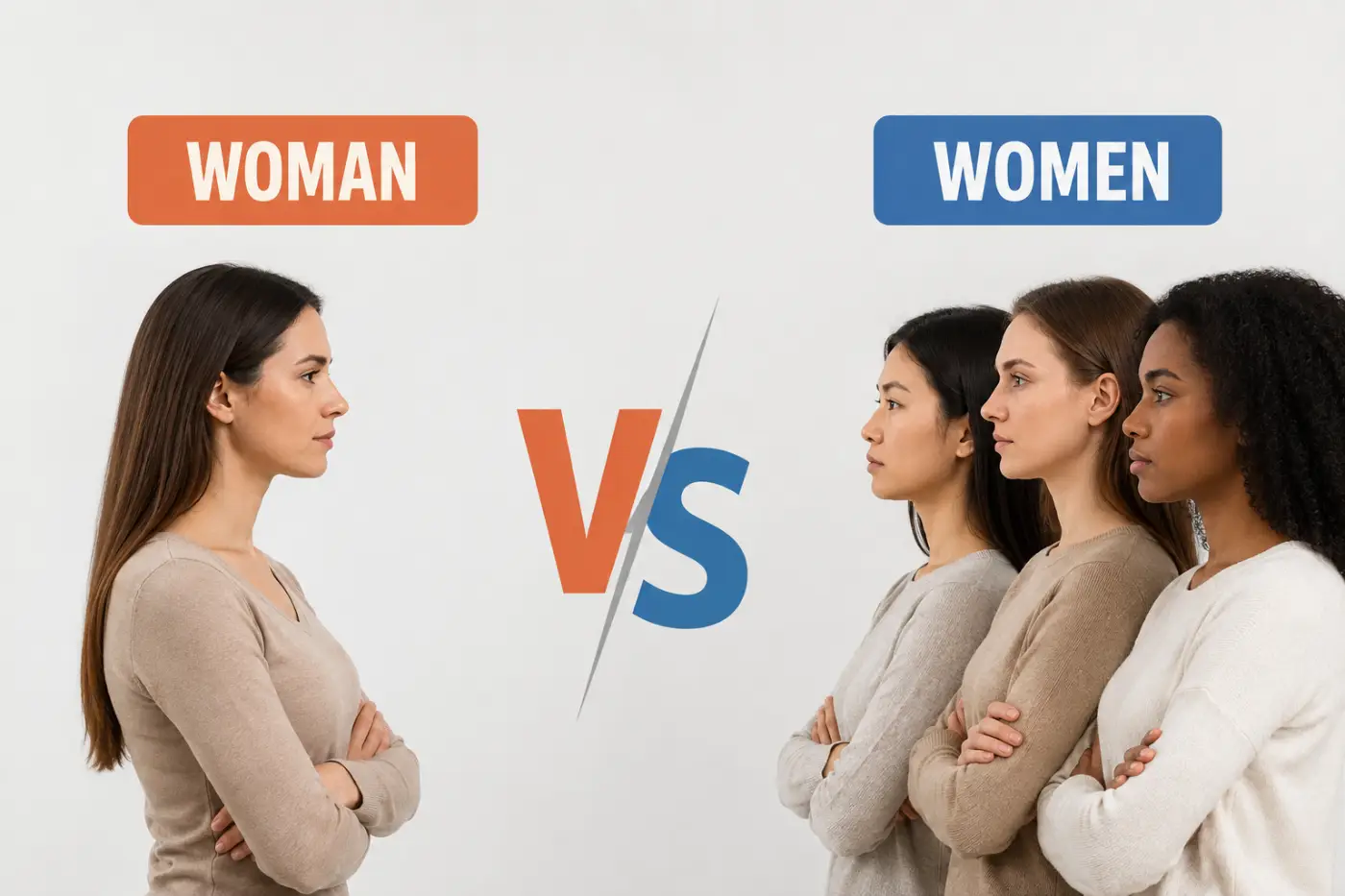
The difference between woman vs women looks simple until you have to choose the right word quickly. Both words refer to adult females and share the same basic meaning. The real difference is number. Woman is singular and refers to one person. Women is plural and refers to two or more people.
The tricky part is pronunciation. The spelling changes from woman to women but the vowel sound changes too. This can make the plural form harder to recognize in conversation. Many English learners also write womans when they need the plural. That form is incorrect in standard English.
Once you understand the singular and plural pattern you can use both words confidently. This guide explains the meaning grammar spelling pronunciation and everyday use of woman vs women. You’ll also see natural examples that show exactly how native English speakers use these words.
Many readers also check Less Than And Greater Than Made Simple.
Quick Answer
Woman is the singular form and means one adult female. Women is the plural form and means two or more adult females. For example you can say one woman but two women. The plural is irregular because you don’t form it by adding s to woman.
Woman Vs Women Comparison Table
| Feature | Woman | Women |
|---|---|---|
| Number | Singular | Plural |
| Meaning | One adult female | Two or more adult females |
| Part of speech | Noun | Noun |
| Correct spelling | Woman | Women |
| Incorrect plural | Womans | Not applicable |
| Pronunciation | /ˈwʊmən/ | /ˈwɪmɪn/ |
| Syllables | Two | Two |
| Example | One woman is waiting. | Two women are waiting. |
| Article | A woman or the woman | The women |
| Verb agreement | Singular verb | Plural verb |
| Common context | One person | More than one person |
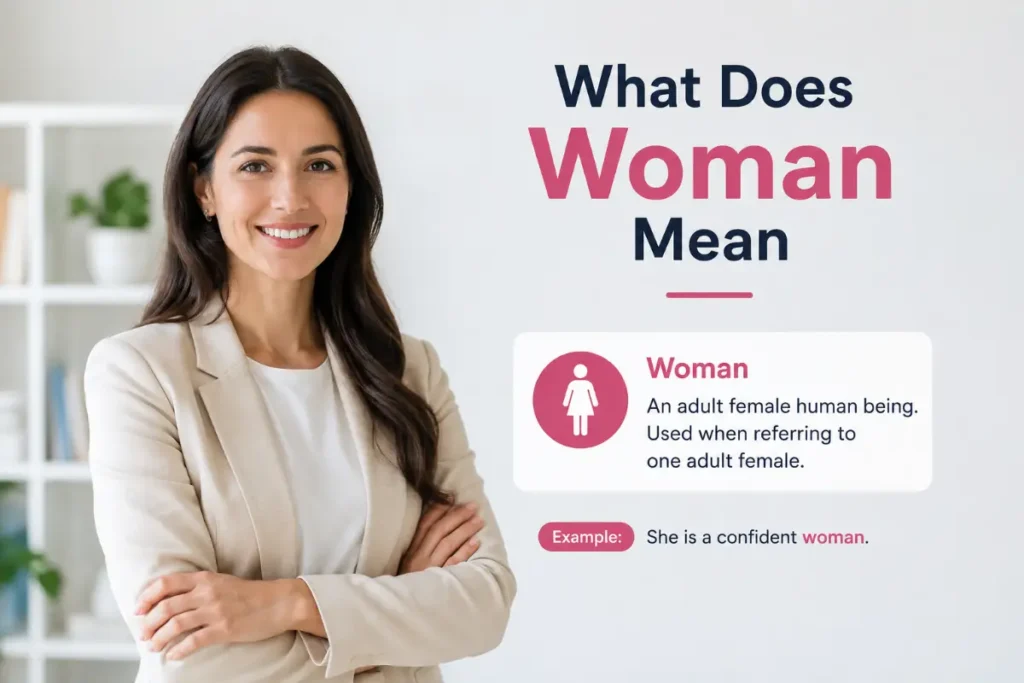
What Does Woman Mean
Woman is a singular noun used for one adult female human.
The plural form is women.
You can use woman when you are talking about one specific person or about an adult female in general.
For example:
- The woman is waiting outside.
- A woman called earlier.
- That woman works at the library.
- Every woman deserves respect.
- She became a successful woman through years of hard work.
The key point is simple. Woman means one.
Woman In Everyday English
The word appears in ordinary conversation all the time.
You might say:
- I spoke with a woman at the front desk.
- There’s a woman outside asking for you.
- My neighbor is a kind woman.
- The woman sitting next to me helped me find my seat.
- She wants to become a businesswoman someday.
In each sentence the noun refers to one adult female.
What Does Women Mean
Women is the plural form of woman. It refers to two or more adult females.
For example:
- The women are waiting outside.
- Three women joined the meeting.
- The women in my family love cooking.
- Several women applied for the position.
- Those women helped organize the event.
The most important rule is this:
Woman means one. Women means more than one.
You don’t add s to woman to make it plural.
Incorrect:
Womans
Correct:
Women
This is an irregular plural. English has many irregular plurals such as man becoming men and child becoming children.
Which One Is Correct
Both woman and women are correct English words.
The correct choice depends on the number of people you mean.
Use woman for one person.
Use women for two or more people.
Compare these sentences:
One woman is standing near the door.
Two women are standing near the door.
Notice another important change. The verb changes too.
The woman is ready.
The women are ready.
This happens because English requires subject and verb agreement. A singular noun normally takes a singular verb. A plural noun takes a plural verb.
Why People Confuse Woman And Women
The words are confusing for several reasons. The first is visual similarity. The second is pronunciation. The third is the fact that English doesn’t form this plural with the usual s ending.
The Spelling Looks Almost The Same
The words differ by only one letter.
Woman
Women
That small spelling difference can be easy to miss when you’re reading quickly.
English learners sometimes remember the beginning of the word but forget the vowel change in the middle.
The Pronunciation Changes
The pronunciation difference surprises many learners.
Woman sounds approximately like wuh mun.
Women sounds approximately like wi min.
So the singular and plural forms don’t simply differ by an added sound at the end.
This is one reason spoken English can make the distinction harder.
English Has An Irregular Plural
Many nouns form plurals by adding s.
- Book becomes books.
- Car becomes cars.
- Teacher becomes teachers.
- Student becomes students.
But woman doesn’t follow this pattern.
It becomes women.
That makes it something learners need to memorize rather than build from the usual plural rule.
Key Differences Between Woman And Women
The biggest difference is grammatical number.
Woman Is Singular
Use woman when you’re talking about one person.
The woman is a doctor.
The singular verb is agrees with the singular noun.
Women Is Plural
Use women when you’re talking about more than one person.
The women are doctors.
The plural verb are agrees with the plural noun.
Articles Work Differently
You can say:
a woman
one woman
the woman
But you cannot say:
a women
For plural nouns you can use:
women
the women
two women
many women
For example:
A woman called me this morning.
The women called me this morning.
Three women called me this morning.
This article pattern gives you another useful clue when choosing the correct form.
Grammar Explanation
Understanding the grammar behind these words makes the difference much easier to remember.
Woman As A Singular Noun
When woman acts as the subject of a sentence it normally takes a singular verb.
The woman works here.
The woman is tired.
That woman has a new car.
The words works is and has all fit a singular subject.
Women As A Plural Noun
When women acts as the subject it normally takes a plural verb.
The women work here.
The women are tired.
Those women have new cars.
Notice the verb changes.
Woman is
Women are
Woman has
Women have
This pattern is especially useful in formal writing because subject and verb agreement matters.
Woman As An Object
You can also use woman as the object of a verb or after a preposition.
I met a woman yesterday.
She spoke to the woman.
He gave the woman a book.
The noun still refers to one person.
Women As An Object
Use women when the object contains more than one person.
I met several women yesterday.
She spoke to the women.
He gave the women some books.
The number stays consistent throughout the sentence.
Spelling Rules For Woman And Women
The spelling difference is worth learning on its own.
The singular form is:
woman
The plural form is:
women
Don’t write womans as the plural.
A useful comparison is:
man → men
woman → women
The spelling pattern is related. Both words change their internal vowel when they become plural.
You can also remember the final letters.
Woman ends with an.
Women ends with en.
That small visual clue can help when you’re writing quickly.
Pronunciation Guide
Pronunciation creates another major difference between the two words.
Woman Pronunciation
IPA: /ˈwʊmən/
It has two syllables.
WUH mun
The main stress falls on the first syllable.
The second syllable is weak and sounds like mən.
Women Pronunciation
IPA: /ˈwɪmɪn/
It also has two syllables.
WIH min
The first syllable receives the main stress.
The second syllable sounds closer to min than mən.
A Common Pronunciation Mistake
Some learners pronounce women as if it were simply woman with an s added.
That’s not how standard English works.
The vowel sound changes.
Woman: /ˈwʊmən/
Women: /ˈwɪmɪn/
A good way to practice is to say the pair slowly.
woman
women
Then put each word into a short sentence.
The woman is here.
The women are here.
This connects pronunciation with grammar and makes the distinction easier to recall.
Woman Vs Women In Everyday Grammar
The difference between woman and women becomes much easier when you pay attention to the words around them. Articles pronouns adjectives and verbs can all give you clues about number.
For example:
That woman is my manager.
Those women are my managers.
The first sentence refers to one person. The second refers to more than one.
Using A Woman
Use a woman when you mean one person and you’re introducing that person for the first time.
Examples:
- A woman asked for directions.
- I saw a woman waiting near the entrance.
- A woman from our office called this morning.
You can’t use a before the plural form.
Incorrect:
A women walked into the room.
Correct:
A woman walked into the room.
Using The Woman
Use the woman when the listener or reader knows which person you mean.
Examples:
- The woman at the reception desk can help you.
- I spoke to the woman you mentioned.
- The woman in the blue jacket is my sister.
Using The Women
Use the women when you’re talking about a specific group of two or more people.
Examples:
- The women at the reception desk can help you.
- I spoke to the women you mentioned.
- The women in the blue jackets are my coworkers.
The article the works with both forms. The noun itself tells us how many people are involved.
Woman Vs Women With Pronouns
Pronouns also need to agree with the number of the noun.
For one person you can use she or her when the context calls for a female pronoun.
For multiple people you can use they or them.
Compare these sentences:
The woman said she would call later.
The women said they would call later.
I met the woman and spoke with her.
I met the women and spoke with them.
This agreement matters in clear formal writing. A sentence can sound awkward if the noun and pronoun don’t match.
Woman Vs Women With Possessives
The possessive forms also follow a useful pattern.
For one woman use:
woman’s
For more than one woman use:
women’s
Examples:
The woman’s bag is on the chair.
The women’s bags are on the chair.
The apostrophe placement changes because the number changes.
Woman’s Means Belonging To One Woman
Examples:
- The woman’s phone is ringing.
- I borrowed the woman’s book.
- The woman’s opinion was helpful.
Women’s Means Belonging To Women
Examples:
- The women’s team won the match.
- The women’s locker room is upstairs.
- The women’s department is on the second floor.
Notice that women’s doesn’t mean womens. The apostrophe remains part of the possessive form.
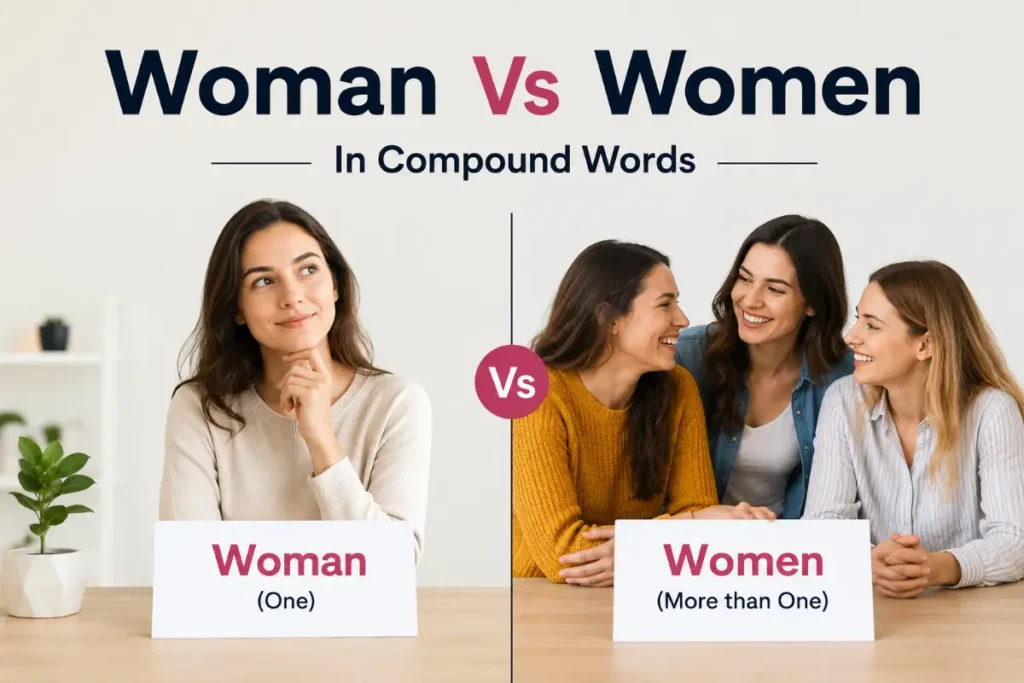
Woman Vs Women In Compound Words
Both forms appear in compound words and expressions.
Common examples include:
- Businesswoman.
- Businesswomen.
- Womanhood.
- Women’s rights.
- Women’s health.
- Woman owned business.
- Women entrepreneurs.
The same singular and plural distinction remains.
Businesswoman means one female business owner or business professional.
Businesswomen means two or more.
For example:
She is a successful businesswoman.
Several businesswomen attended the conference.
Woman Vs Women In Formal Writing
Formal writing requires careful agreement and precise word choice.
Consider this sentence:
The woman interviewed for the position has strong qualifications.
The subject is singular so has is correct.
Now compare:
The women interviewed for the position have strong qualifications.
The subject is plural so have is correct.
This distinction matters in academic papers professional reports news writing and workplace communication.
A small spelling error can change the grammar of the entire sentence.
Woman Vs Women In Informal Writing
Casual writing follows the same basic grammar rules. Text messages social posts and informal emails still need the correct singular and plural forms if you want your meaning to stay clear.
For example:
That woman is hilarious.
Those women are hilarious.
Informal language can bend some grammar rules but woman and women don’t normally switch roles.
Real Life Examples Of Woman And Women
Seeing both words in different situations makes the pattern easier to recognize.
Daily Conversation
- I met a woman at the coffee shop this morning.
- The woman next door has a beautiful garden.
- Two women helped me find the right train.
- Those women work at the local bookstore.
- My aunt is an inspiring woman.
- The women in my family love getting together on weekends.
Workplace Examples
- A woman from the sales team will contact you.
- The woman leading the meeting has twenty years of experience.
- Several women applied for the position.
- The women on our team handled the project successfully.
- She’s a talented businesswoman.
- The company supports women in leadership roles.
Email Examples
- I spoke with a woman from the customer service department.
- The women who attended the workshop will receive certificates.
- A woman from the accounting team sent the report.
- The women’s meeting will begin at noon.
Academic Writing
- The study examines how one woman influenced the political movement.
- Several women contributed to the research.
- The author presents the woman as a symbol of independence.
- The experiences of women have shaped the field over many decades.
Journalism
- A woman was rescued after the storm.
- Three women were recognized for their community service.
- The woman spoke to reporters after the event.
- The women later appeared at a public ceremony.
Social Media
- That woman always has the best advice.
- These women are doing amazing work in their communities.
- Proud of the women who helped make this project possible.
- I met a wonderful woman today.
The context changes but the basic rule never does. One person takes woman. More than one takes women.
Common Mistakes With Woman And Women
Mistake One
Womans
This is not the standard plural form.
Use women instead.
Mistake Two
One women
This is incorrect because one requires a singular noun.
Correct:
One woman
Mistake Three
Two woman
This is incorrect because two requires a plural noun.
Correct:
Two women
Mistake Four
A women
The article a refers to one person.
Correct:
A woman
Mistake Five
Women is
The plural noun women normally takes are when it acts as the subject.
Correct:
Women are important members of every community.
Mistake Six
Woman are
The singular noun woman normally takes is.
Correct:
The woman is waiting outside.
Mistake Seven
The woman’s are
This combines a singular possessive form with a plural verb and usually creates an error.
If you mean several women you could write:
The women are waiting.
If you mean something belongs to one woman you could write:
The woman’s bags are waiting inside.
The second sentence uses woman’s as a possessive. The bags can still be plural because the possessive noun and the possessed noun don’t have to share the same number.
Woman Vs Women And Subject Verb Agreement
This is one of the most useful grammar points to master.
Singular Pattern
The woman is working.
The woman has finished the report.
Plural Pattern
The women are working.
The women have finished the report.
Notice the changes.
is → are
has → have
does → do
her → their
This pattern appears across the entire sentence.
For another common grammar confusion, see More Than Vs More Then Which One Is Correct (2026).
Historical Development Of Woman And Women
The difference between the two forms has deep roots in the history of English.
The modern word woman developed from Old English wīfmann. This was formed from words referring to a female person and a human being or person.
Over centuries the pronunciation and spelling changed. The modern singular form eventually became woman.
The plural developed through the older Germanic pattern that also affected man and men.
This explains why English doesn’t use the regular plural womans.
The forms are not random. They’re the result of centuries of sound changes and grammatical development.
British And American English
There is no major spelling difference between American English and British English for woman and women.
The same forms are used in both varieties.
American English:
one woman
two women
British English:
one woman
two women
Canadian English and Australian English also use these same forms.
The pronunciation can vary slightly by region and individual speaker but the singular and plural distinction remains the same.
Why Women Sounds Different From Woman
The pronunciation difference comes from historical sound changes in English.
Modern speakers don’t simply add a plural ending to woman. The internal vowel changes too.
Think of the pair as two separate forms that belong together.
Woman → /ˈwʊmən/
Women → /ˈwɪmɪn/
This is similar to other irregular English pairs where the spelling and pronunciation change inside the word.
For an English learner the safest approach is to memorize the pair rather than trying to predict the plural from the singular.
Is Woman Always Singular
Yes. In standard modern English woman is a singular count noun.
You can say:
one woman
a woman
the woman
You can’t normally use woman by itself to mean several people.
For several people use women.
Is Women Always Plural
Yes. Women is the plural form of woman.
You can use it for two or more people.
Examples:
Two women
Several women
Many women
The women
You generally don’t use women after a singular determiner such as a or one.
A Useful Way To Think About The Difference
Picture a single person standing alone.
That’s woman.
Now picture a group of people standing together.
That’s women.
The spelling changes because the grammatical number changes.
One → woman
Two or more → women
That simple mental picture can prevent many mistakes before they happen.
When To Use Woman And Women
Choosing between woman and women becomes automatic once you connect each word with its number.
Use woman when you mean one adult female.
Use women when you mean two or more adult females.
For example:
- One woman is waiting outside.
- Two women are waiting outside.
- A woman called the office.
- Several women called the office.
The words around the noun often make the answer obvious. Words such as one and a point toward woman. Words such as two several many and these point toward women.
Woman And Women In Questions
Questions follow the same singular and plural rules.
For one person:
Is the woman your sister.
For multiple people:
Are the women your sisters.
You can also ask:
Who is that woman.
Who are those women.
The verb changes because the subject changes from singular to plural.
This is useful in conversation because the correct form often depends on the verb you choose.
Woman And Women With Demonstratives
Words such as this that these and those provide another quick clue.
Use this or that with the singular form.
This woman is my teacher.
That woman lives next door.
Use these or those with the plural form.
These women are my teachers.
Those women live next door.
A simple memory rule works well.
This woman.
These women.
That woman.
Those women.
Woman And Women In Academic Writing
Academic writing often discusses groups of people so women appears frequently. Still the singular form woman remains important when a paper focuses on one individual.
Compare:
The study examines the experiences of women in rural communities.
The study examines the experience of one woman in a rural community.
The first sentence discusses a group. The second focuses on an individual.
Academic writers should also avoid changing between singular and plural without a reason. Consistent number makes an argument easier to follow.
Woman And Women In Workplace English
Professional communication requires the same basic grammar as everyday English.
Examples include:
- The woman responsible for the account will contact you.
- The women responsible for the accounts will contact you.
- One woman leads the department.
- Three women lead different departments.
- We interviewed a woman for the position.
- We interviewed several women for the position.
In workplace writing the difference can affect the meaning of a sentence. A reader needs to know if you’re discussing one person or a group.
Woman And Women In Literature
Writers have long used both forms to talk about individual characters and groups.
A novel might introduce one character as a woman and later refer to several characters as women.
For example:
The woman stood quietly near the window.
Later:
The women gathered around the table.
Literary writing also uses these words in broader descriptions of identity experience society and relationships. The grammar remains the same even when the writing becomes more creative.
Woman And Women In Journalism
News writing often uses both forms because journalists describe individuals and groups.
Examples:
- A woman was rescued from the building.
- Two women were rescued from the building.
- The woman later spoke to reporters.
- The women later spoke to reporters.
The number of people involved can change the verb as well as the noun.
A careful editor checks both parts of the sentence before publication.
Woman And Women In Social Media
Social media often uses short informal sentences. Even so the distinction remains useful.
Examples:
That woman is a legend.
Those women are incredible.
I met a wonderful woman today.
These women inspire me every day.
Informal writing may drop some words but the singular and plural forms don’t become interchangeable.
Social media can also create spelling myths because users type quickly. A misspelling repeated thousands of times can start to look normal. Frequency online doesn’t make an incorrect form standard English.
Common Questions About Woman And Women
What Is The Plural Of Woman
The plural of woman is women.
You don’t form the plural by adding s. The correct pair is woman for one person and women for two or more people.
For example:
One woman.
Two women.
Many women.
The form womans is not the standard plural in English.
Is Women Singular Or Plural
Women is plural.
It refers to two or more adult females.
For example:
The women are talking.
The plural noun takes the plural verb are.
The singular form is woman.
The woman is talking.
Is Woman Singular Or Plural
Woman is singular.
It refers to one adult female.
You can use it after words such as a one and each.
Examples include:
A woman.
One woman.
Each woman.
You cannot use a women in standard English.
Why Is The Plural Of Woman Women
The plural women comes from the historical development of English rather than the regular rule of simply adding s.
English contains many irregular plurals that developed from older forms. Man and men follow a related pattern. Woman and women preserve a similar internal vowel change.
The forms therefore need to be learned as a pair.
How Do You Pronounce Woman And Women
Woman is pronounced approximately WUH mun and has the IPA pronunciation /ˈwʊmən/.
Women is pronounced approximately WIH min and has the IPA pronunciation /ˈwɪmɪn/.
Both words have two syllables but their vowel sounds differ.
Can I Say Women For One Person
No. In standard English women is plural and refers to more than one person.
Use woman for one person.
Correct:
One woman arrived early.
Incorrect:
One women arrived early.
The same rule applies to articles and numbers.
What Is The Possessive Form Of Woman
The singular possessive form is woman’s.
The plural possessive form is women’s.
Examples:
The woman’s car is outside.
The women’s cars are outside.
The apostrophe placement changes because the singular and plural forms are different.
Is Womans A Correct Word
Womans is not the standard plural form of woman.
The correct plural is women.
You may sometimes see womans online because of typing mistakes or nonstandard writing. It isn’t the form you should use in professional academic or edited English.
Memory Tricks For Woman And Women
A few quick tricks can make the difference stick.
Think One And Many
Connect woman with one.
Connect women with many.
One woman.
Many women.
This is the easiest rule for most learners.
Remember The Vowels
Look at the middle of each word.
Woman contains o.
Women contains e.
Think:
One woman.
Several women.
The spelling difference then becomes easier to recall.
Connect Woman With Man
English gives you a useful pair.
man → men
woman → women
Both singular words change their internal vowel in the plural.
This isn’t a rule you can apply to every English noun but it works perfectly for these two common words.
Use The Verb As A Clue
If you’re unsure about the noun ask yourself which verb belongs in the sentence.
The woman is.
The women are.
If is sounds right you probably need woman.
If are sounds right you probably need women.
This trick works especially well when speaking quickly.
Related Words And Expressions
The words woman and women belong to a larger family of vocabulary connected with people gender adulthood and identity.
Related forms include:
- Womanhood.
- Womanly.
- Womanly.
- Womanish.
- Businesswoman.
- Businesswomen.
- Chairwoman.
- Chairwomen.
- Superwoman.
- Women’s.
- Womenfolk.
Some of these words have specific stylistic or cultural uses. Choose them based on context rather than treating them as simple substitutes for woman or women.
Woman And Female
Woman and female aren’t always interchangeable.
Female can function as an adjective or noun but often sounds more clinical or technical when used as a noun.
For everyday human references, woman is usually the more natural noun.
For example:
She is a woman.
In a biological or scientific context you might see:
The study included female participants.
Context matters.
Woman And Lady
Lady can sometimes refer to a woman but the words aren’t exact synonyms.
Lady can sound polite or old fashioned in some contexts. It can also appear in fixed expressions and titles.
For ordinary neutral writing woman is usually the clearest choice.
Women And Ladies
The plural women refers directly to adult females.
Ladies can have a more polite or social tone and appears in expressions such as ladies and gentlemen.
Again the words aren’t interchangeable in every sentence.
Expert Editor’s Note
A professional editor’s first concern is accuracy. When editing woman and women the key question is grammatical number.
If the noun refers to one adult female use woman.
If it refers to two or more adult females use women.
Editors also check the surrounding grammar. Determiners pronouns and verbs need to agree with the noun.
Consider this sentence:
Those woman is waiting outside.
It contains two number errors.
Those is plural but woman is singular.
Is is singular but the intended subject is plural.
The corrected sentence is:
Those women are waiting outside.
This illustrates an important editing principle. Don’t correct only the spelling. Check the entire sentence for agreement.
Dictionaries list woman as the singular noun and women as its plural. Major English dictionaries also distinguish their pronunciations. Standard English does not treat womans as the regular plural.
For formal writing the safest approach is simple. Choose the form that matches the number of people and make the rest of the sentence agree with it.
Internal Linking Opportunities
Two useful internal articles can support this topic naturally.
- Man Vs Men Difference Explained can appear after the introduction because it teaches the related singular and plural pattern.
- Commonly Confused English Words And Their Meanings can appear near the conclusion as a broader resource for readers who want to improve word choice.
Learn the difference in Freshmen Vs Freshman Which One Is Correct (2026).
Conclusion
The difference between woman vs women comes down to one basic idea: number.
Woman is singular and refers to one adult female.
Women is plural and refers to two or more adult females.
Remember these two examples:
One woman is waiting.
Two women are waiting.
Also remember that the plural isn’t womans. The correct plural is women and its pronunciation changes from /ˈwʊmən/ to /ˈwɪmɪn/.
When you aren’t sure which form to use, look at the words around it. A and one point to woman. Two several many these and those point to women.
Once singular and plural become second nature, this common English confusion disappears.
One woman. Many women. One small spelling change. A big difference in meaning.

Senior Grammar Editor
Olivia Reynolds is a grammar editor and language writer who enjoys making complex English rules easy to understand. She specializes in grammar, punctuation, sentence structure, and everyday writing tips, helping readers write with greater confidence and clarity.