
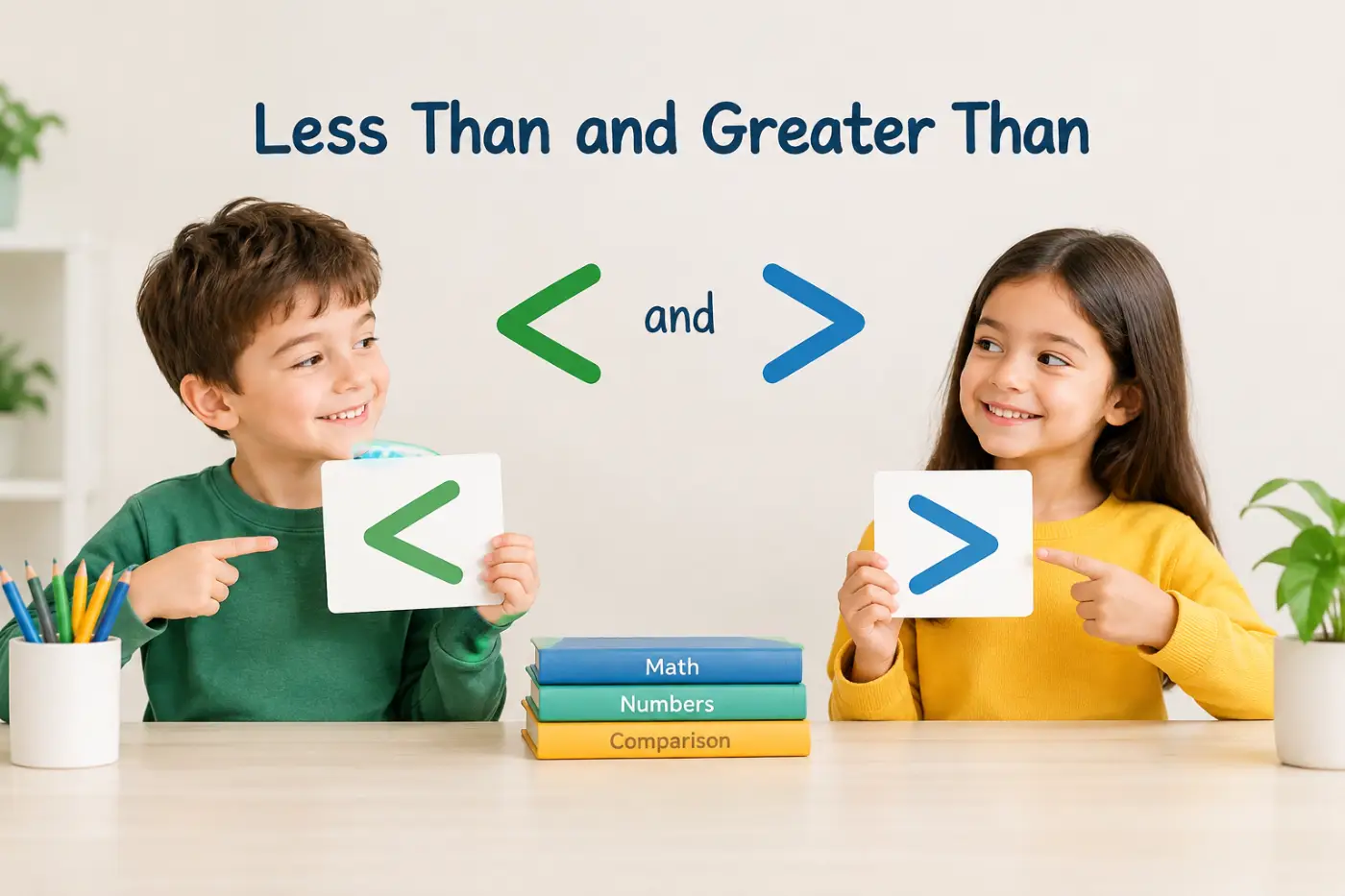
If you’ve ever paused over less than and greater than symbols and wondered which direction they should face you’re not alone. The symbols < and > look simple but they cause plenty of mistakes in math homework spreadsheets coding and everyday comparisons.
The good news is that the rule is straightforward. < means less than and > means greater than. The smaller number goes on the side of the opening and the larger number goes near the pointed end. So 3 < 8 means three is less than eight while 8 > 3 means eight is greater than three.
The confusion usually comes from trying to remember which way the symbol points. Words such as less and greater also work differently from the symbols so beginners can easily reverse them.
This guide explains less than and greater than from the ground up. You’ll learn what each symbol means how to read them aloud how to compare negative numbers decimals and fractions and how these signs work with equal values. You’ll also see practical examples common mistakes memory tricks and useful rules for school work programming and formal writing.
Many readers also check Anyway Vs Anyways Which One Is Correct (2026).
Quick Answer
< means less than. > means greater than. The wider opening faces the larger number while the pointed end faces the smaller number. For example 4 < 9 means four is less than nine and 9 > 4 means nine is greater than four. The two statements express the same comparison from opposite directions.
Less Than And Greater Than Comparison
| Symbol | Meaning | How to read it | Example |
|---|---|---|---|
| < | Less than | Is less than | 3 < 7 |
| > | Greater than | Is greater than | 7 > 3 |
| ≤ | Less than or equal to | Is less than or equal to | 3 ≤ 7 |
| ≥ | Greater than or equal to | Is greater than or equal to | 7 ≥ 3 |
| = | Equal to | Is equal to | 5 = 5 |
The two main symbols are < and >.
The symbol < tells you the number on the left is smaller.
The symbol > tells you the number on the left is larger.
This distinction matters because the direction of the symbol changes the meaning of the entire statement.
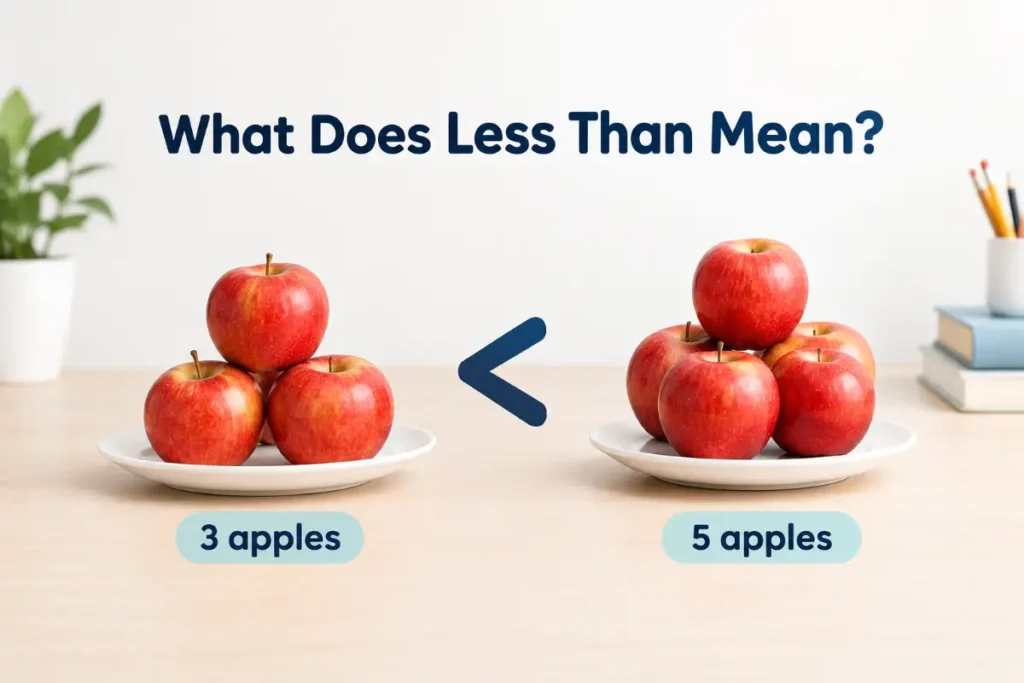
What Does Less Than Mean
Less than means one value has a smaller amount or numerical value than another.
The symbol for less than is <.
For example:
2 < 6
You read this as:
Two is less than six.
The number 2 has a smaller value than 6.
Another example is:
15 < 20
This means fifteen is less than twenty.
The symbol doesn’t mean that the two numbers are equal. It tells you that the first value is strictly smaller than the second.
Less Than In Everyday Language
The phrase less than appears outside mathematics too.
You might say:
- The package weighs less than five pounds.
- The movie lasted less than two hours.
- Fewer than ten people attended the meeting.
- The temperature stayed below 50 degrees.
In mathematical writing you can convert the first example into an inequality:
Weight < 5 pounds
The symbol gives you a short way to express the same idea.
What Does Greater Than Mean
Greater than means one value has a larger numerical value than another.
The symbol for greater than is >.
For example:
9 > 4
You read this as:
Nine is greater than four.
Nine has a larger value than four.
Another example is:
25 > 18
This means twenty five is greater than eighteen.
The phrase can also describe quantities outside pure mathematics.
For example:
The building is greater than 100 feet tall.
In everyday writing people may prefer more than or over depending on the context.
Which Symbol Means Less Than
The symbol < means less than.
The pointed end faces the smaller value.
For example:
4 < 10
The pointed end faces 4.
The wider opening faces 10.
You can think of the symbol as a little arrow pointing toward the smaller number.
That gives you a quick visual clue:
4 < 10
The point is near 4 because 4 is smaller.
Which Symbol Means Greater Than
The symbol > means greater than.
The pointed end faces the smaller value while the open side faces the larger value.
For example:
10 > 4
The open side faces 10.
The point faces 4.
Notice something important. The same two numbers can create two correct statements if you reverse their positions.
4 < 10
and
10 > 4
Both are true.
They simply describe the comparison from opposite directions.
How To Remember Less Than And Greater Than
The most useful memory trick is to think of the symbol as a hungry mouth.
The open side faces the larger number because the hungry mouth wants the bigger value.
For example:
8 > 3
The wide opening faces 8.
Or:
3 < 8
The wide opening still faces 8.
The pointed end always faces the smaller number.
Another useful trick is to forget the words for a moment and look at the shape.
<
The point is on the left.
>
The point is on the right.
Then compare the numbers and place the point toward the smaller one.
The Point Faces The Smaller Number
This is the simplest rule to memorize.
Point = smaller.
Opening = larger.
So:
2 < 9
The point faces 2.
And:
9 > 2
The point faces 2 again.
Once this becomes automatic you won’t need to think about the symbol direction for very long.
Less Than And Greater Than With Number Lines
A number line makes the relationship even clearer.
Numbers increase as you move to the right.
For example:
1 2 3 4 5 6 7 8
Numbers farther to the right are greater.
Numbers farther to the left are smaller.
So if you compare 3 and 7:
3 < 7
because 3 appears to the left of 7.
If you compare 7 and 3:
7 > 3
because 7 appears to the right of 3.
This idea works with negative numbers too.
For example:
−5 < −2
Although 5 looks larger than 2 when you ignore the signs the negative values change the comparison.
On a number line −5 sits to the left of −2. Therefore −5 is less than −2.
Comparing Negative Numbers
Negative numbers often create confusion because the usual visual instinct can lead you astray.
Consider:
−8 < −3
This is correct.
Why?
Because −8 is farther left on the number line.
Another example:
−2 > −7
This is also correct.
−2 is closer to zero and therefore has the greater value.
A useful rule is this:
For negative numbers the number closer to zero is greater.
So:
−4 > −9
and:
−9 < −4
Don’t judge negative numbers by the size of the digits alone. Look at their positions on the number line.
Comparing Decimals
The same symbols work with decimals.
For example:
3.4 < 3.9
because 3.4 is smaller than 3.9.
You can also compare numbers with different numbers of decimal places.
For example:
4.5 < 4.50
This statement needs special attention.
Actually 4.5 = 4.50 because adding a zero to the end of a decimal doesn’t change its value.
So the correct comparison is:
4.5 = 4.50
Another example:
4.05 < 4.5
You can write 4.5 as 4.50 to make the comparison easier.
Then:
4.05 < 4.50
This method helps prevent mistakes.
Comparing Fractions
Fractions can require a little more work.
Consider:
1/2 < 3/4
You can convert both fractions to decimals:
1/2 = 0.5
3/4 = 0.75
So:
0.5 < 0.75
The same less than and greater than rules apply.
For fractions with the same denominator the comparison is easier.
For example:
3/8 < 7/8
The denominators match so you only need to compare the numerators.
Three is less than seven.
Therefore:
3/8 < 7/8
Less Than And Greater Than With Zero
Zero provides a useful reference point.
Positive numbers are greater than zero.
Negative numbers are less than zero.
Examples:
5 > 0
0 > −5
−3 < 0
0 < 8
You can picture zero as the middle of a number line.
Values to the right are greater than zero.
Values to the left are less than zero.
Less Than Or Equal To
The symbol ≤ means less than or equal to.
It gives you two possibilities.
The first value can be smaller.
Or the two values can be equal.
For example:
x ≤ 10
This means x can be 10 or any value below 10.
Valid examples include:
10 ≤ 10
8 ≤ 10
0 ≤ 10
−5 ≤ 10
But this is false:
12 ≤ 10
because 12 is greater than 10.
Why The Equal Sign Matters
Compare these two statements:
x < 10
x ≤ 10
The first excludes 10.
The second includes 10.
That small line under the less than symbol changes the meaning.
Greater Than Or Equal To
The symbol ≥ means greater than or equal to.
It means the first value can be greater than the second value or exactly equal to it.
For example:
x ≥ 5
Possible values include:
5
6
10
100
The value cannot be 4 if the inequality must remain true.
Compare:
x > 5
with:
x ≥ 5
The first requires x to be greater than 5.
The second allows x to equal 5.
Less Than And Greater Than In Inequalities
An inequality is a mathematical statement comparing two values or expressions.
Common inequality symbols include:
- <
- ≤
- ≥
For example:
x + 2 < 9
To solve it subtract 2 from both sides:
x < 7
This tells you that x can be any value smaller than 7.
Another example:
x − 4 > 6
Add 4 to both sides:
x > 10
The solution is every value greater than 10.
Need another quick comparison? Read Having vs Having: Same word, same spelling, same meaning.
What Happens When You Multiply Or Divide By A Negative Number
This is one of the most important inequality rules.
When you multiply or divide both sides of an inequality by a negative number you must reverse the inequality symbol.
For example:
3 < 5
Multiply both sides by −1:
−3 > −5
The symbol changes from < to >.
Why?
Because multiplying by −1 flips the numbers across zero on the number line.
This rule is essential when solving algebraic inequalities.
Example
Suppose:
−2x < 8
Divide both sides by −2.
Because you’re dividing by a negative number you reverse the sign.
x > −4
Forgetting to reverse the symbol is one of the most common inequality mistakes.
Less Than And Greater Than In Real Life
These symbols aren’t limited to classroom exercises.
They appear in financial data science statistics programming spreadsheets science and technical documents.
Money
Price < $50
This means the price is below $50.
Price > $100
This means the price is above $100.
Age
Age ≥ 18
This means the person is 18 or older.
Age < 18
This means the person is younger than 18.
Temperature
Temperature > 90°F
The temperature is above 90 degrees Fahrenheit.
Temperature < 32°F
The temperature is below the freezing point of water.
Time
Time < 30 minutes
The time is under 30 minutes.
Time ≥ 30 minutes
The time is at least 30 minutes.
Less Than And Greater Than In Programming
The symbols < and > also appear in many programming languages.
They usually act as comparison operators.
For example a programming language may evaluate:
5 < 10
as true.
It may evaluate:
10 < 5
as false.
Similarly:
10 > 5
is true.
The exact syntax can vary between programming languages especially when the symbols are combined with other operators. Still the basic mathematical meaning remains the same.
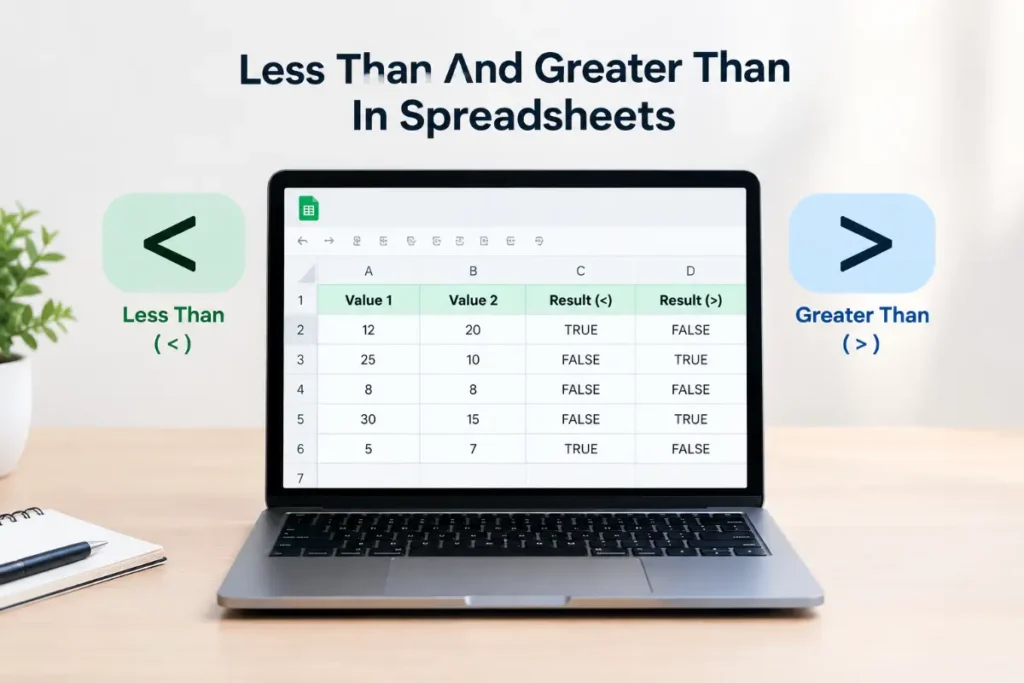
Less Than And Greater Than In Spreadsheets
Spreadsheet software commonly uses comparison operators in formulas and logical tests.
For example a condition can test if a value is greater than 100.
A1 > 100
Or it can test if a value is less than 50.
A1 < 50
The comparison becomes useful for sorting data filtering records and creating conditional logic.
Common Mistakes With These Symbols
The biggest mistake is reversing the symbol.
Someone may write:
9 < 3
when they mean that nine is greater than three.
The correct statement is:
9 > 3
Another common mistake is forgetting the equal part of ≤ or ≥.
For example:
x < 10
doesn’t include 10.
x ≤ 10
does include 10.
These symbols may look almost identical but the extra line has a real mathematical meaning.
Less Than And Greater Than In Writing
Mathematical symbols are useful when you’re writing equations tables formulas or technical material.
In ordinary prose you may want to spell out the relationship.
For example:
The temperature was less than 40 degrees.
This is natural in general writing.
A technical document might instead use:
Temperature < 40°F
Both communicate the same basic idea.
The best choice depends on the audience and purpose.
Is More Than The Same As Greater Than
Usually yes.
In everyday English more than often expresses the same numerical relationship as greater than.
For example:
More than 20 people attended.
This means the number of people was greater than 20.
In mathematical notation you could write:
n > 20
The terms aren’t always interchangeable in every context because more than has broader everyday uses. Still they often express the same numerical comparison.
Is Less Than The Same As Fewer Than
Not always.
Less than commonly refers to amounts or measurements.
Fewer than traditionally refers to countable items.
For example:
The bottle contains less than one liter of water.
Fewer than ten students attended.
Modern American English often uses less than more broadly in casual speech. Still fewer than remains a useful choice when you’re clearly talking about countable items.
Less Than And Greater Than In Formal Mathematics
Mathematics treats these symbols precisely.
If:
a < b
then a is strictly less than b.
If:
a > b
then a is strictly greater than b.
The word strictly matters because equality isn’t allowed.
For example:
5 < 5
is false.
And:
5 > 5
is also false.
If you want to allow equality you need:
5 ≤ 5
or:
5 ≥ 5
Both are true.
A Useful Property Called Transitivity
Inequalities also follow logical patterns.
Suppose:
2 < 5
and:
5 < 9
Then:
2 < 9
This is called the transitive property.
The same idea works with greater than.
If:
10 > 7
and:
7 > 3
then:
10 > 3
This property helps you compare values without checking every pair separately.
Less Than And Greater Than With Variables
Variables can represent unknown values.
Consider:
x < 12
This means x can be any value smaller than 12.
For whole numbers possible values include:
11
10
9
and so on.
If the problem says:
x > 12
then x must be greater than 12.
Possible whole number values include:
13
14
15
and so on.
The symbol tells you the direction of the solution.
Number Line Graphs For Inequalities
When you graph inequalities on a number line the endpoint tells you something important.
For:
x < 5
use an open circle at 5 because 5 isn’t included.
Shade toward the numbers smaller than 5.
For:
x ≤ 5
use a filled circle at 5 because 5 is included.
Then shade toward the smaller values.
For:
x > 5
use an open circle at 5 and shade toward larger values.
For:
x ≥ 5
use a filled circle at 5 and shade toward larger values.
This visual method is especially useful when learning algebra.
Expert Editor’s Note
From an English and mathematical writing perspective the most important point is consistency.
Use less than when the first value is smaller.
Use greater than when the first value is larger.
When writing for beginners spell out the phrase at least once before relying heavily on symbols. In technical work symbols are usually clearer and more compact.
Also pay attention to the difference between < and ≤. The first excludes equality while the second includes it.
The same principle applies to > and ≥.
A clean mathematical statement should leave no doubt about the intended relationship.
Frequently Asked Questions
What Does The Less Than Symbol Mean
The symbol < means the value on the left is smaller than the value on the right. For example 4 < 9 means four is less than nine. The pointed end faces the smaller number while the wider opening faces the larger number.
What Does The Greater Than Symbol Mean
The symbol > means the value on the left is larger than the value on the right. For example 9 > 4 means nine is greater than four. The wider opening faces the larger value and the pointed end faces the smaller value.
How Can I Easily Remember Which Symbol Means Less Than
Remember the rule the point faces the smaller number. In 3 < 8 the pointed end faces 3 because 3 is smaller. You can also imagine the symbol as a hungry mouth that opens toward the larger number.
What Is The Difference Between Less Than And Less Than Or Equal To
Less than uses < and excludes equality. Less than or equal to uses ≤ and allows equality. So x < 5 doesn’t include 5 while x ≤ 5 does include 5.
What Is The Difference Between Greater Than And Greater Than Or Equal To
Greater than uses > and excludes equality. Greater than or equal to uses ≥ and allows equality. Therefore x > 10 means x must be above 10 while x ≥ 10 allows x to equal 10.
Why Does The Inequality Sign Change With Negative Numbers
When you multiply or divide both sides of an inequality by a negative number the direction reverses. For example 3 < 5 becomes −3 > −5 after multiplying both sides by −1. The reversal reflects the way negative values change position on the number line.
Is Greater Than The Same As More Than
For numerical comparisons they usually express the same basic idea. Seven is greater than five and seven is more than five communicate the same relationship. In mathematical notation the relationship is written 7 > 5.
Is Less Than The Same As Below
They can communicate the same numerical relationship in many contexts. For example The temperature is less than 50 degrees and The temperature is below 50 degrees have essentially the same meaning. In mathematics < is the precise symbol for less than.
Conclusion
The difference between less than and greater than comes down to one simple rule.
< means less than.
> means greater than.
The pointed end faces the smaller number and the open side faces the larger number.
So 3 < 8 means three is less than eight.
And 8 > 3 means eight is greater than three.
Remember that ≤ includes equality while ≥ also includes equality. When solving inequalities always watch for negative multiplication or division because the symbol must reverse.
If you remember only one rule remember this:
The point faces the smaller value.
Once that visual becomes second nature the symbols stop looking like tricky little arrows and start doing exactly what they were designed to do.
You may also want to read Better Than Or Better Then Which One Is Correct 2026.
Internal Linking Opportunities
- Less Than Or Fewer Than could cover the difference between quantity and countable nouns in everyday English.
- Greater Than Or More Than could explain mathematical comparisons and natural usage in American English.

Senior Grammar Editor
Olivia Reynolds is a grammar editor and language writer who enjoys making complex English rules easy to understand. She specializes in grammar, punctuation, sentence structure, and everyday writing tips, helping readers write with greater confidence and clarity.