
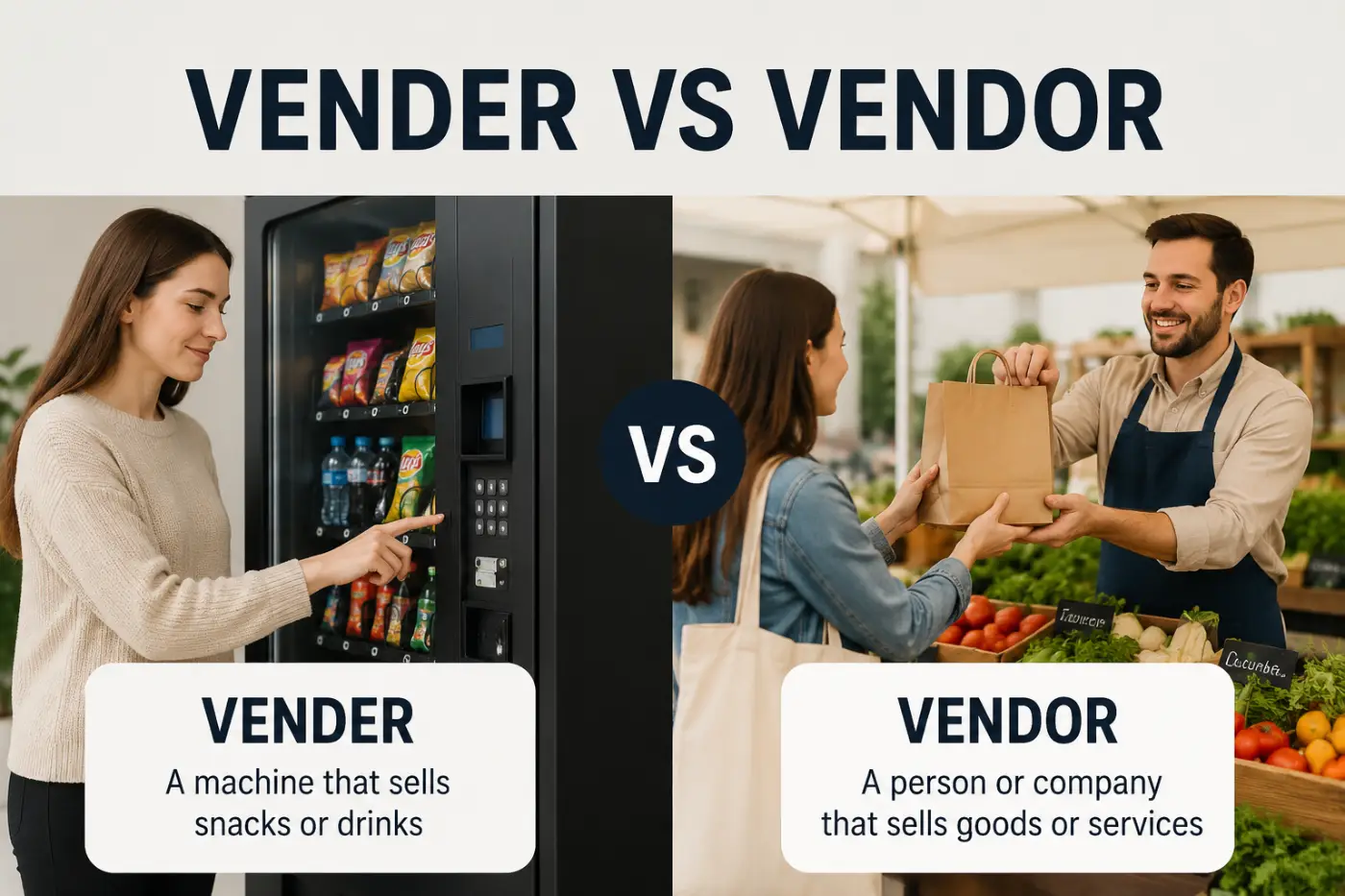
If you’ve searched for vender vs vendor you’re probably trying to figure out which spelling belongs in your writing. The short answer is simple: vendor is the standard and far more common spelling in modern American English. Vender is also a real English word, but it’s an uncommon variant that most writers don’t need.
The confusion comes from the fact that both forms have the same basic meaning. Both can refer to a person or business that sells goods or services. They also sound the same in ordinary American English. That makes the difference almost invisible when you hear the word spoken.
For everyday writing, business communication, websites, contracts, reports, and professional documents, vendor is the safest choice. It is the form readers expect to see.
This guide explains the difference between vender and vendor in plain English. You’ll learn what each word means, how the spellings developed, where each form appears, how American and British usage differ, and which version professional editors generally recommend.
Still confused? Compare Imbed Vs Embed Which Spelling Is Correct 2026.
Quick Answer
Vendor is the preferred spelling in modern English, especially in American English. Vender is a legitimate but uncommon spelling variant with the same basic meaning. Use vendor in business writing, formal documents, websites, academic work, and everyday communication unless you have a specific reason to preserve the less common spelling vender.
Vender Vs Vendor Comparison
| Feature | Vender | Vendor |
|---|---|---|
| Correct spelling | Yes | Yes |
| Common spelling | No | Yes |
| Meaning | A person or business that sells something | A person or business that sells something |
| Part of speech | Noun | Noun |
| Pronunciation | Usually the same as vendor | Usually the same as vender |
| American English | Uncommon | Standard and common |
| British English | Rare | Standard |
| Formal writing | Acceptable but unusual | Preferred |
| Business writing | Rare | Very common |
| Plural | Venders | Vendors |
| Verb form | Not normally used | Not normally used |
| Example | The vender sold fresh fruit. | The vendor sold fresh fruit. |
The important point is that this isn’t a case of one spelling being completely wrong. Vender exists. The practical choice for most modern writers is still vendor.
What Does Vendor Mean
Vendor is a noun for a person, company, or organization that sells goods or services.
You might hear the word in a street market or in a corporate purchasing department. The meaning stays basically the same even though the setting changes.
Simple Definition Of Vendor
A vendor is someone who sells products or services.
For example:
- A food vendor sells food.
- A software vendor sells software.
- A market vendor sells products at a market.
- A clothing vendor sells clothing.
- A business vendor supplies products or services to another company.
The word can describe both an individual seller and a larger company.
Vendor In Everyday English
You might use vendor when talking about someone selling goods at a market.
The vendor sells handmade candles.
The street vendor offered fresh fruit.
We bought lunch from a local vendor.
Vendor In Business English
Business English uses vendor very often.
A vendor might provide office equipment, software, cleaning services, advertising, transportation, construction work, or raw materials.
For example:
The company selected a new software vendor.
Our vendor delivered the equipment on Tuesday.
The purchasing team is reviewing three potential vendors.
The contract requires the vendor to meet specific quality standards.
Here, vendor has a broader meaning than simply someone standing behind a market stall. It can refer to an established company that provides products or services to another organization.
What Does Vender Mean
Vender is an accepted spelling variant of vendor.
It refers to someone who sells goods or services. The basic meaning doesn’t change.
For example:
The fruit vender opened his stall early.
The company contacted a local vender.
Those sentences can be understood clearly. Still, most modern readers would expect vendor instead.
Is Vender A Misspelling
Not exactly.
Calling vender a simple spelling mistake would be too strong. Dictionaries recognize it as a variant form. The problem is frequency and convention.
If you write vender in a modern business document, readers may assume you made a typo because vendor is so much more familiar.
That’s an important distinction for writers.
A word can be technically valid while still being a poor practical choice for most situations.
Which One Is Correct
Vendor is the preferred spelling.
Vender is also a legitimate variant but is much less common.
If you’re writing an email, article, report, contract, business proposal, school assignment, product description, or website, use vendor.
For example:
Preferred: We need to find a reliable vendor.
Less common: We need to find a reliable vender.
The first sentence sounds normal to modern American readers. The second isn’t necessarily grammatically wrong, but it looks unusual.
Why Vendor Is The Better Choice
Language isn’t only about what a dictionary allows. Good writing also considers what readers expect.
Vendor has become the established spelling across modern business and commercial English. Search results, company documents, purchasing systems, software documentation, and professional publications overwhelmingly use vendor.
That makes it the natural default.
Why People Confuse Vender And Vendor
The confusion has a straightforward explanation.
They Sound The Same
In most varieties of English, vender and vendor are pronounced the same or nearly the same.
That means hearing the word doesn’t help you decide which spelling to use.
If someone says:
We need a new vendor.
You can’t reliably determine the spelling from the sound alone.
This is similar to many English word pairs where pronunciation doesn’t reveal spelling.
They Have The Same Meaning
Both words refer to a seller.
That creates another source of confusion. When two spellings have the same pronunciation and meaning, it’s easy to assume they’re equally common.
They aren’t.
The Difference Is Only One Letter
Compare the words:
vender
vendor
The only difference is the vowel in the final syllable.
That tiny visual difference can easily disappear during fast typing or proofreading.
Autocorrect Can Add Confusion
Modern writing tools can also make things confusing. A spelling checker might accept vender because it is a legitimate dictionary word.
That doesn’t mean it’s the best word for your audience.
This is an important editing lesson. Spell checkers usually tell you if something is recognized. They don’t always tell you which valid option sounds most natural in modern usage.
Key Differences Between Vender And Vendor
The biggest difference isn’t meaning. It’s usage frequency and preference.
Meaning
Both words can mean a person or company that sells something.
Vendor:
The vendor sells computer equipment.
Vender:
The vender sells computer equipment.
The meaning is essentially the same.
Spelling
The standard modern spelling is vendor.
The less common variant is vender.
Usage
Vendor appears constantly in modern English.
You’ll find it in:
- Business contracts.
- Purchasing documents.
- Retail descriptions.
- Software documentation.
- Company websites.
- News reports.
- Government documents.
- Academic writing.
- Everyday conversation.
Vender appears much less often.
Formality
Neither word is inherently informal. The difference is mainly conventional.
Vendor fits both casual and formal contexts.
Vender can be grammatically acceptable but may look unusual in polished professional writing.
Regional Usage
Vendor is widely used in American English and British English.
Vender exists as a variant but is uncommon in contemporary usage.
So this isn’t mainly a British versus American spelling issue. Both regions generally favor vendor.
Vendor As A Person
A vendor can be an individual seller.
For example:
The vendor sold handmade jewelry at the market.
The vendor offered us a discount.
A local vendor supplies fresh vegetables to the restaurant.
In these examples, vendor refers to a person engaged in selling.
Vendor As A Business
A vendor can also be a company.
This use is especially common in business English.
For example:
Our company works with several technology vendors.
The vendor provides technical support.
We are negotiating a new agreement with the vendor.
The word doesn’t require the seller to be an individual. Context determines the exact meaning.
Vendor In Technology
Technology has made vendor an especially common business term.
A technology vendor might sell software, hardware, cloud services, cybersecurity tools, networking equipment, or technical support.
Examples include:
The company changed its cloud vendor.
The IT team contacted the software vendor.
The vendor released a security update.
The procurement department compared several technology vendors.
This is one reason vendor has become so familiar to modern readers. The word appears constantly in professional and technical writing.
Vendor In Retail
Retail is another common setting.
A vendor may sell products directly to consumers or supply products to a retailer.
For example:
The market has dozens of independent vendors.
The store works with local food vendors.
The event organizer invited several clothing vendors.
In this context, vendor often has a broad commercial meaning.
Vendor In Events And Markets
The word also appears frequently when talking about events.
A festival might have food vendors, craft vendors, merchandise vendors, and beverage vendors.
Examples include:
The festival has more than twenty food vendors.
Each vendor must follow the event’s safety rules.
The organizers are accepting applications from local vendors.
This use is completely natural in American English.
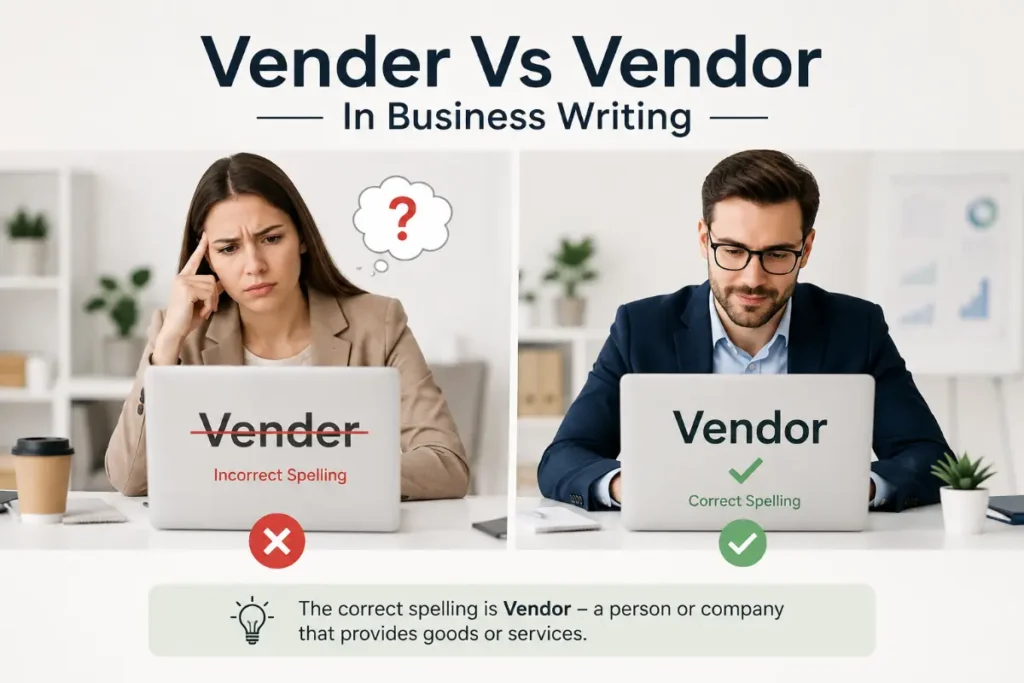
Vender Vs Vendor In Business Writing
For business writing, vendor is the clear choice.
Imagine you’re preparing a contract.
You wouldn’t normally write:
The vender must provide the equipment by Friday.
A more natural professional version is:
The vendor must provide the equipment by Friday.
The same applies to emails.
Please contact the vendor for updated pricing.
The vendor has confirmed the delivery date.
We’re reviewing our current vendor agreements.
These sentences sound familiar because vendor is the established business term.
Vendor In Procurement
Procurement teams commonly use terms such as:
- Vendor management.
- Vendor agreement.
- Vendor selection.
- Vendor relationship.
- Vendor evaluation.
- Vendor contract.
- Vendor onboarding.
- Vendor payment.
- Vendor performance.
- Vendor risk.
These established phrases strongly favor vendor.
Vender Vs Vendor In Academic Writing
Academic writers should normally use vendor.
If you’re discussing markets, retail, economics, business, technology, or supply chains, vendor will look natural to readers.
For example:
The study examined how vendors respond to changes in consumer demand.
The researchers interviewed local vendors.
The company relied on multiple vendors for essential materials.
Using vender isn’t likely to change the meaning, but it may distract readers because the spelling looks unfamiliar.
Good academic writing removes distractions whenever possible. Vendor does that better.
Vender Vs Vendor In Emails
Use vendor in professional emails.
For example:
Please ask the vendor to send the updated invoice.
I’ve contacted the vendor about the delayed shipment.
The vendor confirmed that the order will arrive tomorrow.
We’re looking for a new vendor for office supplies.
There’s little reason to choose vender in these situations.
Vender Vs Vendor In Everyday Conversation
People generally say vendor.
For example:
I bought it from a street vendor.
The food vendor was really friendly.
There’s a new vendor at the farmers market.
Because the words usually sound the same, the difference matters more when you’re writing than when you’re speaking.
Real Life Examples Of Vendor
Here are natural examples across different contexts.
Daily Conversation
- We bought snacks from a local vendor.
- The vendor gave us a better price.
- I know a vendor who sells handmade furniture.
- That food vendor has the best sandwiches in the market.
Workplace
- Our vendor delivered the supplies this morning.
- The finance team needs the vendor’s invoice.
- We’re reviewing our vendor contracts.
- The vendor provides customer support around the clock.
Business Communication
- Please contact the vendor before placing another order.
- The purchasing team approved the new vendor.
- We need to compare vendor pricing before making a decision.
- The vendor agreed to extend the payment period.
Technology
- Our software vendor released a new version.
- The IT department is evaluating several cloud vendors.
- We need to contact the hardware vendor for assistance.
Retail
- The store works with several local vendors.
- Each vendor must follow the market’s rules.
- The vendor supplied products to retailers across the state.
Academic Writing
- The researchers interviewed independent vendors in the region.
- Small vendors often depend on local customer demand.
These examples show why vendor is the practical spelling to remember. It works comfortably across almost every modern context where the word appears.
Spelling Rules For Vender And Vendor
The spelling difference between vender and vendor isn’t caused by a complicated English rule. Both spellings developed as accepted forms of the same word. The modern preference simply settled around vendor.
The safest spelling rule for modern writers is easy.
Use vendor unless you have a specific reason to use the variant vender.
Why Vendor Looks More Familiar
The spelling vendor has become firmly established in commercial English.
You see it in phrases such as:
- Vendor agreement.
- Vendor management.
- Vendor payment.
- Vendor selection.
- Vendor relationship.
- Vendor contract.
- Vendor software.
- Vendor services.
Because these combinations appear so often, vendor feels natural to most readers.
Why Vender Still Exists
English has many words with spelling variants. Some survive even after one form becomes much more common.
Vender is one of those variants.
It isn’t a creative spelling or an internet invention. It has a history in English and dictionaries recognize it. However, its modern use is limited compared with vendor.
That distinction matters when you’re editing professional content.
A dictionary can tell you that a word is valid. Usage tells you how natural that word will feel to most readers.
The Grammar Of Vendor
Vendor is a countable noun.
You can talk about one vendor or several vendors.
Singular Form
The singular form is vendor.
Examples:
The vendor called this morning.
We hired a new vendor.
A vendor offered us a better price.
Plural Form
The plural form is vendors.
Examples:
The market has several vendors.
We work with five vendors.
The vendors submitted their proposals.
The plural simply adds s.
Possessive Form
For one vendor use vendor’s.
Example:
The vendor’s contract expires next month.
For multiple vendors use vendors’.
Example:
The vendors’ contracts expire next month.
This small punctuation difference is worth watching in formal writing.
Is Vendor A Verb
In standard modern English vendor functions primarily as a noun.
You wouldn’t normally use vendor as a verb in ordinary professional writing.
Instead of saying:
The company vendors its products.
Use a more precise verb such as:
The company sells its products.
The company supplies its products.
The company distributes its products.
The company provides its products to retailers.
This is a useful editing point because English often allows nouns to become verbs in informal speech. That doesn’t mean every noun makes a natural verb.
Is Vender A Verb
The same caution applies to vender.
Although historical English contains related verb usage, modern writers generally use vender as a noun when it appears at all.
For contemporary writing, choose clear verbs such as sell, supply, provide, or distribute.
Precision usually beats clever wording.
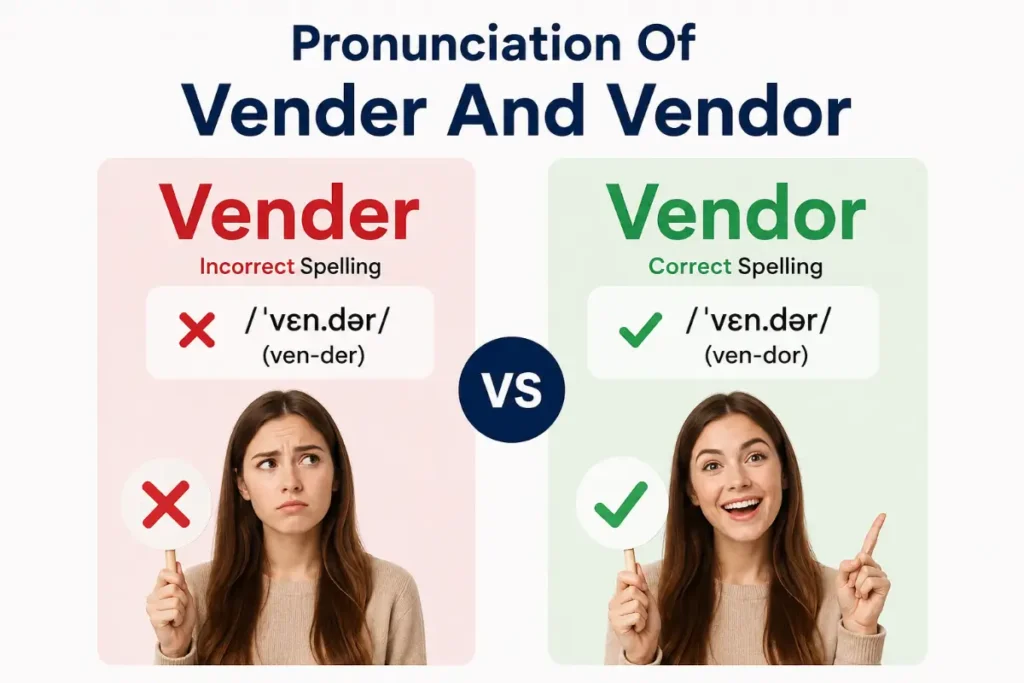
Pronunciation Of Vender And Vendor
Pronunciation rarely helps you distinguish these words because they are pronounced alike or nearly alike in standard English.
Vendor Pronunciation
American English commonly pronounces vendor as:
VEN der
IPA:
/ˈvɛndər/
The first syllable receives the main stress.
Vender Pronunciation
Vender is commonly pronounced:
VEN der
IPA:
/ˈvɛndər/
So the two spellings don’t give you a useful pronunciation contrast.
This makes the pair similar to many English words where the listener needs context to understand the intended word.
When someone says:
I spoke with the vendor.
You understand the meaning from the sentence. The sound itself doesn’t reveal much about the spelling.
Word Origin Of Vendor
The history of vendor goes back to Latin.
The English word ultimately comes from Latin vendere meaning to sell. It passed through French before becoming established in English.
The same root is connected with words related to selling and commerce.
The historical connection explains why the word has long been associated with people who sell goods.
How The Word Developed
The path is broadly connected to:
Latin vendere
French forms related to selling
English vendor
Over time vendor became a familiar English noun for a seller.
The spelling vender developed as a variant influenced by the pronunciation and English spelling patterns.
Modern English eventually favored vendor strongly in commercial contexts.
Vender Vs Vendor In American English
American English strongly prefers vendor.
This is especially clear in business and technology.
An American company is likely to talk about:
- Vendor management.
- Vendor contracts.
- Vendor pricing.
- Vendor relations.
- Vendor support.
- Vendor payments.
- Vendor software.
- Vendor requirements.
You may still encounter vender, but most American readers will recognize vendor immediately.
For content written specifically for a United States audience, vendor should be your default.
Vender Vs Vendor In British English
British English also uses vendor.
You can find the word in British business writing, retail discussions, property contexts, and legal language.
Vender exists as a less common spelling but doesn’t represent a standard British alternative in the way that some famous American and British spelling differences do.
For example, color and colour have a clear regional distinction.
Vender and vendor don’t work that way.
The main difference is usage frequency rather than national spelling policy.
A related grammar guide is Nosey or Nosy Which Spelling Is Correct 2026.
Canadian And Australian English
Canadian English generally favors vendor.
Australian English also commonly uses vendor.
So if you’re writing for an international English speaking audience, vendor is the safest option.
It has broad recognition and doesn’t create the visual distraction that vender sometimes causes.
When Should You Use Vender
There are only a few practical reasons to choose vender.
You might preserve it when:
- You’re quoting an original historical document.
- You’re reproducing the spelling used by a specific source.
- You’re discussing spelling variants.
- A proper name officially uses the spelling.
- You’re studying historical English usage.
Outside situations like these, vendor is normally the better choice.
When Should You Use Vendor
Use vendor in almost every modern context involving a seller.
It works in:
- Business writing.
- Academic writing.
- Journalism.
- Websites.
- Product descriptions.
- Contracts.
- Emails.
- Reports.
- Marketing content.
- Government documents.
- Technology writing.
- Everyday conversation.
If you’re unsure, choose vendor.
That’s the practical rule an editor would give a writer.
Common Mistakes With Vender And Vendor
Mistaking A Variant For A Typo
A writer may see vender and immediately mark it as completely incorrect.
That’s not quite accurate.
It’s better to describe it as an uncommon variant.
However, correcting it to vendor in modern professional writing is usually sensible.
Assuming Both Forms Are Equally Common
They’re not.
Both forms can refer to a seller, but vendor is much more familiar to modern readers.
A dictionary listing doesn’t mean two forms have equal status in everyday usage.
Using Vender In A Business Phrase
You might write:
Vender management.
That phrase looks unusual.
The established form is:
Vendor management.
The same applies to vendor agreement, vendor selection, vendor payment, and vendor relationship.
Thinking The Difference Is Regional
Some spelling differences exist because American and British English developed different conventions.
This isn’t one of the major examples.
American English uses vendor.
British English uses vendor.
Canadian English uses vendor.
Australian English uses vendor.
Real World Examples Using Vendor
The following examples show how naturally vendor works across different settings.
Customer Service
The vendor replaced the damaged item.
Retail
The vendor sells handmade furniture at the weekend market.
Technology
Our software vendor released a major update.
Finance
The accounting department is waiting for the vendor invoice.
Construction
The contractor contacted the equipment vendor.
Healthcare
The hospital selected a new medical equipment vendor.
Education
The school signed an agreement with a technology vendor.
Events
Several food vendors will attend the festival.
Manufacturing
The manufacturer depends on several suppliers and vendors.
Journalism
Local vendors said rising costs were affecting their businesses.
Academic Writing
The study examined the challenges faced by independent vendors.
Legal Writing
The agreement defines the responsibilities of the vendor.
Email Writing
Please send the updated information to the vendor.
Informal Conversation
I know a vendor who sells great coffee.
Vendor And Supplier Are Not Always The Same
Another useful distinction involves vendor and supplier.
People sometimes treat them as exact synonyms. In everyday speech that can work, but business language can give them slightly different roles.
A supplier generally provides goods or materials to another business.
A vendor generally sells goods or services to a customer or organization.
The same company can sometimes be both.
For example, a company that provides computer equipment to another company can be called a supplier or a vendor depending on the business context.
The exact boundary isn’t fixed across every industry.
Vendor And Seller Are Not Always The Same
Seller is a broader everyday word.
A seller is simply someone who sells something.
Vendor often carries a more commercial or business focused meaning.
Compare these sentences:
The seller listed the used bicycle online.
The software vendor provides technical support.
Both are natural. The second sentence sounds more professional because vendor is common business vocabulary.
Vendor And Merchant
Merchant is another related word.
A merchant traditionally refers to someone involved in buying and selling goods.
Vendor can have a narrower practical sense of someone or something offering goods or services for sale.
The words overlap, but they aren’t always interchangeable.
A street vendor sounds perfectly natural.
A street merchant is possible but has a different feel.
A software vendor sounds natural.
A software merchant sounds unusual in most modern business contexts.
Vendor And Retailer
A retailer sells goods directly to consumers.
A vendor can sell directly to consumers or provide goods and services to another business.
For example:
The retailer sells shoes to customers.
The vendor supplies the retailer with shoes.
The two words can describe different positions in the same commercial chain.
Vendor And Contractor
A contractor performs work under an agreement.
A vendor typically sells products or services.
There can be overlap.
A company might call a cleaning company a vendor because it purchases cleaning services from that company. Another organization might call the same company a contractor.
Context determines the preferred term.
Memory Tricks For Vender And Vendor
The easiest memory trick is to connect vendor with vend.
The Latin root behind the word is connected with selling. English words such as vend and vendor share this commercial connection.
Think:
Vend means sell. Vendor means seller.
That gives you a useful mental bridge.
Another trick is even simpler.
Vendor is the version you see in business.
If you’re writing about a company that sells software, equipment, services, or supplies, vendor will almost always be the right choice.
A Quick Test For Writers
Before publishing your sentence, replace the word with seller.
If the sentence describes someone or a company that sells something, vendor will usually work.
For example:
The company is our software vendor.
The company is our software seller.
The first sounds more natural in professional English.
Then check the spelling.
If you’ve written vender, ask yourself if there’s a special reason to use the uncommon variant.
If there isn’t one, change it to vendor.
That small edit makes your writing look more familiar and polished.
Common Mistakes With Vender And Vendor
The biggest mistake is treating vender and vendor as two completely different words. They aren’t. Both can refer to someone who sells goods or services.
The real difference is modern usage and spelling preference. Vendor is the normal choice for almost all current English writing. Vender is a valid but uncommon variant.
Mistake One Is Calling Vender Completely Wrong
You may see someone correct vender to vendor and say the first spelling is incorrect.
That’s an oversimplification.
Vender is recognized as a spelling variant. The problem is that it isn’t the spelling most readers expect.
Think of it like an old road that still exists but isn’t the route most people take. You can travel it but the main road is vendor.
Mistake Two Is Assuming Both Forms Are Equally Common
They aren’t.
A reader is far more likely to encounter vendor in a business report than vender.
The same applies to phrases such as:
- Vendor management.
- Vendor agreement.
- Vendor selection.
- Vendor relationship.
- Vendor payment.
- Vendor contract.
- Vendor software.
- Vendor services.
Using vender in these phrases may cause readers to pause and wonder if you’ve made a spelling error.
Mistake Three Is Choosing Vender In Professional Writing
Imagine you’re writing a proposal for a client.
You write:
We are evaluating several potential venders.
The meaning is clear. Still, vendors looks much more polished.
Professional writing benefits from familiar language. You don’t want an unusual spelling to steal attention from your message.
Mistake Four Is Thinking Vendor And Vender Have Different Meanings
They generally don’t.
Both refer to a seller.
The difference isn’t like accept and except. Those words have completely different meanings.
Instead, vender and vendor are variant spellings with the same basic meaning.
Mistake Five Is Treating Vendor As A Verb
In ordinary modern English, vendor works as a noun.
You should write:
The company sells software.
The company supplies software.
The company provides software.
Avoid forcing vendor into a verb position simply because English sometimes turns nouns into verbs.
Vender Vs Vendor In Modern Digital Writing
The internet has made vendor especially dominant.
Technology websites, online stores, business platforms, procurement systems, software companies, and corporate documents use vendor constantly.
You’ll commonly see phrases such as:
software vendor
cloud vendor
security vendor
technology vendor
payment vendor
service vendor
approved vendor
preferred vendor
These established combinations make vendor the obvious choice for digital content.
If you’re writing an article for a US audience, use vendor.
Vender Vs Vendor In Search And SEO
Search behavior also matters for modern writers.
Someone searching for a business that supplies products or services will usually expect the spelling vendor.
This means your website copy should normally use phrases such as:
Find a reliable vendor.
Compare software vendors.
Choose the right vendor.
Vendor management services.
The goal isn’t to repeat the word unnecessarily. Use the natural term your audience already recognizes.
Good SEO follows good language. Don’t replace a familiar word with an obscure variant just to create another spelling variation.
Vender Vs Vendor In Formal Writing
Formal writing calls for vendor.
Use it in:
- Business reports.
- Legal documents.
- Academic papers.
- Government forms.
- Procurement documents.
- Professional emails.
- Company policies.
- Contracts.
- Technical documentation.
- News articles.
For example:
The organization entered into an agreement with an approved vendor.
The procurement team evaluated the vendor’s performance.
The researchers interviewed several independent vendors.
These sentences sound natural and professional.
Vender Vs Vendor In Informal Writing
You can still use vendor in casual writing.
In fact, there’s usually no reason to switch to vender just because the setting is informal.
For example:
That vendor has great coffee.
I bought this from a local vendor.
We found a new vendor at the market.
Vendor works comfortably in both formal and informal English.
What Professional Editors Recommend
A professional editor usually has two questions.
Is the spelling valid?
Does it fit the intended audience and style?
For vender, the answer to the first question is yes.
For the second question, the answer is usually no if vendor is available.
Editors generally favor the established modern spelling because it is familiar, clear, and widely accepted.
This is especially important in commercial writing. Readers don’t gain anything from seeing an uncommon spelling when the standard form communicates the same idea.
What Dictionaries Tell Us
Major English dictionaries recognize vendor as the standard word for a seller.
They also record vender as a variant spelling in some dictionaries.
This gives us a useful lesson about dictionaries.
A dictionary entry doesn’t automatically mean every spelling has the same frequency or editorial preference.
English contains many variants. Some are common. Others are rare. Some appear mainly in historical sources or particular regions.
For modern general purpose writing, vendor is the strong default.
What Style Guides Prefer
Most professional style decisions favor clarity and consistency.
If your audience expects vendor, changing to vender doesn’t improve the sentence.
Consider:
The company selected a new vendor.
The company selected a new vender.
The first version feels immediately familiar to most American readers.
The second may make readers wonder if it’s a typo.
That is enough reason for an editor to choose vendor.
Which Word Sounds More Natural To Native Speakers
In modern American English, vendor sounds more natural in written and spoken contexts.
You might hear:
The vendor called me yesterday.
That sounds completely ordinary.
You could technically write:
The vender called me yesterday.
Most readers will still understand it. Some may notice the unusual spelling because they are accustomed to seeing vendor.
So the issue isn’t comprehension. It’s naturalness.
Related Words You Should Know
Understanding related vocabulary can prevent other word choice problems.
Vendor
A person or business that sells goods or services.
Seller
A broad everyday term for someone who sells something.
Supplier
A person or company that provides goods or materials to another business or customer.
Merchant
A person or business involved in buying and selling goods.
Retailer
A business that sells products directly to consumers.
Distributor
A business that moves products from manufacturers to retailers or other buyers.
Wholesaler
A business that sells goods in larger quantities to retailers or other businesses.
These words overlap but don’t always mean exactly the same thing.
Synonyms For Vendor
Depending on the context, you can use:
- Seller.
- Supplier.
- Merchant.
- Trader.
- Provider.
- Retailer.
- Distributor.
- Dealer.
Context matters. A software company may be called a vendor or provider. A person selling fruit at a market is more naturally called a vendor or seller.
Common Phrases With Vendor
Learning common phrases can make the correct spelling easier to remember.
- Vendor management.
- Vendor agreement.
- Vendor contract.
- Vendor selection.
- Vendor relationship.
- Vendor payment.
- Vendor invoice.
- Vendor account.
- Vendor portal.
- Vendor support.
- Vendor pricing.
- Vendor evaluation.
- Vendor requirements.
- Vendor services.
- Vendor performance.
Notice how naturally vendor fits all of these expressions.
Frequently Confused Words Related To Vendor
English learners often encounter other words connected with buying and selling.
Buyer is the person purchasing something.
Seller is the person selling something.
Supplier provides goods or materials.
Customer purchases goods or services.
Client receives professional services.
Consumer uses or buys a product or service.
Knowing these distinctions can help you choose a more precise word instead of using vendor for every commercial situation.
FAQs About Vender And Vendor
Is Vendor Or Vender The Correct Spelling
Vendor is the preferred spelling in modern English. Vender is also an accepted variant but is much less common. For American English especially, vendor is the natural choice in business writing, everyday writing, websites, academic work, and professional communication.
Is Vender A Misspelling Of Vendor
Not exactly. Vender is a legitimate spelling variant rather than a simple spelling error. However, it is uncommon in modern English. If you use it in ordinary professional writing, readers may assume you’ve made a typo. Vendor is the safer and more familiar form.
Do Vendor And Vender Mean The Same Thing
Yes. Both words can refer to a person or business that sells goods or services. The main difference is usage frequency. Vendor is far more common today, so it is normally the better choice for modern writing.
Is Vendor American Or British English
Vendor is used in both American and British English. It is also common in Canadian and Australian English. Vender isn’t a major regional alternative in the way some famous American and British spelling differences are. The main issue is that vender is much less common.
How Do You Spell The Plural Of Vendor
The plural of vendor is vendors.
For example:
The company works with several vendors.
The market has dozens of vendors.
If you use the uncommon variant vender, its plural is venders.
What Is The Difference Between A Vendor And A Supplier
A vendor is someone or a business that sells goods or services. A supplier usually provides goods or materials to another business. The terms can overlap, and companies may use them differently depending on their industry and internal terminology.
Should I Use Vendor In A Business Email
Yes. Vendor is the preferred spelling for business emails. It is familiar, professional, and widely used in phrases such as vendor agreement, vendor invoice, vendor pricing, and vendor management. Using the less common vender doesn’t add any useful meaning.
Why Does Vender Exist If Vendor Is More Common
English has always developed spelling variants. Vender survived as an alternative form connected to the same word family as vendor. Over time, vendor became much more established in modern commercial English. The variant remains recognizable but has a much smaller role in current writing.
Need another quick comparison? Read Focussing Or Focusing Which Spelling Is Correct 2026 Guide.
Conclusion
The answer to vender vs vendor is straightforward.
Vendor is the spelling you should normally use. It means a person or business that sells goods or services and works naturally in everyday English, business communication, academic writing, journalism, technology, and formal documents.
Vender isn’t simply a misspelling. It is a legitimate but uncommon variant. You may encounter it in dictionaries or older material, but it isn’t the spelling most modern readers expect.
If you’re writing for an American audience, vendor is the clear practical choice.
Remember one simple rule: when you mean a seller in modern English, vendor is the spelling to reach for.
Good writing doesn’t just use words that are technically correct. It uses the words readers recognize without hesitation.

Editorial Reviewer & Proofreader
Grace Mitchell reviews Gramlify’s articles for clarity, consistency, and readability. She is passionate about creating accurate, approachable content that helps English learners build confidence.