
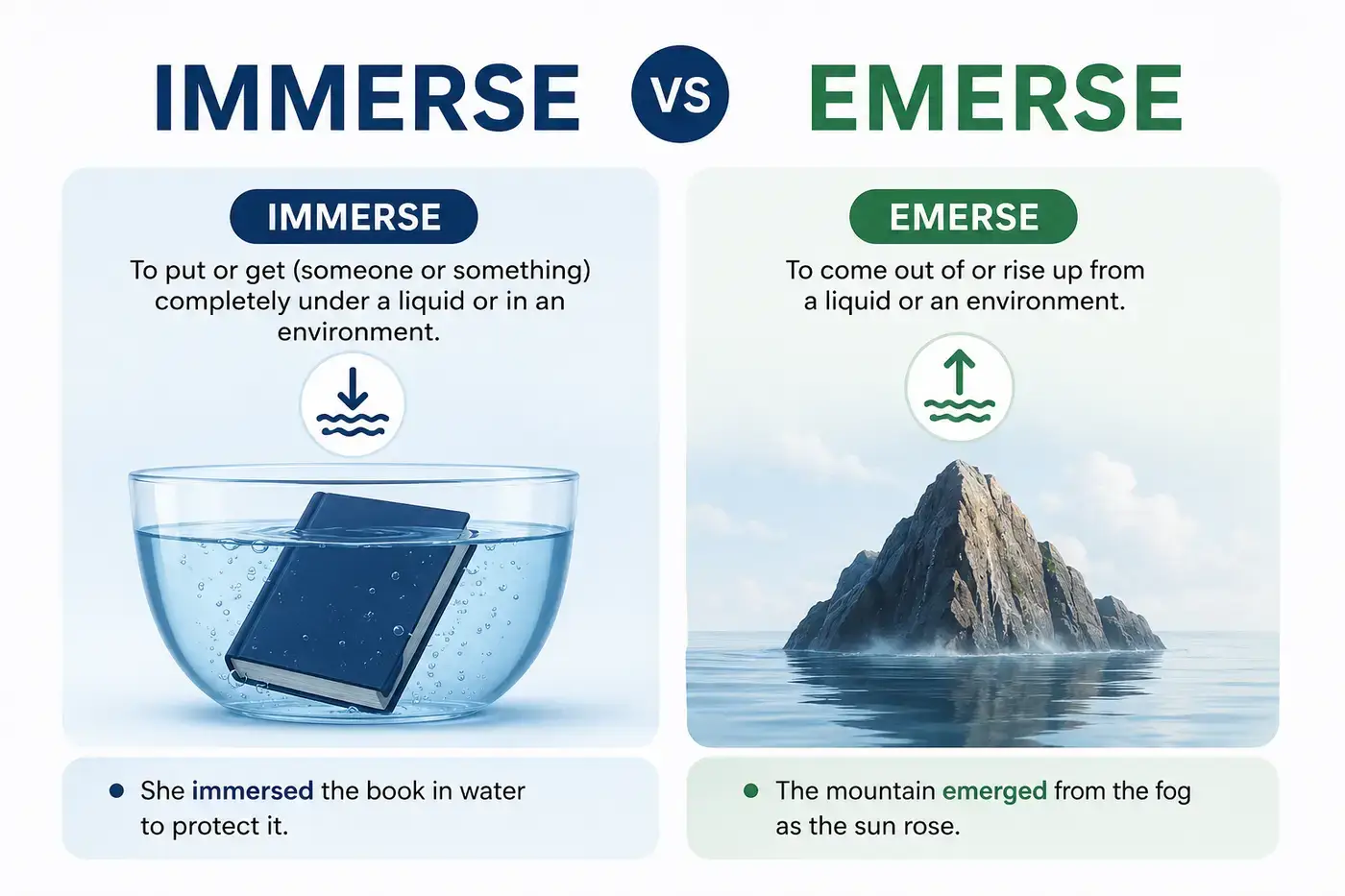
If you’ve searched for immerse vs emerse, you’re probably trying to figure out which spelling is correct. The short answer is simple. Immerse is the correct English word in almost every situation. Emerse is not a standard English verb and is usually a misspelling or a case of confusing it with another word.
The confusion is easy to understand. Both words look similar, share many of the same letters, and have related Latin roots connected to water or movement. Add fast typing, autocorrect, and pronunciation, and it’s easy to see why people mix them up.
Still, they do not mean the same thing. One is a common English verb used in everyday speech, education, business, and literature. The other appears mainly in scientific writing as an adjective and almost never as a verb.
In this guide, you’ll learn the meaning of each word, why people confuse them, when each one is correct, how professional editors use them, and plenty of real examples to help you remember the difference with confidence.
Many readers also check Theater Or Theatre Which Spelling Is Correct 2026.
Quick Answer
Immerse is the correct verb that means to put something completely into a liquid or become deeply involved in an activity or experience. Emerse is not a standard English verb. It exists only as a specialized adjective in biology and should not replace immerse in normal writing.
Immerse Vs Emerse Comparison Table
| Feature | Immerse | Emerse |
|---|---|---|
| Standard English verb | Yes | No |
| Part of speech | Verb | Adjective in biology |
| Meaning | Put into liquid or become deeply involved | Growing or rising above water |
| Common usage | Everyday English | Scientific writing |
| Formal writing | Very common | Rare outside biology |
| Informal writing | Common | Almost never used |
| Dictionary status | Standard English | Specialized scientific term |
| Example | Immerse the cloth in water. | An emerse aquatic plant grows above the water. |
What Does Immerse Mean
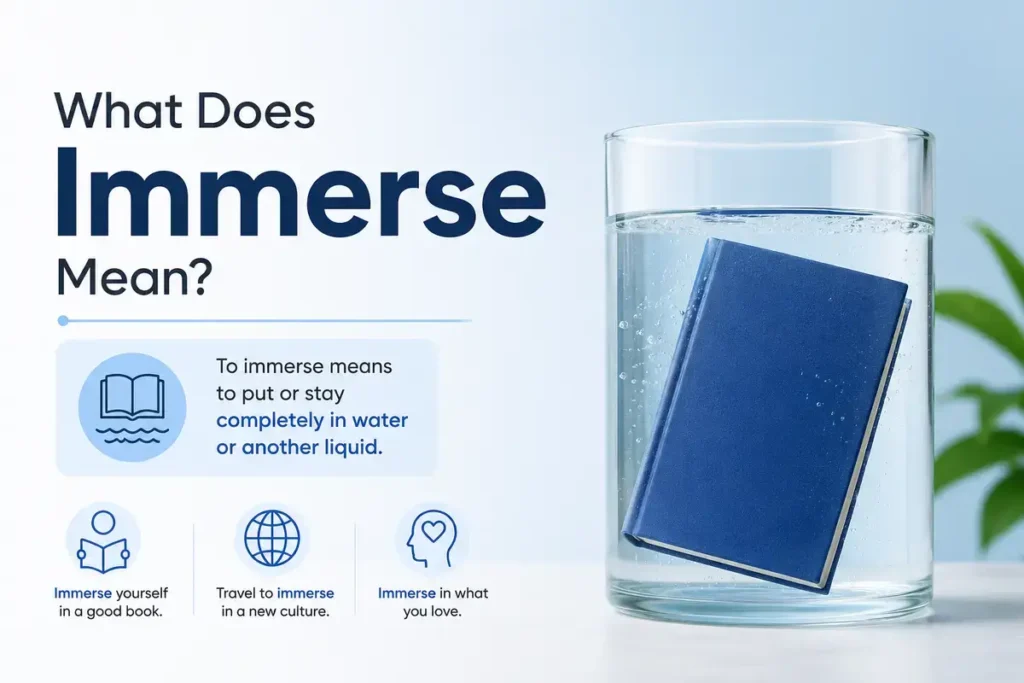
Immerse is a verb with two main meanings.
The first meaning is physical. It means to place something completely under a liquid.
Examples include placing vegetables in boiling water, dipping a paintbrush into paint, or lowering an object into water.
The second meaning is figurative. It means becoming completely involved in an activity, subject, culture, or experience.
Simple Definition
Immerse means to place something fully into a liquid or to become completely absorbed in something.
Everyday Examples
- Immerse the tea bag in hot water for three minutes.
- She likes to immerse herself in mystery novels.
- Students should immerse themselves in English every day.
- We decided to immerse ourselves in the local culture during our vacation.
- The photographer immersed the paper in the developing solution.
Immerse In Different Contexts
Daily conversation.
I want to immerse myself in learning Spanish.
Workplace.
New employees should immerse themselves in the company handbook.
Education.
Teachers encourage students to immerse themselves in reading.
Travel.
The best way to understand another country is to immerse yourself in its culture.
Creative writing.
Good stories immerse readers from the very first page.
What Does Emerse Mean
Unlike immerse, emerse is not a common English word.
It is a technical adjective used mainly in botany, biology, and ecology.
It describes a plant or part of a plant that grows above the surface of water while remaining rooted below it.
Simple Definition
Emerse describes aquatic plants or plant parts that rise above the water.
Scientific Examples
- The pond contains several emerse aquatic plants.
- The emerse leaves receive direct sunlight.
- Some species produce both submerged and emerse foliage.
Unless you are reading scientific research or writing about aquatic plants, you are unlikely to see this word.
For everyday English, immerse is almost always the word you need.
Which One Is Correct
For nearly every English learner and writer, immerse is the correct choice.
Use immerse when you mean putting something into liquid or becoming deeply involved in an activity.
Use emerse only when discussing aquatic plants or biological subjects where the scientific meaning applies.
Compare these examples.
✔ Immerse the fabric in cold water.
✔ She wanted to immerse herself in the new language.
✔ The lake contains several emerse plants.
✘ Emerse the fabric in cold water.
✘ I want to emerse myself in history books.
The last two examples are incorrect because emerse is not used as a verb in standard English.
Why People Confuse Immerse And Emerse
The confusion comes from several sources.
Similar Spelling
The words differ by only one letter.
When people type quickly, replacing im with em is an easy mistake.
Similar Pronunciation
Many English learners pronounce both words similarly.
Because the difference is subtle, people often assume both spellings are acceptable.
Latin Roots
Both words trace back to Latin words related to movement and water.
That shared history makes them look connected even though modern English uses them differently.
Autocorrect And Spell Check
Some spell checkers recognize emerse because it appears in scientific dictionaries.
Seeing it accepted can make writers think it works everywhere.
Scientific Vocabulary
People reading gardening, aquarium, or botany articles may encounter emerse and mistakenly believe it is another spelling of immerse.
It is not.
Key Differences Between Immerse And Emerse
| Feature | Immerse | Emerse |
|---|---|---|
| Function | Verb | Adjective |
| Main meaning | Put into liquid or become deeply involved | Growing above water |
| Everyday English | Yes | Rare |
| Academic English | Common | Mostly biology |
| Can describe actions | Yes | No |
| Can replace the other | No | No |
The easiest way to remember the difference is simple.
If someone is doing something, you almost always need immerse.
If you are describing a special type of aquatic plant, emerse may be correct.
Grammar Behind Immerse And Emerse
Understanding the grammar makes it much easier to choose the correct word.
Immerse Is A Verb
A verb describes an action.
Immerse tells us what someone or something does.
Examples.
- Immerse the vegetables in ice water.
- She immersed herself in research before writing the report.
- The students immersed themselves in the language during the exchange program.
Notice that immerse can change its form like other regular verbs.
Present.
I immerse myself in books every weekend.
Past.
She immersed the photograph in the chemical solution.
Present participle.
They are immersing themselves in local traditions.
Past participle.
He has immersed himself in classical music.
Emerse Is An Adjective
An adjective describes a noun.
Emerse describes a particular type of aquatic plant or plant part.
Examples.
- The pond contains emerse vegetation.
- The emerse stems grow above the waterline.
Unlike immerse, emerse does not describe an action.
Spelling Rules
The spelling difference is small, but the meanings are very different.
Why Immerse Starts With Im
The prefix im comes from Latin and often suggests movement into or within something.
Think about these words.
- Import.
- Implant.
- Immerse.
In immerse, the idea is moving into a liquid or becoming deeply involved in something.
Why Emerse Starts With Em
The scientific word emerse comes from the Latin verb meaning to rise out of water.
It shares its history with words like emerge and emergent.
That connection explains why emerse describes something growing above the water instead of going into it.
Easy Spelling Tip
Remember this simple idea.
Immerse begins with Im for In.
Emerse begins with Em for Emerge.
One goes into the water.
The other comes out of it.
Pronunciation Guide
Although the spellings are different, the pronunciation is also slightly different.
Immerse
IPA
American English
/ɪˈmɝːs/
Syllables
Im merse.
Stress
The second syllable receives the strongest stress.
Emerse
IPA
American English
/ɪˈmɝːs/ or /ɛˈmɝːs/
Because emerse is a specialized scientific term, pronunciation varies slightly among speakers and researchers.
Common Pronunciation Mistakes
Some learners pronounce immerse like emerge.
Others assume emerse is simply another pronunciation of immerse.
Neither assumption is correct.
The words have different meanings even when they sound similar.
Learn the difference in Dutchess vs Duchess Which Spelling Is Correct 2026 Guide.
Word Origin
Knowing where these words came from makes the difference easier to remember.
Origin Of Immerse
Immerse comes from the Latin word immergere.
It combines two parts.
In meaning into.
Mergere meaning to dip or plunge.
The original meaning was to place something completely under water.
Later, English speakers expanded the meaning to include becoming deeply involved in an activity, subject, or experience.
Origin Of Emerse
Emerse comes from the Latin word emergere.
Its original meaning was to rise out of water.
Scientists later adopted emerse to describe aquatic plants whose leaves or stems extend above the water’s surface.
That scientific meaning remains unchanged today.
British American Canadian And Australian English
There is no meaningful spelling difference across major English speaking countries.
American English uses immerse.
British English uses immerse.
Canadian English uses immerse.
Australian English uses immerse.
The same applies to emerse in scientific writing.
No regional variety replaces immerse with emerse in everyday English.
Real Life Examples
Seeing the words in context helps build confidence.
Daily Conversation
- I like to immerse myself in history podcasts.
- She immersed her hands in warm water.
- We immersed ourselves in the festival from the first day.
- The children immersed themselves in the art project.
Workplace
- New employees should immerse themselves in the training materials.
- Our manager encouraged everyone to immerse themselves in customer feedback.
- The consultant immersed himself in company data before making recommendations.
Emails
- Please immerse the samples in the cleaning solution before testing.
- I plan to immerse myself in the new software this week.
Academic Writing
- Researchers immersed the specimens in a preservative solution.
- Students are encouraged to immerse themselves in primary historical sources.
Literature
- The novel quickly immerses readers in a world of mystery.
- The author immersed every character in emotional conflict.
Journalism
- Visitors can immerse themselves in local traditions during the festival.
- The documentary immerses viewers in life beneath the ocean.
Social Media
- I can’t wait to immerse myself in this new book.
- The museum lets you immerse yourself in ancient history.
Science
- The marsh contains several emerse plant species.
- Scientists observed emerse leaves during the dry season.
- The aquarium supports both submerged and emerse vegetation.
- Emerse growth becomes more noticeable as water levels fall.
- Botanists carefully documented each emerse stem before collecting samples.
When To Use Immerse
Use immerse when talking about actions involving complete involvement or placing something into a liquid.
Common situations include.
- Learning a language.
- Reading books.
- Watching documentaries.
- Traveling.
- Cooking.
- Photography.
- Laboratory work.
- Art.
When To Use Emerse
Use emerse only in scientific subjects such as.
- Botany.
- Ecology.
- Aquatic biology.
- Environmental science.
- Wetland research.
Outside those fields, most native English speakers rarely encounter the word.
Common Mistakes People Make
Even experienced writers sometimes confuse immerse and emerse because the spellings are so close. In most cases, the mistake happens simply because people have never seen emerse used in its proper scientific sense.
Using Emerse Instead Of Immerse
Incorrect.
I want to emerse myself in the local culture.
Correct.
I want to immerse myself in the local culture.
Why?
The sentence describes becoming deeply involved in an experience. The correct verb is immerse.
Using Emerse As A Verb
Incorrect.
Please emerse the fabric in cold water.
Correct.
Please immerse the fabric in cold water.
Why?
Emerse is not a standard English verb. It cannot replace immerse.
Thinking Emerse Is An Alternative Spelling
Many learners assume emerse is the British spelling of immerse.
It is not.
British English, American English, Canadian English, and Australian English all use immerse as the standard verb.
Confusing Immerse With Emerge
These words also look alike but have different meanings.
Immerse means to go into something completely.
Emerge means to come out or become visible.
Examples.
✔ The diver immersed himself in the water.
✔ The diver emerged from the water.
The actions move in opposite directions.
Easy Memory Tricks
A simple memory trick can save you from making this mistake.
Think About The Prefix
Im reminds you of in.
If something goes into water or into an experience, choose immerse.
Connect Emerse With Emerge
Both words begin with em.
They share the idea of coming out or rising upward.
That makes it easy to remember why scientists use emerse for plants growing above the water.
Ask Yourself One Question
Is something going into something else?
If yes, use immerse.
Is a scientist describing a plant growing above water?
If yes, emerse may be the correct term.
Related Words
Learning related words helps expand your vocabulary and reduces confusion.
Synonyms For Immerse
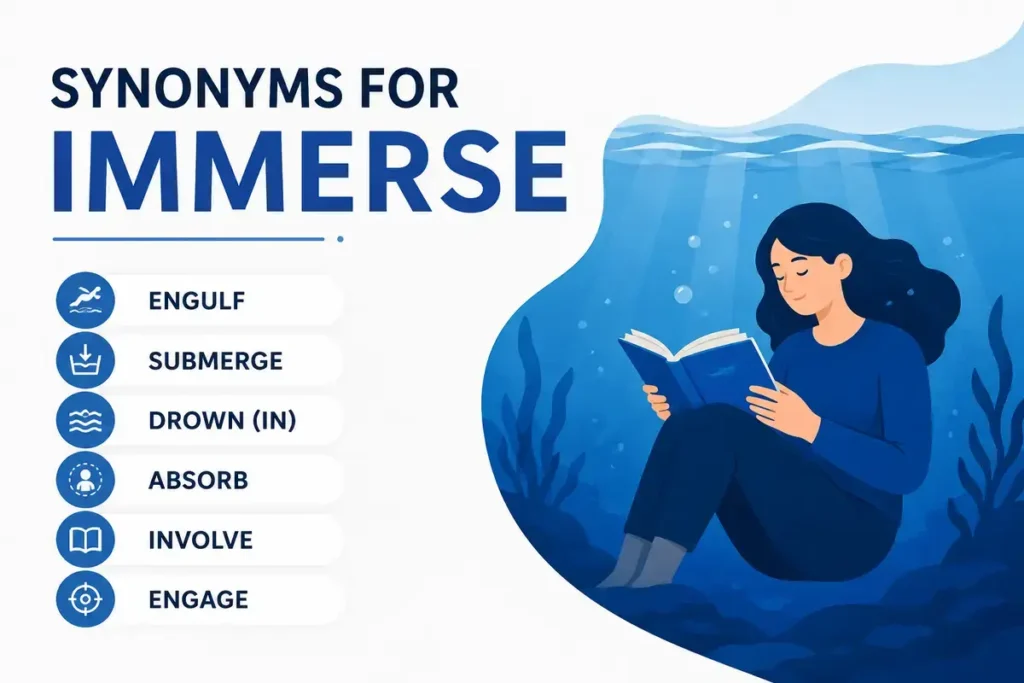
- Submerge.
- Dip.
- Plunge.
- Soak.
- Absorb.
- Engage.
- Involve.
- Surround.
Opposites Of Immerse
- Emerge.
- Withdraw.
- Remove.
- Surface.
- Exit.
Related Scientific Words
- Emerge.
- Emergent.
- Submerged.
- Aquatic.
- Wetland.
- Vegetation.
Frequently Confused Words
- Immerse and emerge.
- Immerse and emerse.
- Submerge and immerse.
- Dip and soak.
- Engage and involve.
Understanding these words makes your writing more precise and natural.
Expert Editor’s Note
Professional editors strongly recommend using immerse unless you are writing about botany, ecology, or aquatic biology.
Major dictionaries list immerse as the standard English verb for placing something into a liquid or becoming deeply involved in an activity.
Although emerse appears in reputable scientific dictionaries, it is a technical adjective with a very narrow meaning. Using it in place of immerse creates a spelling mistake in ordinary English.
When proofreading, editors pay close attention to this pair because spell checkers sometimes accept emerse without recognizing that it does not fit the sentence.
If your audience is the general public, immerse is almost always the correct choice.
Frequently Asked Questions
Is Immerse Or Emerse Correct?
Immerse is the correct word in standard English. It means to place something into a liquid or become deeply involved in an activity. Emerse is a specialized scientific adjective used mainly in botany and aquatic biology.
Is Emerse A Real Word?
Yes. Emerse is a real English word, but its use is limited to scientific fields. It describes plants or plant parts that grow above the surface of water. It is not used as a replacement for immerse.
Can I Use Emerse Instead Of Immerse?
No. The two words have different meanings and different grammar roles. In everyday writing, using emerse instead of immerse is considered incorrect.
What Does Immerse Mean In Everyday English?
Immerse means putting something completely into a liquid or becoming fully involved in an activity, subject, or experience. It is common in conversation, education, business, and literature.
Is Immerse Used In Formal Writing?
Yes. Immerse is appropriate in both formal and informal writing. Academic papers, books, newspapers, and professional documents all use this verb naturally.
Is There A British Spelling Of Immerse?
No. British English and American English both use immerse. There is no regional spelling difference for this word.
Why Do Spell Checkers Sometimes Accept Emerse?
Some dictionaries used by spelling software include scientific vocabulary. Since emerse is a legitimate biological term, spell checkers may not flag it even when it is used incorrectly in an everyday sentence.
Need another quick comparison? Read Attornies or Attorneys Which Spelling Is Correct (2026).
Conclusion
The answer to immerse vs emerse is straightforward.Immerse is the correct English verb for putting something into a liquid or becoming completely involved in an activity, experience, or subject.Emerse is a specialized adjective used almost exclusively in biology to describe aquatic plants that grow above the water’s surface.The biggest mistake is assuming they are alternative spellings of the same word. They are not.When you are writing for school, work, or everyday communication, choose immerse with confidence. Reserve emerse for scientific discussions where its technical meaning truly applies.A single letter changes the spelling, but it also changes the meaning completely.

Editorial Reviewer & Proofreader
Grace Mitchell reviews Gramlify’s articles for clarity, consistency, and readability. She is passionate about creating accurate, approachable content that helps English learners build confidence.
1 thought on “Immerse Vs Emerse Which Word Is Correct 2026 Guide”