
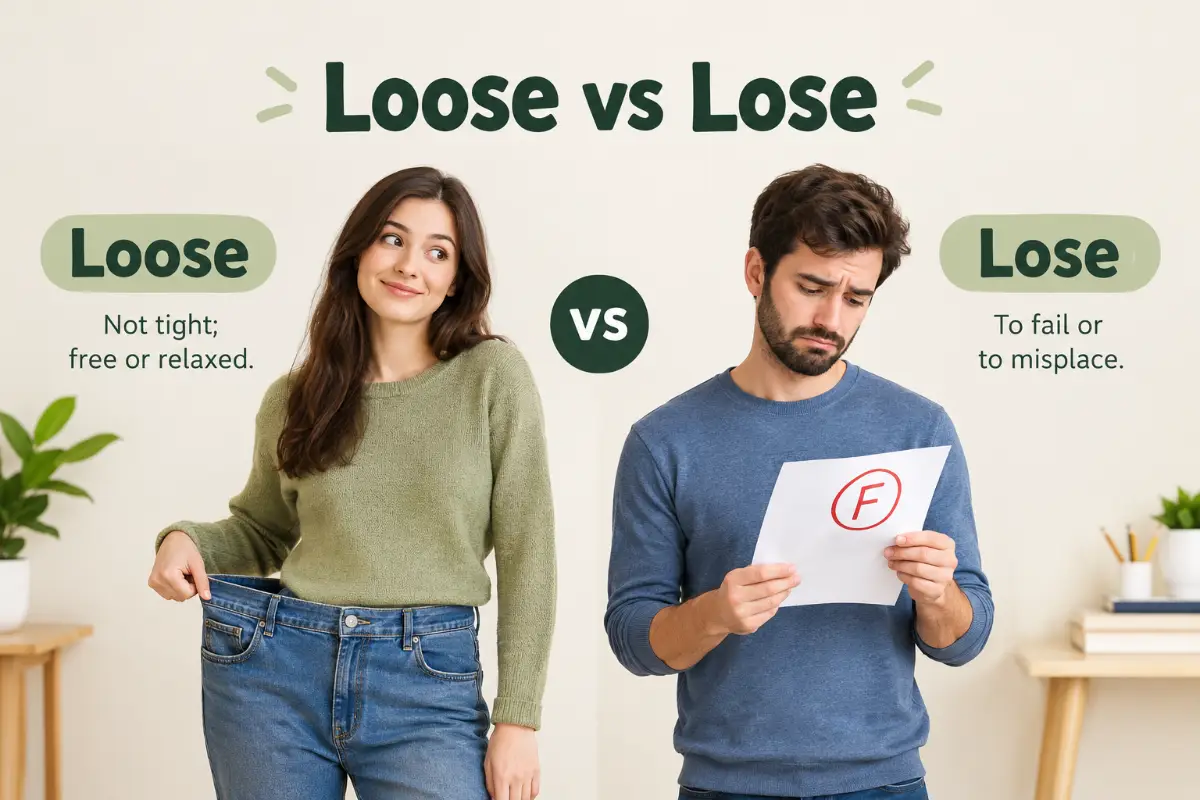
Mixing up loose vs lose is one of the most common spelling and word usage problems in English. The two words look almost identical. They differ by only one letter. Yet they have completely different meanings and they sound different when spoken.
If you write I don’t want to loose my phone you have used the wrong word. The correct sentence is I don’t want to lose my phone. On the other hand if you write My shoelaces are lose you have also chosen the wrong word. The correct sentence is My shoelaces are loose.
The good news is that you don’t need to memorize a complicated grammar rule. Loose usually describes something that isn’t tight or secure. Lose usually means to misplace something to no longer have something or to fail to win.
The confusion often comes from spelling habits pronunciation mistakes fast typing and the fact that both words are built from similar letters. This guide explains the difference in plain English. You’ll learn the meanings grammar pronunciation word history common mistakes and practical memory tricks that make the distinction easy to remember.
For another common grammar confusion, see Loot Vs Lute Which Word Should You Use 2026.
Quick Answer
Loose is an adjective meaning not tight not firmly attached or not controlled. Lose is mainly a verb meaning to misplace something stop having something or fail to win. For example My shirt is loose and I don’t want to lose my shirt. They sound different and have different grammatical jobs.
Loose Vs Lose Comparison Table
| Feature | Loose | Lose |
|---|---|---|
| Part of speech | Mainly adjective | Mainly verb |
| Basic meaning | Not tight or not firmly held | Misplace something or fail to keep or win it |
| Pronunciation | /luːs/ | /luːz/ |
| Final sound | S sound | Z sound |
| Example | My jacket is loose. | Don’t lose your jacket. |
| Common meaning | Not tight | Misplace or fail |
| Past tense | Not applicable as an adjective | Lost |
| Present participle | Not applicable | Losing |
| Common phrase | Loose clothing | Lose weight |
| Opposite | Tight | Find or win |
The easiest distinction is this.
Loose describes something.
Lose describes an action or change involving something you no longer have or fail to keep.
What Does Loose Mean
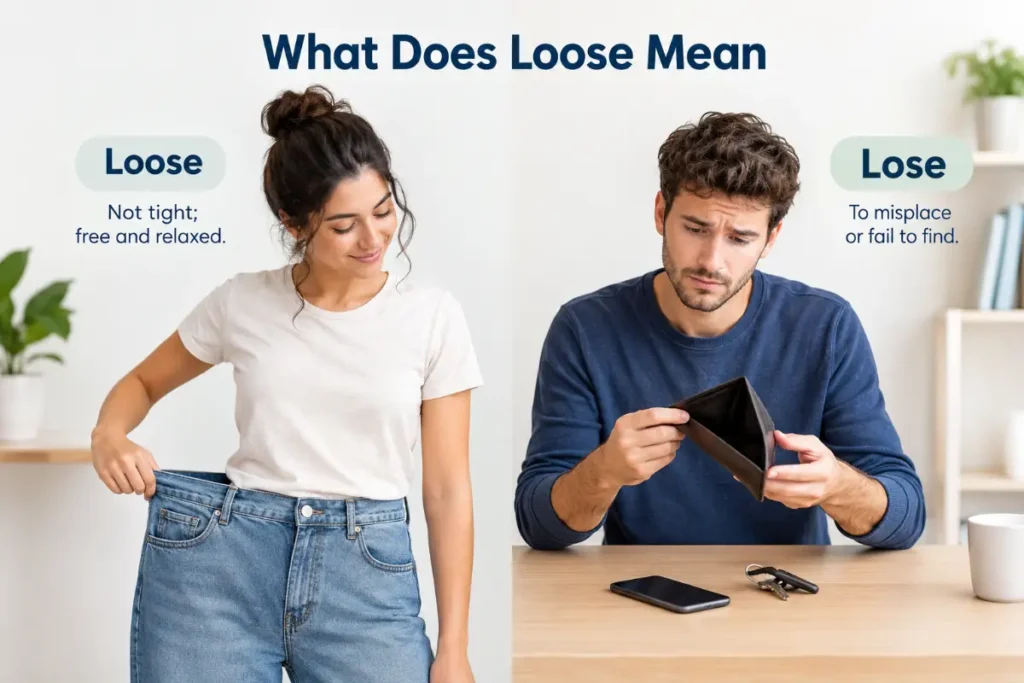
Loose is mainly an adjective. It describes something that isn’t tight firmly fixed securely attached or closely controlled.
Think about the opposite of loose.
The most common opposite is tight.
A loose shirt isn’t tight around your body. A loose screw isn’t firmly attached. A loose tooth isn’t firmly fixed in place.
Loose Definition
The most common meaning of loose is not tight or not firmly held in place.
Examples include:
- My shoes feel loose.
- The door handle is loose.
- She prefers loose clothing.
- One of the buttons on my coat is loose.
- The dog got loose from the yard.
The last example is slightly different. Here loose describes freedom from restraint. The dog isn’t being held or controlled anymore.
Loose As An Adjective
Adjectives describe nouns. Since loose is commonly an adjective it tells us something about a person place thing or idea.
Consider this sentence.
The screw is loose.
The noun is screw. The adjective loose tells us its condition.
Another example is.
These jeans are loose.
The adjective tells us the jeans aren’t tight.
This is an important grammar clue. If you’re describing the condition of something you’re probably looking for loose.
Common Meanings Of Loose
The word loose has several related meanings. They all connect to the basic idea of something being free from tightness control or attachment.
Not Tight
This is the most common meaning.
Examples.
- The jacket is too loose around the waist.
- I bought a loose sweater for winter.
- These shoes are loose on my feet.
Not Firmly Attached
Here loose means something can move because it isn’t securely fixed.
Examples.
- The table has a loose leg.
- I noticed a loose wire behind the desk.
- One of the tiles is loose.
- The handle became loose after years of use.
Free From Restraint
Loose can also describe someone or something that has escaped control.
Examples.
- The horse broke the fence and ran loose.
- Keep the dog inside so it doesn’t get loose.
- Several balloons came loose from the string.
Not Strictly Controlled
The word can describe rules or control that aren’t strict.
Examples.
- The school has loose rules about clothing.
- The team follows a loose schedule.
- We only have a loose plan for the weekend.
Here loose means flexible or not tightly organized.
What Does Lose Mean
Lose is mainly a verb. It describes an action or situation in which someone stops having something fails to keep something or fails to win.
This is the word you need for expressions such as lose your keys lose money lose weight and lose a game.
Lose Definition
Lose means to no longer have something because it has disappeared been misplaced been taken away or failed to be kept.
It can also mean to fail to win.
Examples.
- I don’t want to lose my phone.
- She lost her keys this morning.
- Our team might lose the game.
- He doesn’t want to lose his job.
- Try not to lose your temper.
The meaning changes slightly from sentence to sentence but the central idea is always connected to no longer having keeping controlling or winning something.
Common Meanings Of Lose
Misplace Something
You can lose something when you can’t find it.
Examples.
- I always lose my sunglasses.
- She lost her wallet at the airport.
- Don’t lose your passport.
- I think I’ve lost my keys again.
This is one of the most common uses in everyday American English.
Fail To Win
You can lose a competition game election race or contest.
Examples.
- Our team lost the game.
- They lost the championship last year.
- I hate losing at chess.
- The candidate lost the election.
The opposite is usually win.
Stop Having Something
You can lose something valuable or important without physically misplacing it.
Examples.
- He lost his job.
- She lost her opportunity.
- They lost their connection.
- We could lose our advantage.
Here the thing isn’t necessarily an object you can hold. The verb still works because something has been taken away or is no longer available.
Lose Weight
One of the most searched and commonly confused expressions is lose weight.
Correct.
I want to lose weight.
Incorrect.
I want to loose weight.
The verb is lose because the sentence describes an action. You want your body weight to decrease.
The adjective loose doesn’t work in this expression.
Which One Is Correct
Both loose and lose are correct English words. The important point is that they don’t mean the same thing.
Use loose when you mean something is not tight secure fixed or controlled.
Use lose when you mean to misplace something fail to win stop having something or experience a reduction.
Compare these sentences.
My shirt is loose.
The shirt isn’t tight.
I don’t want to lose my shirt.
You don’t want to misplace it or stop having it.
Another useful pair is.
The dog is loose.
The dog isn’t restrained.
Don’t lose the dog.
Don’t let the dog disappear or become impossible to find.
The spelling changes because the meaning changes.

Why People Confuse Loose And Lose
The confusion isn’t random. English learners and native speakers can both make this mistake because the words share several visual features.
The Words Look Almost Identical
Both words begin with loo.
Only the final letter changes.
Loose
Lose
When you’re typing quickly your brain can easily focus on the familiar shape rather than the grammatical role of the word.
The Words Are Related In Appearance
The spelling makes the words look like different forms of the same word. They aren’t.
Loose and lose have different meanings and different historical development.
You can’t turn lose into loose by adding an extra letter. The extra o changes the word completely.
Fast Typing Causes Mistakes
A person may know the difference perfectly well and still type the wrong word.
This happens often in emails texts comments and social media posts because people write quickly and don’t always proofread.
For example.
I don’t want to loose this opportunity.
The writer probably understands the meaning. The mistake comes from spelling rather than vocabulary.
Pronunciation Adds To The Problem
The words sound similar because they begin with the same long vowel sound.
But the final consonant is different.
Loose ends with an S sound.
Lose ends with a Z sound.
That small difference is easy to miss when someone speaks quickly.
Autocorrect Doesn’t Always Save You
Spell check tools can catch many spelling mistakes but context based correction isn’t perfect.
Both loose and lose are legitimate English words. A grammar or spell checker may not always recognize that you’ve chosen the wrong one for your sentence.
For example.
I don’t want to loose my wallet.
Every word is technically spelled correctly from the dictionary’s perspective. The problem is word choice.
This is why understanding meaning matters more than relying entirely on autocorrect.
Key Difference Between Loose And Lose
The clearest difference is grammatical.
Loose is mainly an adjective.
Lose is mainly a verb.
That distinction solves most cases.
Loose Describes
Loose can describe.
- Clothing.
- Screws.
- Wires.
- Teeth.
- Animals that aren’t restrained.
- Rules.
- Plans.
- Structures that aren’t firmly attached.
Example.
The handle is loose.
Lose Describes An Action
Lose can describe.
- Misplacing something.
- Failing to win.
- No longer having something.
- Experiencing a reduction.
- Failing to maintain something.
- Forgetting or missing something in certain expressions.
Example.
I lost my keys.
The distinction becomes much easier when you stop looking at the spelling and ask what the sentence means.
Loose And Lose In Grammar
Grammar provides one of the strongest ways to tell these words apart.
Loose Is Usually An Adjective
An adjective describes a noun.
Examples.
The shirt is loose.
She wore a loose dress.
The screw feels loose.
The dog is loose.
In each sentence loose gives information about the condition or state of something.
Lose Is A Verb
A verb describes an action or state.
Examples.
I might lose my keys.
We could lose the game.
She lost her phone.
They are losing money.
Because lose is a verb it can change tense.
Present.
I lose things easily.
Past.
I lost my keys yesterday.
Present progressive.
I am losing patience.
Future.
I might lose my chance.
This is a major clue. Lose has verb forms. Loose doesn’t work as the verb in these standard uses.
The Verb Forms Of Lose
Understanding the different forms of lose makes it easier to recognize the word in real sentences.
Present Tense
Lose
Examples.
- I often lose my keys.
- We don’t want to lose the match.
- Some people lose focus when they’re tired.
Third Person Singular
Loses
Examples.
- She loses her phone all the time.
- He loses patience quickly.
- The team loses confidence after a bad start.
Notice the spelling.
Lose becomes loses.
It doesn’t become looses.
Past Tense
Lost
Examples.
- I lost my wallet.
- She lost the game.
- We lost our chance.
Past Participle
Lost
Examples.
- I’ve lost my keys.
- He has lost interest.
- They had lost hope.
Present Participle
Losing
Examples.
- I’m losing patience.
- She is losing weight.
- The team is losing confidence.
Notice another important spelling point.
Lose becomes losing.
You don’t add an extra o.
Correct.
Losing
Incorrect.
Loosing
Why Loosing Is Usually Wrong
Loosing is one of the most common mistakes connected with this topic.
If you mean the verb lose then the correct form is losing.
Correct.
I’m losing my keys.
Correct.
We’re losing the game.
Correct.
She’s losing weight.
Incorrect.
I’m loosing my keys.
Incorrect.
We’re loosing the game.
The reason is simple. The verb is spelled lose. When you add ing you remove the final silent e.
Lose becomes losing.
You don’t double the o.
Is Loosing Ever A Word
Yes but it is rare.
Loosing can appear as a form of the verb loose. In that unusual use it means releasing or setting something free.
For example.
The archer was loosing arrows.
This literary or specialized use exists but it is far less common than losing.
For normal everyday writing you almost certainly need losing when you mean no longer having something or failing to win.
Loose Vs Lose Pronunciation
Pronunciation offers another useful clue.
Loose
The standard pronunciation is.
/luːs/
It has one syllable.
The final sound is an unvoiced s sound like the sound at the end of bus.
Think.
Loose rhymes with goose.
Lose
The standard pronunciation is.
/luːz/
It also has one syllable.
The final sound is a voiced z sound like the sound at the end of buzz.
Think.
Lose rhymes with choose.
A Simple Sound Test
Say these pairs aloud.
Loose and goose.
Lose and choose.
The vowel sound is similar but the final consonant changes.
Loose ends with s.
Lose ends with z.
This pronunciation difference can help you catch the spelling when you’re speaking or listening.
Spelling Rules For Loose And Lose
The spelling difference looks small but it follows two completely different words.
Loose Has Double O
Loose contains two o letters before the final se.
L O O S E
Lose Has One O
Lose contains one o before the final se.
L O S E
A useful visual trick is to think of the extra o in loose as extra space.
Something loose has room.
Something tight does not.
This isn’t a formal spelling rule but it’s an effective memory aid.
Loose And Lose In American English
American English uses both words in the same basic way as British English.
There isn’t a major American versus British spelling difference here.
The same distinction applies across major English varieties.
Loose means not tight or not firmly controlled.
Lose means misplace fail to win or stop having something.
Canadian English and Australian English follow the same basic distinction as well.
The real challenge isn’t regional spelling. It’s word choice.
Real Life Examples With Loose
Seeing loose in natural sentences helps you recognize its role.
Everyday Conversation
- My shoes are too loose.
- This ring feels loose on my finger.
- The dog got loose again.
- I prefer loose shirts in the summer.
- One of the screws is loose.
Workplace
- The cable is loose behind the monitor.
- We only have a loose plan for the meeting.
- The company has a loose dress code.
Writing
- The author uses a loose structure rather than a strict format.
- The connection between the two ideas is loose.
Common Expressions
- Keep a loose grip on the handle.
- The children were allowed to run loose in the yard.
- The team worked from a loose outline.
- A loose connection can cause the device to stop working.
- The jacket has a loose fit.
Real Life Examples With Lose
Now compare those examples with the verb lose.
Everyday Conversation
- Don’t lose your keys.
- I always lose my sunglasses.
- We could lose the game.
- She doesn’t want to lose her phone.
- I lost my wallet yesterday.
Workplace
- We can’t afford to lose this customer.
- The company could lose money this quarter.
- Don’t lose sight of the main goal.
- We don’t want to lose valuable time.
- The business may lose its advantage.
Academic Writing
- Students can lose interest when lessons become repetitive.
- The study examines how communities lose access to public resources.
Formal Writing
- The organization could lose public trust.
- The policy may cause the country to lose valuable investment.
- Researchers must avoid losing important data.
The Most Common Expressions With Loose
Some phrases make loose especially easy to identify.
Loose Change
Loose change means coins carried separately rather than stored in a wallet or another organized place.
Example.
I found some loose change in my car.
Loose Clothing
Loose clothing isn’t tight against the body.
Example.
She prefers loose clothing during hot weather.
Loose Ends
To tie up loose ends means to finish small unfinished tasks or details.
Example.
I need to tie up a few loose ends before I leave work.
On The Loose
If someone or something is on the loose they are free and not under control.
Example.
The escaped dog is still on the loose.
Let Loose
To let loose means to release someone or something from restraint. It can also mean to relax and behave more freely.
Example.
The children finally let loose after the exam.
The Most Common Expressions With Lose
The verb lose appears in many everyday phrases.
Lose Weight
Example.
She wants to lose weight through exercise and healthier meals.
Lose Time
Example.
We can’t afford to lose time during the project.
Lose Money
Example.
The business could lose money if costs keep rising.
Lose Focus
Example.
It’s easy to lose focus when you’re tired.
Lose Interest
Example.
Students may lose interest if the lesson feels disconnected from real life.
Lose Hope
Example.
Don’t lose hope after one setback.
Lose Your Mind
This informal expression can mean becoming extremely upset confused or excited.
Example.
I thought I was going to lose my mind after searching for my keys for an hour.
Lose Your Temper
This means becoming angry and showing it.
Example.
Try not to lose your temper during the argument.
A Quick Test For Choosing The Right Word
When you’re unsure about loose vs lose use this three step test.
Step One
Ask if you are describing something that isn’t tight secure or controlled.
If yes use loose.
My belt is loose.
Step Two
Ask if you’re talking about misplacing something failing to win or no longer having something.
If yes use lose.
I don’t want to lose my belt.
Step Three
Check the grammar.
If the word describes a noun use loose.
If the word expresses an action use lose.
This test takes only a few seconds and works in most everyday situations.
Loose Vs Lose In A Single Example
Consider this sentence pair.
The screw is loose so don’t lose it.
Both words are correct.
Loose describes the screw.
Lose describes the possibility of no longer having it.
This is one of the best examples because it shows how close the words can appear while still doing completely different jobs.
The same pattern works elsewhere.
My shoelace is loose so I don’t want to lose my shoe.
The dog is loose so don’t lose sight of it.
The connection is loose so we could lose the signal.
Once you see the two words working together the distinction becomes much easier to remember.
Loose Vs Lose In Formal And Informal Writing
The difference between loose and lose stays the same in formal and informal English. What changes is how often each word appears and which expressions sound natural in a particular setting.
In casual conversation you’ll hear both words constantly. In academic and professional writing you’ll also see both but usually in more precise constructions.
Loose In Everyday Writing
Loose commonly describes physical objects clothing rules plans and connections.
Examples.
- The screw is loose.
- I bought a loose fitting jacket.
- We have a loose schedule for the trip.
- The wire is loose.
- The rules are fairly loose.
The meaning depends on the noun but the basic idea remains the same. Something isn’t tight fixed strict or firmly controlled.
Lose In Everyday Writing
Lose appears even more often because it has many meanings.
Examples.
- I don’t want to lose my phone.
- We could lose the game.
- She doesn’t want to lose her job.
- Try not to lose your temper.
- I don’t want to lose touch with my old friends.
In each example lose expresses an action or change.
Loose Vs Lose In Workplace English
Workplace writing creates some useful distinctions because both words can appear in professional contexts.
Loose In Professional Writing
You might describe a flexible process as loose.
Example.
The team follows a loose schedule during the early planning stage.
You might also describe a physical problem.
The technician found a loose connection in the system.
You can use loose in formal writing when the meaning is precise. It isn’t an informal word by itself.
Lose In Professional Writing
Lose is extremely common in business and professional English.
Examples.
The company could lose several major clients.
We don’t want to lose valuable time.
Poor communication can cause a business to lose customer trust.
The team may lose its competitive advantage.
These sentences sound completely natural in professional writing.
Loose Vs Lose In Academic Writing
Academic writers use both words but often choose more precise alternatives when the context calls for them.
Loose In Academic Writing
Examples.
The researchers used a loose definition of social identity.
The theory provides a loose framework for analyzing the data.
Here loose means broad or not strictly defined.
Lose In Academic Writing
Examples.
Students can lose motivation when they receive unclear feedback.
A researcher may lose important information during data collection.
The argument loses strength when the evidence isn’t clearly connected to the conclusion.
The verb can apply to abstract ideas as well as physical objects.
Loose Vs Lose In Social Media
Social media creates plenty of spelling mistakes because people write quickly and often rely on memory.
One of the most common mistakes is writing loose when the intended word is lose.
For example.
Don’t loose hope.
The correct version is.
Don’t lose hope.
Another common mistake is.
I don’t want to loose you.
The correct version is.
I don’t want to lose you.
The problem isn’t pronunciation alone. People often remember the visual shape of the word and add an extra o.
Need another quick comparison? Read Touchbase Or Touch Base Which One Is Correct 2026 Guide.
Loose Vs Lose In Text Messages
Texting encourages speed. That makes small spelling differences easy to overlook.
You might see messages like.
I’m going to loose my mind.
The correct spelling is.
I’m going to lose my mind.
You might also see.
My jeans are lose.
The correct sentence is.
My jeans are loose.
A quick meaning check can catch both mistakes.
If something isn’t tight use loose.
If something is disappearing being misplaced or no longer being kept use lose.
Common Expressions You Should Know
Some phrases are so common that learning them as complete expressions can make the distinction much easier.
Loose Cannon
A loose cannon is a person who behaves unpredictably and may cause problems because they aren’t easy to control.
Example.
The manager considered him a loose cannon during negotiations.
Loose Ends
Loose ends are unfinished details or tasks.
Example.
I need to tie up a few loose ends before the project is finished.
On The Loose
On the loose means free from control or confinement.
Example.
The escaped dog is still on the loose.
Let Loose
Let loose means to release something or to relax and behave freely.
Example.
The children let loose after the final exam.
Loose Change
Loose change means coins carried separately rather than stored in a wallet or organized container.
Example.
I found some loose change under the sofa.
Lose Touch
Lose touch means to stop communicating with someone regularly.
Example.
We lost touch after college.
Lose Track
Lose track means to stop knowing where something is or what is happening.
Example.
I lost track of time while reading.
Lose Sight
Lose sight of can mean physically stop seeing something or forget an important goal.
Example.
Don’t lose sight of your main objective.
Lose Control
Lose control means no longer being able to manage something or yourself.
Example.
The driver lost control of the vehicle.
Loose Vs Lose In Idioms And Expressions
Idioms can make the difference even easier because many established expressions use one specific word.
Consider these pairs.
Let loose means to release or relax.
Let go has a similar meaning but doesn’t use lose.
Tie up loose ends means finish unfinished matters.
Lose track of time means stop noticing how much time has passed.
Lose your temper means become angry.
Loose cannon describes someone unpredictable.
The key is to learn these phrases as complete units rather than trying to spell each word from memory.
Can Loose Be A Verb
Yes. This point causes some confusion because loose isn’t always an adjective.
Loose can function as a verb meaning to release or set free. This use is less common in modern everyday American English than the adjective.
Example.
The sailors loosed the ropes.
This means they released the ropes.
Another example appears in older or literary language.
The hunter loosed an arrow.
Here loosed means released.
Most everyday writers won’t need this verb. Still it explains why forms such as loosed and loosing can exist.
Loose As A Verb Vs Lose
The meanings are very different.
Loose as a verb means release.
Lose means fail to keep or no longer have.
Compare.
They loosed the horses.
They released the horses.
They lost the horses.
They could no longer find or keep the horses.
That difference is important.
Loose Vs Lose In Different Tenses
Because lose is a verb it changes form to express time.
Present
I lose my keys often.
Past
I lost my keys yesterday.
Present Progressive
I am losing my keys less often now.
Present Perfect
I’ve lost my keys again.
Future
I might lose my keys if I don’t put them away.
Loose doesn’t follow this pattern when it acts as an adjective.
You can say.
The door is loose.
But you don’t create a past tense such as loosed to describe the door’s condition.
If you use loosed as a verb it has a different meaning. It means released.
Loose Vs Lose And The Word Lost
Lost is the past tense and past participle of lose.
This creates another useful clue.
Lose.
Lost.
Losing.
Loses.
These are all forms of the same verb.
Examples.
I lose things easily.
I lost my wallet.
I’m losing patience.
She loses her keys often.
By contrast loose normally stays the same when it works as an adjective.
The shoe is loose.
The shoes are loose.
The loose shoe caused a problem.
Notice that loose doesn’t change for singular and plural nouns.
Loose Vs Lose And Sentence Structure
Sentence structure can help you identify the correct word.
Loose Before A Noun
She wore a loose shirt.
Here loose directly describes shirt.
Loose After A Linking Verb
The shirt is loose.
Here loose describes the subject after the linking verb is.
Lose After A Subject
She may lose her shirt.
Here lose is the main verb.
Lose With An Object
He lost his wallet.
The object is wallet.
The verb lost tells us what happened to it.
This simple grammatical test works far better than trying to memorize hundreds of examples.
Loose Vs Lose And Word Families
Understanding related forms gives you another advantage.
Loose Word Family
Loose
Loosely
Loosen
Loosened
Loosening
Examples.
The rules are loose.
The instructions are loosely organized.
Please loosen the knot.
The knot has loosened.
Notice something interesting.
The verb loosen means to make something less tight.
That word is related to loose.
Lose Word Family
Lose
Loses
Lost
Losing
Examples.
I lose my keys.
She loses her phone.
He lost his wallet.
They’re losing the game.
These forms belong to the verb lose.
Loose And Loosen Are Not The Same
Another common mistake is confusing loose with loosen.
Loose is usually an adjective meaning not tight.
Loosen is a verb meaning to make something less tight.
Compare.
The knot is loose.
The knot isn’t tight.
Loosen the knot.
Make the knot less tight.
This distinction can help you remember the connection between loose and loosen.
Lose And Loose In Questions
The same rules apply when you ask a question.
Correct.
Did you lose your keys?
Correct.
Is your shoelace loose?
Correct.
Incorrect.
Did you loose your keys?
Incorrect.
Is your shoelace lose?
The helping verb can give you another clue.
After did you normally use the base verb.
Did you lose it?
Not.
Did you lost it?
And certainly not.
Did you loose it?
Loose Vs Lose With Helping Verbs
Helping verbs also reveal the grammatical role.
Correct.
I might lose the game.
She could lose her job.
They will lose money.
He has lost his wallet.
We are losing time.
With loose you might see forms such as.
The cable is loose.
The cables are loose.
The cable became loose.
The adjective describes the condition while lose expresses the action.
A Teacher’s Simple Rule
If I were explaining loose vs lose to a beginner in an English class I’d start with two opposites.
Loose means the opposite of tight.
Lose means the opposite of find or win.
That gives you three very useful pairs.
Loose ↔ Tight
Lose ↔ Find
Lose ↔ Win
Examples.
My shoes are loose.
The opposite is.
My shoes are tight.
Then.
I might lose my keys.
The opposite is.
I might find my keys.
And.
Our team could lose.
The opposite is.
Our team could win.
When you connect each word to its opposite the difference becomes much harder to forget.
A Linguist’s View Of The Difference
From a language perspective the confusion is interesting because English has many pairs where a tiny spelling difference creates a major change in meaning.
Loose and lose are not simply two spellings of one word. They have separate lexical identities and separate grammatical functions in their most common uses.
The pronunciation also reinforces the distinction.
Loose ends with the voiceless /s/ sound.
Lose ends with the voiced /z/ sound.
English learners may not notice that final sound at first because it comes after the same long vowel. With practice the distinction becomes much easier to hear.
Why Native Speakers Make The Mistake Too
You don’t have to be an English learner to confuse these words.
Native speakers sometimes write loose instead of lose because spelling doesn’t always follow pronunciation in a simple way.
The mistake is especially common in fast informal writing.
You may see it in.
- Social media comments.
- Text messages.
- Online forums.
- Sports discussions.
- Personal blogs.
- Casual emails.
This doesn’t mean the words are interchangeable. It simply shows how easy a spelling error can survive when the intended meaning is obvious from context.
A Professional Proofreading Test
When editing a sentence containing loose or lose don’t focus on the spelling first.
Focus on the meaning.
Ask.
Does the word mean not tight or not firmly controlled?
Use loose.
Does the word mean misplace fail to win or stop having something?
Use lose.
Then check the grammar.
If the word acts as an adjective loose is likely correct.
If it acts as a verb lose is likely correct.
This two part test catches almost every common error.
Common Mistakes To Watch For
Here are some of the most frequent errors.
- Loose weight instead of lose weight.
- Loose your keys instead of lose your keys.
- Loose hope instead of lose hope.
- Loose the game instead of lose the game.
- The shirt is lose instead of the shirt is loose.
- Loosing weight instead of losing weight.
- Loosing the game instead of losing the game.
- Looses his temper instead of loses his temper.
These mistakes all become easier to fix once you identify the intended meaning.
Memory Tricks That Actually Work
A good memory trick should be quick enough to use when you’re writing.
Loose Has Extra Room
The extra o in loose can remind you of extra space.
Something loose has room.
Loose clothes have extra room.
Lose Has One Less O
You can connect lose with the idea of something being gone.
One o is gone from the spelling.
This isn’t a formal grammar rule but it makes a useful visual reminder.
Loose Rhymes With Goose
Say.
Loose and goose.
Both end with the s sound.
Lose Rhymes With Choose
Say.
Lose and choose.
Both end with the z sound.
Remember The Opposites
This is probably the strongest trick.
Loose means not tight.
Lose means not keep or not win.
If you remember the opposites you can usually recover the correct word even when you’re tired or typing quickly.
Common Mistakes With Loose And Lose
Many spelling mistakes happen because loose and lose look almost identical. The easiest way to avoid them is to focus on meaning instead of appearance.
Using Loose When You Mean Lose
A common mistake is writing loose when you mean to misplace something, fail to win, or stop having something.
Incorrect: I don’t want to loose my phone.
Correct: I don’t want to lose my phone.
Incorrect: Our team can’t loose this game.
Correct: Our team can’t lose this game.
Remember that lose is the verb you need when something disappears from your possession or you fail to win.
Using Lose When You Mean Loose
The opposite mistake also happens.
Incorrect: My shoes are lose.
Correct: My shoes are loose.
Incorrect: The dog got lose from the yard.
Correct: The dog got loose from the yard.
Use loose when something isn’t tight, isn’t firmly attached, or has escaped from control.
Writing Loosing Instead Of Losing
This mistake deserves special attention.
When you mean the present participle of lose, the correct spelling is losing.
Incorrect: I am loosing my patience.
Correct: I am losing my patience.
Incorrect: She is loosing interest.
Correct: She is losing interest.
The word loosing does exist, but it comes from the verb loose and has a different meaning. It can mean releasing something or setting something free, although it is uncommon in everyday English.
Writing Loss Instead Of Lose
Loss and lose belong to the same word family, but they have different grammatical jobs.
Correct: I don’t want to lose my keys.
Correct: Losing my keys was a frustrating loss.
Lose is a verb. Loss is a noun.
This distinction becomes easier once you look at the sentence structure.
Memory Tricks For Loose And Lose
A good memory trick can save you from checking the dictionary every time.
Loose Has Two Os
Think of the two Os in loose as two extra spaces.
Loose things have extra space.
A loose shirt has extra room. Loose screws have room to move. Loose hair isn’t held tightly in place.
Lose Has One O
Think of lose as having one O because something has gone missing.
You lose your wallet.
You lose a game.
You lose your keys.
You lose track of time.
A simple rule works surprisingly well.
Loose means not tight. Lose means no longer have or fail to win.
Listen To The Final Sound
The pronunciation gives you another useful clue.
Loose ends with an S sound, like the sound in bus.
Lose ends with a Z sound, like the sound in choose.
So you can remember:
Loose sounds like goose.
Lose sounds like choose.
The spelling and pronunciation work together once you notice the difference.
Related Words You Should Know
Understanding related words makes the distinction even clearer.
Loosen
Loosen means to make something less tight.
Example: Please loosen the knot.
Example: He loosened his tie after dinner.
Example: The mechanic loosened the bolt.
Loosely
Loosely means in a way that isn’t tight or exact.
Example: The scarf was loosely wrapped around her neck.
It can also describe something that isn’t strictly organized or closely connected.
Example: The movie is loosely based on a true story.
Loss
Loss is the noun connected to lose.
Example: The team suffered a painful loss.
Example: Losing the document caused a major loss of time.
Lost
Lost is the past tense and past participle of lose.
Example: I lost my wallet yesterday.
Example: She has lost her keys.
Example: We lost the final match.
Notice the pattern.
Loose → loosen → loosely
Lose → lost → losing → loss
These word families help you recognize the correct form quickly.
Loose Vs Lose In Everyday Questions
Questions provide another useful test because the grammar often makes the answer obvious.
Did you lose your phone?
Is your jacket loose?
Did we lose the game?
Are these screws loose?
Have you lost your keys?
Is the lid loose?
The question structure can help you identify the word before you even think about spelling.
If the sentence asks about something being tight or secure, loose is usually the answer.
If it asks about misplacing something, failing to win, or no longer having something, lose is usually the answer.
Loose Vs Lose In Professional Writing
These two words matter in professional writing because a single letter can change the meaning of a sentence.
Consider this workplace sentence.
Incorrect: Please make sure we don’t loose the client.
Correct: Please make sure we don’t lose the client.
Now compare it with this sentence.
Correct: The connection between the two parts is loose.
The first sentence needs a verb. The second needs an adjective.
In emails, reports, resumes, presentations, and business documents, these mistakes can make otherwise polished writing look careless. A quick meaning check usually catches them.
Loose Vs Lose In Academic Writing
Academic writing also requires careful word choice.
Consider this example.
Incorrect: Researchers may loose important data.
Correct: Researchers may lose important data.
Now compare it with this sentence.
Correct: The samples were stored in a loose container.
The first sentence describes something disappearing or no longer being available. The second describes something that isn’t tightly secured.
The difference is small on the page but important in meaning.
A Simple Editing Test For Loose And Lose
When proofreading, ask one question.
Am I talking about something being free or not tight, or am I talking about something disappearing or failing?
If you’re describing something that isn’t tight, choose loose.
If you’re describing something you no longer have, something you fail to win, or something you stop experiencing, choose lose.
Try these examples.
I don’t want to lose my passport.
My passport case is loose.
We could lose the contract.
The connection is loose.
She lost her necklace.
The necklace clasp is loose.
Once you focus on meaning, the spelling becomes much easier.
Expert Editor Note
The best way to remember loose vs lose isn’t to memorize complicated grammar rules. Learn the basic job each word performs.
Loose describes.
Lose acts.
Loose is usually an adjective. It describes something that isn’t tight, isn’t firmly attached, or isn’t under control.
Lose is a verb. It describes an action or change involving possession, success, awareness, control, or experience.
This simple distinction solves most problems.
The spelling trick gives you a second layer of protection. Two Os belong to loose. One O belongs to lose.
If you remember only one sentence, remember this:
Loose has extra room. Lose means something is gone.
Frequently Asked Questions About Loose And Lose
What is the difference between loose and lose.
Loose usually means not tight, not firmly attached, or free from restraint. Lose is a verb meaning to misplace something, fail to win, stop having something, or no longer experience something.
For example, you can have a loose shoelace, but you can lose your shoe. The two words look similar, but they perform different grammatical roles and have different meanings.
Is it lose or loose my keys.
The correct sentence is I might lose my keys.
Use lose because you’re talking about misplacing something or no longer knowing where it is.
You would use loose to describe something that isn’t tight or secure.
For example, My key ring is loose means the key ring isn’t firmly secured.
Is it loose or lose a game.
The correct phrase is lose a game.
Lose is the verb used when someone fails to win.
For example, Our team could lose the game.
Loose doesn’t work here because it describes something that isn’t tight or firmly controlled.
Is it losing or loosing.
Losing is correct when you mean the present participle of lose.
For example, I am losing my patience.
For example, She is losing her phone again.
Loosing is a real but uncommon word connected to loose. It can refer to releasing or setting something free. In ordinary writing, losing is almost always the form you need when talking about lose.
Is loose an adjective or a verb.
Loose is most commonly an adjective.
It describes something that isn’t tight, secure, fixed, or controlled.
For example, The button is loose.
Loose can also function as a verb, although this use is much less common in modern everyday English. As a verb, it can mean to release or set free.
Why do people spell lose as loose.
People often confuse the words because they have nearly identical spellings and very similar pronunciation.
The extra O in loose can make it feel like the natural spelling of lose. However, the meanings are different.
A useful memory rule is simple: loose has two Os and describes extra room, while lose has one O and describes something being gone.
How do you remember loose and lose.
Think about the extra O in loose as extra space.
A loose shirt has extra space. A loose knot has extra space. A loose lid isn’t held tightly.
Then remember that lose has one O.
You lose your keys. You lose a game. You lose track of time.
This visual association makes the spelling easier to recall.
Is it loose weight or lose weight.
The correct phrase is lose weight.
Lose is the verb because it describes a change in the amount of weight someone has.
For example, She wants to lose weight.
Loose weight is incorrect in this meaning.
You can use loose to describe clothing after someone loses weight, such as My old jeans are loose now.
A related grammar guide is Next Friday Vs This Friday Which One Should You Use 2026 Guide.
Final Takeaway
The difference between loose vs lose becomes simple once you stop treating them as spelling variations of the same word.
Loose describes something that isn’t tight, firmly attached, controlled, or restricted.
Lose describes an action involving something you no longer have, something you fail to win, or something you stop experiencing.
Use these examples as your final check.
My shoes are loose.
I don’t want to lose my shoes.
The lid is loose.
I could lose the lid.
The team might lose the game.
The knot is loose.
One spelling trick can help you remember everything else.
Loose has two Os because it has extra room. Lose has one O because something is gone.
Once that distinction becomes automatic, one of the most common English spelling mistakes becomes much easier to avoid.

Vocabulary & Language Research Writer
Ethan Parker researches English vocabulary, word meanings, slang, idioms, and commonly confused words. His goal is to help readers understand how English is actually used in everyday conversations and writing.