
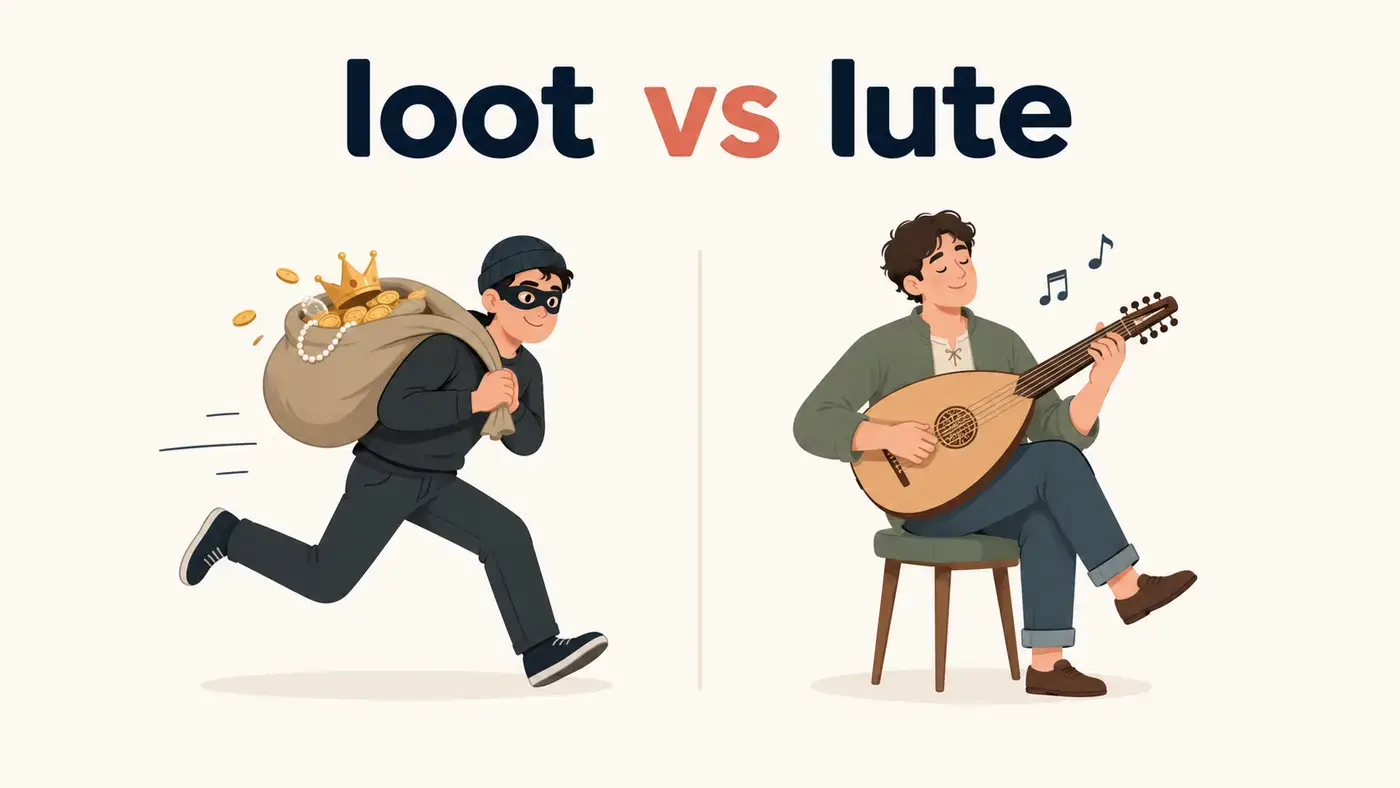
If you’ve searched for loot vs lute, you’re likely trying to figure out which word fits your sentence. These two words sound exactly alike in most English accents, yet they have completely different meanings. One refers to stolen valuables or items collected after victory. The other is a beautiful stringed musical instrument with a long history.
Because they are homophones, many writers accidentally swap them. Spellcheck may not catch the mistake since both are valid English words. A single misplaced letter can completely change the meaning of a sentence.
The good news is the difference is easy to remember once you understand what each word means and how native speakers use them. You do not need to memorize complicated grammar rules. Instead, focus on the meaning, context, and a few simple memory tricks.
This guide explains loot vs lute with clear definitions, grammar tips, pronunciation, real world examples, common mistakes, and expert editing advice. By the end, you’ll know exactly which word to choose every time.
Many readers also check Fair Vs Good Which Word Should You Use 2026.
Quick Answer
Loot means money, valuables, or goods stolen or taken during a robbery, war, or crime. It can also refer to rewards collected in games.
Lute is a stringed musical instrument with a rounded body and a short neck. Although loot and lute sound alike, they have different meanings and are never interchangeable.
Loot Vs Lute Comparison Table
| Feature | Loot | Lute |
|---|---|---|
| Part of speech | Noun and verb | Noun |
| Meaning | Stolen goods or valuables. Can also mean to steal. | A stringed musical instrument. |
| Pronunciation | /luːt/ | /luːt/ |
| Correct spelling | Yes | Yes |
| Common context | Crime, history, gaming, news | Music, history, education |
| Formal writing | Common | Common |
| Can replace the other | No | No |
| Example | The thieves escaped with the loot. | She learned to play the lute. |
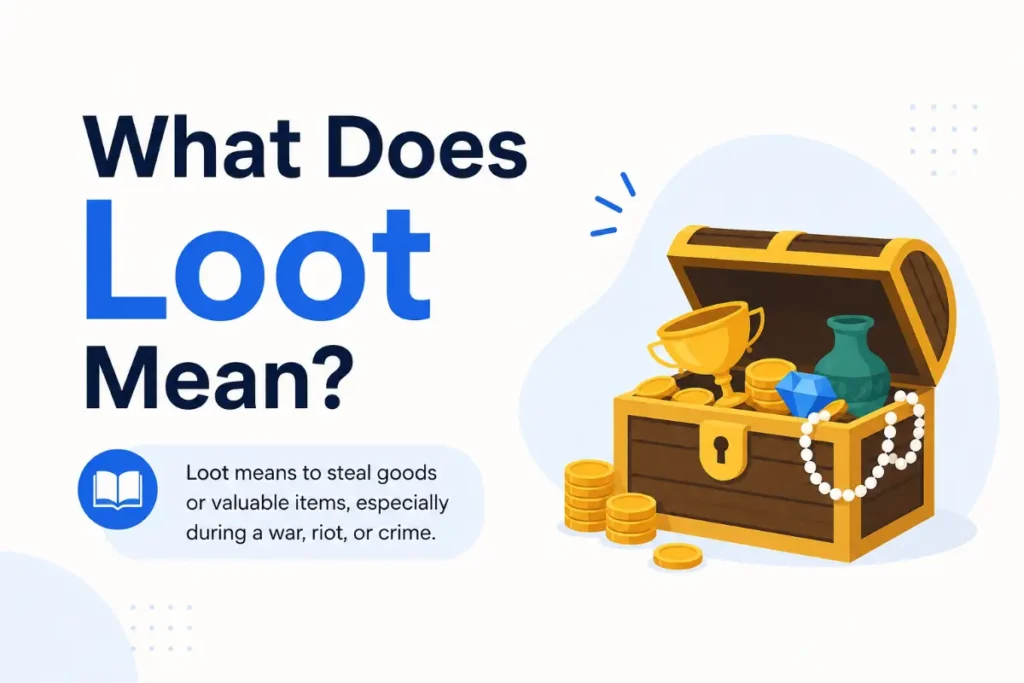
What Does Loot Mean
Loot usually refers to money, jewelry, valuables, or other items taken illegally. It can also describe rewards collected in video games or treasure found after completing a mission.
As a verb, loot means to steal property, especially during war, riots, or disasters.
Simple Definition
Loot means stolen goods or the act of stealing valuable items.
Loot As A Noun
Examples.
- Police recovered the stolen loot.
- The robbers divided the loot after the burglary.
- Pirates hid their loot on a remote island.
- The museum displayed ancient treasure recovered from buried loot.
- The team shared the game loot after defeating the final boss.
Loot As A Verb
Examples.
- The criminals looted several stores during the riot.
- Soldiers were forbidden to loot villages.
- Thieves looted the warehouse overnight.
- The gang planned to loot expensive electronics.
- Authorities worked quickly to stop people from looting abandoned buildings.
What Does Lute Mean
A lute is a traditional stringed musical instrument with a rounded back, a short neck, and strings that are plucked with the fingers.
The lute became especially popular during the Renaissance and the Baroque period. It played an important role in European music for hundreds of years.
Simple Definition
A lute is a historical string instrument that belongs to the same broad family as guitars and mandolins.
Examples Of Lute
- She played the lute during the concert.
- The musician carefully tuned his lute.
- The museum owns a rare Renaissance lute.
- Students studied the history of the lute in music class.
- The composer wrote several beautiful pieces for the lute.
Which One Is Correct
Both loot and lute are correct English words.
The right choice depends entirely on your meaning.
Use loot when talking about stolen property, treasure, rewards, or the act of stealing.
Use lute when referring to the musical instrument.
Compare these examples.
✔ The thieves escaped with the loot.
✔ The performer carried a beautifully decorated lute.
✘ The musician tuned his loot.
✘ The robbers escaped with the lute.
Both incorrect sentences completely change the intended meaning.
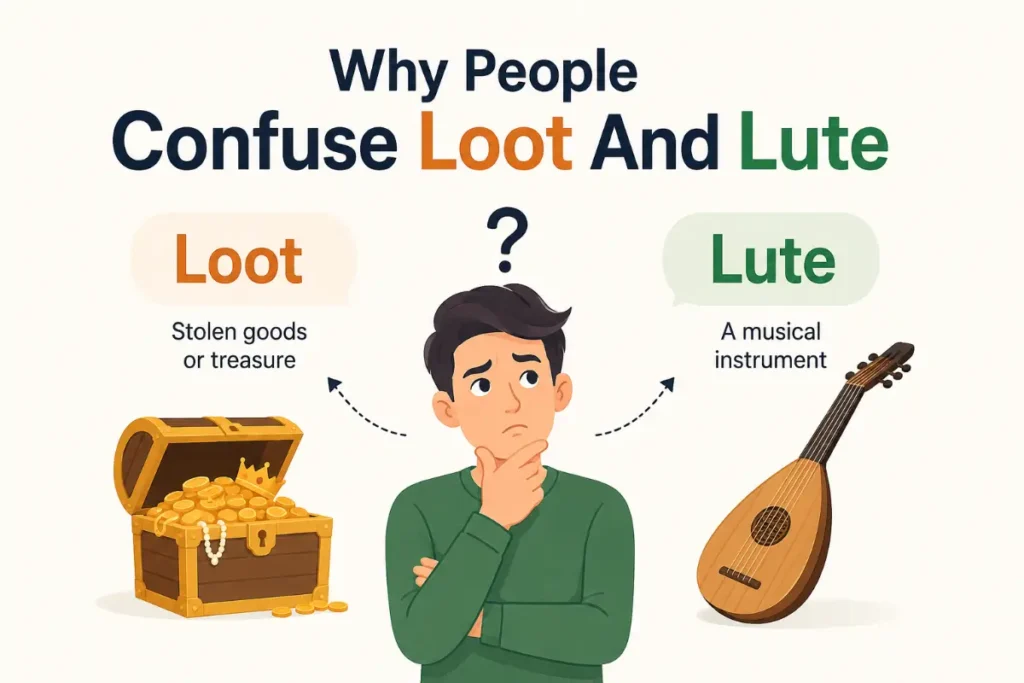
Why People Confuse Loot And Lute
These words cause confusion for several reasons.
They Sound Exactly The Same
Both words are pronounced /luːt/ in standard American and British English.
When people hear them in conversation, they rely on context to understand the meaning.
Only One Letter Changes
The spelling differs by a single letter.
Loot.
Lute.
Quick typing often leads to accidental mistakes.
Spellcheck Does Not Help
Since both words exist in English, spellcheck usually accepts either spelling.
That makes proofreading especially important.
They Rarely Appear Together
Most people learn each word in completely different situations.
Loot appears in crime reports, history books, news stories, and video games.
Lute appears in music classes, historical novels, museums, and orchestras.
Because people do not often compare them directly, the difference can be easy to forget.
Key Differences Between Loot And Lute
| Feature | Loot | Lute |
|---|---|---|
| Refers to | Property or valuables | Musical instrument |
| Part of speech | Noun and verb | Noun |
| Topic | Crime, treasure, gaming | Music, history |
| Action involved | Taking valuables | Playing music |
| Emotional tone | Usually negative | Usually positive or neutral |
One simple idea makes the difference easy to remember.
Loot belongs to the world of treasure.
Lute belongs to the world of music.
Grammar Explanation
The grammar difference between loot and lute is simple because they belong to different parts of speech and serve different purposes.
Loot Can Be A Noun Or A Verb
As a noun, loot means stolen property, treasure, or valuable items taken by force or theft.
Examples.
- The police recovered the stolen loot.
- The pirates buried their loot on the island.
As a verb, loot means to steal or carry away valuables.
Examples.
- The rioters looted several businesses.
- Criminals looted the abandoned building.
Lute Is Only A Noun
Lute is always a noun. It names a musical instrument.
Examples.
- She bought an antique lute.
- The performer played the lute beautifully.
Unlike loot, lute is never used as a verb in standard English.
Pronunciation Guide
These words are homophones, which means they share the same pronunciation but have different meanings and spellings.
| Word | IPA | Syllables | Stress |
|---|---|---|---|
| Loot | /luːt/ | 1 | Loot |
| Lute | /luːt/ | 1 | Lute |
Common Pronunciation Mistake
There is no pronunciation difference between these words in standard American or British English.
Native speakers depend on the surrounding sentence to understand which word is intended.
Learn the difference in Bearer vs Barer Which One Is Correct (2026 Guide).
Word Origin
Understanding the history of each word makes them easier to remember.
Loot
The word loot comes from the Hindi word lūt, meaning to rob or plunder. English adopted it during the British colonial period in India. Over time it became part of everyday English and now commonly refers to stolen valuables, treasure, or rewards collected in games.
Lute
The word lute traces its roots to the Arabic word alʿūd, which referred to a wooden stringed instrument. It entered Europe through Medieval Latin and Old French before becoming the English word lute.
Although the words sound identical today, they come from completely different languages and have unrelated histories.
British And American English
There is no spelling difference between British and American English.
Both varieties use:
- Loot.
- Lute.
The meanings are also identical across the United States, the United Kingdom, Canada, Australia, and New Zealand.
The only variation comes from context.
In gaming communities, loot appears far more often because players frequently talk about loot boxes, loot drops, and rare loot.
Lute mainly appears in music, education, museums, and historical discussions.
Real Life Examples
Seeing both words in natural sentences is the fastest way to remember them.
Daily Conversation
- The thieves escaped with the loot before police arrived.
- She practices the lute every evening.
- We found hidden loot in the treasure chest during the game.
- His grandfather owns an old lute from Italy.
Workplace
- Security reported that expensive equipment was part of the stolen loot.
- The museum purchased a beautifully restored lute.
- Investigators searched for the missing loot all week.
- The event featured a professional lute player.
Emails
- Please send the inventory of the recovered loot.
- The music department needs a new lute for the performance.
Academic Writing
- Historians documented how invading armies collected loot after battles.
- The lute became one of Europe’s most popular Renaissance instruments.
Literature
- Pirates celebrated after finding the hidden loot.
- The young musician carried her lute across the countryside.
Journalism
- Police displayed the recovered loot during a press conference.
- The festival included a remarkable lute recital.
Social Media
- I finally found legendary loot after hours of playing.
- That lute performance gave me goosebumps.
History
- Ancient armies often returned home with valuable loot.
- Skilled craftsmen built lutes by hand using carefully selected wood.
Common Mistakes
Many writers know both words but still choose the wrong one because they sound exactly alike.
Here are the mistakes editors notice most often.
Using Loot Instead Of Lute
Incorrect.
I learned to play the loot when I was a child.
Correct.
I learned to play the lute when I was a child.
The sentence talks about a musical instrument, so lute is the correct word.
Using Lute Instead Of Loot
Incorrect.
The robbers escaped with the lute.
Correct.
The robbers escaped with the loot.
The sentence refers to stolen valuables, so loot is the right choice.
Assuming Loot Only Means Stolen Property
Many people forget that loot also refers to rewards collected in video games.
Correct.
The players found rare loot after defeating the final boss.

Thinking Lute Is An Old Word Nobody Uses
The instrument may be ancient, but lute still appears in music schools, orchestras, museums, history books, and academic writing.
Easy Memory Tricks
These simple tricks make the difference easy to remember.
Loot Has Two Os
Think of the two O letters as two gold coins.
Gold coins remind you of treasure and stolen valuables.
Loot equals treasure.
Lute Starts With Lu
Think of lute as a musical instrument similar to a guitar.
The word belongs with music instead of treasure.
Picture The Scene
If you imagine pirates, robbers, treasure chests, or video games, choose loot.
If you picture musicians, concerts, medieval castles, or orchestras, choose lute.
The image usually gives you the answer instantly.
Related Words
Expanding your vocabulary makes these words easier to remember.
Words Related To Loot
- Treasure.
- Plunder.
- Spoils.
- Booty.
- Stolen goods.
- Valuables.
Words Related To Lute
- Guitar.
- Mandolin.
- Harp.
- Lyre.
- String instrument.
- Renaissance music.
Frequently Confused Words
- Loot and Lute.
- Steal and Steel.
- Principal and Principle.
- Brake and Break.
- Stationary and Stationery.
Learning homophones together helps you avoid future spelling mistakes.
Expert Editor’s Note
Professional editors pay close attention to homophones because spellcheck rarely catches them.
Every major dictionary recognizes both loot and lute as correct English words. The important point is choosing the one that matches your meaning.
If your sentence involves crime, treasure, history, or gaming, loot is almost certainly correct.
If your sentence involves music, instruments, or the Renaissance, lute is the word you need.
One careful proofread is usually enough to catch this mistake before publishing.
Frequently Asked Questions
Is Loot Or Lute Correct?
Both are correct English words. Loot refers to stolen valuables or treasure. Lute is a musical instrument. The correct choice depends on the meaning of your sentence.
Why Do Loot And Lute Sound The Same?
They are homophones. Homophones share the same pronunciation but have different spellings and meanings. English has many pairs like this.
Is Loot Only Used For Crime?
No. Besides stolen property, loot is also widely used in video games to describe rewards, equipment, weapons, or treasure collected by players.
What Kind Of Instrument Is A Lute?
A lute is a plucked string instrument with a rounded back and a short neck. It became popular during the Renaissance and influenced the development of several modern string instruments.
Does British English Spell These Words Differently?
No. British English, American English, Canadian English, and Australian English all use the same spellings and meanings.
How Can I Remember The Difference Quickly?
Think about the topic. Treasure points to loot. Music points to lute. That simple association works almost every time.
Can Spellcheck Find This Mistake?
Usually not. Since both words are correctly spelled, spellcheck accepts them. Reading the sentence for meaning is the best way to catch the error.
Learn the difference in Laser Or Lazer Which Spelling Is Correct 2026.
Conclusion
The difference between loot vs lute is straightforward once you know what each word means.
Loot refers to stolen property, treasure, or valuable rewards collected in games. It can also be used as a verb meaning to steal.
Lute is a stringed musical instrument with a long and fascinating history.
Since both words sound exactly the same, they often confuse writers and English learners. The easiest way to remember them is to connect loot with treasure and lute with music.
The next time you see these homophones, think about the context first. One extra second can save you from an embarrassing spelling mistake.

Vocabulary & Language Research Writer
Ethan Parker researches English vocabulary, word meanings, slang, idioms, and commonly confused words. His goal is to help readers understand how English is actually used in everyday conversations and writing.