
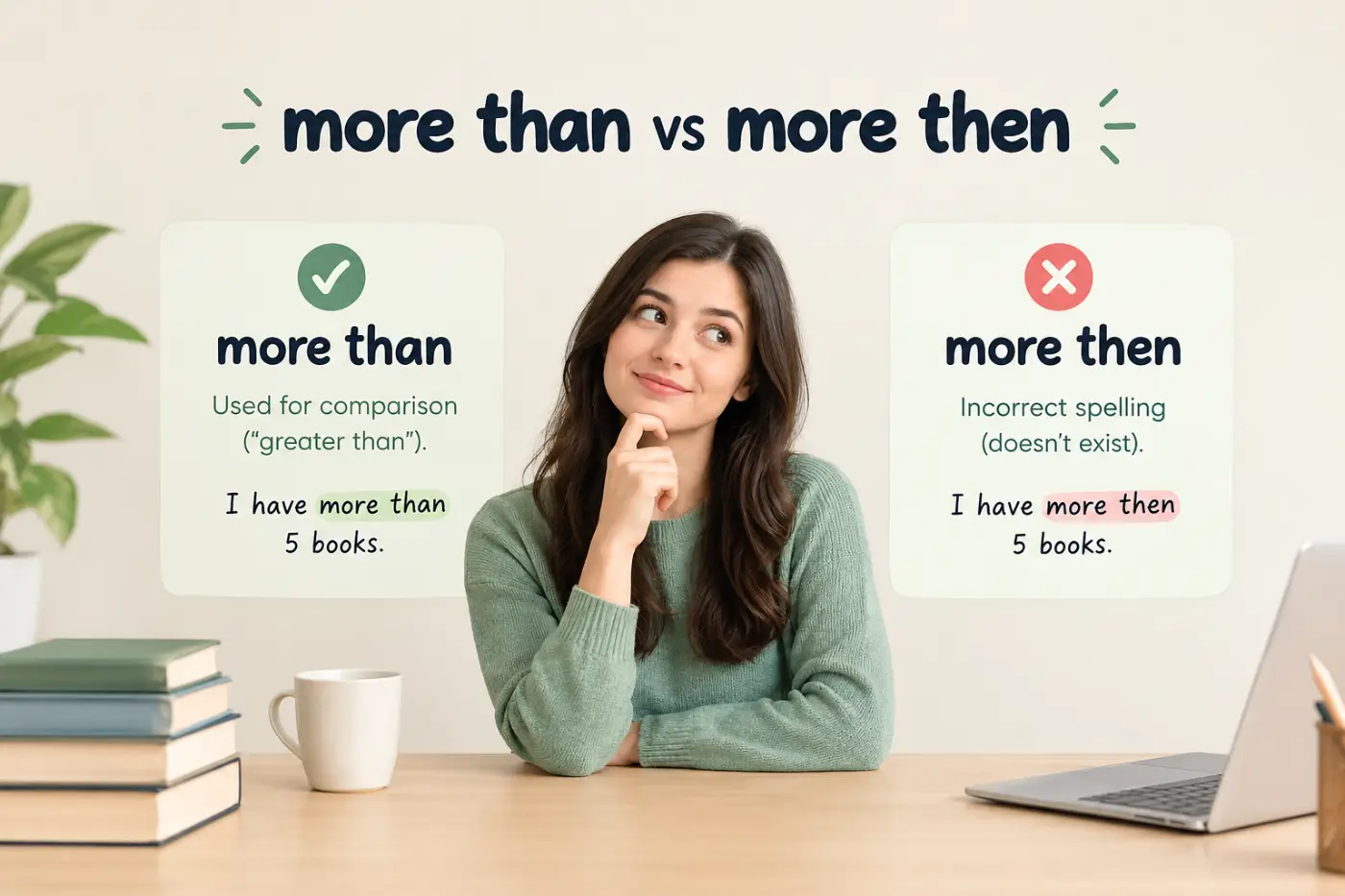
If you’ve ever paused while writing more than vs more then you’re not alone. These two phrases look almost identical because they differ by only one letter. Yet they have completely different jobs in a sentence.
The correct phrase for comparisons and amounts is more than. The phrase more then is usually incorrect when the writer intends to make a comparison. It combines two different words that have separate meanings. Than introduces a comparison while then relates to time order or what happens next.
For example you can write I have more than five dollars because you’re comparing an amount with five dollars. You can also write Finish your homework then watch TV because then shows what happens next.
This small spelling difference can affect the meaning and credibility of your writing. The good news is that the rule is simple once you understand what each word does.
This guide explains the difference between more than vs more then with clear definitions grammar rules pronunciation examples common mistakes memory tricks and practical advice for formal and informal writing.
For another common grammar confusion, see Woman Vs Women Which Word Should You Use 2026 Guide.
Quick Answer
Use more than when you’re comparing amounts numbers people things or degrees. Use then when you’re talking about time sequence or the next action. So more than ten people attended is correct. More then ten people attended is incorrect because then doesn’t introduce a comparison.
More Than Vs More Then Comparison
| Feature | More Than | More Then |
|---|---|---|
| Correct for comparisons | Yes | No |
| Main meaning | A greater amount or degree | Usually an incorrect form of more than |
| Key word | Than | Then |
| Grammar role | Comparison word | Time or sequence word |
| Used with numbers | Yes | No |
| Used to show order | No | Yes |
| Formal writing | Correct | Usually incorrect |
| Example | She has more than $50. | More then $50. |
| Correct alternative | More than $50. | She finished dinner then left. |
The easiest rule is this.
Than compares. Then shows what happens next.
That single distinction solves most problems involving these two words.
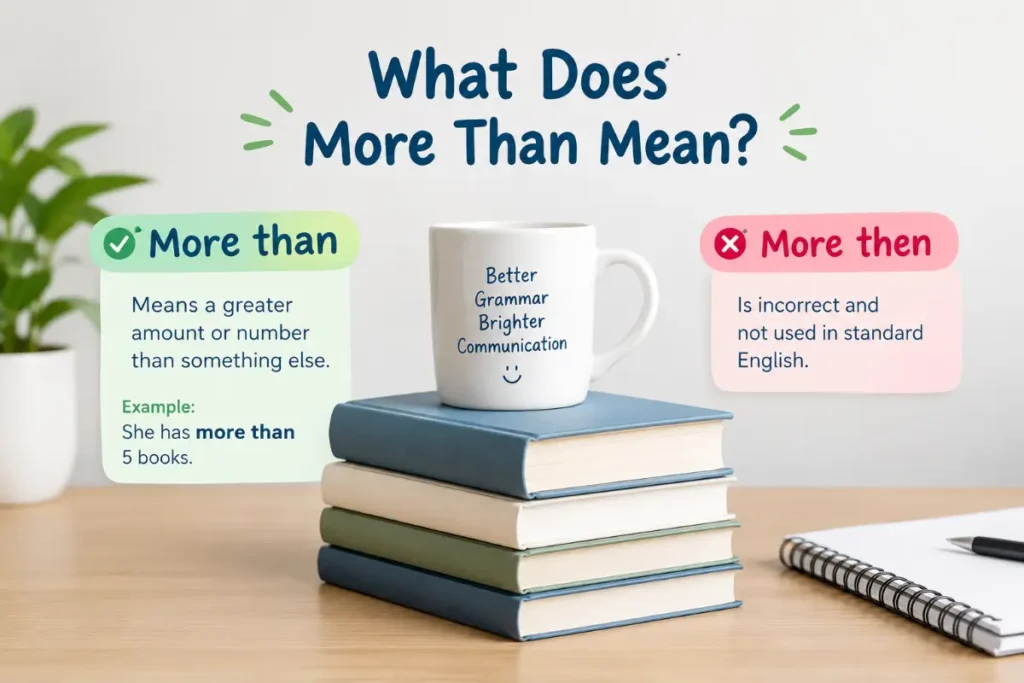
What Does More Than Mean
More than means a greater amount or degree compared with something else.
It can describe numbers quantities ages distances time levels and many other forms of comparison.
Consider this sentence.
The box weighs more than ten pounds.
The writer compares the actual weight with ten pounds. The box weighs a greater amount.
Here are some more examples.
- She earns more than $60,000 a year.
- We waited more than an hour.
- More than 100 people attended the event.
- He is more than six feet tall.
- The repair cost more than I expected.
In every example than connects two sides of a comparison.
What Does Then Mean
Then is an adverb that usually relates to time order or sequence.
It can mean at that time or next.
For example.
We lived in New York then.
Here then refers to a particular time in the past.
Now consider this sentence.
Finish your work then call me.
The word then tells the reader what should happen next.
This gives you a useful contrast.
More than means a greater amount.
Then means at that time or next.
They may look similar but they don’t perform the same job.
Which One Is Correct
For comparisons the correct phrase is more than.
Use it when you mean a greater amount or a higher degree.
Correct.
The movie lasted more than two hours.
Incorrect.
The movie lasted more then two hours.
The second sentence uses then where than is required.
However then is completely correct in other sentences.
Correct.
We ate dinner then went home.
Here there is no comparison. The sentence describes two actions in sequence.
A useful editing test is to replace than with compared with.
If the sentence still expresses a comparison then than is probably the correct choice.
For example.
She has more than five books.
You can think of it as She has a greater number compared with five books.
The comparison is clear.
Now try the same test with then.
She finished more then left.
Here then means next. It doesn’t compare anything.
Why People Confuse More Than And More Then
The confusion is understandable because than and then sound similar and appear in many of the same sentences.
The difference is easy to miss during fast typing or casual writing.
Visual Similarity
The words contain almost the same letters.
Than
Then
The only difference is the vowel in the middle.
That tiny difference can disappear when someone reads quickly.
Similar Pronunciation
In many American English accents than and then can sound very similar in connected speech.
The first vowel differs but the distinction may be subtle.
That matters because many spelling mistakes begin with pronunciation. Someone hears a word and later guesses its spelling.
Fast Typing
When people type quickly they often write the more familiar looking word without stopping to check the sentence.
This happens especially with short function words. Writers often focus on the main idea and overlook a small word such as than.
Autocorrect And Spell Check
Spell check can make this mistake harder to notice.
Both than and then are legitimate English words. A spelling checker may not flag the wrong choice because the word itself is spelled correctly.
The problem is semantic rather than purely spelling based.
For example.
There were more then 500 customers.
Every individual word is spelled correctly. The sentence still contains an error because then doesn’t belong in that comparison.
Social Media And Informal Writing
Online writing spreads common mistakes quickly.
A person may see more then used repeatedly in comments captions or posts. After enough exposure the incorrect form can start to look normal.
Frequency doesn’t make a usage correct.
The Core Difference Between Than And Then
Understanding than and then separately makes the entire issue much easier.
Than Is Used For Comparison
Than introduces the second part of a comparison.
Examples.
- This car is faster than mine.
- Maria is taller than her brother.
- The new version is better than the old one.
- I have more work than you.
- The test was easier than expected.
In each sentence one thing is being compared with another.
Then Is Used For Time
Then often refers to a point in time.
Example.
I lived there then.
The word tells us when something was true.
Then Is Also Used For Sequence
Then can tell us what happens next.
Example.
First wash the vegetables then cut them.
The sequence is clear.
First one action happens.
Then another action follows.
Grammar Explanation
The grammar behind this distinction is straightforward.
Than As A Comparison Word
In traditional grammar than functions as a conjunction or preposition depending on how it appears in a sentence.
For most everyday writing you don’t need to worry about the technical label. The practical rule matters more.
Use than after comparative expressions.
Examples include.
- More than.
- Less than.
- Better than.
- Faster than.
- Taller than.
- Older than.
- Easier than.
- Stronger than.
Notice the pattern.
more than
less than
better than
The word than connects the comparison.
Then As An Adverb
Then is an adverb.
It commonly tells us when something happened or what happens next.
Examples.
I was younger then.
We went home then.
Finish the report then send it.
The word doesn’t create a comparison.
More Than As A Fixed Expression
More than appears so often together that many writers treat it as a single phrase.
It can express quantity.
More than 200 students enrolled.
It can express degree.
The result was more than impressive.
It can also add emphasis.
She is more than capable of doing the job.
Here more than doesn’t simply mean a numerical amount. It can mean very or to a greater degree than expected depending on the context.
How More Than Works With Numbers
One of the most common uses of more than involves numbers.
Examples.
- More than 20 people came.
- The building is more than 100 years old.
- I’ve spent more than $200.
- The video received more than one million views.
- The journey took more than three hours.
The basic meaning is always a greater amount than the number mentioned.
If 21 people came then more than 20 people came is true.
If a trip lasted three hours and ten minutes then the trip lasted more than three hours is true.
More Than With Quantities
You don’t need a number for more than to be correct.
It can describe quantities in general.
Examples.
- We need more than enough food.
- She has more than enough experience.
- The project requires more than a few changes.
- He wanted more than one answer.
- The company needs more than good intentions.
Here more than communicates a quantity or degree greater than the idea that follows.
More Than With Adjectives
The phrase can also appear before adjectives and expressions that show degree.
Examples.
- The job is more than difficult.
- Her reaction was more than reasonable.
- The result was more than disappointing.
- The problem is more than serious.
- His explanation was more than convincing.
These sentences can carry extra emphasis.
For example the problem is more than serious suggests the problem goes beyond what the speaker would normally call serious.
In formal writing you should use this structure carefully because the exact meaning depends on context.
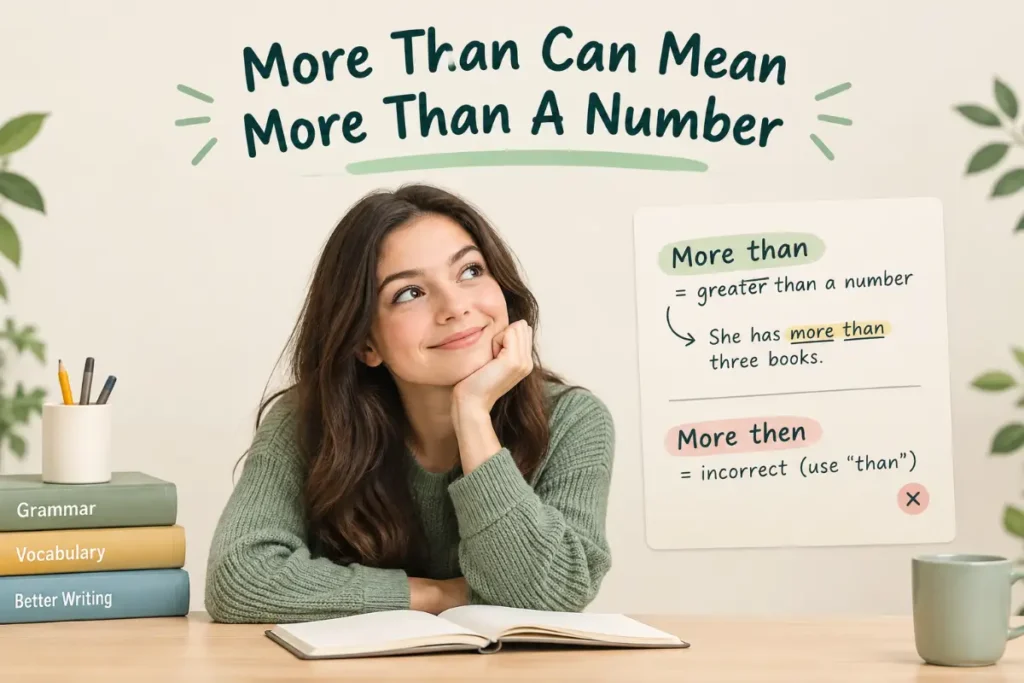
More Than Can Mean More Than A Number
This is an important point that simple grammar guides often miss.
More than can communicate quantity but it can also communicate degree.
Compare these sentences.
The store has more than 500 customers.
This refers to quantity.
Now consider.
She is more than ready.
This doesn’t mean you can count her readiness. It means she is fully ready or extremely ready.
Another example.
The explanation was more than enough.
This means the explanation exceeded what was needed.
So more than has a wider range of uses than many learners first realize.
Then Can Show A Sequence
The most common everyday use of then is to show the order of events.
Examples.
- Wake up then make breakfast.
- Check the address then place the order.
- Read the instructions then begin the test.
- Save the document then close the program.
- Call me then tell me what happened.
In each sentence then means something close to next.
This creates a simple memory clue.
If next works in the sentence then then may be correct.
For example.
Finish your homework then watch TV.
You could say.
Finish your homework next watch TV.
The second version sounds awkward but the sequence idea is clear.
Then Can Refer To A Past Time
Then can also mean at that time.
Examples.
- I didn’t know her then.
- We lived in Chicago then.
- Things were different then.
- He was a student then.
- I was much younger then.
This use has nothing to do with comparison.
That is why then cannot replace than in phrases such as more than ten.
Real Life Examples With More Than
Here are natural examples showing how Americans use more than in everyday communication.
Daily Conversation
- I’ve known her for more than ten years.
- We need more than one person to move this table.
- The restaurant is more than five miles from here.
- He spent more than an hour looking for his keys.
- I expected more than this.
Workplace Writing
- The project will take more than two weeks.
- More than 50 employees attended the training.
- The proposal received more than 100 responses.
- We need more than a quick fix.
- The team has more than enough information to make a decision.
Emails
- Thank you for giving us more than enough time to prepare.
- The shipment arrived more than three days earlier than expected.
- We received more than 300 applications.
Academic Writing
- More than half of the participants completed the survey.
- The study lasted more than six months.
- The sample included more than 1,000 responses.
Journalism
- More than 10,000 people attended the festival.
- The storm caused more than $5 million in damage.
Social Media
- This post received more than 20,000 views.
- I’ve watched this movie more than five times.
These examples show why more than is so useful. It works naturally with numbers quantities time distance money degree and frequency.
Real Life Examples With Then
Now compare those examples with sentences using then.
Daily Conversation
- We had lunch then went shopping.
- I’ll call you then.
- I didn’t understand it then.
- Finish this first then take a break.
- Things were different then.
Workplace Writing
- Review the document then send it to the client.
- We can discuss the budget then decide on the next step.
- Save your changes then close the file.
Emails
- Please review the attached document then let me know if you have questions.
- I’ll finish the report then send you the final version.
These sentences use then to show time or sequence.
A Simple Test For More Than Vs More Then
When you’re unsure which word to use ask yourself what the sentence is doing.
Test One
Is the sentence comparing two amounts or degrees?
Use than.
The box weighs more than 20 pounds.
Test Two
Is the sentence telling you what happens next?
Use then.
Pack the box then label it.
Test Three
Is the sentence talking about a particular time?
Use then.
I lived there then.
This three question test handles most situations without requiring complicated grammar rules.
Common Mistakes With More Than
Some errors appear again and again.
Mistake One
There were more then 50 guests.
Correct.
There were more than 50 guests.
The sentence compares the number of guests with 50.
Mistake Two
It costs more then $100.
Correct.
It costs more than $100.
Money creates a comparison.
Mistake Three
She is more then capable.
Correct.
She is more than capable.
Here more than emphasizes degree rather than a specific number.
Mistake Four
The trip took more then three hours.
Correct.
The trip took more than three hours.
Time duration is being compared with three hours.
Common Mistakes With Then
The reverse mistake can happen too.
Mistake One
First read the instructions than begin.
Correct.
First read the instructions then begin.
The sentence describes sequence.
Mistake Two
I didn’t understand it than.
Correct.
I didn’t understand it then.
The sentence refers to a past time.
Mistake Three
Finish your work than call me.
Correct.
Finish your work then call me.
The second action happens after the first.
Why Spell Check Often Misses More Then
This deserves special attention because it causes many avoidable errors.
A spell checker mainly looks for words that aren’t recognized as correctly spelled words. Then is a real English word. So is than.
When you write more then five the software may see no spelling problem.
The issue is context.
This is called a contextual error. The word itself is spelled correctly but it is the wrong word for the sentence.
Professional proofreading still matters because software can recognize spelling without fully understanding the writer’s intended meaning.
Is More Then Ever Correct
Yes but only when more and then serve separate grammatical purposes.
The phrase more then is not normally a replacement for more than.
Consider a sentence such as.
He wanted more then realized he had enough.
Here more means an additional amount and then means afterward.
The sentence could be understood as.
He wanted more. Afterward he realized he had enough.
This is completely different from writing.
He wanted more then $50.
If the intended meaning is a greater amount than $50 then the correct form is more than $50.
The key is context. More then can appear as two separate words in a sentence but it should not be used as the standard comparison phrase.
Spelling Rules To Remember
There isn’t a complicated spelling rule behind this difference.
The important distinction comes from meaning.
Than
Think comparison.
more than
less than
better than
faster than
Then
Think time.
then
now and then
back then
first then
This connection is more useful than trying to memorize isolated spellings.
Pronunciation Guide
The two words are easy to confuse because their pronunciation is close.
Than
Common American English pronunciation is approximately:
/ðæn/
It has one syllable.
The vowel is similar to the vowel sound in cat for many speakers.
Then
Common American English pronunciation is approximately:
/ðɛn/
It also has one syllable.
The vowel is closer to the vowel sound in bed.
The distinction can become less obvious in fast conversation. That’s one reason spelling mistakes occur.
When writing, rely on meaning rather than sound.
British American Canadian And Australian English
The basic distinction between than and then is the same across major English varieties.
American English uses than for comparisons and then for time and sequence.
British English follows the same rule.
Canadian English follows the same rule.
Australian English follows the same rule.
You won’t normally find a regional spelling variation that makes more then an accepted replacement for more than.
The difference is grammatical rather than regional.
Word Origin
The words than and then have different historical paths even though their modern spellings look similar.
Than developed from an Old English word connected with comparison. Over time it became the standard word used to introduce the second element of a comparison.
Then also comes from Old English. Its earlier forms were connected with time and sequence.
Their histories help explain why they developed into separate words with different meanings.
The similarity of their modern forms doesn’t mean they are interchangeable.
Why Than Is Essential In Comparisons
Comparative structures depend on clear relationships.
Consider.
John is taller than Mark.
The word than tells us who John is being compared with.
Now consider.
John is taller then Mark.
The sentence contains a word associated with time or sequence instead of comparison. The meaning becomes grammatically incorrect.
The same pattern appears with more.
She has more money than I do.
The phrase tells us that her amount is greater.
The word than connects the two sides of the comparison.
More Than In Formal Writing
More than is completely appropriate in professional and academic writing.
Examples.
More than 60 percent of respondents supported the proposal.
The company has operated for more than 25 years.
The experiment required more than four hours to complete.
There is no need to replace more than with a more complicated expression simply to sound formal.
Clear writing usually wins.
At the same time you should avoid casual shortcuts or incorrect substitutions such as more then.
More Than In Informal Writing
The phrase is equally natural in everyday English.
You might say.
I’ve told you more than once.
That costs more than I expected.
We need more than a minute.
She has more than enough food.
These expressions are common and natural for American English speakers.
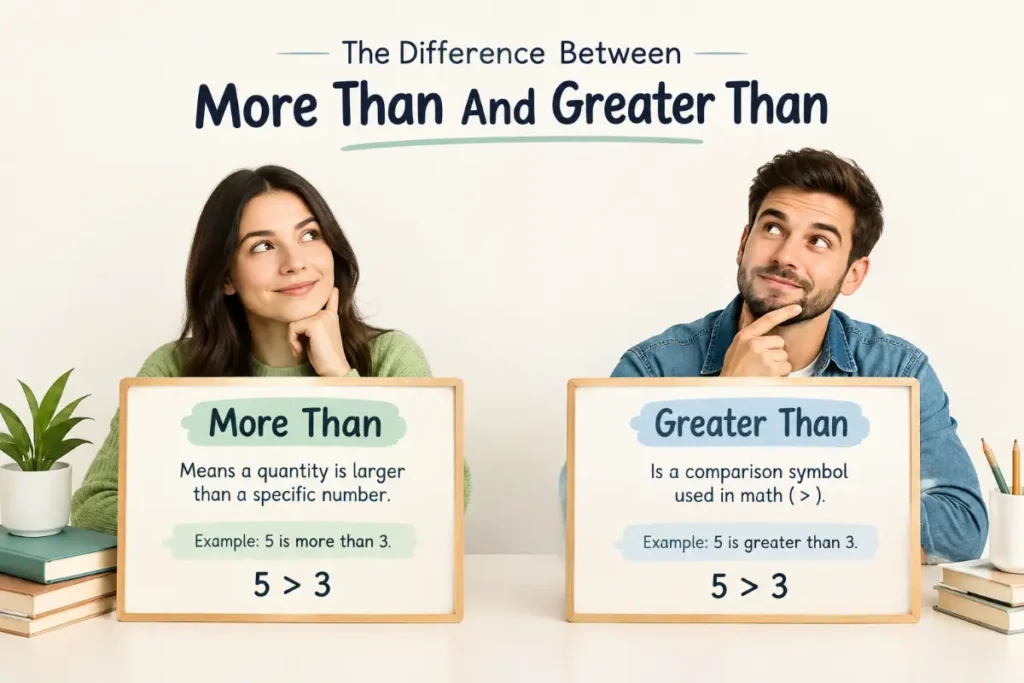
The Difference Between More Than And Greater Than
In some formal contexts greater than can replace more than.
For example.
The temperature was more than 100 degrees.
The temperature was greater than 100 degrees.
Both can work depending on context.
However more than is usually more natural in everyday English.
You wouldn’t normally need to replace a simple phrase with a more technical one.
For general readers more than is clear and direct.
The Difference Between More Than And Over
Another common question is the difference between more than and over.
In many contexts they are interchangeable when describing amounts.
Examples.
More than 500 people attended.
Over 500 people attended.
Both are widely used in American English.
Some traditional style guidance has preferred more than for precise numerical comparisons. Modern usage often accepts over as well.
For formal writing more than remains an excellent choice because its comparison meaning is completely clear.
More Than And Less Than
Once you understand more than the related phrase less than becomes easy.
More than means a greater amount.
Less than means a smaller amount.
Examples.
- More than 100 people attended.
- Less than 100 people attended.
- The trip took more than two hours.
- The trip took less than two hours.
- She earns more than I do.
- She earns less than I do.
The word than remains the same because both expressions create comparisons.
More Than And Fewer Than
You can also compare countable nouns using more than and fewer than.
Examples.
More than 20 students joined the class.
Fewer than 20 students joined the class.
The distinction between fewer and less matters in formal English because fewer normally refers to countable nouns.
The comparison word remains than.
More Than And No More Than
These phrases can have different meanings depending on context.
More than means above a stated amount.
The repair cost more than $500.
No more than often means a maximum amount.
The repair should take no more than two hours.
The word than remains part of the comparison.
This is another reason it’s useful to understand the role of than instead of memorizing only one phrase.
More Than And More Then In Search Queries
People often search for phrases such as.
more than or more then
is it more than or more then
more than vs more then grammar
more than 10 or more then 10
more then correct spelling
These searches usually come from one simple concern. The writer knows the sentence needs a comparison but isn’t sure which spelling belongs there.
The answer remains consistent.
Use more than for comparison.
Use then for time and sequence.
Once you understand the difference you won’t need to memorize every individual phrase.
Memory Tricks
A good memory trick should be quick enough to use while writing.
Than Has A Comparison
Remember:
Than compares.
If you’re comparing two things then than is the word you need.
More than ten.
Faster than me.
Better than before.
Then Has Time
Remember:
Then tells time.
If you can replace the word with next or at that time then then may be correct.
Finish this then call me.
I lived there then.
Remember The Letter E
One popular memory trick is to connect the e in then with event.
An event happens in time.
This isn’t a grammar rule. It’s simply a useful memory aid.
For comparison remember than.
More than.
Less than.
Better than.
That repeated pattern will become automatic with practice.
More Than Vs More Then In Real Writing
The difference becomes much easier once you see these words doing real work in sentences. More than handles comparison. Then handles time and sequence. The surrounding sentence usually gives you the answer.
More Than In Everyday Conversation
American English speakers use more than constantly when talking about amounts and degrees.
- I’ve been waiting for more than an hour.
- She has more than enough money for lunch.
- We need more than two people to move this.
- That costs more than I expected.
- He’s more than ready to start.
- I’ve told you more than once.
- The drive takes more than three hours.
- She weighs more than her sister.
- We received more than 100 messages.
- This job requires more than basic computer skills.
Each sentence contains a comparison or expresses an amount beyond a stated point.
More Than In The Workplace
Professional writing uses more than in reports emails proposals and presentations.
Consider these examples.
- The company employs more than 500 people.
- The project took more than six months to complete.
- We received more than 200 applications.
- The new process saves more than five hours each week.
- The department needs more than additional staff.
- The final cost was more than $10,000.
- The report contains more than 50 pages.
- The issue is more than a simple technical problem.
Notice the last example. More than doesn’t always introduce a number. It can show that something goes beyond a particular description.
More Than In Academic Writing
Academic writers often use more than to describe data quantities and comparisons.
Examples include.
- More than half of the participants completed the survey.
- The study examined more than 2,000 responses.
- The treatment period lasted more than eight weeks.
- More than one factor contributed to the result.
- The evidence suggests more than a temporary change.
- The researchers collected more than enough data for the analysis.
The phrase is completely appropriate in formal writing. There’s no need to replace it with a complicated alternative simply to sound academic.
More Than In Emails
You may see more than in ordinary professional emails.
For example.
Thank you for giving us more than enough time to prepare the presentation.
The shipment arrived more than two days ahead of schedule.
We have more than enough information to move forward.
These sentences sound natural because than creates the intended comparison.
Then In Real Writing
Then has two main jobs. It can refer to a time in the past or show what happens next.
Then Shows Sequence
Use then when one action follows another.
- Open the file then check the figures.
- Finish your lunch then take your medicine.
- Read the question then choose your answer.
- Save the document then close the program.
- Call the customer then update the account.
- Wash the vegetables then cut them.
- Start the engine then wait a few seconds.
- Check the address then place the order.
In each example you could understand then as next.
Then Refers To A Past Time
Then can also mean at that time.
- I lived in Texas then.
- She was a teacher then.
- We didn’t know about the problem then.
- Things were different then.
- I was much younger then.
- He wasn’t interested in football then.
This use has no connection with comparison.
More Than Vs More Then In Common Sentences
The easiest way to understand the difference is to compare sentences that look almost identical.
Amounts
Correct.
There were more than 100 people at the event.
Incorrect.
There were more then 100 people at the event.
The first sentence compares the actual number with 100.
Money
Correct.
The laptop costs more than $800.
Incorrect.
The laptop costs more then $800.
The writer is comparing the price with $800.
Time Duration
Correct.
The movie lasted more than two hours.
Incorrect.
The movie lasted more then two hours.
The phrase describes a duration greater than two hours.
Sequence
Correct.
We ate dinner then watched a movie.
Here then means afterward.
You couldn’t use than because no comparison exists.
More Than Can Compare People
The phrase isn’t limited to numbers.
You can use it to compare people.
- Sarah has more experience than Tom.
- My brother earns more than I do.
- She knows more about the subject than I expected.
- He spends more time studying than his friends.
- This teacher gives more homework than the previous one.
In each case than connects the two sides of the comparison.
This is one of the most important patterns to recognize.
More + comparison + than.
Many readers also check Has Been Vs Have Been Which One Is Correct (2026).
More Than Can Compare Things
The same rule applies to objects and ideas.
- This phone costs more than the other model.
- The new design uses more energy than the old one.
- This book contains more information than the earlier edition.
- The blue car has more storage space than the red one.
- The new system requires more maintenance than the old system.
Again the word is than because the sentence compares two things.
More Than With Pronouns
Some comparisons become tricky when pronouns appear after than.
For example.
She has more experience than I do.
This is a clear and formal construction.
In casual American English you may also hear.
She has more experience than me.
Both occur frequently. The first version makes the underlying verb clear.
The same pattern appears in sentences such as.
He earns more than I do.
They know more than we do.
She works harder than he does.
The important point for this article is that than remains the comparison word.
More Than With Verbs
Than can introduce a comparison involving an action.
Examples.
- I exercise more than my brother does.
- She travels more than I do.
- He talks more than he listens.
- They work more than we expected.
- The company sells more than it did last year.
These sentences show that more than isn’t only about physical quantities. It can compare actions and degrees.
More Than One
More than one is a particularly common phrase.
It means at least two.
Examples.
- More than one person complained.
- More than one answer may be correct.
- More than one employee reported the problem.
- More than one solution exists.
- More than one student asked the same question.
There is an interesting grammar point here.
More than one normally takes a singular noun and singular verb.
Correct.
More than one student has complained.
Not normally.
More than one student have complained.
The meaning refers to multiple people but the grammatical structure treats one student as the core noun phrase.
More Than Enough
More than enough means an amount greater than what is needed.
Examples.
- We have more than enough food.
- She has more than enough experience.
- There’s more than enough room.
- You gave me more than enough time.
- The evidence is more than enough to support the claim.
This expression is common in both formal and informal English.
It can also carry emphasis.
That’s more than enough.
Depending on the context this can mean the amount has exceeded what is needed or that the speaker wants the situation to stop.
More Than Once
More than once means two or more times.
Examples.
- I’ve visited New York more than once.
- She warned him more than once.
- The issue has happened more than once.
- I’ve read this book more than once.
The phrase is common because than creates a comparison between the actual number of times and one time.
More Than Ever
More than ever means to a greater degree than before.
Examples.
- I appreciate my family more than ever.
- We need teamwork more than ever.
- People rely on technology more than ever.
- She feels confident more than ever before.
Here the phrase doesn’t compare two physical quantities. It compares a current degree with an earlier degree.
More Than Just
More than just means something goes beyond a basic description.
Examples.
- She’s more than just a manager.
- This is more than just a game.
- The problem is more than just financial.
- He became more than just a coworker.
- The book offers more than just entertainment.
This construction is especially useful in persuasive and descriptive writing.
More Than Likely
More than likely is a common expression meaning very likely or probably.
Example.
She’s more than likely to accept the offer.
It can also appear in informal conversation.
You’ll more than likely see him there.
This is another example of than working correctly without a numerical comparison.
More Than Welcome
More than welcome means completely welcome or very welcome.
Examples.
- You’re more than welcome to stay.
- Guests are more than welcome to use the lounge.
- You’re more than welcome to call me anytime.
Again the phrase expresses degree rather than quantity.
More Than Meets The Eye
More than meets the eye is a familiar English expression.
It means something contains more information or complexity than is immediately obvious.
For example.
There’s more to this story than meets the eye.
The phrase works because than introduces a comparison between what appears obvious and what actually exists.
More Than And Comparatives
A useful grammar pattern is the combination of more and than.
Examples.
more expensive than
more useful than
more interesting than
more difficult than
more important than
more effective than
For example.
This method is more effective than the old one.
The structure is straightforward.
more + adjective + than
The adjective describes the quality being compared.
Than After Less
The same comparison rule applies to less than.
Examples.
- The trip took less than an hour.
- She spent less than $50.
- Fewer than 20 people attended.
- The package weighs less than five pounds.
This reinforces the main rule.
Than belongs to comparison.
It doesn’t belong only to more than.
Than After Better
You’ll also see than after comparative adjectives.
Examples.
- This option is better than the first one.
- The weather is warmer than yesterday.
- Her explanation was clearer than mine.
- This route is shorter than the other route.
- The new system is faster than the old one.
If you’re comparing two things then than is the natural choice.
Then In Instructions
Instructions often use then because they describe a series of actions.
For example.
- Enter your password then click Sign In.
- Select the file then press Open.
- Read the question then write your answer.
- Mix the ingredients then place the dish in the oven.
- Check the receipt then leave the store.
This type of writing appears in manuals tutorials recipes classroom instructions and workplace procedures.
Then In Storytelling
Writers use then to move a story forward.
For example.
She opened the door. Then she heard a strange noise.
Or.
He looked at the clock then grabbed his coat.
The word helps readers follow the order of events.
It can make a sequence feel immediate and easy to follow.
Then In Conditional Sentences
Then can also appear in conditional structures.
For example.
If you finish early then you can leave.
In careful formal writing the comma and placement can vary depending on the sentence structure. The key point is that then can signal the result of a condition.
Another example is.
If the weather improves then we’ll go outside.
Here then means something close to in that case.
Then Can Mean At That Point
Another useful meaning is at that point.
Example.
If you aren’t ready then we’ll wait.
Here then refers to the situation described by the condition.
This is different from the comparison function of than.
Can More Then Ever Be Correct
Yes. This deserves a careful answer because the phrase can appear legitimately when more and then belong to different parts of the sentence.
Consider:
She wanted more then changed her mind.
The sentence contains more and then as separate words.
It means she wanted an additional amount and afterward changed her mind.
But this sentence is different:
She wanted more then $20.
If the intended meaning is that she wanted an amount greater than $20 then the sentence should be:
She wanted more than $20.
So don’t treat more then as a fixed phrase. Look at the role of each word.
When More Then Is A Typing Error
If you see more then immediately before a number or quantity the writer probably intended more than.
Examples.
more then 10
more then $50
more then three hours
more then enough
more then one person
These should normally be:
more than 10
more than $50
more than three hours
more than enough
more than one person
A Practical Editing Method
If you’re proofreading your own writing search your document for more then.
Don’t automatically change every result. Read the full sentence.
If the sentence makes a comparison replace then with than.
If then means afterward or at that time leave it alone.
This is a better editing method than blindly using spell check.
Common Questions About More Than
Is More Than Always A Comparison
Not always in the narrow mathematical sense. More than can express a greater quantity but it can also express a greater degree or emphasis. Expressions such as more than enough and more than capable show that broader use.
Is More Than Grammatically Correct
Yes. More than is standard English and appears in everyday conversation academic writing journalism business writing and formal documents.
Is More Then Grammatically Correct
The combination can appear when more and then have separate functions in a sentence. However more then is not the correct replacement for more than when you mean a greater amount or degree.
Can I Use Over Instead Of More Than
In many contexts yes. More than 100 people attended and over 100 people attended are both common in American English. More than is a clear choice when you want to emphasize the comparison.
Is Than A Preposition Or Conjunction
Its grammatical classification can depend on how it functions in a sentence. Traditional grammar often treats than as a conjunction in structures such as She is taller than I am and as a preposition in structures such as She is taller than me. For practical writing the key point is that than introduces comparison.
Expert Editor’s Note
When editing professional English the most useful approach is semantic rather than visual.
Don’t ask which spelling looks right. Ask what relationship the sentence expresses.
If the sentence compares amount degree size age cost distance or quality use than.
If the sentence describes time sequence or a result use then.
Dictionaries treat than and then as separate words with different meanings. Standard style guides also recognize than as the normal word for comparisons.
A professional editor would therefore correct:
The company hired more then 50 people.
to:
The company hired more than 50 people.
But an editor would leave this sentence alone:
The company hired more people then expanded its office.
Here more and then perform different jobs. More expresses an increased number and then shows what happened afterward.
That distinction is worth remembering because it prevents overcorrection.
Common Mistakes With More Than And More Then
The biggest mistake is simple. Writers use then when they need than because the two words look and sound similar.
- More then $50 is incorrect when the intended meaning is an amount greater than $50.
- More than $50 is correct when comparing an amount with $50.
- Finish the report and then send it is correct because then shows the next step.
- I wanted more then changed my mind is correct because then introduces what happened next.
- She earns more than I do is correct because the sentence compares two amounts.
- She finished first and then went home is correct because the sentence describes a sequence.
A useful editing habit is to stop and ask what job the word is doing. If it creates a comparison, use than. If it shows time, sequence, or consequence, use then.
More Than Vs More Then In Questions
Questions can make the distinction easier to spot because the intended meaning usually becomes clear from the context.
Consider these examples.
- Do you have more than ten dollars.
- Did you wait more than an hour.
- Did you buy more than five tickets.
- What happened then.
- What did you do then.
- What happened next and then.
The first three examples involve comparison. The last three involve time or sequence.
A question such as Did you spend more then ten dollars is incorrect when the writer means Did you spend an amount greater than ten dollars.
The correct version is Did you spend more than ten dollars.
More Than Vs More Then With Money
Money is one of the most common places where this mistake appears.
Use more than when comparing a price, cost, salary, payment, budget, or amount.
- The jacket costs more than $100.
- She saved more than $500.
- The repair will cost more than expected.
- The company spent more than its original budget.
- He earns more than his brother.
Do not use more then for these comparisons.
Then can still appear in a sentence about money when it has a separate meaning.
For example, consider this sentence.
She wanted more money then decided to wait.
Here, more describes an increased amount and then introduces the next action. Both words are correct because they perform different jobs.
More Than Vs More Then With Time
Time expressions create another useful distinction.
Use more than when you compare a period of time with another amount.
- I waited more than two hours.
- The project took more than three weeks.
- He has lived there for more than ten years.
- The meeting lasted more than an hour.
Use then when you describe what happened at a particular point in time or what happened next.
- We finished dinner and then watched a movie.
- She was younger then.
- Back then, phones were much simpler.
- I didn’t understand it then.
Notice the difference.
I waited more than two hours compares the waiting period with two hours.
I finished dinner and then left describes the order of two actions.
More Than Vs More Then With People
The word than also works when comparing people.
- Maria is taller than James.
- David works harder than I do.
- She knows more than me in casual speech.
- He has more experience than his manager.
- They invited more people than we expected.
Then does not perform this comparison.
A sentence such as Maria is taller then James is incorrect if the intended meaning is that Maria has greater height than James.
The correct sentence is Maria is taller than James.
More Than Vs More Then With Adjectives
Comparative adjectives often appear with than.
- This book is better than the first one.
- The new model is faster than the old model.
- This route is longer than I expected.
- Her answer was clearer than mine.
- The second option is more practical than the first.
This pattern helps reveal why than is a comparison word.
The word then cannot replace it.
This book is better then the first one is incorrect.
The correct form is This book is better than the first one.
More Than Vs More Then In Academic Writing
Academic writing needs especially careful editing because a single wrong word can make polished work look careless.
Use more than for comparisons involving data, quantities, percentages, results, populations, studies, and measurements.
- More than 60 percent of participants completed the survey.
- The study included more than 500 students.
- The treatment group showed more improvement than the control group.
- The second experiment produced more accurate results than the first.
- The region contains more than one million residents.
Use then for chronological relationships.
- Researchers collected the data and then analyzed the results.
- The first test was completed, and then the second phase began.
- The sample was examined and then classified.
In academic writing, context usually makes the correct choice obvious.
More Than Vs More Then In Business Writing
Professional emails often contain both words, so the distinction matters.
Use more than when discussing costs, targets, quantities, deadlines, performance, or comparisons.
- We received more than 200 applications.
- The final cost was more than expected.
- The new system processes more orders than the previous system.
- We need more than one approval before moving forward.
Use then when explaining steps.
- Review the document and then send it to the client.
- Complete the form and then submit your request.
- We’ll discuss the budget and then make a final decision.
A simple rule works well in workplace writing.
Comparison means than.
Next step means then.
More Than Vs More Then In Social Media Writing
Informal writing creates many spelling mistakes because people type quickly and rarely proofread short posts.
A person might write more then enough or more then five people without noticing the mistake.
The correct forms are more than enough and more than five people.
Social media writing also creates another problem. Autocorrect often doesn’t flag the mistake because then is a real English word.
A spell checker may recognize both words as valid. It cannot always determine the meaning you intended.
Human proofreading still matters when two legitimate words are easy to confuse.
A Simple Proofreading Test
Use this three step test whenever you see more then in your writing.
- Replace then with next.
If the sentence still makes sense, then may be correct.
She finished her work and then left.
She finished her work and next left.
The wording is awkward but the basic meaning remains clear.
- Replace then with than.
If the sentence expresses a comparison, than is probably correct.
The house costs more than $300,000.
The house costs more than $300,000 clearly compares the price with $300,000.
- Ask what relationship the sentence expresses.
Comparison points to than.
Sequence points to then.
Time points to then.
Greater quantity points to than.
This method works faster than memorizing dozens of examples.
Related Words That Cause Similar Confusion
More than and more then aren’t the only commonly confused words in English.
Several other pairs cause problems because their spelling or pronunciation is similar.
- Than and then.
- Your and you’re.
- Its and it’s.
- Their and there.
- Affect and effect.
- Accept and except.
- Advice and advise.
- Loose and lose.
- Principal and principle.
- Complement and compliment.
The lesson is broader than this single pair.
A word can be spelled correctly and still be wrong for the sentence. Good editing checks meaning as well as spelling.
More Than And Then Can Appear Together
One of the easiest ways to understand the difference is to see both words working in the same sentence.
- She earned more than expected and then invested the money.
- We waited more than an hour and then went home.
- He bought more than he needed and then gave the rest away.
- The company hired more than 100 workers and then opened another office.
- They practiced for more than six months and then entered the competition.
In each example, than handles the comparison and then handles the sequence.
This is an important point because some writers think the two words compete with each other. They don’t.
They have different grammatical roles.
More Than Is The Correct Choice In Most More Then Errors
When writers ask about more than vs more then, the answer is usually more than.
The phrase more than is a standard expression used to show greater quantity, degree, amount, or extent.
The phrase more then is not normally a fixed comparison phrase.
That does not mean the words more and then can never appear beside each other. They can, but each word must have its own function.
For example.
She wanted more then realized she already had enough.
Here, more means an additional amount. Then means afterward.
But this sentence is incorrect.
She wanted more then $100.
If the intended meaning is an amount greater than $100, the correct sentence is this.
She wanted more than $100.
Memory Tricks For More Than And More Then
A short memory trick can prevent the mistake before it happens.
Think of than as the comparison word.
More than.
Less than.
Greater than.
Smaller than.
Better than.
Faster than.
Older than.
Think of then as the timeline word.
First this happens.
Then something happens next.
You can also remember this simple phrase.
Than compares. Then continues.
That single sentence covers the core distinction.
Expert Editor Note
From an editing perspective, more than should be your automatic choice when the sentence compares quantity, degree, value, number, or extent.
Native speakers sometimes pronounce than weakly in fast speech, which can make it sound similar to other short function words. That similarity explains part of the spelling confusion, but it doesn’t change the grammar.
When proofreading, don’t rely only on spell check. Both than and then are standard English words, so software may accept the wrong one.
Read the sentence for meaning.
If the sentence answers the idea of greater than, choose than.
If it answers the idea of next or at that time, choose then.
That approach is more reliable than trusting automatic correction.
Frequently Asked Questions
Is more than correct or more then correct.
More than is correct when you mean greater than or a greater amount. Then normally refers to time, sequence, or what happens next. For example, More than 20 people attended the event is correct. We ate dinner and then left is also correct. More then is usually a spelling error when used as a comparison.
Why do people write more then instead of more than.
People often confuse these words because they look similar and can sound similar during fast speech. Both are common English words, so spell check may not identify the mistake. Typing quickly can make the problem worse. The best solution is to connect than with comparison and then with time or sequence.
Is more then ever grammatically correct.
Yes, but only when more and then perform separate grammatical jobs. For example, She wanted more then changed her mind is correct because then means afterward. More then is not correct when you intend to express a comparison such as more than $50 or more than three people.
Should I use more than or more then in formal writing.
Use more than when you mean greater in number, amount, degree, or extent. Use then when you mean next, afterward, or at a particular past time. Formal writing does not change this distinction. The same grammar applies in academic papers, business reports, emails, applications, and professional documents.
Is more than the same as greater than.
They often express the same basic comparison, especially with numbers and quantities. More than is usually more natural in everyday English. Greater than is common in technical, mathematical, scientific, and formal contexts. For example, more than 100 people and greater than 100 people both express a comparison, although the first sounds more natural in ordinary conversation.
How can I remember the difference between than and then.
Remember one simple rule. Than compares. Then continues. Use than after comparisons such as more than, less than, better than, and faster than. Use then for sequence and time such as first this happened and then something else happened. This rule handles most everyday cases.
Can more than appear with an adjective.
Yes. More than can express a greater degree or amount and can appear with adjectives and other structures. Examples include more than happy, more than ready, more than enough, and more than capable. The exact meaning depends on the sentence, but than remains part of the comparison or degree expression.
Is more than one grammatically correct.
Yes. More than one is a standard English expression. Despite referring to multiple things, it is normally followed by a singular noun and singular verb when it functions as the subject. For example, More than one student has asked the same question. The expression means multiple individual people or things but follows a special agreement pattern.
You may also want to read Simpler Or More Simple Which Form Is Correct 2026.
Final Takeaway
The difference between more than vs more then is easy once you focus on meaning.
Use more than for comparison.
Use then for time, sequence, or what happens next.
More than five people attended the meeting.
We finished the meeting and then went home.
More than shows a comparison. Then moves the sentence forward.
When you spot more then in your writing, pause for a second and ask whether you’re comparing something. If you are, change then to than.
Than compares. Then continues.
That simple rule is enough to keep one of the most common English word choice mistakes out of your writing.

Senior Grammar Editor
Olivia Reynolds is a grammar editor and language writer who enjoys making complex English rules easy to understand. She specializes in grammar, punctuation, sentence structure, and everyday writing tips, helping readers write with greater confidence and clarity.