

The difference between has been vs have been comes down mainly to the subject of the sentence. Both forms are correct. The key is knowing who or what you’re talking about.
English learners often hesitate between these two forms because has and have both connect with been. The confusion gets stronger when the sentence uses a long subject or a tense such as the present perfect continuous. A sentence can sound familiar and still have the wrong helping verb.
The basic rule is simple. Use has been with a singular third person subject such as he, she, it, or a singular noun. Use have been with I, you, we, they, and plural nouns.
For example, you say She has been working but They have been working. You say The company has been growing but The companies have been growing.
That small agreement rule controls most cases. However, has been and have been appear in several important English structures. They can describe states that started in the past and continue now. They can also describe completed experiences, recent changes, passive actions, and ongoing activities.
This guide explains the difference clearly so you can choose the right form in conversation, emails, schoolwork, professional writing, and everyday English.
Learn the difference in Freshmen Vs Freshman Which One Is Correct (2026).
Quick Answer
Use has been with a singular third person subject such as he, she, it, or a singular noun. Use have been with I, you, we, they, and plural nouns. Both forms are correct. The choice depends on subject verb agreement and the tense or sentence structure being used.
Has Been Vs Have Been Comparison
| Feature | Has been | Have been |
|---|---|---|
| Basic function | Perfect form of be | Perfect form of be |
| Main difference | Used with singular third person subjects | Used with I, you, we, they, and plural subjects |
| Singular noun | Yes | Usually no |
| Plural noun | No | Yes |
| He | Yes | No |
| She | Yes | No |
| It | Yes | No |
| I | No | Yes |
| You | No | Yes |
| We | No | Yes |
| They | No | Yes |
| Present perfect | Yes | Yes |
| Present perfect continuous | Yes | Yes |
| Present perfect passive | Yes | Yes |
| Example | She has been busy. | They have been busy. |
The easiest rule to remember is this.
Has been goes with he, she, it, and singular nouns.
Have been goes with I, you, we, they, and plural nouns.
There are a few important details behind that rule. Understanding them will help you avoid mistakes instead of simply memorizing a pattern.

What Does Has Been Mean
Has been is the third person singular form of the present perfect construction of be.
It combines has with the past participle been.
For example:
She has been tired.
The store has been busy.
He has been helpful.
In each sentence, the subject is singular and belongs to the third person.
The phrase can describe a state that began in the past and continues into the present. It can also describe something that happened during a period leading up to now.
Has Been With A State
You can use has been to describe a condition or situation.
She has been sick since Monday.
The weather has been unusually warm.
The restaurant has been crowded all evening.
These sentences connect a past period with the present.
Has Been With An Adjective
You can also put an adjective after has been.
The project has been difficult.
He has been helpful.
The movie has been popular.
Here been works as the main verb. The adjective tells us about the subject.
Has Been With A Noun
A noun can follow has been when it identifies or describes the subject.
She has been a teacher for ten years.
He has been the team captain since January.
The building has been a landmark for decades.
The structure is:
Subject + has been + noun phrase.
What Does Have Been Mean
Have been uses the same basic perfect construction but works with different subjects.
Use it with I, you, we, they, and plural nouns.
Examples include:
I have been busy.
You have been helpful.
We have been patient.
They have been successful.
The students have been quiet.
The grammar changes because the subject changes.
Have Been With A State
You can use have been to describe a condition or situation connected with the present.
I have been tired lately.
We have been busy this week.
They have been happy with the results.
The employees have been concerned about the change.
Have Been With An Adjective
An adjective can follow have been.
The children have been quiet.
We have been careful.
They have been honest with us.
The adjective describes the subject.
Have Been With A Noun
You can also use a noun phrase after have been.
They have been good friends for years.
We have been neighbors since 2020.
I have been a teacher for five years.
Which One Is Correct
Both has been and have been are correct.
Neither form is automatically better. The subject determines which one you need.
Compare these sentences.
She has been working.
They have been working.
The verb phrase stays almost the same. Only the helping verb changes because the subject changes.
Another example makes the pattern even clearer.
The student has been studying.
The students have been studying.
The first sentence has a singular subject. The second has a plural subject.
This is a subject verb agreement issue. The noun itself does not decide the form based on how long or complicated it looks. Its grammatical number does.
The Basic Rule For Has Been
Use has been with:
- He.
- She.
- It.
- A singular person.
- A singular thing.
- A singular organization.
- A singular noun phrase.
Examples:
He has been working all morning.
She has been very patient.
It has been difficult.
The teacher has been helpful.
My brother has been busy.
The company has been growing.
The new policy has been successful.
Notice that has been does not mean the action is necessarily finished. The rest of the sentence tells us what has happened and how the time connection works.
The Basic Rule For Have Been
Use have been with:
- I.
- You.
- We.
- They.
- Plural nouns.
Examples:
I have been studying.
You have been very helpful.
We have been waiting.
They have been working.
The students have been practicing.
My friends have been traveling.
The companies have been competing.
The special point that often surprises learners is I.
Even though I refers to one person, standard English uses have, not has.
Correct:
I have been busy.
Incorrect:
I has been busy.
This is one of the forms English learners need to memorize because it doesn’t follow a simple singular versus plural rule.
Has Been Vs Have Been In Present Perfect
One major use of both forms appears in the present perfect tense.
The present perfect connects a past event or state to the present.
The basic pattern is:
Subject + has or have + past participle.
Since the past participle of be is been, we get:
She has been.
They have been.
The choice between has and have comes from the subject.
Examples With Has Been
He has been to New York three times.
She has been a doctor since 2018.
The store has been open since nine.
The company has been successful for years.
Examples With Have Been
I have been to New York three times.
We have been friends since college.
They have been successful for years.
The stores have been open since nine.
The present perfect often appears with words such as since, for, already, recently, ever, never, and yet.
For example:
She has been here since noon.
They have been here since noon.
The time expression stays the same. The helping verb changes with the subject.
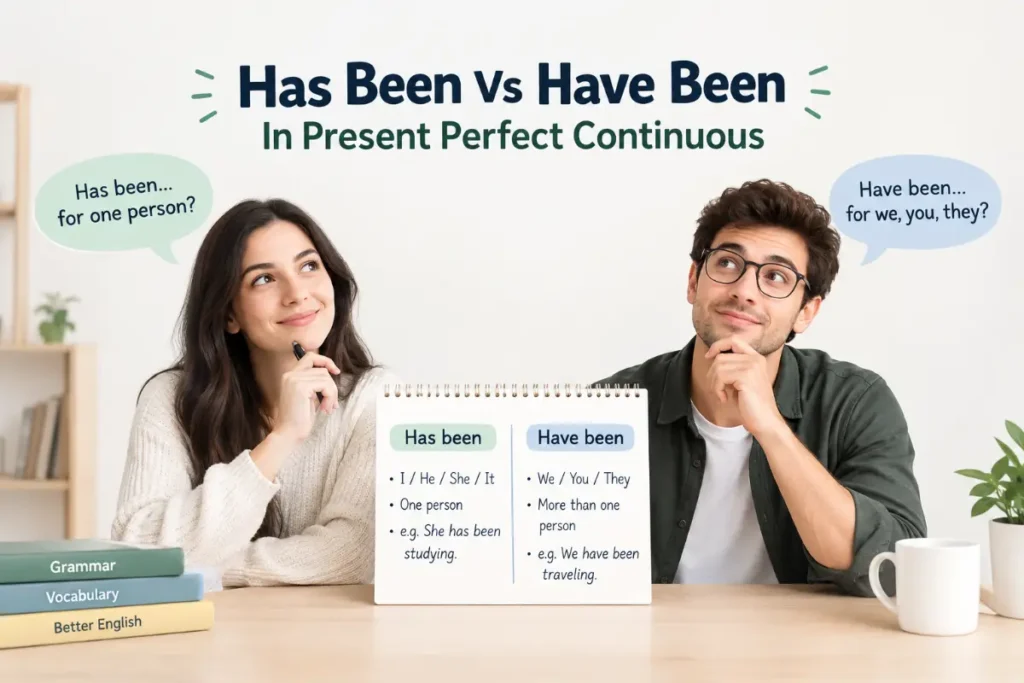
Has Been Vs Have Been In Present Perfect Continuous
This is one of the most common places you’ll see both forms.
The present perfect continuous describes an activity that started in the past and continues up to now or has recently stopped with a visible result.
The basic structure is:
Subject + has or have been + verb ending in ing.
Examples:
She has been studying.
They have been studying.
He has been working.
We have been working.
The word been remains the same. The helping verb changes.
Has Been Working
Use this structure with a singular third person subject.
He has been working all day.
She has been learning Spanish.
The company has been hiring new employees.
The dog has been sleeping for hours.
Have Been Working
Use this structure with I, you, we, they, and plural subjects.
I have been working all day.
You have been learning quickly.
We have been learning Spanish.
They have been working since morning.
The employees have been preparing the report.
Has Been Vs Have Been With Since And For
Since identifies the starting point.
For identifies the length of time.
Both can work with has been and have been.
Examples with has been:
She has been here since Monday.
He has been working for three hours.
The company has been operating since 1995.
Examples with have been:
We have been here since Monday.
They have been working for three hours.
The companies have been operating since 1995.
A useful test is to ask what the subject is doing grammatically before you choose the verb.
If the subject is she, use has.
If the subject is they, use have.
Has Been Vs Have Been With Singular And Plural Nouns
Nouns can make the choice slightly harder because a long noun phrase can hide the actual subject.
Consider this sentence:
The list of changes has been updated.
The subject is list, not changes.
List is singular, so we use has been.
Now compare:
The changes to the policy have been approved.
The subject is changes. It is plural, so we use have been.
This is a common proofreading issue. Writers sometimes choose the verb based on the noun closest to it rather than the actual subject.
More Examples
The group of students has been waiting.
The groups of students have been waiting.
The box of documents has been opened.
The boxes of documents have been opened.
The collection of photographs has been preserved.
The photographs in the collection have been preserved.
The main noun controls agreement.
Has Been Vs Have Been With Collective Nouns
Collective nouns can cause confusion because English usage differs across regions and style traditions.
Words such as team, family, company, government, and committee can refer to a group.
In American English these nouns are generally treated as singular when the group acts as one unit.
So American English normally uses:
The team has been practicing.
The company has been growing.
The committee has been meeting every Friday.
British English can sometimes use plural agreement when the members of the group are being emphasized.
For example:
The team have been arguing among themselves.
American writers generally prefer:
The team has been arguing among themselves.
The exact style can depend on the publication and the intended meaning. For American English writing the safest general rule is to treat a collective noun as singular when it represents one group acting as a unit.
Has Been Vs Have Been In Passive Sentences
Both forms also appear in the present perfect passive.
The structure is:
Subject + has or have been + past participle.
Examples:
The report has been completed.
The reports have been completed.
The house has been renovated.
The houses have been renovated.
The same agreement rule applies.
A singular subject takes has been.
A plural subject takes have been.
This is important because passive sentences often contain several nouns. Don’t let the noun after been distract you from the subject.
Compare:
The report has been reviewed by the editors.
The subject is report. It is singular.
The reports have been reviewed by the editor.
The subject is reports. It is plural.
Has Been Vs Have Been In Questions
The same rule applies when you form questions.
For has been questions:
Has she been working?
Is he feeling better?
Do you know if the store has been open today?
For have been questions:
Have you been working?
Are they still waiting?
Do you know if the students have been studying?
Notice that the helping verb moves before the subject.
The basic pattern becomes:
Has or have + subject + been + rest of sentence?
Has Been Vs Have Been In Negative Sentences
Negative forms are also straightforward.
Use has not been or hasn’t been with singular third person subjects.
Use have not been or haven’t been with I, you, we, they, and plural subjects.
Examples:
She hasn’t been feeling well.
He hasn’t been available.
The store hasn’t been open.
I haven’t been sleeping well.
We haven’t been informed.
They haven’t been contacted.
Contractions are especially common in everyday American English.
In formal writing you may choose the full forms:
She has not been available.
They have not been informed.
In casual emails or conversation the contractions sound more natural:
She hasn’t been available.
They haven’t been informed.
Has Been Vs Have Been With Pronouns
Pronouns make the rule easy to see.
| Pronoun | Correct form |
|---|---|
| I | have been |
| You | have been |
| He | has been |
| She | has been |
| It | has been |
| We | have been |
| They | have been |
Memorize this pattern and many sentences will become automatic.
The most important pair to remember is:
He has been.
They have been.
Then remember the special case:
I have been.
That small set gives you a strong foundation for the rest of the grammar.
A Simple Way To Choose Between Them
When you’re unsure about has been vs have been don’t stare at the two phrases. Look at the subject.
Try replacing the subject with a pronoun.
For example:
The manager has been working.
Replace the manager with she.
She has been working.
That confirms has been.
Now try:
The managers have been working.
Replace the managers with they.
They have been working.
That confirms have been.
This substitution test is one of the easiest methods teachers use because it works even when the original subject is complicated.
Common Sentence Patterns
Once you recognize the main structures you can use these forms with much more confidence.
Has Been + Adjective
She has been patient.
The weather has been strange.
The process has been difficult.
Have Been + Adjective
They have been patient.
We have been careful.
The results have been impressive.
Has Been + Noun
He has been a teacher for years.
She has been the manager since June.
Have Been + Noun
They have been friends since childhood.
We have been neighbors for ten years.
Has Been + Ing Verb
He has been studying.
She has been cooking.
The company has been expanding.
Have Been + Ing Verb
I have been studying.
We have been cooking.
They have been expanding.
Has Been + Past Participle
The letter has been sent.
The building has been repaired.
Have Been + Past Participle
The letters have been sent.
The buildings have been repaired.
These patterns cover a large share of the situations where English speakers use has been and have been.
The Biggest Difference To Remember
The meaning of has been and have been isn’t usually different by itself.
The main difference is subject agreement.
Think of has and have as two forms of the same helping verb.
The subject chooses the form.
She → has been.
He → has been.
It → has been.
I → have been.
You → have been.
We → have been.
They → have been.
Once that pattern becomes familiar you won’t need to guess. You can identify the subject and select the correct form naturally.
Why People Confuse Has Been And Have Been
The confusion usually starts with the fact that has and have both belong to the same verb. They also appear before been in many of the same sentence patterns.
The real difference isn’t the word been. It’s the subject that comes before the verb.
For example.
The child has been sleeping.
The children have been sleeping.
The sentence structure barely changes. The subject changes from singular to plural and the helping verb changes with it.
Similar Sentence Structure
Both forms can describe something that started in the past and connects to the present.
She has been working here for five years.
They have been working here for five years.
That similarity makes the forms easy to confuse. English learners often remember the whole phrase without paying attention to the subject.
The Role Of Subject Verb Agreement
English verbs change form to agree with certain subjects.
With has been, the subject is normally a singular third person subject.
With have been, the subject can be first person singular, second person singular or plural, first person plural, third person plural, and more.
That sounds complicated at first. In practice, the pronoun chart makes it much easier.
| Subject | Correct form | Example |
|---|---|---|
| I | have been | I have been studying. |
| You | have been | You have been studying. |
| He | has been | He has been studying. |
| She | has been | She has been studying. |
| It | has been | It has been raining. |
| We | have been | We have been studying. |
| They | have been | They have been studying. |
The pattern becomes much easier once you stop thinking about has and have as separate vocabulary words and see them as forms of the same auxiliary verb.
Has Been And Have Been In Different Tenses
The phrases has been and have been often appear in perfect constructions. However, the exact meaning depends on what follows them.
This is important because the same two words can introduce different grammatical structures.
Present Perfect With Been
The present perfect can describe a past experience or a situation that connects to the present.
She has been to Chicago.
They have been to Chicago.
In these sentences been is the past participle of be and the phrase describes experience.
It can also describe a continuing state.
He has been a teacher for twenty years.
They have been friends since childhood.
Present Perfect Continuous
Add an ing verb after been and you get the present perfect continuous.
She has been studying.
They have been studying.
This form emphasizes an activity that has continued over a period of time.
For example.
She has been studying for three hours.
The focus is on the ongoing activity.
Present Perfect Passive
When been comes before a past participle the construction can be passive.
The report has been completed.
The reports have been completed.
Here the report receives the action.
This structure is common in workplace writing academic writing journalism and official communication.
Has Been Vs Have Been In Everyday Conversation
Native speakers use both forms constantly in ordinary speech.
The main difference comes from the subject rather than the level of formality.
Consider these examples.
I’ve been busy.
She’s been busy.
We’ve been busy.
They’ve been busy.
In spoken American English contractions are very common.
I have becomes I’ve.
You have becomes you’ve.
We have becomes we’ve.
They have becomes they’ve.
He has becomes he’s.
She has becomes she’s.
It has becomes it’s.
This can create another layer of confusion because the written form hides the difference.
For example.
She’s been working.
The contraction she’s means she has in this sentence.
But in another sentence it can mean she is.
She’s working.
The surrounding grammar tells you which meaning is intended.
Has Been Vs Have Been In Questions And Answers
Short answers can also help you recognize the correct form.
Question.
Has Maria been working today?
Answer.
Yes she has.
Question.
Have Maria and David been working today?
Answer.
Yes they have.
The answer repeats the auxiliary verb used in the question.
This gives you a useful grammar clue. If the question begins with has then a third person singular answer normally uses has.
If it begins with have then the answer normally uses have.
Has Been Vs Have Been With Long Subjects
Long subjects cause many agreement mistakes.
Consider this sentence.
The list of recommended books has been updated.
Some writers see books close to the verb and mistakenly choose have.
But books isn’t the subject.
The subject is list.
Since list is singular the correct sentence is:
The list of recommended books has been updated.
Now look at this sentence.
The recommended books on the list have been updated.
Here books is the subject and it is plural.
So have been is correct.
A Reliable Editing Trick
Ignore extra words between the subject and the verb.
Look for the main noun.
The collection of old photographs has been preserved.
Main noun: collection.
Correct form: has been.
The photographs from the old collection have been preserved.
Main noun: photographs.
Correct form: have been.
This technique is especially useful when proofreading essays reports and professional documents.
Has Been Vs Have Been With Indefinite Pronouns
Some pronouns are singular and therefore take has been.
Examples include:
Everyone has been invited.
Someone has been calling.
Each has been inspected.
Nobody has been informed.
Other pronouns are plural.
Many have been affected.
Several have been selected.
Few have been completed.
There are also pronouns that can be singular or plural depending on the noun they refer to.
All of the water has been used.
All of the bottles have been used.
The word all doesn’t automatically determine the verb. The noun that follows it helps determine agreement.
Has Been Vs Have Been With There
Sentences beginning with there can make subject agreement harder to spot.
Consider:
There has been a problem.
The real subject is a problem. It is singular.
Now compare:
There have been several problems.
The subject is several problems. It is plural.
This gives us an important pattern.
There has been + singular noun.
There have been + plural noun.
Examples.
The schedule has changed.
An error has appeared in the report.
A delay has also occurred.
But:
Several changes have been made.
Many errors have also been found.
Three delays have occurred.
This distinction matters in both conversation and formal writing.
Learn the difference in Footnote Before or After Period (2026 Guide).
Has Been Vs Have Been With Uncountable Nouns
Uncountable nouns generally take singular agreement.
For example:
The information has been useful.
The research has been valuable.
The equipment has been inspected.
The furniture has been delivered.
Even though these things can represent large amounts they are grammatically singular in standard English.
So we use has been.
Compare:
The equipment has been repaired.
The machines have been repaired.
The first subject is an uncountable noun. The second is a plural count noun.
Real Life Examples Of Has Been And Have Been
Seeing the forms in different settings helps you develop an instinct for correct usage.
Daily Conversation
- I’ve been tired all week.
- She’s been busy since Monday.
- We’ve been friends for years.
- They’ve been waiting outside.
- He’s been very quiet today.
- You’ve been really helpful.
These examples sound natural because the contractions match normal conversational English.
Workplace Communication
- The manager has been reviewing the proposal.
- The employees have been preparing for the meeting.
- The company has been expanding into new markets.
- The teams have been working on separate projects.
- The report has been sent to the client.
- The reports have been sent to the clients.
Professional writing often uses these structures to describe ongoing work or completed processes.
Email Writing
- I have been trying to reach you about the schedule.
- She has been handling the account since January.
- We have been reviewing the documents.
- The request has been approved.
These forms work well in professional emails because they clearly connect past actions with the current situation.
Academic Writing
- Researchers have been studying the effects of sleep deprivation.
- The study has been cited by several scholars.
- The authors have been examining changes in language use.
- The theory has been debated for decades.
Academic writing often uses the present perfect to connect earlier research with current knowledge.
Journalism
- The government has been investigating the issue.
- Officials have been monitoring the situation.
- The company has been facing criticism.
- Several organizations have been calling for reform.
The tense helps journalists describe developments that remain relevant at the time of writing.
Social Media
- I’ve been thinking about this all day.
- You’ve been amazing.
- She’s been the real MVP.
- They’ve been posting updates all morning.
These examples show how the grammar works in casual digital communication too.
Common Mistakes With Has Been And Have Been
Most errors fall into a few predictable groups.
Mistake One Using Has With I
Incorrect:
I has been working all day.
Correct:
I have been working all day.
Even though I refers to one person it takes have.
Mistake Two Using Have With He
Incorrect:
He have been waiting.
Correct:
He has been waiting.
Third person singular subjects take has.
Mistake Three Using Has With They
Incorrect:
They has been studying.
Correct:
They have been studying.
They takes have in standard English.
Mistake Four Using Have With A Singular Noun
Incorrect:
The company have been growing.
For standard American English:
The company has been growing.
The noun company is singular.
Mistake Five Letting A Nearby Plural Noun Control The Verb
Incorrect:
The list of items have been updated.
Correct:
The list of items has been updated.
The subject is list.
Mistake Six Confusing There Has Been And There Have Been
Incorrect:
There has been several problems.
Correct:
There have been several problems.
The noun problems is plural.
But:
There has been a problem.
That sentence is correct because problem is singular.
Has Been Vs Have Been In Formal Writing
Both forms are completely normal in formal English.
You don’t need to avoid them in academic papers reports business documents or professional emails.
The important issue is correct agreement and clear meaning.
For example:
The committee has been reviewing the proposal.
This is perfectly appropriate for a formal report.
So is:
The researchers have been examining the results.
There is no need to replace these structures with complicated alternatives simply to sound professional.
Good formal writing is usually clear rather than unnecessarily complicated.
Has Been Vs Have Been In Informal Writing
Informal writing often uses contractions.
Instead of:
She has been working all day.
You might write:
She’s been working all day.
Instead of:
They have been waiting for us.
You might write:
They’ve been waiting for us.
Both forms are grammatically correct.
The full form can sound more deliberate or formal. The contraction usually sounds more natural in conversation and casual messages.
Has Been Vs Have Been In American English
American English follows the same core subject agreement rule.
Use:
The company has been growing.
The companies have been growing.
He has been working.
They have been working.
I have been working.
There isn’t a separate American spelling rule that changes has been into have been.
The difference is grammatical rather than regional.
British English follows the same basic rule. Some differences can appear with collective nouns because British English sometimes allows plural agreement when the individual members of a group are the focus.
Canadian and Australian English also use the same basic distinction.
For American English writing the standard rule remains straightforward.
Singular third person takes has been.
I you we they and plural subjects take have been.
How Native Speakers Choose The Right Form
Native speakers rarely stop to think about the grammar rule consciously.
They recognize the subject and the correct verb pattern almost automatically.
You can build the same instinct by practicing sentence pairs.
Read these aloud:
She has been working.
They have been working.
The dog has been sleeping.
The dogs have been sleeping.
The company has been growing.
The companies have been growing.
The repeated pattern trains your ear and your writing at the same time.
After enough practice the wrong version begins to sound noticeably unnatural.
When Has Been And Have Been Cannot Be Swapped
These forms aren’t interchangeable.
Compare:
The child has been crying.
The children have been crying.
Changing the helping verb without changing the subject creates a grammar error.
You also can’t choose based on the length of the subject.
The group of students has been studying.
Not:
The group of students have been studying.
The word students is plural but it isn’t the main subject.
Likewise:
The students in the group have been studying.
Now students is the subject and have been is correct.
The key is always grammatical agreement.
A Fast Test For Writers And English Learners
If you’re writing quickly and suddenly wonder if you need has been or have been use this three step test.
- Find the subject.
- Replace it with a pronoun.
- Choose the matching form.
Example:
The new employee has been learning quickly.
Replace the new employee with she.
She has been learning quickly.
So has been is correct.
Now:
The new employees have been learning quickly.
Replace the subject with they.
They have been learning quickly.
So have been is correct.
This method works far better than choosing the form by sound alone.
A Useful Pattern For Memorization
Keep this small pattern in your head:
I have been.
You have been.
He has been.
She has been.
It has been.
We have been.
They have been.
If you know these seven patterns you already know the core rule.
The rest is practice.
Common Mistakes In Has Been And Have Been
The most common errors with has been and have been happen when writers focus on the word closest to the verb instead of the actual subject.
The safest habit is to identify the subject first. Once you know the subject you can choose has or have with confidence.
Using Has Been With I
Incorrect.
I has been working all morning.
Correct.
I have been working all morning.
The pronoun I always takes have in this construction.
Using Have Been With He She Or It
Incorrect.
She have been waiting for an hour.
Correct.
She has been waiting for an hour.
The same rule applies to he and it.
He has been studying.
It has been raining.
Using Has Been With They
Incorrect.
They has been looking for you.
Correct.
They have been looking for you.
They takes have even when it refers to one person in singular they usage.
For example:
Jordan has been working late.
They have been working late.
The pronoun controls the verb form.
Using Have Been With A Singular Noun
Incorrect.
The student have been studying.
Correct.
The student has been studying.
Now change the noun to its plural form.
The students have been studying.
The change from student to students changes the helping verb from has to have.
Letting A Nearby Noun Control The Verb
This is one of the most important proofreading mistakes.
Incorrect.
The collection of photographs have been damaged.
Correct.
The collection of photographs has been damaged.
The subject is collection. The word photographs is part of a longer noun phrase but doesn’t control the verb.
Compare this sentence:
The photographs in the collection have been damaged.
Now photographs is the subject. Therefore have been is correct.
Has Been And Have Been With There
The construction there has been and there have been deserves special attention.
Use there has been with a singular noun.
There has been a problem.
An accident has occurred.
The schedule has also changed.
Use there have been with a plural noun.
Several problems have come up.
Two accidents have also occurred.
Many changes have been made.
This pattern appears frequently in news reports professional writing and everyday conversation.
A quick test is to look at the noun that follows been.
A problem is singular.
Several problems is plural.
That tells you which form to use.
Has Been And Have Been With Collective Nouns
Collective nouns can create some regional differences.
Words such as team family company government and committee describe groups but can function grammatically as singular nouns.
In standard American English the singular form is normally preferred when the group acts as one unit.
The team has been practicing.
The company has been growing.
The committee has been discussing the proposal.
British English sometimes uses plural agreement when the writer wants to emphasize the individual members.
The team have been arguing among themselves.
American readers generally expect the singular form in this situation:
The team has been arguing among themselves.
For American English writing keep the rule simple. Treat a collective noun as singular when it represents one unified group.
Has Been And Have Been In Passive Voice
Both forms work in passive constructions.
The structure is:
Subject + has or have been + past participle.
Examples include:
The report has been completed.
The reports have been completed.
The building has been repaired.
The buildings have been repaired.
The subject still controls the helping verb.
This point matters because passive sentences often contain several nouns.
Consider:
The report has been reviewed by the editors.
The subject is report.
Now compare:
The reports have been reviewed by the editor.
The subject is reports.
The words editors and editor don’t affect the choice.
Has Been And Have Been In Questions
Questions follow the same agreement rule.
Use has with singular third person subjects.
Has she been working today?
Is he feeling better?
Do you know if the store has been open?
Use have with I you we they and plural subjects.
Have you been working today?
Have they been feeling better?
Have the stores been open?
The helping verb moves before the subject but keeps the same agreement pattern.
Short Answers
The same pattern appears in short answers.
Has she been busy?
Yes she has.
Have they been busy?
Yes they have.
This makes short answers a useful way to practice subject verb agreement.
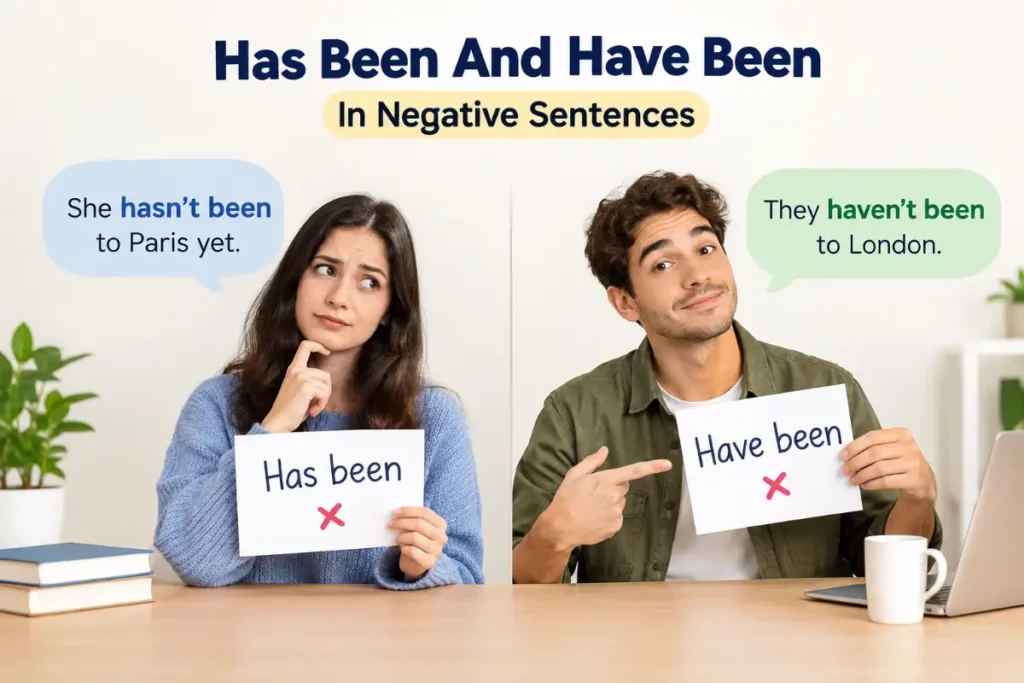
Has Been And Have Been In Negative Sentences
Negative sentences use not after the helping verb.
With singular third person subjects:
She has not been sleeping well.
He has not been available.
The store has not been open.
With I you we they and plural subjects:
I have not been sleeping well.
We have not been informed.
They have not been contacted.
Contractions are common in everyday American English.
She hasn’t been sleeping well.
They haven’t been contacted.
In formal writing the full forms may sound more deliberate.
The company has not been informed.
The employees have not been notified.
Both are grammatically correct.
Real Life Examples You Can Copy
The following examples show how native speakers use these forms across different settings.
Everyday Conversation
- I have been tired all week.
- She’s been busy since Monday.
- We’ve been friends for years.
- They’ve been waiting outside.
- He’s been quiet today.
- You’ve been very helpful.
Workplace Writing
- The manager has been reviewing the proposal.
- The employees have been preparing for the meeting.
- The company has been expanding rapidly.
- The teams have been working on separate projects.
- The report has been sent to the client.
- The reports have been sent to the clients.
Email Writing
- I have been trying to reach you about the schedule.
- She has been handling the account since January.
- We have been reviewing the documents.
- The request has been approved.
- They have been waiting for your response.
Academic Writing
- Researchers have been studying the effects of sleep deprivation.
- The study has been cited by several scholars.
- The authors have been examining changes in language use.
- The theory has been debated for decades.
- The results have been analyzed using several methods.
Journalism
- The government has been investigating the issue.
- Officials have been monitoring the situation.
- The company has been facing criticism.
- Several organizations have been calling for reform.
Informal Online Writing
- I’ve been thinking about this all day.
- You’ve been amazing.
- She’s been posting updates all morning.
- They’ve been talking about it for weeks.
Memory Tricks For Has Been And Have Been
You don’t need a complicated grammar formula.
Use the pronoun trick.
Has Belongs With He She And It
Think:
He has been.
She has been.
It has been.
If you can replace the subject with one of these pronouns then has been is usually the right choice.
Have Belongs With I You We And They
Think:
I have been.
You have been.
We have been.
They have been.
If the subject matches one of these pronouns use have been.
Remember The Special I Rule
Many learners see I as singular and assume it should take has.
Don’t make that assumption.
Standard English says:
I have been.
Not:
I has been.
The form I have is simply part of standard English grammar.
Related Words And Expressions
Understanding related forms can help you see the larger grammar system.
Be
Be is the base form.
I want to be ready.
Am
Am is used with I in the present tense.
I am ready.
Is
Is is used with singular third person subjects.
She is ready.
Are
Are is used with you we they and plural subjects.
They are ready.
Was
Was is commonly used with I and singular third person subjects in the simple past.
She was ready.
Were
Were is used with you we they and plural subjects.
They were ready.
Been
Been is the past participle of be.
It appears in perfect constructions.
She has been busy.
They have been busy.
Seeing the whole family of forms makes has been and have been easier to understand.
Has Been Vs Have Been Vs Had Been
Another common source of confusion is had been.
The difference is mainly about time.
Has been connects a past situation with the present and works with singular third person subjects.
She has been working here for five years.
Have been does the same with I you we they and plural subjects.
They have been working here for five years.
Had been refers to a situation that happened before another point in the past.
She had been working there for five years before she moved.
They had been working there for five years before they moved.
The simple timeline is:
Has been connects past and present.
Have been connects past and present.
Had been places the situation before another past event.
This distinction becomes especially useful when writing stories reports and academic explanations.
Has Been Vs Have Been Vs Is And Are
Learners also sometimes confuse perfect forms with simple present forms.
Compare:
She is tired.
She has been tired.
The first describes her current state.
The second suggests that the state began earlier or has existed during a period leading to now.
Now compare:
They are busy.
They have been busy.
Again the first focuses on the current condition. The second connects the condition with a previous period.
The difference isn’t always dramatic in casual conversation but it can change the time meaning of a sentence.
Has Been Vs Have Been In Questions About Experience
The present perfect form has been or have been can also describe life experience.
Has she been to California?
Have they been to California?
Have you been to California?
Here been to usually means that someone visited a place and returned.
This differs from:
She has gone to California.
That sentence normally suggests she went there and hasn’t returned yet or that her current location is California.
This is a useful distinction for English learners because has been and has gone can look similar but communicate different situations.
Expert Editor’s Note
From an editing perspective the safest approach is simple.
Don’t choose has been or have been because one sounds more formal. Don’t choose based on the noun closest to the verb. Identify the grammatical subject first.
Professional editors also look at the entire verb phrase.
In She has been studying the phrase expresses a present perfect continuous action.
In She has been a teacher it expresses a continuing state or role.
In The report has been completed it forms part of a present perfect passive construction.
The word been stays the same in all three examples. The surrounding grammar determines the meaning.
Dictionaries and standard grammar references treat has and have as forms of the auxiliary verb have. The choice follows subject agreement.
For American English the practical rule is reliable.
He she it and singular nouns take has been.
I you we they and plural nouns take have been.
When editing your own work don’t make the sentence more complicated than it needs to be. Find the subject and match the verb.
Final Takeaway
The difference between has been vs have been isn’t about choosing the better phrase. Both are correct.
The choice depends on the subject.
Use has been with he, she, it, and singular nouns.
Use have been with I, you, we, they, and plural nouns.
Remember one more important point. I takes have, even though it refers to one person.
If you can identify the subject then you can usually solve the problem in seconds. Good grammar often works that way. Once you see the pattern the guesswork disappears.
Frequently Asked Questions
Should I Say I Have Been Or I Has Been?
You should say I have been. The pronoun I takes have in standard English. For example you can say I have been working all day or I have been waiting since noon. Never use I has been in standard English.
Should I Say She Has Been Or She Have Been?
Use she has been. She is a third person singular pronoun so it takes has. For example She has been studying for three hours is correct. The form she have been is not standard English.
Is It They Have Been Or They Has Been?
The correct form is they have been. The pronoun they takes have. This remains true when singular they refers to one person. For example Alex said they have been working all morning follows standard subject verb agreement.
Why Do We Say I Have Been If I Is Singular?
English doesn’t use has with every singular subject. The pronoun I has its own agreement pattern and takes have. This is also seen in other perfect constructions such as I have finished and I have seen it. So I have been is the standard form.
Is Has Been Present Perfect?
Yes. Has been can form part of the present perfect. For example She has been to Boston uses the present perfect. It can also appear in the present perfect continuous as in She has been working and in the present perfect passive as in The report has been completed.
Is Have Been Present Perfect Continuous?
It can be. In a sentence such as They have been working all morning the structure is present perfect continuous. However have been can also appear in other perfect constructions. For example They have been to Boston uses the present perfect to describe experience.
Which Sounds More Natural Has Been Or Have Been?
Neither is more natural by itself. The subject determines the correct form. She has been working sounds natural because she takes has. They have been working sounds natural because they takes have. The important issue is agreement rather than style.
What Is The Easiest Way To Remember Has Been And Have Been?
Memorize two groups. He she and it have has been. I you we and they have have been. Then check the main subject before choosing the verb. This simple habit prevents most errors with these two forms.
For another common grammar confusion, see Any Problem Or Any Problems Which One Is Correct 2026.
Final Editorial Recommendation
When you’re unsure about has been or have been, don’t rely on what sounds familiar. Find the subject first.
She has been.
He has been.
It has been.
I have been.
You have been.
We have been.
They have been.
That small pattern covers the heart of the rule. Master it and you’ll get these forms right in everyday speech academic writing professional emails and almost every other situation where English uses has been or have been.

Senior Grammar Editor
Olivia Reynolds is a grammar editor and language writer who enjoys making complex English rules easy to understand. She specializes in grammar, punctuation, sentence structure, and everyday writing tips, helping readers write with greater confidence and clarity.