
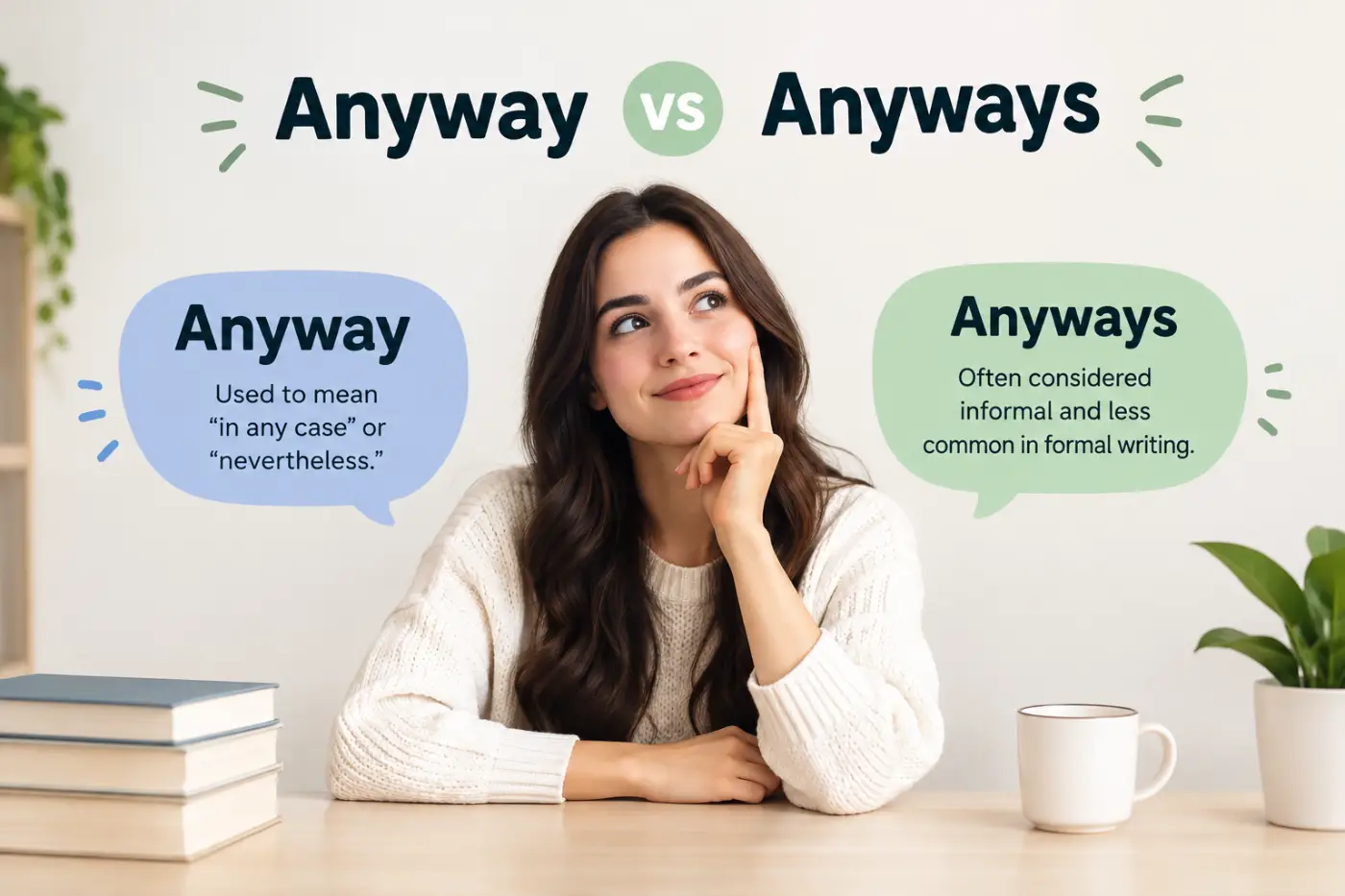
The choice between anyway vs anyways looks simple until you notice that both forms appear everywhere. You might see anyway in formal writing and then come across anyways in a text message or casual conversation. That can make you wonder if one is wrong or if they simply belong to different varieties of English.
The short answer is that anyway is the standard form in modern English. Anyways also exists and is widely used in informal American English. It can sound natural in conversation but many editors consider it less suitable for formal writing.
The confusion comes from the fact that anyways looks like a normal adverb ending in s. English has many words that work this way. However anyway has a long history as the standard form and its use covers several meanings.
You can use anyway to mean regardless of what happened. You can also use it to return to a topic or emphasize that something remains true. In casual speech you may hear anyways used in the same situations.
This guide explains the difference between anyway and anyways with clear definitions grammar rules pronunciation examples and practical advice for everyday and professional writing.
Learn the difference in Has Been Vs Have Been Which One Is Correct (2026).
Quick Answer
Anyway is the standard form and the safest choice in all types of English writing. Anyways is also used in informal American English and casual speech. It usually has the same basic meaning as anyway but can sound less formal or nonstandard to some readers. For school work professional writing and formal communication use anyway.
Anyway Vs Anyways Comparison Table
| Feature | Anyway | Anyways |
|---|---|---|
| Correct English | Yes | Yes in informal usage |
| Standard form | Yes | No |
| Part of speech | Adverb | Adverb |
| Main meaning | Regardless or in spite of that | Usually the same as anyway |
| Formal writing | Recommended | Usually avoid |
| Casual conversation | Very common | Common in some varieties |
| American English | Common | Common in informal speech |
| British English | Standard | Less common |
| Canadian English | Standard | Mostly informal |
| Australian English | Standard | Mostly informal |
| Pronunciation | Usually pronounced anyway | Usually pronounced anyways |
| Tone | Neutral | Casual |
| Safe choice | Yes | No for formal writing |
| Example | I was tired but I went anyway. | I was tired but I went anyways. |
What Does Anyway Mean
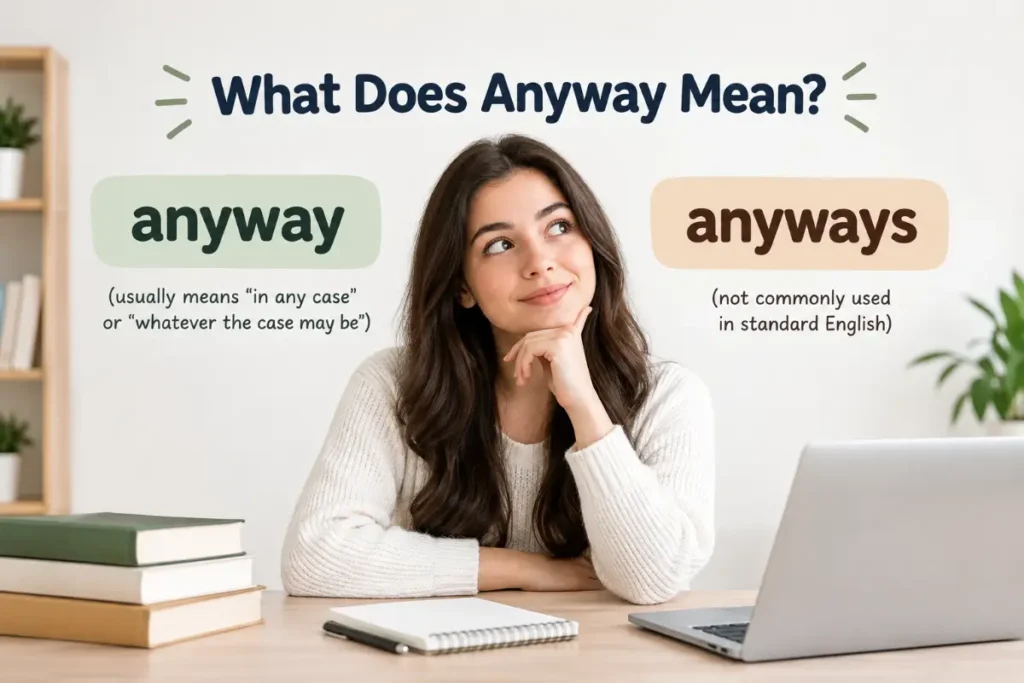
Anyway is an adverb with several closely related uses.
The most common meaning is regardless or in spite of something.
For example:
I was tired but I went anyway.
The speaker was tired. That fact didn’t change the decision.
Anyway can also help a speaker return to an earlier topic.
For example:
Anyway I need to finish this report before lunch.
Here the word doesn’t mean regardless in a strict sense. Instead it signals a shift back to the main point.
It can also emphasize that something is true despite a possible objection.
For example:
It was expensive but I bought it anyway.
The price was a problem. The speaker bought the item despite that problem.
Anyway As A Word For Regardless
This is one of the most useful meanings to remember.
Consider this sentence:
I didn’t feel ready but I applied anyway.
The meaning is:
I didn’t feel ready but I applied regardless.
Another example is:
The weather was terrible but we went anyway.
The bad weather didn’t stop the plan.
Anyway As A Conversation Marker
People also use anyway to move a conversation forward.
For example:
Anyway what time are you leaving tomorrow?
The speaker may have been discussing another subject and now wants to return to the main topic.
You might also hear:
Anyway where were we?
This use is extremely common in spoken English.
Anyway For Returning To The Main Point
Writers and speakers often use anyway when they want to stop discussing a side issue.
For example:
The meeting took longer than expected. Anyway we need to finish the budget today.
The word helps the writer return to the main subject.
It can act like a small signpost in conversation.
What Does Anyways Mean
Anyways is a variant of anyway. It appears most often in informal American speech and writing.
In many casual sentences it carries the same basic meaning.
For example:
I was tired but I went anyways.
This sentence is common in casual conversation.
However many teachers editors and style guides prefer:
I was tired but I went anyway.
The difference isn’t usually about meaning. It is mainly about register and standard usage.
Register means the level or style of language used in a particular situation.
Anyway works comfortably in casual conversation formal writing academic work emails journalism and professional communication.
Anyways feels more conversational.
Is Anyways Wrong
Calling anyways simply wrong would be too broad.
English speakers have used the form for a long time and modern speakers still use it. Major dictionaries record it as an informal or dialectal form.
The important point is practical rather than absolute.
If you’re writing an essay a business email a school assignment a report or a formal article anyway is the better choice.
If you’re writing dialogue a casual text message or a deliberately conversational piece anyways can fit the voice.
That distinction gives you a much more useful rule than simply memorizing that one word is right and the other is wrong.
Which One Is Correct
Anyway is the standard and preferred form.
Anyways is an informal variant that appears mainly in casual speech and informal writing.
So if you’re unsure which one to use choose anyway.
For example:
Correct and standard:
I didn’t want to go but I went anyway.
Informal:
I didn’t want to go but I went anyways.
Both sentences communicate the same basic idea.
The first version works almost everywhere. The second has a more casual conversational feel.
The Best Rule For Writers
Use anyway by default.
Use anyways only when the informal tone is intentional.
This is especially important in professional and academic writing. You don’t gain anything by using anyways there. Anyway is clearer safer and more widely accepted.
Why People Confuse Anyway And Anyways
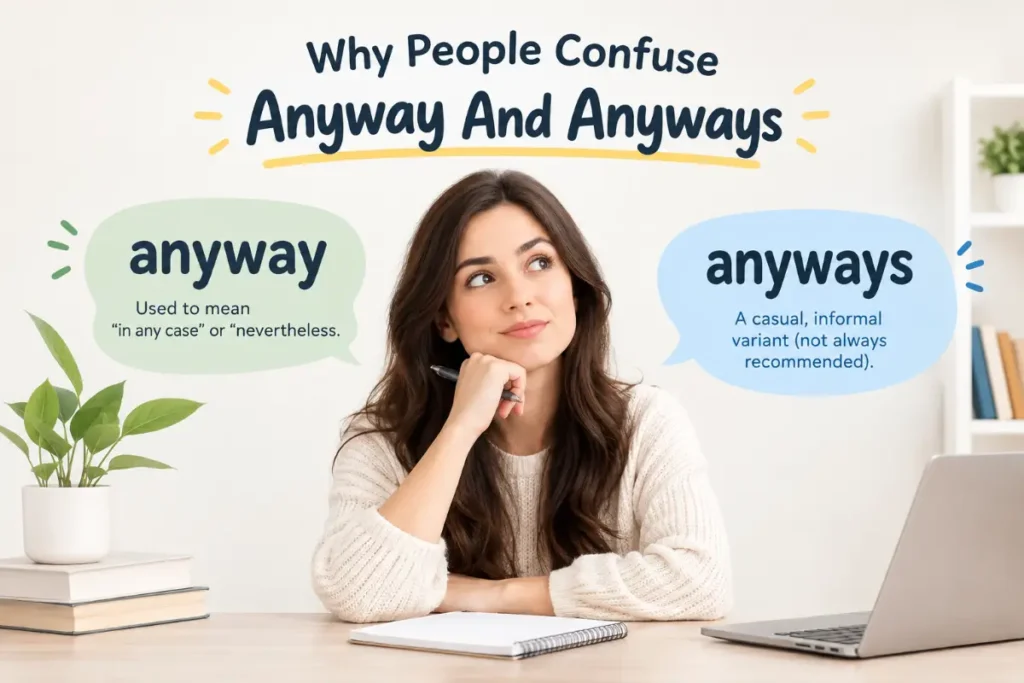
The confusion isn’t surprising. Several features of English make anyways look perfectly reasonable.
The Extra S Looks Familiar
English has many adverbs that end in s.
Examples include:
- Sometimes.
- Always.
- Afterwards.
- Besides.
- Likewise.
Because of this pattern learners may assume that adding s to anyway creates another standard form.
But English doesn’t always follow a perfectly predictable pattern.
Anyway developed as its own established word. The extra s in anyways doesn’t create a new grammatical meaning.
Spoken English Influences Writing
People often write the way they speak.
If someone regularly hears anyways from friends family members or online creators they may naturally use it in their own writing.
This is especially common in text messages social media comments and informal posts.
Social Media Makes Informal Forms More Visible
Online communication has made conversational English much more visible.
A person might see:
Anyways I’m heading home.
Then they may assume the form is equally appropriate in a college essay or business email.
The word itself isn’t the problem. The context matters.
Regional Usage Creates Confusion
English changes from one region and speech community to another.
American speakers commonly use anyways in casual conversation. Some speakers use it frequently while others rarely use it.
In other English speaking communities anyway is much more strongly preferred.
That doesn’t make one group of speakers wrong. It shows how register and regional habits shape language.
Autocorrect Is Not A Grammar Teacher
Digital writing tools can reinforce familiar patterns. If a word appears in your messages often enough a keyboard may stop drawing attention to it.
Autocorrect also doesn’t always tell you the best choice for a particular writing situation.
A word can be recognizable and still be a poor choice for formal prose.
Key Differences Between Anyway And Anyways
The biggest difference isn’t meaning. It is style.
Meaning
Both words can express the idea of doing something regardless of another fact.
I was sick but I went anyway.
I was sick but I went anyways.
The basic message is the same.
Grammar
Both function as adverbs.
They can modify a verb phrase or help connect ideas in a sentence.
For example:
She decided to stay anyway.
She decided to stay anyways.
The grammar structure remains essentially the same.
Register
This is where the distinction becomes useful.
Anyway has a neutral register.
Anyways has a more informal register.
That means anyway fits a wider range of situations.
Formality
For formal writing choose anyway.
Use it in:
- Academic papers.
- Business reports.
- Professional emails.
- Resumes.
- News writing.
- Formal essays.
- Official documents.
Anyways can sound too casual in these settings.
Regional Usage
Anyway is widely accepted throughout major English speaking regions.
Anyways is especially associated with informal American English although it isn’t limited to the United States.
The form also appears in other varieties of English and in older English usage.
Tone
Compare these:
I didn’t agree with the decision but I supported the team anyway.
I didn’t agree with the decision but I supported the team anyways.
The first sounds neutral.
The second sounds more conversational.
Neither creates a major difference in meaning.
Grammar Explanation
Understanding the grammar behind anyway and anyways helps explain why they can appear in similar sentences.
Both Words Function As Adverbs
An adverb can modify a verb adjective another adverb or an entire clause.
In:
I went anyway.
Anyway adds information about the action went.
The meaning is close to:
I went regardless.
In:
Anyway we should leave now.
The word works more like a discourse marker. It helps organize the conversation rather than simply modifying one verb.
Anyway Does Not Have Plural Forms
One common misunderstanding comes from the final s in anyways.
The s doesn’t mean that anyways is a plural form.
You don’t have:
one anyway
two anyways
That isn’t how the word works.
Anyway is an adverb and adverbs don’t become plural in this way.
Anyway Does Not Change With Tense
The word remains the same across verb tenses.
Present:
I don’t like the plan but I’ll support it anyway.
Past:
I didn’t like the plan but I supported it anyway.
Future:
I may not like the plan but I’ll support it anyway.
The form doesn’t change.
Anyway With Modal Verbs
You can use anyway with modal verbs such as will would can and might.
Examples:
I’ll go anyway.
She would have gone anyway.
He might complain anyway.
We can finish it anyway.
The word remains unchanged.
Where Should Anyway Go In A Sentence
Position can affect rhythm and emphasis.
At The End
This is one of the most common positions.
I decided to go anyway.
She bought the dress anyway.
We’ll finish the project anyway.
This position often emphasizes the idea of regardless.
At The Beginning
Anyway can also introduce a new thought or redirect a conversation.
Anyway I need to get back to work.
Anyway let’s talk about the real problem.
Anyway what happened next?
This use is especially common in conversation.
In The Middle
You can also place anyway inside a sentence.
I think anyway that we should leave.
This structure is possible but can sound less natural in many situations.
A smoother version might be:
I think we should leave anyway.
Good writers usually place the word where the meaning and rhythm feel clearest.
Anyway As A Conversation Marker
One important detail often missed in simple grammar explanations is that anyway doesn’t always mean regardless.
It can also organize spoken thought.
Imagine two friends talking.
One friend tells a long story about a delayed flight. After discussing several side details the other person says:
Anyway what time are we meeting tonight?
Here anyway signals a return to the main topic.
It can also signal that a speaker wants to end a subject.
For example:
Anyway I don’t want to argue about it anymore.
In this sentence the speaker isn’t saying regardless. Instead anyway helps close the discussion.
This makes the word especially useful in natural conversation.
Anyway And Anyways In Text Messages
Casual messaging is one place where anyways feels perfectly at home for many speakers.
You might see:
Anyways I’m almost home.
Anyways what are you doing later?
Anyways forget about it.
Anyways I should probably go.
These sentences reflect conversational speech.
If you’re texting a close friend there is usually no need to replace anyways with anyway unless you simply prefer the standard form.
The situation changes when the same sentence moves into a professional setting.
For example:
Anyways I wanted to follow up on our meeting.
A better professional version is:
Anyway I wanted to follow up on our meeting.
The second version sounds cleaner and more appropriate for work communication.
Anyway And Anyways In Formal Writing
Formal writing rewards precision and consistency.
For essays reports applications and professional documents anyway is the stronger choice.
For example:
The original approach was expensive. The company proceeded anyway.
That sentence is concise and neutral.
Using anyways would make the writing sound more conversational without adding meaning.
Academic writers usually have no reason to choose the informal variant.
The same principle applies to professional emails.
Instead of:
Anyways I wanted to ask about the revised schedule.
Write:
Anyway I wanted to ask about the revised schedule.
The second version feels more polished without sounding stiff.
Anyway Vs Anyways And Punctuation
Punctuation depends on the role anyway plays in the sentence.
When it appears at the beginning as a conversation marker it can be followed by a comma.
For example:
Anyway I need to leave.
In careful formal prose you may write:
Anyway I need to leave.
When the word works as an integrated adverb at the end of a sentence no special punctuation is normally needed.
For example:
I went anyway.
The important point is not to add punctuation simply because you see the word. Look at how it functions in the sentence.
Real Life Examples With Anyway
These examples show how anyway works naturally in different contexts.
Daily Conversation
- I didn’t feel like cooking but I made dinner anyway.
- She knew it would be difficult but she tried anyway.
- We missed the first bus but we got there anyway.
- I don’t really like coffee but I’ll have one anyway.
- Anyway what are you doing tonight?
Workplace
- The deadline was tight but the team finished the project anyway.
- We don’t have all the information yet but we can start anyway.
- Anyway I’ll send you the updated document this afternoon.
- The original plan changed but we moved forward anyway.
Professional Email
- Anyway I wanted to follow up on our conversation.
- The meeting was moved to Friday but I can attend anyway.
- Anyway please let me know if you need anything else.
Academic Writing
- The evidence was limited but the researchers continued their analysis anyway.
- The initial theory had several weaknesses but it remained influential anyway.
Journalism
- The storm caused major delays but flights continued anyway.
- The proposal faced strong criticism but the council approved it anyway.
Social Media
- I didn’t win but I had fun anyway.
- Anyway I’m taking a break from my phone tonight.
Literature And Dialogue
- I knew the journey would be difficult but I went anyway.
- Anyway the truth had to come out eventually.
These examples show why anyway is such a flexible word. It can express contrast or help manage the flow of a conversation.
Pro Insight
If you’re writing for a broad audience and you need one form that will never make readers pause anyway is the smart default. Save anyways for situations where you deliberately want a casual spoken voice.
The extra s isn’t the important part. Context is.
Common Mistakes With Anyway And Anyways
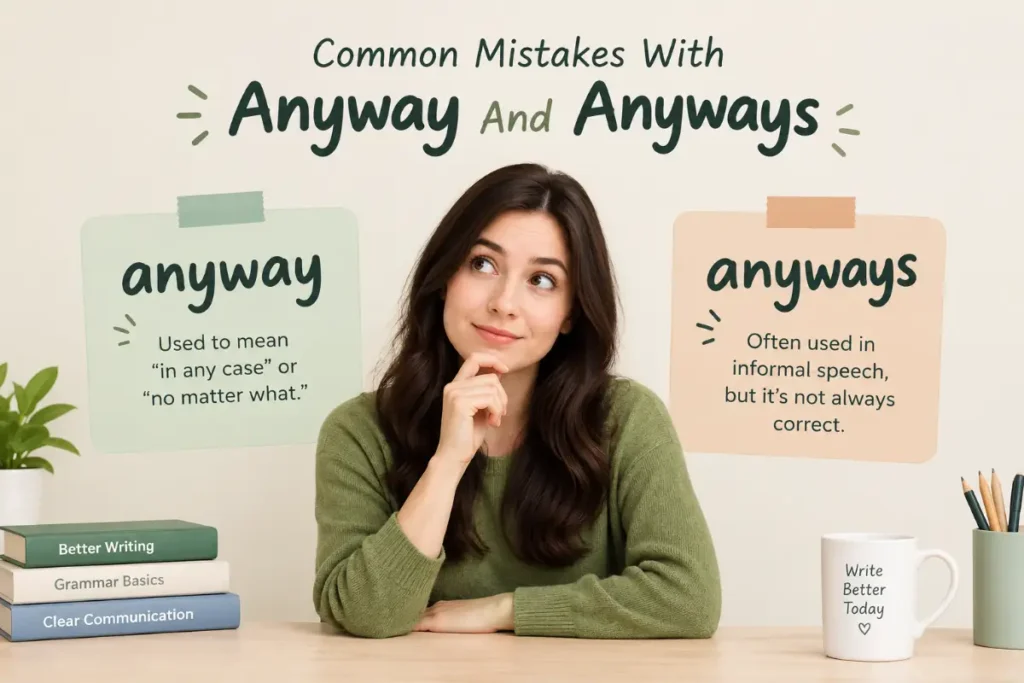
The biggest mistake is treating anyway and anyways as completely interchangeable in every setting. Their basic meaning can overlap but their tone and acceptability can change with the situation.
Using Anyways In Formal Writing
A sentence like this may sound too casual in a formal essay.
Anyways the results support the original argument.
A better version is:
Anyway the results support the original argument.
For academic and professional writing anyway is the safer choice because it has a neutral tone.
Assuming Anyways Is Always Wrong
The opposite mistake is also common.
Some people claim that anyways is never correct English. That isn’t accurate.
The word has a real history in English and dictionaries record its use. Modern speakers use it especially in informal American English.
The better rule is simple.
Anyways is informal. Anyway is standard and widely appropriate.
Treating The Final S As A Plural
The s in anyways doesn’t indicate a plural.
You aren’t making anyway plural.
Instead you’re dealing with a variant form that developed alongside the standard form.
This matters because English learners sometimes try to apply noun rules to an adverb.
Replacing Every Use Of Anyway With Anyways
You don’t need to do this.
If a sentence already contains anyway then changing it to anyways usually adds nothing except a more casual tone.
For example:
I knew it was risky but I did it anyway.
This sounds natural in almost every setting.
Anyway Vs Anyways In Different Contexts
Context is the easiest way to understand the practical difference.
In Casual Conversation
Both forms can occur.
A friend might say:
Anyways what were you saying?
Another person might say:
Anyway what were you saying?
Both sound natural to many American speakers.
The first version has a slightly more relaxed conversational feel.
In A Text Message
Anyways can fit naturally.
Anyways I’ll call you later.
Still there?
Anyways forget what I said.
These messages are informal so conversational language works well.
In A Business Email
Use anyway.
For example:
Anyway I wanted to follow up on our discussion.
This sounds professional without becoming stiff.
In An Academic Essay
Use anyway when the word genuinely belongs in the sentence.
However academic writers should also consider if the word is needed at all.
For example:
The evidence was limited but the researchers continued their investigation anyway.
That works because anyway expresses contrast.
In Dialogue
An author can use anyways to make dialogue sound conversational.
For example:
Anyways I don’t think we should go.
The choice can help reflect how a particular character speaks.
A professional editor doesn’t automatically change every instance to anyway. The writer’s intended voice matters.
Anyway Vs Anyways In American English
American English accepts anyway as the standard form.
Anyways is also familiar to American speakers and appears frequently in casual speech.
You’ll often hear it in conversations such as:
Anyways I’m going home.
Anyways let’s move on.
Anyways what happened next?
This doesn’t mean that every American speaker uses the form. Some speakers strongly prefer anyway and may consider anyways unnecessary or incorrect in formal contexts.
That difference is mainly about language style rather than basic comprehension.
Anyway Vs Anyways In British English
British English strongly favors anyway as the standard form.
You can still encounter anyways in British speech and writing but it tends to carry an informal or regional flavor.
For a British English learner writing an essay or professional email anyway is clearly the better choice.
The same advice works for most international English writing.
Canadian And Australian English
Canadian and Australian English also use anyway as the standard form.
Anyways can appear in informal speech but doesn’t generally replace the standard form in formal writing.
If you’re writing for an international audience anyway gives you the broadest acceptance.
The History Of Anyway And Anyways
The story behind these words is more interesting than the spelling suggests.
Anyway developed from older combinations involving any and way. The basic idea was connected to acting or proceeding by any manner or route.
Over time the word became an adverb with meanings such as regardless and in any case.
Anyways also has a long history. The form isn’t simply a recent internet invention.
That point matters because language users sometimes assume that every informal variant came from social media. Many have much older roots.
Modern English has retained both forms but their usage has separated by register.
Anyway became the standard form.
Anyways survived mainly in informal and regional usage.
Is Anyways Slang
Calling anyways slang isn’t quite accurate.
Slang usually refers to highly informal vocabulary associated with particular groups or social settings.
Anyways is better described as an informal variant of anyway.
It is familiar to a large number of English speakers and appears in everyday speech.
That distinction matters for writers.
You don’t need to treat anyways as forbidden language. You simply need to understand its register.
Think of it like clothing.
You might wear sneakers when meeting friends. You might choose something more formal for a job interview. Neither choice makes the other piece of clothing fake.
Language works in a similar way.
Anyway And Anyways In Professional Communication
Professional writing needs a clear and controlled tone.
That doesn’t mean every sentence has to sound formal. It means your word choices should fit your audience and purpose.
For most workplace writing anyway is the stronger option.
Compare these sentences.
Anyways I wanted to check on the status of the report.
Anyway I wanted to check on the status of the report.
The second version sounds more polished.
You could also make the sentence more direct:
I wanted to check on the status of the report.
This last version removes anyway completely when it isn’t doing useful work.
That is an important editing principle. Don’t keep a word simply because it is grammatically possible. Keep it because it helps the sentence.
Many readers also check Less Than And Greater Than Made Simple.
Anyway And Anyways In Academic Writing
Academic writing usually favors precise and neutral language.
Anyway can be useful when it clearly expresses a contrast.
For example:
The sample size was small but the findings were useful anyway.
In other cases the word may feel conversational.
Instead of:
Anyway the researchers reached a different conclusion.
You might write:
The researchers reached a different conclusion.
Or:
Nevertheless the researchers reached a different conclusion.
The best choice depends on the relationship between the ideas.
Academic writing isn’t about using the most complicated word. It is about making the logic easy to follow.
Anyway Vs Regardless
Anyway and regardless often overlap.
Compare:
I wasn’t feeling well but I went anyway.
I wasn’t feeling well but I went regardless.
Both sentences mean that the speaker went despite not feeling well.
The difference is tone.
Regardless can sound more formal or emphatic.
Anyway is more natural in everyday conversation.
For many casual situations anyway is the word native speakers reach for first.
Anyway Vs Anyhow
Anyhow is another word that can overlap with anyway.
For example:
I wasn’t sure about the plan but I agreed anyway.
I wasn’t sure about the plan but I agreed anyhow.
Both can mean in spite of that.
However anyway is more common in modern standard English.
Anyhow can sound more informal or old fashioned depending on the sentence and speaker.
If you’re unsure which one sounds most natural choose anyway.
Anyway Vs In Any Case
In any case can also express a similar idea.
Compare:
It may rain but we’ll go anyway.
It may rain but we’ll go in any case.
Both work.
The first is shorter and more conversational.
The second can sound slightly more deliberate or formal.
This gives writers another useful option when they want to avoid repeating anyway.
Common Expressions With Anyway
Several everyday expressions use anyway naturally.
Anyway You Look At It
This means that the conclusion stays the same from different perspectives.
For example:
Anyway you look at it the project needs more time.
If You Like It Anyway
This can emphasize that a person’s opinion remains positive despite another issue.
For example:
The color isn’t perfect but I like the design anyway.
Anyway You Slice It
This is an idiomatic expression meaning that the result doesn’t change.
For example:
Anyway you slice it we need a bigger budget.
This expression is more figurative and conversational.
Common Mistakes To Avoid
Keep these practical rules in mind.
- Use anyway in formal writing.
- Use anyways when a deliberately casual voice calls for it.
- Don’t treat the final s as a plural ending.
- Don’t assume anyways is automatically an error.
- Don’t assume the two forms have different basic meanings.
- Don’t use anyway repeatedly as a filler word.
That last point deserves attention.
When Anyway Becomes A Filler Word
People often use anyway to organize conversation.
That’s normal.
But too much of it can make writing feel loose.
Consider:
Anyway I went to the store and anyway I saw John and anyway we talked about the project.
The sentence feels messy because anyway isn’t adding enough meaning.
A cleaner version might be:
I went to the store and saw John. We talked about the project.
Good editing isn’t just about choosing the correct word. It is also about knowing when to remove a word.
Expert Editor’s Note
From an editorial perspective anyway should be your default.
It has the widest range of acceptable uses and works naturally in formal and informal English. It also avoids distracting readers who view anyways as overly casual.
That doesn’t mean an editor should automatically change anyways.
If a writer is creating dialogue a personal essay a social media post or another piece with a strong conversational voice the informal form may serve a purpose.
Editors look at three things before changing a word.
- Is the form grammatically acceptable?
- Does it fit the intended audience?
- Does it match the writer’s voice?
Anyways can pass the first test in informal English. It may fail the second or third depending on the context.
For general purpose writing anyway remains the safest and most natural choice.
Real Life Examples With Anyways
Anyways works best when the writing is casual and conversational. It often appears in speech and relaxed online communication where people write the way they talk.
These examples show how the word can sound natural without suggesting that it belongs in every type of writing.
Daily Conversation
- Anyways I’m going to head home.
- I wasn’t sure about the restaurant but we went anyways.
- Anyways what did you decide?
- She forgot her umbrella but went outside anyways.
- I know it’s late but I’m calling anyways.
- Anyways let’s talk about something else.
Text Messages
- Anyways I’ll see you tomorrow.
- I have to finish this tonight anyways.
- Anyways don’t worry about it.
- We were going to leave early anyways.
In messages like these anyways gives the conversation a relaxed spoken feel.
Social Media
- Anyways that’s enough internet for me today.
- I didn’t get the photo I wanted but I’m posting it anyways.
- Anyways who’s ready for the weekend?
- I probably shouldn’t have bought another book but I did anyways.
These uses are casual and expressive. The form fits the relaxed nature of the medium.
Dialogue In Fiction
- Anyways I don’t think we should go.
- I was going to tell you anyways.
- Anyways what happened after that?
- You knew the answer anyways.
An author might choose anyways because it reflects how a character speaks.
When Anyway Is Better Than Anyways
There are situations where anyway is clearly the better choice.
Job Applications
Use anyway in cover letters resumes and professional statements.
Instead of:
Anyways I believe my experience would help your team.
Write:
Anyway I believe my experience would help your team.
In many cases you could make it even stronger by removing the word entirely.
My experience would help your team.
That version gets straight to the point.
Business Reports
Professional reports generally benefit from neutral language.
Use:
The original strategy failed but the company continued anyway.
Avoid:
The original strategy failed but the company continued anyways.
The first version fits a formal business setting better.
School Assignments
Teachers generally expect standard written English.
Use:
The experiment produced unexpected results but the researchers continued anyway.
Avoid using anyways unless you’re specifically discussing informal language or reproducing dialogue.
Academic Research
Academic prose usually favors anyway when the word is necessary.
For example:
The initial evidence was weak but the researchers proceeded anyway.
You could also replace it with a more formal expression such as nevertheless when that better reflects the relationship between the ideas.
How Native Speakers Hear The Difference
Native speakers don’t always stop and think about a grammar rule when they hear anyways.
They usually understand it immediately from context.
Still the word can create a different impression.
Anyway tends to sound neutral.
Anyways tends to sound casual.
For some speakers it can also sound playful regional or strongly conversational.
That reaction depends on the speaker and audience.
This is why language advice shouldn’t reduce the issue to right versus wrong. Good English also involves knowing how a word sounds to different readers.
Can You Use Anyways In An Essay
You can find anyways in informal essays personal writing blogs and other conversational forms of prose.
That doesn’t make it the best choice for a traditional academic essay.
If your goal is standard formal English use anyway.
For example:
The evidence was incomplete but the study continued anyway.
That sentence is clear and appropriate for academic prose.
If you’re writing a personal essay with a strong conversational voice anyways may be intentional. In that case the choice becomes a matter of voice rather than basic grammar.
Can You Start A Sentence With Anyway
Yes.
Starting a sentence with anyway is completely natural.
For example:
Anyway I need to finish this before dinner.
Anyway let’s get back to the original question.
Anyway what happened next?
This use is especially common in conversation.
Some writers avoid sentence openings like this because they associate them with casual speech. But there is nothing inherently ungrammatical about beginning a sentence with anyway.
The important question is what role the word plays.
Can You Start A Sentence With Anyways
Yes. You can hear and read this in informal English.
For example:
Anyways I’m going home.
Anyways let’s move on.
Anyways what were you saying?
The sentences are understandable and natural for many speakers.
Still anyway is the stronger default for standard writing.
Anyway And Anyways In Questions
Both forms can appear in questions when the speaker uses the word to redirect the conversation.
For example:
Anyway what are we doing tomorrow?
Anyways what are we doing tomorrow?
The first is more neutral.
The second sounds more casual.
You can also use anyway at the end of a question.
Why did you call me anyway?
Here anyway has a slightly different conversational function. It can add emphasis or suggest that the speaker is curious about the reason behind something.
Anyway And Anyways In Negative Sentences
Both forms can occur in sentences with negative ideas.
For example:
I wasn’t going to buy it anyway.
I wasn’t going to buy it anyways.
The meaning is close but the first form is more standard.
Notice another useful point. In this sentence anyway can suggest that the outcome was already decided.
I wasn’t going to go anyway.
This can mean that some other event doesn’t matter because the speaker had no intention of going.
Anyway And Anyways At The End Of A Sentence
This is one of the most natural positions for anyway.
Examples include:
- I decided to stay anyway.
- She called me anyway.
- We finished the project anyway.
- He knew the answer anyway.
- I’ll probably go anyway.
The same structures can use anyways in informal speech.
However anyway remains the preferred written form.
Common Expressions And Phrases
Knowing common phrases can make the difference easier to understand.
Anyway
Anyway I was saying
This helps a speaker return to a previous point.
Thanks anyway
This expresses gratitude even when something didn’t work out.
For example:
Thanks anyway. I appreciate your help.
I would have done it anyway
This means the speaker would have taken the same action regardless of another event.
It doesn’t matter anyway
This suggests that another fact doesn’t change the final result.
Anyways
Anyways I’m leaving
This is a casual way to shift the conversation or end a topic.
I was going to do it anyways
This means the speaker intended to do something regardless.
These expressions are more conversational than formal.
Related Words And Expressions
Several words overlap with anyway in meaning.
Regardless
This means without being affected by something.
I was tired but I went regardless.
Nevertheless
This means in spite of something that has just been mentioned.
The task was difficult. Nevertheless the team completed it.
This word is more formal than anyway.
Nonetheless
This has a meaning similar to nevertheless.
The plan had several problems. Nonetheless we continued.
Anyhow
This can mean much the same as anyway.
I wasn’t sure it would work but I tried anyhow.
In Any Case
This expression often means regardless or no matter what.
In any case we need to make a decision.
Choosing among these expressions depends on tone and context.
Memory Trick For Anyway And Anyways
Use this simple rule.
Anyway is your all purpose choice.
If you’re writing something important and you’re not sure which form to choose use anyway.
You can remember it as:
Anyway works anywhere.
That isn’t a grammar rule. It’s simply a practical memory aid.
For anyways, remember:
Anyways sounds like everyday speech.
This helps you connect the extra s with a more casual conversational setting.
A Simple Decision Test
When you’re editing a sentence ask yourself three questions.
- Am I writing formally?
If yes use anyway.
- Am I writing casual dialogue or a relaxed message?
If yes either form may fit but anyway remains the safest standard choice.
- Am I trying to reproduce natural informal speech?
If yes anyways may work if it matches the speaker’s voice.
This test takes only a few seconds.
Final Grammar Check
Before publishing your writing check every use of anyways.
If the piece is formal change it to anyway.
If the piece is casual ask yourself if the extra s adds anything to the voice. If it doesn’t then anyway is usually cleaner.
The goal isn’t to eliminate informal English. The goal is to control it.
A skilled writer knows when a casual form sounds natural and when standard English serves the reader better.
Expert Editor’s Final Advice
If you’re an English learner the safest rule is extremely simple.
Use anyway.
You’ll be correct in formal writing casual writing professional communication academic work and ordinary conversation.
Learn anyways as an informal variant rather than treating it as a completely separate word.
That distinction gives you confidence without forcing you to label everyday speech as bad English.
Still confused? Compare Woman Vs Women Which Word Should You Use 2026 Guide.
Conclusion
The difference between anyway vs anyways is mainly about standard usage and tone rather than meaning.
Anyway is the standard form. It works in formal writing and casual conversation and it remains the best choice when you want language that fits almost any audience.
Anyways is an informal variant. Many speakers use it naturally in conversation texts social media and casual dialogue. It isn’t necessary to treat it as a spelling error but it can sound too casual in professional or academic writing.
If you’re writing an essay business email report application or other formal document choose anyway.
If you’re writing realistic dialogue or a relaxed message anyways can fit the voice.
The most useful takeaway is this: anyway is the safe standard choice while anyways is a casual variation.
When in doubt don’t gamble on the extra letter. Anyway works almost anywhere.

Senior Grammar Editor
Olivia Reynolds is a grammar editor and language writer who enjoys making complex English rules easy to understand. She specializes in grammar, punctuation, sentence structure, and everyday writing tips, helping readers write with greater confidence and clarity.