
The difference between any time vs anytime looks tiny. The meaning can also seem identical at first glance. Yet the two forms don’t always work in the same places. If you’ve ever paused while writing an email or checking a sentence because you weren’t sure if any time should be two words or anytime should be one word you’re not alone.
The good news is that both forms are correct. The key is grammar. Any time is a noun phrase that usually refers to an unspecified point or period of time. Anytime is an adverb that means at any time or whenever.
That distinction explains most of the confusion.
For example you can write Call me any time when you mean at any point. You can also write Call me anytime. Both can sound natural in American English. However the one word form has limits that the two word form doesn’t.
This guide explains the difference in plain English. You’ll learn how to choose the correct form in everyday speech formal writing emails academic work and other common situations. You’ll also see why dictionaries accept both forms and why any time remains the safer choice in some sentence structures.
Still confused? Compare On To Vs Onto Which One Is Correct (2026).
Quick Answer
Any time and anytime can both mean at any time. Use anytime mainly as an adverb meaning whenever or at any time. Use any time when any modifies the noun time or when another word such as at or of comes before the phrase. When you’re unsure choose any time in formal writing.
Any Time Vs Anytime Comparison Table
| Feature | Any time | Anytime |
|---|---|---|
| Spelling | Two words | One word |
| Part of speech | Noun phrase | Adverb |
| Basic meaning | Any point or period of time | At any time or whenever |
| Correct English | Yes | Yes |
| Common in American English | Yes | Yes |
| Formal writing | Very safe choice | Acceptable in many uses |
| Can follow at | Yes | No in standard usage |
| Can follow of | Yes | No |
| Can be modified by an adjective | Yes | No |
| Example | You can call at any time. | You can call anytime. |
The most important difference is grammatical rather than semantic. In many everyday sentences both forms communicate nearly the same idea.
What Does Any Time Mean
Any time is made up of two separate words.
The word any acts as a determiner. The noun time refers to a point or period when something happens.
Together they can mean an unspecified time or any possible point in time.
For example.
- You can visit us at any time.
- Do you have any time this afternoon?
- I don’t have any time to waste.
- Any time after six works for me.
- She can leave at any time.
Notice something important in these examples. The phrase can function as a normal noun phrase. You can place words around time and modify it.
That flexibility is one of the clearest reasons to keep any time as two words.
The Meaning Of Any Time
Depending on the sentence any time can refer to several related ideas.
It can mean any possible moment.
The package could arrive at any time.
It can refer to an unspecified amount of time.
I don’t have any time today.
It can describe a period that fits a person’s schedule.
Any time after lunch is fine.
It can also appear in questions.
Do you have any time to talk?
These uses all treat time as a noun.
What Does Anytime Mean
Anytime is an adverb. It generally means at any time or whenever.
It often describes when an action can happen.
For example.
- Call me anytime.
- You can stop by anytime.
- Come over anytime you’re in town.
- Feel free to ask anytime.
- You can contact the office anytime.
In each example anytime tells us when something can happen.
This is why you shouldn’t automatically treat anytime as a simple spelling variation of any time. The words can overlap in meaning but their grammatical roles differ.
Which One Is Correct
Both any time and anytime are correct.
The choice depends on how the phrase works in the sentence.
Use anytime when it functions as an adverb meaning at any time.
Use any time when time functions as a noun or when the phrase appears after a preposition such as at.
Compare these sentences.
You can call anytime.
Here anytime acts as an adverb.
You can call at any time.
Here any time follows the preposition at and functions as a noun phrase.
Both sentences are correct.
However this sentence is not standard.
You can call at anytime.
The usual form is.
You can call at any time.
That small rule will solve a large number of real world spelling questions.
Why People Confuse Any Time And Anytime
The confusion exists because the two forms often express the same basic idea.
If someone says Call me any time and another person says Call me anytime the listener understands essentially the same message.
English has many pairs like this. A phrase that begins as two words can sometimes develop into a single word over time. That process can make spelling rules harder to spot.
They Sound The Same
In normal American speech any time and anytime sound the same.
That means you can’t rely on pronunciation to choose the spelling.
If someone says.
You can visit anytime.
You won’t hear a clear pause between any and time.
The surrounding grammar gives you the clue.
They Look Almost Identical
The only visible difference is the space.
That makes the choice feel more like a spelling issue than a grammar issue. In reality grammar provides the better answer.
Everyday English Uses Both
American speakers commonly use both forms.
You might hear.
Come by anytime.
You might also hear.
Come by any time.
Neither sentence causes confusion.
The important difference appears when the phrase has another grammatical role.
Digital Writing Adds To The Confusion
Text messages social media posts and informal emails often favor shorter forms. That can make anytime look like the default spelling.
It isn’t always the best choice.
A professional writer still needs to look at the structure of the sentence.
The Main Difference Between Any Time And Anytime
The easiest rule is this.
Anytime works as an adverb.
Any time works as a noun phrase.
Consider these examples.
I’ll help you anytime.
Here anytime tells us when the speaker will help.
Now consider.
I don’t have any time.
Here time is clearly a noun. The speaker means they don’t have any available time.
You can’t replace it with anytime.
I don’t have anytime.
That sentence is not standard American English.
This gives you a useful test. If the sentence talks about having time needing time finding time spending time or using time then any time will often be the correct form.
When To Use Any Time
There are several situations where any time is the clear choice.
After At
When the phrase follows at use any time.
- You can call me at any time.
- The store may close at any time.
- He could arrive at any time.
- Please contact us at any time.
This is one of the most useful rules to remember.
Do not write at anytime in standard formal English.
When Time Is A Noun
Use any time when you’re talking about time as something someone has uses needs or spends.
- Do you have any time?
- I don’t have any time today.
- She didn’t have any time to prepare.
- We need any time we can get.
- He spends any time he has with his family.
The exact grammar can vary across these sentences but time remains a noun.
When Another Word Modifies Time
The two word form also works when an adjective or other modifier describes time.
For example.
- Any free time is helpful.
- Any extra time would be useful.
- Any available time will work.
Here any modifies the noun phrase built around time.
The one word form cannot perform this job.
When To Use Anytime
Use anytime when it functions as an adverb.
It usually answers the question when.
Anytime Meaning At Any Time
This is the most common use.
- You can email me anytime.
- Call anytime you need help.
- Stop by anytime.
- We can talk anytime.
- She can visit anytime.
You could often replace anytime with at any time without changing the basic meaning.
For example.
Call me anytime.
becomes.
Call me at any time.
The second sentence is slightly more formal and explicit.
Anytime Meaning Whenever
Sometimes anytime has a meaning close to whenever.
For example.
Anytime you feel tired you should take a break.
This means roughly.
Whenever you feel tired you should take a break.
In this type of sentence anytime works naturally as an adverbial expression.
The Important Rule About At Anytime
One of the most common mistakes is writing at anytime.
In standard English the preferred form is at any time.
Correct.
You may leave at any time.
Incorrect.
You may leave at anytime.
Why?
The preposition at introduces a noun phrase. Here any modifies the noun time. The words therefore remain separate.
This rule is especially useful in formal writing.
If you see at anytime in a sentence you’re editing change it to at any time.
Any Time In Questions
The two word form often appears naturally in questions.
Consider these examples.
- Do you have any time today?
- Will you have any time tomorrow?
- Did you have any time to rest?
- Can you spare any time this week?
- How much time do you have?
Here time refers to an amount or period that someone may have available.
You shouldn’t use anytime in these structures.
Do you have anytime today?
That doesn’t work in standard American English.
The difference becomes clear if you substitute another noun.
You can say.
Do you have any money?
Do you have any free time?
The same noun based structure applies to any time.
Any Time With Of
Another strong clue is the preposition of.
When any time follows of keep the words separate.
Examples.
- I can help at any time of day.
- You can visit at any time of year.
- She can work at any time of the week.
- The service is available at any time of day.
Here time is a noun and takes the phrase that follows it.
Writing anytime of day is not the standard form.
Any Time In Formal Writing
If you’re writing an academic paper a business email a report or an official notice any time is often the safest choice when the phrase follows a preposition.
For example.
Please contact the department at any time if you need additional information.
This sentence is clear and conventional.
You can also use anytime when it functions clearly as an adverb.
For example.
Students may contact the instructor anytime during office hours.
Still some editors may prefer at any time in formal prose because it sounds more explicit.
The best approach isn’t to avoid anytime completely. Instead look at the sentence structure and choose the form that fits.
Any Time In Informal Writing
Casual American English uses anytime frequently.
You might text a friend.
Come over anytime.
Or write.
Call me anytime you’re free.
The one word form feels short natural and conversational.
You can also write the same ideas with two words.
Come over any time.
Call me any time you’re free.
Both can work in informal writing.
The one word form often feels more compact while the two word form can put slightly more focus on the idea of time.
Any Time Vs Anytime In American English
American English accepts both forms but usage depends on grammar and style.
The one word anytime has become common as an adverb. It is especially natural in conversational American English.
The two word any time remains necessary when time functions as a noun phrase.
This distinction matters more than trying to decide which spelling is universally correct.
English learners sometimes search for one winning form. There isn’t one.
The better question is.
What grammatical job is the phrase doing in this sentence?
That question leads you to the right spelling much more reliably.
A Quick Test For Choosing The Right Form
Try replacing anytime with at any time.
If the sentence still works naturally the one word form may be appropriate.
For example.
Call me anytime.
Replace it.
Call me at any time.
Both work.
Now try.
I don’t have any time.
Replace it.
I don’t have at any time.
That fails.
So anytime cannot replace any time there.
This test isn’t perfect for every sentence but it works well for everyday usage.
Any Time Vs Anytime Examples
Here are practical examples that show how the forms behave in different settings.
Daily Conversation
- Call me anytime you need me.
- You can come over any time after dinner.
- Do you have any time to talk?
- Feel free to text me anytime.
- We can meet at any time that works for you.
Workplace
- You can contact the support team anytime.
- Please call us at any time if the problem continues.
- Do you have any time available this afternoon?
- The manager is available anytime during normal office hours.
- We don’t have any time to waste before the deadline.
Email Writing
- Please reach out at any time if you have questions.
- You can email me anytime this week.
- Do you have any time available for a short meeting?
- I’m happy to discuss the project at any time.
Academic Writing
- Students may access the resource anytime during the course.
- Researchers can encounter problems at any time during an experiment.
- The study doesn’t provide any time estimate for the next stage.
- Participants may withdraw at any time.
Social Media
- You can join us anytime.
- Any time is a good time for coffee.
- Message me anytime you’re in town.
- I don’t have any time for drama today.
These examples show why meaning alone isn’t enough. Grammar determines the spelling in many sentences.
What To Remember So Far
The core rule is simple.
Anytime is usually an adverb.
Any time is a noun phrase.
When at comes before the phrase use at any time.
When you’re talking about having or using time use any time.
When you’re telling someone they can do something whenever they want anytime often sounds natural.
Once you start looking at the grammatical role instead of the visual spelling the difference becomes much easier to spot.
Spelling Rules For Any Time And Anytime
The spelling looks simple because neither form contains unusual letters. The real issue is deciding when the words should stay together.
Unlike words that change because of British or American spelling rules any time and anytime differ mainly because of their grammatical function.
Any Time As Two Words
Keep any time as two words when time acts as a noun.
Examples include.
- I don’t have any time today.
- Do you have any time after lunch?
- Any time is fine with me.
- We need any time we can get.
The word any modifies the noun time. Nothing unusual happens to the spelling.
Anytime As One Word
Use anytime as one word when it functions as an adverb.
Examples include.
- Call me anytime.
- You can visit anytime.
- Feel free to ask anytime.
- Come back anytime.
Here the word doesn’t describe an amount of time. It tells us when an action can happen.
Why At Any Time Stays Separate
The phrase at any time contains a preposition followed by a noun phrase.
The structure is.
at + any + time
For that reason professional editors normally write at any time rather than at anytime.
This is one of the strongest practical rules in the entire comparison.
Is Anytime One Word Or Two Words
Anytime is one word when it functions as an adverb.
Any time is two words when time functions as a noun.
Both spellings are established in modern English.
This isn’t simply a case of one spelling being correct and the other being wrong. Context decides the form.
Compare these sentences.
You can call anytime.
You can call at any time.
Both express the idea that the person can call whenever they want.
Now compare.
I don’t have any time.
Here time clearly behaves like a noun. The one word form doesn’t work.
Is Anytime Formal English
Yes. Anytime is standard English when it functions correctly as an adverb.
Still style can affect which form sounds best.
In casual writing people often choose.
Call me anytime.
In formal writing many editors prefer.
Please contact me at any time.
The second version isn’t automatically more correct. It simply sounds more formal and explicit.
That distinction matters for students and professionals. You don’t need to remove anytime from formal writing. You simply need to use it in the right grammatical position.
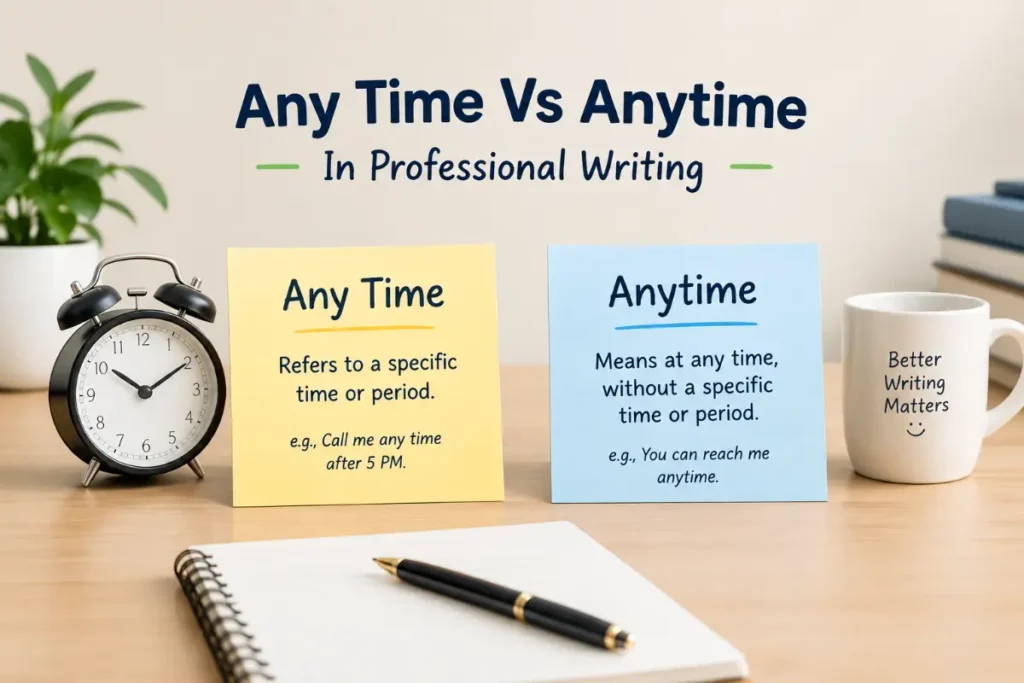
Any Time Vs Anytime In Professional Writing
Professional writing rewards clarity.
Suppose you’re writing a customer service message.
Please contact us anytime if you need assistance.
This is grammatically fine.
You could also write.
Please contact us at any time if you need assistance.
The second version has a more formal tone.
For a workplace email you might choose either based on the tone of the message.
For an official policy you might prefer at any time because it leaves less room for stylistic debate.
For a friendly email you might naturally choose anytime.
The rule isn’t about making your writing sound fancy. It’s about choosing the form that fits both grammar and context.
Any Time Vs Anytime In Academic Writing
Academic writing often favors precise and formal phrasing.
Consider.
Participants may withdraw from the study at any time.
This is clear and conventional.
You could write.
Participants may withdraw from the study anytime.
The sentence is understandable and grammatically acceptable in many modern contexts. Still the first version is often the stronger editorial choice for academic prose.
Academic writing tends to favor explicit structures because they reduce ambiguity and keep the tone formal.
The same principle applies to legal writing research papers formal reports and institutional policies.
Any Time Vs Anytime In Emails
Email writing gives you more freedom because the right choice depends on the relationship and purpose.
Friendly Email
You can call me anytime.
This sounds warm and natural.
Professional Email
Please contact me at any time if you need additional information.
This sounds more formal.
Scheduling Email
Any time after 3 p.m. works for me.
Here you need the two word form because you’re talking about a possible time.
This is an important distinction.
You can’t write.
Anytime after 3 p.m. works for me.
Many speakers use that form in casual English and it can appear in edited writing. However any time after 3 p.m. is the clearer traditional choice when time is modified by a following phrase.
Any Time Vs Anytime In Questions
Questions reveal the grammatical difference especially well.
Asking About Available Time
Use any time.
Do you have any time this week?
Will you have any time tomorrow?
Can you spare any time for a meeting?
Here time refers to an amount or period that someone has available.
Asking About When Something Can Happen
Use anytime when it functions as an adverb.
Can I call anytime?
Can I visit anytime?
Can we talk anytime this afternoon?
The distinction is subtle but useful.
For another common grammar confusion, see Simpler Or More Simple Which Form Is Correct 2026.
Any Time Vs Anytime With Modifiers
A modifier can reveal the correct structure.
Consider.
Any free time is useful.
Any extra time would help.
Any available time will work.
In each sentence time is a noun modified by another word.
Now compare.
Call me anytime.
Here there is no adjective modifying time. The entire word acts as an adverb.
This gives you another useful editing test.
If you can naturally put an adjective before time then the two word form is usually required.
Any Time Vs Anytime And Punctuation
Neither form requires special punctuation simply because of its spelling.
However punctuation can depend on the larger sentence.
For example.
Call me anytime if you need help.
No comma is needed because the ending if you need help is closely connected to the main instruction.
You could also write.
Any time you need help call me.
This sentence needs punctuation based on sentence structure rather than the spelling of any time.
The spelling and punctuation questions should stay separate. Changing two words into one doesn’t create a punctuation rule.
Regional English Differences
The basic distinction appears across major English varieties.
American English
American English commonly uses anytime as an adverb.
Come over anytime.
Any time remains standard when time functions as a noun.
British English
British English also uses both forms. Traditional style preferences may favor any time in more contexts than some American writers do.
You may encounter.
You can call at any time.
This is especially common in formal prose.
Canadian English
Canadian English generally follows the same distinction found in American and British English.
Both forms occur and context determines the preferred spelling.
Australian English
Australian English also recognizes both forms. Formal writing tends to favor the clearer two word structure in constructions such as at any time.
The key point is that this isn’t a simple US versus UK spelling difference. Grammar plays the larger role.
Is Any Time Ever Wrong
Yes.
Sometimes people use anytime where the sentence requires a noun phrase.
For example.
I don’t have anytime.
In standard edited English the preferred form is.
I don’t have any time.
The same applies to similar structures.
Incorrect.
Do you have anytime available?
Better.
Do you have any time available?
Incorrect.
At anytime during the event.
Better.
At any time during the event.
The issue isn’t that anytime is a bad word. The issue is that the sentence needs time to function as a noun.
Is Any Time Ever Better Than Anytime
Yes.
Any time is often better when you want maximum grammatical clarity.
It’s especially useful in formal writing.
For example.
Employees may request assistance at any time.
The structure is unmistakable.
You can also use any time when another word or phrase modifies time.
Any time after noon is acceptable.
Any free time should be used wisely.
She didn’t have any time to prepare.
In each case keeping the words separate makes the noun structure visible.
Is Anytime Ever Better Than Any Time
Yes.
Anytime is often the most natural choice when you’re simply saying at any time in casual conversation.
Compare.
You can call me at any time.
You can call me anytime.
The second sentence feels shorter and more conversational.
That’s why you’ll see it often in messages invitations captions and friendly emails.
Good writing isn’t always about choosing the most formal option. It’s about matching the form to the purpose.

Common Mistakes With Any Time And Anytime
Mistake One
I don’t have anytime.
Correct.
I don’t have any time.
The noun time refers to an amount that the speaker has available.
Mistake Two
Call me at anytime.
Correct.
Call me at any time.
The preposition at is followed by the noun phrase any time.
Mistake Three
Anytime after lunch works for me.
Better.
Any time after lunch works for me.
Here time refers to a possible period and is followed by the modifying phrase after lunch.
Mistake Four
Do you have anytime tomorrow?
Correct.
Do you have any time tomorrow?
The question asks about available time.
Mistake Five
Assuming anytime is always informal slang.
It isn’t.
It is a legitimate English adverb. The important question is how you use it.
Common Internet Myths
Online grammar discussions sometimes make this issue sound more complicated than it is.
One common claim says anytime is always wrong. That’s false.
Another claim says anytime has completely replaced any time. That’s also false.
A third claim says American English uses one form while British English uses the other. That’s too simple.
Real usage doesn’t fit those absolute rules.
The reliable approach is grammatical.
Look at the role of time in the sentence. If it acts as a noun use any time. If the whole expression acts as an adverb use anytime.
Memory Tricks For Any Time And Anytime
A few quick memory tricks can make the distinction stick.
The Noun Test
Ask if you’re talking about time as something you have.
If yes use two words.
I don’t have any time.
The At Test
If you see at before the expression use two words.
At any time.
This is one of the easiest rules to remember.
The Whenever Test
If you can replace anytime with whenever and the sentence still makes sense then the one word form is often appropriate.
Call me anytime.
Call me whenever.
The meanings aren’t identical in every context but the substitution works well as a quick test.
The Most Important Memory Line
Any time names time. Anytime tells when.
That short rule captures the core difference.
Related Words And Expressions
Understanding nearby words can help you build a stronger sense of time expressions.
Similar Expressions
- At any time.
- Whenever.
- At any point.
- At all times.
- At the moment.
- Any time soon.
- Any time now.
Related Time Words
- Sometimes.
- Sometime.
- Some time.
- Anytime.
- Any time.
- Every time.
- Anytime soon.
The words sometime and some time deserve special attention because they create a similar spelling problem.
Compare.
I’ll visit sometime.
This means at an unspecified time.
I’ll need some time.
This means an amount of time.
The same basic idea appears with anytime and any time. Grammar helps you choose the form.
Any Time Vs Sometime And Sometimes
These words often appear together in grammar questions.
Anytime means at any time.
Call me anytime.
Sometime means at an unspecified time.
Let’s meet sometime next week.
Sometimes means on some occasions.
I sometimes work late.
Some time refers to an amount or period of time.
I need some time to think.
Learning these distinctions makes time expressions much easier to handle.
Expert Editor’s Note
A professional editor doesn’t usually ask which form looks more common in isolation. The editor asks what role the expression plays in the sentence.
That’s the safest approach with any time and anytime.
If time acts as a noun keep it separate.
If anytime acts as an adverb use the closed form.
When a preposition such as at introduces the phrase the traditional edited form is at any time.
Style guides and dictionaries can differ in how much flexibility they allow around adverbial anytime. Modern American English accepts the one word form widely. Still formal prose often benefits from the explicit phrase at any time.
Native speakers also use both forms naturally. Their choice depends on grammar context rhythm and tone rather than a simple rule that says one spelling is always better.
For writers the practical lesson is simple. Don’t memorize hundreds of isolated examples. Understand the grammatical structure and the correct spelling will usually follow.
A Practical Editing Checklist
Before publishing an article email essay or report check the sentence with these questions.
- Is time acting as a noun?
Use any time.
- Does at come immediately before the phrase?
Use at any time.
- Does the word mean whenever or at any time?
Anytime may be the right choice.
- Are you talking about how much time someone has?
Use any time.
- Are you writing formal or academic prose?
Consider at any time when that structure fits naturally.
- Does another word modify time?
Keep any time separate.
This checklist handles most real world cases without making the rule harder than it needs to be.
Real Life Sentence Comparison
Seeing similar sentences side by side is one of the fastest ways to understand the difference.
| Sentence | Correct Form | Reason |
|---|---|---|
| Call me anytime. | Anytime | Adverb |
| Call me at any time. | Any time | Noun phrase after at |
| I don’t have any time. | Any time | Time is a noun |
| Do you have any time today? | Any time | Asking about available time |
| Visit us anytime. | Anytime | Adverb |
| Any time after five works. | Any time | Time is modified by after five |
| You may leave at any time. | Any time | Noun phrase after at |
| Feel free to ask anytime. | Anytime | Adverb |
| She needs any time she can get. | Any time | Time is a noun |
| You can contact us anytime. | Anytime | Adverb |
The pattern becomes much easier to see when you compare complete sentences rather than isolated spellings.
More Real Life Examples Of Any Time And Anytime
The difference becomes much easier when you see these words in situations people actually encounter.
Everyday Conversation
- You can call me anytime.
- Come by any time this weekend.
- I don’t have any time right now.
- We can meet anytime after lunch.
- Any time is a good time for a walk.
- Call me at any time if you need help.
- Do you have any time to talk tonight?
- You can stop by anytime you’re nearby.
Workplace Communication
- Employees can report problems at any time.
- You can email me anytime during the week.
- Do you have any time available tomorrow?
- Any time after two works for our team.
- The system may be updated at any time.
- Please contact your supervisor anytime you need assistance.
Email Writing
- Please contact me at any time if you have questions.
- Feel free to reach out anytime.
- Do you have any time available for a short call?
- I’m available anytime this afternoon.
- Any time after 10 a.m. works for me.
- You may request additional information at any time.
Academic Writing
- Students may withdraw from the study at any time.
- Researchers should record any time spent outside the testing area.
- The results can change at any time as new evidence becomes available.
- Participants can contact the research team anytime during the study.
Journalism
- The agreement could end at any time.
- The storm may arrive at any time tonight.
- Officials said the situation could change anytime.
Social Media
- Message me anytime.
- Any time is a good time to start something new.
- I don’t have any time for unnecessary drama.
These examples show an important point. The meaning alone doesn’t always determine the spelling. The grammatical structure does.
Any Time Vs Anytime In Common Phrases
Some expressions appear often enough that it’s useful to learn their standard forms.
At Any Time
This is always written as two words in standard edited English.
You can cancel at any time.
The rules may change at any time.
Any Time Soon
The traditional form is any time soon.
Will the package arrive any time soon?
Here time functions as a noun within the expression.
Any Time Now
The standard form is any time now.
The bus should arrive any time now.
Again the phrase refers to an unspecified point in time.
Any Time Of Day
Use two words.
You can call at any time of day.
The noun time is followed by the phrase of day.
Anytime You Need Help
Use the one word form when it means whenever.
Call me anytime you need help.
This construction is common in friendly and professional communication.
Any Time And Anytime In Negative Sentences
Negative sentences can reveal the difference clearly.
Consider.
I don’t have any time.
Here any time means any amount of available time.
You can’t replace it with anytime.
Now consider.
You don’t need to call anytime soon.
Here anytime belongs to the expression anytime soon and acts adverbially.
There is also a subtle difference between these two ideas.
I don’t have any time.
This talks about an amount of time.
I don’t want to leave anytime soon.
This talks about when an action will happen.
That distinction is useful far beyond this one spelling question.
Any Time And Anytime In Questions About Schedules
Scheduling language creates many situations where both forms appear.
Use any time when asking about available time.
Do you have any time after three?
Is there any time that works for you?
Use anytime when asking about permission or possibility.
Can I call anytime?
Can we meet anytime this week?
However real speech can be flexible. Native speakers may use anytime in scheduling sentences that some traditional editors would write with any time.
When precision matters follow the grammatical structure rather than copying casual speech.
Any Time Or Anytime In A Sentence With A Clause
Both forms can appear before a clause but they don’t always have the same grammatical role.
Consider.
Call me anytime you need help.
Here anytime means whenever.
Now consider.
Any time you need help is a good time to call.
This sentence treats any time as a noun phrase.
The difference may seem small but the sentence structure changes.
Another example makes it clearer.
Anytime you’re ready we can begin.
This means whenever you’re ready.
Any time you’re ready is fine with me.
This treats any time as the subject of the sentence.
The second structure strongly favors the two word form because time functions as a noun.
Can Anytime Start A Sentence
Yes.
Anytime can begin a sentence when it functions as an adverb.
For example.
Anytime you need help you can call me.
It can also appear at the beginning of a sentence as part of a clause.
Anytime she visits the city she stops by.
In careful writing you may add a comma after the opening clause when the sentence structure calls for it.
The spelling isn’t affected by the comma.
Can Any Time Start A Sentence
Yes.
Any time can also begin a sentence when it functions as a noun phrase.
For example.
Any time after noon works for me.
Any time is a good time to start.
Any time you spend learning is valuable.
Here time remains a noun.
This is a good reminder that sentence position alone doesn’t determine the spelling.
What Native Speakers Usually Say
Native speakers don’t stop to analyze this rule every time they write.
They learn the patterns through years of reading and speaking.
In casual American English anytime is especially natural when it means whenever.
Come anytime.
Call anytime.
Ask anytime.
The two word form remains common when the sentence focuses on time as a noun.
I don’t have any time.
Any time after five works.
At any time during the day.
Good English learners can develop the same instinct by noticing these patterns instead of memorizing isolated rules.
Common Mistakes To Avoid
Keep these five errors in mind.
Mistake One
Writing at anytime.
Use at any time.
Mistake Two
Writing I don’t have anytime.
Use I don’t have any time.
Mistake Three
Assuming anytime is always informal or incorrect.
It is a standard adverb.
Mistake Four
Assuming any time is always required.
That’s also incorrect. Anytime is perfectly natural when it works as an adverb.
Mistake Five
Choosing the spelling based only on pronunciation.
The two forms are normally pronounced the same. Grammar provides the better clue.
Frequently Asked Questions
Is Any Time Or Anytime Correct
Both are correct. Anytime is an adverb meaning at any time or whenever. Any time is a noun phrase that refers to an unspecified point amount or period of time. Use at any time after the preposition at. The correct form depends on the grammatical role of time in the sentence.
Should I Write At Any Time Or At Anytime
Write at any time. In standard edited English the preposition at is followed by the two word noun phrase. For example you can write Please contact us at any time. The form at anytime is generally treated as an error in careful formal writing.
Is Anytime One Word In American English
Yes. Anytime is a standard American English adverb. It commonly means at any time or whenever. For example Call me anytime is natural and correct. American English also uses any time when time functions as a noun such as in I don’t have any time.
Is Any Time More Formal Than Anytime
Not always. The two word form is often more suitable in formal structures such as at any time. Anytime is also standard English when used as an adverb. Formal writing may favor at any time because the phrase sounds explicit and fits traditional editorial style.
Can I Say Any Time Soon
Yes. The standard expression is any time soon. For example Do you think the package will arrive any time soon? In this expression time functions as a noun. Don’t automatically close the words simply because the phrase refers to an uncertain future moment.
What Is The Difference Between Anytime And Whenever
Anytime and whenever can overlap when they describe an action that can happen at any point. Call me anytime and Call me whenever you need help express similar ideas. However whenever can also introduce repeated situations or conditions and therefore has uses that anytime doesn’t always cover.
Can Anytime Be Used In Formal Writing
Yes. Anytime is grammatically correct when it functions as an adverb. Still formal writers often choose at any time in official notices academic prose policies and professional documents. The choice should depend on sentence structure tone and clarity rather than a belief that one word is automatically informal.
How Do I Remember The Difference Between Any Time And Anytime
Remember this simple rule: any time names time while anytime tells when. If you’re talking about having time or using time write any time. If you’re saying that an action can happen at any point use anytime. After at use any time.
Expert Editor’s Final Advice
When editing any time and anytime don’t rely on the common claim that one form is correct and the other is wrong. That rule is too blunt.
Both forms have legitimate grammatical uses.
A professional editor looks at the sentence and asks what time is doing.
If it acts as a noun use any time.
If the whole word acts as an adverb use anytime.
This distinction also explains why at any time is preferred over at anytime. The preposition at introduces a noun phrase and time remains the noun.
The same reasoning helps with expressions such as any time after lunch and any time of day.
For formal writing the two word form can sometimes offer greater clarity. In friendly conversation anytime often sounds more natural.
Don’t make the rule harder than it is. Grammar gives you the answer most of the time.
You may also want to read Spoilt Vs Spoiled Which Word Is Correct 2026.
Conclusion
The difference between any time vs anytime comes down to grammar rather than simple spelling.
Use anytime when it acts as an adverb and means at any time or whenever.
Use any time when time acts as a noun.
Remember these examples.
Call me anytime.
I don’t have any time.
You can contact me at any time.
Any time after lunch works.
That last distinction is the one worth remembering. Anytime tells when. Any time talks about time.
Once you recognize that pattern you’ll stop guessing and start choosing the form naturally.

Senior Grammar Editor
Olivia Reynolds is a grammar editor and language writer who enjoys making complex English rules easy to understand. She specializes in grammar, punctuation, sentence structure, and everyday writing tips, helping readers write with greater confidence and clarity.