
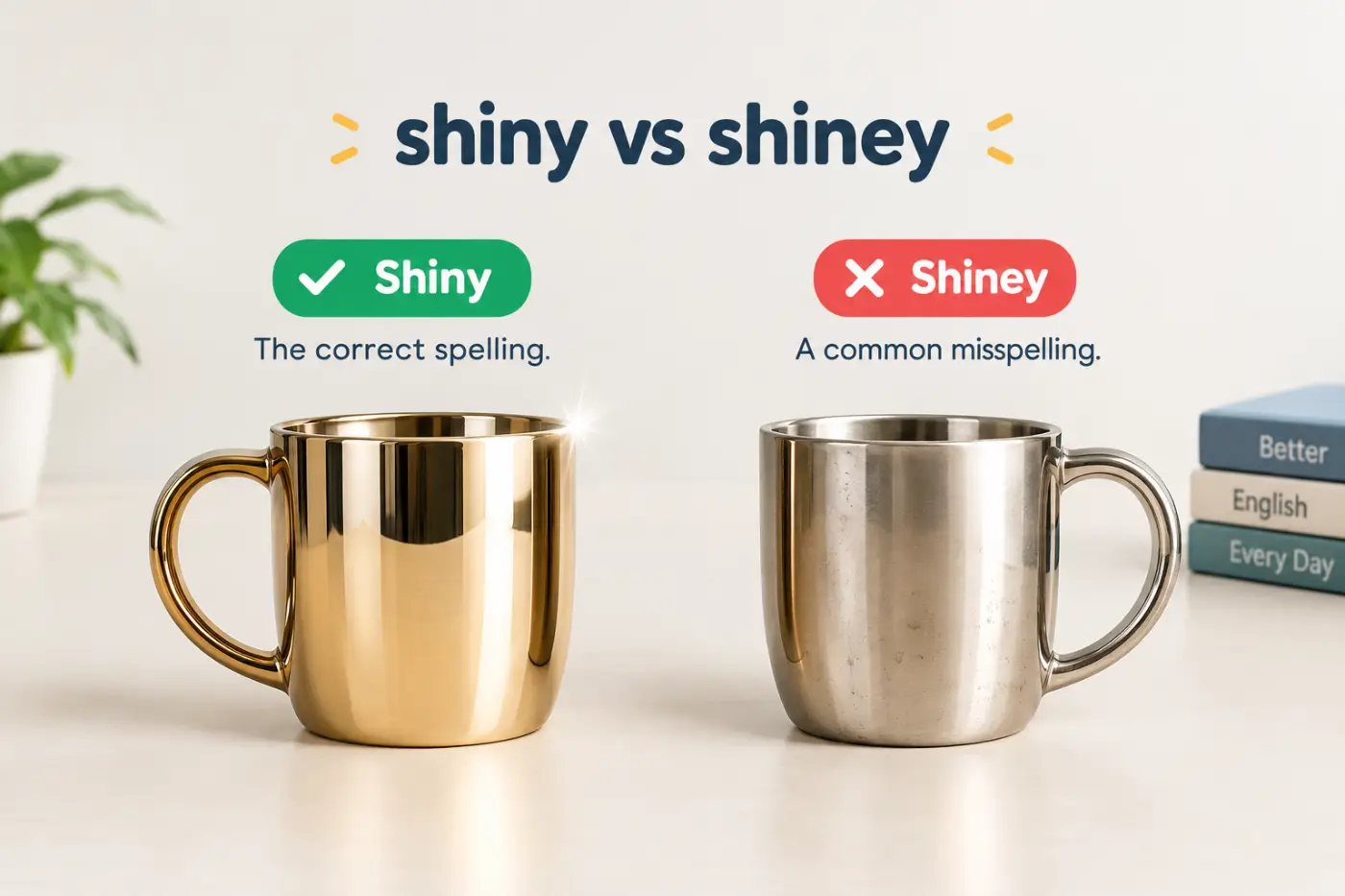
If you’ve searched for shiny vs shiney you’re probably trying to decide which spelling belongs in your sentence. The confusion is understandable. Both versions look natural at first glance and the word sounds the same when spoken. But only one is the standard spelling in modern English.
Shiny is the correct spelling. Shiney is generally considered a misspelling when you mean something that reflects light or has a bright surface.
The mistake often comes from a familiar spelling pattern. English has many adjectives that end in y after a consonant. However, people sometimes add an extra e because the word shine already contains one. That creates shiney even though the standard adjective follows a different pattern.
This guide explains the difference between shiny and shiney in plain English. You’ll learn the correct spelling, the grammar rule behind it, pronunciation, word origin, regional usage, common mistakes, and plenty of examples for everyday and formal writing.
Need another quick comparison? Read Chefs Or Cheves Which Spelling Is Correct 2026.
Quick Answer
Shiny is the correct standard spelling. It means reflecting light or having a bright polished surface. Shiney is usually a spelling mistake and isn’t the accepted standard form of the adjective. Use shiny in schoolwork, professional writing, emails, and everyday English.
Shiny Vs Shiney Comparison Table
|
Feature
|
Shiny
|
Shiney
|
| — | — | — |
|
Correct standard spelling
|
Yes
|
No
|
|
Part of speech
|
Adjective
|
Nonstandard spelling of shiny
|
|
Meaning
|
Reflecting light or looking bright
|
Intended to mean shiny
|
|
Pronunciation
|
/ˈʃaɪni/
|
Usually pronounced the same as shiny
|
|
Common use
|
Standard English
|
Typographical or spelling error
|
|
Formal writing
|
Recommended
|
Avoid
|
|
Informal writing
|
Recommended
|
Avoid unless preserving a name or deliberate spelling
|
|
Example
|
The floor looks shiny.
|
Incorrect in standard usage: The floor looks shiney.
|
What Does Shiny Mean
Shiny is an adjective that describes something with a surface that reflects light. It can also describe something that looks bright, polished, glossy, or new.
Simple Definition
Shiny means reflecting light or having a smooth and bright appearance.
For example, a freshly polished shoe can look shiny. A new metal coin can have a shiny surface. A person’s hair may look shiny after they wash or condition it.
Common Meanings Of Shiny
The word has a few closely related uses.
Reflecting Light
This is the most direct meaning.
- The shiny metal caught the sunlight.
- Her shoes were clean and shiny.
- The lake looked shiny under the afternoon sun.
Glossy Or Polished
Something can look shiny because its surface has been polished or coated.
- He bought a shiny new car.
- The magazine has a shiny cover.
- The furniture has a shiny finish.
New Or Attractive
In informal English shiny can suggest something new or appealing.
- The children were excited about their shiny new backpacks.
- She showed me her shiny new laptop.
In this use the word doesn’t always describe literal reflection. It can also suggest freshness or appeal.
Bright Or Lustrous
Shiny can describe hair eyes fabric decorations and other things that appear bright or glossy.
- Her shiny hair caught the light.
- The dancer wore a shiny silver jacket.
- The shiny decorations made the room feel festive.
What Does Shiney Mean
Shiney is generally a misspelling of shiny when used as the ordinary English adjective.
It doesn’t have a separate standard meaning in this context. If you write shiney shoes or a shiney surface you’re almost certainly trying to write shiny shoes or a shiny surface.
Is Shiney Ever Used Intentionally
Yes. A nonstandard spelling can appear in specific situations without being an error.
For example.
- A person’s name or surname. A name may be spelled Shiney or contain a similar form. Proper names follow the spelling chosen by the person or family.
- A fictional character. An author may deliberately give a character an unusual name.
- A brand or product name. A business may use a creative spelling for branding.
- A direct quote. If you’re reproducing someone’s exact words you may preserve their spelling.
These special cases don’t change the standard English spelling. For the ordinary adjective meaning reflecting light use shiny.
Which One Is Correct
Shiny is correct. Shiney is incorrect in standard English when you mean bright or reflective.
Use shiny in sentences such as.
- The shiny floor was freshly cleaned.
- She wore a shiny dress.
- The new coins look shiny.
- His shoes are shiny after polishing.
Avoid shiney in standard writing.
- Incorrect: The car has a shiney finish.
- Correct: The car has a shiny finish.
- Incorrect: I bought a shiney jacket.
- Correct: I bought a shiny jacket.
The rule is simple. The adjective formed from shine is spelled shiny, not shiney.
Why People Confuse Shiny And Shiney
The error is common because English spelling doesn’t always match the patterns learners expect. Several factors make shiney look tempting.
The Word Shine Already Contains An E
The base verb is shine. When people turn it into an adjective they may assume the spelling should remain visible.
That leads to this mistaken pattern.
shine + y = shiney
But English doesn’t always form adjectives by attaching a suffix without changing the spelling. In this case the accepted form is shiny.
The Pronunciation Doesn’t Help
Shiny and shiney are normally pronounced the same when someone reads shiney as an attempted spelling of shiny.
Both would be understood as something like SHY nee. Since speech doesn’t reveal the spelling, learners must remember the written form.
Familiar Spelling Patterns Can Mislead Writers
English contains many words where an e remains before a suffix.
Examples include.
- Nice becomes nicely.
- Safe becomes safely.
- Large becomes largely.
However, these examples don’t mean every word ending in silent e keeps that letter before y. Spelling depends on the word and its established form.
Fast Typing And Autocorrect
When people type quickly they may write shiney because their fingers follow the letters they hear or because they connect the adjective directly to shine. Spell checkers may catch the error but not every writing tool flags every nonstandard word.
Internet And User Generated Content
People encounter misspellings in comments captions product listings and informal posts. Seeing a spelling repeatedly can make it look accepted even when dictionaries and edited publications use another form.
Frequency online doesn’t automatically establish standard spelling.
Key Differences Between Shiny And Shiney
The main difference is standard spelling. These aren’t two words with separate meanings like affect and effect.
Meaning
Shiny means bright or reflective.
Shiney usually represents an attempt to write shiny and doesn’t have a separate standard dictionary meaning as the ordinary adjective.
Grammar
Shiny is an adjective.
It describes a noun.
- A shiny table.
- Shiny hair.
- Shiny shoes.
Shiney doesn’t function as a separate standard adjective.
Pronunciation
The intended pronunciation is generally the same.
Shiny: /ˈʃaɪni/
The word has two syllables.
SHY nee
Formality And Register
Shiny works in formal and informal writing.
Shiney should be avoided in standard writing unless it is part of a proper name, brand, fictional term, or intentional spelling.
Regional Usage
The standard spelling is shiny in American English and British English. Canadian and Australian English also use shiny.
This isn’t a British versus American spelling difference. Unlike color and colour or center and centre, the two forms don’t represent accepted regional variants of the adjective.
Grammar Explanation For Shiny
Understanding how shiny works in a sentence helps prevent spelling and usage mistakes.
Shiny Is An Adjective
An adjective describes a noun or gives more information about it.
Examples.
- The shiny apple looked fresh.
- She bought a shiny handbag.
- We cleaned the shiny windows.
In each sentence shiny tells us something about the noun.
Shiny Before A Noun
This is called attributive use.
- A shiny surface.
- A shiny button.
- A shiny black jacket.
- Shiny silver shoes.
Shiny After A Linking Verb
Shiny can also appear after linking verbs such as look, seem, appear, and be.
- The floor is shiny.
- Her shoes look shiny.
- The paint seems shiny.
- The new tiles appear shiny.
Comparative And Superlative Forms
The adjective can take comparative and superlative forms.
|
Degree
|
Form
|
Example
|
| — | — | — |
|
Positive
|
Shiny
|
This table is shiny.
|
|
Comparative
|
Shinier
|
This table is shinier than the old one.
|
|
Superlative
|
Shiniest
|
That is the shiniest table in the room.
|
Notice the spelling.
Shiny → shinier → shiniest
The final y changes to i before er and est.
Examples.
- Shiny becomes shinier.
- Shiny becomes shiniest.
This is another reason to learn the correct base form.
Can Shiny Be A Noun
In standard modern English shiny is primarily an adjective. In some contexts people may use related forms such as shine or shininess as nouns.
Examples.
- The polish gave the table a beautiful shine.
- The shininess of the surface made it difficult to photograph.
Shininess is the noun form that describes the quality of being shiny.
Can Shiny Be An Adverb
No. Shiny is not the standard adverb form.
Instead use an adverbial phrase or another suitable word.
- The surface reflects light brightly.
- The metal gleams in the sun.
Don’t use shiny as an adverb to describe how an action happens.
Spelling Rules Behind Shiny
The correct spelling becomes easier to remember when you understand the word’s form.
Shine And Shiny Are Related But Not Spelled By Simple Addition
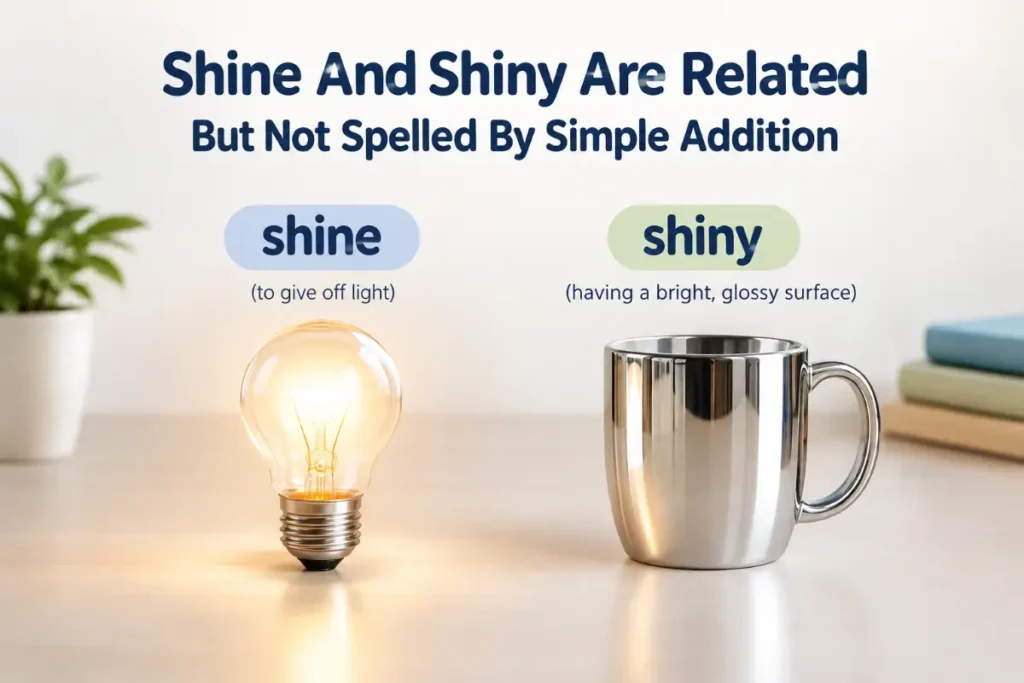
Shine is a verb.
Shiny is an adjective.
The relationship is clear in meaning but the spelling changes.
|
Word
|
Part of speech
|
Example
|
| — | — | — |
|
Shine
|
Verb
|
The stars shine at night.
|
|
Shiny
|
Adjective
|
The stars look shiny in the illustration.
|
|
Shininess
|
Noun
|
The polish increased the shininess of the surface.
|
The adjective isn’t spelled shiney in standard English.
Why The E Disappears
The spelling shiny is an established form in English. It follows the adjective pattern associated with shine but doesn’t retain the final silent e.
You shouldn’t try to create the word by mechanically adding y to every verb that ends in e. English spelling includes many historical patterns that learners need to learn as established forms.
Related Words With Similar Patterns
Several English adjectives lose a final e or change their spelling when they take a suffix.
- Noise becomes noisy.
- Ice becomes icy.
- Spice becomes spicy.
- Taste becomes tasty.
- Grease becomes greasy.
These examples show a useful pattern. Words ending in e may form adjectives ending in y without keeping the e.
However, spelling rules have exceptions. The safest approach is to learn common word families together.
Shiny And Shininess
When forming the noun shininess, the adjective changes from y to i before ness.
Shiny → shininess
Correct.
- The shininess of the floor made the room look brighter.
Incorrect.
- The shineyness of the floor made the room look brighter.
A related grammar guide is Tweek Vs Tweak Which Spelling Is Correct 2026.
Pronunciation Guide
Pronunciation isn’t the source of the spelling difference because shiny and the attempted spelling shiney sound the same in ordinary use.
Shiny
IPA: /ˈʃaɪni/
Syllables: Two.
Stress: The first syllable.
Pronunciation: SHY nee.
Common Pronunciation Mistakes
Most learners pronounce shiny correctly once they hear it. The bigger problem is spelling it.
Avoid adding an extra syllable.
Correct.
SHY nee
Not.
SHY nee ee
The word has two syllables.
Etymology And Word Origin
The history of shiny helps explain why the spelling is established as it is.
Origin Of Shine
The verb shine has Old English roots. It developed from an early Germanic word family connected with brightness and light.
Over time English used shine for emitting light and for producing a bright or polished appearance.
Origin Of Shiny
The adjective shiny developed from the word shine to describe something that reflects light or has a bright surface.
The suffix y is commonly used in English to form adjectives that mean having a particular quality.
Examples include.
- Cloud becomes cloudy.
- Rain becomes rainy.
- Dirt becomes dirty.
- Shine becomes shiny.
The spelling shiny became the standard form through regular usage and dictionary recognition.
Why Word History Matters
English spelling often reflects long historical development rather than a perfectly logical system. A word may look as if it should follow one pattern but still have a different established spelling.
That is why shiny is best learned as a complete word rather than as shine + y written mechanically.
British American Canadian And Australian English
Shiny is the standard spelling across major varieties of English.
American English
American English uses shiny.
- The new shoes are shiny.
- The kitchen floor looks shiny.
British English
British English also uses shiny.
- The polished table was shiny.
- She wore a shiny costume.
Canadian English
Canadian English uses shiny as well. There is no accepted Canadian spelling shiney for the ordinary adjective.
Australian English
Australian English also uses shiny.
The spelling doesn’t change based on the country. This is a universal standard spelling issue rather than a regional spelling difference.
Real Life Examples Of Shiny
The following examples show how shiny works in different settings.
Daily Conversation
- Your new shoes are really shiny.
- The kitchen floor looks shiny after cleaning.
- I found a shiny coin on the sidewalk.
- Her hair looks shiny in the sunlight.
- That silver watch has a shiny surface.
Workplace
- The designer chose a shiny finish for the product packaging.
- Please clean the shiny metal panel before the presentation.
- The new office furniture has a smooth shiny surface.
- The photographer avoided direct light because the shiny material caused glare.
Emails
- The sample has a shiny coating that makes the colors stand out.
- Please confirm if you prefer the matte finish or the shiny finish.
- The printed brochure looks shiny under bright light.
Academic Writing
- The researchers examined how light reflects from a shiny surface.
- The experiment compared the temperature of shiny and dark materials.
- A shiny surface can produce strong reflections under direct illumination.
Journalism
- The new building features shiny glass walls that reflect the surrounding skyline.
- The artist used shiny metal to create contrast with the rough stone.
Literature
- The story describes a shiny river under the moonlight.
- The character admired the shiny ornaments displayed in the shop window.
Social Media
- My new sneakers are so shiny.
- A little polish and these shoes look shiny again.
- Shiny things always catch my attention.
- This shiny finish looks great in the sunlight.
These examples cover casual use and more formal descriptions without changing the spelling.
Common Mistakes To Avoid
Mistake One Writing Shiney
Incorrect.
- She bought a shiney necklace.
Correct.
- She bought a shiny necklace.
Mistake Two Assuming Shiney Is A British Variant
It isn’t. Shiny is the standard spelling in both American and British English.
Mistake Three Adding An Extra E In Related Forms
Incorrect.
- Shineyness.
Correct.
- Shininess.
The adjective ends in y and the noun changes that y to i before ness.
Mistake Four Confusing Shiny With Shining
These words are related but not identical.
Shiny describes a surface or appearance.
Shining often describes something that emits light or is currently giving off light. It can also describe something excellent or impressive.
Examples.
- The shiny floor reflected the lamp.
- The stars are shining tonight.
Mistake Five Assuming Shiny Always Means New
A shiny object may be new but it doesn’t have to be. Polishing an old object can make it shiny.
- The old car looked shiny after a fresh coat of wax.
Memory Tricks For Remembering Shiny
A good memory trick should be short enough to use while writing.
Think Of Shiny As A Shine With Y
Remember the standard spelling as a word family.
Shine → Shiny → Shininess
The adjective uses y and drops the final e.
Use The Icy And Spicy Pattern
Think of these familiar words.
- Ice → icy.
- Spice → spicy.
- Shine → shiny.
They all show how an adjective can end in y without keeping the final e.
Remember The Phrase Shiny Shoes
The phrase shiny shoes is common and easy to visualize. Picture polished shoes reflecting light. That image can help lock in the correct spelling.
Check The Extra E
When you write shiney ask yourself.
Does the standard adjective use the spelling shiny?
Yes. Remove the extra e.
Related Words And Expressions
Learning related vocabulary helps you recognize the word in different contexts.
Synonyms For Shiny
Depending on the context you can use.
- Glossy.
- Polished.
- Lustrous.
- Reflective.
- Bright.
- Gleaming.
- Sparkling.
- Glimmering.
These words aren’t always exact replacements. For example reflective focuses on bouncing light while glossy often describes a smooth polished surface.
Opposites Of Shiny
- Dull.
- Matte.
- Tarnished.
- Cloudy.
- Rough.
- Lusterless.
The best opposite depends on the object.
- A matte finish doesn’t reflect much light.
- A tarnished surface has lost its original brightness.
- A dull object lacks shine or vividness.
Related Word Forms
|
Word
|
Meaning
|
Example
|
| — | — | — |
|
Shine
|
To give off or reflect light
|
The stars shine brightly.
|
|
Shiny
|
Reflecting light
|
The table is shiny.
|
|
Shinier
|
More shiny
|
This surface is shinier.
|
|
Shiniest
|
Most shiny
|
That is the shiniest object.
|
|
Shininess
|
The quality of being shiny
|
The shininess comes from the polish.
|
|
Shining
|
Giving off or reflecting light
|
The sun is shining.
|
Related Expressions
Some common expressions use shine rather than shiny.
- Take a shine to someone means to begin liking someone.
- Rise and shine is a cheerful way to tell someone to wake up.
- Come rain or shine means regardless of what happens.
- Everything that glitters is not gold reminds us that attractive appearances can be misleading.
These expressions are related to the broader word family but don’t change the spelling of shiny.
Expert Editor’s Note
From an editing perspective the choice is straightforward.
Shiny is the standard dictionary spelling for the adjective meaning reflecting light or having a bright surface. Shiney is not the standard form for this meaning.
A professional editor would correct shiney to shiny in an article, email, academic assignment, product description, or business document. The only reason to preserve Shiney would be if it were a proper name, brand, fictional term, or exact quoted text.
The most useful editorial rule is simple. Don’t judge spelling by how familiar a version looks online. Check the established word form and use it consistently.
If you’re writing for a broad English speaking audience, shiny is the clear choice.
Frequently Asked Questions
Is Shiny Or Shiney Correct
Shiny is the correct standard spelling. It describes something that reflects light or has a bright polished appearance. Shiney is generally a misspelling and should be corrected in standard English writing.
Is Shiney A Word In The Dictionary
Shiney isn’t the standard spelling of the common adjective meaning reflective or glossy. Some dictionaries or databases may contain similar forms as names or specialized entries. For ordinary English writing use shiny.
Why Is Shiny Spelled Without An E
Shiny is the established adjective form related to shine. English doesn’t always preserve a base word’s final silent e when forming an adjective. The standard spelling is learned as shiny rather than shiney.
Is Shiny The Same In American And British English
Yes. American and British English both use shiny. Canadian and Australian English use the same spelling too. This isn’t a regional spelling difference like color and colour.
How Do You Pronounce Shiny
Shiny is pronounced SHY nee and has two syllables. Its IPA pronunciation is /ˈʃaɪni/. The first syllable receives the main stress.
What Is The Comparative Form Of Shiny
The comparative form is shinier and the superlative form is shiniest.
Examples.
- This surface is shinier than that one.
- That is the shiniest car in the parking lot.
Is Shiney Ever Correct
It can be correct as a proper name, brand name, fictional name, or deliberate spelling. However, when you mean something that reflects light, the standard adjective is shiny.
What Is The Noun Form Of Shiny
The noun form is shininess. It describes the quality of being shiny.
Example.
The shininess of the polished floor made the room brighter.
Still confused? Compare Pentoxide Vs Pentaoxide Which Spelling Is Correct 2026 Guide.
Conclusion
The difference between shiny vs shiney is simple.
Shiny is the correct standard spelling. It describes something bright, glossy, polished, or reflective.
Shiney is usually a misspelling and shouldn’t appear in standard writing unless it serves as a proper name or intentional spelling.
The easiest way to remember the correct form is to learn the word family.
Shine → Shiny → Shinier → Shiniest → Shininess.
Next time you’re describing polished shoes, glossy packaging, bright metal, or a reflective surface, choose shiny. One small spelling choice can make your writing look much more polished.

Editorial Reviewer & Proofreader
Grace Mitchell reviews Gramlify’s articles for clarity, consistency, and readability. She is passionate about creating accurate, approachable content that helps English learners build confidence.