
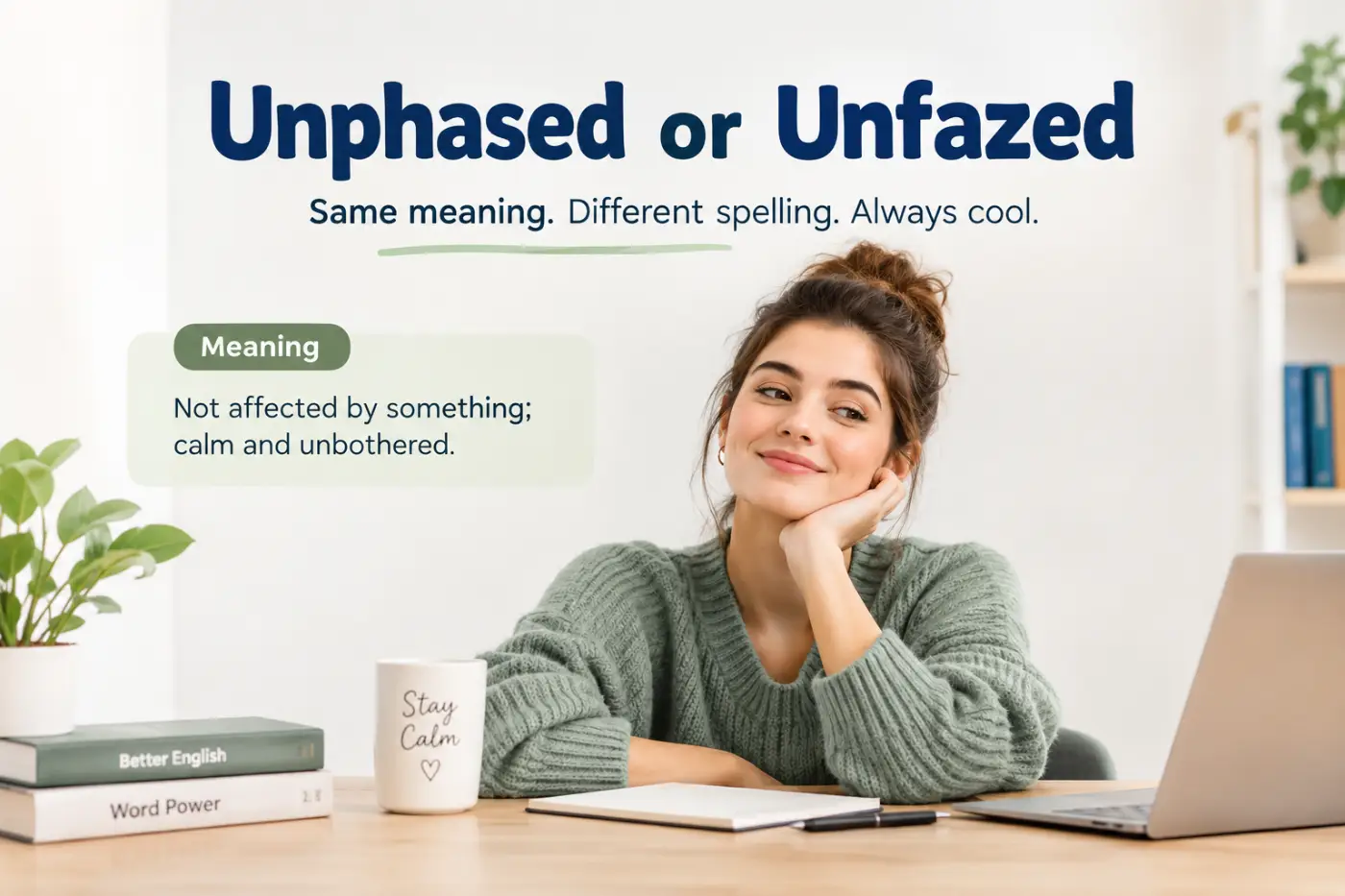
If you’ve ever wondered about unphased or unfazed you aren’t alone. These words look and sound so similar that even confident writers sometimes pause before choosing one. The confusion gets stronger because both forms appear online and both seem to fit the idea of staying calm.
The good news is that unfazed is the standard word when you mean calm and unaffected by something surprising difficult or upsetting. Unphased appears in some writing but it is far less common and generally isn’t the preferred choice for this meaning. In most cases, unfazed is the word you want.
The difference isn’t just about spelling. It also involves word history usage and how English speakers recognize established expressions. Understanding those details can help you avoid an error in an email essay caption or professional document.
This guide explains the meaning of each form why people confuse them how to pronounce them and how to use unfazed naturally. You’ll also find real life examples common mistakes memory tricks and practical advice for choosing the right word with confidence.
Many readers also check Coachs Or Coaches Which Spelling Is Correct 2026.
Quick Answer
Unfazed is the standard spelling when you mean calm and not bothered by something. For example, She remained unfazed by the criticism. Unphased is sometimes used as a variant or mistaken spelling, but it is not the usual choice in standard English. Use unfazed in formal and everyday writing.
Unphased Or Unfazed Comparison Table
|
Feature
|
Unfazed
|
Unphased
|
| — | — | — |
|
Standard spelling
|
Yes
|
Not the usual spelling for this meaning
|
|
Meaning
|
Calm and unaffected
|
Sometimes used as a variant of unfazed
|
|
Part of speech
|
Adjective
|
Adjective when used as a variant
|
|
Pronunciation
|
Usually the same as unphased
|
Usually the same as unfazed
|
|
Common usage
|
Everyday speech and formal writing
|
Less common and often treated as a misspelling
|
|
Formal writing
|
Preferred
|
Avoid unless a specific source or context requires it
|
|
Example
|
He remained unfazed by the noise.
|
Unphased is not the preferred spelling in this sentence.
|
What Does Unfazed Mean
Unfazed is an adjective that means not bothered, worried, surprised, or upset by something that might affect other people.
It describes someone who stays calm and composed even when facing pressure, criticism, danger, confusion, or an unexpected event.
Simple Definition Of Unfazed
Unfazed means calm and unaffected by something difficult or surprising.
For example.
Despite the sudden change in plans, Maya remained unfazed.
This sentence tells us that Maya didn’t become worried or upset by the change.
How To Use Unfazed In Everyday English
You can use unfazed to describe a person’s reaction to a situation.
- He looked unfazed by the long line.
- She was unfazed when the presentation started late.
- The dog remained unfazed by the thunder.
- I was unfazed by the negative comments.
- The team stayed unfazed after falling behind in the first half.
The word often suggests that something could have caused a reaction but didn’t.
Unfazed Does Not Mean Careless
A person who is unfazed stays calm. That doesn’t automatically mean the person is careless, emotionless, or unaware of danger.
For example.
The firefighter remained unfazed while following the emergency plan.
This describes composure under pressure. It doesn’t suggest the firefighter ignored the risk.

What Does Unphased Mean
Unphased is a form that appears in English writing, but it is much less common than unfazed when people mean calm or unaffected.
Some dictionaries and usage references recognize unphased as a variant spelling of unfazed. However, many editors and style guides still recommend unfazed because it is the established and widely accepted form.
Why Unphased Causes Confusion
The spelling unphased looks logical because English has many words beginning with ph.
Examples include.
- Phone.
- Phrase.
- Philosophy.
- Physical.
That pattern can make people assume unphased must be the correct spelling of the adjective. But English spelling doesn’t always follow a predictable sound pattern.
In unfazed, the key word is faze, not phase.
That distinction matters.
Which One Is Correct
Unfazed is the preferred and standard spelling for the meaning calm and unaffected.
Use it in essays, workplace writing, emails, articles, and everyday conversation.
Examples.
✔ She remained unfazed by the difficult question.
✔ He seemed unfazed by the sudden criticism.
✔ The children were unfazed by the rain.
Unphased is not the usual spelling you should choose for this meaning. It appears in some dictionaries and real world usage as a variant, but it remains much less common and may be marked as nonstandard or less preferred depending on the reference.
The Best Rule To Remember
If you mean not bothered or not affected, write unfazed.
The unexpected result left her unfazed.
This is the safest choice for clear and professional English.
Why People Confuse Unphased And Unfazed
The confusion between these words is understandable because English contains several similar looking words with different meanings.
Visual Similarity
The two forms differ by only one letter.
- Unfazed.
- Unphased.
When reading quickly, the eye may treat them as the same word. This happens especially when someone has heard the word often but hasn’t seen its spelling in print.
Similar Pronunciation
In common English pronunciation, unfazed and unphased are usually pronounced the same way.
That makes the difference difficult to notice in conversation.
When people hear a word before seeing it written, they may connect the sound to the more familiar spelling pattern phase and write unphased.
The Influence Of Phase
The word phase is familiar to most English speakers.
It means a stage or period in a process.
Examples.
- The project is entering its final phase.
- Children often go through different phases.
- The moon moves through several phases.
Because phase is common, people may assume that unphased comes from it. But the adjective meaning calm comes from faze.
Internet And Social Media Usage
Online writing spreads both correct and incorrect spellings quickly. When people see unphased in captions, comments, or posts, they may assume it is equally standard.
Repeated exposure can make a spelling feel right even when it isn’t the preferred form in edited English.
Autocorrect And Spellcheck Limitations
Spellcheck tools can help catch mistakes, but they aren’t perfect. Some may accept unphased because it appears in dictionaries or online text. Others may suggest unfazed.
A word appearing in spellcheck doesn’t always mean it is the best choice for your sentence. Context and standard usage still matter.
Historical Confusion
The words faze and phase look related, but they have different histories and meanings. Their similar spelling developed through English’s habit of borrowing words and using familiar letter patterns.
The important point is that unfazed is connected to faze, not phase.
The Key Difference Between Faze And Phase
Understanding the root words makes the spelling much easier.
Faze Means To Bother Or Disturb
Faze is a verb that means to disturb, worry, or unsettle someone.
Examples.
- The criticism didn’t faze her.
- Loud noises can faze some animals.
- The difficult interview question failed to faze him.
When you add the prefix un to the past participle fazed, you get unfazed.
Faze → fazed → unfazed.
Phase Means A Stage Or Period
Phase is usually a noun that means a stage in a process or a period of development.
Examples.
- The company is in a growth phase.
- The moon is entering a new phase.
- The repair work will happen in three phases.
The word phase does not create the adjective unfazed.
Side By Side Comparison
|
Word
|
Meaning
|
Example
|
| — | — | — |
|
Faze
|
To bother or disturb
|
The pressure didn’t faze him.
|
|
Fazed
|
Bothered or disturbed
|
She looked fazed by the news.
|
|
Unfazed
|
Not bothered or disturbed
|
She remained unfazed by the news.
|
|
Phase
|
A stage or period
|
The project entered a new phase.
|
This is the most useful distinction in the entire comparison.
Unfazed comes from faze. Unphased looks like it comes from phase, but phase is a different word.
Grammar Explanation
Unfazed Is An Adjective
An adjective describes a noun or pronoun. Unfazed describes a person, animal, or sometimes a thing that remains unaffected.
Examples.
- She is unfazed.
- He remained unfazed.
- The students looked unfazed.
- The machine continued working unfazed by the heat.
The word can appear after linking verbs such as be, remain, seem, and look.
Unfazed As A Subject Complement
A subject complement follows a linking verb and describes the subject.
The athlete remained unfazed.
Here, unfazed describes the athlete.
Other examples.
- The manager seemed unfazed by the delay.
- Her expression stayed unfazed throughout the interview.
- The crowd appeared unfazed by the announcement.
Unfazed In Passive Style
Unfazed is also the past participle form of the verb faze used as an adjective.
Compare these sentences.
The criticism fazed him.
He was fazed by the criticism.
He was unfazed by the criticism.
The first sentence says the criticism affected him. The last sentence says it did not.
Common Sentence Patterns
These structures are natural and useful.
Remain unfazed by something.
She remained unfazed by the negative review.
Be unfazed by something.
He was unfazed by the unexpected question.
Seem unfazed.
The speaker seemed unfazed by the interruption.
Look unfazed.
She looked unfazed after the announcement.
Stay unfazed.
The players stayed unfazed under pressure.

Can Unfazed Be Used With A Person Or Thing
Yes. It most often describes people, but it can also describe animals, groups, or things in a figurative sense.
Examples.
- The cat remained unfazed by the vacuum cleaner.
- The team was unfazed by the setback.
- The old building stood unfazed by the storm.
The last example is more literary because buildings don’t have emotions. Still, English often uses adjectives figuratively.
Still confused? Compare Input Or Imput Which Spelling Is Correct 2026.
Spelling Rules And Word Formation
The spelling of unfazed becomes easier once you understand the word’s structure.
The Root Word Is Faze
The base word is faze.
Add the past tense ending d.
Faze → fazed.
Add the prefix un to express the opposite.
Un + fazed → unfazed.
The spelling keeps the z from faze.
Why The Z Matters
The letter z is the clue that connects unfazed to faze.
Compare.
- Faze.
- Fazed.
- Unfazed.
The spelling ph belongs to phase, which has a different meaning.
Is Unfazed Hyphenated
No. Unfazed is written as one word.
Correct.
She remained unfazed by the criticism.
Incorrect.
She remained un fazed by the criticism.
Incorrect.
She remained un-fazed by the criticism.
Does Unfazed Change In The Plural
No. Adjectives don’t usually change for singular or plural nouns.
Examples.
- The student was unfazed.
- The students were unfazed.
- The child remained unfazed.
- The children remained unfazed.
The adjective stays the same.
Pronunciation Guide
Pronunciation helps explain why people confuse the two spellings.
Unfazed
IPA.
/ʌnˈfeɪzd/
Syllables.
Un fazed.
Stress pattern.
The main stress falls on fazed.
Faze
IPA.
/feɪz/
It rhymes with words such as.
- Maze.
- Haze.
- Gaze.
- Blaze.
Phase
IPA.
/feɪz/
Phase and faze are homophones. They sound the same but have different meanings and spellings.
That is one reason unphased feels tempting. People may connect the sound of fazed with the familiar spelling of phase.
Common Pronunciation Mistake
Some learners pronounce unfazed as if it contains a separate syllable for phase.
The natural pronunciation is usually.
un FAZED
Not.
un PHASE ed
The word has two syllables in ordinary pronunciation.
Etymology And Word Origin
The history of unfazed is especially useful because it explains why the spelling uses z.
The Origin Of Faze
The verb faze is an American English word that developed from an older form related to the idea of frightening or unsettling someone. Its history is often connected with the word feeze or feaze, which meant to frighten or disturb.
Over time, faze became the common modern spelling.
The Meaning Changed Over Time
Today, faze usually means to bother, unsettle, or disturb someone.
For example.
The sudden criticism didn’t faze her.
The adjective unfazed developed naturally from this verb.
It means not fazed or not disturbed.
Why Phase Is Different
Phase comes from a different historical source. It entered English through Latin and Greek and originally referred to appearance or a stage in a process, especially in astronomy.
The two words may sound alike, but their origins are not the same.
Real Life Examples Of Unfazed
The word unfazed works in many settings. These examples show how native speakers use it naturally.
Daily Conversation
- I thought she’d be upset, but she was completely unfazed.
- He stayed unfazed when everyone started asking questions.
- My dog is unfazed by fireworks.
- She seemed unfazed by the long wait.
- Even after the mistake, he remained unfazed.
Workplace
- Our manager was unfazed by the sudden change in the schedule.
- The team remained unfazed after losing an important client.
- She looked unfazed during the difficult negotiation.
- He was unfazed by the tough questions from the board.
- The staff stayed unfazed and handled the issue professionally.
Emails
- Although the deadline moved forward, our team remains unfazed and prepared.
- She was unfazed by the revision requests and updated the document quickly.
- He remained unfazed by the feedback and continued improving his work.
Academic Writing
- The researcher remained unfazed by the criticism of the study.
- The character appears unfazed by the social pressure around him.
- The speaker’s calm response suggests that he was unfazed by the challenge.
Journalism
- The candidate appeared unfazed by questions about the controversial decision.
- The goalkeeper remained unfazed after conceding an early goal.
- The company was unfazed by the temporary drop in sales.
Literature And Creative Writing
- She stood at the doorway, unfazed by the storm outside.
- The detective remained unfazed as the clues grew more confusing.
- He was unfazed by the silence that followed his announcement.
Social Media
- Unfazed by the drama. Still focused on the goal.
- She stayed unfazed and kept moving forward.
- The real skill is staying unfazed when things get messy.
These examples show that unfazed can sound professional, casual, dramatic, or motivational depending on the context.
Common Mistakes To Avoid
Mistake One Using Unphased In Formal Writing
Although unphased appears in real world usage, unfazed is the safer and more widely accepted form.
If you’re writing a report, essay, email, or article, choose unfazed.
Mistake Two Confusing Faze With Phase
Incorrect understanding.
Unfazed means connected to a stage or period.
Correct understanding.
Unfazed means not bothered or disturbed.
Remember that phase relates to stages. Faze relates to emotional disturbance.
Mistake Three Assuming Unfazed Means Emotionless
Someone can be unfazed and still care deeply.
She was unfazed by the criticism but took time to consider the useful feedback.
This sentence shows calmness without suggesting indifference.
Mistake Four Using Unfazed When You Mean Uninterested
These words are related but not identical.
Unfazed means something doesn’t disturb you.
Uninterested means you don’t have an interest in something.
Compare.
He was unfazed by the criticism.
He wasn’t bothered.
He was uninterested in the discussion.
He didn’t care to participate or learn more.
Mistake Five Treating Spellcheck As The Final Authority
A spellchecker can recognize a word without telling you which form is best for your audience or context.
For polished writing, check a trusted dictionary and consider standard usage. Unfazed is the strongest default.
Memory Tricks To Remember Unfazed
A good memory trick connects the spelling to the meaning.
Think Of Faze As Bother
Remember this sentence.
Nothing can faze me.
Now turn it into the opposite.
I’m unfazed.
The connection is direct.
Faze means bother. Unfazed means not bothered.
Think Of Phase As A Stage
Use this separate memory clue.
A phase is a stage.
The moon has phases. A project has phases. A person may go through a phase.
But a calm person is unfazed.
Use The Z Reminder
The z in unfazed reminds you of the root word faze.
Faze → fazed → unfazed.
If you’re tempted to use ph, ask yourself if you mean a stage or period. If you don’t, unfazed is likely the word you need.
Related Words And Expressions
Learning related vocabulary helps you use unfazed more naturally.
Synonyms For Unfazed
Depending on the context, you can use.
- Unbothered.
- Unperturbed.
- Unruffled.
- Calm.
- Composed.
- Undisturbed.
- Untroubled.
- Steady.
- Cool headed.
- Collected.
These words aren’t perfect substitutes in every sentence. For example, unperturbed often sounds more formal, while unbothered is common in casual speech.
Antonyms For Unfazed
Words with opposite meanings include.
- Fazed.
- Bothered.
- Disturbed.
- Upset.
- Worried.
- Shaken.
- Unsettled.
- Troubled.
- Nervous.
- Alarmed.
Related Expressions
Native speakers often express the same idea with phrases such as.
- Not bothered.
- Not shaken.
- Keeping a cool head.
- Staying calm under pressure.
- Taking it in stride.
- Keeping composure.
- Not letting it get to you.
For example.
She took the criticism in stride.
This has a meaning close to she remained unfazed by the criticism.
Expert Editor’s Note
From an editing standpoint, unfazed is the clear recommendation for standard English.
The word is established in dictionaries and widely used in both formal and informal writing. It also has a clear connection to the verb faze, which means to disturb or unsettle.
Unphased does appear in published writing and dictionary records as a variant in some references. Still, its lower frequency and association with the unrelated word phase make it a poor default choice for most writers.
If you’re proofreading an article, school assignment, business email, or professional report, use unfazed unless you have a specific reason to preserve another spelling.
A useful editorial principle applies here.
Choose the established form that communicates your meaning clearly.
You don’t need to use the rarest spelling to sound knowledgeable. In this case, the familiar spelling is the stronger one.
Frequently Asked Questions
Is Unphased Or Unfazed Correct
Unfazed is the preferred spelling when you mean calm and unaffected. Unphased appears as a less common variant in some usage references, but most writers should choose unfazed in standard English. The word comes from faze, which means to bother or disturb.
What Does Unfazed Mean
Unfazed means calm and not bothered by something that might normally cause worry or surprise. For example, She remained unfazed by the criticism means the criticism did not upset or unsettle her.
Is Unphased A Real Word
Unphased appears in English usage and is recognized as a variant in some dictionaries. However, it is much less common than unfazed and is often treated as a nonstandard or less preferred spelling. Use unfazed when you want the clearest standard form.
Why Is Unfazed Spelled With A Z
Unfazed comes from the verb faze, which means to bother or disturb. The spelling keeps the z from the root word. It isn’t derived from phase, which means a stage or period in a process.
Are Unfazed And Unphased Pronounced The Same
Yes. In common English pronunciation, unfazed and unphased are usually homophones. They sound alike even though unfazed is the preferred spelling for the meaning not bothered.
Is Unfazed Formal English
Yes. Unfazed is appropriate in formal writing, academic work, journalism, workplace communication, and everyday conversation. It may sound slightly more polished than casual alternatives such as not bothered or unbothered.
What Is The Difference Between Unfazed And Unbothered
Both words describe someone who isn’t affected by something. Unfazed often emphasizes calmness under pressure or in the face of surprise. Unbothered can also suggest a lack of concern or interest and is more common in casual speech.
How Do I Remember The Correct Spelling
Connect unfazed to faze, which means to bother. Think of the phrase Nothing can faze me. The opposite is I’m unfazed. Remember that phase means a stage or period and has a different meaning.
You may also want to read Combatting Or Combating Which Spelling Is Correct 2026.
Conclusion
The difference between unphased or unfazed becomes clear when you look at the root word.
Unfazed is the standard and preferred spelling for someone who remains calm and unaffected. It comes from faze, meaning to bother or disturb.
Unphased appears in some English usage, but it is much less common and isn’t the best default for formal or everyday writing.
The most useful rule is simple.
If you mean not bothered, choose unfazed.
Keep that connection in mind and you’ll avoid one of the most common spelling traps in English. When the pressure rises, let your writing stay unfazed too.

Editorial Reviewer & Proofreader
Grace Mitchell reviews Gramlify’s articles for clarity, consistency, and readability. She is passionate about creating accurate, approachable content that helps English learners build confidence.