

If you’re trying to choose between blankie or blanky you’re dealing with a small spelling difference that can cause a surprisingly big pause. Both forms refer to a beloved blanket in informal English. The word often describes a small blanket that a young child carries or keeps nearby for comfort and security.
For most American English writing blankie is the clearest choice. Cambridge Dictionary lists blankie as an informal noun used mainly in US English and gives blankey as another form. Collins also recognizes blanky as British baby talk for a comfort blanket.
That means blanky isn’t simply a meaningless typo. It’s a real informal form with dictionary support. The choice mostly comes down to spelling preference and regional usage rather than a major difference in meaning.
This guide explains the meaning of both words. You’ll also learn how they’re pronounced. Where they come from. How they work in sentences. Which form fits American English best. And when you should simply use blanket or comfort blanket instead.
Many readers also check Clutz Or Klutz Which Spelling Is Correct 2026 Guide.
Quick Answer
Blankie is the safest spelling for most American English readers when you mean a child’s favorite comfort blanket. Blanky is also an established informal form and is listed by Collins as British baby talk for a comfort blanket. The two forms usually have the same meaning and differ mainly in spelling and regional usage.
Blankie Or Blanky At A Glance
| Feature | Blankie | Blanky |
|---|---|---|
| Correct spelling | Yes | Yes in informal usage |
| Meaning | A small or comforting blanket | A comfort blanket |
| Part of speech | Noun | Noun |
| Pronunciation | /ˈblæŋ.ki/ | /ˈblæŋ.kɪ/ in Collins |
| Register | Informal | Informal and baby talk |
| US usage | Mainly US | Less established for this meaning |
| UK usage | Used | Recognized as British baby talk |
| Formal writing | Usually avoid | Usually avoid |
| Common context | Children and family speech | Children and family speech |
| Safer choice for US readers | Yes | Less often preferred |
Cambridge gives blankie the pronunciation /ˈblæŋ.ki/ and identifies it as an informal noun used mainly in the United States. Collins gives blanky as British baby talk and defines it as a comfort blanket.
So the practical answer is simple. If you’re writing for a general American audience use blankie. If you’re intentionally reflecting British baby talk blanky can fit naturally.

What Does Blankie Mean
Blankie is an informal noun for a blanket. More specifically it often means a small blanket or part of a blanket that a young child uses for comfort.
Cambridge describes it as a blanket that can help a child feel safe and happy. Its examples show the word being used in ordinary family situations such as bedtime and travel.
For example:
The baby won’t sleep without her blankie.
Here blankie doesn’t simply mean any blanket. It suggests a particular blanket that has emotional importance to the child.
A child may carry it around the house. Sleep with it every night. Take it on trips. Hold it during stressful moments. The object becomes familiar and reassuring.
That is why blankie often has a warmer tone than the ordinary word blanket.
Compare these sentences:
Please put a blanket on the bed.
Please find Mia’s blankie.
The first sentence describes an ordinary household item. The second points to a specific comfort object with personal meaning.
WordWeb similarly defines blankie as an informal term for a blanket or toy that a child carries around for comfort. It also lists blanky as an informal related form.
What Does Blanky Mean
Blanky is another informal word for a comfort blanket.
Collins lists blanky in British English as baby talk and defines it as a comfort blanket. It also gives the plural form blankies.
For example:
The little girl took her blanky to bed.
He wouldn’t leave his blanky behind.
Where’s your blanky?
The meaning is very close to blankie.
The important point is that blanky has legitimate dictionary support. It isn’t accurate to call every use of it a spelling mistake. Wiktionary also records blanky as an alternative form of blankie when it has the blanket meaning.
However, there is one complication. Blanky has another historical slang meaning in British and Australian English. Wiktionary records it as a euphemistic substitute for an offensive intensifier. That meaning is unrelated to the comfort blanket sense.
For modern learners asking about a child’s blanket, the relevant meaning is the noun referring to the comfort object.
Which One Is Correct
Both blankie and blanky can be correct when they mean a child’s comfort blanket.
For American English blankie is the better default.
Cambridge labels blankie as informal and mainly US English. It also lists blankey as an alternative spelling.
Collins gives blanky a clear dictionary entry but specifically marks it as British baby talk.
So an editor working with a US audience would normally choose:
blankie
An editor deliberately writing British dialogue or reproducing a character’s speech might choose:
blanky
Neither spelling is appropriate for formal academic writing simply because both are informal words.
If the context is formal you can replace either one with:
- blanket.
- comfort blanket.
- security blanket.
- child’s comfort blanket.
That choice removes the informal tone completely.
Why People Confuse Blankie And Blanky
The confusion is easy to understand because the two words look and sound almost the same.
The only major spelling change is the final ie versus y.
Both forms are also based on the same familiar word. They point to the same basic idea. And people usually learn them through speech rather than through formal vocabulary lessons.
The Sound Is Nearly Identical
Cambridge gives blankie as /ˈblæŋ.ki/.
Collins gives blanky as /ˈblæŋkɪ/.
For most American speakers these forms sound extremely close.
That creates a natural spelling problem. You may know exactly what word you mean but still have to stop and think about how to write it.
Informal Words Have Flexible Spellings
English speakers often create affectionate forms without following one single spelling rule.
Compare:
- dog becomes doggie.
- cat becomes kitty.
- bird becomes birdie.
- sweet becomes sweetie.
- blanket becomes blankie.
The ie ending has a long history in affectionate and familiar vocabulary.
At the same time English also uses y in similar informal forms.
That gives speakers room to create forms such as blanky.
People Often Learn The Word Through Speech
A child doesn’t usually learn the word from a dictionary.
They hear a parent say something like:
Where’s your blankie?
Later they may see the word written as blanky or blankie.
Since the pronunciation doesn’t clearly tell you which spelling to use the confusion can linger.
Social Media Adds More Variation
Informal writing online has made personal spellings much more visible.
A parent may write blankie. Another may write blanky. Someone else may write blankey.
Seeing several forms doesn’t mean they all have exactly the same dictionary status.
Cambridge specifically lists blankie and blankey while Collins has a separate entry for blanky.
This is a good reminder that internet frequency alone doesn’t decide standard usage.
Autocorrect Can Make The Choice More Confusing
Spell checkers often handle informal vocabulary differently from common standard words.
If your device doesn’t recognize blankie or blanky it may suggest blanket instead.
That doesn’t prove the informal form is wrong. It may simply mean the software has a limited dictionary or is trying to normalize informal language.
Blankie Or Blanky And The Difference In Meaning
For the comfort blanket meaning there is no major semantic difference between the two forms.
Both can refer to a familiar blanket that a child loves and uses for reassurance.
The distinction is mainly about:
- spelling.
- region.
- register.
- personal preference.
- voice and tone.
Think of them as close relatives rather than two completely different words.
Blankie
Blankie tends to sound familiar and natural in American English.
My daughter still sleeps with her blankie.
The sentence sounds casual and affectionate.
Blanky
Blanky can carry the same affectionate meaning.
My daughter still sleeps with her blanky.
The sentence is understandable to American readers but may sound more like baby talk or a regional form.
Collins specifically identifies blanky as British baby talk.
Blanket
Blanket is the neutral standard word.
My daughter still sleeps with her blanket.
This version doesn’t carry the same childish or affectionate tone.
That distinction matters when you’re choosing words for a particular audience.
Blankie Or Blanky In American English
For a US audience blankie is the practical choice.
Cambridge explicitly describes it as an informal word used mainly in US English.
You might hear it in:
- family conversations.
- parenting discussions.
- children’s books.
- bedtime routines.
- casual text messages.
- social media posts.
- nostalgic conversations about childhood.
For example:
Don’t forget your blankie before we leave.
She found her old blankie in the attic.
The toddler carried his blankie through the airport.
The word feels natural because American English commonly uses affectionate forms in family settings.
Still, blankie isn’t a formal replacement for blanket.
You wouldn’t normally write:
The patient was covered with a blankie during the procedure.
In professional medical writing the natural choice is:
The patient was covered with a blanket during the procedure.
Context matters more than the spelling alone.
Blankie Or Blanky In British English
British usage gives blanky a stronger dictionary identity.
Collins marks blanky as British English and labels it baby talk.
That doesn’t mean British speakers never use blankie. Informal vocabulary can cross regional boundaries. It simply means blanky has documented British usage as a comfort blanket.
For example:
The child wouldn’t go to sleep without his blanky.
This sounds perfectly natural in a child focused British context.
If you’re writing a British children’s story the spelling can help create a particular voice. If you’re writing general international content there is little reason to force one regional form.
Blankie Or Blanky In Canadian And Australian English
Regional vocabulary can vary even when speakers understand the same word.
Canadian English often shares vocabulary with American and British English. As a result readers will generally understand blankie and blanky from context.
Australian English also has documented uses of blanky unrelated to the comfort blanket meaning. Wiktionary records the slang sense in Australian and UK usage.
That makes context especially important in Australian writing.
If you mean a child’s comfort blanket say blankie, blanky, or simply comfort blanket according to your intended voice.
If there is any possibility of confusion use comfort blanket.
The Grammar Of Blankie And Blanky
Both blankie and blanky function as nouns when they mean a comfort blanket.
They aren’t verbs. They aren’t adjectives.
The basic pattern is straightforward:
The blankie is on the bed.
Here blankie is a singular countable noun.
You can use an article:
a blankie.
the blankie.
You can also use possessives:
my blankie.
her blankie.
the baby’s blankie.
You can also describe the noun by adding adjectives:
a soft blankie.
her old blankie.
his favorite blanky.
The grammar is ordinary. The unusual part is the informal vocabulary.
The Plural Of Blankie
The plural of blankie is blankies.
This follows the normal spelling pattern for nouns ending in ie.
The final ie changes to ies.
So:
one blankie.
two blankies.
Not:
two blankieses.
And not:
two blankie.
Collins lists blankies as the plural form of blanky as well.
So you can write:
The nursery was full of blankets and blankies.
The plural form is useful in parenting writing and children’s stories.
How To Use Blankie In A Sentence
Blankie works best when the sentence has an informal or affectionate tone.
Here are natural examples.
- The baby reached for her blankie.
- Don’t forget your blankie before bedtime.
- His favorite blankie has a blue corner.
- She carried her blankie into the car.
- We washed the blankie while he was napping.
- The toddler won’t sleep without his blankie.
- Grandma repaired the hole in her old blankie.
- He keeps his childhood blankie in a box.
- The dog somehow stole the baby’s blankie.
- She hugged her blankie during the thunderstorm.
- The daycare asked parents to label each child’s blankie.
- My niece takes her blankie everywhere.
- We couldn’t find the blankie after bedtime.
- Her blankie is soft but completely worn out.
- The child smiled when she saw her blankie.
- He packed his favorite blankie for the trip.
- Mom tucked the blankie around the baby.
- The old blankie has become a treasured keepsake.
- She refuses to throw away her childhood blankie.
- His blankie makes unfamiliar places feel safer.
These examples show something important. Blankie usually works because the context is personal and informal.
How To Use Blanky In A Sentence
The same basic sentence patterns work with blanky.
- The baby grabbed her blanky.
- He took his blanky upstairs.
- Where’s my blanky?
- She can’t sleep without her blanky.
- The little boy carried his blanky everywhere.
- His grandmother washed the blanky.
- The blanky was tucked under the pillow.
- She found her old blanky in a storage box.
- The child hugged her blanky during the storm.
- He brought his blanky on vacation.
The grammar doesn’t change because the spelling changes.
That is an important point for English learners. Blankie and blanky are different spellings of an informal noun. They don’t represent different tenses or grammatical forms.
Blankie In Everyday Conversation
The word is especially natural in conversations involving children.
Did you bring your blankie?
Go get your blankie.
Your blankie is in the dryer.
Is this your blankie?
These sentences sound warm and familiar.
An adult might also use blankie jokingly or affectionately.
For example:
I’m staying home tonight with my tea and my blankie.
Here the speaker may be using childish language deliberately. The word can create a cozy or playful mood.
That’s a useful distinction. Informal doesn’t always mean childish in a negative sense. It can also signal affection, nostalgia, humor, or emotional warmth.
Blankie In Parenting And Family Writing
Parenting content often needs language that feels personal rather than clinical.
Compare:
The child uses a blanket as a source of comfort.
with:
The child won’t go anywhere without her blankie.
The first sounds formal and descriptive. The second sounds like a parent talking about real life.
Both can be correct. The right choice depends on the purpose.
For an academic paper comfort object or security blanket may be more appropriate.
For a family blog blankie may sound much more natural.
Blankie In Workplace Writing
This is where register matters.
You can use blankie in an informal workplace message if the situation is personal or humorous.
I finally found the blankie my daughter left in my car.
But professional documents usually call for blanket or comfort blanket.
For example:
The shelter provided each child with a warm blanket.
is more appropriate than:
The shelter provided each child with a warm blankie.
The second sentence isn’t grammatically wrong. It simply has a more childish and affectionate tone.
Professional writing isn’t just about correctness. It’s also about choosing a word that matches the setting.
Blankie In Academic Writing
Academic writing normally favors neutral vocabulary.
Instead of:
Many children become attached to a blankie.
an academic writer might choose:
Many children become attached to a comfort object such as a blanket.
The second sentence gives readers a more precise and neutral description.
You can still mention blankie if you’re discussing the word itself.
For example:
The informal term blankie is commonly used to describe a child’s comfort blanket.
That is a perfectly reasonable academic use because the word is the subject of the discussion.
Blankie In Children’s Literature
Children’s literature is one place where blankie can work beautifully.
The word immediately creates a sense of familiarity.
Lily hugged her blankie and climbed into bed.
The sentence feels closer to a child’s world than:
Lily hugged her blanket and climbed into bed.
Both are grammatically correct. The first carries a stronger sense of attachment.
Writers often choose vocabulary for emotional effect. Blankie is useful because the spelling itself can make the object feel personal.
Blankie In Social Media Writing
Social media gives informal vocabulary plenty of room to breathe.
You might see:
Coffee, pajamas, and my favorite blankie.
or:
Found my childhood blankie today. Instant nostalgia.
These posts aren’t trying to sound academic. The informal word fits the relaxed setting.
However, don’t mistake social media frequency for dictionary authority.
A word can appear thousands of times online and still be nonstandard. In this case the good news is that blankie has dictionary support from Cambridge and blanky has dictionary support from Collins.
That gives us evidence beyond casual internet usage.
Internal Linking Opportunity
A useful related article could explore Blankey Or Blankie and explain the third spelling that readers sometimes encounter.
Another strong internal link could cover Security Blanket Meaning And Usage for readers who want the neutral expression behind these informal words.
Spelling Rules Behind Blankie
There isn’t a complex spelling rule that forces blankie over blanky.
Instead the forms reflect different ways English creates affectionate vocabulary.
Blankie uses the familiar ie ending.
Blanky uses a y ending.
This resembles patterns found in other informal words.
For example:
- baby.
- puppy.
- kitty.
- doggie.
- birdie.
- sweetie.
English doesn’t have one universal rule that says every affectionate noun must use ie.
That is why it is safer to treat blankie as an established spelling and blanky as an established variant rather than inventing a rule that doesn’t exist.
Why Blankie Ends In Ie
The ie ending helps make the word look and feel affectionate.
The base word is blanket.
The informal form removes the final t and adds ie:
blanket → blankie
Wiktionary records the etymology of blankie as blanket + ie.
This kind of word formation is common in English.
It can make a word feel smaller, softer, friendlier, or more personal.
That doesn’t mean the word always describes a physically smaller object. The emotional tone matters more than the literal size.
Why Blanky Ends In Y
Blanky follows another familiar informal pattern.
Instead of using ie, it uses y:
blanket → blanky
Wiktionary records blanky as an alternative form of blankie when it has the comfort blanket meaning.
Collins gives the form its own British English entry and identifies it as baby talk.
So the spelling isn’t random. It represents a recognized informal formation.
The Difference Between Blankie And Blanket
This distinction is more important than the difference between blankie and blanky.
Blanket is the normal neutral word.
A blanket can be:
- a bed covering.
- a warm covering for a person.
- an animal covering.
- a layer of snow.
- a broad covering in figurative language.
Collins lists these wider meanings for blanket.
Blankie is narrower in everyday use. It usually suggests a particular informal comfort blanket.
Compare:
The hotel gave us an extra blanket.
The child brought her blankie.
The first is about warmth and practical use. The second suggests emotional attachment.
Blankie And Security Blanket
Security blanket is a more neutral expression for a familiar object that gives a child a sense of comfort or safety.
Collins defines a security blanket as a small blanket or other soft item that a young child may carry for reassurance.
So these terms overlap:
blanket is the broadest term.
comfort blanket emphasizes comfort and attachment.
security blanket emphasizes reassurance and emotional security.
blankie is an affectionate informal term.
blanky is an informal variant with documented British baby talk usage.
Choosing among them depends on tone more than basic meaning.
Is Blankie A Real Word
Yes.
Blankie is a real English word with dictionary support.
Cambridge lists it as an informal noun and provides its pronunciation and meaning.
WordWeb also lists blankie as an informal noun and gives blankies as its derived plural.
Calling it baby talk or informal vocabulary doesn’t make it incorrect.
English contains thousands of informal words that are perfectly legitimate in the right context.
The important question is not simply:
Is this word real?
A better editorial question is:
Is this word appropriate for this audience and purpose?
For blankie, the answer is yes in casual and family contexts.
Is Blanky A Real Word
Yes, but its dictionary profile is more regional and informal.
Collins lists blanky as British baby talk meaning a comfort blanket.
Wiktionary also records it as an alternative form of blankie for this meaning.
So it would be misleading to call blanky simply wrong.
At the same time, if you’re writing standard American English for a broad audience, blankie is the safer default because Cambridge specifically identifies it as mainly US usage.
Is Blankie A Formal Word
No.
Blankie is informal.
Cambridge explicitly labels it informal.
That doesn’t make it bad English. It simply tells you about register.
Use it comfortably in:
- casual conversation.
- family messages.
- children’s stories.
- parenting content.
- informal social posts.
- personal memories.
Use blanket, comfort blanket, or security blanket in more formal settings.
Is Blanky A Formal Word
No.
Collins labels blanky as baby talk.
That places it even more clearly in informal language.
A formal report should not normally use:
The participant brought a blanky to the session.
A neutral version would be:
The participant brought a comfort blanket to the session.
The second version tells readers exactly what the object is without adding a childish tone.
Can Adults Say Blankie
Absolutely.
Adults use informal vocabulary all the time.
An adult might say:
I’m taking my blankie and going to bed.
That could be playful. It could be nostalgic. It could simply be affectionate.
The word doesn’t become incorrect because an adult says it.
Still, the context changes the effect. In a professional report the word may sound out of place. In a personal conversation it can sound completely natural.
Can Adults Say Blanky
Yes.
The same principle applies to blanky.
An adult can use it in casual speech or writing. The word may sound more regional or childlike depending on the speaker and audience.
If you’re writing for American readers and want the most immediately familiar informal form blankie is usually the cleaner choice.
Common Mistakes With Blankie And Blanky
Several mistakes appear repeatedly when people discuss these words.
Calling Blanky Always Wrong
This is too absolute.
Collins recognizes blanky as British baby talk for a comfort blanket.
So don’t teach learners that the spelling is always incorrect.
Calling Blankie Formal English
It isn’t.
Cambridge labels blankie informal.
A word can be correct and still be inappropriate for formal writing.
Using Blankie For Every Blanket
This can make your writing sound childish.
A normal bed covering is simply a blanket.
Blankie usually carries an affectionate or personal meaning.
Assuming The Two Forms Have Different Objects
They generally don’t.
For the comfort blanket meaning the difference is mostly spelling and regional preference.
Treating Internet Usage As The Final Authority
Online usage can show how people write. It doesn’t replace dictionary evidence.
For this word pair we have stronger evidence from established dictionaries. Cambridge recognizes blankie while Collins recognizes blanky.
Confusing Blanky With Other Slang
This is especially important in British and Australian contexts because blanky has another recorded slang sense unrelated to blankets.
Context normally makes the intended meaning clear.
Memory Tricks For Blankie Or Blanky
If you mainly write American English remember this:
Blankie has the ie ending. Think of a little blanket becoming a friendly blankie.
You can also connect it with other affectionate words:
- birdie.
- doggie.
- sweetie.
- blankie.
If you’re learning British baby talk remember:
Blanky is the comfort blanket word listed by Collins.
For formal writing use the easiest memory trick of all:
Formal context? Write blanket.
That rule will save you from most problems.
Related Words For Blankie And Blanky
Understanding nearby vocabulary makes the distinction easier.
Blanket
The ordinary neutral noun for a warm covering.
Comfort Blanket
A blanket that a child is strongly attached to. Collins also records a figurative meaning for something a person relies on for security.
Security Blanket
A familiar object that provides reassurance and emotional security.
Comfort Object
A broader neutral phrase for an object that helps someone feel calm or secure.
Lovey
An informal term sometimes used for a child’s favorite comfort object. The exact object can vary.
Throw
A small decorative or casual blanket used around a home. It doesn’t normally carry the child comfort meaning of blankie.
Quilt
A type of bed covering made from layers of material. It isn’t a synonym for blankie.
Duvet
A soft filled bed covering. Again, it isn’t interchangeable with blankie.
The larger vocabulary picture helps because it shows that blankie isn’t simply a cute spelling of every kind of blanket. It has a particular emotional and informal use.
Expert Editor’s Note
From an editing perspective the most useful rule is simple.
If you’re writing for a US audience and the intended meaning is a child’s beloved comfort blanket blankie is the safest choice. Cambridge’s labeling supports that choice by marking it informal and mainly US. )
If the text deliberately uses British baby talk blanky is defensible. Collins gives it a specific British English entry and defines it as a comfort blanket.
I wouldn’t replace blankie with blanky just to create variety. That would make the spelling inconsistent without adding meaning.
Consistency matters.
If a children’s story uses blankie in chapter one then switches to blanky in chapter four without a character or regional reason the change may look like an editing mistake.
The same principle applies to content marketing and educational writing. Pick the form that suits your audience and stay consistent.
For formal documents the strongest editorial choice is usually neither. Use blanket, comfort blanket, or security blanket.
That keeps the tone neutral and avoids unnecessary baby talk.
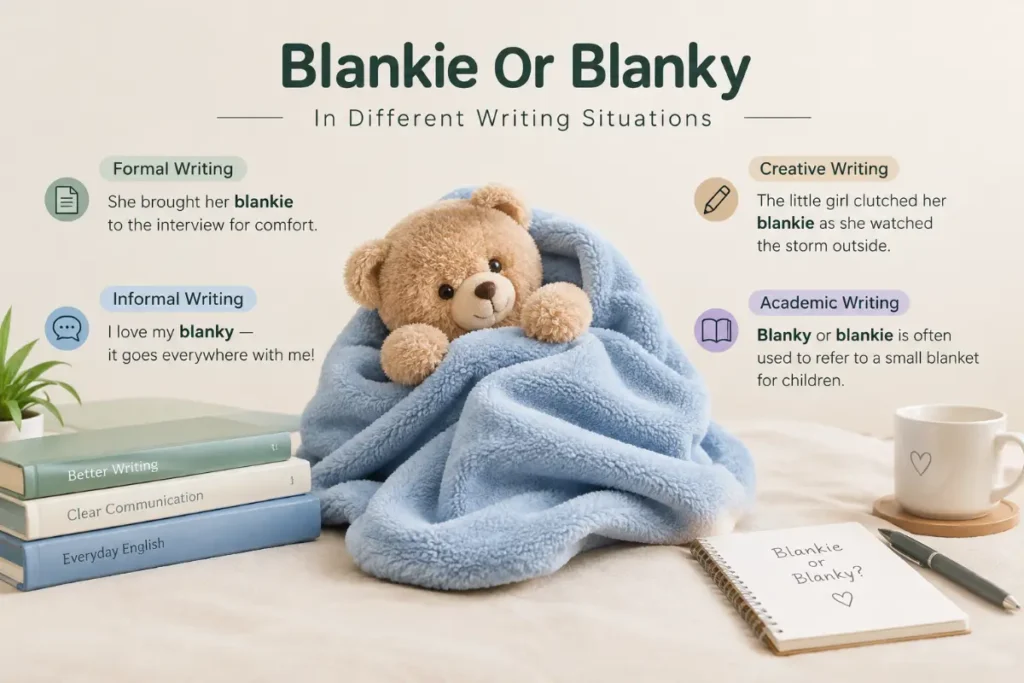
Blankie Or Blanky In Different Writing Situations
The best spelling isn’t always about grammar. It can also be about voice.
A children’s story can benefit from blankie because the word sounds affectionate.
A dictionary article can discuss blankie because the informal form itself is the topic.
A medical report should normally use blanket or comfort blanket.
A British children’s character might naturally say blanky.
Good editing means matching the word to the job.
In A Text Message
Blankie works naturally.
Don’t forget your blankie tonight.
A text message is informal enough for the word to fit without explanation.
In A Parenting Blog
Blankie is also a natural choice.
Every parent knows the panic that starts when a toddler can’t find their favorite blankie.
The word sounds personal and conversational.
In A Children’s Book
Both forms can work.
Teddy tucked the blankie under his chin.
The spelling helps establish a gentle child centered voice.
In A School Essay
It depends on the topic.
If the essay discusses childhood comfort objects then blankie can appear as the name of the object.
If the essay simply describes bedding then blanket is better.
In A Research Paper
Use a neutral term such as comfort blanket or security blanket unless you’re specifically analyzing the word blankie.
In A Business Report
Use blanket.
Informal diminutives usually don’t belong in formal business prose unless they’re part of a product name or quoted material.
In Dialogue
All three can work.
Did you bring your blanket?
sounds neutral.
Did you bring your blankie?
sounds affectionate or child friendly.
Did you bring your blanky?
can sound regional or especially childlike.
Dialogue gives writers more freedom because real people don’t always speak in formal dictionary English.
You may also want to read Camisole Meaning Slang Explained Clearly(2026 Guide).
Blankie Or Blanky And Tone
Tone is one of the most overlooked parts of word choice.
Blanket sounds neutral.
Blankie sounds affectionate.
Blanky can sound affectionate and childlike with a stronger British association.
That difference may seem tiny. In a short sentence it can change the emotional temperature.
Compare:
He reached for his blanket.
He reached for his blankie.
The second sentence suggests a personal relationship with the object.
It hints that the blanket is special.
That is exactly why informal vocabulary can be powerful. A small word choice can carry emotional information without adding another sentence.
Blankie Or Blanky And Register
Register means the level of formality associated with language.
A useful scale looks like this:
Blanket
Neutral and standard.
Comfort blanket
Neutral and descriptive.
Security blanket
Neutral and often used in psychological or figurative contexts.
Blankie
Informal and affectionate.
Blanky
Informal and baby talk in the Collins entry.
This isn’t a ranking of correctness. It’s a guide to context.
A formal word isn’t automatically better. An informal word isn’t automatically worse.
The right word is the one that fits the situation.
Can Blankie Mean More Than A Blanket
Usually blankie refers to the comfort blanket itself.
WordWeb also allows a blanket or toy that a child carries for comfort.
That broader idea connects it with the concept of a security object.
For example:
Her stuffed rabbit became her blankie.
In a family conversation this could make sense if the family uses blankie as a personal name for the child’s comfort object.
However, this isn’t the safest general dictionary definition.
If you’re explaining the word to English learners keep the main meaning clear:
Blankie means an informal comfort blanket, especially one associated with a child.
Can Blankie Be A Name
Yes.
Families often give special objects their own names.
A child’s favorite blanket might be called:
- Blankie.
- Bluey.
- Bunny.
- Softie.
- Baby.
- Bear.
In that case the word can function almost like a personal name within the family.
For example:
Blankie has to come everywhere with us.
This is highly informal and depends on the family’s naming habit.
When Blankie is used as a specific name it may be capitalized.
That is different from the ordinary noun:
She packed her blankie.
The capitalization depends on function rather than pronunciation.
Blankie Or Blanky In Possessive Forms
Because these words are nouns you can form possessives normally.
For singular blankie:
the baby’s blankie.
Emma’s blankie.
For plural blankies:
the children’s blankies.
The apostrophe rules are the same as for other nouns.
You don’t need a special grammar rule just because the word is informal.
Blankie Or Blanky In Questions
Questions follow ordinary English structure.
Where is my blankie?
Did you wash the blankie?
Can I have my blankie?
Which blankie is yours?
With blanky:
Where is my blanky?
Did you pack the blanky?
Nothing changes grammatically.
The spelling doesn’t affect sentence structure.
Blankie Or Blanky In Negative Sentences
Again the grammar is ordinary.
She doesn’t sleep without her blankie.
He didn’t bring his blanky.
We don’t need another blanket.
These examples show how context determines the word choice.
The informal forms remain nouns. They don’t create special tense rules.
Blankie Or Blanky And Pronunciation
Pronunciation is one reason the words are so easy to confuse.
Cambridge gives blankie as:
/ˈblæŋ.ki/.
The word has two syllables:
BLANG kee
The main stress falls on the first syllable.
Collins gives blanky as:
/ˈblæŋkɪ/.
Again the stress falls on the first syllable.
For many speakers the two words sound almost identical.
That means pronunciation isn’t a reliable way to decide the spelling.
Common Pronunciation Mistake
Don’t pronounce the first part as if it were blank followed by a completely separate word.
The sound flows naturally:
BLANG kee
The nk sound links the first syllable to the second.
The final sound is a short unstressed vowel in the dictionary pronunciations.
Does Blankie Sound Childish
It can.
That is part of its charm.
The ie ending makes the word sound smaller and more affectionate. The context decides how strongly that childish quality comes through.
For example:
My daughter can’t sleep without her blankie.
sounds completely natural in family writing.
But:
The corporation issued each employee a blankie.
sounds odd unless the sentence is intentionally humorous.
The problem isn’t grammar. The problem is register.
Does Blanky Sound Childish
Usually yes.
Collins explicitly labels blanky as baby talk.
That makes it especially suitable for:
- children’s dialogue.
- family conversations.
- playful writing.
- British children’s stories.
- affectionate references to childhood.
It is less suitable for formal prose.
Is Blankie A Diminutive
It is useful to describe blankie as an affectionate diminutive form of blanket.
A diminutive is a form that can express smallness, familiarity, affection, or informality.
English uses many such forms.
Examples include:
- doggie.
- kitty.
- birdie.
- sweetie.
- auntie.
The ending doesn’t always mean the object is literally small.
A child’s full sized favorite blanket can still be called a blankie.
The emotional relationship is often more important than physical size.
The Origin Of Blankie
The word is built from blanket with an affectionate ie ending.
Wiktionary records blankie as derived from blanket + ie.
The base word blanket is much older.
Collins traces blanket to Middle English and Old French forms connected with blanc, meaning white.
So the history looks roughly like this:
blank
↓
blanket
↓
blankie
The modern informal word is therefore rooted in an ordinary English noun rather than being a recent internet invention.
The Origin Of Blanky
Blanky developed from the same base idea.
Wiktionary records its comfort blanket sense as blanket + y and identifies it as an alternative form of blankie.
The two forms therefore have closely connected histories.
This is another reason not to invent a major meaning difference between them.
They are different informal formations built around the same underlying word.
Is Blankie New Internet Slang
No.
The word predates modern social media by a long way.
Dictionary and historical sources connect blankie with the older word blanket and show established usage. Wiktionary records it as an informal noun derived from blanket + ie.
So if you see blankie on social media today you’re seeing an old informal word in a modern setting.
It isn’t a word invented by texting culture.
Is Blanky New Slang
No.
The comfort blanket sense also has documented usage outside modern internet culture.
Collins gives it a British English entry.
Wiktionary records historical evidence for the comfort blanket sense as an alternative form of blankie.
The internet has probably increased the visibility of different spellings. It didn’t create the basic word.
Blankie And Historical English
English has always allowed speakers to create affectionate forms.
This is one reason informal vocabulary can feel unpredictable to learners.
There isn’t a single suffix rule that controls every affectionate noun.
Some forms use ie.
Some use y.
Others remain personal family expressions.
Blankie has crossed the line into established dictionary vocabulary. Blanky has also gained dictionary recognition in the comfort blanket sense.
That is why both deserve a place in a careful explanation.
Blankie Or Blanky And Dictionary Evidence
Dictionary evidence matters because it separates established usage from random spelling.
Cambridge lists blankie as an informal noun and gives its US usage and pronunciation.
Collins lists blanky as British baby talk for a comfort blanket.
Wiktionary records blanky as an alternative form of blankie for this sense.
WordWeb lists blankie as informal vocabulary and gives blankies as the plural.
Taken together these sources support a careful conclusion:
Blankie is an established informal form. Blanky is also established in informal usage but has a stronger British and baby talk association in major dictionary evidence.
That is more accurate than saying one is right and the other is wrong.
Blankie Or Blanky And Formality
If you’re unsure what to choose in professional writing use the neutral word blanket.
This isn’t because blankie is incorrect.
It’s because formal writing generally benefits from precise neutral vocabulary.
For example:
Casual:
She grabbed her blankie before bed.
Neutral:
She grabbed her blanket before bed.
More descriptive:
She grabbed her comfort blanket before bed.
Each sentence is grammatically correct.
The tone changes.
That is what good word choice is about.
A Practical Decision Guide
Use this simple guide when you’re writing.
Choose blankie when:
- Your audience is mainly American.
- The tone is casual.
- You’re talking about a child’s comfort blanket.
- You want an affectionate or nostalgic tone.
- You’re writing dialogue or children’s content.
Choose blanky when:
- You’re reflecting British baby talk.
- The speaker naturally uses that form.
- You’re writing a character with that regional voice.
- The informal spelling is part of the intended style.
Choose blanket when:
- The context is formal.
- You’re writing academic material.
- You’re writing professional documents.
- You mean any ordinary blanket.
- You want a neutral word.
A Note On Blankey
There is a third spelling worth knowing.
Blankey appears as an alternative form in Cambridge’s entry for blankie.
This spelling can appear in casual writing.
However, if you’re choosing a default spelling for an American audience, blankie remains the cleanest choice.
You don’t need to use blankey simply because it exists.
The same editorial principle applies here. A recognized variant isn’t automatically the best form for every audience.
Common Search Questions About Blankie Or Blanky
People searching this word pair usually want one of a few things.
They may ask:
Is blankie or blanky correct?
They may want to know:
How do you spell the word for a child’s comfort blanket?
They may also ask:
Is blankie a real word?
Or:
Is blanky British?
The answers connect.
Blankie is an established informal word and is mainly US according to Cambridge.
Blanky is also an established informal form and is specifically labeled British baby talk by Collins.
That gives writers enough information to choose confidently without treating informal vocabulary as a simple right or wrong test.
How Native Speakers Usually Think About The Choice
Native speakers rarely stop to analyze the grammar of blankie.
They recognize the word from context.
A parent may naturally say blankie because it sounds affectionate.
A British speaker may use blanky.
Another family may have its own preferred spelling.
This is common with informal vocabulary.
People often learn these words through relationships and conversation rather than classrooms.
That is why personal and regional variation can exist even when dictionaries document only certain forms.
What Professional Editors Look For
An experienced editor usually checks three things.
Accuracy
Is the word established and appropriate for the intended meaning?
For blankie the answer is yes.
For blanky the answer is also yes in its documented comfort blanket sense.
Register
Does the word fit the level of formality?
Both are informal.
Consistency
Does the writer use the same form throughout the piece?
If a text chooses blankie, keep using blankie unless a deliberate regional or character based reason calls for a change.
That small detail can make writing look carefully edited.
Twenty More Natural Examples
The best way to understand an informal word is to see how it behaves in real sentences.
Here are additional examples across different settings.
Daily Conversation
Can you grab the baby’s blankie?
Her blankie is still in the washing machine.
He left his blanky at Grandma’s house.
I thought you packed your blankie.
The cat is sleeping on the baby’s blankie.
Family Messages
Please remember to bring Ava’s blankie tonight.
We found the missing blankie under the couch.
His old blankie is finally getting a wash.
She won’t go to sleep until someone finds her blankie.
Parenting Content
A favorite blankie can become part of a child’s bedtime routine.
Some children carry their blankie with them when they visit unfamiliar places.
Washing a beloved blankie can become a surprisingly serious parenting challenge.
Children’s Stories
Max hugged his blankie and closed his eyes.
The little bear couldn’t find his blankie anywhere.
Lily tucked her blankie under her chin and smiled.
Casual Social Media
Rainy afternoon, hot chocolate, and my favorite blankie.
Found my childhood blankie today and suddenly I’m five again.
Nothing beats a cozy blanket and a quiet night.
Formal Or Educational Writing
The child became attached to a comfort blanket during early childhood.
Researchers may describe such an object as a security blanket or comfort object.
Notice the difference. The first groups use an affectionate informal word. The last group uses neutral descriptive vocabulary.
Common Mistakes To Avoid
Mistake One Using Blankie In Formal Writing
If the tone is academic or professional use blanket, comfort blanket, or security blanket.
Mistake Two Saying Blanky Is Always Wrong
That ignores dictionary evidence.
Collins explicitly recognizes blanky as British baby talk for a comfort blanket.
Mistake Three Assuming Blankie Means Any Blanket
It usually carries a more specific informal and emotional meaning.
Mistake Four Changing Spelling Without A Reason
Don’t switch between blankie and blanky randomly.
Choose the form that fits your audience.
Mistake Five Treating Informal As Incorrect
Informal vocabulary is still real vocabulary.
The label tells you how the word is used. It doesn’t automatically say the word is wrong.
Mistake Six Ignoring Regional Meaning
The word blanky has additional slang history in British and Australian usage.
If you’re writing for an international audience and want zero ambiguity use comfort blanket.
Blankie Or Blanky In Professional Editing
A professional editor doesn’t usually ask only:
Is this spelling correct?
The better questions are:
Is this the intended meaning?
Does this audience understand it?
Does the register fit?
Is the regional variety appropriate?
Is the spelling consistent?
Those questions lead to better writing.
On a US parenting website, blankie is a natural choice.
In a British children’s story, blanky can work well.
When writing an academic paper, comfort blanket is usually clearer.
The word itself isn’t the entire decision. Context finishes the job.
Blankie Or Blanky For English Learners
English learners often expect spelling to follow a clean set of rules.
Unfortunately English doesn’t always cooperate.
Informal vocabulary is especially flexible.
When you encounter blankie and blanky, don’t assume one must be a typo simply because the other looks more familiar.
Instead check:
- What does the word mean?
- What kind of English is being used?
- Is the writing formal or informal?
- What does the dictionary evidence show?
- What audience will read it?
For this pair the answers point toward a useful rule:
Blankie is the best general informal choice for American English. Blanky is an established informal form with strong British baby talk usage.
Is Blankie More Common Than Blanky
The available dictionary evidence makes blankie the clearer default for American English.
Cambridge labels it mainly US and gives it the primary dictionary entry.
Collins separately recognizes blanky as British baby talk.
However, exact frequency claims can depend on the corpus, time period, spelling variant, and region.
For practical writing you don’t need a precise numerical frequency.
You only need the editorial distinction:
American audience: blankie.
British baby talk: blanky.
Formal audience: blanket or comfort blanket.
Can You Use Blankie In A Formal Dictionary Article
Yes, if you’re talking about the word itself.
For example:
Blankie is an informal noun meaning a child’s comfort blanket.
That is formal writing about an informal word.
The mistake would be assuming that the word becomes formal simply because the surrounding article is formal.
This distinction is important in language teaching.
A dictionary can explain slang without becoming slangy.
An academic paper can discuss informal vocabulary without using it as its main register.
Can You Use Blanky In A Formal Article
Yes, for the same reason.
If you’re analyzing the word blanky, you can write:
Blanky is an informal British baby talk term for a comfort blanket.
That is a formal statement about informal vocabulary.
The issue isn’t the presence of the word. The issue is how the word functions.
Blankie Or Blanky And Pronunciation In American English
For American readers the two spellings are unlikely to create a major pronunciation difference.
The Cambridge pronunciation for blankie is:
/ˈblæŋ.ki/.
Break it into two parts:
BLANG + kee
The first syllable receives the main stress.
The spelling ie doesn’t mean you should pronounce the ending like the long vowel in pie.
Instead it produces the short final sound represented in the Cambridge transcription.
This is another reason listening alone doesn’t tell you which spelling to choose.
Blankie And The Word Blanket
Understanding the base word makes the spelling easier to remember.
Blanket is the ordinary noun.
Blankie is an affectionate informal form.
The relationship is similar to the way English speakers modify familiar words in casual speech.
You don’t need to memorize a complicated historical rule.
Just remember:
Blanket is neutral. Blankie is affectionate.
That distinction will take you a long way.
Blankie Or Blanky And Word Choice
Suppose you’re writing this sentence:
The child carried her favorite _____ everywhere.
Which word should you use?
If the tone is neutral:
blanket
If the tone is affectionate and American:
blankie
If you’re using British baby talk:
blanky
If you’re writing professionally about attachment:
comfort blanket
If you’re discussing reassurance more broadly:
security blanket
The blank isn’t really asking for a spelling answer alone. It’s asking for the right register.
That is why word choice is more useful than memorizing isolated rules.
A Simple Rule For Writers
When in doubt use this three step rule.
Casual American English:
Use blankie.
British baby talk:
Blanky is a valid choice.
Formal or neutral writing:
Use blanket or comfort blanket.
This rule handles most real world situations without overthinking the spelling.
Related Expressions
Several expressions sit close to blankie in meaning.
Comfort Object
A broad term for an item that provides emotional comfort.
Security Blanket
An object or sometimes a person that provides a sense of safety or reassurance. Collins records both the literal child related sense and the broader figurative sense.
Comfort Blanket
A blanket that a child is strongly attached to. It can also describe something figuratively relied upon for security.
Creature Comforts
This phrase refers to things that make life more comfortable. It isn’t a synonym for blankie but shares the idea of physical or emotional comfort.
Cozy Blanket
A descriptive phrase rather than a special vocabulary item.
These related expressions help you choose a neutral alternative when blankie feels too informal.
Opposites And Contrasts
There isn’t a true opposite of blankie because it names an object rather than a quality or action.
You can contrast it with ideas such as:
- discomfort.
- insecurity.
- exposure.
- cold.
- unfamiliarity.
But these are conceptual contrasts rather than dictionary opposites.
Don’t force an opposite into your writing simply because a vocabulary exercise asks for one.
What Dictionaries Tell Us
The strongest evidence available for this spelling question is consistent enough to support a practical answer.
Cambridge identifies blankie as an informal noun used mainly in US English. It defines the word as a blanket especially associated with a young child’s feeling of safety and happiness.
Collins identifies blanky as British baby talk for a comfort blanket.
Wiktionary records blanky as an alternative form of blankie for the comfort blanket meaning.
WordWeb also lists blankie as informal vocabulary and gives blankies as its plural.
This evidence supports a nuanced answer rather than a simple correct versus incorrect verdict.
Frequently Asked Questions
Is blankie or blanky the correct spelling
Both forms can be correct when they mean a child’s comfort blanket. Cambridge lists blankie as an informal noun used mainly in US English. Collins lists blanky as British baby talk for a comfort blanket. For a general American audience blankie is the safer default.
Is blankie a real word
Yes. Blankie is an established informal English noun. Cambridge defines it as a blanket especially a small one associated with a young child’s comfort and sense of security. It isn’t simply an internet spelling or a random family expression.
Is blanky a real word
Yes. Blanky is a recognized informal word for a comfort blanket. Collins lists it as British baby talk. Wiktionary also records it as an alternative form of blankie in this meaning.
Is blankie American English
Cambridge labels blankie as informal and mainly US English. That makes it a particularly natural choice for American readers. It can still be understood outside the United States because the word is not limited to American usage.
Is blanky British English
Blanky has a documented British English use. Collins labels it British baby talk and defines it as a comfort blanket. That doesn’t mean the word is restricted to Britain in every context. It means British usage has a clear dictionary record.
What does blankie mean
Blankie means an informal blanket, especially a small or familiar blanket that a child uses for comfort and security. The word often refers to a particular beloved blanket rather than any ordinary blanket. Cambridge specifically connects the word with a young child’s feeling of safety and happiness.
What does blanky mean
Blanky means a comfort blanket in its relevant modern informal sense. Collins labels it British baby talk. It normally describes a blanket that a child is attached to and uses for comfort. It doesn’t normally describe every blanket in a home.
What is the plural of blankie
The plural is blankies. The final ie changes to ies, following a common English spelling pattern. For example: one blankie becomes two blankies. WordWeb records blankies as the derived plural form.
Can adults use the word blankie
Yes. Adults can use blankie in casual conversation, family writing, humor, or nostalgic contexts. The word is informal and can sound childlike or affectionate. That doesn’t make it grammatically incorrect. In formal writing blanket or comfort blanket will usually fit better.
Should I use blankie in formal writing
Usually not. Blankie is informal. If you need a neutral or professional tone use blanket, comfort blanket, or security blanket instead. You can still use blankie in a formal article if the article is discussing the word itself.
Is blankie short for blanket
Yes. Blankie developed from blanket as an affectionate informal form. Wiktionary records its etymology as blanket + ie. The ending helps create the familiar and child friendly tone associated with the word.
Learn the difference in Wack Or Whack Which Word Is Correct 2026 Guide.
Final Verdict On Blankie Or Blanky
If you’re writing for an American audience and need an informal word for a child’s beloved comfort blanket blankie is the safest choice.
Blanky isn’t simply wrong. Collins recognizes it as British baby talk for a comfort blanket and Wiktionary records it as an alternative form of blankie.
The biggest mistake is treating this as a simple spelling error.
The real distinction is usage and register.
Use blankie in casual American English, especially in friendly, everyday conversation.
In some regional or character voices, blanky can also work. The spelling gives the word a more playful or informal feel.
For neutral or formal writing, choose blanket, comfort blanket, or security blanket. These forms are clearer and more appropriate for general audiences.
Once you see the difference that way the choice becomes much easier.
When the word carries comfort and childhood memories, blankie is usually the spelling American readers will recognize first.

Vocabulary & Language Research Writer
Ethan Parker researches English vocabulary, word meanings, slang, idioms, and commonly confused words. His goal is to help readers understand how English is actually used in everyday conversations and writing.