

If you’re wondering about nosey or nosy, you’re dealing with two spellings of the same English word. Both are correct. Both describe someone who shows too much interest in other people’s private business. The main difference is spelling preference rather than meaning. Major dictionaries such as Cambridge and Oxford list nosey as a variant of nosy.
For most general writing, especially in American English, nosy is the spelling I’d choose. It’s short, familiar, and widely recognized. Nosey isn’t a misspelling, though. It’s an accepted alternative.
The confusion makes sense because nosey looks closely connected to the noun nose. In fact, the word does have a historical connection to nose. The spelling with the extra e also makes the relationship visually obvious. Still, modern dictionaries recognize both forms.
This guide explains the difference between nosey and nosy, how to pronounce them, how to use them in sentences, how their forms change in comparative and superlative structures, and why nosy is usually the safer choice in edited American English. You’ll also see natural examples that show how native speakers use the word in everyday conversation and formal contexts.
Learn the difference in Seal Vs Seel Which Spelling Is Correct 2026 Guide.
Quick Answer
Nosy and nosey are both correct spellings. They have the same meaning, pronunciation, and grammatical function. Nosy is the spelling I recommend for most American English writing because it’s the more common modern form. Nosey is an accepted variant and isn’t an error.
Nosey or Nosy Comparison
| Feature | Nosy | Nosey |
|---|---|---|
| Correct spelling | Yes | Yes |
| Meaning | Too interested in other people’s affairs | Same |
| Part of speech | Adjective | Adjective |
| Pronunciation | /ˈnoʊzi/ in US English | /ˈnoʊzi/ in US English |
| Meaning in British English | Same | Same |
| Meaning in American English | Same | Same |
| Tone | Usually informal and mildly disapproving | Usually informal and mildly disapproving |
| Comparative | Nosier | Usually nosier |
| Superlative | Nosiest | Usually nosiest |
| Related noun | Nosiness | Nosiness |
| Related adverb | Nosily | Nosily |
| Recommended general spelling | Yes | Accepted variant |
Cambridge lists nosy as an adjective and identifies nosey as an alternative spelling. Oxford does the same. American Heritage also gives nosy or nosey as accepted forms.
What Does Nosy Mean
Nosy is an adjective that describes someone who takes too much interest in matters that don’t concern them.
A nosy person might ask personal questions, listen to private conversations, inspect someone else’s belongings, or try to discover information that another person would rather keep private.
For example:
My neighbor is very nosy about everyone on the street.
The sentence doesn’t simply say that the neighbor is curious. It suggests that the curiosity crosses a social boundary.
That distinction matters. Curious can be positive. A curious student wants to understand how something works. A curious reader wants to learn more about a subject. Nosy usually carries a negative or disapproving tone because the person’s curiosity involves other people’s private affairs. Cambridge and Oxford both describe the word in terms of excessive interest in other people and their affairs.
Nosy as an Adjective
The most common use of nosy is as an adjective.
You can use it before a noun:
She has a nosy coworker.
You can also use it after a linking verb:
Her coworker is nosy.
It can describe a person:
He’s incredibly nosy.
It can also describe behavior, questions, or actions:
That was a nosy question.
She asked some nosy questions about my salary.
His nosy behavior made everyone uncomfortable.
The word often works best with people and questions related to private information.
What Does Nosey Mean
Nosey has the same meaning as nosy.
If you write:
She’s a nosy neighbor.
or:
She’s a nosey neighbor.
the meaning is the same.
Oxford lists nosey as another form of nosy, while Cambridge identifies it as an alternative spelling. Collins also describes nosey as a variant spelling.
So you don’t need to memorize two separate definitions.
Think of them as two spellings for one adjective:
nosy = nosey
The difference is written form rather than meaning.
Which One Is Correct
Both nosy and nosey are correct.
That answer is important because many word comparison articles incorrectly treat one spelling as wrong. Major dictionaries do not support that approach.
Cambridge lists nosy and gives nosey as an alternative. Oxford lists nosy and also recognizes nosey. American Heritage likewise records both forms.
So these are all acceptable:
Don’t be so nosy.
Don’t be so nosey.
She’s always asking nosy questions.
She’s always asking nosey questions.
However, accepted does not always mean equally useful in every writing situation. If you need one spelling for general American English, I’d use nosy.
That choice keeps your writing aligned with the main form shown by major learner dictionaries and avoids making the spelling look unusual to readers who expect the shorter form.
Why People Confuse Nosey and Nosy
The confusion comes mainly from the relationship between the word and the noun nose.
The spelling nosey visually suggests:
nose + y
That makes intuitive sense. Someone who gets into other people’s business is often described metaphorically as putting their nose into things.
The spelling nosy looks less obvious at first. A learner may see it and wonder if the missing e is a typo.
It isn’t.
English has many words whose spelling changes when a suffix is added. In this case, the accepted spelling nosy has become established alongside nosey.
There’s another reason the two forms cause trouble. People often learn English through speech before they learn the written form. Since nosy and nosey are pronounced the same, listening doesn’t help you decide which spelling to use.
Autocorrect can add another layer of confusion. A device may recognize both forms depending on its dictionary and language settings. That can make learners assume that one version must be incorrect when both are accepted.
The Key Difference Between Nosey and Nosy
There is no meaningful difference in definition between the two spellings.
Both describe excessive curiosity about other people’s affairs.
The useful difference is simply this:
Nosy is the spelling I’d normally choose in general writing.
Nosey is a recognized variant.
This is a spelling preference rather than a difference in grammar, pronunciation, or meaning.
That makes the comparison much easier than many English word pairs. You don’t need to remember different situations for each word. You only need to remember that both forms refer to the same idea.
Nosy and Nosey Pronunciation
Both spellings are pronounced the same.
In American English, the pronunciation is:
/ˈnoʊzi/
You can think of it as two syllables:
NOH zee
The first syllable receives the main stress.
In British English, Cambridge gives the pronunciation as:
/ˈnəʊzi/
The vowel quality differs slightly because of the normal pronunciation differences between American and British English. The spelling does not create a different pronunciation.
Common Pronunciation Mistake
Some learners may pronounce nosey as though it contains two separate words:
nose ee
That isn’t how the adjective normally sounds.
The word has two syllables:
NOH zee
The same pronunciation applies to nosy.
Is Nosy an Adjective
Yes.
Nosy is primarily an adjective.
It describes a person or thing associated with excessive curiosity.
Examples include:
He’s a nosy neighbor.
That was a nosy question.
My aunt can be pretty nosy.
The reporter seemed nosy about the actor’s private life.
You can also use it after a linking verb:
She became nosy after hearing the rumor.
He seems nosy whenever someone mentions money.
The adjective can modify both people and the behavior associated with them.
Grammar Rules for Nosy
The grammar of nosy is straightforward.
It normally appears as an adjective before a noun or after a linking verb.
Before a Noun
a nosy neighbor
a nosy coworker
a nosy child
a nosy reporter
a nosy question
After a Linking Verb
She is nosy.
He seems nosy.
They became nosy.
My neighbors are getting nosy.
You can also modify it with adverbs:
She’s extremely nosy.
He’s surprisingly nosy.
They’re becoming increasingly nosy.
This gives you plenty of natural ways to use the word without forcing the same sentence pattern.
Comparative and Superlative Forms
Like many short adjectives ending in y, nosy changes its ending when you form the comparative and superlative.
The usual forms are:
nosy → nosier → nosiest
For example:
My sister is nosier than I am.
He became nosier after the meeting.
She’s the nosiest person in the office.
Cambridge lists nosier as the comparative form and nosiest as the superlative form.
The spelling changes from y to i before the comparative and superlative endings.
That gives you:
nosy
nosier
nosiest
Avoid forms such as noseyer or noseyiest in standard edited writing.
Nosy in Everyday Conversation
The word is especially common in casual speech.
You might call a friend nosy in a playful way:
You’re so nosy. I wasn’t going to tell you yet.
The word can sound lighthearted when the situation is harmless.
However, it can also sound insulting:
Stop being nosy and leave her alone.
Context controls the strength of the word.
Calling someone nosy usually suggests that they have crossed a line. Still, it is generally less severe than words that describe serious harassment or deliberate invasion of privacy.
That makes nosy useful in everyday conversation because it can express mild annoyance without sounding overly formal.
Nosy in Professional Writing
You can use nosy in professional writing, but context matters.
The word is informal and often disapproving. Oxford and Cambridge both label it as informal or disapproving.
For example:
The manager was concerned about nosy questions from reporters.
That sentence is perfectly understandable.
However, a formal report might use a more precise phrase:
The manager was concerned about intrusive questions from reporters.
In academic writing, terms such as intrusive, inquisitive, meddlesome, or overly curious may fit better depending on the exact meaning.
That doesn’t make nosy incorrect. It simply means that word choice should match the register.
Nosey or Nosy in American English
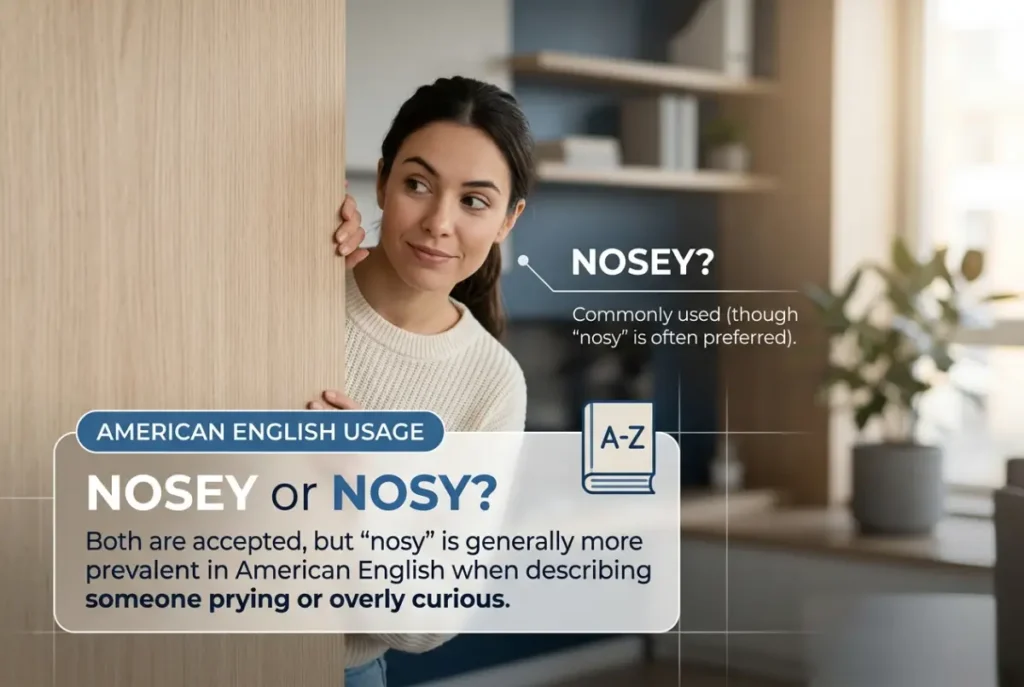
Both forms appear in American English. Nosy is the spelling you’ll see most often as the main dictionary entry. Nosey is also accepted and carries the same meaning.
So this isn’t a simple American versus British spelling difference. Both forms can appear across major varieties of English.
For general American writing, nosy is the practical choice. It’s familiar and easy to recognize. However, you don’t need to correct nosey simply because you prefer the shorter spelling.
Canadian English
Canadian English can use both nosy and nosey. There isn’t a firm rule that reserves one spelling for Canadian writers.
Australian English
Australian English also uses the word in everyday communication. As with American and British English, both spellings can occur.
The main point is simple. Nosy is the useful default. Nosey remains a legitimate variant.
Nosy or Nosey in Formal Writing
If you’re writing a school assignment, business document, website article, email, or general educational resource, nosy is a sensible choice.
Major dictionaries treat nosy as a standard form and recognize nosey as a variant. That gives you solid editorial support for using either spelling.
Still, accepted spelling doesn’t mean every publication must use both forms. A publication can have a preferred style. If its style guide consistently uses nosey, follow that preference.
Good editing also means respecting consistency. If you choose nosy in a piece of writing, keep using nosy unless you have a clear reason to preserve nosey.
Nosy or Nosey in Informal Writing
Informal writing gives you plenty of freedom.
You can use either spelling in texts, social media posts, casual emails, personal messages, and conversations.
For example:
You’re getting nosy again.
You’re getting nosey again.
The meaning stays the same.
If you want the spelling that feels most familiar to the widest group of American readers, nosy is the safer choice.
Twenty Natural Examples of Nosy and Nosey
These examples show how the adjective works in real sentences. You can replace nosy with nosey in most of them without changing the meaning.
Daily Conversation
- My little brother is incredibly nosy about everything.
- Don’t be so nosy. It’s a private conversation.
- She asked a nosy question about my age.
- Our neighbor is always nosy about who visits us.
- I know you’re curious, but don’t get too nosy.
Family And Friends
- My aunt gets nosy whenever someone starts talking about relationships.
- Her friends were too nosy about the surprise party.
- The kids became nosy when they saw a wrapped package.
- He’s nosier than his older brother.
- My cousin is probably the nosiest person I know.
Workplace
- A nosy coworker asked how much I earned.
- She tried to avoid nosy questions during the meeting.
- The new employee seemed friendly rather than nosy.
- His nosy behavior made the conversation uncomfortable.
Emails And Messages
- I hope this doesn’t sound nosy, but can I ask why you left the project?
- Sorry for being nosy. I was just curious about the announcement.
- Please don’t take this the wrong way. I’m not trying to be nosy.
Academic And Formal Contexts
- The article examines how people respond to nosy questions about their private lives.
- The survey asked participants how they react to intrusive or nosy behavior.
- The journalist was criticized for asking nosy questions during the interview.
Notice how the word can appear in many settings. The difference is mainly tone. Nosy is natural in conversation and can also appear in published writing when the writer wants a direct and conversational word.
Common Mistakes With Nosy and Nosey
Several mistakes appear regularly when people use these words.
Treating Nosey as Wrong
This is the biggest mistake.
Nosey is not simply a misspelling of nosy.
It’s an accepted spelling variant. Major dictionaries recognize it as such.
Treating Nosy as Wrong
The opposite mistake happens too.
Nosy is completely correct.
It isn’t an incomplete version of nosey. It has its own established dictionary entry and is widely used.
Using Noisy Instead of Nosy
This is a different word.
Noisy relates to sound.
The classroom was noisy.
Nosy relates to unwanted curiosity.
The neighbor was nosy.
A simple memory trick can help:
Noisy means full of noise.
Nosy means sticking your nose into other people’s business.
Assuming Pronunciation Changes
The extra e in nosey doesn’t give the word a different pronunciation.
Both spellings are normally pronounced the same way.
In American English, the pronunciation is approximately:
NOH zee
The word has two syllables with the main stress on the first syllable.
Writing Noseyer
The standard comparative form is nosier.
She’s nosier than her brother.
Not:
She’s noseyer than her brother.
The spelling changes from y to i before the comparative ending.
Writing Noseyiest
The standard superlative form is nosiest.
He’s the nosiest person in the group.
Not:
He’s the noseyiest person in the group.
Remember the pattern:
nosy
nosier
nosiest
Nosily and Nosiness
The word has two useful related forms.
Nosily is an adverb. It describes an action performed in a nosy way.
She looked nosily through the papers.
Nosiness is a noun. It describes the quality or behavior of being nosy.
His nosiness annoyed his coworkers.
These forms are useful because they let you describe the behavior itself rather than simply describing a person.
The word family can be remembered like this:
nosy
nosily
nosiness
You can also add the comparison forms:
nosier
nosiest
The Difference Between Nosy and Curious
This distinction is important because curious and nosy can look like synonyms at first.
They aren’t always interchangeable.
Curious usually means wanting to know or understand something.
I’m curious about how the machine works.
That sounds neutral or positive.
Nosy suggests that the curiosity has crossed a social boundary.
I’m nosy about your personal finances.
That sentence suggests unwanted interest in private information.
The subject of the curiosity often helps you choose the right word.
Curious
Usually neutral or positive.
Nosy
Usually informal and disapproving.
Someone can be curious about history, science, music, or technology. Calling that person nosy would change the meaning.
On the other hand, someone who keeps asking personal questions about your relationship may reasonably be described as nosy.
Nosy vs Inquisitive
Inquisitive also describes someone who wants information. However, it often sounds more positive or neutral than nosy.
Compare these sentences:
The inquisitive student asked several questions about astronomy.
That sounds positive.
The nosy neighbor asked several questions about my divorce.
That sounds intrusive.
The difference comes from the subject and the social boundary involved.
Inquisitive often suggests a desire to learn.
Nosy often suggests unwanted interest in private matters.
Many readers also check Natzi Or Nazi Which Spelling Is Correct 2026.
Nosy vs Intrusive
Intrusive is often stronger than nosy.
A nosy person may ask too many personal questions. An intrusive person may interfere with someone’s privacy or personal space in a more serious way.
Compare:
That was a nosy question.
The reporter’s behavior became intrusive.
The first sentence expresses annoyance. The second suggests a stronger violation of personal boundaries.
This distinction matters in careful writing because nosy, intrusive, and meddlesome aren’t exact substitutes.
Nosy vs Snoopy
Snoopy can also describe someone who is overly interested in other people’s private affairs.
Stop being so snoopy.
My snoopy little brother found the hidden gift.
The word can sound playful. It can also sound critical.
Nosy is the more direct and widely useful choice when you want to describe unwanted curiosity.
Related Expressions With Nosy
English has several expressions connected to the idea of getting involved in other people’s business.
Stick Your Nose Into Something
This expression means to interfere in something that doesn’t concern you.
He always sticks his nose into other people’s business.
The expression also helps explain why nosey feels like a natural spelling. English has long connected the nose with the idea of poking into matters that aren’t yours.
Nose Around
To nose around means to look around or investigate because you’re curious.
She started nosing around the office after everyone left.
The phrase can describe harmless curiosity or unwanted investigation depending on the situation.
Nosy Parker
Nosy Parker is an informal British expression for someone who is too interested in other people’s affairs.
It has an older feel today and isn’t especially common in everyday American English.
The expression is still interesting because it shows how deeply the idea of the nose became connected with unwanted curiosity in English.
Word Origin of Nosy and Nosey
The history of nosy makes the meaning easier to understand.
The word comes from nose with the suffix y. Earlier uses referred to someone or something with a prominent nose. Later, the word developed its modern sense of someone who is excessively curious about other people’s affairs.
The metaphor is easy to picture.
Someone who is nosy is figuratively putting their nose into other people’s business.
That image is still alive in expressions such as stick your nose into something and nose around.
The spelling nosey makes the connection with nose more obvious.
The spelling nosy is the shorter established form.
Both have remained in English.
Why the Word Has a Negative Tone
The word isn’t negative because curiosity itself is bad.
Curiosity can be useful.
A curious student might ask:
Why does this chemical reaction happen?
That person wants to learn.
A nosy person might ask:
How much money do you make?
That person may be asking for private information.
The difference is the boundary.
That’s why nosy often carries a mildly negative tone. It suggests that someone has gone beyond normal curiosity and entered another person’s private space.
Still, context matters.
A friend might say:
You’re so nosy. Fine. I’ll tell you.
In that situation, the word may sound playful rather than harsh.
Memory Trick for Nosy
Use this simple association:
Nosy means nose in someone else’s business.
Picture someone physically sticking their nose into a private conversation.
That image connects the spelling with the meaning.
For the two spellings, remember:
Nosy is the shorter form.
Nosey is the accepted variant.
If you need one spelling for everyday writing, choose nosy.
A Simple Rule for Writers
When you’re unsure, use this rule:
Write nosy for general modern English.
Use nosey when you’re following an established spelling in a source, publication style, quotation, or existing piece of content.
You don’t need to treat nosey as an error.
The most important thing is consistency.
Once you choose your preferred spelling, stick with it throughout the same piece of writing. That small editorial habit makes your work look more polished and intentional.
Expert Editor’s Note
From an editing perspective, I wouldn’t mark nosey as a spelling error.
That distinction matters. A good editor should separate an incorrect spelling from an accepted spelling variant. If a dictionary recognizes a form as legitimate, changing it just to match another preferred form can be unnecessary.
Major dictionaries recognize both nosy and nosey. Cambridge lists nosey as an alternative spelling of nosy. Oxford also recognizes both forms. American Heritage lists nosy or nosey as accepted forms.
For general American English content, I’d normally choose nosy. It’s concise, familiar, and easy for readers to recognize.
That recommendation doesn’t make nosey wrong. It simply gives you a practical default.
Consistency matters too. If you choose nosy in an article, keep that spelling throughout the article unless you have a specific reason to preserve nosey.
What Dictionaries Say
Major dictionaries agree on the central point.
Cambridge defines nosy as being too interested in what other people are doing or wanting to discover too much about them. It also lists nosey as an alternative spelling.
Oxford defines nosy as being too interested in things that don’t involve you. It also recognizes nosey as another form.
American Heritage records nosy or nosey and connects the word with intrusive curiosity about other people’s affairs.
Collins also identifies nosey as a variant spelling of nosy.
The evidence points in the same direction. You can confidently use either spelling.
Which Spelling Should You Use
If you want one clear editorial recommendation, use nosy.
That’s the spelling I’d choose for most general American English writing.
Use nosey when you have a reason to retain that spelling. For example, you might keep it in a quotation, a publication that prefers it, or existing copy where maintaining the original spelling matters.
The important point is that you don’t need to correct nosey simply because nosy is your preferred form.
Is Nosy More Common Than Nosey
The two spellings don’t have exactly the same level of usage.
Nosy is generally treated as the main modern form by major dictionaries. Nosey is commonly presented as a variant.
That gives writers a useful signal.
If you’re creating a new article or writing a general American English sentence from scratch, nosy is the natural default.
Still, frequency doesn’t determine correctness. A less common spelling can remain completely legitimate.
That’s the case here.
Is Nosey British or American
Neither spelling belongs exclusively to one major variety of English.
Both nosy and nosey occur in British English and American English. This isn’t a simple regional spelling pair like some well known differences between British and American vocabulary.
So avoid this rule:
Nosy is American and nosey is British.
That rule is too simplistic.
A better rule is:
Both forms are used in different English varieties. Nosy is the practical default for general writing.
Is Nosy the Same as Noisy
No.
These words look similar but have completely different meanings.
Nosy means too interested in other people’s private affairs.
My neighbor is nosy.
Noisy means producing or containing a lot of sound.
My neighbor is noisy.
The first person asks too many personal questions. The second person makes too much noise.
The pronunciation also differs.
A useful memory trick is:
Nosy asks questions.
Noisy makes noise.
This is one of the most useful distinctions to remember when writing quickly.
Is Nosy a Slang Word
Nosy is generally described as informal rather than pure slang.
It’s common in everyday speech and casual writing.
Don’t be so nosy.
You can also find it in journalism and published writing when the writer wants a conversational tone.
In highly formal academic writing, you might choose a more precise word such as intrusive, inquisitive, or meddlesome.
The right choice depends on the exact idea you want to express.
Is Nosy Rude
It can be.
Calling someone nosy usually suggests that they’re asking questions or seeking information that isn’t their business.
For example:
Why are you being so nosy?
That sentence can sound confrontational.
However, friends and family members often use nosy playfully.
You’re so nosy. I knew you’d ask.
The relationship between the speakers and the tone of the conversation determine how harsh the word sounds.
If you want to sound more polite, you can soften the idea:
I hope I’m not being too curious.
I don’t mean to pry.
I hope you don’t mind me asking.
These expressions work better when the topic is sensitive.
Common Phrases With Nosy
Nosy often appears with nouns connected to privacy, personal information, and social boundaries.
Common combinations include:
- nosy neighbor
- nosy coworker
- nosy question
- nosy person
- nosy reporter
- nosy child
- nosy relative
- nosy behavior
- nosy people
The phrase nosy neighbor is especially natural in everyday English.
You can also use nosy with words such as questions, comments, behavior, and attitude.
For example:
She kept asking nosy questions about my relationship.
His nosy behavior made everyone uncomfortable.
I didn’t appreciate her nosy comments.
Related Words and Synonyms
Several English words overlap with nosy, but each has its own shade of meaning.
Curious
Interested in learning or discovering something.
Curious is usually neutral or positive.
I’m curious about how the machine works.
Inquisitive
Interested in finding out information.
Inquisitive often sounds neutral or positive.
The inquisitive student asked several questions.
Intrusive
Interfering with someone’s privacy or personal space.
Intrusive is often stronger than nosy.
His questions became intrusive.
Meddlesome
Trying to interfere in other people’s affairs.
Meddlesome usually has a clearly negative tone.
Her meddlesome behavior caused problems.
Snoopy
Overly interested in other people’s private matters.
Snoopy is informal and can sound playful.
My little brother is being snoopy again.
Prying
Trying to discover private information.
Prying often sounds strongly negative.
I don’t appreciate your prying questions.
Inquiring
Seeking information.
Inquiring is usually neutral and can sound more formal.
She made an inquiring remark about the process.
The best synonym depends on the situation. A curious person wants to learn. A nosy person wants information that may not concern them. An intrusive person may cross a stronger personal boundary.
Opposites of Nosy
English doesn’t have one perfect opposite for nosy.
Depending on the context, you might use:
- respectful
- discreet
- private
- reserved
- uninterested
- nonintrusive
For example:
She’s very respectful of other people’s privacy.
That sentence expresses the opposite behavior more naturally than trying to force a single antonym.
Common Search Questions About Nosey and Nosy
Is Nosy or Nosey Correct
Both are correct. Nosy is the spelling I’d recommend for most general writing, especially in American English. Nosey is an accepted variant with the same meaning and pronunciation. You don’t need to correct nosey simply because nosy is the form you prefer.
Is Nosey a Misspelling of Nosy
No. Nosey is an accepted spelling variant of nosy. Both words describe someone who shows too much interest in other people’s affairs. If you’re choosing a spelling for new content, nosy is the cleaner default. However, nosey remains completely understandable and legitimate.
Is Nosy American or British
Both American and British English use nosy. Nosey also appears in both varieties. This isn’t a strict regional spelling difference. If you need one spelling for general American English writing, nosy is a practical choice.
How Do You Spell Nosy in the Past Tense
Nosy is an adjective, so it doesn’t have a past tense. You can say someone was nosy, became nosy, or had been nosy. If you’re looking for a related verb, nose around can describe looking around or investigating because of curiosity.
What Is the Comparative of Nosy
The comparative form is nosier.
My sister is nosier than I am.
The spelling changes from y to i before the comparative ending.
The superlative form is nosiest.
She’s the nosiest person in the office.
Avoid forms such as noseyer and noseyiest in standard edited English.
What Is the Superlative of Nosy
The superlative form is nosiest.
He’s the nosiest person in our family.
The spelling follows the standard pattern for adjectives ending in y:
nosy → nosier → nosiest
The accepted variant nosey doesn’t normally produce forms such as noseyer or noseyiest.
What Is the Difference Between Nosy and Curious
Curious usually means interested in learning or discovering something. It can sound completely positive. Nosy suggests that someone’s curiosity has gone too far and involves another person’s private affairs. A student can be curious about science. A neighbor can be nosy about your personal life.
Is Nosy a Negative Word
Usually, yes. Nosy normally carries an informal and mildly disapproving tone because it suggests unwanted interest in another person’s affairs. However, people often use it playfully with friends and family. The context and relationship between the speakers determine how negative the word sounds.
What Is the Noun Form of Nosy
The noun form is nosiness.
His nosiness annoyed his coworkers.
Nosiness refers to the quality or behavior of being too interested in matters that don’t concern you.
The spelling is important because you shouldn’t form the noun by simply adding an ending to nosey.
What Is the Adverb Form of Nosy
The adverb is nosily.
She looked nosily through the papers.
Nosily means in a nosy manner. It’s grammatically correct but less common in everyday speech than nosy.
Is Nosy the Same as Noisy
No.
Nosy means overly interested in other people’s private affairs.
Noisy means producing or containing a lot of sound.
Compare:
The neighbor is nosy.
The neighbor is noisy.
A nosy person asks too many questions. A noisy person makes too much sound.
Can You Say Nosier and Nosiest
Yes.
The standard forms are:
nosy
nosier
nosiest
For example:
Jake is nosier than his brother.
Maria is the nosiest person at work.
These forms follow the usual spelling pattern for adjectives ending in y.
Internal Linking Opportunity
A useful related article to place before the conclusion is Noisy or Nosy Which Word Should You Use. It directly addresses one of the most common spelling and meaning confusions connected with nosy.
Another strong internal topic is Curious vs Inquisitive What Is the Difference. It can help readers understand the difference between neutral curiosity and curiosity that crosses a social boundary.
Need another quick comparison? Read Receiver Vs Reciever Which Spelling Is Correct 2026 Guide.
Final Takeaway
The answer to nosey or nosy is straightforward.
Both spellings are correct.
Nosy is the spelling I’d recommend for most general American English writing.
Nosey is an accepted variant with the same basic meaning and pronunciation.
The word describes someone who shows too much interest in other people’s affairs. It usually sounds informal and mildly disapproving, although friends can use it playfully.
Remember the main word family:
nosy
nosier
nosiest
nosily
nosiness
Also keep nosy separate from noisy. A nosy person asks unwanted questions. A noisy person makes too much sound.
If you need one spelling and don’t want to think twice, choose nosy. It’s simple, familiar, and widely recognized.
A small spelling choice can save a lot of second guessing. Once you remember that both forms are valid, this particular English trap loses its bite.

Editorial Reviewer & Proofreader
Grace Mitchell reviews Gramlify’s articles for clarity, consistency, and readability. She is passionate about creating accurate, approachable content that helps English learners build confidence.