
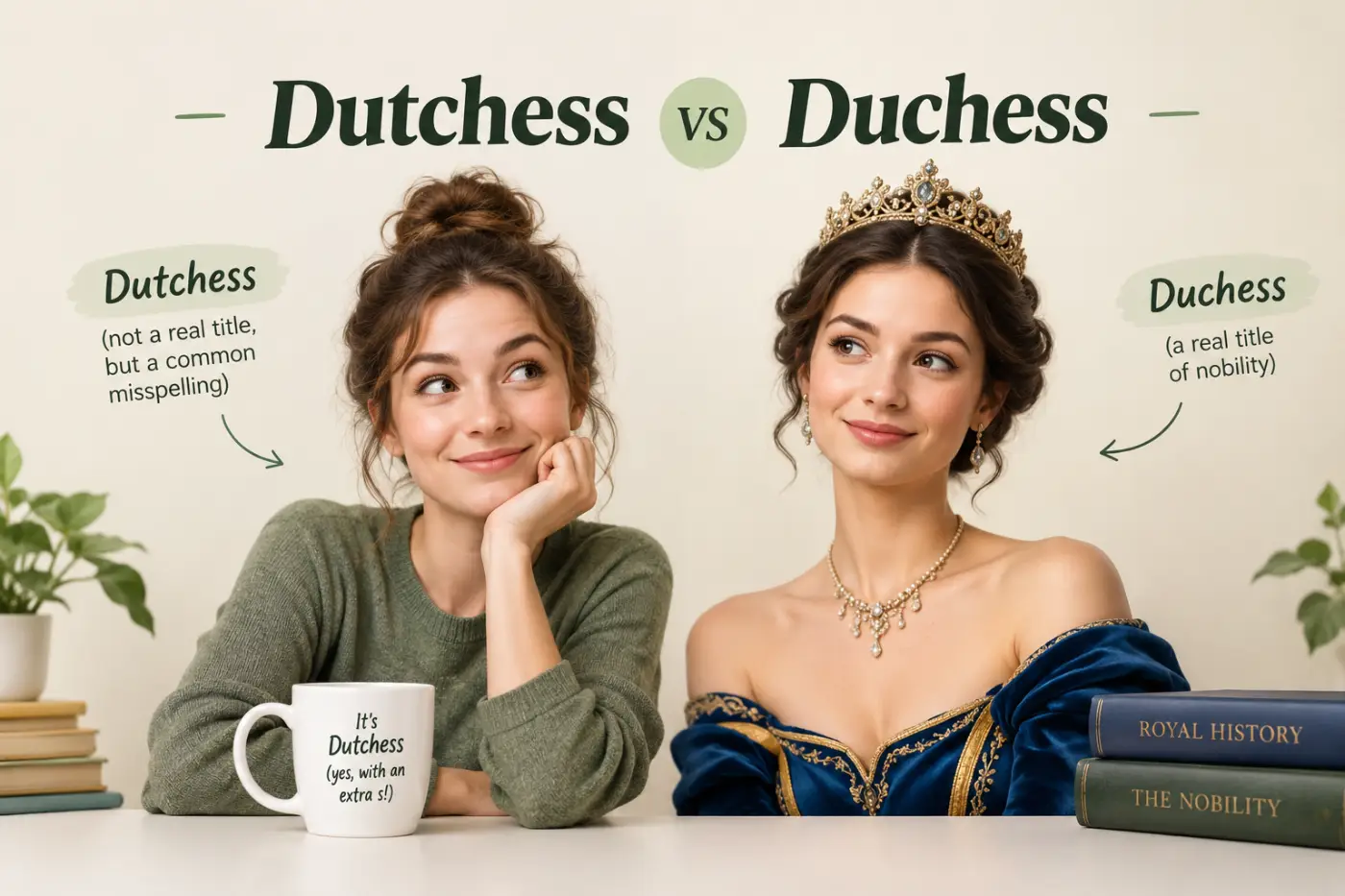
If you’re searching for dutchess vs duchess, the answer depends on what you’re trying to name. Duchess is the standard English word for a woman who holds the rank of duke or is traditionally the wife or widow of a duke. Dutchess is not the standard spelling of that title. However, Dutchess is a real spelling in proper names, most famously Dutchess County in New York.
That small extra t causes a surprising amount of confusion. The two forms look almost identical and sound very similar. People can also encounter Dutchess in a familiar place name and then assume it must be an accepted alternative spelling of the noble title. That assumption can lead to mistakes in emails, school assignments, articles, captions, and other formal writing.
The good news is that the distinction is easy once you connect each spelling with its proper use. This guide explains the meaning, spelling, pronunciation, grammar, history, common mistakes, and real world use of duchess and Dutchess. You’ll also learn why Dutchess County has the extra t and how to remember the correct form without second guessing yourself.
You may also want to read Using or Useing Which Spelling Is Correct.
Quick Answer
Duchess is the correct standard English spelling for the female equivalent of a duke and for a woman who holds that rank. Dutchess is not the standard spelling of the title. However, Dutchess is correct in proper names such as Dutchess County, New York, whose spelling comes from an older form of the word.
Duchess vs Dutchess At A Glance
| Feature | Duchess | Dutchess |
|---|---|---|
| Standard English word | Yes | Not for the noble title |
| Main meaning | A woman who holds the rank of duke or is traditionally the wife or widow of a duke | Mainly found in specific proper names |
| Part of speech | Noun | Proper noun when used in a name |
| Spelling | D U C H E S S | D U T C H E S S |
| Pronunciation | Usually /ˈdʌtʃɪs/ or /ˈdʌtʃəs/ | Usually pronounced like Duchess in the place name |
| Common use | Titles and discussions of nobility | Dutchess County and other established names |
| Standard modern title | Yes | No |
| Plural | duchesses | Depends on the proper name or surname |
| Example | The duchess attended the ceremony. | She lives in Dutchess County. |
The most important point is simple: use duchess for the title and Dutchess when the proper name specifically uses that spelling.
What Does Duchess Mean
Duchess is a noun. It refers to a woman who holds the rank of duke or to a woman who is traditionally the wife or widow of a duke. The exact role can depend on the system of nobility and the historical period involved.
In everyday English, the word is most often connected with royalty, aristocracy, noble families, historical titles, and formal names.
For example:
The duchess attended the ceremony.
The duke and duchess welcomed their guests.
The novel features a young duchess who inherits an estate.
A duchess can hold a title in her own right. The word doesn’t always mean simply the wife of a duke. Modern dictionary definitions recognize both the female holder of the rank and the traditional marital connection.
That distinction matters in careful writing because reducing the word to one narrow definition can leave out an important part of its meaning.
Duchess Is The Standard Spelling
When you mean the noble title, spell the word:
duchess
Not:
dutchess
For example:
Correct: The duchess arrived at the palace.
Incorrect: The dutchess arrived at the palace.
Correct: The Duchess of York attended the event.
Incorrect: The Dutchess of York attended the event.
The standard English spelling has no t after the u.
That makes the relationship with duke especially useful. The masculine title is duke and the corresponding feminine title is duchess.
Think of the pair as:
duke → duchess
The extra t in Dutchess doesn’t belong to the standard title.
What Does Dutchess Mean
Dutchess is a more complicated case because it isn’t simply an incorrect string of letters in every situation.
In modern English, Dutchess is best known as part of a proper name. The clearest example is Dutchess County in New York. The State of New York officially identifies the county as Dutchess County.
So these two sentences are both correctly spelled:
The duchess attended the ceremony.
They moved to Dutchess County.
The spelling changes because the words serve different purposes.
In the first sentence, duchess is a common noun describing a title.
In the second sentence, Dutchess is part of an official geographic name.
That distinction is important for editors. A spell checker or dictionary rule that treats Dutchess as simply wrong can miss the role of proper names. You shouldn’t change the spelling of an established name just because it differs from the modern common noun.
Why Dutchess County Has A T
This is the part that makes the comparison especially interesting.
Dutchess County was one of the original twelve counties established in the Province of New York in 1683. The county was named after Mary of Modena, who was then Duchess of York and the wife of the future King James II of England. The county government explains that its spelling preserves a seventeenth century form of duchess found in the original law establishing the county.
So the extra t in Dutchess County isn’t a modern spelling mistake.
It has historical roots.
The spelling survived as part of the county’s official name even though modern standard English uses duchess for the title.
This gives us an important writing lesson: proper names can preserve older spellings long after ordinary English has changed.
You can see similar patterns in family names, town names, street names, institutions, and historical places. Once a spelling becomes part of an official name, changing it to match modern spelling can create a new error.
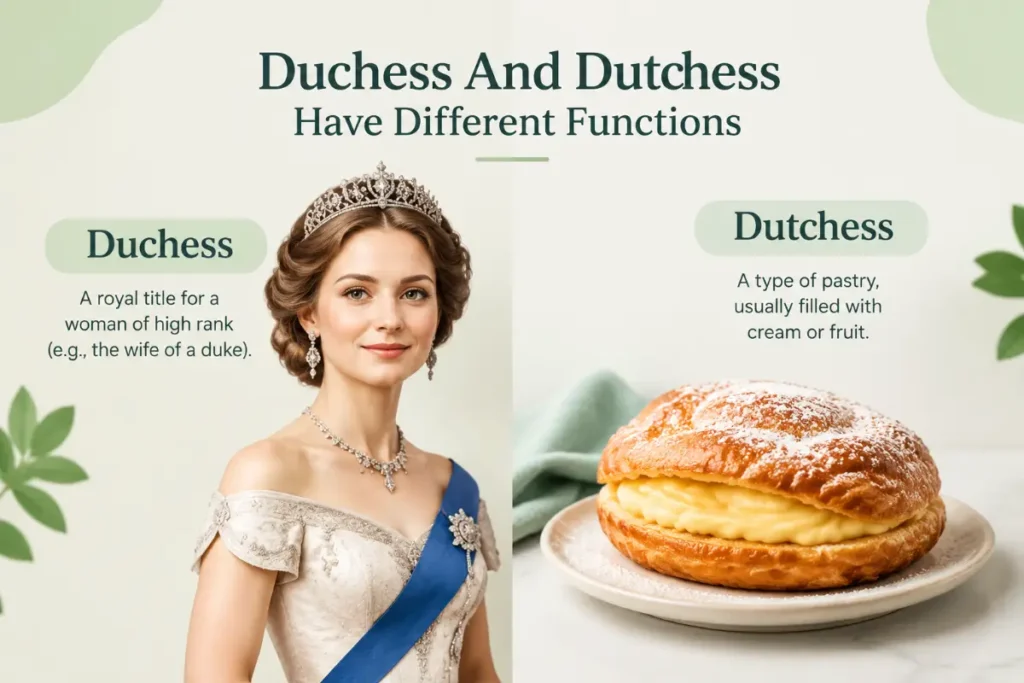
Duchess And Dutchess Have Different Functions
The easiest way to understand the difference is to look at what each form does in a sentence.
Duchess functions as the standard English noun for the title.
Dutchess functions mainly as part of a proper name.
Compare these examples:
The duchess spoke to the reporters.
The museum is located in Dutchess County.
The duchess visited the historic estate.
The family has lived in Dutchess County for generations.
In the first and third sentences, the word describes a noble title.
In the second and fourth sentences, Dutchess is part of a geographic name.
This is why saying Dutchess is always wrong is too broad. It is wrong when used as the standard spelling of the noble title. It is correct in established names that use Dutchess.
Which One Is Correct
If you’re asking about the title, duchess is correct.
If you’re writing the official name Dutchess County, then Dutchess is correct.
The answer therefore depends on the context.
| What you mean | Correct form |
|---|---|
| Female equivalent of duke | duchess |
| Woman who holds the rank of duke | duchess |
| Traditional wife or widow of a duke | duchess |
| Duchess as a general noun | duchess |
| Dutchess County in New York | Dutchess |
| An established proper name containing Dutchess | Preserve the official spelling |
For normal English writing, the safest rule is straightforward:
If you mean the title, use duchess.
If you mean a specific proper name that officially uses Dutchess, keep the proper name unchanged.
Why People Confuse Dutchess And Duchess
The confusion comes from several factors working together.
First, the forms differ by only one letter. That makes the eye easy to fool. A reader can see duchess and dutchess side by side and notice the difference immediately. In normal reading, however, that extra letter can slip past unnoticed.
Second, the pronunciation doesn’t clearly reveal the spelling. Both forms can be pronounced in essentially the same way. Hearing the word therefore doesn’t tell you that the standard title has no t.
Third, Dutchess County is a real and well known geographic name. Someone who has seen the place name may reasonably assume that Dutchess is another accepted spelling of duchess.
Finally, English contains many words with tch spellings. Words such as match, watch, and catch can make the extra t feel natural when people try to spell a sound they have heard.
The mistake is understandable. It still matters to use the correct form in formal writing.
The Pronunciation Of Duchess
The standard English pronunciation of duchess is close to:
DUCH ess
Common dictionary based transcriptions include /ˈdʌtʃɪs/ and /ˈdʌtʃəs/. The first syllable carries the main stress.
The word has two syllables:
duch • ess
The first syllable sounds like the vowel sound in cup for many American English speakers. The second syllable is weak.
Importantly, the spelling doesn’t have a separate t sound. The ch represents the familiar sound heard in words such as church and teacher.
That can help explain the spelling. The pronunciation sounds like it could tempt someone toward a tch spelling, but the written form is inherited from the historical form of the word rather than built from modern sound alone.
Is Duchess A Noun
Yes. Duchess is a noun.
It names a person associated with the rank or title of duke.
Examples include:
The duchess entered the room.
The historian wrote about the duchess.
Several duchesses attended the ceremony.
The title appeared throughout the novel.
Because duchess is a noun, it can appear in normal noun positions within a sentence.
Duchess As A Subject
The duchess arrived early.
Here, duchess is the subject of the sentence.
Duchess As An Object
The reporter interviewed the duchess.
Here, duchess is the object of the verb interviewed.
Duchess After A Preposition
The guests spoke with the duchess.
Here, the noun follows the preposition with.
These basic patterns make the word easy to use once the spelling is settled.
What Is The Plural Of Duchess
The plural of duchess is:
duchesses
You add es because the singular form ends in ss.
Singular:
duchess
Plural:
duchesses
Examples:
One duchess attended the event.
Two duchesses attended the event.
The museum displays portraits of several duchesses.
The plural form is worth learning because writers sometimes try to create it by adding only s. That produces duchesss, which is incorrect.
The spelling pattern is similar to other nouns ending in ss.
For example:
class → classes
glass → glasses
dress → dresses
duchess → duchesses
The pronunciation also changes slightly because the plural adds another syllable.
Duchess In Formal Writing
Duchess appears most often in formal contexts because noble titles are more common in historical writing, journalism, biographies, literature, royal coverage, and discussions of aristocracy.
You may encounter the word in:
Royal news reports.
Historical books.
Biographies.
Museum descriptions.
Academic writing about European history.
Literary fiction.
Formal speeches.
Official titles.
That doesn’t mean the word is difficult or overly formal. It simply refers to a specific social and historical title.
For example:
The duchess opened the exhibition.
The historian examined the role of duchesses in eighteenth century society.
The biography explores the duchess’s influence on court life.
In each sentence, duchess is the natural spelling.
Capitalization Of Duchess
Capitalization depends on how the word is used.
When duchess is a general noun, it is normally lowercase.
For example:
The duchess attended the ceremony.
When it forms part of a formal title, capitalization can apply depending on the title and the style being followed.
For example:
The Duchess of York
The key point is that capitalization and spelling are separate questions.
Changing duchess to Dutchess doesn’t make the word more formal. The extra t changes the spelling and can turn a correct title into an error.
At the same time, Dutchess must retain its established capitalization when it appears in a proper name such as Dutchess County.
Duchess And Duke
The strongest memory connection is the relationship between duke and duchess.
A duke is a person who holds the rank of duke.
A duchess is the corresponding female title.
The two words are historically related. Duchess comes through French from forms connected with the word for duke. Etymological sources trace it to Old French duchesse and ultimately to Medieval Latin ducissa, the feminine form related to dux, meaning leader or commander.
That history gives you a useful spelling clue.
duke → duchess
Not:
duke → dutchess
The word is connected to duke, not to Dutch.
That single connection can prevent the most common spelling mistake.
Dutchess vs Duchess In Real Life
The difference becomes much easier when you see the words in natural sentences. In ordinary English, duchess refers to a person or title. Dutchess usually belongs to a proper name.
Here are examples across everyday and professional contexts.
Daily Conversation Examples
- The duchess visited the historic estate during her tour.
- I read a biography about a famous duchess last weekend.
- The duke and duchess appeared together at the ceremony.
- The story follows a young duchess who must protect her family.
- She dressed as a duchess for the historical costume party.
- The duchess greeted visitors outside the museum.
- The children learned about the duchess during their history lesson.
- The novel introduces its heroine as a wealthy duchess.
These examples all use duchess because the word refers to the title or the person who holds it.
Workplace And Professional Examples
- The duchess attended the charity event as a guest of honor.
- The newspaper published a profile of the duchess.
- The historian gave a lecture about the life of the duchess.
- The museum label identifies the woman in the portrait as a duchess.
- The author described the duchess as an influential figure at court.
These sentences show that duchess works naturally in journalism, historical writing, museum descriptions, and professional communication.
Geographic Examples
- My friend lives in Dutchess County.
- The report examines housing trends in Dutchess County.
- They moved to Dutchess County several years ago.
- The organization serves communities throughout Dutchess County.
- The family owns a small business in Dutchess County.
- We spent the weekend exploring Dutchess County.
- The school district serves students in Dutchess County.
Here Dutchess is correct because it belongs to the official geographic name.
Academic And Historical Examples
- The historian examined the duchess’s role in court politics.
- The biography describes the duchess’s relationship with the royal family.
- Students studied the political influence of duchesses during the period.
- The article discusses how noble titles changed over time.
- The researcher consulted historical records about the duchess.
Notice the possessive form in examples 21 and 22. The singular possessive is duchess’s in ordinary modern English style.
Duchess In Literature
The word duchess appears naturally in historical fiction, fantasy, romance, drama, and other forms of literature.
Authors often use the title to establish a character’s social position quickly. Instead of explaining that a character belongs to a particular level of the nobility, the single word duchess can provide that information immediately.
For example:
The duchess entered the ballroom without a word.
The young duchess inherited the estate after her father died.
Everyone in the village knew the duchess by reputation.
These sentences use the title as part of the story rather than as a technical explanation.
Literary writers can also use the word figuratively or humorously. A character might be called a duchess as a playful nickname. In that situation, the writer still normally uses the standard spelling duchess unless the character’s name has a deliberately unusual spelling.
Dutchess As A Proper Name
Proper names deserve special attention because they don’t always follow the spelling patterns we expect from ordinary vocabulary.
Dutchess County is the clearest example in this comparison.
The county’s official history explains that the name traces back to the colonial period and that the spelling with the extra t was preserved from an older form used when the county was established. (dutchessny.gov)
This means an editor should not silently change Dutchess County to Duchess County.
That would create an error in the proper name.
The same principle applies to other established names. If an organization or place officially uses a particular spelling, writers should reproduce the name accurately.
This is one reason professional proofreading requires more than checking a word against a general spelling list. Context matters.
Is Dutchess A Misspelling Of Duchess
Not always.
If someone writes Dutchess when they mean the noble title, it is a spelling error.
For example:
The Dutchess arrived at the palace.
If the writer means the noble title, the standard form is:
The duchess arrived at the palace.
However, Dutchess is not an error when it appears in an established proper name such as Dutchess County.
This distinction prevents an overly simple rule.
A good editor asks:
What does this word refer to?
If it refers to a female noble title, use duchess.
If it is part of an official name that uses Dutchess, preserve that spelling.
Common Mistakes With Duchess
The most common mistake is adding the t.
Mistake One
Incorrect:
The dutchess attended the event.
Correct:
The duchess attended the event.
Mistake Two
Incorrect:
The Dutchess of York attended the ceremony.
Correct:
The Duchess of York attended the ceremony.
The second example needs duchess because the word is part of a title.
Mistake Three
Incorrect:
The county is called Duchess County.
Correct:
The county is called Dutchess County.
This mistake goes in the opposite direction. Here the writer has removed the t from an official proper name.
Mistake Four
Incorrect:
Several duchess attended the ceremony.
Correct:
Several duchesses attended the ceremony.
The issue here isn’t the main spelling. It’s the plural form.
Mistake Five
Incorrect:
The duchesses’s estates were nearby.
Correct:
The duchesses’ estates were nearby.
When a plural noun already ends in s, the possessive normally takes an apostrophe after the final s.
Duchess And Possessive Forms
Possessives can cause another small spelling problem.
For one duchess, use:
duchess’s
Example:
The duchess’s carriage arrived at noon.
For more than one duchess, use:
duchesses’
Example:
The duchesses’ estates were located across the region.
This follows a familiar English pattern.
Singular:
duchess’s
Plural:
duchesses
Plural possessive:
duchesses’
That distinction matters in formal writing because apostrophe errors can change the grammatical meaning of a sentence.
Duchess In British And American English
The spelling duchess is standard in both British and American English.
This is not a British versus American spelling difference.
British English:
duchess
American English:
duchess
Canadian English:
duchess
Australian English:
duchess
The core spelling stays the same.
That matters because some English learners see a British title and assume the American form might use a different spelling. In this case, it doesn’t.
The difference between duchess and Dutchess comes from usage and historical naming rather than a regional spelling system.
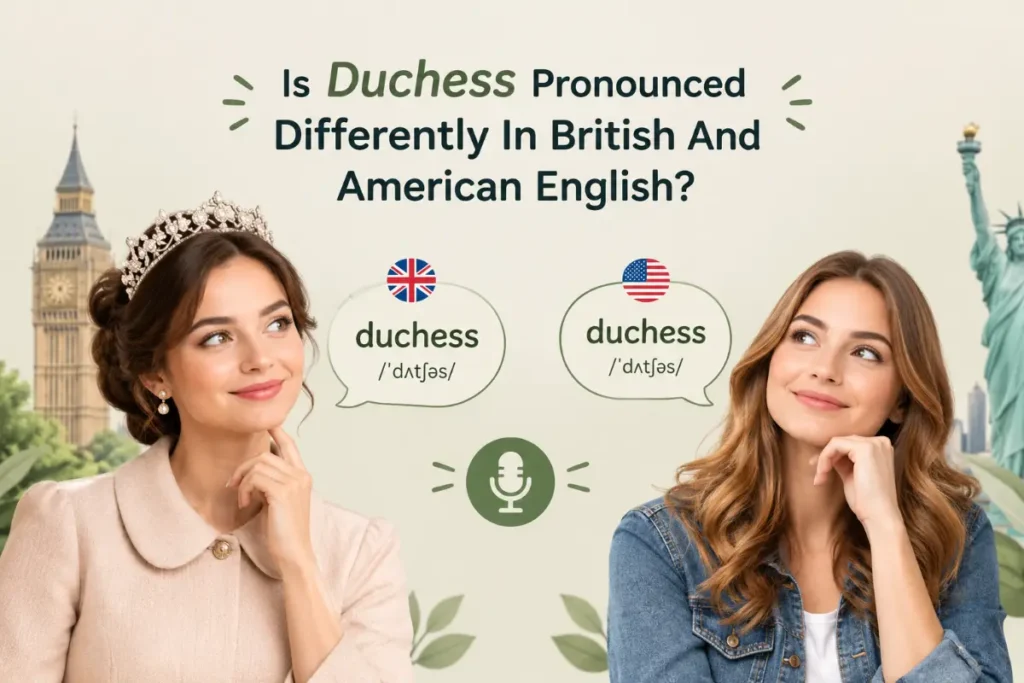
Is Duchess Pronounced Differently In British And American English
There can be small pronunciation differences between speakers and dictionaries, but the word remains recognizably the same.
American speakers commonly use a pronunciation close to DUCH iss or DUCH us.
British speakers may have slightly different vowel qualities depending on accent and regional speech.
Those accent differences don’t create two separate standard spellings.
Most importantly, neither pronunciation requires the spelling dutchess.
English spelling often preserves historical forms that don’t map perfectly onto modern pronunciation. That’s one reason learners should avoid trying to spell a word only from the way it sounds.
Why The Extra T Feels Natural
The spelling dutchess can look surprisingly convincing.
That happens partly because English has many words in which tch represents the sound /tʃ/.
Consider:
catch
fetch
hatch
match
pitch
watch
The tch pattern is familiar. When people hear the /tʃ/ sound in duchess, they may unconsciously expect the same spelling pattern.
But duchess follows a different historical spelling pattern.
The word begins with duch rather than dutch.
That difference is easy to miss because both spellings produce a similar visual shape.
This is a classic example of why English spelling cannot always be predicted perfectly from pronunciation.
Is Dutchess Related To Dutch
No. The Dutchess in Dutchess County is not simply the word Dutch with an extra ending.
The historical name comes from the title Duchess. The spelling was preserved in an older form of the name.
That makes this memory trick useful:
Duchess relates to duke.
Dutchess County relates to a historical place name.
The words may look as though Dutchess contains Dutch, but that visual connection is misleading.
Duchess Word Origin
The history of duchess helps explain why the modern spelling looks the way it does.
Etymological sources trace the word through Middle English and Old French forms connected with the feminine title for duke. Old French used duchesse, while Medieval Latin had ducissa. These forms ultimately connect with Latin dux, meaning a leader or commander. (etymonline.com)
The modern English form developed over centuries.
That history also explains why trying to create the spelling from modern pronunciation can lead you astray. English words often carry traces of older languages and older spelling conventions.
The word duke has a related history. It came into English through French and ultimately traces back to Latin dux.
So the family relationship is meaningful:
duke → duchess
That is a much better spelling connection than:
Dutch → dutchess
Does Dutchess Have A Separate Dictionary Meaning
For ordinary English vocabulary, duchess is the established noun for the title.
Dutchess is most important as a proper name rather than as a separate standard English title.
That means you shouldn’t treat the two words as ordinary synonyms.
They are not interchangeable.
You wouldn’t normally write:
The Dutchess of Cambridge.
You would write:
The Duchess of Cambridge.
At the same time, you would write:
Dutchess County, New York.
This is a usage distinction rather than a simple right word versus wrong word situation.
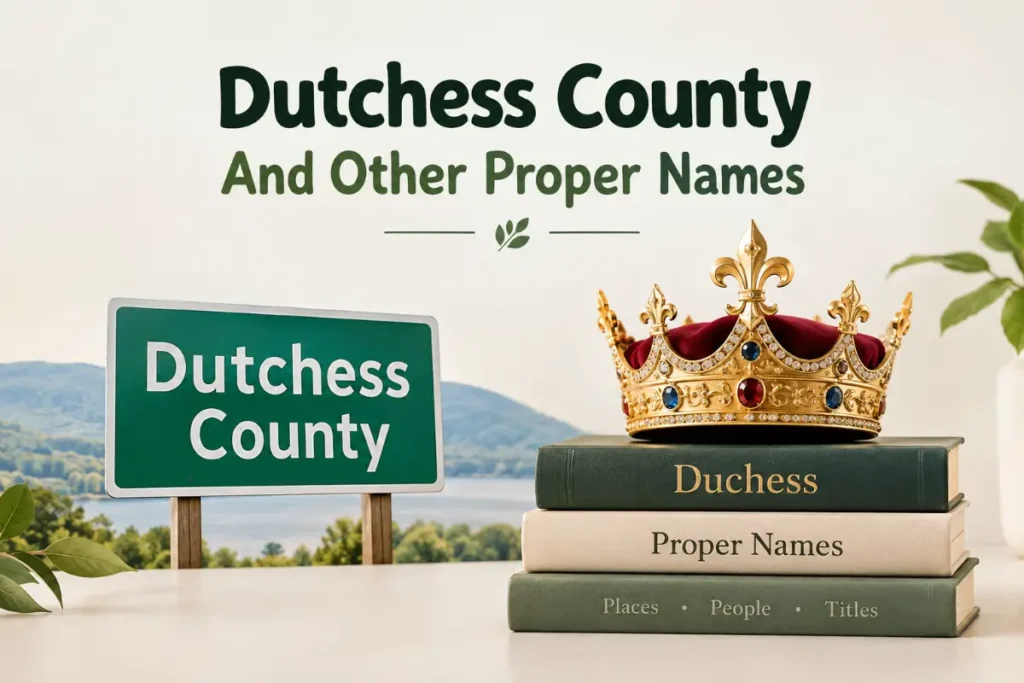
Dutchess County And Other Proper Names
The most familiar example is Dutchess County, but the broader lesson applies to names.
Proper names can preserve:
Old spellings.
Historical spellings.
Family spellings.
Local conventions.
Colonial spellings.
Traditional institutional names.
An editor should therefore verify a proper name rather than automatically correcting it to a modern dictionary form.
For instance, changing the spelling of a county name because it looks unusual would be similar to changing a person’s surname because another spelling appears more common.
Names have their own identity.
Common Internet Misconceptions
Online writing creates several myths about this pair.
Myth One
Dutchess is simply an alternative spelling of duchess.
For the standard English title, it isn’t. Duchess is the normal spelling.
Myth Two
Dutchess is always wrong.
That’s also too broad. Dutchess is correct in established names such as Dutchess County.
Myth Three
Dutchess County is misspelled.
It isn’t. The county’s historical spelling is official and intentionally preserved. (dutchessny.gov)
Myth Four
The extra T changes the pronunciation.
It doesn’t necessarily do so in the proper name Dutchess County. The two forms are pronounced very similarly.
Myth Five
British English uses Dutchess.
It doesn’t. The standard title is duchess in British English as well as American English.
Need another quick comparison? Read Noteable Or Notable Which Spelling Is Correct 2026.
Memory Tricks For Duchess
A good spelling trick should be quick enough to use when you’re writing.
Connect Duchess With Duke
Remember:
duke → duchess
If you can spell duke, you can remember that duchess begins with duch.
Think Of The Title
Picture a royal title:
Duchess
The title has no t.
Save Dutchess For The Place Name
Think:
Dutchess County has the extra T.
This is especially useful if you live in or frequently write about New York.
Avoid The Dutch Trap
The visual sequence dutch can make the spelling feel familiar. Don’t let the word Dutch pull you toward the wrong spelling of the title.
The title is:
duchess
Not:
dutchess
Related Words
Learning related vocabulary can make the distinction easier to remember.
Duke
A duke is a nobleman who holds the rank of duke.
Duchess
A duchess is the corresponding female title.
Prince
A prince is a male member of a royal family or a male ruler of a principality depending on the historical and political context.
Princess
A princess is a female member of a royal family or the feminine counterpart of prince.
Count
A count is a European noble title. In some countries, equivalent titles use different names.
Countess
A countess is the feminine form associated with count.
Earl
An earl is a British noble title.
Lady
Lady can be used as a courtesy title and has several historical and social uses in British English.
These words belong to the broader vocabulary of titles and nobility. Their exact status can vary across countries and historical periods.
Similar Looking Words That Cause Spelling Errors
English contains many word pairs and near pairs that differ by only one letter.
That’s why dutchess vs duchess belongs to a larger spelling problem.
Writers often make mistakes when:
A familiar letter pattern looks more natural.
A proper name resembles an ordinary word.
Pronunciation suggests a spelling that English doesn’t use.
Autocorrect reinforces a mistaken form.
Search results show an unusual spelling repeatedly.
A typo becomes familiar through repeated exposure.
The solution isn’t to memorize thousands of isolated spellings. It’s to connect spelling with meaning and context.
That approach gives you a stronger mental map.
Search Results Can Reinforce The Wrong Form
Internet exposure can make a misspelling look legitimate.
Imagine seeing dutchess several times in user generated posts. Your brain starts treating the form as familiar. Familiarity can feel like correctness even when the spelling remains wrong for the intended meaning.
Proper names make this especially tricky because Dutchess genuinely appears in legitimate sources.
A search for dutchess can therefore produce valid results. Those results don’t prove that dutchess is the standard spelling of the noble title.
The context still matters.
This is an important lesson for English learners: frequency on the internet isn’t the same thing as standard dictionary usage.
Autocorrect And Spell Check
Spell check can help but it shouldn’t replace context.
A writing program might recognize duchess as a normal English word. It might also recognize Dutchess because proper names and place names can appear in dictionaries or user dictionaries.
A spell checker can identify many obvious errors. It may not understand what you intended.
For example:
The Dutchess attended the reception.
A spell checker might not flag the sentence if it recognizes Dutchess as a name.
A human editor can spot the contextual problem by asking what the sentence means.
That’s why proofreading requires meaning as well as spelling.
Expert Editor’s Note
A professional editor would keep the rule simple.
Use duchess for the noble title. Preserve Dutchess when it belongs to an established proper name.
That rule handles almost every ordinary case.
I’d also avoid treating Dutchess as merely a typo. That shortcut can create problems when editing geographic names.
For example, changing Dutchess County to Duchess County would make the text look more familiar while making the official name less accurate.
Editors should respect proper names.
At the same time, editors should correct dutchess when a writer uses it as the general title.
The surrounding sentence provides the evidence.
A useful editing question is:
Is this word naming a title or naming a place?
If it names the title, use duchess.
If it names the New York county, use Dutchess.
That simple test is more reliable than memorizing a rule without context.
What Dictionaries And Style Guides Suggest
Standard English dictionaries define duchess as the feminine title associated with duke. Major dictionary resources distinguish the ordinary noun from proper names and historical naming conventions. (Merriam Webster)
Style guides also place strong emphasis on accuracy in proper names. A publication may have its own capitalization and title style, but it should not casually alter an established place name.
For professional writing, the safest approach is to check the official source when a proper name looks unusual.
That habit helps with much more than Dutchess.
It also protects you from errors involving surnames, organizations, institutions, geographic locations, historical names, and branded terms.
When To Use Duchess
Use duchess when you mean:
- A woman who holds the rank of duke.
- The traditional wife or widow of a duke.
- A noble title in historical writing.
- A fictional woman who holds the title.
- A general reference to the title.
Examples:
The duchess addressed the audience.
The novel follows a young duchess.
The duchess’s estate was restored.
Several duchesses appear in the historical record.
When To Use Dutchess
Use Dutchess when it belongs to an established proper name.
The clearest everyday example is:
Dutchess County
Examples:
She lives in Dutchess County.
The organization operates throughout Dutchess County.
Dutchess County is located in New York.
The county government publishes information about local services.
In these sentences, changing Dutchess to Duchess would make the proper name inaccurate.
A Simple Editing Test
When you’re unsure, stop and identify the noun’s job.
Ask:
Am I talking about a person with a noble title?
Use duchess.
Am I writing the official name of Dutchess County or another established name that uses Dutchess?
Keep Dutchess.
This test takes only a few seconds.
It also works better than trying to remember which spelling looks familiar.
Final Practical Rule
There is one rule worth remembering above all others:
Duchess is the standard English word. Dutchess is mainly a proper name spelling.
If you’re describing a noble title, choose duchess.
If you’re writing Dutchess County, keep the t.
That small distinction will prevent almost every common mistake involving these two forms.
Dutchess vs Duchess In A Sentence
The fastest way to master the difference is to see the two forms side by side.
| Sentence | Correct form | Why |
|---|---|---|
| The duchess entered the room. | duchess | It refers to a noble title. |
| The Duchess of Cambridge attended the event. | Duchess | It forms part of a formal title. |
| She lives in Dutchess County. | Dutchess | It is part of an official place name. |
| The historian wrote about the duchess. | duchess | It refers to a woman with the title. |
| Dutchess County has several historic sites. | Dutchess | It is the official county name. |
| The duchess spoke with reporters. | duchess | It is a common noun. |
| The duchess’s portrait hangs in the gallery. | duchess | It is the singular possessive form. |
| Several duchesses attended the ceremony. | duchesses | It is the plural form. |
| The duchesses’ estates were nearby. | duchesses’ | It is the plural possessive form. |
| They moved to Dutchess County last year. | Dutchess | It is a proper geographic name. |
These examples show why spelling alone doesn’t tell the whole story. Context determines the correct form.
Duchess In Formal And Informal Writing
Duchess can appear in both formal and informal writing. The difference comes from the subject rather than from the spelling itself.
In formal writing you might see:
The duchess attended the diplomatic reception.
In historical writing:
The duchess played an important role in the development of the estate.
In fiction:
The duchess stared through the palace window.
In casual conversation:
I watched a documentary about a duchess last night.
The word remains duchess in all four examples.
Informal writing doesn’t create an alternative spelling.
Dutchess In Formal Writing
Dutchess can also appear in formal writing when the subject is the place.
For example:
The report examines population growth in Dutchess County.
The organization provides services throughout Dutchess County.
Researchers collected data from communities in Dutchess County.
Here the spelling is not a stylistic choice. It is part of the proper name.
That’s an important distinction for students and professional writers. You shouldn’t change a proper name simply because another spelling looks more familiar.
Duchess In Journalism
News writing often uses duchess when reporting on royal families and historical figures.
For example:
The duchess attended the public ceremony.
The newspaper published an interview with the duchess.
The duchess visited the community center.
Journalists generally need to identify titles accurately because titles carry information about a person’s position.
At the same time, a news article about New York geography would retain Dutchess County.
For example:
Officials announced a new program in Dutchess County.
The two forms can therefore appear in the same article while serving completely different functions.
Duchess In Academic Writing
Academic writers should use duchess when discussing the title.
For example:
The duchess held considerable influence at court.
The study examines the political role of the duchess.
Several duchesses appear in the historical records.
Academic writing also benefits from precise historical terminology. If the writer is discussing a specific person, the correct title should be checked against reliable historical sources.
If the research concerns the New York county, however, the proper name remains Dutchess County.
Precision matters more than visual consistency.
Duchess In Emails
You may not use the word duchess often in everyday email. Still, the same spelling rule applies when it appears.
For example:
The article discusses the duchess’s involvement in the project.
The museum recently acquired a portrait of the duchess.
The event will focus on the history of the duchess’s family.
If you’re writing about a location:
The conference will take place in Dutchess County.
Again, context does the work.
Duchess In Social Media
Social media often produces spelling confusion because posts are written quickly.
A caption might say:
Meeting the duchess was an unforgettable experience.
That spelling is correct if the person has the title.
A post about the New York location might say:
Beautiful afternoon in Dutchess County.
That spelling is also correct.
The casual nature of social media doesn’t change the standard spelling of the title.
A Note About Titles
Titles can be tricky because capitalization varies by editorial style.
A writer might use lowercase duchess when referring to the title generally:
The duchess arrived at noon.
A formal title may be capitalized when it directly precedes or forms part of a person’s name depending on the publication’s style:
The Duchess of York attended the ceremony.
Different style guides can have different capitalization preferences. The spelling duchess itself doesn’t change.
The important point is that capitalization should not be confused with the extra t.
Duchess and Dutchess are different spellings.
Why Historical Spellings Survive
English is full of historical leftovers.
Some spellings remain because people have used them for centuries. Others survive in proper names because changing them would change the identity of a person, place, organization, or institution.
Dutchess County is a good example.
The county name preserves an older spelling associated with the title. The county’s historical records explain the connection to the Duchess of York and the spelling used when the county was established. (dutchessny.gov)
This is why modern readers should resist the temptation to correct every unusual spelling.
Sometimes the unusual spelling is the correct historical form.
The Difference Between A Word And A Name
One of the most useful lessons from dutchess vs duchess is the difference between ordinary vocabulary and proper names.
A common noun names a general person, place, thing, or idea.
A proper noun identifies a specific person, place, organization, or other named entity.
duchess is a common noun when used generally.
Dutchess County is a proper name.
That difference affects capitalization, spelling, and editing.
Consider:
The duchess visited the county.
Here duchess is a general title.
The duchess visited Dutchess County.
Now both forms appear in the same sentence. Each is correct because each serves a different purpose.
This is a perfect example of why context beats memorization.
Can Duchess Be A Name
Yes. Duchess can also be used as a personal or character name in some contexts.
A pet might be named Duchess.
A fictional character might be named Duchess.
A business or product might use Duchess as part of its name.
In those cases, capitalization and spelling depend on the established name.
For example:
Duchess is the name of my dog.
The novel introduces a character named Duchess.
That doesn’t turn dutchess into a general alternative spelling. It simply shows that proper names can have their own conventions.
Is Duchess A Gendered Word
Traditionally, duchess identifies the female counterpart of duke.
The terminology comes from systems of nobility in which titles were historically gendered.
Modern discussions of titles can involve different rules depending on the country, historical period, inheritance system, and specific title. For ordinary English usage, however, duchess remains the established term.
This is another reason not to treat duchess and Dutchess as spelling variants. They don’t represent two gender forms or two regional versions of the same title.
Common Search Questions About Duchess
People searching this spelling often have a few related questions.
Is Dutchess A Correct Word
Dutchess is correct in established proper names such as Dutchess County. It is not the standard spelling for the noble title. If you mean the female equivalent of duke, use duchess.
Is Duchess The Female Version Of Duke
Yes. Duchess is the traditional feminine counterpart of duke. It can refer to a woman who holds the rank of duke and has also traditionally referred to the wife or widow of a duke.
Why Does Dutchess County Have Two Ts
Dutchess County preserves an older spelling connected with the title Duchess. The county was established in the Province of New York in 1683 and was named in connection with Mary of Modena, Duchess of York. The historical spelling was retained in the county’s name. (dutchessny.gov)
Do Duchess And Dutchess Sound The Same
They can sound essentially the same in normal speech. The main difference is spelling and usage. Duchess is the standard title. Dutchess appears mainly in specific proper names.
Is Duchess British Or American English
Duchess is standard in both British and American English. Canadian and Australian English also use duchess for the title.
What Is The Plural Of Duchess
The plural is duchesses.
For example:
Several duchesses attended the event.
The spelling adds es to the singular form.
What Is The Possessive Of Duchess
For one duchess, use duchess’s.
Example:
The duchess’s estate was restored.
For more than one duchess, use duchesses’.
Example:
The duchesses’ estates were restored.
Is Dutchess A Misspelling
It depends on the context. Dutchess is a misspelling when someone uses it for the noble title. It is correct when it belongs to an established name such as Dutchess County.
How Do You Remember Duchess
Connect the word with duke.
Think:
duke → duchess
Then remember that Dutchess belongs to the proper name Dutchess County.
Does Duchess Have A Silent Letter
No separate t belongs in the standard spelling. The ch represents the familiar /tʃ/ sound. The word is commonly pronounced with two syllables.
Quick Reference For Writers
When editing your own sentence, use this mini guide.
Use duchess for a title.
The duchess arrived.
Use Duchess in a formal title when your style guide calls for capitalization.
The Duchess of York arrived.
Use duchesses for the plural.
Several duchesses attended.
Use duchess’s for the singular possessive.
The duchess’s estate was nearby.
Use duchesses’ for the plural possessive.
The duchesses’ estates were nearby.
Use Dutchess for the official county name.
She lives in Dutchess County.
This small set of rules covers most situations.
What Native Speakers Expect
Native English speakers generally expect duchess when they see the noble title.
The form dutchess may look familiar because of the place name and because the extra t fits a common English spelling pattern. Still, in standard prose, a reader who sees dutchess used as the title may recognize it as a spelling mistake.
That doesn’t mean the error prevents understanding. The intended meaning will often be obvious.
Good writing aims for more than being understandable.
It aims for accuracy.
Using duchess signals that you know the standard form. Keeping Dutchess in a proper name shows that you’ve checked the name instead of automatically correcting it.
A Practical Proofreading Method
If you’re proofreading an article, essay, or website page, search for both forms.
Look for:
duchess
dutchess
Then inspect every occurrence.
Don’t replace every instance of Dutchess automatically.
Check the surrounding words.
If you see:
Dutchess County
the spelling is intentional.
If you see:
the Dutchess attended the ceremony
and the writer means a noble title, change it to:
the duchess attended the ceremony.
This simple search method is useful because spell check may not catch contextual errors.
Why Context Matters More Than Spell Check
Spell check works mainly at the word level.
Human proofreading works at the meaning level.
That difference matters here.
Both duchess and Dutchess can appear in legitimate English text. A computer may recognize both. Only context tells you which form belongs in a particular sentence.
This is a broader lesson for English learners.
A word can be correctly spelled and still be the wrong word for the sentence.
That’s why strong vocabulary skills involve three things:
Spelling.
Meaning.
Context.
When those three work together, your writing becomes much more precise.
Expert Editor’s Final Advice
If I were reviewing a manuscript and found dutchess, I wouldn’t correct it immediately.
First, I’d check what the writer means.
If the sentence refers to a noblewoman, I’d change it to duchess.
If the sentence refers to Dutchess County, I’d leave it alone.
That small pause is good editing practice. It prevents a correction from creating a new error.
For English learners, the same habit is worth developing. Don’t ask only, Does this spelling look right?
Ask:
What does this word mean here?
What role does it play in the sentence?
Is it a common noun or a proper name?
Those questions often solve spelling problems faster than memorizing another isolated rule.
Need another quick comparison? Read Specialty Or Speciality Which Spelling Is Correct 2026 Guide.
Final Conclusion
The difference between dutchess vs duchess comes down to spelling, meaning, and context.
Duchess is the standard English word for the female equivalent of duke. It refers to a woman who holds the rank of duke and has traditionally also referred to the wife or widow of a duke.
Dutchess is not the standard spelling of that title. However, it is correct in established proper names such as Dutchess County, New York.
The extra t in Dutchess County has a historical explanation. It comes from an older spelling associated with the title and was preserved as part of the county’s official name. (dutchessny.gov)
So remember one simple pair:
duke → duchess
Then remember the exception in the proper name:
Dutchess County
If you’re writing about the noble title, use duchess. If you’re writing the official name of the New York county, keep Dutchess exactly as it is.
One extra letter can change the context. Good writers let the meaning choose the spelling.

Editorial Reviewer & Proofreader
Grace Mitchell reviews Gramlify’s articles for clarity, consistency, and readability. She is passionate about creating accurate, approachable content that helps English learners build confidence.