

If you’ve ever written about money or large numbers in South Asian English, you may have paused over lacs or lakhs. Both forms appear online and in everyday writing, so it’s easy to wonder if one is wrong or if they have different meanings.
The short answer is that lakhs is the more widely recognized plural form in standard English. Lakh means 100,000. So you can write one lakh, five lakhs, or ten lakhs. The spelling lac is also a recognized variant, and lacs can appear as its plural form. Collins lists both lakh and lac as English forms and records the plurals lakhs and lacs.
For most readers, especially in formal English, lakh and lakhs are the clearest choices.
This guide explains the difference between the two spellings, how to use them in sentences, how dictionaries treat them, how they relate to Indian and Pakistani English, and which form an editor would normally choose.
Still confused? Compare Busyness Vs Business Which Word Should You Use.
Quick Answer
Lakhs is the preferred plural spelling in most English writing. Lakh means 100,000. You can write one lakh for 100,000 and five lakhs for 500,000. Lac and lacs are also recognized variants, especially in South Asian usage, but lakh and lakhs are usually the clearest choices.
Lacs or Lakhs Comparison
| Feature | Lacs | Lakhs |
|---|---|---|
| Singular form | lac | lakh |
| Plural form | lacs | lakhs |
| Meaning | 100,000 | 100,000 |
| Part of speech | Noun | Noun |
| Pronunciation | Usually like lock or laak depending on variety | Usually like lock or laak depending on variety |
| Main use | South Asian English | South Asian English |
| Meaning difference | None in the numerical sense | None in the numerical sense |
| Formal writing | Acceptable | Usually preferred |
| Common context | Money and large numbers | Money and large numbers |
| Example | 5 lacs | 5 lakhs |
The important point is simple: lacs and lakhs refer to the same numerical value when they are used as variants of the same noun.
A lakh equals 100,000. Oxford defines lakh as 100,000 and identifies it as an Indian English term. Oxford also gives lakh as the singular form and lakh or lakhs as its plural forms.
Collins gives a broader picture. It lists lakh and lac as forms and records lakh, lac, lakhs, and lacs as plural forms in its British English entry. It also identifies the word as a term used in India and Pakistan.
So the choice is mainly about spelling preference and consistency, not numerical meaning.
What Does Lakh Mean
A lakh is a number equal to 100,000.
The word is commonly used in Indian English and is also familiar in Pakistani English. It frequently appears when people talk about money, salaries, property prices, business figures, populations, exam results, and other large numbers.
For example:
One lakh = 100,000
Two lakhs = 200,000
Five lakhs = 500,000
Ten lakhs = 1,000,000
This system can look unfamiliar to readers who mainly use American English. In the United States, people normally express 100,000 as one hundred thousand rather than one lakh.
Cambridge defines lakh as the number 100,000 and labels it as Indian English. Its example uses 50 lakh rupees to describe a total cost.
That usage is important because it shows that lakh isn’t simply an informal spelling of an ordinary English number. It is an established English noun used in a particular regional variety of English.
Lakh In Everyday Usage
You might hear or read sentences such as:
She earns two lakhs a month.
The house costs eighty lakhs.
The video received several lakhs of views.
The company invested five lakhs in the project.
In South Asian English, these sentences can sound completely natural.
For an American audience, however, the same figures may need explanation. A sentence such as The house costs eighty lakhs may not immediately tell a US reader how much money that represents.
In American English, 8 million rupees or 8,000,000 rupees may be clearer depending on the context.
What Does Lac Mean
Lac is a variant spelling of lakh.
When lac refers to the South Asian number system, it also means 100,000. Its plural form can be lacs.
For example:
One lac = 100,000
Five lacs = 500,000
Ten lacs = 1,000,000
Collins specifically records lac as a variant of lakh and gives lac and lacs among its plural forms.
That means lacs is not simply a spelling mistake.
Still, that doesn’t mean lacs is always the best choice.
If you’re writing a modern English article for a broad international audience, lakhs will usually be easier for readers to recognize. If you’re writing for a publication that consistently uses lac, then lacs can be appropriate.
Consistency matters.
Which One Is Correct
Lakhs is the safer and more widely recognized plural form in general English writing.
However, lacs is also a legitimate variant when it means multiple units of 100,000.
So these forms can all be correct:
one lakh
five lakhs
one lac
five lacs
The key is to understand that lakh and lac are spelling variants rather than two different numbers.
Oxford gives lakh as the main dictionary form and lists its plural as lakh or lakhs.
Collins takes a broader approach and explicitly recognizes lac as a variant.
For an editor, that creates a useful practical rule:
Use lakh and lakhs unless you have a clear reason to use lac and lacs.
That choice will generally make your writing easier for readers who know the term from Indian or Pakistani English.
Is Lacs A Correct Spelling
Yes. Lacs is a correct spelling when it is used as the plural of lac in the South Asian number system.
It isn’t accurate to label lacs as an incorrect spelling across the board.
Dictionaries matter here because they show established usage rather than personal preference. Collins explicitly records lac and lacs alongside lakh and lakhs.
However, dictionary recognition doesn’t automatically make every variant equally useful in every context.
Think of it like choosing between two established roads. Both can get you to the same destination, but one may be easier for more people to recognize.
For broad English content, lakhs usually wins on familiarity.
Is Lakhs A Correct Spelling
Yes. Lakhs is a correct plural form of lakh.
In fact, it is often the best choice for readers who expect the spelling lakh.
Examples include:
The property is worth twenty lakhs.
The campaign raised ten lakhs.
More than three lakhs of people attended the event.
The business earned several lakhs during the first quarter.
Oxford records lakh as an Indian English number meaning 100,000 and gives lakh and lakhs as plural forms.
Cambridge also uses lakh in its example 50 lakh rupees.
That gives lakh strong dictionary support as the standard headword.
Lakh And Lakhs In Grammar
The basic grammar is straightforward.
Use lakh for one unit.
Use lakhs for more than one unit.
Examples:
One lakh rupees was transferred.
Two lakhs were transferred.
The company paid one lakh rupees.
The company paid three lakhs.
There is one detail worth noticing. In South Asian English, speakers often use a number directly before lakh in ways that differ from the number patterns familiar to American English.
For example:
Five lakh rupees
This construction is common in Indian English and appears in dictionary examples. Cambridge gives 50 lakh rupees as an example.
You may also see:
five lakhs
The exact construction can depend on the sentence and the variety of English being used.
An editor should avoid forcing American number patterns onto established South Asian English usage.

Why People Confuse Lacs And Lakhs
The confusion usually comes from seeing both forms in real writing.
A reader may encounter:
The apartment costs 50 lakhs.
Then somewhere else:
The apartment costs 50 lacs.
Both sentences can refer to the same amount.
That naturally raises a question: Is one a mistake?
Usually, no.
The confusion comes from several sources.
Different Dictionary Forms
Some dictionaries prefer lakh as the main form while also recognizing lac.
Oxford uses lakh as its headword.
Collins recognizes both lakh and lac.
So readers may encounter different forms depending on the dictionary or publication they use.
Regional English
English changes across regions.
American English has its own vocabulary and number conventions. British English has others. Indian English and Pakistani English also have established vocabulary and usage patterns.
Words such as lakh and crore are good examples.
Oxford identifies lakh and crore as Indian English terms. A crore is 10 million or 100 lakh.
This regional context matters because a form that feels unusual to an American reader can still be completely normal in another English variety.
Familiarity With South Asian Numbering
Someone who regularly uses the international numbering system may expect:
100,000
500,000
1,000,000
Someone familiar with the South Asian numbering system may naturally think:
one lakh
five lakhs
ten lakhs
Neither system is inherently wrong.
The important issue is audience.
Online Usage
Search engines expose readers to millions of examples from different countries. As a result, people see lakh, lakhs, lac, and lacs side by side.
Online frequency can make a spelling look correct even when the writer hasn’t checked its dictionary status.
In this case, the good news is that both major variants have genuine dictionary support. The choice is mainly one of standard form, audience, and editorial consistency.
Lacs Or Lakhs For Formal Writing
For formal writing, lakhs is generally the better default.
This is especially useful when you are writing for a broad audience or publishing educational material.
For example:
The company reported annual revenue of 25 lakhs.
This is clear to readers familiar with South Asian English and uses the more widely recognized lakh spelling.
If the intended audience is mainly American, you may want to give the international value as well:
The company reported annual revenue of 25 lakhs, or 2.5 million rupees.
That small clarification removes unnecessary friction for the reader.
For academic writing, clarity should come first. If the term is central to the subject, define it at first use.
For example:
The study examined households earning more than five lakhs per year, equivalent to 500,000 rupees.
After that, you can use lakhs without repeatedly explaining it.
Lacs Or Lakhs For Money
Both lacs and lakhs can refer to money when they represent units of 100,000.
For example:
The car costs six lakhs.
The car costs six lacs.
Both can mean 600,000 rupees.
Still, six lakhs is usually the cleaner editorial choice.
You may also see the phrase lakh rupees after a number:
The project cost 30 lakh rupees.
This construction is common in Indian English and appears in Cambridge’s dictionary example.
The best choice depends on the variety of English you’re writing in.
If your publication uses Indian or Pakistani English, keep the local convention.
If your publication targets international readers, consider giving the equivalent in millions or standard numerals when the amount matters.
Lacs Or Lakhs For Numbers
The same principle applies beyond money.
A lakh can describe any quantity of 100,000.
For example:
The video received three lakhs of views.
The town has more than two lakh residents.
The organization distributed five lakhs of books.
However, these constructions are strongly associated with South Asian English.
For an American audience, it may be clearer to write:
The video received 300,000 views.
The town has more than 200,000 residents.
The organization distributed 500,000 books.
This isn’t about declaring one style correct and the other incorrect. It’s about making the number instantly understandable to the intended reader.
Lakh And Lakhs Examples
Here are natural examples showing how the word works in context.
- The house costs twenty lakhs.
- She saved one lakh rupees for the trip.
- The company invested ten lakhs in new equipment.
- The scholarship is worth two lakhs.
- He earns three lakhs a year from the business.
- The project received funding of fifty lakhs.
- More than one lakh people visited the event.
- The organization raised five lakhs for the campaign.
- The treatment cost several lakhs.
- The property was sold for eighty lakhs.
- The startup secured twenty lakh rupees in funding.
- The wedding budget was around fifteen lakhs.
- The company has invested nearly one crore, or one hundred lakhs.
- The video crossed one lakh views within a day.
- The new machine cost four lakhs.
- The family spent three lakhs on repairs.
- The fund has grown to ten lakhs.
- The university awarded scholarships worth five lakhs.
- The campaign reached more than two lakh people.
- The apartment was listed at forty lakhs.
Notice that the form can change with the construction.
You may see one lakh for a single unit and two lakhs when referring to multiple units. You may also see two lakh rupees in South Asian English.
That variation doesn’t automatically signal an error. Context and regional convention matter.
A Useful Rule For Writers
If you’re unsure which form to use, follow this simple rule:
Choose lakh and lakhs as your default.
Use lac and lacs when you are following an established regional style or a source that consistently uses those spellings.
Most importantly, don’t switch between the forms without a reason.
A paragraph that begins with five lakhs and later changes to ten lacs can look careless even though both forms have dictionary support.
Consistency is one of the easiest ways to make writing look professionally edited.
Lacs Or Lakhs In Pronunciation
The pronunciation of lakh can vary slightly across English varieties. In South Asian English it commonly sounds close to laak. The vowel may be short or long depending on the speaker and regional accent.
A simple pronunciation guide is:
lakh: /lɑːk/
lakhs: /lɑːks/
The final h doesn’t create a separate syllable. It also doesn’t mean you should pronounce the word as two parts.
For most learners the easiest approximation is:
lakh → laak
lakhs → laaks
The plural lakhs adds an s sound at the end. That final sound matters because it marks the plural.
How Many Syllables Does Lakh Have
Lakh has one syllable.
Lakhs also has one syllable.
For example:
one lakh
five lakhs
You don’t pronounce lakhs as something like lak hes. The word remains a single syllable.
Lacs Or Lakhs Pronunciation
The spelling difference doesn’t create a major difference in meaning or pronunciation.
lac and lakh can both refer to 100,000.
In many varieties of South Asian English, the two forms may sound very similar or effectively the same. The main difference appears in the spelling rather than the numerical meaning.
The plural forms follow the same pattern:
lac → lacs
lakh → lakhs
So if you’re learning the word for speaking, focus more on understanding the number system than on trying to create a strong distinction between the two spellings.
Lacs Or Lakhs Spelling Rules
There isn’t a complicated spelling rule behind lakh.
The word is an established English borrowing from a South Asian language tradition. English speakers have used more than one spelling because transliteration can represent sounds in different ways.
That explains why you may see:
lakh
lakhs
lac
lacs
These aren’t four completely different words.
Instead, they represent variants connected to the same number term.
For practical writing, remember this pattern:
One lakh
Two lakhs
One lac
Two lacs
The most useful standard pattern for general English is:
lakh → lakhs
Is The H In Lakh Silent
The h in lakh doesn’t function like a separate English syllable.
For many English speakers, the pronunciation is close to laak. The spelling reflects the transliteration of the source word rather than a familiar English spelling pattern.
This can confuse learners because English spelling doesn’t always provide a reliable guide to pronunciation.
Compare this with words such as laugh, though, and through. Their written forms contain combinations that don’t map neatly onto their sounds.
With lakh, the key point is simpler. Don’t try to pronounce the word as lack h.
Lakh And Lac As Regional English
One of the most important points about lakh and lac is that they belong to a regional number vocabulary that has become established in English.
Indian English commonly uses lakh and crore.
Pakistani English also commonly uses lakh and crore.
You can therefore encounter expressions such as:
two lakh rupees
five lakhs
one crore
three crore rupees
These expressions may sound unfamiliar to someone who mainly uses American English. That doesn’t make them incorrect.
English isn’t limited to one national variety.
Indian English has its own established vocabulary and conventions. Pakistani English does too. Professional editing means recognizing legitimate regional usage instead of treating every unfamiliar form as an error.
Lakh In American English
Lakh isn’t a common everyday number term in American English.
An American reader is much more likely to understand:
100,000
than:
one lakh
For this reason, writers targeting a US audience should think about clarity.
If the regional context matters, you can keep the word and explain it:
The property sold for 50 lakhs, or 5 million rupees.
If the regional term doesn’t matter, the standard international number may be easier:
The property sold for 5 million rupees.
This is especially important in journalism, business writing, educational content, and websites with an international audience.
Lakh In British English
British English has long had contact with South Asian vocabulary. As a result, lakh appears in British dictionaries and English usage.
However, that doesn’t mean every British speaker uses the term regularly.
A British reader may understand lakh because of familiarity with Indian English, Pakistani English, regional history, media, travel, or cultural contexts.
The same editorial principle applies.
Use lakh when it communicates something important about the regional context. Otherwise, consider giving the equivalent in a more familiar number format.
Lakh In Canadian English
Canadian English generally follows the international English number system rather than using lakh as an everyday native number term.
Still, Canadian readers may encounter lakh in writing about South Asia.
For example:
The scholarship was worth five lakhs.
This makes sense in an article about an Indian university or Pakistani organization.
If you’re writing for a broad Canadian audience, adding the numerical equivalent can make the sentence easier to understand.
Lakh In Australian English
Australian English also uses the standard international number system in ordinary writing.
The term lakh can still appear in Australian publications when the subject involves South Asia.
For example:
The property was valued at 30 lakhs.
In a general Australian article, a writer may instead choose:
The property was valued at 3 million rupees.
The best choice depends on context and audience.
Lakh And Crore
If you’re learning lakh, you’ll often encounter crore too.
A lakh equals:
100,000
A crore equals:
10,000,000
That means:
1 crore = 100 lakhs
This relationship explains many South Asian number expressions.
For example:
25 lakhs = 2.5 million
50 lakhs = 5 million
75 lakhs = 7.5 million
100 lakhs = 1 crore
These conversions can help readers who aren’t familiar with the South Asian numbering system.
Lakh And Million
The South Asian system and the international system organize large numbers differently.
The basic comparison is:
| South Asian term | International value |
|---|---|
| 1 lakh | 100,000 |
| 5 lakhs | 500,000 |
| 10 lakhs | 1,000,000 |
| 25 lakhs | 2,500,000 |
| 50 lakhs | 5,000,000 |
| 75 lakhs | 7,500,000 |
| 1 crore | 10,000,000 |
This is why ten lakhs equals one million.
Once you remember that relationship, larger amounts become much easier to understand.
Grammar Of Lakh And Lakhs
The grammar becomes easier if you treat lakh as a countable noun.
Use the singular form with one:
one lakh
Use the plural form when referring to multiple lakh units:
two lakhs
five lakhs
twenty lakhs
However, South Asian English also commonly places a number directly before lakh when it modifies a currency amount:
five lakh rupees
twenty lakh rupees
fifty lakh rupees
This construction is established in Indian English.
So both of these patterns can appear:
five lakhs
five lakh rupees
They don’t always function in exactly the same way grammatically.
The first treats lakhs as the noun being counted. The second uses lakh as part of a compound quantity before the currency noun.
One Lakh Or One Lakhs
The correct form is:
one lakh
Not:
one lakhs
The reason is simple. One refers to a single unit.
For example:
The prize is one lakh rupees.
She received one lakh from the fund.
Using lakhs after one is a common learner error.
Think of the same pattern in ordinary English:
one dollar
not one dollars
one million
not one millions
one lakh
not one lakhs
Many readers also check Laser Or Lazer Which Spelling Is Correct 2026.
Two Lakh Or Two Lakhs
This question is slightly more interesting because both forms can appear in real South Asian English.
When lakh functions as a countable noun by itself, the plural form is natural:
two lakhs
five lakhs
When it directly modifies a currency noun, South Asian English commonly uses the singular form:
two lakh rupees
five lakh rupees
For example:
The house costs five lakhs.
The house costs five lakh rupees.
Both constructions can be found in South Asian English.
For learners, the safest approach is to notice the structure rather than memorizing one rigid rule.
Ten Lakh Or Ten Lakhs
Both forms can be correct in different constructions.
Use ten lakhs when the noun is functioning as the thing being counted.
The investment was ten lakhs.
Use ten lakh rupees when lakh directly modifies rupees.
The investment was ten lakh rupees.
This distinction explains why native and fluent South Asian English speakers may use both forms naturally.
For general learners, this is an important editorial point. Not every variation in regional English should be flattened into one supposedly universal rule.
Lakh Rupees Or Lakhs Rupees
The natural South Asian English construction is:
lakh rupees
rather than:
lakhs rupees
For example:
The project cost five lakh rupees.
You can also say:
The project cost five lakhs.
But five lakhs rupees is not the form you should choose.
The structure changes because lakh is modifying the currency noun rupees.
A useful pattern is:
five lakh rupees
ten lakh dollars
The second expression can be understood grammatically, although the use of lakh with dollars is less common because the term belongs strongly to the South Asian number system.
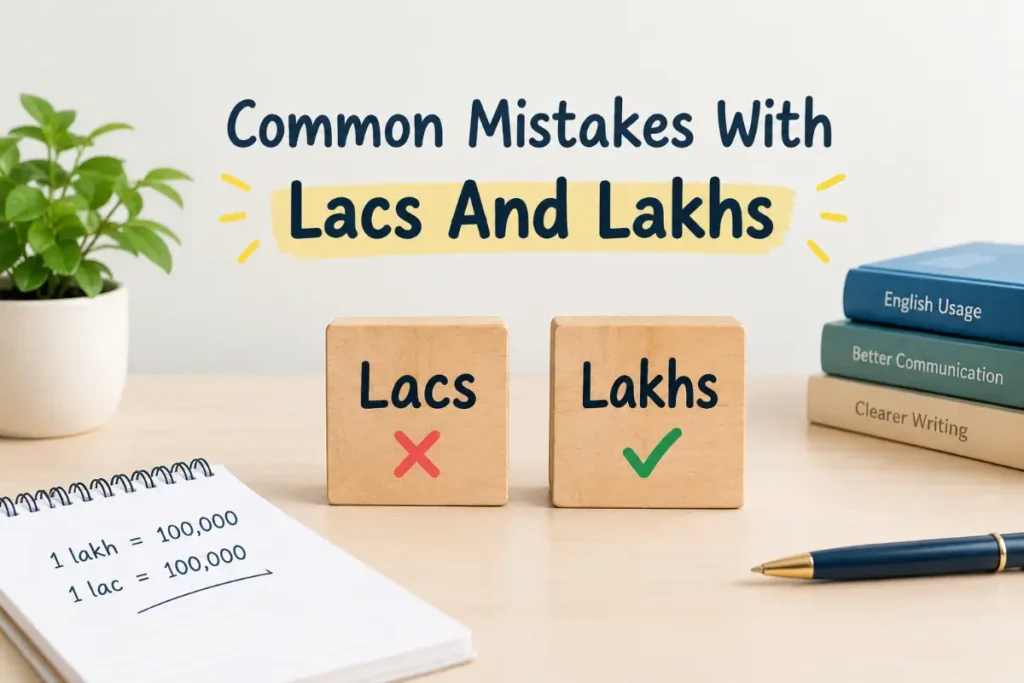
Common Mistakes With Lacs And Lakhs
Several mistakes appear again and again.
Mistake One
One lakhs rupees
Better:
One lakh rupees
The singular form follows one.
Mistake Two
Five lakhs rupees
Better:
Five lakh rupees
Or:
Five lakhs
Don’t combine the plural lakhs with rupees in this construction.
Mistake Three
One lac
This isn’t wrong.
It is a recognized variant. However, one lakh is usually the more useful choice for general writing.
Mistake Four
Five lakh equals 500,000
Better:
Five lakhs equals 500,000.
Or:
Five lakh rupees equals 500,000 rupees.
The grammatical construction matters.
Mistake Five
Treating lakh as a synonym for million.
It isn’t.
One lakh = 100,000.
One million = 1,000,000.
A million equals ten lakhs.
Is Lakh Singular Or Plural
Lakh is the singular form.
Lakhs is the ordinary plural form when the word is used as a countable noun.
Examples:
one lakh
two lakhs
three lakhs
ten lakhs
However, South Asian English often uses lakh in compound quantity expressions:
two lakh rupees
ten lakh people
This explains why learners may see lakh after numbers greater than one.
The distinction is based on sentence structure rather than simple counting alone.
Is Lac Singular Or Plural
Lac is the singular variant.
Lacs is the plural variant.
Examples:
one lac
two lacs
five lacs
The same meaning applies:
one lac = 100,000
five lacs = 500,000
Still, lakh and lakhs are generally better default choices for modern English writing.
Can You Use Lakh In Academic Writing
Yes.
You can use lakh in academic writing when the term is relevant to the subject or source material.
For example:
The survey included more than one lakh households.
However, academic writing places a high value on clarity.
If your readers may not know the term, define it when you first introduce it:
The survey covered more than one lakh households, or 100,000 households.
After that, you can continue using lakh if it helps maintain consistency.
If the article is aimed at an American academic audience, 100,000 may be more efficient.
Can You Use Lakhs In Formal Writing
Yes.
Lakhs is perfectly suitable for formal writing when you’re using South Asian English.
It can appear in:
- Academic papers.
- Government reports.
- Financial documents.
- Newspaper articles.
- Business reports.
- Educational material.
- Legal or policy documents.
- Research studies.
The key is consistency and audience awareness.
For formal international writing, define unfamiliar regional terms at first use.
Can You Use Lacs In Formal Writing
Yes, but lacs is less useful as a default form.
If a government report, organization, publication, or source consistently uses lacs, an editor shouldn’t change every occurrence simply because lakhs feels more familiar.
Instead, check the publication’s style.
A good editor respects established terminology when it serves a clear purpose.
For original general content, however, lakhs is usually the stronger choice.
Lacs Or Lakhs In Journalism
Journalists should think about the reader first.
A South Asian publication may naturally write:
The project cost 200 lakhs.
An international publication may prefer:
The project cost 20 million rupees.
An American publication might write:
The project cost about 20 million rupees.
The amount stays the same. The presentation changes.
That is a useful lesson in editorial writing. Good writing isn’t only about finding a technically correct word. It’s about choosing the form that lets the reader understand the information quickly.

Lacs Or Lakhs On Social Media
Social media is much less consistent.
You’ll find:
1 lakh views
1 lac views
1L views
100K views
These forms can all appear in online conversations.
The best choice depends on the audience.
For a South Asian audience, 1 lakh views may feel natural.
For an international audience, 100K views may be instantly clearer.
For formal content, spell out the number or use a standard numerical form instead of relying on informal abbreviations.
Memory Tricks For Lacs And Lakhs
A simple memory trick can help.
Remember:
Lakh has an H.
Think:
Hundred thousand starts with H.
This isn’t an etymological rule. It’s simply a memory aid.
Another useful trick is:
Lakh = 100,000.
Then build upward:
10 lakhs = 1 million.
100 lakhs = 1 crore.
For spelling, remember:
Lakh → lakhs
If you’re writing for a broad audience and you aren’t following a specific regional style, choose lakh and lakhs.
Related Words And Expressions
If you’re learning this vocabulary, several related terms are worth knowing.
Crore
A crore equals 10 million.
One crore = 100 lakhs.
Million
A million equals 1,000,000.
Therefore:
One million = 10 lakhs.
Billion
A billion equals 1,000,000,000.
Therefore:
One billion = 1,000 crores.
Hundred Thousand
One hundred thousand equals one lakh.
This is often the clearest equivalent for readers unfamiliar with South Asian numbering.
Rupee
The rupee is the currency used in India and several other South Asian countries.
The word frequently appears alongside lakh in discussions about salaries, property prices, business transactions, education, and personal finance.
Expert Editors Note
From an editing perspective the safest default is lakh for the singular and lakhs for the plural.
That recommendation isn’t based on one dictionary alone. Oxford lists lakh as the main form and identifies it as an Indian English term. Cambridge also uses lakh and defines it as 100,000. Collins recognizes both lakh and lac and includes lakhs and lacs among the plural forms.
So an editor shouldn’t mark lacs as an outright spelling error.
Instead, look at three things.
- Audience. Use the form your readers are most likely to recognize.
- Style. Follow the spelling already used consistently in the publication.
- Context. Keep regional terminology when it adds useful cultural or linguistic meaning.
For general English content, lakh and lakhs are usually the strongest choices.
For a South Asian publication that consistently uses lac and lacs, changing the spelling serves little purpose.
The larger editorial lesson is simple. Dictionary variation doesn’t always mean one form is wrong. Sometimes it reflects regional usage and different paths through which a word entered English.
What Dictionaries Say About Lakh
Dictionary evidence is especially useful with lacs or lakhs because online usage can make both forms look equally common.
Oxford Learner’s Dictionaries gives lakh as the main entry and defines it as 100,000. It identifies the term as Indian English and gives lakh and lakhs as plural forms.
Cambridge Dictionary also defines lakh as 100,000 and labels it Indian English. Its example uses 50 lakh rupees.
Collins provides the broader variant picture. It recognizes lac as a variant of lakh and includes lacs alongside lakhs.
That evidence supports a practical conclusion.
Lakhs is not merely a popular internet spelling. It is a well established plural form.
Lacs is also a recognized variant.
Lacs Or Lakhs In Different Types Of Writing
The right choice can change slightly with the type of writing.
Everyday Conversation
In South Asian English, both forms can occur naturally.
The apartment costs ten lakhs.
The apartment costs ten lacs.
A speaker may choose one based on habit or local convention.
Business Writing
For business documents, consistency becomes more important.
If a company uses lakhs throughout a report, keep that form.
For example:
The company reported revenue of 25 lakhs during the quarter.
If the document targets international readers, you could clarify the amount:
The company reported revenue of 25 lakhs, equal to 2.5 million rupees.
Academic Writing
Academic writers should define regional terms when readers may not know them.
For example:
The study examined households earning more than five lakhs, or 500,000 rupees, annually.
After defining the term, you can use lakhs throughout the paper.
Journalism
Journalists should consider audience comprehension.
A Pakistani or Indian publication may naturally use:
The project will cost 100 lakhs.
An American newspaper may prefer:
The project will cost 10 million rupees.
Both can communicate the same amount.
Financial Writing
Financial writing demands precision.
If the document is for a South Asian audience, lakhs can be perfectly appropriate.
If the document crosses international markets, adding the numerical equivalent can prevent confusion.
Social Media
Social media allows more informal forms such as 1 lakh, 1 lac, 100K, and 100,000.
Still, informal usage shouldn’t guide formal spelling decisions.
A form appearing frequently on social media doesn’t automatically make it the preferred editorial form.
Common Myths About Lacs And Lakhs
Several myths make this question more confusing than it needs to be.
Myth One
Lacs is always wrong.
That’s false.
Lac is a recognized variant of lakh, and lacs can function as its plural. Collins records the variant.
Myth Two
Lakh is only used in India.
That’s too narrow.
The word is strongly associated with Indian English, but it also appears in Pakistani English and other writing connected with South Asian numbering.
Myth Three
Lakh means one million.
It doesn’t.
One lakh = 100,000.
Ten lakhs = 1,000,000.
That distinction is essential.
Myth Four
Lakh and crore are interchangeable.
They aren’t.
One lakh = 100,000.
One crore = 10,000,000.
A crore equals 100 lakhs.
Myth Five
Lakhs must always be used after a number greater than one.
Not in every construction.
South Asian English commonly uses five lakh rupees while also using five lakhs when lakhs functions as the noun.
The sentence structure determines the form.
Lakh In Voice Search
People often ask this question conversationally.
They may search:
Is lacs or lakhs correct?
How do you spell lakh in English?
Is lakhs a correct word?
Does lac mean 100,000?
Is lakh singular or plural?
A strong answer should address the question immediately.
The simplest response is:
Both lacs and lakhs can be correct. Lakh is the preferred singular form and lakhs is the most common plural form in general English writing. Lac is a recognized variant and lacs is its plural.
That answer works well for voice search because it gives the key distinction without making the reader search through several paragraphs.
Lacs Or Lakhs For A US Audience
For a US audience, lakhs is usually the better choice if you need the South Asian term at all.
However, American readers are more familiar with:
100,000
500,000
1 million
than:
one lakh
five lakhs
ten lakhs
So context matters.
For example:
The scholarship is worth five lakhs.
A US reader may understand the sentence from context but still need to calculate the amount.
A clearer version is:
The scholarship is worth five lakhs, or 500,000 rupees.
For a general US website, you might simply write:
The scholarship is worth 500,000 rupees.
The best editorial choice depends on the purpose of the article.
If you’re explaining South Asian English, keep lakh.
If you’re simply reporting a financial figure to Americans, the standard numerical form may be clearer.
Lacs Or Lakhs In Pakistani English
Lakh is familiar in Pakistani English and appears frequently in discussions about money.
People commonly talk about:
one lakh rupees
five lakh rupees
ten lakhs
fifty lakhs
one crore rupees
This vocabulary is part of everyday number usage in Pakistan.
For Pakistani readers, changing every occurrence of lakh into 100,000 can make writing feel unnecessarily formal or foreign.
That is an important point for editors. Good editing doesn’t mean removing regional English. It means making the language appropriate for its audience.
Lacs Or Lakhs In Indian English
The same principle applies to Indian English.
Lakh is a familiar and established number term.
You may see:
two lakh rupees
ten lakh people
fifty lakhs
one crore
Indian English publications frequently use this vocabulary without explanation because their readers already understand it.
If you’re writing for an international audience, however, a brief explanation can help.
Is Lakh An English Word
Yes.
Lakh is an established English word in dictionaries.
Its strong association with South Asian English doesn’t make it any less legitimate as an English vocabulary item.
English contains thousands of words that originated in other languages. Many became established through trade, migration, colonial history, science, food, culture, and everyday communication.
The important question isn’t simply where a word came from.
The better question is how English speakers use it today.
In the case of lakh, dictionaries clearly recognize its English usage.
Lakh Word Origin
Lakh ultimately comes from the South Asian number word associated with the value 100,000.
The English spelling reflects a transliteration tradition rather than an original English spelling pattern.
The variant lac developed as another English spelling of the same term.
This history helps explain why both forms exist.
It also explains why learners shouldn’t expect the spelling to behave like a native English word with a simple spelling rule.
The word entered English through sustained contact with South Asian languages and cultures. Over time, lakh became established in English usage.
Why Lakh Has Multiple Spellings
Languages often borrow words before they develop a single fixed spelling.
Different writers may represent the same sound in different ways when moving a word from one writing system into another.
That process can create spelling variants.
Lakh and lac are a good example.
Over time, dictionaries and publications may favor one form while still recognizing another.
This is common in English. Spelling doesn’t always move toward one universal answer.
For writers, the practical lesson is more useful than the historical detail:
Pick one established form and use it consistently.
Lakh Vs Lac In Search Results
Search results can make the distinction look more complicated than it is.
A search for lacs or lakhs may return pages using:
lacs
lakhs
lac
lakh
The presence of multiple forms doesn’t mean the search engines are treating them as four separate concepts.
They generally refer to the same number term when used in this context.
Search engines also reflect regional writing patterns. A page from India may use one spelling while a page from Pakistan or another English speaking region may use another.
That is why search frequency alone isn’t a reliable way to decide which spelling is best.
Dictionary evidence and audience expectations matter more.
A Practical Style Guide For Lakh
If you’re writing an article, report, website, or educational resource, this simple style guide will keep your usage clean.
- Use lakh for one unit.
- Use lakhs for multiple units when the word functions as a noun.
- Use lakh in constructions such as five lakh rupees.
- Use lac and lacs only when following a recognized regional or house style.
- Define lakh for readers who may not know the South Asian numbering system.
- Give the international numerical equivalent when the exact amount matters.
- Don’t switch between lakh and lac without a reason.
- Don’t confuse lakh with million.
- Remember that ten lakhs equals one million.
- Follow the publication’s established style when editing existing material.
This approach handles most situations without unnecessary rules.
Which Form Sounds More Natural
For most modern English readers familiar with South Asian English, lakh and lakhs tend to feel more natural than lac and lacs.
That doesn’t make lac wrong.
It simply makes lakh the stronger default for original writing.
If I were editing a general English article for a broad audience, I’d choose lakh.
If I were editing a South Asian publication that already uses lac, I’d preserve the house style.
If I were writing for Americans who don’t need the regional term, I’d usually use the equivalent number instead.
That is the kind of decision a professional editor makes. The goal isn’t to pick the word that looks most familiar to the editor. The goal is to choose the form that serves the reader.
Frequently Asked Questions About Lacs Or Lakhs
Is Lacs Or Lakhs Correct
Both lacs and lakhs can be correct. Lakh is the more widely recognized singular form, while lakhs is its common plural. Lac is a recognized variant, and lacs can be used as its plural. For general English writing, lakh and lakhs are usually the better default because they have strong dictionary support and broad recognition.
Is Lakhs A Real Word
Yes. Lakhs is a legitimate plural form of lakh. A lakh equals 100,000. The word is established in English and is especially common in Indian English and other South Asian varieties. Dictionaries including Oxford and Cambridge recognize lakh, while Collins also recognizes the variant lac.
Is Lacs A Correct English Word
Yes. Lacs can be a correct English plural when it is used as the plural of lac, a recognized variant of lakh. Collins records lac as a variant and recognizes lacs as a plural form. Still, lakhs is generally the stronger choice for original writing aimed at a broad audience.
What Is The Plural Of Lakh
The usual plural is lakhs when the word functions as a countable noun. For example, you can write one lakh and five lakhs. South Asian English also commonly uses the singular form before a currency noun, as in five lakh rupees. The grammatical structure explains the difference.
Is One Lakh 100,000
Yes. One lakh equals 100,000. This is the basic value you need to remember. Ten lakhs equal one million, and 100 lakhs equal one crore. The term is especially common in Indian English and other South Asian varieties of English.
Is Ten Lakhs One Million
Yes. Ten lakhs equal one million. Since one lakh equals 100,000, multiplying it by ten gives 1,000,000. This conversion is useful when reading financial reports, property prices, salaries, news articles, and other South Asian English content.
Should I Write Five Lakh Or Five Lakhs
Both forms can appear depending on the sentence. Five lakhs works when the noun itself is being counted. Five lakh rupees is a common South Asian English construction because lakh directly modifies rupees. For example, you can write The house costs five lakhs or The house costs five lakh rupees.
Is Lakh Used In American English
Lakh isn’t a common everyday number term in American English. American readers are more familiar with 100,000 or one hundred thousand. However, American publications can use lakh when discussing South Asian culture, business, history, or economics. If the audience may not know the term, define it at first use.
Is Lac The Same As Lakh
Yes, when the words refer to the South Asian number system, lac is a variant of lakh and both mean 100,000. The main difference is spelling. Collins recognizes both forms. For general English writing, lakh is usually the safer default.
How Do You Write 500,000 In Lakhs
500,000 equals five lakhs. You can also write the amount as five lakh when it directly modifies a currency or quantity noun in South Asian English. For example, 500,000 rupees can be expressed as five lakh rupees.
What Is The Difference Between Lakh And Crore
A lakh equals 100,000 while a crore equals 10,000,000. One crore is therefore equal to 100 lakhs. These terms belong to the South Asian numbering system and are especially common in Indian and Pakistani English.
Many readers also check Home Made Or Homemade Which One Is Correct 2026 Guide.
Final Verdict On Lacs Or Lakhs
The answer is straightforward.
Lakh is the preferred singular form for most general English writing.
Lakhs is the preferred plural form.
Lac is a recognized variant.
Lacs is a recognized plural variant of lac.
So if you’re choosing a form from scratch, use lakh and lakhs.
If you’re editing an existing document that consistently uses lac and lacs, you don’t need to change it simply because another spelling is more familiar.
The biggest mistake is not choosing lac instead of lakh. The bigger problem is treating the two as completely different words or assuming one is automatically incorrect.
Remember the number first:
One lakh = 100,000.
Then remember the spelling:
lakh → lakhs.
Once that pattern is clear, the rest falls into place. Good word choice isn’t about chasing a single supposedly perfect form. It’s about using the established form that fits your audience, context, and style.

Vocabulary & Language Research Writer
Ethan Parker researches English vocabulary, word meanings, slang, idioms, and commonly confused words. His goal is to help readers understand how English is actually used in everyday conversations and writing.