

If you’ve ever typed busing or bussing and stopped to wonder which spelling belongs in your sentence, you’re not alone. The two forms look almost identical. Both are found in dictionaries. Both can be grammatically correct. The tricky part is that English uses them differently across regions and contexts.
For most American writing about transporting people by bus, busing is the clearest default. Bussing is also an established spelling and is especially familiar in British English and in American restaurant language such as bussing tables. Major dictionaries recognize both forms for the verb bus.
That makes this more than a simple right versus wrong spelling question. The choice depends on the meaning you intend, the variety of English you’re writing in, and the style you want to follow.
In this guide, you’ll learn exactly when to use busing and bussing. You’ll also see how the forms work in American and British English, why the spelling looks unusual, how the verb behaves in different tenses, and which form I’d recommend for a US audience.
Still confused? Compare Until Or Untill Which Spelling Is Correct 2026 Guide.
Quick Answer
Busing and bussing are both correct spellings of the verb bus. In American English, busing is a common choice for transporting people by bus. Bussing is also accepted and is especially common in British English and in the American phrase bussing tables. Your best choice depends on context and regional style.
Busing Or Bussing Comparison
| Feature | Busing | Bussing |
|---|---|---|
| Base verb | bus | bus |
| Part of speech | Verb form or noun | Verb form or noun |
| Main meaning | Transporting by bus | Transporting by bus or clearing tables |
| American English | Very common | Also accepted |
| British English | Used | Common |
| Restaurant context | Used | Very common |
| Present participle | Yes | Yes |
| Gerund | Yes | Yes |
| Pronunciation | /ˈbʌsɪŋ/ | /ˈbʌsɪŋ/ |
| Meaning changes because of spelling | Usually no | Usually no |
| Best US default for transportation | Busing | Acceptable |
| Best known restaurant phrase | Busing tables occurs | Bussing tables is very familiar |
The important point is simple. The extra s does not automatically make bussing wrong. Major dictionaries list both busing and bussing as forms of bus. Oxford lists busing and bussing among the American English forms of the verb. Collins likewise records both spellings.
What Busing Means
Busing is the present participle and gerund form of the verb bus.
When bus means to transport someone by bus, busing means the act or process of doing that.
For example:
The school is busing students to another campus.
Here busing means transporting students by bus.
The word can also work as a noun. In American English, busing has a well established use for organized student transportation. It can refer to transporting students to schools outside their local neighborhoods. The term is especially associated with school integration policies in US history. Collins and Oxford both record this use.
For example:
The district changed its busing policy this year.
In this sentence, busing refers to the system or practice of transporting students.
Busing In Everyday Transportation
The word isn’t limited to schools.
You can use busing for many kinds of organized transportation.
For example:
The hotel is busing guests from the airport.
The company is busing employees to the conference.
The event organizers arranged busing between the parking area and the stadium.
The resort provides busing to nearby attractions.
In each case, the basic idea is transportation by bus.
Busing In School Contexts
School transportation is one of the most familiar contexts for busing in American English.
You might see sentences such as:
The district provides busing for students who live far from school.
The school expanded its busing program.
Parents received new information about student busing.
The word can also appear in discussions of US education policy and school integration.
That historical meaning matters because busing is sometimes used in political or historical writing with a more specific sense. In those contexts, the word can refer to transporting students between neighborhoods or schools as part of efforts to create racially integrated classrooms.
So context matters. A sentence about airport transportation uses the general transportation sense. A sentence about US education history may use the more specific school integration sense.
What Bussing Means
Bussing is also a legitimate form of the verb bus.
It can mean transporting people by bus:
The company is bussing employees to the event.
It can also mean clearing used dishes from restaurant tables:
The server is bussing tables after the dinner rush.
That second meaning is particularly familiar in American restaurant English.
The important detail is that bussing does not have only one meaning.
Some writers assume that bussing must refer to restaurant work while busing must refer to transportation. That shortcut isn’t reliable. Dictionaries recognize bussing as a form of bus when the verb means transportation. Collins specifically gives both spellings for the transportation sense.
Bussing In Transportation
You can use bussing when people are being transported by bus.
For example:
The hotel is bussing guests to the airport.
The school is bussing students to a temporary campus.
The company is bussing employees to the training center.
The spelling is especially natural in British English. Collins lists bussing alongside busing for the transportation sense.
Bussing In Restaurants
Restaurant English gives bussing another very familiar use.
To bus tables means to remove dirty dishes and other used items from restaurant tables. The worker doing this may be called a busser.
For example:
She spent the evening bussing tables.
We need someone to help with bussing during the dinner rush.
He started bussing tables while he was in college.
Oxford and Collins both recognize bus as a verb for clearing restaurant tables.
This explains why many American readers see bussing and immediately think of restaurants. It doesn’t mean the spelling is restricted to that setting.
Which One Is Correct
Both busing and bussing are correct.
That is the answer to the spelling question.
If you’re writing for a general US audience and you mean transporting people by bus, busing is usually the easiest choice.
If you’re writing about restaurant work, bussing tables is a very familiar expression.
If you’re writing in British English, bussing is a common form for the transportation meaning.
So the practical rule looks like this:
- Use busing as your default US spelling for transportation by bus.
- Use bussing for restaurant table service.
- Use bussing for transportation when following British English conventions.
- Don’t mark bussing as an automatic spelling error.
- Stay consistent within the same piece of writing.
This approach matches dictionary evidence better than the simple claim that one spelling is correct and the other is wrong. Oxford lists busing and bussing as forms of the American English verb bus. Collins also gives both forms.

Why People Confuse Busing And Bussing
The confusion comes from a genuine spelling problem rather than careless writing.
The base word bus ends in s. When you add ing, many English speakers expect the final consonant to double in some situations.
That expectation is reasonable.
Consider these common forms:
run → running.
sit → sitting.
stop → stopping.
The consonant doubles because English spelling has established patterns for adding certain endings.
So when people see bus, they may naturally think:
bus → bussing.
That form looks familiar because it resembles other doubled consonant patterns.
At the same time, busing is established English. That creates a conflict between a spelling pattern that feels logical and the actual historical usage of the word.
The Visual Similarity
The two forms differ by only one letter.
busing.
bussing.
That tiny difference is easy to miss when you’re reading quickly.
It also creates an awkward situation for writers. A person may know that running has two n’s and assume that bussing must follow the same pattern. Another writer may have seen busing in American school or transportation writing and assume that bussing is simply a mistake.
Neither assumption is fully accurate.
The Restaurant Connection
American readers also encounter bussing frequently in restaurant contexts.
The phrase bussing tables is well established. That repeated exposure can make bussing feel more natural than busing.
At the same time, American education writing often uses busing.
That creates two familiar spelling patterns:
busing students.
bussing tables.
The difference can look like a difference in meaning. In reality, it is partly a difference in established usage and regional convention.
British And American Usage
Regional English adds another layer.
American English commonly uses busing for the transportation sense. British English commonly uses bussing. Collins records both forms across its British and American entries.
This is a useful lesson for English learners.
Not every spelling difference has a neat rule that works everywhere. Sometimes English develops competing forms and different varieties settle on different preferences.
The Double S Looks More Predictable
There is another reason bussing can look attractive.
English has many verbs that double a final consonant before ing:
plan → planning.
shop → shopping.
run → running.
sit → sitting.
So bus → bussing looks perfectly reasonable.
The problem is that English spelling isn’t a mathematical formula. Established words can preserve unusual or competing forms.
That’s exactly what happened with bus.
Collins notes that busing developed with a single s and describes the spelling as an irregular form that may have helped avoid association with the separate word buss.
The Difference Between Busing And Bussing
The biggest difference isn’t simply the number of s’s.
The real difference is usage preference.
Busing For Transportation
For American English, busing is a strong choice when you mean transporting people by bus.
The district is busing students to a new school.
The hotel offers busing between the airport and the resort.
The event includes free busing from the parking lot.
This form is especially useful in US writing because it aligns with common American dictionary usage. Oxford lists busing as an accepted American English form.
Bussing For Transportation
Bussing can also mean transporting people by bus.
The hotel is bussing guests to the terminal.
The school is bussing students from nearby neighborhoods.
The company arranged bussing for conference attendees.
The form is particularly common in British English.
So if you see bussing passengers in British writing, don’t treat it as a spelling error.
Bussing Tables
In American restaurant language, bussing tables is extremely familiar.
I worked as a server and spent part of the shift bussing tables.
The restaurant needs another employee for bussing tables.
Good bussing keeps the dining room moving during busy hours.
Here the word refers to clearing tables rather than transporting people.
Busing Tables
You may also encounter busing tables.
The single s isn’t automatically incorrect simply because the phrase refers to restaurant work. The underlying verb is still bus, and dictionaries recognize multiple forms of that verb. Oxford lists the restaurant sense under bus and lists busing and bussing as its ing forms.
Still, for a US reader, bussing tables may look more familiar because it is a strongly established restaurant expression.
Grammar Of Busing And Bussing
Both words are present participles and gerunds of the verb bus.
That distinction sounds technical, but the idea is simple.
A present participle usually works as part of a verb phrase.
The company is busing employees to the event.
The company is bussing employees to the event.
Here busing and bussing help form the progressive verb phrase is busing or is bussing.
A gerund works like a noun.
Busing students requires careful planning.
Bussing tables can be tiring during a busy shift.
In both examples, the ing form names an activity.
Present Tense Forms
The base verb is:
bus.
The third person singular form can appear as:
buses.
busses.
American English commonly uses buses for the verb. Other varieties and dictionaries recognize busses as well. Oxford lists both forms.
For example:
The company buses employees to the factory.
Past Tense Forms
The past tense also has two established forms:
bused.
bussed.
For American English, bused is a common choice.
For British English, bussed is common.
Collins records both forms in its treatment of the verb.
Examples:
The students were bused to another school.
The students were bussed to another school.
Both can be correct depending on the English variety and style.
The Full Verb Pattern
A useful way to remember the forms is to see them together.
| Form | Common US spelling | Common British spelling |
|---|---|---|
| Base form | bus | bus |
| Third person | buses | busses |
| Past tense | bused | bussed |
| Past participle | bused | bussed |
| Present participle | busing | bussing |
This regional pattern is one of the main reasons the spelling causes confusion.
However, don’t treat the table as an absolute wall between varieties. Dictionaries record overlap. American English can use bussing and British English can encounter busing. The table shows common tendencies rather than rigid rules.

Spelling Rules For Busing And Bussing
The spelling becomes easier to understand when you look at the base word and the ending separately.
The base verb is:
bus.
Add ing and you get two established forms:
busing.
bussing.
English usually has rules for doubling a final consonant, but bus is one of the words where established usage allows variation.
That is why applying a simple rule such as “double the final consonant” doesn’t give you the full answer.
Why Busing Has One S
Busing isn’t a typo.
It’s a standard form recognized by major dictionaries. Collins records busing as an American English form and gives it alongside bussing. Oxford also lists busing as an American English form of bus.
The single s can feel strange because readers are accustomed to consonant doubling in words such as running and planning.
Still, busing is standard English.
Why Bussing Has Two S’s
Bussing also follows a spelling pattern that looks familiar to English speakers.
The final s in bus is doubled before ing:
bus → bussing.
That spelling is especially common in British English and is also well established in American English.
So both forms have a legitimate place in English.
The safest editorial approach isn’t to invent a rule that eliminates one of them. Instead, choose the form that fits your audience and context.
Pronunciation Of Busing And Bussing
The two forms are normally pronounced the same.
The pronunciation is:
/ˈbʌsɪŋ/.
You can think of it in three parts:
bus + ing.
The first syllable receives the main stress.
The pronunciation sounds roughly like:
BUS ing.
The spelling difference doesn’t create a meaningful pronunciation difference in ordinary speech.
Common Pronunciation Mistake
Some learners may try to pronounce the double s in bussing as if it created an extra sound.
It doesn’t.
The two s’s don’t mean that you say a longer or stronger s sound.
Both busing and bussing normally have the same pronunciation. Collins gives /ˈbʌsɪŋ/ for busing and bussing.
Is Busing Pronounced Like Using
No.
Busing begins with the sound of bus.
busing → /ˈbʌsɪŋ/.
Using begins with a different vowel sound.
using → /ˈjuːzɪŋ/.
The difference is important in speech.
Busing Or Bussing In American English
For a US audience the safest practical choice is busing when you mean transporting people by bus. It’s clear and widely recognized in American English.
For example:
The school district is busing students to the new campus.
The hotel provides busing between the airport and the resort.
The event organizers arranged busing for guests.
However, bussing is also a valid American English spelling. You’ll often see it in restaurant writing because bussing tables is a familiar expression.
The important point for editors is consistency. If your article follows US spelling conventions then busing is a strong default for transportation. If you choose bussing because your source or house style prefers it then don’t treat the form as an error.
Busing Or Bussing In British English
British English gives bussing a stronger position.
A British writer may naturally write:
The school is bussing children to another campus.
The company is bussing workers to the site.
The single s form busing can still be understood. However, bussing is a familiar British spelling for the present participle of bus.
This is a good example of why regional English matters. A spelling that looks unusual to an American reader may be perfectly normal in British writing.
The same pattern can appear in other verb forms.
| Form | US preference | British preference |
|---|---|---|
| Present tense | buses | busses |
| Past tense | bused | bussed |
| Present participle | busing | bussing |
These are preferences rather than absolute rules. English varieties overlap. Dictionary entries also recognize more than one form. For that reason, context and consistency matter more than trying to label one spelling as universally correct.
Need another quick comparison? Read Noteable Or Notable Which Spelling Is Correct 2026.
Busing Or Bussing In Canadian English
Canadian English sits between American and British usage in many areas. That can make forms such as busing and bussing less predictable than a simple US versus UK comparison suggests.
Canadian writers may encounter both spellings. The appropriate choice often depends on the publication’s style guide and the writer’s regional convention.
For a Canadian publication, the best editorial practice is to check the publication’s preferred dictionary or style guide and then use one form consistently.
If you’re writing for a broad North American audience, busing is generally an easy form for readers to understand.
Busing Or Bussing In Australian English
Australian English also uses bussing in contexts involving transportation by bus.
For example:
The company is bussing passengers to the terminal.
Australian English has its own spelling preferences in many areas. Therefore, writers shouldn’t assume that every spelling convention used in the United States will transfer directly to Australia.
If the intended audience is Australian, follow an Australian dictionary or the publication’s house style.
For international content, both forms can be understood. The important task is to make your regional choice deliberate rather than accidental.
Twenty Real Life Examples Of Busing And Bussing
The fastest way to understand the distinction is to see the words in natural sentences.
Daily Conversation
- The hotel is busing guests to the airport every morning.
- We’re bussing everyone to the concert after dinner.
- The school started busing students from the new neighborhood.
- The tour company arranged bussing for the group.
These examples show that both spellings can describe transportation.
Workplace Writing
- The company provides busing for employees who work the night shift.
- We need to arrange bussing for conference attendees.
- The plant began busing workers from the downtown parking area.
- Management approved bussing between the two office locations.
The word works naturally in workplace communication when transportation is part of an organized service.
Emails
- The school will begin busing students to the temporary building on Monday.
- Please let us know if you need bussing from the hotel to the conference center.
- The event team has arranged busing for registered guests.
- We’re finalizing the bussing schedule this afternoon.
In formal emails, busing can be especially useful for American readers because it is familiar and straightforward.
Academic Writing
- The district expanded student busing during the following school year.
- Researchers examined the effects of school busing on enrollment patterns.
- The policy changed how students were bussed across district boundaries.
- Historical studies often discuss busing as part of school integration efforts.
Academic writing benefits from precise context. If you’re discussing US education history, busing can carry a specific policy meaning beyond ordinary transportation.
Journalism
- The city will provide busing for residents during the construction project.
- Officials announced new bussing arrangements before the event.
- The district is reviewing its student busing program.
- Organizers arranged bussing for thousands of spectators.
News writing may use either form depending on regional style and the source material.
Restaurant Writing
The restaurant meaning deserves separate attention.
- The manager asked two employees to help with bussing tables.
- She learned the basics of bussing during her first restaurant job.
- Good bussing keeps tables available during busy periods.
- The restaurant hired a new worker to handle bussing during dinner.
Here bussing means clearing dishes and other used items from tables.
Busing And Bussing In School Writing
School writing deserves special attention because busing has a strong historical and political meaning in American English.
The word can simply mean transporting students by bus.
The district provides busing for students who live several miles from school.
However, busing can also refer to programs designed to transport students between different neighborhoods or schools as part of desegregation efforts.
That use became especially prominent in the United States during the twentieth century.
If you’re writing about American history, civil rights, education policy, or school integration, don’t replace busing with a vague phrase such as school transportation. The broader term may lose an important part of the historical meaning.
For example:
The debate over school busing became a major issue in several American cities.
That sentence communicates more than simple transportation.
Busing And Bussing In Restaurant English
Restaurant English has its own vocabulary.
To bus a table means to remove used dishes, glasses, utensils, napkins, and other items after customers finish eating.
The person who performs this work is often called a busser.
For example:
The busser cleared the table quickly.
She spent the evening bussing tables.
The restaurant needs help with bussing during the dinner rush.
You may also see busing tables.
Both forms occur. However, bussing tables is highly familiar to many American readers.
This is one reason learners sometimes believe that bussing is specifically the restaurant spelling. That’s understandable but too narrow.
The spelling can refer to transportation too.
Busing Or Bussing In Formal Writing
For formal US writing, I recommend busing when the intended meaning is transportation by bus.
It’s short. It’s clear. It’s widely recognized.
For example:
The university provides busing between the main campus and the research center.
That sentence works well in a report or university publication.
In British writing, bussing may be the more natural choice.
The main editorial rule is simple. Match the spelling to your audience and keep your usage consistent.
If you’re writing for a US website then using busing for transportation is usually the cleanest editorial decision.
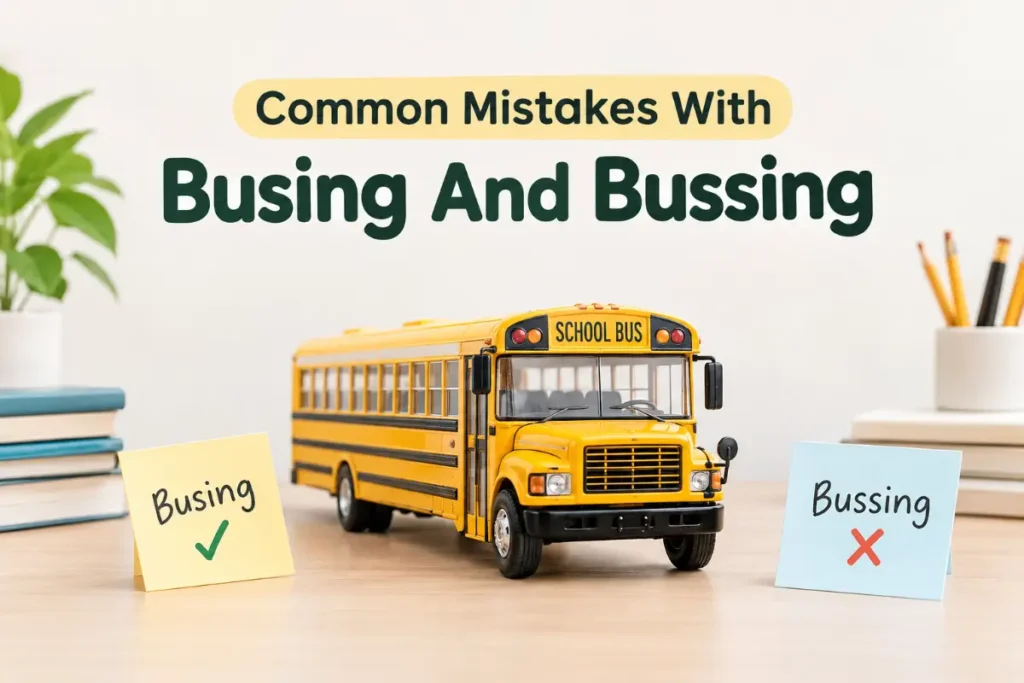
Common Mistakes With Busing And Bussing
The most common mistakes come from treating the two spellings as simple opposites.
Mistake One
Assuming bussing is always wrong.
It’s not.
Bussing is a recognized spelling.
Mistake Two
Assuming busing is a typo.
It isn’t.
Busing is a standard form and is especially common in American English.
Mistake Three
Using bussing only for restaurants.
The restaurant meaning is common but not exclusive.
You can also use bussing for transportation by bus.
Mistake Four
Assuming one spelling has a different pronunciation.
In ordinary speech, the two forms are pronounced the same.
Mistake Five
Changing forms randomly within one article.
If you’re writing an American English article and choose busing for transportation, don’t switch between busing and bussing without a reason.
Consistency makes professional writing easier to read.
Mistake Six
Applying a doubling rule mechanically.
The fact that many English verbs double their final consonant before ing doesn’t mean every verb follows the same visible pattern.
English spelling has exceptions and competing forms.
Mistake Seven
Calling one form incorrect without checking regional English.
A form that seems unusual in American English may be normal in British English.
This is an important lesson for English learners. Dictionary entries and regional style guides are more reliable than blanket spelling rules found on social media.
Memory Tricks For Busing And Bussing
A simple memory trick can make the choice much easier.
Think:
US transportation = busing.
The single s gives you the shorter American default.
Then remember:
Restaurant work = bussing tables.
The double s can remind you of the busy restaurant setting.
This isn’t a complete spelling rule because bussing can also refer to transportation. It’s simply a practical memory aid.
Another trick is to connect busing with the word bus.
bus → busing.
You can also remember the regional pattern:
American preference → busing.
British preference → bussing.
Don’t let the mnemonic replace dictionary knowledge. Use it as a quick mental shortcut when you’re writing.
Related Words And Expressions
Understanding related forms can help you recognize the word in different sentences.
Bus
Bus is the base verb.
The company will bus employees to the site.
It can also be a noun referring to the vehicle.
The bus arrived at eight.
Buses
Buses is a common present tense form in American English.
The district buses students from several neighborhoods.
Bussed
Bussed is an accepted past tense and past participle form.
The students were bussed to another school.
This form is especially familiar in British English.
Bused
Bused is also accepted.
The district bused students to another campus.
It is especially common in American English.
Busser
A busser is a restaurant worker who clears tables.
The busser cleared the dishes after the guests left.
The spelling busser is closely associated with American restaurant English.
Bus Service
Bus service is often clearer than a gerund when you’re discussing transportation as a general service.
The school provides bus service for eligible students.
In formal writing, this phrase can sometimes be more precise than busing.
Expert Editor’s Note
As an editor, I wouldn’t mark bussing as wrong simply because the document uses American English.
That would be too rigid.
Instead, I’d first identify the intended meaning and then check the publication’s style.
For a US article about transporting people by bus, I’d normally choose busing. It’s clean and familiar. It also avoids distracting readers who associate bussing with restaurant work.
For a restaurant article, I’d accept bussing tables because that expression is firmly established in American usage.
For British English, I’d be comfortable with bussing as the transportation form.
The dictionary evidence supports this flexible approach. Oxford lists busing and bussing as forms of bus and identifies bus as a verb used for transporting people and for clearing tables. Collins likewise records both forms and recognizes their regional and contextual uses.
A good editor also looks beyond the spelling itself.
Ask three questions:
- What does the writer mean?
- Who will read the text?
- What spelling does the chosen style guide prefer?
Those questions usually solve the problem quickly.
For general US content, my editorial preference is busing for transportation. For restaurant table service, bussing tables is a natural choice. For British content, bussing may be the better regional fit.
FAQs About Busing And Bussing
Is busing or bussing correct?
Both busing and bussing are correct forms of the verb bus. In American English, busing is a common choice for transporting people by bus. Bussing is also accepted and is especially familiar in British English and in the American restaurant phrase bussing tables. The correct choice depends on context and regional style.
Is busing the American spelling?
Busing is a common American spelling for the present participle of bus. It is widely used when talking about transporting people by bus and is particularly familiar in US discussions of school transportation. American English also recognizes bussing, so it isn’t accurate to describe that form as simply incorrect.
Is bussing the British spelling?
Bussing is a common British form of the present participle of bus. British writers may use it when referring to transporting people by bus. American English also uses the form in some contexts. Regional preferences can differ, so the spelling should match the audience and style guide.
Is bussing tables correct?
Yes. Bussing tables is a standard expression in restaurant English. It means clearing used dishes and other items from restaurant tables. You may also see busing tables because both forms are established. In American restaurant writing, however, bussing tables is especially familiar and natural.
Is busing tables also correct?
Yes. Busing tables can be correct because busing is an accepted present participle of bus. Still, many American readers are more accustomed to bussing tables in restaurant contexts. If you’re writing for a US audience, either can work, but consistency and house style should guide your final choice.
Why does bussing have two s’s?
Bussing reflects a spelling pattern in which the final consonant of the base word is doubled before the ing ending. The form became established alongside busing, which uses one s. English doesn’t always apply spelling patterns uniformly, so both forms survived in standard usage.
Do busing and bussing sound the same?
Yes. In normal speech, busing and bussing have the same pronunciation: /ˈbʌsɪŋ/. The extra written s in bussing doesn’t create an additional spoken sound. The difference is primarily a spelling and usage distinction.
Which spelling should I use in American English?
For general US writing, busing is a strong default when you mean transporting people by bus. If you’re talking about restaurant table service, bussing tables is very familiar. You can also encounter bussing for transportation in American sources, so it shouldn’t be treated as an error.
What is the past tense of bus?
Both bused and bussed are accepted forms. Bused is especially common in American English, while bussed is common in British English. The same regional pattern helps explain why American writers often prefer busing while British writers often prefer bussing.
Is bussing only used for restaurant work?
No. Bussing can mean transporting people by bus as well as clearing tables in a restaurant. The intended meaning comes from context. For example, bussing students to school concerns transportation, while bussing tables concerns restaurant service.
Does busing mean school transportation?
It can. Busing has a general meaning involving transportation by bus. In American English, it can also refer specifically to student transportation and historically to programs that transported students as part of school desegregation efforts. Context tells you which meaning is intended.
Which sounds more natural to American readers?
For transportation, busing is usually the cleanest default for American readers. For restaurant work, bussing tables is highly familiar. Still, bussing isn’t an error in American English. The strongest choice depends on the meaning, audience, and publication style.
Final Recommendation
If you’re writing for a US audience, use busing when you mean transporting people by bus.
Use bussing naturally when you’re talking about bussing tables in a restaurant. You can also encounter bussing for transportation, and that spelling is especially common in British English.
The most important point is this:
Busing and bussing are both correct.
Don’t turn a regional spelling preference into a right or wrong spelling rule. Instead, look at the meaning, identify your audience, follow the appropriate style, and stay consistent.
A related grammar guide is Mentioned Vs Mentionned Which Spelling Is Correct 2026 Guide.
Conclusion
The busing or bussing question looks like a tiny spelling problem, but it reveals an important feature of English. Two forms can coexist because language develops through history, regional use, and everyday speech rather than through perfectly uniform rules.
For American writing, busing is my preferred spelling for transportation by bus. Bussing is also legitimate and remains especially familiar in restaurant language and British English.
So when you’re writing for a US audience, remember the simplest rule: busing for transportation is a safe default. Bussing tables is a natural restaurant expression.
Once you understand the context, the extra s stops being a stumbling block and becomes a useful clue to usage.

Editorial Reviewer & Proofreader
Grace Mitchell reviews Gramlify’s articles for clarity, consistency, and readability. She is passionate about creating accurate, approachable content that helps English learners build confidence.