
Have you ever wanted to compliment someone on a great idea but paused to wonder if you should write complement or compliment? You’re not alone. These two words sound exactly alike in standard English, yet they have different meanings. Choosing the wrong one can change your sentence and leave readers wondering what you intended to say.
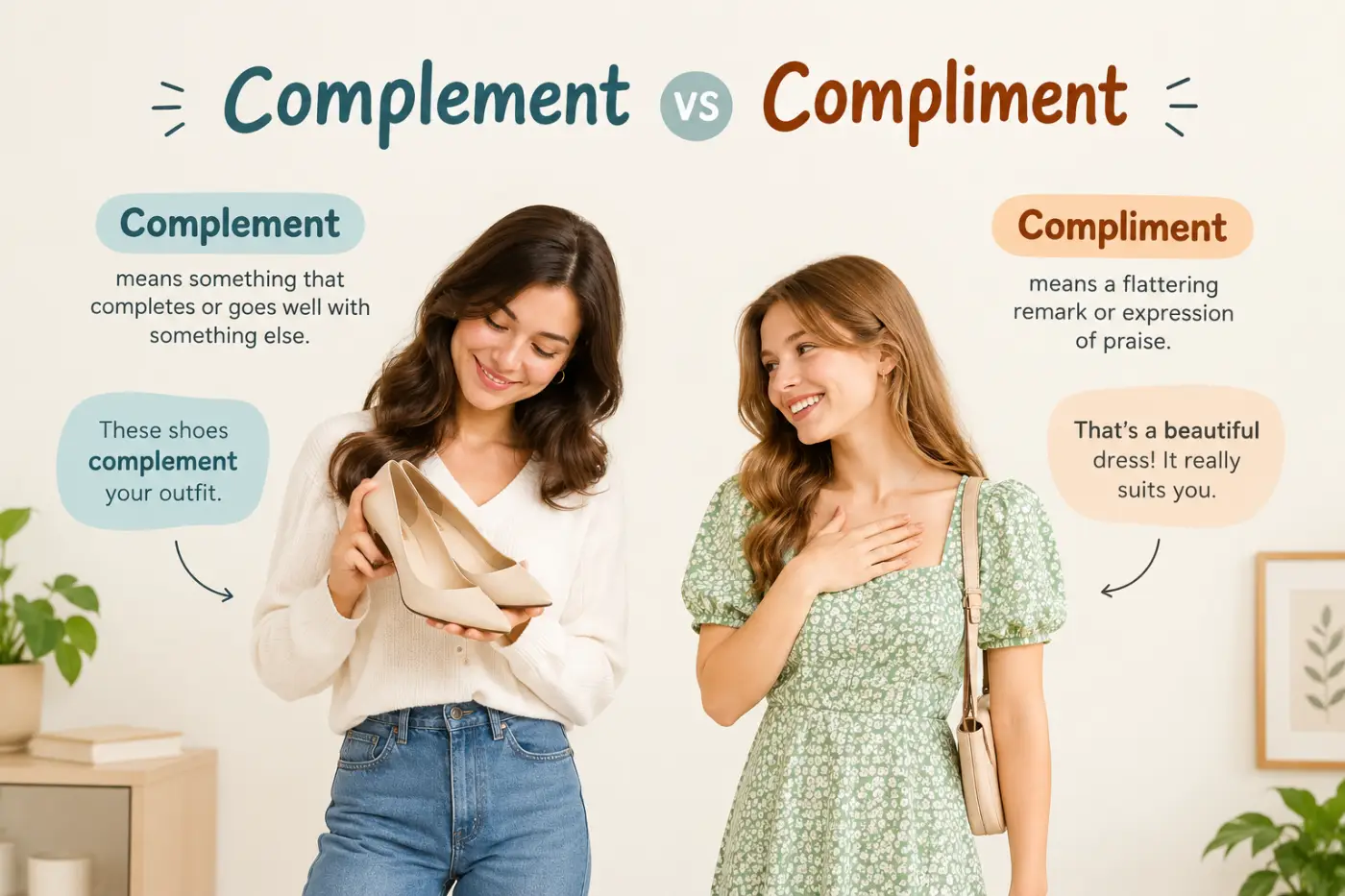
The difference between complement vs compliment comes down to what you want to express. A complement is something that completes, improves, or goes well with something else. A compliment is a kind or approving remark that shows admiration or appreciation. For example, a blue tie might complement a gray suit, while telling someone that their suit looks great is a compliment.
Both spellings are correct, so this isn’t a case of choosing a standard spelling over a mistake. Instead, you need to understand the meaning of each word and use it in the right context.
In this guide, you’ll learn how to distinguish the two words, remember their meanings, use them as nouns and verbs, and avoid common writing mistakes. You’ll also find practical examples for everyday conversations, professional emails, academic writing, and social media. By the end, you’ll have a simple way to choose the right word without second guessing yourself.
Learn the difference in Implicit Vs Complicit Differences Meanings And Correct 2026.
Quick Answer
Complement means something that completes, improves, or matches another thing. Compliment means a kind remark or an expression of praise. For example, a scarf can complement an outfit, but saying that someone looks stylish is a compliment. Both words are correct, and the right choice depends on the meaning of your sentence.
Complement vs Compliment Comparison Table
The easiest way to distinguish these words is to focus on their purpose. One describes a relationship between things that work well together. The other expresses praise or admiration.
| Feature | Complement | Compliment |
|---|---|---|
| Main meaning | Something that completes or enhances another thing | Praise or an expression of admiration |
| Part of speech | Noun and verb | Noun and verb |
| Pronunciation | KAHM pluh ment | KAHM pluh ment |
| Noun example | The sauce is a perfect complement to the fish. | She gave me a lovely compliment. |
| Verb example | These colors complement each other. | I complimented him on his presentation. |
| Common contexts | Design, food, grammar, science, and business | Conversation, appreciation, work, and relationships |
| Opposite or contrast | Something that clashes or fails to match | An insult or criticism |
| Spelling clue | Think of completing something | Think of praising someone |
| Correct spelling | Complement | Compliment |
Notice that pronunciation doesn’t help you choose between these words. They are homophones, which means they sound alike but have different meanings and spellings.
The most reliable test is to ask yourself what the sentence communicates. If something completes or enhances something else, use complement. If someone expresses admiration or approval, use compliment.
What Does Complement Mean
Complement refers to something that completes, balances, enhances, or works well with another thing. It can also describe the act of improving something by adding a suitable or helpful element.
The word works as both a noun and a verb. Its meaning stays connected to the idea of making something more complete or effective.
Complement as a noun
As a noun, complement identifies something that completes or enhances another thing. The two elements often work well together, and each contributes to the overall result.
Examples include:
- The lemon sauce is a perfect complement to the grilled fish.
- Her calm personality is a good complement to his energetic nature.
- The wooden table is a beautiful complement to the modern kitchen.
- The new software provides a useful complement to our existing tools.
- Fresh flowers make a lovely complement to the room.
In each example, the complement adds something useful or pleasing. It doesn’t simply praise the other item. Instead, it completes or improves the overall combination.
Complement as a verb
As a verb, complement means to complete, enhance, or go well with something.
For example:
- This jacket complements your shoes.
- The quiet music complements the peaceful atmosphere.
- Her research complements the findings of the earlier study.
- The new feature complements the app’s existing functions.
- His practical experience complements his academic knowledge.
The verb often appears with a direct object. In the sentence The jacket complements your shoes, the jacket is the subject, and the shoes are the thing it enhances.
Common uses of complement
You’ll often see complement in these situations:
Fashion and design. Colors, clothes, accessories, and decorations can complement one another.
Example: The cream curtains complement the dark wooden furniture.
Food and drink. One flavor or ingredient can enhance another.
Example: Fresh herbs complement the rich flavor of the soup.
Work and teamwork. Different skills can make a team more effective.
Example: Her technical skills complement his leadership experience.
Education and research. One source of information can add value to another.
Example: The survey results complement the findings from the interviews.
Grammar. A complement can complete the meaning of a grammatical structure. For example, in the sentence She is a teacher, the phrase a teacher is a subject complement because it identifies the subject.
This grammatical use is important because complement has a technical meaning beyond everyday conversation. It refers to a word or phrase that completes the meaning of another element in a sentence.
What Does Compliment Mean
Compliment means an expression of praise, admiration, approval, or appreciation. As a verb, it means to say something positive about a person, their work, their appearance, or an action they have taken.
Unlike complement, this word focuses on expressing a favorable opinion.
Compliment as a noun
As a noun, compliment refers to the positive remark itself.
Examples include:
- She gave me a thoughtful compliment about my writing.
- His manager offered a compliment on the quality of his work.
- That was a lovely compliment to receive.
- He took her kind words as a compliment.
- Your feedback is the nicest compliment I could receive.
In these examples, the compliment communicates approval or appreciation. It might make someone feel valued, encouraged, or respected.
A compliment doesn’t need to focus on appearance. You can compliment someone’s honesty, patience, creativity, effort, or problem solving skills.
Compliment as a verb
As a verb, compliment means to praise someone or express admiration for something they have done.
Examples include:
- I complimented her on her presentation.
- The teacher complimented the student on his progress.
- My colleague complimented me on the report.
- They complimented the chef on the meal.
- She compliments people when she notices their hard work.
When you use compliment as a verb, the person receiving the praise often follows the verb. The word on commonly introduces the reason for the praise.
For example, you can say, I complimented Maya on her excellent presentation.
You can also say, I complimented Maya’s presentation. In this version, the presentation itself receives the praise.
Common uses of compliment
Everyday conversation. People compliment one another on their clothes, skills, ideas, and achievements.
Example: Your new haircut looks great. That’s a lovely compliment to give a friend.
Workplace communication. Managers and coworkers use compliments to recognize good work.
Example: The supervisor complimented the team on meeting the deadline.
Relationships. Compliments can express affection, appreciation, or admiration.
Example: He complimented his partner on her kindness.
Customer service. A customer may praise an employee for helpful service.
Example: The customer sent a compliment to the store manager about the staff.
Writing and public speaking. Speakers and writers may compliment someone’s argument, performance, or contribution.
Example: The reviewer complimented the author on the clarity of the explanation.
The central idea remains the same in every context. A compliment expresses praise rather than describing how two things fit together.
The Main Difference Between Complement and Compliment
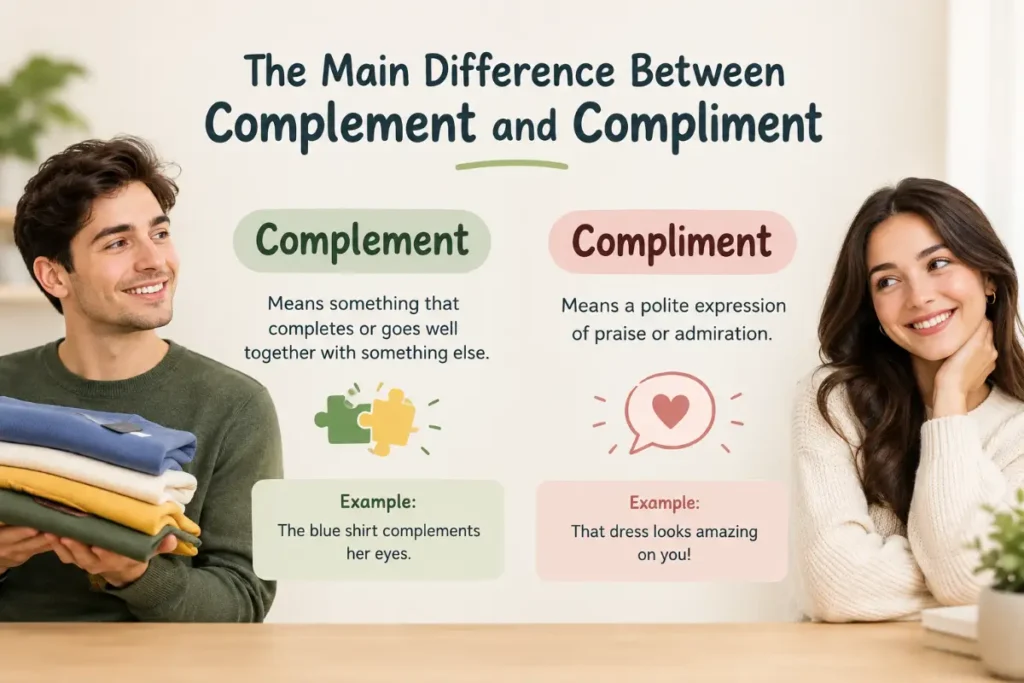
The difference becomes easier to remember when you look at what each word does.
A complement adds value by completing, balancing, or enhancing something. A compliment adds value through words of praise.
Consider these two sentences:
The green tie complements his suit.
This means the tie looks good with the suit. The two items work well together.
I complimented him on his suit.
This means I told him something positive about his suit.
The first sentence describes how two things relate to each other. The second describes an act of praise.
A simple test for choosing the right word
Ask yourself one question: Am I talking about something that goes well with another thing, or am I talking about praise?
Use complement when you mean:
- Complete.
- Enhance.
- Balance.
- Match well with.
- Add something useful to another thing.
Use compliment when you mean:
- Praise.
- Admire.
- Appreciate.
- Say something kind.
- Recognize someone’s effort or achievement.
For example, a skilled editor might complement a writer’s work by improving its structure. The editor might also compliment the writer on the strength of the original ideas.
Both actions are positive, but they describe different things. Understanding that difference is the key to using these words correctly.
Grammar Explanation for Complement vs Compliment
Both complement and compliment can function as nouns and verbs. Their grammar is similar, but their meanings and common sentence patterns differ.
How to use complement in a sentence
As a noun, complement often follows an article or an adjective. It can also appear after a preposition.
Examples.
- The painting is a perfect complement to the room.
- Fresh fruit makes an excellent complement to breakfast.
- The new course serves as a useful complement to the training program.
As a verb, complement usually takes a direct object. The subject is the thing that completes or enhances something else.
Examples.
- The blue curtains complement the white walls.
- Her experience complements his technical knowledge.
- These exercises complement the lessons in the textbook.
Pay attention to subject verb agreement. Use complements with a singular third person subject and complement with a plural subject or the pronouns I, you, we, and they.
For example, write This color complements the furniture but These colors complement the furniture.
How to use compliment in a sentence
As a noun, compliment can appear with articles and descriptive words.
Examples.
- She received a sincere compliment from her teacher.
- His comment was a wonderful compliment.
- I appreciated the kind compliment about my work.
As a verb, compliment often appears in the pattern compliment someone on something.
Examples.
- I complimented her on her presentation.
- The manager complimented the staff on their excellent service.
- We complimented the chef on the meal.
You can also compliment a person or thing directly.
For example, She complimented my writing means she said something positive about it.
Complement and compliment in different tenses
Both verbs follow regular English verb patterns.
| Form | Complement | Compliment |
|---|---|---|
| Base form | complement | compliment |
| Third person singular | complements | compliments |
| Present participle | complementing | complimenting |
| Simple past | complemented | complimented |
| Past participle | complemented | complimented |
Examples.
- Present. The colors complement each other.
- Present. She compliments her coworkers on their work.
- Past. The curtains complemented the furniture.
- Past. He complimented me on my speech.
- Present continuous. The new design is complementing the existing layout.
- Present continuous. She is complimenting the students on their progress.
The same spelling patterns apply to both verbs. However, the meaning still determines which word belongs in your sentence.
Complement in English grammar
The word complement also has a special role in grammar. A grammatical complement completes the meaning of another word or structure.
For example, in the sentence The sky is blue, the adjective blue is a subject complement because it describes the subject the sky after the linking verb is.
In She became a doctor, the noun phrase a doctor is a subject complement because it identifies what the subject became.
A complement can also follow a verb and complete its meaning.
Consider the sentence They elected Maria president. The word president is an object complement because it identifies the role given to Maria.
This technical meaning has nothing to do with praising someone. Therefore, grammar books use complement, never compliment, for this purpose.
Spelling Rules for Complement and Compliment
The spelling difference lies in one vowel. Complement contains an e after the initial compl, while compliment contains an i in that position.
Both spellings are standard English. Neither is a regional variation or an accepted alternative spelling of the other.
Why the middle vowel matters
The words look almost identical because they share most of their letters. However, that single vowel signals a difference in meaning.
Compare these examples.
- The necklace complements her dress.
- She complimented her friend on the dress.
In the first sentence, the necklace enhances the dress. In the second, someone expresses praise.
Changing the vowel changes the word, so a spelling checker may not flag the mistake. Both forms exist in standard English dictionaries.
Do not change the spelling based on tense
Some writers remember the difference between the base forms but become uncertain when using the past tense or present participle.
The good news is that the usual verb endings work the same way.
- Complement becomes complemented or complementing.
- Compliment becomes complimented or complimenting.
For example, The artwork complemented the furniture is correct when the artwork enhanced the furniture.
Likewise, The customer complimented the employee is correct when the customer praised the employee.
Common spelling mistakes
The most common error isn’t creating a new spelling. It’s choosing a correctly spelled word with the wrong meaning.
Incorrect for the intended meaning.
She gave me a complement on my haircut.
Correct.
She gave me a compliment on my haircut.
The first sentence uses a real English word, but it doesn’t express praise. A spelling checker might accept it because complement is spelled correctly.
The same issue occurs in reverse.
Incorrect for the intended meaning.
The curtains compliment the sofa.
Correct.
The curtains complement the sofa.
The curtains work well with the sofa. They aren’t offering it praise.
Pronunciation Guide for Complement vs Compliment
Complement and compliment are homophones in standard English. They have the same pronunciation, so you usually can’t identify the correct spelling by listening alone.
Both words are commonly pronounced /ˈkɑːm.plə.mənt/ in American English, although the first vowel may vary slightly by accent.
Syllables and word stress
Both words have three syllables.
- Com.
- Ple.
- Ment.
The main stress falls on the first syllable.
You can represent the stress as COM puh ment. The middle syllable has a reduced vowel, often called a schwa, which sounds like the relaxed vowel in about.
The final syllable is pronounced ment.
Common pronunciation mistakes
Some learners try to pronounce the e in complement differently from the i in compliment. In ordinary English speech, that difference doesn’t reliably distinguish the two words.
The best approach is to learn the meanings alongside the spellings. When speaking, context usually makes the intended meaning clear.
For example, if someone says, That jacket really complements your outfit, the context points to the idea of matching or enhancing.
If someone says, That was a lovely compliment, the context points to praise.
Need another quick comparison? Read Ballot Or Bullet Which Word Is Correct 2026 Guide.
Word Origin and Etymology
The histories of complement and compliment help explain why the words look so similar.
Both entered English through French and Latin influences. Over time, their spellings became distinct as their meanings developed along different paths.
The origin of complement
Complement comes from Latin complementum, meaning something that fills up or completes. The Latin verb complere means to fill or complete.
This history connects directly to the modern meaning. A complement adds something that makes another thing complete, balanced, or more effective.
For example, a side dish can complement a main course because it adds to the meal. A final chapter can complement a book by supplying useful information.
The origin of compliment
Compliment developed through French and Italian forms associated with expressions of respect, courtesy, and praise. Its history is connected to the idea of showing regard for another person.
Today, the word commonly describes an approving remark or an expression of admiration.
For example, saying Your explanation was very clear can be a compliment because it expresses appreciation for someone’s communication.
How the spellings became distinct
The two words share historical roots and have overlapping letter patterns. However, their meanings gradually became more specialized.
Complement retained its connection to completion and wholeness. Compliment became associated with praise and courtesy.
Knowing the history can make the difference easier to remember, but you don’t need to memorize Latin or French roots to use the words correctly. The practical distinction between completing something and praising someone is enough for most writing situations.
British vs American English
The spelling distinction between complement and compliment is the same in American and British English. Neither word changes spelling based on the country.
American, British, Canadian, and Australian writers use both words with the same core meanings.
| Variety of English | Correct spelling for enhancement | Correct spelling for praise |
|---|---|---|
| American English | complement | compliment |
| British English | complement | compliment |
| Canadian English | complement | compliment |
| Australian English | complement | compliment |
Some English words have regional spelling differences, such as color and colour. This pair doesn’t follow that pattern.
American English examples
The warm lighting complements the restaurant’s modern design.
My supervisor complimented me on the presentation.
British English examples
The blue scarf complements her coat.
The teacher complimented the pupil on his progress.
Canadian and Australian English examples
The new software complements the company’s existing systems.
She complimented her colleague on the thoughtful report.
These examples follow the same spelling and grammar rules across all four varieties.
When editing international content, don’t change complement to compliment or the other way around to match a regional style guide. Instead, preserve the intended meaning.

Real Life Examples of Complement vs Compliment
Examples make the difference easier to recognize because the words often appear in familiar situations. The following sentences show how each word works in everyday speech, professional communication, education, journalism, and online conversations.
Everyday conversation
- The red shoes complement your black dress.
- Thanks for the compliment. That made my day.
- Her sense of humor complements his quiet personality.
- I wanted to compliment you on your cooking.
- The fresh salad is a nice complement to the pasta.
The first, third, and fifth examples describe things that work well together. The second and fourth involve praise.
Workplace communication
- Her project management skills complement his technical expertise.
- The director complimented the team on meeting its goals.
- This training course is a useful complement to our onboarding program.
- My supervisor complimented me on the report’s clear structure.
- The new employee’s experience complements the team’s existing strengths.
These examples show why the distinction matters in professional writing. Complement describes how skills, tools, or programs fit together. Compliment describes recognition or praise.
Emails and business messages
- Your research complements the findings in our earlier report.
- I wanted to compliment you on the thoughtful proposal.
- The attached guide serves as a complement to the training materials.
- Thank you for the compliment on my presentation.
- The updated dashboard complements the existing reporting system.
In a work email, use compliment when you want to recognize a person’s contribution. Use complement when you explain how one resource supports another.
Academic writing
- The interviews complement the results of the quantitative survey.
- The professor complimented the student on the strength of her argument.
- This chapter provides a useful complement to the earlier discussion.
- The researcher complimented the participants on their careful observations.
- The two theories complement each other by explaining different aspects of the problem.
Academic writing often uses complement to describe related evidence, methods, or theories. However, compliment remains useful when a writer describes praise or recognition.
Journalism and literature
- The photographer’s images complement the article’s detailed reporting.
- The critic complimented the director on the film’s careful pacing.
- The final chapter acts as a complement to the novel’s opening scene.
- The reviewer offered a compliment on the author’s vivid descriptions.
- The documentary’s interviews complement its historical footage.
These examples demonstrate how the words work in descriptive and analytical writing. One concerns how parts fit together, while the other concerns positive judgment.
Social media and informal writing
- Those colors complement each other beautifully.
- That is such a sweet compliment.
- Your caption complements the photo perfectly.
- I had to compliment her on that amazing performance.
- The music and visuals complement each other so well.
Online writing often moves quickly, which makes these words easy to mix up. Still, the same distinction applies in captions, comments, direct messages, and posts.
Examples that show both words together
Sometimes you can use both words in the same sentence.
- I complimented her on the way her accessories complement her outfit.
- The editor complimented the writer on how the examples complement the main argument.
- He received a compliment because his new glasses complemented his style.
- The chef complimented the farmer on the fresh ingredients that complemented the dish.
- The manager complimented the team on choosing tools that complement one another.
These sentences are useful because they show the words performing different jobs within the same context. The person offers praise with a compliment, while the things being discussed complement one another.
Common Mistakes With Complement and Compliment
Even experienced writers sometimes confuse these words because spelling software doesn’t always recognize errors involving correctly spelled words. The best way to avoid mistakes is to focus on meaning and sentence structure.
Mistake 1 Using compliment when you mean enhance
Incorrect.
The blue paint compliments the white furniture.
Correct.
The blue paint complements the white furniture.
The paint enhances the appearance of the furniture. It doesn’t praise it.
Mistake 2 Using complement when you mean praise
Incorrect.
She complemented me on my excellent work.
Correct.
She complimented me on my excellent work.
The sentence describes an expression of praise, so complimented is the right choice.
Mistake 3 Assuming one spelling is incorrect
Neither word is a misspelling of the other. Both are standard English words with different meanings.
For example, complementary skills describes skills that work well together. Complimentary remarks describes words of praise.
The spelling depends on the intended meaning, not on which word looks more familiar.
Mistake 4 Confusing complimentary with complementary
These adjectives create another common problem.
Complementary means completing, enhancing, or working well with something else.
Example. The two departments have complementary responsibilities.
Complimentary means expressing praise or provided free of charge.
Examples. She made complimentary remarks about the service. The hotel offers complimentary breakfast.
The word complimentary has two common meanings, so context matters. In a hotel advertisement, it usually means free. In a conversation about someone’s work, it often means praising or approving.
Mistake 5 Forgetting the correct preposition
When compliment is a verb, writers commonly use on to introduce the reason for the praise.
Natural.
I complimented him on his presentation.
Also natural.
I complimented his presentation.
With complement, the verb commonly takes the thing being enhanced as its object.
Natural.
The curtains complement the furniture.
The pattern you choose should match the intended meaning.
Mistake 6 Trusting autocorrect too much
A spell checker may accept complement in a sentence that requires compliment because the spelling itself is valid.
For example, Thank you for the complement may pass a basic spelling check. However, the intended word is compliment.
When proofreading, check the meaning of the whole sentence rather than relying on the software to identify every error.
Mistake 7 Assuming positive meanings are interchangeable
Both words can appear in positive contexts, but they aren’t synonyms.
A good color combination can complement an outfit. A kind remark can compliment the person wearing it.
Remember that complement describes a useful or pleasing relationship between things. Compliment describes praise or appreciation.
Memory Tricks for Complement vs Compliment
The easiest way to remember complement vs compliment is to connect each spelling with its main meaning. You don’t need to memorize complicated grammar rules or word histories. A simple memory trick can help you choose the right word in seconds.
Remember complement with complete
The word complement contains the same first four letters as complete. Both words connect to the idea of making something whole or better.
Think of this example.
The final ingredient completes the recipe and complements the other flavors.
You can also remember this connection through everyday objects. A matching belt complements a pair of shoes because the two items work well together.
Use complement when something completes, enhances, balances, or supports something else.
Remember compliment with praise
The word compliment contains an i. Connect that letter with the idea of saying something nice about an individual.
For example, imagine telling a friend, I love your new haircut. You’re giving your friend a compliment.
Remember this simple association.
Compliment means praise.
You can also picture a person smiling after hearing a kind remark. That positive response can remind you that a compliment expresses appreciation or admiration.
Use a two question test
When you’re unsure which spelling to use, ask yourself these two questions.
- Does the sentence describe something that completes or enhances another thing? Use complement.
- Does the sentence describe praise or an approving remark? Use compliment.
Consider these examples.
The necklace complements the dress because the two items look good together.
The salesperson complimented the customer on her choice because the salesperson expressed praise.
This quick test works for both nouns and verbs.
Practice with a short exercise
Choose the correct word for each sentence.
- The new curtains ___ the furniture.
- My teacher gave me a wonderful ___.
- I wanted to ___ you on your excellent work.
- The side dish is a perfect ___ to the main course.
- The manager ___ the team on its performance.
- These two colors ___ each other.
Answers.
- Complement.
- Compliment.
- Compliment.
- Complement.
- Complimented.
- Complement.
If you answered all six correctly, you’ve understood the main distinction. If you missed one, look at the meaning of the sentence instead of focusing only on the spelling.
Related Words and Expressions
Learning related words can help you understand the difference more deeply. It also makes it easier to use the right expression in different situations.
Complementary vs complimentary
These adjectives are closely related to the main pair and deserve special attention.
Complementary describes things that complete, enhance, or work well with each other.
Examples.
- The two colors are complementary.
- Their skills are complementary.
- The course offers complementary lessons that cover different topics.
Complimentary can mean expressing praise or provided free of charge.
Examples.
- She made complimentary comments about the speaker.
- The hotel provides complimentary coffee.
- The customer received complimentary tickets to the event.
The distinction is especially important in business and hospitality writing. A complimentary service is usually free, while a complementary service works well with another service.
Synonyms for complement
The best synonym depends on the sentence. No single word replaces complement in every context.
| Related word | Meaning | Example |
|---|---|---|
| Complete | Make something whole | The final chapter completes the book. |
| Enhance | Improve quality or appeal | The lighting enhances the room. |
| Supplement | Add something extra | The guide supplements the main textbook. |
| Balance | Create a suitable relationship | The acidity balances the sweetness. |
| Match | Go well with something | The shoes match the dress. |
| Augment | Increase or strengthen | The new data augment the existing research. |
These words overlap with complement, but they aren’t always interchangeable. For instance, supplement often emphasizes adding extra material, while complement emphasizes how one thing completes or enhances another.
Synonyms for compliment
A compliment expresses praise or admiration. Depending on the situation, you can use related words such as these.
| Related word | Meaning | Example |
|---|---|---|
| Praise | Express approval | The teacher praised her effort. |
| Admiration | Respect or appreciation | He expressed admiration for her courage. |
| Appreciation | Recognition of value | She showed appreciation for the team’s work. |
| Commendation | Formal recognition of good work | The employee received a commendation. |
| Flattery | Praise that may be excessive or insincere | His flattery sounded exaggerated. |
| Acclaim | Public praise or approval | The performance received widespread acclaim. |
The word flattery often suggests praise intended to please someone or gain an advantage. In contrast, a compliment can be completely sincere and natural.
Antonyms and contrasting expressions
An antonym is a word with an opposite meaning. The best opposite for each word depends on the context.
For complement, useful contrasts include:
- Clash.
- Conflict.
- Contradict.
- Undermine.
- Disrupt.
For example, the bright red curtains clash with the pale blue walls.
For compliment, useful contrasts include:
- Insult.
- Criticism.
- Disapproval.
- Condemnation.
- Reproach.
For example, the manager criticized the report instead of complimenting the employee on it.
Keep in mind that these words don’t work as perfect opposites in every sentence. A color that fails to complement another color might simply look ordinary rather than clash with it.
Related expressions worth learning
Some common phrases can help you use these words more naturally.
Pay someone a compliment. Give someone praise.
Example. I wanted to pay her a compliment on her presentation.
Take something as a compliment. Interpret a remark as praise.
Example. He took the suggestion as a compliment.
Complimentary remarks. Positive or approving comments.
Example. The reviewer made complimentary remarks about the novel.
A perfect complement. Something that fits or enhances another thing especially well.
Example. Fresh mint is a perfect complement to the dessert.
Complement each other. Work well together because of shared or different qualities.
Example. Their skills complement each other.
These expressions are useful in conversation, emails, essays, and professional writing.
Expert Editor’s Note on Complement vs Compliment
As an editor, I recommend checking the meaning before checking the spelling. Both words are correct, and a standard spell checker may not catch a substitution error because the unintended word is still spelled properly.
The distinction is straightforward.
Use complement when something completes, enhances, or works well with another thing. Use compliment when someone expresses praise, approval, or admiration.
What dictionaries tell us
Standard English dictionaries distinguish the words by meaning rather than treating one as a variant of the other. They recognize complement as a word connected to completion or enhancement and compliment as a word connected to praise or courtesy.
The adjective forms follow the same distinction. Complementary describes things that complete or enhance each other. Complimentary describes praise or something supplied free of charge.
What professional editors recommend
When editing a sentence, identify the relationship between the subject and the rest of the sentence.
Consider this example.
The photographs compliment the article.
If the writer means that the photographs improve the article by adding useful visual information, change compliment to complement.
Now consider this sentence.
The reviewer complemented the author on the clear explanation.
If the reviewer praised the author, use complimented instead.
A professional editor checks meaning, grammar, and context together. The goal isn’t simply to find a word that looks correct. It’s to make sure the sentence communicates the intended idea.
Which word sounds more natural to native speakers
Both words sound natural when used correctly. Native speakers generally distinguish them through context because they have the same pronunciation.
For example, Your shoes complement your outfit sounds natural when describing appearance. I complimented you on your outfit sounds natural when describing praise.
Neither spelling is more formal or more correct than the other. The right choice depends entirely on what you want to say.
A final proofreading tip
When reviewing a document, search for both complement and compliment. Then check each occurrence manually.
Also search for complementary and complimentary. These adjective forms can create errors that basic grammar tools overlook.
This small proofreading step can prevent confusing mistakes in business reports, educational materials, product descriptions, and everyday writing.
Frequently Asked Questions
What is the difference between complement and compliment
Complement means something completes, enhances, or works well with something else. Compliment means praise or an expression of admiration. A necklace can complement a dress, while telling someone that the dress looks beautiful is a compliment. Both words are correct, but they serve different purposes.
Is complement or compliment correct
Both spellings are correct English words. Use complement when you mean to complete or enhance something. Use compliment when you mean to praise someone or make an approving remark. The correct spelling depends on the meaning of the sentence, not on regional spelling rules.
How do you remember complement vs compliment
Connect complement with complete. Both relate to making something whole or better. Connect compliment with praise and kind words. If you’re describing how two things work together, choose complement. If you’re describing something nice said to another person, choose compliment.
Are complement and compliment homophones
Yes. In standard English, complement and compliment are pronounced the same way. They have different spellings and meanings, so they are homophones. Because pronunciation doesn’t distinguish them, you need to use the sentence’s meaning to select the correct word.
What does it mean to complement someone
In everyday English, people usually compliment someone when they praise that person’s appearance, work, or behavior. However, you can say that one person’s skills complement another person’s skills. In that sentence, complement means the skills work well together. The intended meaning determines the word.
What does it mean to compliment someone
To compliment someone means to express praise, admiration, or appreciation. For example, you might compliment a coworker on a presentation or compliment a friend on a new haircut. The phrase compliment someone on something is a common and natural sentence pattern.
What is the difference between complementary and complimentary
Complementary means completing, enhancing, or working well with something else. Complimentary can mean expressing praise or provided free of charge. For example, complementary colors work well together, while complimentary hotel breakfast means breakfast is provided at no extra charge.
Is complimentary the same as free
In many business and hospitality contexts, complimentary means free of charge. A hotel might offer complimentary breakfast or a company might provide complimentary tickets. However, the word can also mean expressing praise, as in complimentary comments. The surrounding sentence reveals which meaning applies.
Can complement and compliment be used as verbs
Yes. Complement means to enhance or complete something, as in The colors complement each other. Compliment means to praise someone or something, as in She complimented him on his work. Both verbs use regular forms such as complemented and complimented in the simple past tense.
Which word should I use in formal writing
Use the word that matches your intended meaning. In formal writing, complement is common when discussing research, skills, methods, systems, and related ideas. Compliment is appropriate when discussing praise or recognition. Neither word is more formal than the other. Accuracy matters more than formality.
Many readers also check Loot Vs Lute Which Word Should You Use 2026.
Conclusion
The difference between complement vs compliment comes down to one simple idea. A complement completes or enhances something, while a compliment expresses praise or admiration.
Both words are correct, and both work as nouns and verbs. They also sound alike, which explains why writers sometimes mix them up. However, their meanings are different enough that using the wrong one can change your sentence.
Remember the connection between complement and complete. Then associate compliment with praise and kind words. When proofreading, pay special attention to these words and their adjective forms, complementary and complimentary.
The best rule is simple. Use complement for things that work well together and compliment for words that make someone feel appreciated. Once you remember that distinction, choosing the right spelling becomes much easier.

Vocabulary & Language Research Writer
Ethan Parker researches English vocabulary, word meanings, slang, idioms, and commonly confused words. His goal is to help readers understand how English is actually used in everyday conversations and writing.