

The article will follow your saved writing preferences and be divided into three sections. It will focus on the main search intent, which is understanding the difference between principal and principle, choosing the correct word, and using each one naturally in everyday and professional writing.
The difference between principal vs principle comes down to meaning. Both words are spelled correctly, both sound almost the same, and both appear in everyday English. However, they serve different purposes. Choosing the wrong one can make an otherwise clear sentence confusing, especially in school assignments, business emails, legal documents, and formal writing.
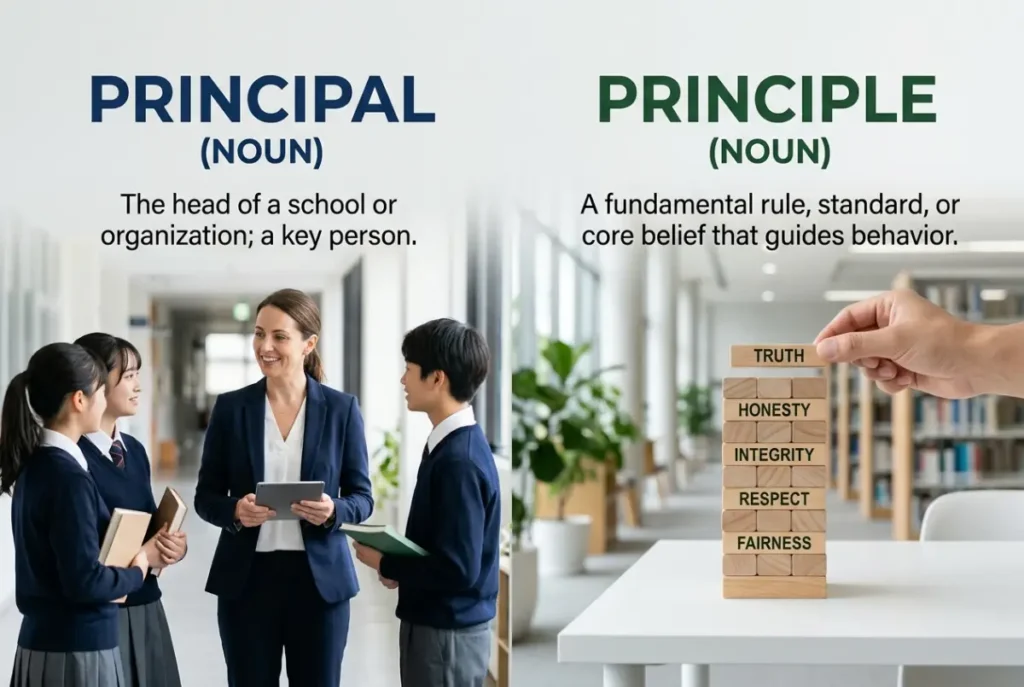
Principal usually refers to a person who leads a school, someone who holds a leading position, or the main amount of money owed or invested. Principle refers to a basic truth, a moral belief, a rule, or a guiding idea. For example, a school principal manages a school, while a school leader might follow the principle that every student deserves respect.
The confusion is understandable because the two words sound alike in many American accents. They also share several letters, and spellcheck tools may not flag the wrong choice because both are valid English words. As a result, even experienced writers sometimes mix them up.
This guide explains the meaning of each word, the difference in spelling and usage, and the easiest ways to remember the correct form. You’ll also find examples from daily conversation, school, business, finance, and academic writing, along with common mistakes and practical editing advice.
Related reading idea: Link to an article about [commonly confused English words and how to use them correctly].
Many readers also check Apposed Vs Opposed Which Word Is Correct 2026.
Quick Answer
Principal means the head of a school, a person in a leading position, or the original amount of a loan or investment. Principle means a basic truth, a moral belief, or a guiding rule. Remember that a school principal leads the school, while a principle guides someone’s actions. Both spellings are correct, but they aren’t interchangeable.
Principal vs Principle Comparison Table
The fastest way to understand these words is to compare their meanings, grammatical roles, and common uses.
| Feature | Principal | Principle |
|---|---|---|
| Main meaning | A leader, the main person or thing, or an original sum of money | A rule, belief, truth, or guiding idea |
| Part of speech | Noun or adjective | Noun |
| Common example | The principal welcomed the students. | Honesty is an important principle. |
| School context | The head of a school | A rule or value that guides a school |
| Financial context | The original amount borrowed or invested | A financial rule or guiding belief |
| Business context | A main party in a transaction or a person in a senior role | A basic rule or standard |
| Common phrase | Principal amount | Moral principle |
| Memory clue | The principal is your pal. | A principle is a rule you believe in. |
| Correct spelling | Principal | Principle |
| Common mistake | Using principal to mean a belief or rule | Using principle to mean a school leader or loan amount |
The key distinction is simple. Principal often identifies a person, a leading position, or something primary. Principle identifies an idea or rule that shapes decisions and behavior.
Principal vs Principle at a Glance
- The principal spoke at the school assembly.
- The teacher explained the principle of fairness.
- I paid off the principal on my loan.
- She refused to compromise her principles.
- Safety is the principal concern.
- The company follows a strict ethical principle.
Notice the final two examples. The adjective principal means main or most important, while the noun principle means a rule or belief. The context tells you which word fits.
What Does Principal Mean
Principal has several related meanings. It can describe a school leader, someone in a leading role, the original amount of money in a loan or investment, or the main person or thing in a situation.
Principal as a Noun
As a noun, principal often refers to a person who holds an important position.
The most familiar example in American English is a school principal. This person usually oversees school operations, supports teachers, manages staff, works with parents, and helps maintain a safe learning environment.
Examples include:
- The principal announced the new school schedule.
- Parents met with the principal to discuss classroom concerns.
- Our principal encouraged students to read more books.
- The principal called a meeting for all teachers.
- She became the principal of a high school last year.
The word also appears in business, law, and finance. In these settings, it can identify a main party, a person responsible for a transaction, or the original amount of money involved in a loan or investment.
For example, in a financial agreement, the principal is the amount borrowed before interest and certain other charges. In an agency relationship, a principal is the person or organization that authorizes another party to act on its behalf.
Principal as an Adjective
Principal can also work as an adjective. In this role, it means main, primary, or most important.
Consider these examples:
- Our principal goal is to improve customer service.
- The principal reason for the delay was bad weather.
- Her principal responsibility is managing the team.
- Cost remains the principal concern for the project.
- The principal issue is a lack of clear communication.
In each sentence, principal describes the main goal, reason, responsibility, concern, or issue. It doesn’t refer to a person or a moral belief.
This adjective is common in formal writing, reports, academic discussions, and business communication. In casual conversation, people often use main or most important instead.
For example, you might write, “The principal cause of the problem was poor planning,” in a formal report. In an everyday conversation, “The main cause was poor planning” sounds more natural.
Principal in Finance
In finance, principal refers to the original amount of money borrowed or invested, excluding interest.
Suppose you borrow $10,000 from a bank. That $10,000 is the principal. If the lender charges interest, the total amount you repay will generally be higher than the original principal.
The same word applies to investments. If you invest $5,000, that initial amount is your principal. Any interest or investment gains are separate from the original amount, although the way earnings are calculated depends on the financial product.
Examples:
- I borrowed $20,000 and started paying down the principal.
- The monthly payment covers both principal and interest.
- Her investment earned interest without reducing the principal.
- Making extra payments can help borrowers reduce their principal faster.
The distinction matters because principal and interest describe different parts of a financial arrangement. Confusing the terms can lead to misunderstandings about loan balances, repayment schedules, and investment returns.
What Does Principle Mean
Principle is a noun that refers to a basic truth, a guiding rule, a moral belief, or a general idea that explains how something works.
Unlike principal, it doesn’t normally identify a person or the original amount of money in a loan. Instead, it describes an idea or standard that can guide behavior, decisions, or reasoning.
Principle as a Moral Belief
A principle can be a personal value that shapes how someone behaves. Common examples include honesty, fairness, responsibility, and respect.
For instance:
- Honesty is one of her strongest principles.
- He refused to lie because it went against his principles.
- The organization operates on the principle of equal treatment.
- She stood by her principles despite strong pressure.
- Respect for others is a principle worth teaching children.
The plural form principles often refers to a set of beliefs that someone considers important. A person might have strong principles, live by certain principles, or refuse to compromise their principles.
In these examples, the word describes values that guide conduct. It doesn’t identify the person who enforces those values.
Principle as a Rule or General Truth
A principle can also describe a rule, a basic idea, or a truth used to explain a subject.
For example:
- The principle of gravity helps explain why objects fall toward Earth.
- The teacher demonstrated a basic principle of mathematics.
- The design follows the principle that form should support function.
- The company adopted a principle of transparent communication.
- The experiment tested a scientific principle.
The exact meaning depends on the subject. In science, a principle may describe a general rule or relationship. In education, it may refer to an idea that supports teaching.
A principle doesn’t always represent a moral belief. It can also be a practical or theoretical foundation.
Principle in Everyday Expressions
English includes several common expressions with principle.
In principle means in theory or according to a general idea, although practical details may still need attention.
Example: “I agree with the proposal in principle, but we need to review the cost.”
As a matter of principle means because of a strong belief or personal standard.
Example: “She doesn’t accept gifts from clients as a matter of principle.”
A man or woman of principle describes someone who tries to act according to firm moral standards.
Example: “The community respected him as a person of principle.”
First principles refers to basic ideas or starting points used to understand or solve a problem.
Example: “The engineer went back to first principles to find the source of the error.”
These expressions are useful in conversation, formal writing, and professional discussions. Learning them as complete phrases can help you use the word naturally.
Which One Is Correct
Both principal and principle are correct English words. Neither spelling is a mistake by itself. The correct choice depends on what you want to say.
Use principal when you mean a school leader, a leading person, a main concern, or the original amount of a loan or investment.
Use principle when you mean a moral belief, a basic truth, a guiding rule, or an idea that explains how something works.
Compare these sentences:
- Correct: The principal addressed the students.
- Incorrect for this meaning: The principle addressed the students.
- Correct: She believes in the principle of equal treatment.
- Incorrect for this meaning: She believes in the principal of equal treatment.
- Correct: We made an extra payment toward the loan principal.
- Incorrect for this meaning: We made an extra payment toward the loan principle.
The incorrect examples use real English words in the wrong contexts. That’s why ordinary spellcheck tools may not catch the error.
How to Choose the Right Word
Ask yourself what the word refers to.
- If it refers to a school leader, use principal.
- If it means main or most important, use principal.
- If it refers to the original amount of a loan or investment, use principal.
- If it describes a moral belief, rule, or basic truth, use principle.
For example, consider the sentence, “The school’s principal follows the principle of fairness.”
The first word identifies the school leader. The second describes the value guiding that leader’s decisions. Both words belong in the sentence, and each has a different job.
That distinction is the most reliable way to choose correctly.
The Key Differences Between Principal and Principle
Although these words look and sound similar, their meanings are distinct. Understanding how they function in a sentence makes the difference much easier to remember.
Difference in Meaning
The main difference is what each word represents.
Principal points to a person, a leading role, a primary concern, or an original financial amount. Principle points to an idea, belief, rule, or truth.
Compare these examples:
| Sentence | Meaning |
|---|---|
| The principal visited each classroom. | A school leader visited the classrooms. |
| The principle of fairness guided the decision. | A guiding value shaped the decision. |
| Our principal concern is student safety. | Safety is the main concern. |
| The scientist explained the principle behind the experiment. | The scientist explained the underlying rule. |
| The borrower paid off the principal. | The borrower repaid the original loan amount. |
A useful editing habit is to replace the word with a simple synonym. If main fits, principal may be correct. If rule, belief, or truth fits, principle is probably the right choice.
This substitution test works well in many sentences, although context still matters.
Difference in Grammar
Another important difference is how the words function grammatically.
Principal can be a noun or an adjective.
As a noun, it can identify a school leader or a person who plays a leading role in a transaction. In finance, it can also identify the original amount of money borrowed or invested.
As an adjective, it means main or most important.
Principle is a noun. It names an idea, belief, rule, or basic truth. It doesn’t normally function as an adjective in standard English.
For example:
- The principal speaker arrived early. Here, principal is an adjective.
- The principal arrived early. Here, principal is a noun.
- The speaker explained a scientific principle. Here, principle is a noun.
- The teacher discussed several principles of learning. Here, principles is a plural noun.
This grammatical difference provides another way to identify the correct word. If you need an adjective meaning main, choose principal. If you need a noun meaning a guiding idea, choose principle.
Difference in Context
The setting often makes the correct word obvious.
In education, principal commonly refers to a school leader. In finance, it refers to the original amount of a loan or investment.
By contrast, principle appears in discussions about ethics, science, education, business standards, and personal beliefs.
Consider a workplace example:
“The principal investigator explained the principle behind the research method.”
Here, principal investigator is a formal title for the person leading a research project. The word principle refers to the basic idea behind the method.
In legal writing, a principal may be a person involved in an agency relationship or a primary party to an arrangement. A principle may be a legal rule or doctrine.
The setting helps you narrow the meaning, but the word’s role in the sentence remains the deciding factor.
Difference in Tone and Formality
Both words work in casual and formal English. Neither is inherently more formal than the other.
However, principal appears in specific professional phrases such as principal investigator, principal amount, principal office, and principal reason. Principle appears in phrases such as guiding principle, moral principle, legal principle, and scientific principle.
In casual conversation, people may use main instead of principal because it sounds simpler.
For example:
- Formal: The principal objective is to reduce costs.
- Conversational: The main goal is to reduce costs.
The meaning stays nearly the same. By contrast, replacing principle with main usually requires rewriting the sentence because a principle is an idea or rule rather than simply the most important item.
Grammar and Sentence Structure
Understanding the grammar of these words can prevent errors in essays, reports, emails, and everyday writing.
How to Use Principal Correctly
As an adjective, principal usually comes before a noun. It identifies the main or most important person, reason, amount, or concern.
Examples:
- The principal reason for the change was cost.
- Our principal goal is to finish the project on time.
- Her principal duty is to manage the department.
- The principal source of income comes from sales.
As a noun, principal can stand alone or appear in a phrase.
Examples:
- The principal spoke to the parents.
- The bank calculated the remaining principal.
- The principal in the agreement authorized the agent to act.
The surrounding sentence tells readers which meaning applies.
How to Use Principle Correctly
As a noun, principle can appear as a subject, an object, or part of a prepositional phrase.
Examples:
- Subject: The principle guides our decisions.
- Object: We discussed an important principle.
- Prepositional phrase: The policy is based on a principle of fairness.
The plural form is principles.
Examples:
- These principles guide our work.
- She explained three basic principles of design.
- The students learned the principles of scientific research.
Use the singular form when referring to one rule or idea. Use the plural form when referring to two or more.
Articles and Determiners
Both words can appear with articles such as a, an, and the, but the sentence must follow normal grammar rules.
Examples:
- The principal met with the teachers.
- A principal concern is the project’s cost.
- The principle of fairness matters.
- A useful principle is to check the facts before making a decision.
Because principal can be an adjective, it often appears before a noun with an article. In “a principal concern,” the article a belongs to the noun phrase, and principal describes concern.
Principle is a countable noun in many contexts, so you can write a principle or several principles.
Possessives and Plurals
The plural of principal is principals when referring to more than one school leader or other person. When used as an adjective, it doesn’t change to a plural form.
Examples:
- Three principals attended the meeting.
- The principals’ conference begins tomorrow.
- Their principal concern is safety.
The plural of principle is principles.
Examples:
- The principles are clearly stated.
- She follows her parents’ principles.
- The company’s principles shape its policies.
Pay attention to apostrophes in possessive forms. Principal’s means something belongs to one principal. Principals’ means something belongs to multiple principals. Principle’s can show possession by a principle, although this construction is less common.
Pronunciation Guide
In most American English accents, principal and principle are pronounced exactly alike. They are homophones, which means they share the same pronunciation but have different meanings and spellings.
The usual American English pronunciation for both words is:
- IPA: /ˈprɪnsəpəl/
- Syllables: prin ci pal
- Stress: The first syllable receives the main stress.
- Sound: The opening sounds like the word print without the final t.
Say both words aloud. You’ll usually hear no difference between them in ordinary American speech.
This shared pronunciation explains much of the confusion. Someone may know exactly what a speaker means but still choose the wrong spelling when writing the sentence.
Common Pronunciation Mistakes
A common mistake is assuming the final letters must create a sound difference. In standard American English, they generally don’t.
Another mistake is placing the main stress on the second syllable. The standard pronunciation stresses the first syllable, as in PRIN ci pal.
You don’t need to exaggerate the unstressed vowels. In natural speech, the middle and final syllables often sound reduced.
For learners, the most useful practice is to say both words aloud and then use them in different sentences. Pronunciation alone won’t tell you which spelling is correct, so connect each word to its meaning.
For example, say “The principal is here” and “Honesty is a principle.” The sounds may match, but the contexts reveal the difference.
Still confused? Compare Maintained Vs Maintenanced Which Word Is Correct 2026 Guide.
Why People Confuse Principal and Principle
Several features make these words easy to mix up. Understanding the causes can help you spot the error before it reaches a final draft.
They Sound the Same
The biggest reason is pronunciation. Most American speakers pronounce principal and principle alike, so listeners receive no clear sound clue that separates the words.
When people write from memory, they may select the spelling they see most often rather than the one that matches the intended meaning.
This problem affects many English homophones. Words such as there, their, and they’re create similar confusion because pronunciation alone doesn’t identify the correct spelling.
Their Spellings Look Similar
Both words begin with princi and contain many of the same letters. The final letters differ, but that small visual difference carries a major change in meaning.
Writers who type quickly may focus on the shared spelling pattern and overlook the ending. This happens more often when someone is drafting an email, taking notes, or writing under time pressure.
A quick proofread that focuses on meaning can catch the problem.
Spellcheck May Miss the Error
Many spelling tools check individual words rather than the meaning of an entire sentence. Since principal and principle are both standard English words, software may accept the wrong choice.
For example, a sentence such as “She believes in the principal of honesty” contains a real word but expresses the wrong meaning.
A grammar tool might flag the sentence based on context, but you shouldn’t assume it will catch every mistake. Reading the sentence carefully remains important.
People Remember the Sound but Not the Meaning
A writer may remember hearing a phrase such as “school principal” or “guiding principle” without remembering which spelling belongs to each phrase.
Learning common word combinations helps solve this problem. Store the words in meaningful phrases rather than memorizing the spellings in isolation.
Useful combinations include:
- School principal.
- Principal amount.
- Principal reason.
- Guiding principle.
- Moral principle.
- Scientific principle.
The more often you see these combinations, the easier it becomes to recognize the right spelling.
Online Writing Reinforces Errors
Social media posts, comments, and informal messages often contain spelling mistakes. When a wrong form appears repeatedly, readers may begin to accept it as correct.
However, repeated online use doesn’t change the standard meanings of these words. A familiar error is still an error when it conflicts with the intended meaning.
The safest approach is to check a reliable dictionary or grammar reference if you’re uncertain. Don’t treat a frequently shared phrase as proof of correct usage.
Real Life Examples of Principal and Principle
Examples make the distinction easier to apply. The following sentences show how both words work across common situations.
Examples From Daily Conversation
- The principal greeted the students at the front door.
- My principal concern is getting home before dark.
- She follows the principle of treating people with respect.
- He won’t break his principles just to fit in.
- The principal reason I called was to ask about tomorrow’s meeting.
In these sentences, principal refers to a school leader or something main. Principle refers to a belief or guiding rule.
Examples From School and Education
- The principal spoke to the parents about the new attendance policy.
- Our science teacher explained the principle of conservation of energy.
- The principal asked students to keep the hallways clean.
- Fairness is an important principle in classroom management.
- The school introduced new teaching principles to support student learning.
Education provides especially clear examples because both words often appear in the same setting, but they serve different purposes.
Examples From Business and the Workplace
- The principal objective of the meeting was to set next year’s budget.
- Our team follows the principle of giving honest feedback.
- The principal investigator presented the research findings.
- The company adopted a principle of transparency in its hiring process.
- The principal reason for the delay was a supply shortage.
These examples work in reports, presentations, meeting notes, and professional emails.
Examples From Finance
- The borrower made an extra payment toward the loan principal.
- My monthly payment includes both principal and interest.
- The investor wanted to protect the principal while earning a return.
- The financial adviser explained the principles of responsible investing.
- The lender calculated the remaining principal before issuing a payoff statement.
Financial writing requires particular care because the difference between principal and interest affects the meaning of a transaction.
Examples From Academic Writing and Journalism
- The principal finding of the study was a strong link between sleep and memory.
- The research examined the principle that repeated practice can improve performance.
- The principal cause of the outage remains under investigation.
- The report discussed the ethical principles behind the new policy.
- The author challenged the principle that economic growth always improves quality of life.
Academic and journalistic writing often use both words to distinguish the main point of a discussion from the ideas that support it.
Examples From Emails and Social Media
- Email: The principal reason for this request is the upcoming deadline.
- Email: We should follow the principle of sharing accurate information.
- Social media: Our school principal made today’s assembly memorable.
- Social media: Kindness is a simple principle that can change someone’s day.
- Work message: I’ll send the principal figures after I verify the calculations.
The examples show that the distinction applies to formal and informal communication alike. The correct spelling depends on meaning, not the type of writing.
Common Mistakes With Principal and Principle
Even strong writers can confuse these words because both spellings are valid. The best way to prevent mistakes is to focus on the meaning of the sentence instead of relying on spelling software alone.
Using Principle for a School Leader
Incorrect: The principle welcomed the new students.
Correct: The principal welcomed the new students.
A school leader is a principal. The word principle refers to an idea or rule, not the person who manages the school.
Using Principal for a Moral Belief
Incorrect: Honesty is an important principal.
Correct: Honesty is an important principle.
Honesty is a value that guides behavior. Therefore, principle is the correct noun.
Confusing Principal and Main
Writers sometimes assume principal can only refer to a person. However, it can also work as an adjective meaning main or most important.
Correct: The principal reason for the decision was cost.
In everyday writing, you could replace principal with main without changing the basic meaning.
Confusing Principal and Interest
In financial writing, principal refers to the original amount borrowed or invested. Interest is the cost of borrowing money or the return earned on money, depending on the arrangement.
Incorrect: The borrower paid down the loan principle.
Correct: The borrower paid down the loan principal.
This distinction matters in mortgage agreements, personal loans, investment reports, and financial statements.
Assuming the Words Are Regional Spellings
Principal and principle are not British and American spelling variants. Both spellings are standard in American, British, Canadian, and Australian English.
The difference is semantic, not regional. Changing the spelling to match a country’s writing conventions won’t solve the problem.
Trusting Autocorrect Without Checking Meaning
A spelling tool may accept both words because both appear in standard dictionaries. However, that doesn’t mean both words fit a particular sentence.
For example, a program may accept “the principle investigator” as a string of correctly spelled words even though principal investigator is the standard professional title.
Read the full sentence after running a spellcheck. Correct spelling requires the right word, not just a word that appears in the dictionary.
Easy Memory Tricks for Principal and Principle
You don’t need to memorize complicated grammar rules to distinguish these words. A few simple memory tricks can help you choose the correct spelling quickly.
Remember That the Principal Is Your Pal
A familiar memory trick is:
The principal is your pal.
Both principal and pal contain the letter a. This can remind you that principal refers to the person who leads a school.
For example, if you’re writing about the person who meets parents, manages teachers, or leads a school, remember your pal, the principal.
The trick also helps with professional titles such as principal investigator, although that title refers to a research leader rather than a school leader.
Connect Principle With Belief
Think of a principle as a rule you believe in.
Both principle and rule describe ideas that can guide decisions. A principle may shape your behavior, explain a scientific concept, or establish a standard for a business.
For example, honesty is a principle because it guides how you treat other people.
Use the Main or Rule Test
When you aren’t sure which spelling to use, replace the word with a simpler term.
- If you mean main, use principal.
- If you mean rule, belief, or truth, use principle.
Try this test:
“The principal concern is safety.”
Replace principal with main. The sentence still makes sense.
“Fairness is an important principle.”
Replace principle with rule. The basic meaning remains clear.
This method is quick and works well during proofreading.
Learn Common Phrases as Complete Units
Memorizing individual spellings is helpful, but learning common expressions can make the choice even easier.
Remember these combinations:
| Principal phrases | Principle phrases |
|---|---|
| School principal | Moral principle |
| Principal amount | Guiding principle |
| Principal reason | Scientific principle |
| Principal concern | Ethical principles |
| Principal investigator | First principles |
| Principal office | Principle of fairness |
When you learn the words in context, you’re less likely to confuse them during writing.
Related Words and Expressions
Understanding related vocabulary helps you use principal and principle with greater precision.
Words Related to Principal
Depending on the context, synonyms for principal include:
- Main. The most important or central item.
- Primary. First in importance or rank.
- Chief. The leading or highest ranking.
- Head. A person who leads an organization or group.
- Director. A person who manages or oversees an organization or activity.
- Capital. Money or assets used for investment or business purposes. This is related to the financial context but isn’t a direct synonym for principal in every situation.
These words aren’t interchangeable in every sentence. For instance, school principal is the normal American term for a school’s leader. Replacing it with school chief might sound unusual in ordinary conversation.
Words Related to Principle
Synonyms for principle depend on its intended meaning.
- Rule. A direction or standard that guides behavior.
- Belief. Something a person accepts as true.
- Value. An idea or quality that someone considers important.
- Doctrine. A belief or set of beliefs, often associated with a formal system.
- Theory. An explanation or set of ideas used to understand something.
- Tenet. A central belief or principle within a system.
- Precept. A rule or instruction that guides conduct.
These words have slightly different meanings. For example, a scientific principle may describe a general relationship, while a moral value concerns what someone considers right or important.
Antonyms and Contrasting Ideas
Neither word has one universal opposite. The best contrast depends on the intended meaning.
For principal meaning main, possible contrasts include secondary or minor.
Example: “The principal reason was cost, while a secondary reason was convenience.”
For principle meaning a moral belief, possible contrasts include inconsistency, dishonesty, or a lack of ethical standards. These describe opposing ideas rather than direct dictionary antonyms.
Example: “Her decision reflected her principles rather than a desire for personal gain.”
Understanding these distinctions can improve word choice and help you express ideas more precisely.
British vs American English
The spellings principal and principle remain the same in standard American and British English. The same distinction applies in Canadian and Australian English.
There is no regional rule that changes principal into principle or the other way around.
| Variety of English | School leader | Guiding rule |
|---|---|---|
| American English | Principal | Principle |
| British English | Principal | Principle |
| Canadian English | Principal | Principle |
| Australian English | Principal | Principle |
Some educational job titles differ across countries and school systems. However, when the word principal is used, it retains its usual spelling and meaning.
For example, an American school principal and an Australian school principal both hold a school leadership role. A principle of fairness retains the same spelling in both countries.
The most important point is that this is a word meaning distinction rather than a regional spelling issue.
Expert Editor’s Note
When proofreading a sentence containing principal or principle, I recommend checking the meaning before checking the spelling.
Both words are standard English entries, so a basic spellcheck may not identify the mistake. Instead, look at the surrounding words and ask what the writer intends to communicate.
If the word refers to a school leader, a main concern, or the original amount of a loan, principal is generally correct. If it refers to a belief, rule, or general truth, principle is the right choice.
Professional editors also pay attention to established expressions. Principal investigator, principal amount, guiding principle, and moral principles are familiar combinations. Using the established form makes writing sound natural and professional.
In academic writing, precision matters more than choosing the more formal sounding word. In an email, report, essay, or financial document, select the word that conveys the intended meaning clearly.
My final recommendation is simple. Learn the two spellings alongside their common phrases, then proofread the sentence for meaning. That approach is more reliable than memorizing the spelling alone.
Frequently Asked Questions
Is principal or principle correct?
Both words are correct, but they have different meanings. Principal refers to a school leader, a leading person, a main concern, or the original amount of a loan or investment. Principle refers to a guiding rule, moral belief, or basic truth. Choose the word that matches the meaning of your sentence.
How do you remember principal vs principle?
Use the memory trick the principal is your pal to remember the spelling for a school leader. For principle, think of a rule or belief that guides your actions. You can also replace principal with main and principle with rule to check which word fits the sentence.
Is a school principal spelled with an a or an e?
A school principal is spelled with an a at the end of the main word before the final l. The correct spelling is principal. Principle, ending in le, means a rule, belief, or basic truth. For example, the principal leads the school, while a principle guides the school’s policies.
Is it principal amount or principle amount?
The correct phrase is principal amount. In finance, principal refers to the original amount of money borrowed or invested, excluding interest. For example, if you borrow $8,000, that amount is your principal. The word principle is incorrect in this financial phrase because it refers to a rule or belief.
What is the plural of principal and principle?
The plural of principal is principals, as in “The principals attended the meeting.” The plural of principle is principles, as in “The principles guide our decisions.” Principal also works as an adjective, and adjectives generally don’t change to show plural forms. For example, you can write “principal concerns” without changing principal.
Are principal and principle homophones?
Yes. In most American English accents, principal and principle are homophones because they share the same pronunciation. Their meanings and spellings differ, though. This makes context especially important when writing. You can usually recognize the intended word by checking if the sentence refers to a person or main item, or to a rule or belief.
Is principal investigator correct?
Yes. Principal investigator is the standard term for the person who leads or directs a research study. Principal means leading or primary in this title. Writing principle investigator is incorrect in standard usage because principle refers to a rule, belief, or basic truth rather than a leadership role.
Can principal be an adjective?
Yes. Principal can function as an adjective meaning main, primary, or most important. For example, “The principal reason for the delay was bad weather.” It can also be a noun, as in “The principal met the parents.” Principle is a noun referring to a rule, belief, or basic truth.
Do British and American English spell principal and principle differently?
No. Both words have the same spelling and basic meanings in standard American, British, Canadian, and Australian English. The confusion doesn’t come from regional spelling differences. It comes from the fact that the words sound alike but serve different purposes in a sentence.
What does in principle mean?
The expression in principle means in theory or according to a general idea, even though practical details may still need to be settled. For example, “We agree with the proposal in principle, but we need to review the budget.” The phrase uses principle because it refers to an idea or general position.
A related grammar guide is Receipt Vs Recipe Which Word Is Correct 2026 Guide.
Conclusion
The difference between principal vs principle is easier to remember once you connect each spelling to its meaning.
Principal refers to a school leader, a leading person, the main concern, or the original amount of a loan or investment. Principle refers to a rule, a moral belief, or a basic truth.
Remember that the principal is your pal, and a principle is a rule you believe in. When you proofread, focus on what the sentence means instead of relying only on spellcheck.
The best writers aren’t the ones who never make mistakes. They’re the ones who know how to spot them and choose the right word with confidence.

Vocabulary & Language Research Writer
Ethan Parker researches English vocabulary, word meanings, slang, idioms, and commonly confused words. His goal is to help readers understand how English is actually used in everyday conversations and writing.