
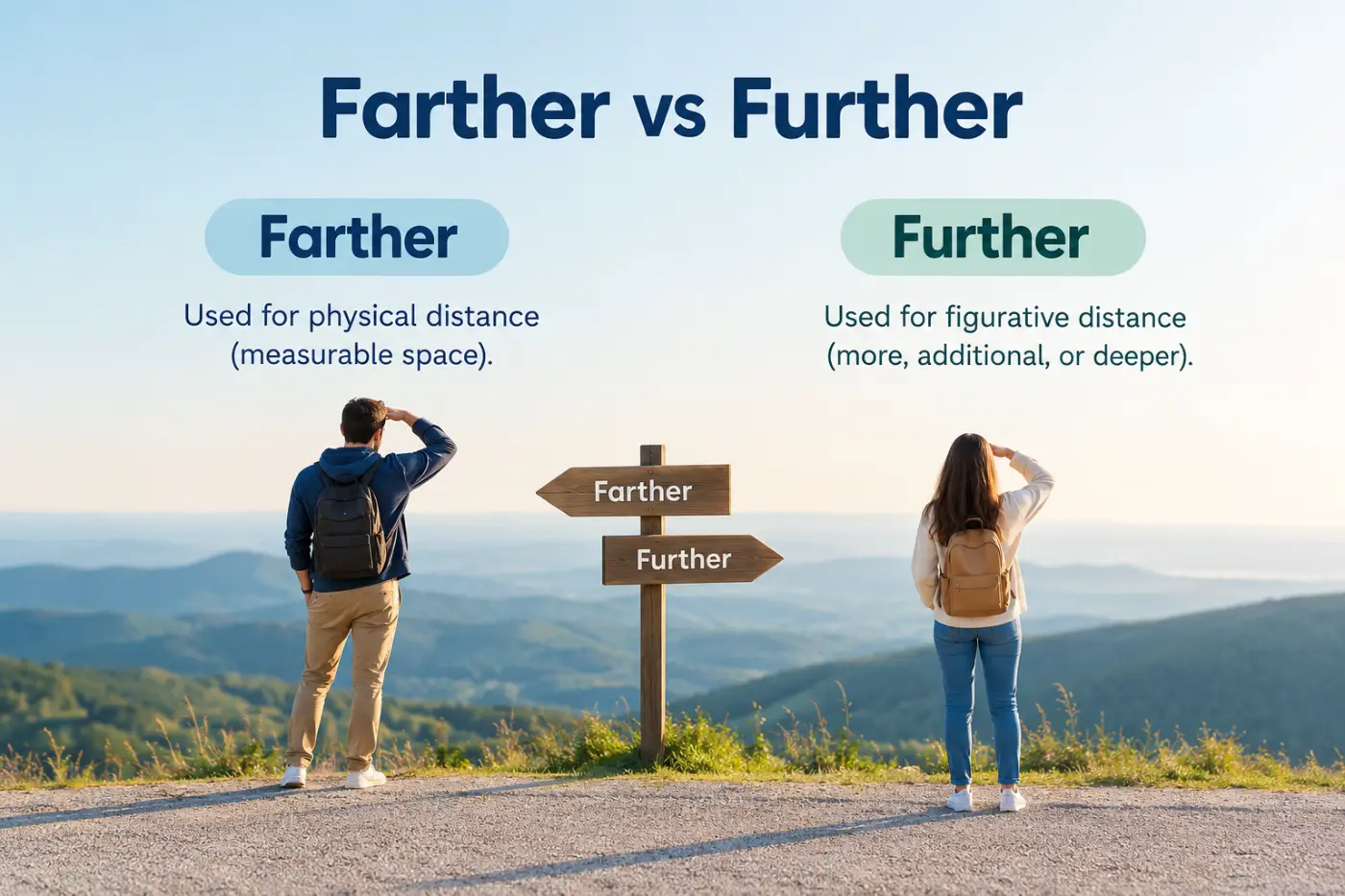
The main difference between farther and further is that farther traditionally refers to physical distance, while further often refers to figurative distance, additional information, or a greater degree. However, modern English allows some overlap, and both words can describe physical distance.
For your article, the most useful approach is to explain the traditional rule first, then show readers how to choose the natural word in everyday conversation, academic writing, and professional communication.
Learn the difference in Serpent Vs Snake Difference Meaning And Correct 2026.
Quick Answer
Use farther when you mean a greater physical distance, such as walking farther down a road. Use further for additional information, more progress, or a greater degree, as in further discussion. Both words can refer to physical distance, so context and clarity matter more than a rigid rule.
Farther vs Further Comparison Table
| Feature | Farther | Further |
|---|---|---|
| Main meaning | Greater physical distance | Additional amount, degree, or progress |
| Part of speech | Adjective or adverb | Adjective, adverb, or verb |
| Physical distance | Common and clear | Also correct in many contexts |
| Figurative meaning | Less common | Very common |
| Additional information | Usually not the best choice | The standard choice |
| Formal writing | Correct | Correct |
| Everyday conversation | Natural | Natural |
| Example | We walked farther. | We need further research. |
The easiest way to remember the difference is to connect farther with physical distance and further with additional progress or information. Keep in mind that this is a helpful guide rather than an absolute rule.
What Farther Means
Farther means at or to a greater physical distance. It can describe how far away something is or how much more distance someone travels.
For example, if one store is two miles away and another is five miles away, the second store is farther from your home.
Farther as an Adverb
An adverb modifies a verb, an adjective, or another adverb. When you use farther as an adverb, it tells the reader that an action extends over a greater distance.
Examples include the following.
- We drove farther than we planned.
- Walk farther down the trail to find the waterfall.
- The dog ran farther into the field.
- I cannot swim any farther without resting.
- The hikers traveled farther than the rest of the group.
In each sentence, farther describes physical movement or distance.
Farther as an Adjective
An adjective describes a noun. As an adjective, farther identifies something located at a greater distance.
Consider these examples.
- The farther entrance is closed.
- We chose the farther parking lot because it was less crowded.
- The farther village has a small medical clinic.
- Their farther destination requires another hour of driving.
The last example sounds less natural than their more distant destination in many contexts. This highlights an important editorial point. Although a word may be grammatically possible, another expression can sound more natural in a particular sentence.
What Further Means
Further means additional, more advanced, or to a greater degree. It can also describe physical distance. In addition, further works as a verb, meaning to help something develop or make progress.
It appears frequently in academic papers, workplace emails, news reports, and everyday conversation.
Further as an Adverb
As an adverb, further often describes additional progress, greater development, or a higher degree.
Examples include the following.
- We need to investigate the problem further.
- The team discussed the proposal further.
- She hopes to advance further in her career.
- The teacher explained the concept further.
- We should examine the evidence further before making a decision.
Here, further describes an extension of an action or process. It doesn’t simply measure the number of feet or miles between two places.
Further as an Adjective
As an adjective, further usually means additional or extra.
For example, you might write the following.
- Please contact us if you need further assistance.
- The committee requested further evidence.
- We have no further questions.
- Further details will be available next week.
- The report requires further review.
These expressions are standard in American English. In professional writing, further information and further assistance are especially useful because they sound clear and polite.
Further as a Verb
Unlike farther, further can function as a verb. It means to promote, advance, or help something progress.
For example:
- The training program will further her career.
- The organization hopes to further its research goals.
- His work helped further our understanding of the issue.
- They launched a campaign to further public awareness.
This grammatical difference is one of the clearest ways to distinguish the two words. You can further a goal, but you cannot use farther in the same way.
Which One Is Correct
Both farther and further are correct English words. Neither spelling is wrong, and the choice depends on meaning and context.
Use farther when you want to emphasize measurable physical distance. Use further when you mean additional information, continued discussion, greater progress, or development.
For instance, consider these sentences.
- Correct and natural: We walked farther along the beach.
- Correct and natural: We need further information.
- Correct and natural: The new policy could further improve safety.
- Also correct: The next gas station is further down the highway.
The last example matters because modern American English often uses further for physical distance. Major dictionaries recognize this overlap, so it would be inaccurate to claim that further can never describe a physical location.
If you’re unsure, ask yourself what the sentence emphasizes. If it measures distance, farther is a strong choice. If it means additional, continued, or advanced, choose further.
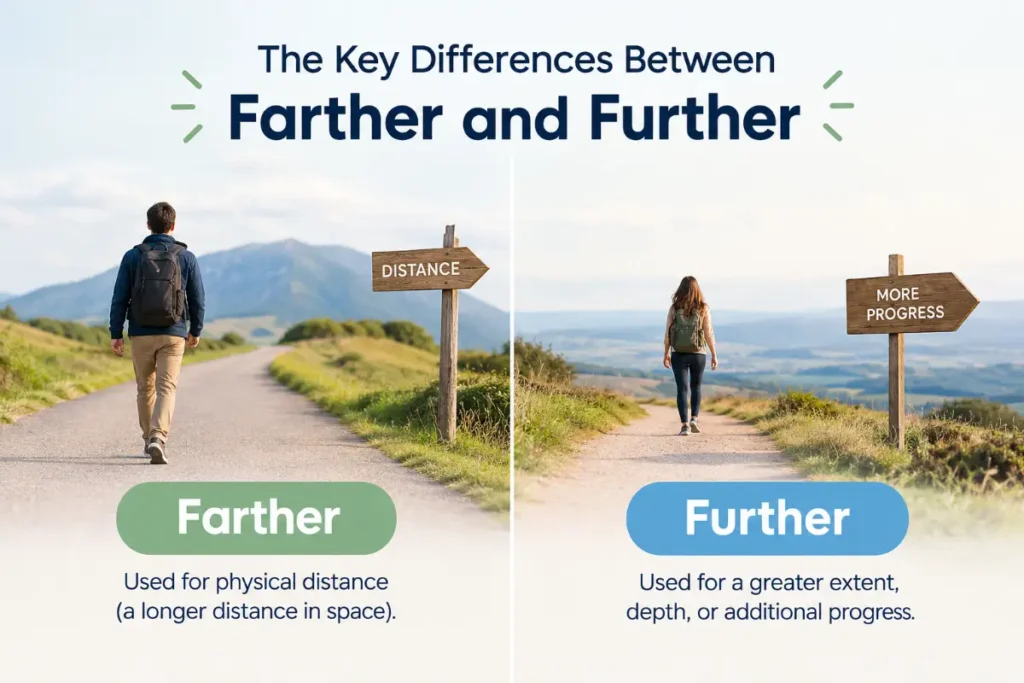
The Key Differences Between Farther and Further
The words share the same root and have similar meanings, but they don’t serve every purpose equally well. Understanding their main differences helps you write more clearly without memorizing a long list of rules.
Physical Distance
Use farther when physical distance is the main point of the sentence.
- The library is farther from school than the bookstore.
- We walked farther after sunset.
- Their house is farther down the street.
- The runner moved farther ahead during the final lap.
You can also use further in these sentences. For many American English speakers, both forms sound natural.
However, farther makes the connection to physical distance especially clear. That’s why it remains a useful choice when precision matters.
Figurative Distance
Figurative distance describes something beyond physical space. It can involve progress, understanding, discussion, or a change in an idea.
For example:
- We need to take the discussion further.
- Her research pushed the field further.
- The company wants to go further with its plans.
- The conversation went further than anyone expected.
In these examples, the word describes how far an idea or process has advanced. You aren’t measuring miles or feet.
Additional Information
When you mean extra information, evidence, assistance, or explanation, further is the natural choice.
Consider these common expressions.
| Expression | Example |
|---|---|
| Further information | Please email us for further information. |
| Further details | Further details will follow tomorrow. |
| Further assistance | Contact support for further assistance. |
| Further research | Further research is needed to confirm the results. |
| Further discussion | The proposal requires further discussion. |
| Further evidence | Investigators are looking for further evidence. |
| Further action | No further action is required. |
| Further notice | The office will remain closed until further notice. |
These phrases appear frequently in American English. Replacing further with farther in them would usually sound unnatural or change the intended meaning.
Progress and Development
Use further when talking about advancing a goal, developing a skill, or improving a situation.
For example, a student might want to further their education. A manager might want to further a business objective. A scientist might work to further public understanding of a discovery.
The word points to progress rather than physical space.
Why People Confuse Farther and Further
The confusion makes sense. Both words contain the same basic idea of going beyond a point, and their meanings overlap in several situations.
They Share a Similar Meaning
Both words can describe going beyond an existing point. That shared meaning makes it hard to draw a perfect line between them.
For instance, We went farther down the road and We went further down the road can both describe the same journey.
The difference becomes clearer when you compare those sentences with We need further research. The second word fits the meaning of additional research, while farther research doesn’t sound natural in standard usage.
Their Pronunciation Is Similar
In American English, farther is commonly pronounced /ˈfɑrðər/, while further is commonly pronounced /ˈfɝːðər/.
Both words have two syllables and carry stress on the first syllable. Their similar rhythm makes them easy to mix up during conversation.
The vowel sound is the main difference. However, pronunciation varies across accents, and the distinction may sound less obvious to some listeners.
People Learn an Oversimplified Rule
Many students learn that farther refers to physical distance and further refers to figurative distance. This rule is helpful, but it leaves out common uses of further for physical distance.
As a result, writers may assume that a familiar expression is incorrect simply because it doesn’t follow the simplified rule.
A better approach is to learn the main distinction while recognizing accepted overlap.
Autocorrect Does Not Always Help
Both words are correctly spelled. A spelling checker may accept either word because neither is a typo.
That means autocorrect cannot always tell you which word fits your intended meaning. You still need to check the context.
Online Advice Can Be Too Strict
Some websites present the distance rule as an absolute law. Others suggest that the two words are interchangeable in every situation.
Neither explanation gives the full picture. The most useful guidance recognizes that farther is especially clear for physical distance, while further has established uses involving addition and progress.
Grammar Rules for Farther and Further
Both words can function as adjectives or adverbs. However, further also works as a verb.
Knowing the grammatical role of each word helps you choose correctly.
Comparative Forms
Farther and further are comparative forms related to far. They express a greater distance or degree.
The word far is the basic form. The comparative forms are farther and further. The superlative forms are farthest and furthest.
Examples:
- The park is far from here.
- The lake is farther away than the park.
- We need further explanation.
- This is the farthest point on the trail.
- That was the furthest the discussion had progressed.
Both farthest and furthest can refer to physical distance. Furthest can also describe the greatest degree of progress or development.
Farther and Further in Comparisons
You can use either word when comparing physical distances.
- My office is farther away than yours.
- My office is further away than yours.
Both sentences are acceptable. The first follows the traditional distance distinction, while the second reflects common modern usage.
For figurative comparisons, further is usually the better choice.
- Her argument goes further than the available evidence supports.
- The revised plan takes the project further toward completion.
Can Further Be a Verb
Yes. This is an important grammatical difference.
As a verb, further means to advance or promote something. Its form changes according to tense and sentence structure.
| Verb form | Example |
|---|---|
| Base form | We aim to further our knowledge. |
| Present tense | She furthers the team’s goals. |
| Past tense | They furthered the project through research. |
| Present participle | He is furthering his education. |
| Past participle | The initiative has furthered public awareness. |
Farther cannot replace the verb further in these sentences.
Farther Along and Further Along
Both expressions are correct, but they can emphasize different ideas.
Farther along often refers to a physical location or a point on a route.
Example: The gas station is farther along the highway.
Further along often describes progress through a process, although it can also refer to a location.
Example: We are further along in the planning process than we expected.
The context tells readers which meaning you intend.
Pronunciation Guide for Farther and Further
Both words have two syllables, with stress on the first syllable.
A related grammar guide is Distress Vs Duress Which Word Is Correct 2026.
Farther
IPA: /ˈfɑrðər/
Sounds roughly like FAR ther.
The first vowel resembles the sound in the American pronunciation of father.
Further
IPA: /ˈfɝːðər/
Sounds roughly like FUR ther.
The first vowel resembles the sound in her for many American speakers.
Pronunciation varies by region and accent, so these transcriptions represent common American pronunciations rather than every English variety.
Both words contain the voiced dental fricative /ð/, the sound at the beginning of this. Avoid replacing it with /d/ if you’re aiming for standard American pronunciation.
The Word Origins of Farther and Further
The two words have a shared history connected to the old English word feor, meaning far or distant.
Over time, English developed different comparative forms. Farther became closely associated with physical distance, while further developed broader uses involving additional action, degree, and progress.
This history helps explain why the words overlap today. They aren’t unrelated terms that happen to look similar. They developed from the same basic idea of distance and extension.
Modern usage reflects centuries of change. That’s one reason the traditional rule is useful but cannot explain every accepted sentence in present day English.
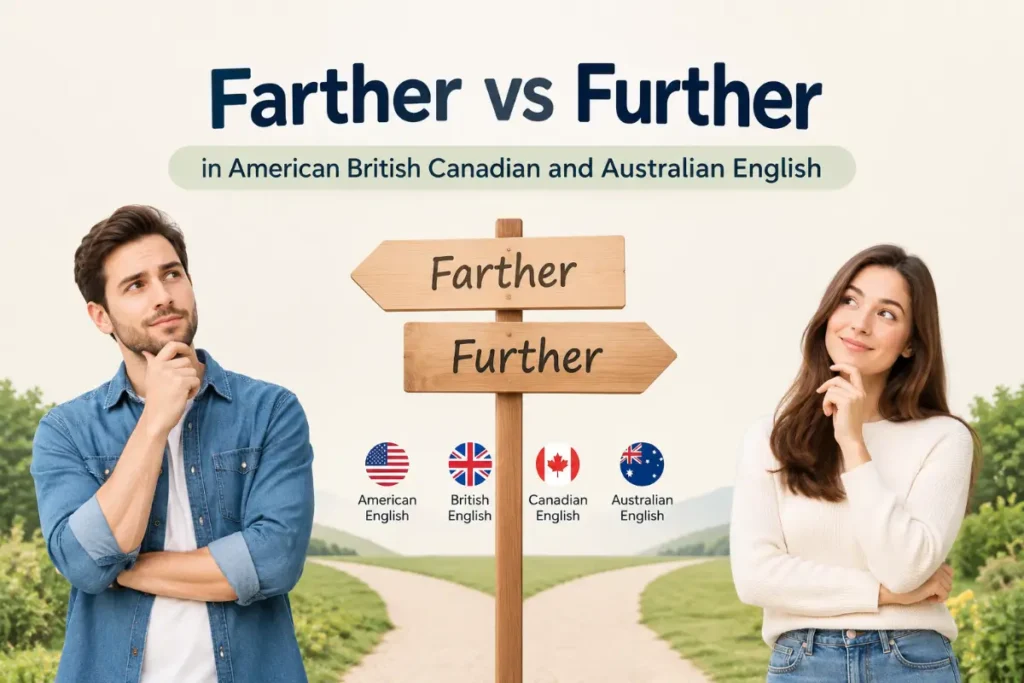
Farther vs Further in American British Canadian and Australian English
The basic distinction appears across major English varieties. However, actual usage depends on context and local preferences.
American English
In the United States, both words are common. Farther often appears in comparisons involving physical distance, while further is standard for additional information and progress.
American writers commonly use expressions such as further notice, further research, and further assistance. Both farther away and further away are accepted.
British English
British English also uses both words. Further appears frequently in formal expressions and can describe physical distance. Farther remains correct when referring to distance.
The difference isn’t a simple American versus British spelling rule. Both words are standard English forms on both sides of the Atlantic.
Canadian English
Canadian English generally follows the same distinction. Writers can use farther for physical distance and further for additional information or progress.
Canadian usage also permits further for physical distance. The surrounding sentence matters more than the country’s spelling conventions.
Australian English
Australian English recognizes both words and uses further in expressions involving extra information or progress. Farther remains available for physical distance, although individual preferences may vary.
For writers serving an international audience, the safest approach is to use farther for clear physical comparisons and further for additional information or figurative progress.
Real Life Examples of Farther vs Further
Examples make the difference easier to remember. The following sentences show how both words work in everyday situations, professional communication, and formal writing.
Everyday Conversation
- Can you walk a little farther so we can find a quieter spot?
- The grocery store is farther away than I remembered.
- We drove farther than planned and ended up near the coast.
- I don’t want to go any farther without checking the map.
- Let’s discuss this further when we have more time.
Workplace Communication
- Please contact the manager for further instructions.
- We need to investigate the issue further before changing the process.
- The new training program will further develop our employees’ skills.
- No further action is needed at this stage.
- Our second office is farther from the airport than the main office.
Emails and Professional Messages
- Please let me know if you require further assistance.
- I’ll send further details once the schedule has been confirmed.
- We can discuss the proposal further during tomorrow’s meeting.
- The delivery center is farther away than our usual supplier.
- Thank you for your time. Please contact me if you have any further questions.
Academic Writing
- Further research is needed to understand the long term effects.
- The study examines the issue further by comparing three groups.
- These findings may further our understanding of language development.
- The second research site is farther from the city center.
- Further analysis revealed a connection between the two variables.
Journalism and Literature
- The search continued farther into the forest.
- The investigation uncovered further evidence of misconduct.
- The story takes the reader further into the character’s troubled past.
- The hikers traveled farther than any other group that day.
- The report calls for further action from local officials.
Social Media and Informal Writing
- I need to look into this further before sharing it.
- We walked farther than we expected, but the view was worth it.
- Can someone provide further details about the event?
- The conversation went further than I thought it would.
- One more mile. We can go farther than we think.
These examples demonstrate a practical pattern. Farther is especially useful when the sentence focuses on physical distance. Further fits additional information, continued discussion, and progress. Both can work for physical distance when the meaning remains clear.
Common Mistakes to Avoid
Even experienced writers sometimes mix up these words. Most errors come from applying the traditional rule too strictly or ignoring the difference between physical distance and additional progress.
Mistake One Using Farther for Additional Information
Incorrect: Please send me farther information about the course.
Better: Please send me further information about the course.
The intended meaning is additional information, so further is the natural choice.
Mistake Two Assuming Further Cannot Describe Distance
Incorrect assumption: Further is always wrong when describing physical distance.
Better understanding: Both words can describe physical distance.
For example, We walked farther along the beach and We walked further along the beach are both acceptable.
Mistake Three Confusing Further With Farther in Formal Writing
Incorrect: The committee requested farther evidence before approving the plan.
Better: The committee requested further evidence before approving the plan.
The word further means additional in this sentence. It is the established choice in standard professional English.
Mistake Four Replacing the Verb Further With Farther
Incorrect: The program will farther our understanding of the problem.
Correct: The program will further our understanding of the problem.
Here, further is a verb meaning to advance or promote. Farther cannot serve this grammatical function.
Mistake Five Treating the Words as Different Spellings of One Word
Neither spelling is incorrect. The words have related meanings, but they don’t always fit the same expressions.
A good editor checks the intended meaning rather than marking one word wrong in every situation.
Memory Tricks for Farther vs Further
You don’t need to memorize dozens of rules. A few simple reminders will help you choose correctly.
Farther means feet and distance.
Think about walking, driving, running, or measuring the space between two places. If you can describe the distance in miles or feet, farther is a strong choice.
Further means extra or progress.
Think about further information, further research, further discussion, or further development. These expressions refer to more of something rather than a measured physical distance.
Remember the overlap.
If further describes physical distance, don’t automatically call it wrong. Modern English accepts both forms in many distance related contexts.
A useful test is to replace further with additional. If the sentence still makes sense, further is probably the better choice.
For example, We need further evidence becomes We need additional evidence. The meaning stays the same.
However, this test doesn’t work for every use of further. In The car traveled further, replacing the word with additional would change the sentence’s meaning.
Related Words and Expressions
Understanding related words can help you express distance and progress more precisely.
| Word or expression | Meaning | Example |
|---|---|---|
| Far | At a great distance | The airport is far away. |
| Farther | At a greater distance | We walked farther today. |
| Farthest | At the greatest distance | This is the farthest cabin. |
| Further | Additional or more advanced | We need further review. |
| Furthest | To the greatest degree or distance | She went the furthest in the competition. |
| More distant | Located at a greater distance | The more distant town has a hospital. |
| Additional | Extra or added | Please provide additional details. |
| Beyond | At or past a point | The trail continues beyond the bridge. |
| Advance | To move forward or make progress | The project will advance next month. |
| Extend | To make something longer or broader | We decided to extend the deadline. |
The best replacement depends on your sentence. For physical distance, more distant can offer clarity. For additional information, additional is often a direct substitute for further. For progress, advance or develop may work better.
An Expert Editor’s Note
As an editor, I’d recommend using farther for physical distance and further for additional information or progress. This approach gives readers a clear distinction and works well in most situations.
However, I wouldn’t automatically change further to farther in a sentence about physical distance. Established dictionaries recognize that further can refer to distance, too. Editing should improve clarity, not enforce an oversimplified rule.
For academic writing, phrases such as further research, further analysis, and further investigation are standard. In workplace communication, further assistance and further details sound natural and professional.
When precision matters, consider the sentence as a whole. If readers might misunderstand the meaning, choose a clearer alternative such as an additional mile, a greater distance, or more information.
The goal isn’t to force a difference where English allows overlap. It’s to select the word that expresses your intended meaning with the least effort from the reader.
Frequently Asked Questions
Is farther or further correct?
Both are correct English words. Use farther when emphasizing physical distance and further for additional information, continued discussion, or progress. However, both words can describe physical distance in modern English. The best choice depends on context and the meaning you want to express.
Is further always figurative?
No. Further can describe physical distance as well as figurative distance. For example, The next town is further down the road is acceptable. The word also means additional in phrases such as further information and further research. Its meaning depends on how you use it.
Can I use further for physical distance?
Yes. Many English speakers use further to describe physical distance, and major dictionaries recognize this usage. For instance, We drove further than expected is correct. You can also write We drove farther than expected. Both forms work in this context.
Is farther more formal than further?
No. Neither word is inherently more formal than the other. Both appear in professional, academic, and everyday writing. The choice depends on meaning rather than formality. Further assistance is natural in a formal email, while farther down the road clearly describes physical distance.
What is the difference between farther and further in American English?
In American English, farther traditionally refers to physical distance, while further usually refers to additional information, degree, or progress. However, American speakers also use further for physical distance. The traditional distinction remains useful, but it isn’t an absolute rule.
Is it further information or farther information?
Further information is the standard expression. Here, further means additional. Farther information sounds unnatural because farther generally emphasizes physical distance rather than an extra amount of information. Use further information in emails, reports, instructions, and everyday communication.
What are the comparative and superlative forms?
Farther and further are comparative forms related to far. Their corresponding superlative forms are farthest and furthest. Both superlatives can refer to physical distance, while furthest also commonly describes the greatest degree of progress or development.
Can further be used as a verb?
Yes. Further can mean to promote, advance, or help something develop. For example, The project will further our understanding of the issue. The word can also appear as furthers, furthered, and furthering. Farther doesn’t have this verb meaning.
Which is correct farther away or further away?
Both expressions are correct. Farther away follows the traditional preference for physical distance, while further away is also common and accepted. You can use either phrase when describing the distance between places, people, or objects.
Do British and American English use these words differently?
Both British and American English use farther and further. The traditional distinction appears in both varieties, and both allow further to refer to physical distance. These words aren’t a simple example of British and American spelling differences. They are standard forms with overlapping meanings.
Many readers also check Receipt Vs Recipe Which Word Is Correct 2026 Guide.
Conclusion
The difference between farther vs further comes down to meaning and context. Farther is a clear choice for physical distance, while further is the natural choice for additional information, continued discussion, and progress.
Remember that the distinction isn’t absolute. Both words can describe physical distance, so don’t assume that further is wrong whenever a sentence refers to a place or journey.
For everyday writing, use farther for measurable distance and further for something extra or more advanced. This simple guideline will help you write naturally without worrying about every borderline case.
Choose the word that makes your meaning clear, and let context do the rest.

Editorial Reviewer & Proofreader
Grace Mitchell reviews Gramlify’s articles for clarity, consistency, and readability. She is passionate about creating accurate, approachable content that helps English learners build confidence.