
People often search for distress vs duress because the two words look alike and both describe difficult situations. At first glance they seem interchangeable. They are not.
The confusion usually starts because both words appear in legal documents news reports and everyday conversations about hardship. They also share a similar spelling and pronunciation. That makes it easy to choose the wrong one even if English is your first language.
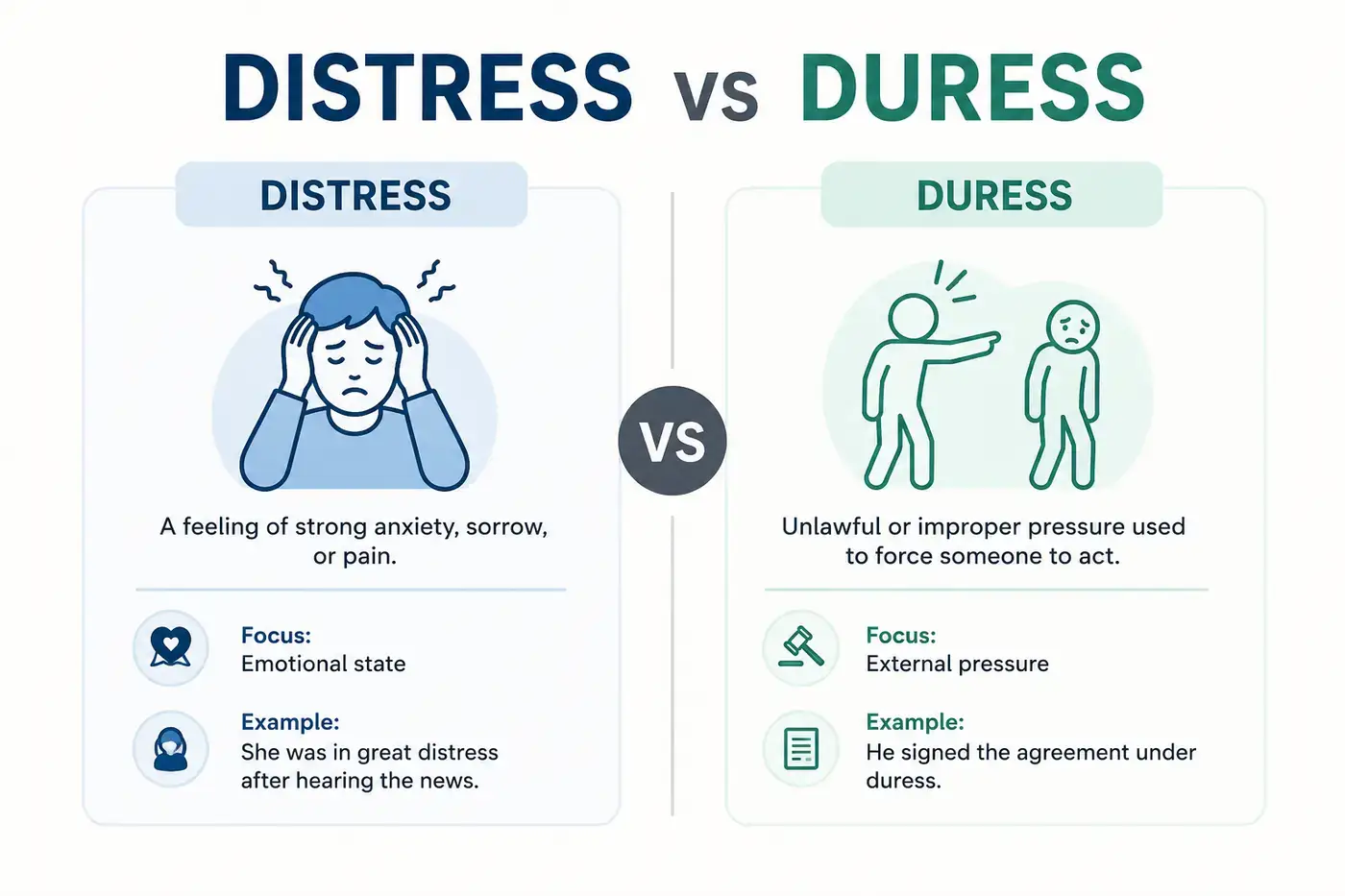
The key difference is simple. Distress describes emotional physical or financial suffering. Duress describes pressure threats or force that makes someone act against their own free will. One focuses on suffering. The other focuses on coercion.
Knowing this difference helps you communicate more clearly. It also prevents mistakes in legal writing academic work professional emails and daily conversations.
This guide explains the meaning of each word in plain English. You’ll learn the grammar behind them see real world examples discover why people confuse them and pick up practical memory tricks that make the difference easy to remember.
Suggested Internal Link: Affect Vs Effect Difference Explained.
For another common grammar confusion, see Tear Vs Tare Which Word Is Correct 2026 Guide.
Quick Answer
Distress means pain suffering hardship or extreme worry. Duress means being forced or pressured into doing something against your will. Both are correct English words but they describe different situations. Use distress for suffering and duress for coercion.
Distress Vs Duress Comparison Table
| Feature | Distress | Duress |
|---|---|---|
| Part of speech | Noun and verb | Noun |
| Main meaning | Suffering hardship or severe anxiety | Force threats or unlawful pressure |
| Common use | Health finance emotions emergencies | Law contracts police investigations |
| Tone | Emotional physical or financial | Legal formal and official |
| Everyday use | Very common | Less common |
| Formal writing | Common | Very common |
| Example | She was in great distress after the accident. | He signed the agreement under duress. |
| Can replace the other | No | No |
What Does Distress Mean
Distress refers to severe suffering or pain. The suffering can be emotional physical mental or financial depending on the situation.
It is one of the most common words used to describe hardship in English.
Simple Definition
Distress means extreme sadness pain worry hardship or discomfort.

When To Use Distress
Use distress when someone is experiencing difficult emotions physical suffering or serious problems.
Examples include.
- She showed signs of emotional distress after hearing the news.
- The family faced financial distress during the recession.
- The injured hiker sent out a distress signal.
- His words caused unnecessary distress.
- The charity helps people in severe distress.
Distress As A Verb
Unlike duress distress can also be a verb.
It means to make someone feel upset anxious or troubled.
Examples.
- The graphic images distressed many viewers.
- It distressed her to see the old building destroyed.
- Please don’t distress yourself over a small mistake.
Common Contexts For Distress
Daily conversation.
She was clearly in distress after losing her wallet.
Healthcare.
Doctors checked the patient for signs of respiratory distress.
Finance.
The company entered financial distress after several years of losses.
Emergency services.
The boat sent a distress call before the storm reached shore.
What Does Duress Mean
Duress refers to being forced threatened or pressured into doing something against your own free will.
The word appears most often in legal situations but it also appears in everyday English when someone acts because they feel they have no real choice.
Simple Definition
Duress means force threats or pressure used to make someone do something unwillingly.
When To Use Duress
Use duress when someone’s decision is influenced by coercion instead of free choice.
Examples include.
- He admitted he signed the document under duress.
- The witness claimed she spoke under duress.
- Any confession made under duress may not be accepted in court.
- She agreed only because she felt under duress.
- The employee said he resigned under duress.
Common Contexts For Duress
Legal writing.
The contract may be invalid because it was signed under duress.
Business.
The company argued that the agreement resulted from economic duress.
Everyday conversation.
I only agreed because I felt under duress.
Although people sometimes use duress outside legal settings the meaning always involves pressure or force rather than ordinary stress.
Which One Is CorrectBoth distress and duress are correct English words.
The right choice depends on the message you want to communicate.
Use distress if someone is suffering emotionally physically mentally or financially.
Use duress if someone is forced pressured or threatened into doing something.
A quick way to choose the correct word is to ask yourself one question.
Is the person suffering or being forced?
If the answer is suffering choose distress.
If the answer is force or pressure choose duress.
Compare these examples.
✔ She experienced emotional distress after the accident.
✔ He signed the papers under duress.
✘ She experienced emotional duress after the accident.
✘ He signed the papers under distress.
The incorrect examples change the meaning because the situations involve different ideas.
Why People Confuse Distress And Duress
Several factors make these words easy to mix up.
Similar Spelling
Both words end with ress and contain almost the same letters. A quick glance can make them appear nearly identical.
Similar Pronunciation
The beginning sounds are different but the endings sound very similar in natural speech. Many people hear one word and mistakenly remember the other.
Similar Contexts
Both words often appear in serious situations involving hardship conflict or legal matters. Since the overall topic is similar people sometimes assume the meanings are the same.
Legal And News Reporting
News articles regularly discuss contracts criminal cases disasters and emergencies. You may see distress in one article and duress in another. Without understanding the meanings readers often blend the two together.
Everyday Assumptions
Many people believe duress simply means stress or emotional pain.It does not.Duress always involves pressure force threats or coercion from another person or circumstance.
Key Differences Between Distress And Duress
Although these words appear in similar situations they describe very different experiences.
| Feature | Distress | Duress |
|---|---|---|
| Main idea | Suffering or hardship | Force or pressure |
| Cause | Illness loss fear money problems grief and emergencies | Threats intimidation coercion or unlawful pressure |
| Emotional focus | Yes | Sometimes |
| Legal meaning | Occasionally | Very often |
| Part of speech | Noun and verb | Noun only |
| Everyday use | Very common | Less common |
| Typical phrase | In distress | Under duress |
The simplest way to remember the difference is this.
Distress describes how someone feels.
Duress explains why someone had no real choice.
Grammar Explanation
Grammar also helps separate these words.
Distress Is A Noun
As a noun distress names a state of suffering or hardship.
Examples.
- The storm left many families in distress.
- Her distress was easy to see.
- Financial distress forced the business to close.
Distress Can Also Be A Verb
Unlike duress the word distress can act as a verb.
Examples.
- The news distressed everyone in the room.
- Please don’t distress yourself over small problems.
- It distressed his parents to see him unhappy.
Duress Is Only A Noun
Duress names a condition where someone is forced or threatened.
Examples.
- The confession was made under duress.
- The judge considered the claim of duress.
- She acted under duress rather than by choice.
You cannot use duress as a verb.
Incorrect.
The threats duressed him into signing.
Correct.
The threats placed him under duress.
Articles And Common Phrases
Both words often appear with articles and prepositions.
Common expressions include.
- In distress.
- Emotional distress.
- Financial distress.
- Under duress.
- Economic duress.
- Acting under duress.
These word combinations sound natural because native speakers use them every day.
Need another quick comparison? Read Maintained Vs Maintenanced Which Word Is Correct 2026 Guide.
Pronunciation Guide
The words look alike but their first syllables sound different.
Distress
IPA
American English
/dɪˈstrɛs/
Syllables
Dis tress.
Stress Pattern
The second syllable receives the strongest stress.
Duress
IPA
American English
/duˈrɛs/
Syllables
Du ress.
Stress Pattern
The second syllable also carries the primary stress.
Common Pronunciation Mistakes
Some English learners pronounce duress like distress because the endings are almost identical.
Slow pronunciation practice helps.
Distress.
Duress.
Notice that only the beginning changes.

Word Origin And History
The history of these words explains why they have different meanings today.
Origin Of Distress
Distress comes from Old French and traces back to Latin words meaning to squeeze press tightly or cause suffering.
Over time English speakers expanded its meaning to include emotional pain physical hardship financial difficulty and emergency situations.
Origin Of Duress
Duress also comes from Old French and shares historical roots connected with pressure and restraint.
Its meaning gradually became more specific in legal English. Today it usually refers to force threats or unlawful pressure that removes a person’s freedom to choose.Although both words share distant historical roots they developed along different paths.One became associated with suffering.The other became associated with coercion.
British American Canadian And Australian English
The meanings of distress and duress remain the same across major English speaking countries.
American English British English Canadian English Australian English and New Zealand English all use these words in the same way.
The biggest difference is frequency.
Distress appears far more often in everyday conversation news reports healthcare finance and emergency services.Duress appears most often in legal writing court cases contracts and official documents.A British lawyer an American judge and an Australian journalist would all understand under duress the same way.Likewise emotional distress has the same meaning across these regions.
Real Life Examples
Seeing both words in context is the fastest way to master them.
Daily Conversation
- She was in distress after losing her dog.
- He only agreed because he felt under duress.
- The child’s cries showed obvious distress.
- Nobody should make an important decision under duress.
Workplace
- Several employees experienced financial distress during the layoffs.
- The manager denied forcing anyone to resign under duress.
- The company offered counseling for workers dealing with emotional distress.
- The agreement could be challenged if it was signed under duress.
Emails
- I’m sorry to hear about your family’s distress.
- Please let us know if you felt under duress during the meeting.
Academic Writing
- Researchers studied psychological distress among teenagers.
- The paper examined economic duress in contract law.
Journalism
- Flood victims remained in distress for several days.
- The suspect claimed his confession was given under duress.
Healthcare
- Nurses recognized signs of respiratory distress immediately.
- The patient showed emotional distress after surgery.
Legal Writing
- A contract signed under duress may not be legally enforceable.
- The attorney argued that the witness acted under duress.
Social Media
- My heart goes out to everyone facing distress after the wildfire.
- Never let anyone pressure you into choices made under duress.
- These examples show an important pattern.
- Distress describes pain hardship or suffering.
- Duress describes force pressure or threats that remove free choice.
Common Mistakes People Make
Many English learners and native speakers confuse distress and duress because both words describe difficult situations. The mistake usually comes from focusing on the overall situation instead of the specific meaning.
Here are the errors editors see most often.
Using Distress Instead Of Duress
Incorrect.He signed the contract under distress.Correct.He signed the contract under duress.Why?The person was forced or pressured into signing. That situation involves duress not emotional suffering.
Using Duress Instead Of Distress
Incorrect.
She experienced emotional duress after losing her job.
Correct.
She experienced emotional distress after losing her job.
Why?
Losing a job can cause suffering anxiety and sadness. It does not automatically involve force or threats.
Thinking Both Words Mean Stress
Many people assume duress simply means severe stress.
It does not.
Duress always includes pressure threats or coercion that removes a person’s freedom to choose.
Using Duress In Ordinary Problems
Incorrect.
I was under duress because traffic was terrible.
Correct.
I was stressed because traffic was terrible.
Or.
The traffic caused me distress.
Traffic is frustrating but it usually does not involve coercion.
Easy Memory Tricks
A simple memory trick makes these words much easier to remember.
Think About The First Letter
Distress starts with D for Damage.
Damage often causes pain suffering or hardship.
Duress starts with Du.
Think of someone saying Do it because another person is forcing them.
That reminds you of pressure or coercion.
Remember The Common Phrases
Native speakers almost always say.
- In distress.
- Emotional distress.
- Financial distress.
- Under duress.
If you remember these expressions you’ll naturally choose the correct word.
Ask Yourself One Question
Is this about suffering or being forced?If it is suffering use distress.If someone had no real choice use duress.
Related Words And Similar Expressions
Expanding your vocabulary helps you understand these words more clearly.
Synonyms For Distress
- Suffering.
- Hardship.
- Anguish.
- Pain.
- Anxiety.
- Misery.
- Trouble.
- Heartache.
Synonyms For Duress
- Coercion.
- Pressure.
- Force.
- Intimidation.
- Threat.
- Compulsion.
- Constraint.
- Intimidation.
Related Words
- Stress.
- Trauma.
- Emergency.
- Hardship.
- Pressure.
- Coerce.
- Intimidate.
- Consent.
Frequently Confused Words
- Stress and distress.
- Distress and disaster.
- Pressure and duress.
- Force and coercion.
- Consent and compliance.
Learning these related words helps you understand the subtle differences native speakers recognize immediately.

Expert Editor’s Note
Professional editors choose these words very carefully because they change the meaning of a sentence.
Major dictionaries define distress as suffering hardship or severe anxiety. They define duress as force threats or unlawful pressure used to influence someone’s actions.
Legal style guides are especially strict with duress because it has a specific legal meaning. A contract signed under duress may not be legally valid. Replacing duress with distress could completely change the meaning of a legal document.
In everyday writing distress appears far more often because people frequently talk about emotional physical and financial hardship.The best approach is simple.If someone is hurting choose distress.If someone is being forced choose duress.
Frequently Asked Questions
What Is The Difference Between Distress And Duress?
Distress refers to emotional physical or financial suffering. Duress refers to force threats or pressure that makes someone act against their own free will. One describes hardship while the other describes coercion.
Can Distress And Duress Be Used Interchangeably?
No. Although both words describe serious situations they have different meanings. Replacing one with the other changes the message and can make a sentence incorrect.
What Does Under Duress Mean?
Under duress means someone acted because of threats pressure or coercion instead of making a free choice. The phrase is especially common in legal English.
Is Distress A Legal Term?
Yes. Distress appears in some legal contexts but it is much more common in healthcare finance emergency services and everyday English. It usually refers to suffering rather than coercion.
Can Duress Be Emotional?
Yes. Emotional pressure can qualify as duress if it removes a person’s ability to make a voluntary decision. In legal situations the exact circumstances matter.
Which Word Is More Common In Everyday English?
Distress is much more common. People regularly use it to describe emotional pain financial hardship health problems and emergency situations. Duress appears less often and is most closely associated with legal discussions.
Is Duress Always Used In Court?
No. Although it is strongly connected with legal language people also use it in everyday conversation to describe situations where they felt pressured into doing something.
Need another quick comparison? Read Nonresponsive Vs Unresponsive Which Word Is Correct 2026.
Conclusion
The difference between distress vs duress comes down to one simple idea.Use distress when someone is experiencing pain hardship anxiety or suffering. Use duress when someone is forced threatened or pressured into acting against their own will.The two words may look similar but they describe completely different situations.If you remember that distress is about suffering and duress is about coercion you’ll choose the correct word with confidence every time.Clear writing starts with choosing the right word and small differences like this make a big impact.

Vocabulary & Language Research Writer
Ethan Parker researches English vocabulary, word meanings, slang, idioms, and commonly confused words. His goal is to help readers understand how English is actually used in everyday conversations and writing.