
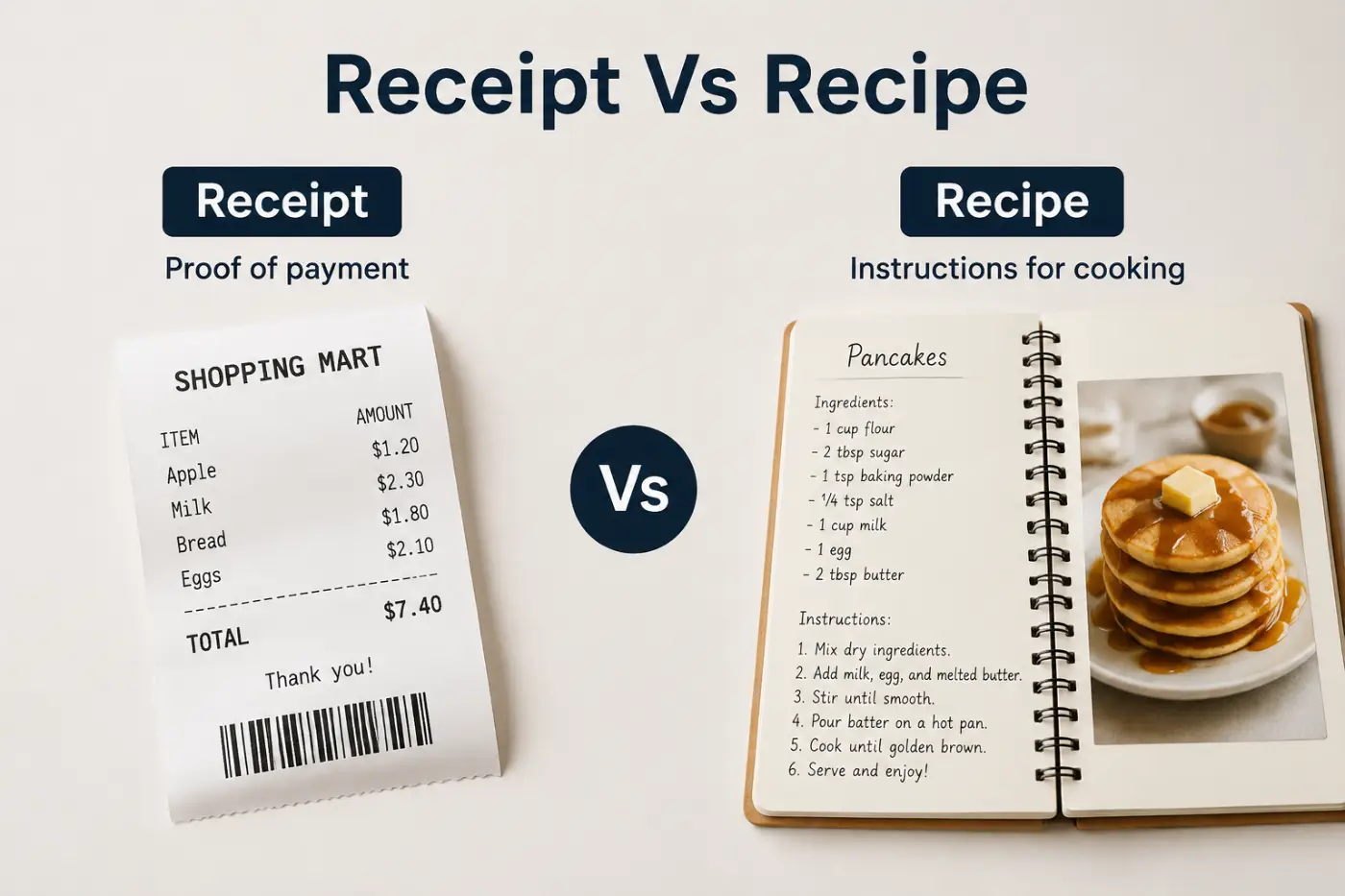
If you’ve ever typed receipt vs recipe into a search box, you’re not alone. These two words look remarkably similar, but they refer to completely different things. One is connected to shopping and proof of payment. The other is connected to cooking and instructions for preparing food.
The confusion usually comes from their spelling. Both words begin with rec and contain similar letters. They also appear in many of the same everyday situations. You might talk about buying ingredients for a recipe and then receive a receipt from the store. That close connection can make the two words even easier to mix up.
The good news is that the difference is simple once you connect each word with its meaning. A receipt is usually a record showing that you bought something or received something. A recipe is a set of instructions for making a particular food or drink.
This guide explains the difference between receipt and recipe in plain English. You’ll learn their meanings, pronunciation, spelling patterns, grammar, origins, common mistakes, regional usage, and practical examples. By the end, you’ll have an easy rule for choosing the right word without second guessing yourself.
You may also want to read Lacs or Lakhs Which Spelling Is Correct (2026).
Quick Answer
Receipt means a written or digital record showing that you bought something or that something was received. Recipe means a set of instructions for preparing food or a drink. Both words are correct spellings, but they have completely different meanings. Remember: you get a receipt after buying something and follow a recipe when cooking.
Receipt Vs Recipe Comparison
| Feature | Receipt | Recipe |
|---|---|---|
| Meaning | A record of a purchase or something received | Instructions for preparing food or drink |
| Part of speech | Noun | Noun |
| Common pronunciation | ri SEET | RES uh pee |
| Silent letter | The p is silent | No silent p |
| Common context | Shopping payments business records | Cooking baking food preparation |
| Plural | Receipts | Recipes |
| Verb connection | Receive | No direct verb form |
| Formality | Used in formal and informal English | Used in formal and informal English |
| Example | Keep your receipt for a return. | Follow the recipe carefully. |
The two words aren’t interchangeable.
You ask for a receipt after making a purchase.
You follow a recipe when making a meal.
What Does Receipt Mean
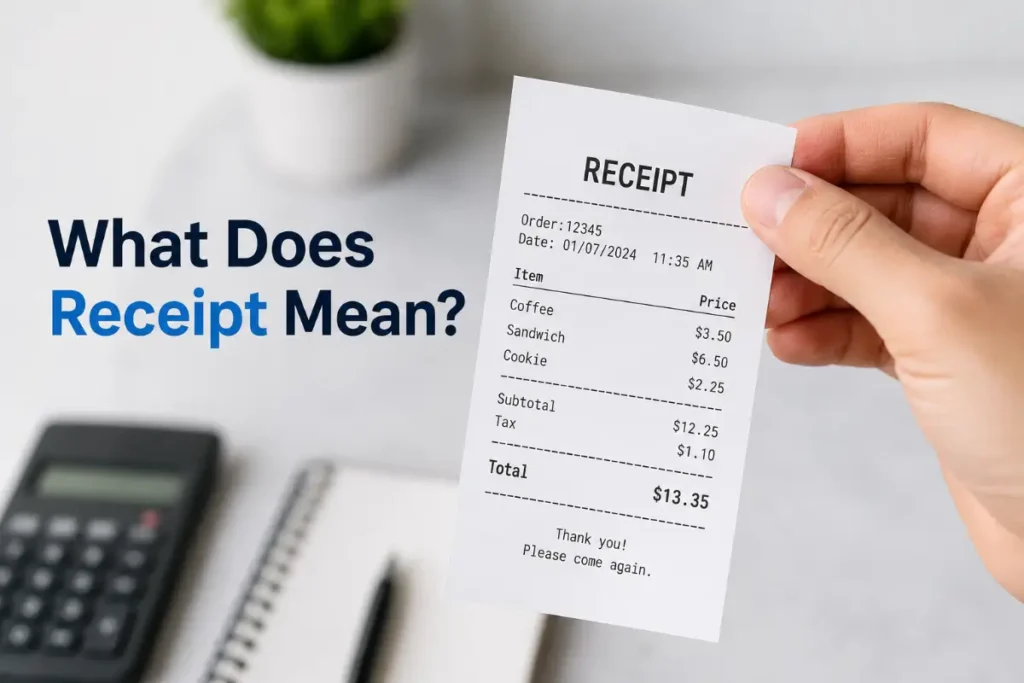
A receipt is a record that confirms something was received. In everyday American English the word most often refers to proof that you paid for something.
For example, when you buy a pair of shoes at a store, the cashier may give you a paper receipt. An online store might send the same information by email instead.
A receipt can show useful details such as the items purchased, prices, taxes, payment method, date, and total amount.
Receipt As Proof Of Purchase
This is the most common meaning in daily American English.
Examples include:
- Please keep your receipt in case you need to return the shirt.
- The cashier printed my receipt.
- I can’t find the receipt for my laptop.
- The store emailed me a digital receipt.
- Do you need a receipt for your purchase?
A receipt can matter when you need a refund, exchange, warranty claim, expense report, or proof of payment.
Receipt Can Mean Something Received
The broader meaning of receipt is the act of receiving something or confirmation that something has been received.
This meaning appears more often in formal or legal writing.
For example:
We acknowledge receipt of your application.
Here, receipt doesn’t mean a shopping slip. It means the company received the application.
Another example is:
Please confirm receipt of this document.
This means the writer wants confirmation that the document arrived.
Receipt In Business Writing
Businesses use receipt in several standard expressions.
Proof of receipt means evidence that something was received.
Receipt of payment means confirmation that a payment was received.
A receipt for expenses means documentation showing that money was spent.
Upon receipt means after something has been received.
Example:
Upon receipt of your payment, we’ll process the order.
This is more formal than everyday conversation but remains common in professional writing.
What Does Recipe Mean
A recipe is a set of instructions that explains how to prepare a particular food or drink.
A recipe normally tells you which ingredients you need and what steps to follow.
For example, a cake recipe might tell you how much flour, sugar, butter, and eggs to use. It may also explain the oven temperature and baking time.
Recipe As Cooking Instructions
This is the main meaning of the word.
Examples include:
- I found a great recipe for chocolate cake.
- This recipe calls for two cups of flour.
- Can you send me your pasta recipe?
- I followed the recipe exactly.
- The recipe takes about thirty minutes to prepare.
A recipe can be simple or highly detailed. It can come from a cookbook, food website, family tradition, cooking class, or personal notes.
Recipe Can Have A Figurative Meaning
English speakers sometimes use recipe in a figurative way.
In this use, recipe means a combination of things that produces a particular result.
For example:
Hard work and patience are a recipe for success.
Nobody is actually cooking. The sentence uses recipe as a metaphor for a useful combination of factors.
Another example is:
Poor planning is a recipe for trouble.
Here, recipe means a set of conditions likely to produce a certain outcome.
This figurative use is common in both conversation and writing.
Which One Is Correct
Both receipt and recipe are correct English words.
The right choice depends entirely on the meaning you want.
Use receipt when you mean a record of a purchase or confirmation that something was received.
Use recipe when you mean cooking or food preparation instructions.
Compare these sentences.
I saved the receipt from the grocery store.
The document proves what you bought and how much you paid.
I saved the recipe for the soup.
The document tells you how to make the soup.
The words may look like close relatives, but they do different jobs.
Receipt In A Sentence
The store gave me a receipt after I paid.
Recipe In A Sentence
The recipe says to bake the bread for thirty minutes.
A useful test is to think about the situation.
If you’re buying, think receipt.
If you’re cooking, think recipe.
Why People Confuse Receipt And Recipe
The confusion isn’t random. Several features of English make these words easy to mix up.
The Words Look Similar
Both words begin with rec and contain similar letters.
receipt
recipe
When you’re typing quickly, your brain may recognize the general shape of the word before you process every letter.
That can lead to accidental substitutions.
Both Words Appear Around Food
This is an especially interesting source of confusion.
Imagine you’re shopping for ingredients. You might look at a recipe while buying the ingredients and then receive a receipt after paying.
So the same activity can involve both words.
For example:
I used a recipe to make the shopping list and saved the receipt after buying everything.
The words belong to the same general situation but have different meanings.
The Pronunciation Is Different
The words don’t sound alike in standard American English.
Receipt is pronounced approximately ri SEET.
Recipe is pronounced approximately RES uh pee.
The spelling can still cause trouble because the written forms are similar even though the spoken forms are noticeably different.
The Silent Letter In Receipt Causes Problems
The p in receipt is silent.
You don’t pronounce it as re ceept.
Instead, the word sounds like ri SEET.
That silent letter comes from the word’s history and spelling development. It also makes the word harder to spell than recipe.
Fast Typing Makes The Problem Worse
When people type quickly, they may remember the sound or general shape of a word instead of its exact spelling.
Someone who wants to write about cooking might accidentally type receipt because the two words are visually close.
Autocorrect can also reinforce mistakes if the wrong word appears in a sentence that still looks grammatically possible.
Internet Use Can Reinforce Confusion
Search results, social media posts, comments, and informal writing often contain spelling errors.
Seeing a mistake repeatedly doesn’t make it correct.
This matters especially for words like receipt and recipe, where both spellings already exist as legitimate English words. A spellchecker may not catch the mistake because it can’t always determine what you intended to say.
For example:
I need the receipt for this chicken.
The sentence is grammatically possible. It simply means something different from:
I need the recipe for this chicken.
Context matters.
The Main Difference Between Receipt And Recipe
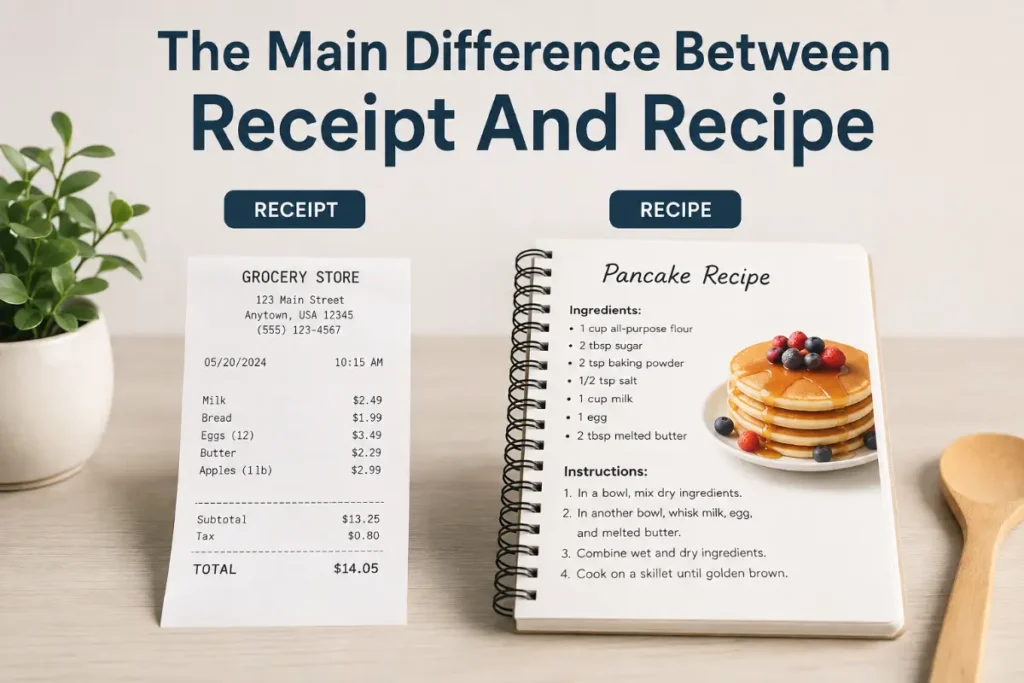
The simplest distinction is based on function.
A receipt records a transaction or confirms that something was received.
A recipe gives instructions.
Think of the difference this way.
Receipt = record.
Recipe = instructions.
That small memory link solves most spelling problems.
Receipt Is Connected With Buying
You might receive a receipt after buying:
- Groceries.
- Clothing.
- Electronics.
- Furniture.
- Airline tickets.
- Restaurant meals.
- Online orders.
The receipt tells you what the transaction involved.
Recipe Is Connected With Making
You might use a recipe to make:
- Soup.
- Bread.
- Cookies.
- Pasta.
- Pizza.
- Cake.
- Cocktails or other drinks.
The recipe tells you how to create the final product.
Receipt Vs Recipe In Everyday Situations
The difference becomes even clearer when you place both words in realistic situations.
At A Grocery Store
You might bring a recipe to the store so you know what ingredients to buy.
After you pay, you receive a receipt.
The recipe helped me choose the ingredients.
The receipt shows what I paid for them.
At A Restaurant
A restaurant can provide both a recipe and a receipt.
A chef might use a recipe to prepare a dish.
A customer receives a receipt after paying the bill.
The chef followed the recipe.
The customer kept the receipt.
When Shopping Online
An online retailer may send you a digital receipt by email.
If you’re buying ingredients for dinner, you might also have a recipe open on your phone.
I checked the recipe before ordering the ingredients.
The store sent the receipt after I paid.
This is a perfect example of why the words can become confused. They can appear in the same conversation while performing completely different roles.
Grammar And Sentence Structure
Both receipt and recipe are countable nouns.
That means you can talk about one receipt or several receipts. You can also talk about one recipe or several recipes.
Singular Form
receipt
recipe
Examples.
I need a receipt.
I need a recipe.
Plural Form
Add s to both words.
receipts
recipes
Examples.
I saved all my receipts.
She collected several recipes.
Notice that the spelling changes only by adding s.
Articles With Receipt
Because receipt is a singular countable noun, it normally needs a determiner.
Correct:
I need a receipt.
The receipt is in my bag.
This receipt is difficult to read.
Incorrect:
I need receipt.
The last sentence needs an article or another determiner in standard English.
Articles With Recipe
The same rule applies to recipe.
Correct:
I need a recipe for dinner.
The recipe looks simple.
This recipe is easy to follow.
Again, a singular countable noun normally needs a determiner.
Possessive Forms
Both words can also show possession.
My receipt is in my wallet.
My mother’s recipe is famous in our family.
For plural forms the apostrophe follows the standard possessive rule.
The customers’ receipts were printed together.
The chefs’ recipes were published in a cookbook.
Receipt And Recipe In Formal Writing
Both words work perfectly well in formal writing.
The difference is not one of formal versus informal English. The difference is meaning.
Receipt appears frequently in business financial legal and administrative writing.
Recipe appears frequently in food journalism cookbooks culinary education and lifestyle writing.
For example:
Please retain your receipt for reimbursement.
This is appropriate in professional communication.
The recipe was tested three times before publication.
This is appropriate in culinary writing.
A good editor won’t replace one word with the other simply because they look similar. Meaning always comes first.
Spelling Rules To Remember
There isn’t a complicated spelling rule connecting the two words. The best approach is to learn their forms as separate vocabulary items.
Receipt Has A Silent P
The spelling is:
r e c e i p t
The pronunciation doesn’t include the p.
Think of the word as:
receive + t
This isn’t a perfect modern spelling rule but it can help you remember the letters.
Recipe Has A Different Ending
The spelling is:
r e c i p e
It ends in pe and is pronounced approximately RES uh pee.
Don’t add the extra t found in receipt.
Need another quick comparison? Read Next Friday Vs This Friday Which One Should You Use 2026 Guide.
Pronunciation Guide
Pronunciation is one of the easiest ways to keep these words separate.
Receipt
American English pronunciation:
/rɪˈsiːt/
It has two syllables.
ri SEET
The stress falls on the second syllable.
The p is silent.
Recipe
American English pronunciation:
/ˈrɛsəpi/
It has three syllables.
RES uh pee
The stress falls on the first syllable.
There is no silent p.
Common Pronunciation Mistake
A common learner error is trying to pronounce the p in receipt.
Don’t say:
re ceept
Say:
ri SEET
Another mistake is giving recipe two syllables.
Standard American English generally uses three syllables:
RES uh pee.
Word Origin And Etymology
The histories of these words explain some of their spelling differences.
Origin Of Receipt
Receipt ultimately traces back to Latin recipere, meaning to receive or take back.
It entered English through Old French and Middle English. Its historical connection with receiving explains why the word can refer broadly to the act of receiving something as well as the document confirming a transaction.
The unusual spelling reflects its Latin and French history. The p is a historical spelling feature even though modern English doesn’t pronounce it.
Origin Of Recipe
Recipe also comes from Latin recipe, meaning take or take this.
The word originally appeared in medical and instructional contexts. It was used as a direction for taking ingredients or substances.
Over time the word became strongly associated with instructions for preparing food.
That history gives us an interesting connection.
Both words ultimately relate to the idea of receiving or taking. Their modern meanings have simply developed in different directions.
Real Life Examples
Seeing the words in natural sentences is one of the best ways to build a lasting distinction.
Daily Conversation
- Can you give me the recipe for that soup?
- I forgot to ask for a receipt.
- The recipe looks easier than I expected.
- I found the receipt in my coat pocket.
- My grandmother gave me her cookie recipe.
- The cashier handed me the receipt.
Workplace
- Please attach the receipt to your expense report.
- The accounting team needs a copy of the receipt.
- Our chef updated the recipe before the new menu launched.
- The restaurant keeps every recipe in a central file.
- I’ve attached the receipt for the office supplies.
- Could you send me the recipe you mentioned yesterday?
- Please keep the receipt until your reimbursement is approved.
- I’ve included the revised recipe with the other documents.
Academic Writing
- The cookbook examines how the recipe changed over time.
- The researcher analyzed several historical recipes.
- The receipt provided evidence of the purchase.
- The study included a detailed record of each ingredient used in the recipe.
Journalism
- The article included a recipe for homemade bread.
- Investigators reviewed the receipt as part of the financial records.
Social Media
- Drop the recipe in the comments.
- I finally found the receipt for this jacket.
- This recipe deserves a spot in your regular dinner rotation.
- I’m keeping every receipt until I finish my budget review.
Family And Personal Writing
- I wrote down Mom’s recipe so nobody would lose it.
- Dad kept the receipt because he wasn’t sure about the return policy.
- This recipe has been in our family for decades.
- I found an old receipt tucked inside the cookbook.
These examples show an important pattern. Receipts document transactions. Recipes guide preparation.
That distinction is the key to everything else in this comparison.
Common Mistakes With Receipt And Recipe
The spelling difference between receipt and recipe is small but the meaning difference is huge. Most errors happen when someone remembers the general shape of the word but not its exact meaning.
Writing Recipe When You Mean Receipt
Incorrect:
Please keep your recipe for the return.
Correct:
Please keep your receipt for the return.
A store needs a receipt as proof of purchase. A cooking recipe has nothing to do with the transaction.
Writing Receipt When You Mean Recipe
Incorrect:
Can you send me the receipt for your pasta?
Correct:
Can you send me the recipe for your pasta?
The second sentence asks for cooking instructions.
Adding A Pronounced P To Receipt
The p in receipt is silent.
Don’t pronounce it as if the word were spelled re ceept. The standard pronunciation sounds like ri SEET.
This silent letter is one reason English learners often find the spelling frustrating.
Spelling Receipt As Reciept
A common spelling mistake is:
reciept
The correct spelling is:
receipt
The vowel order is ei after the c.
Spelling Recipe As Receipe
Another common error is:
receipe
The correct spelling is:
recipe
The word has ci before the final pe.
A useful visual comparison is:
receipt
recipe
The first word contains ei and ends in pt.
The second contains ci and ends in pe.
British And American English
There is no major spelling difference between American and British English for receipt or recipe.
American English uses:
receipt
recipe
British English uses the same spellings:
receipt
recipe
Canadian English and Australian English also use these standard spellings.
The pronunciation can vary slightly from speaker to speaker because English accents differ. The basic meanings remain the same.
Regional Usage
You can use receipt and recipe confidently in the United States the United Kingdom Canada Australia and other English speaking regions.
There isn’t a regional spelling choice such as the difference between color and colour.
That makes this comparison easier than many other English spelling questions.
Receipt And Recipe In Formal Writing
Both words are completely suitable for formal writing when used correctly.
A financial report might say:
Employees must submit receipts for approved expenses.
A culinary textbook might say:
The recipe requires the ingredients to be mixed thoroughly.
An academic paper might use recipe in a discussion of food culture.
A legal or business document might use receipt when discussing confirmation of payment or delivery.
The important editorial rule is simple. Don’t choose a word because it looks more formal. Choose it because it expresses the intended meaning.
Receipt And Recipe In Informal Writing
Casual English uses both words constantly.
You might text a friend:
Send me that recipe when you get a chance.
You might message someone after shopping:
I found the receipt in my car.
Social media also creates plenty of opportunities to use both words.
A food creator might post:
Full recipe is in my bio.
A shopper might write:
I finally found the receipt.
The informal setting doesn’t change the spelling or basic meaning.
Memory Tricks For Receipt And Recipe
A good memory trick should be short enough to use when you’re writing quickly.
Remember Receipt As A Record
Think:
Receipt = record.
A receipt records a purchase.
You can connect the first letters mentally:
Receipt. Record.
Both begin with R.
Remember Recipe As A Preparation Plan
Think:
Recipe = instructions.
A recipe tells you what to use and what to do.
You can picture a recipe card sitting beside a mixing bowl.
Use The Shopping Test
Ask yourself:
Did I buy it or make it?
If you’re talking about proof of buying something, use receipt.
If you’re talking about instructions for making something, use recipe.
Use The Kitchen Test
If you can imagine a cookbook page the word is probably recipe.
If you can imagine a cash register printing a small slip the word is probably receipt.
This visual trick works especially well for English learners because it connects the spelling to a concrete object.
Related Words And Expressions
Understanding related vocabulary helps you see how each word fits into English.
Words Related To Receipt
Common related words include:
- Purchase.
- Payment.
- Transaction.
- Invoice.
- Bill.
- Proof of purchase.
- Refund.
- Exchange.
- Expense.
- Confirmation.
These words often appear in the same business or shopping context.
Words Related To Recipe
Common related words include:
- Ingredients.
- Instructions.
- Cooking.
- Baking.
- Preparation.
- Method.
- Directions.
- Measurements.
- Serving.
- Cookbook.
These words naturally belong to the world of food preparation.
Receipt And Invoice
Receipt and invoice are sometimes confused because both appear in financial transactions.
An invoice is a request for payment or a document listing money owed.
A receipt generally confirms that payment has been made or something has been received.
For example:
The company sent an invoice before the payment was due.
The company sent a receipt after the payment was made.
This distinction matters in accounting and business communication.
Receipt And Bill
A bill tells you how much you owe.
A receipt confirms that you paid.
At a restaurant you might receive a bill first and a receipt after payment.
Recipe And Instructions
A recipe is a specific type of instruction.
You can have instructions for assembling furniture or using software. A recipe normally gives instructions for preparing food or drinks.
So every recipe contains instructions but not every set of instructions is a recipe.
Expert Editor’s Note
From an editing perspective the most useful approach is to treat receipt and recipe as completely separate vocabulary items.
Their similar spelling can tempt writers to focus on letters instead of meaning. Professional proofreading works in the opposite direction. Start with the intended meaning and then select the word.
Dictionaries define receipt around the idea of receiving something and the document that confirms a transaction. They define recipe around instructions for preparing food and drink. Both are established standard English words.
Native speakers don’t normally treat these words as variants of one another. They hear and understand them as separate words.
For formal writing, precision matters even more. A financial report containing recipe instead of receipt can create genuine confusion. A cookbook containing receipt instead of recipe can make the writer appear careless.
The safest editorial rule is simple:
A receipt proves what you received or paid for. A recipe explains how to prepare something.
Once that distinction becomes automatic, spelling becomes much easier.
Frequently Asked Questions
Is Receipt Or Recipe The Correct Spelling?
Both spellings are correct, but they have different meanings. Receipt refers to a record of a purchase or confirmation that something was received. Recipe refers to instructions for preparing food or a drink. You need receipt for shopping transactions and recipe for cooking instructions.
What Is The Difference Between Receipt And Recipe?
A receipt is normally a document showing that you bought something or that something was received. A recipe is a set of instructions for preparing food or a drink. The words look similar but aren’t interchangeable. Think of a receipt as a record and a recipe as a set of instructions.
Why Is The P Silent In Receipt?
The silent p comes from the historical development of the word. Receipt entered English through French and ultimately traces back to Latin. The spelling preserved a connection to its earlier form even though English pronunciation changed. Modern speakers pronounce the word approximately ri SEET.
How Do You Spell Receipt Correctly?
The correct spelling is receipt. A common mistake is writing reciept. Remember that the word contains ei after the c and ends with pt. The p isn’t pronounced, so hearing the word alone may not make the spelling obvious.
How Do You Spell Recipe Correctly?
The correct spelling is recipe. It begins with rec and contains ci before the final pe. The word has three syllables in standard American English and is pronounced approximately RES uh pee.
Can Receipt And Recipe Be Used In The Same Sentence?
Yes. In fact, they can naturally appear together when discussing grocery shopping. For example: I followed the recipe at home and kept the receipt from the grocery store. The recipe explains how to prepare the food while the receipt records the purchase.
Is Receipt Related To Receive?
Yes. Receipt is historically connected to the idea of receiving. In modern English the word commonly refers to a document confirming a purchase or something received. This connection can help explain the unusual spelling and the silent p.
Is Recipe Only Used For Food?
The main meaning of recipe involves instructions for preparing food or drinks. English also uses the word figuratively to describe a combination of things likely to produce a result. For example, Poor communication is a recipe for trouble uses recipe as a metaphor rather than referring to cooking.
For another common grammar confusion, see Principal vs Principle (2026 Guide).
Final Thoughts On Receipt And Recipe
The difference between receipt vs recipe is much easier than the spelling makes it seem.
A receipt is a record. You usually get one after buying something or receiving something.
A recipe is a set of instructions. You use one to prepare food or drinks.
The words share several letters and can appear in the same situation. You might read a recipe while shopping for ingredients and then receive a receipt at the checkout. That connection explains some of the confusion but doesn’t change their meanings.
If you’re unsure which word to use, remember two simple associations:
Receipt means record.
Recipe means instructions.
Also remember that the p in receipt is silent. The word sounds like ri SEET, while recipe sounds like RES uh pee.
One small spelling difference can change the entire meaning of a sentence. Learn the meaning first and the spelling will follow.

Editorial Reviewer & Proofreader
Grace Mitchell reviews Gramlify’s articles for clarity, consistency, and readability. She is passionate about creating accurate, approachable content that helps English learners build confidence.