
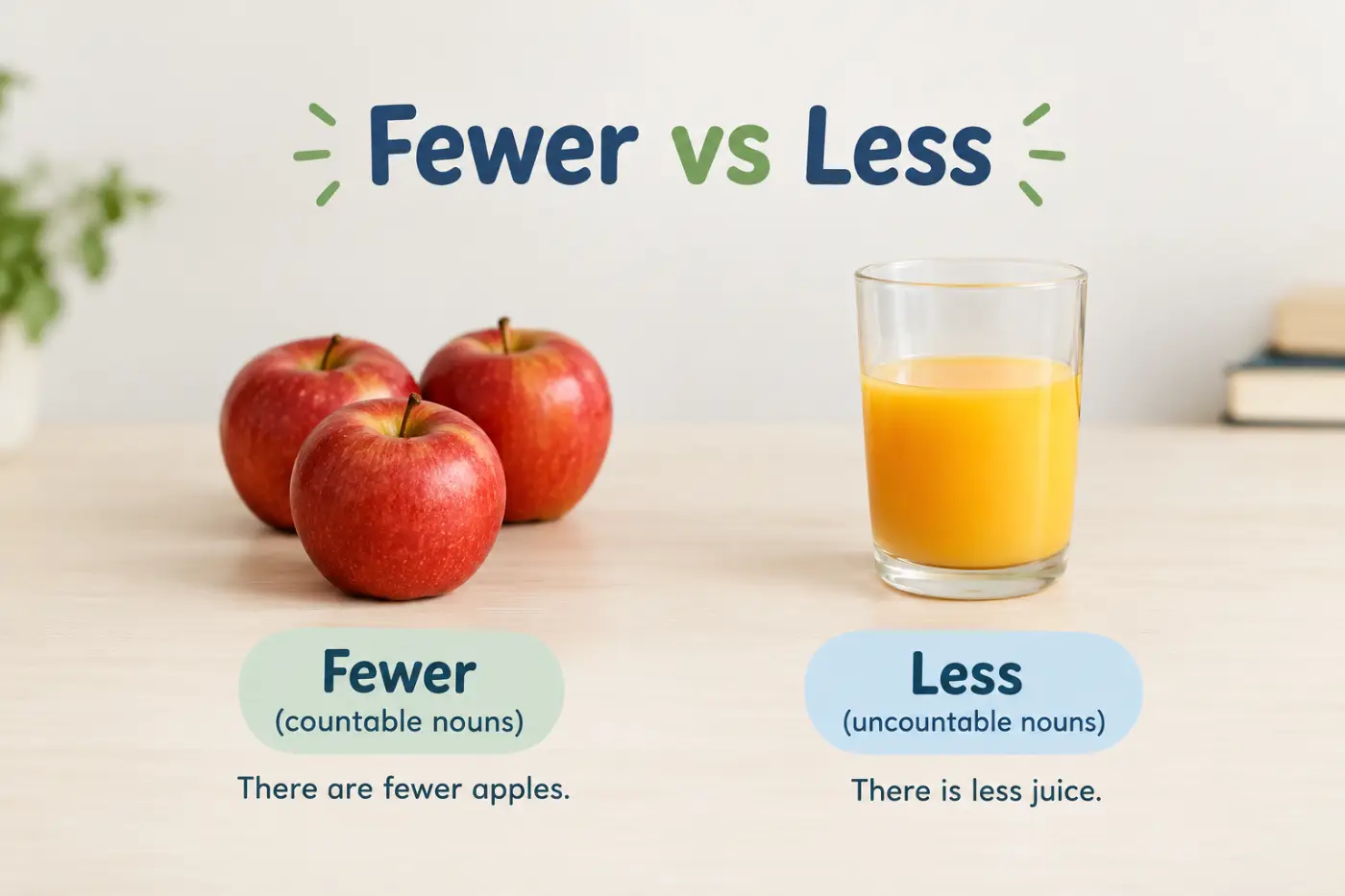
Choosing between fewer vs less can feel tricky, even for people who speak English every day. You might write fewer mistakes in an email, less time on a project, or wonder if a sign should say fewer than ten items or less than ten items. Both words refer to a smaller amount, so the difference isn’t always obvious.
The basic rule is simple. Use fewer for things you can count individually and less for amounts you don’t usually count as separate items. For example, fewer books means a smaller number of books, while less water means a smaller amount of water. Once you understand this distinction, you’ll find it much easier to choose the right word in everyday conversation and formal writing.
However, English has a few exceptions that make the rule more interesting. We say less than $20, less than an hour, and less than five miles in many situations, even though money, time, and distance can be measured or counted in different ways. We also use fewer and less in fixed expressions and comparisons.
This guide explains the difference between fewer and less, shows you how to use each word naturally, and explores the grammar rules behind common examples. You’ll also learn how to handle numbers, measurements, percentages, time, money, and situations where both words might seem possible.
Many readers also check Filed Vs Filled Which Word Is Correct 2026 Guide.
Quick Answer
Use fewer with countable nouns and less with uncountable nouns. Write fewer apples because you can count individual apples. Write less sugar because sugar is treated as an amount. However, less is also common with time, money, distance, and measurements. The best choice depends on the noun and the meaning of the sentence.
Fewer vs Less Comparison Table
| Feature | Fewer | Less |
|---|---|---|
| Main meaning | A smaller number | A smaller amount or degree |
| Grammar | Usually used with plural countable nouns | Usually used with uncountable nouns |
| Common examples | Fewer people, fewer cars, fewer errors | Less water, less traffic, less stress |
| Questions it answers | How many? | How much? |
| Comparative form | Fewer | Less |
| Opposite | More | More |
| Everyday use | Fewer emails, fewer problems | Less work, less noise |
| Common exception | Used for countable items | Often used with time, money, distance, and measurements |
| Formal writing | Preferred for countable items | Preferred for uncountable amounts |
| Common mistake | Using fewer with an uncountable noun | Using less with an ordinary plural countable noun |
The central distinction is between number and amount. Fewer usually points to separate items, while less focuses on a quantity, degree, or overall amount.
For example, you might have fewer cookies on a plate but less cookie dough in a bowl. Cookies are individual items. Cookie dough is treated as a mass.
What Does Fewer Mean
Fewer means a smaller number of people, objects, events, or other countable things. It is the comparative form of few and normally appears before a plural countable noun.
Use fewer when you can identify separate units and count them one by one.
Examples include:
- Fewer students attended the lecture.
- We received fewer complaints this month.
- She made fewer spelling mistakes in her latest essay.
- The new schedule includes fewer meetings.
- Fewer birds visited the garden this morning.
In each example, the noun refers to things you can count individually. You can count students, complaints, mistakes, meetings, and birds.
Fewer in Everyday Conversation
People use fewer when talking about numbers, choices, tasks, and individual objects.
For example, a friend might say, “I have fewer errands to run today.” A parent might tell a child, “You need to make fewer mistakes on your homework.” At work, a manager might say, “We need fewer meetings and more time to finish our projects.”
These sentences all focus on reducing the number of separate things.
Fewer in Formal Writing
Fewer is especially useful in reports, academic papers, business documents, and analytical writing.
Consider these examples.
- The second group reported fewer symptoms than the first group.
- The revised process produced fewer errors.
- Fewer participants completed the final survey.
- The updated policy resulted in fewer customer complaints.
In each sentence, fewer makes the comparison clear because the writer refers to countable items or people.
Can Fewer Describe People
Yes. Fewer often appears with people and groups when the writer discusses numbers.
For example:
- Fewer employees worked remotely this quarter.
- Fewer customers visited the store after the price increase.
- Fewer applicants met the minimum requirements.
Remember that fewer describes the number of people, not their individual qualities. It doesn’t automatically suggest that having fewer people is good or bad. The surrounding sentence provides that meaning.
What Does Less Mean
Less means a smaller amount, quantity, degree, or extent of something. It usually appears with uncountable nouns, although it also has established uses with measurements and other expressions.
Common examples include less water, less information, less patience, less noise, and less effort.
Consider these sentences:
- I need less sugar in my coffee.
- We have less time than we expected.
- She feels less stress after changing jobs.
- This recipe requires less oil.
- The new computer uses less energy.
Water, time, stress, sugar, oil, and energy are treated as amounts in these examples. You don’t normally count them as separate individual units.
Less in Everyday Conversation
Less is common when people discuss time, feelings, effort, food, money, and general quantities.
For example, someone might say, “I need less screen time before bed.” A colleague might ask for less paperwork. A cook might use less salt in a recipe.
The word can also describe a lower degree of a quality.
- The second explanation was less confusing.
- This route is less dangerous at night.
- The new version is less expensive.
- He seemed less worried after the meeting.
Here, less modifies adjectives rather than nouns. It shows that a quality exists to a smaller degree.
Less in Formal Writing
Less appears in professional and academic writing when the writer discusses amounts, intensity, or degree.
Examples include:
- The revised design requires less material.
- Participants reported less anxiety after the program.
- The treatment group consumed less sugar.
- The updated software places less demand on the processor.
Less is useful for comparing overall quantities and levels. The key is to identify what the sentence measures.
Can Less Describe Countable Things
Yes, in certain established contexts. English speakers commonly use less with amounts of time, money, distance, and other measurements.
For example:
- The trip took less than two hours.
- The jacket costs less than $50.
- The destination is less than five miles away.
- The container holds less than three liters.
These sentences are natural because the speaker treats the number as part of a measurement or a single overall quantity. This usage doesn’t mean fewer has become incorrect for every countable noun. Instead, it reflects a long established pattern in English.
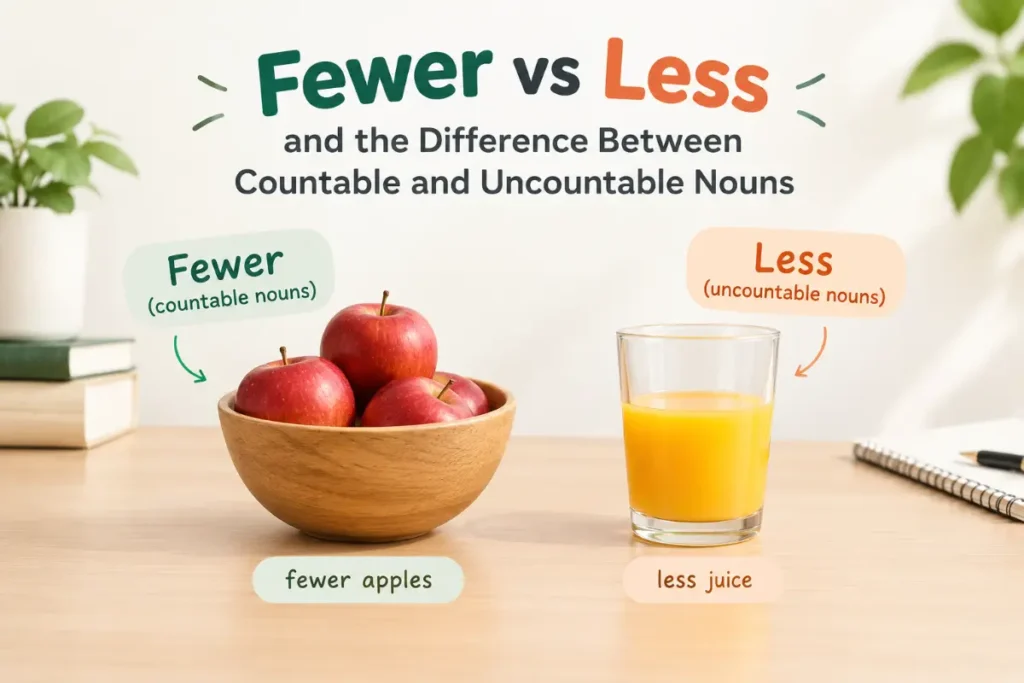
Fewer vs Less and the Difference Between Countable and Uncountable Nouns
To choose the correct word, you first need to know how English treats the noun in your sentence.
A countable noun refers to something you can count as an individual unit. An uncountable noun refers to a substance, mass, quality, or general quantity that English doesn’t normally count as separate units in that meaning.
This distinction matters more than the physical nature of the thing. Some nouns can be countable in one context and uncountable in another.
Countable Nouns
Countable nouns have singular and plural forms. They can usually follow numbers directly.
| Singular | Plural | Example with Fewer |
|---|---|---|
| Book | Books | Fewer books |
| Person | People | Fewer people |
| Chair | Chairs | Fewer chairs |
| Mistake | Mistakes | Fewer mistakes |
| Question | Questions | Fewer questions |
| Dollar | Dollars | Fewer dollars in certain counting contexts |
| Idea | Ideas | Fewer ideas |
| Appointment | Appointments | Fewer appointments |
You can say one book, two books, or ten books. Therefore, fewer books is the standard choice when you mean a smaller number of books.
The same principle applies to other plural countable nouns.
For example, fewer questions means a smaller number of questions. Fewer appointments means a smaller number of appointments. Fewer ideas means a smaller number of ideas.
Uncountable Nouns
Uncountable nouns generally don’t take a plural form when used in their ordinary uncountable sense. They often refer to substances, information, feelings, or abstract concepts.
| Uncountable Noun | Natural Example |
|---|---|
| Water | Less water |
| Advice | Less advice |
| Information | Less information |
| Furniture | Less furniture |
| Traffic | Less traffic |
| Equipment | Less equipment |
| Patience | Less patience |
| Research | Less research |
| Luggage | Less luggage |
| Homework | Less homework |
You wouldn’t normally say three informations or five furnitures in standard English. Instead, you might say three pieces of information or five pieces of furniture.
Because the noun itself is uncountable, less is the usual choice.
For example, “We need less information” is correct when you mean a smaller amount of information. If you mean a smaller number of separate facts, you could say “We need fewer facts.”
That distinction is useful because the noun you choose can change which comparative word sounds natural.
Some Nouns Can Be Countable or Uncountable
English doesn’t classify every noun in just one way. The meaning and context can change how a noun behaves.
Consider the word chicken.
- We have fewer chickens on the farm this year.
- We ate less chicken at dinner.
In the first sentence, chickens refers to individual animals. In the second, chicken refers to food.
The same pattern appears with paper.
- We received fewer papers this week.
- We used less paper during the project.
Papers refers to separate documents or assignments. Paper refers to the material.
Other examples include:
- Fewer coffees were sold this morning. This refers to individual servings.
- I drink less coffee now. This refers to the beverage in general.
- Fewer experiences were discussed in the report. This refers to separate events or situations.
- She has less experience than her colleague. This refers to overall knowledge or skill gained over time.
The practical rule is to examine the noun’s meaning in the sentence, not just the word itself.
Which One Is Correct
Both fewer and less are correct English words. Neither is a misspelling, and neither is universally better than the other.
The correct choice depends on the noun or quality you’re comparing.
Use fewer for ordinary plural countable nouns.
- Fewer cars were on the road.
- We need fewer chairs.
- She made fewer errors.
Use less for uncountable nouns.
- There is less traffic today.
- We need less furniture.
- He made less progress than expected.
Use less for degrees of adjectives and adverbs.
- The second option is less practical.
- She spoke less confidently during the interview.
- This method is less effective.
Use less for many measurements.
- It took less than an hour.
- The bag weighs less than ten pounds.
- The store is less than two miles away.
A common editing mistake is to apply the basic countability rule without checking the context. For example, fewer than five miles is possible when you emphasize a count of miles, but less than five miles is the more familiar choice when you describe distance.
The same distinction appears with money. Fewer than ten dollars can make sense when discussing individual dollar bills or coins. Less than ten dollars is the natural choice when discussing the total price of something.
The goal isn’t to memorize a rigid rule for every sentence. Instead, identify the meaning you want to express and follow the normal English pattern for that meaning.
Fewer vs Less in Common Situations
Some nouns cause more confusion than others. Time, money, distance, percentages, and numbers can all be counted or measured, so the usual rule doesn’t always settle the question.
The following examples show how meaning and context guide the choice.
Fewer vs Less With Time
Both words can appear in sentences about time, but they serve different purposes.
Use fewer when you count separate periods, events, or units as individual items.
- I attended fewer classes this month.
- We scheduled fewer meetings this week.
- She completed fewer hours of training than expected.
Use less when you refer to time as an overall amount or duration.
- I have less time to finish the report.
- The new route takes less time.
- We spent less than an hour at the museum.
Notice the difference between fewer hours and less time. Fewer hours treats hours as countable units. Less time focuses on the total duration.
You can also say “less than five minutes” because English commonly uses less in expressions that measure duration.
Fewer vs Less With Money
Money creates a similar distinction.
Use less when you mean a lower total cost or amount of money.
- This laptop costs less than $800.
- We spent less money on groceries this week.
- The repair should cost less than $100.
Use fewer when you count separate financial items.
- We received fewer payments this month.
- The company issued fewer refunds.
- She collected fewer coins than her brother.
You can also use fewer with dollars when you mean individual countable dollar units. However, when discussing a total price, less than $20 is the natural choice.
For example, “The meal costs less than $20” sounds more natural than “The meal costs fewer than $20.”
Fewer vs Less With Distance
When talking about distance, less is usually the natural choice.
- The hotel is less than three miles away.
- We walked less than a mile before it started raining.
- The new route covers less distance.
However, fewer can work when you count distinct units or compare the number of miles recorded in a specific context.
For most everyday writing, choose less for distance as a measurement. It sounds natural and communicates the intended meaning clearly.
Fewer vs Less With Numbers
Numbers themselves don’t always tell you which word to use. The noun and the intended meaning matter.
Compare these examples.
- Fewer than ten students attended the workshop.
- Less than ten minutes remained.
- Fewer than twenty applications were approved.
- Less than twenty dollars was enough to cover the cost.
In the first and third examples, the writer counts separate people and applications. In the second and fourth, the writer discusses time and money as overall quantities.
A helpful question is this: Are you counting individual things, or measuring a total amount?
That question solves most cases.
Fewer vs Less With Percentages
Percentages can describe either a countable group or an amount.
Use fewer when the sentence focuses on individual people, objects, or events.
- Fewer than 10 percent of students missed the exam.
- Fewer than 20 percent of applicants reached the final stage.
Use less when the percentage describes a quantity, degree, or amount.
- The new process produced less than 10 percent waste.
- The material contained less than 5 percent moisture.
The word following the percentage often helps determine the best choice. Students and applicants are countable people. Waste and moisture are treated as amounts in these examples.
Fewer vs Less With Food
Food provides some of the clearest examples because many food words can be countable or uncountable.
| Situation | Natural Choice | Reason |
|---|---|---|
| Individual apples | Fewer apples | Apples are countable |
| A quantity of rice | Less rice | Rice is uncountable |
| Individual sandwiches | Fewer sandwiches | Sandwiches are countable |
| A quantity of cheese | Less cheese | Cheese is treated as an amount |
| Individual eggs | Fewer eggs | Eggs are countable |
| A quantity of flour | Less flour | Flour is uncountable |
| Individual cookies | Fewer cookies | Cookies are countable |
| A quantity of soup | Less soup | Soup is treated as an amount |
The same food can also change categories depending on the sentence.
For example, “I ate fewer chocolates” refers to individual pieces of chocolate. “I ate less chocolate” refers to a smaller amount of the food.
Both sentences are correct, but they emphasize different things.
Fewer vs Less With Work and Homework
Work and homework are usually uncountable when they refer to tasks or effort as a general amount.
For example:
- I have less work to do today.
- The students received less homework this week.
- We need less effort to maintain the new system.
However, you can use fewer when you identify individual tasks or assignments.
- I have fewer tasks to finish today.
- The students received fewer assignments this week.
- We completed fewer projects this quarter.
This distinction helps you write more precisely. Less work refers to a lower overall workload, while fewer tasks refers to a smaller number of separate duties.
Fewer Than vs Less Than
The expressions fewer than and less than follow the same general distinction.
Use fewer than with plural countable nouns.
- Fewer than 50 people attended.
- Fewer than ten questions remain.
- Fewer than 100 tickets were available.
Use less than with amounts, measurements, and uncountable nouns.
- Less than 50 percent of the material was usable.
- Less than ten minutes remained.
- Less than a gallon of milk was left.
However, English often uses less than with numbers that represent measurements or totals.
- The box weighs less than five pounds.
- The house is less than ten miles away.
- The service costs less than $30 a month.
These expressions are common and natural. You don’t need to replace less with fewer just because a number appears in the sentence.
Is Fewer Than Five People Correct
Yes. Fewer than five people is correct because people are countable.
You can count one person, two people, three people, and so on. Therefore, fewer than five people follows the standard rule.
The same principle applies to fewer than ten books, fewer than twenty customers, and fewer than a hundred applications.
Is Less Than Five People Correct
You may hear less than five people in casual speech, and some speakers use less with countable nouns in broader ways. However, fewer than five people is the standard choice in careful writing because people are countable.
For professional documents, school assignments, and edited articles, use fewer than five people.
Is Less Than Five Items Correct
In standard edited English, fewer than five items is generally preferred because items are countable.
You may encounter less than five items in signs, casual speech, or informal writing. Still, if you’re writing instructions or proofreading a formal document, fewer than five items is the safer choice.
The familiar phrase “10 items or less” is common in stores, but “10 items or fewer” follows the traditional countability rule more closely.
The Grammar Behind Fewer and Less
Understanding the grammar makes these words easier to use without memorizing every example.
Fewer Is a Comparative Determiner
In a sentence such as “We need fewer chairs,” fewer comes before the plural noun chairs and tells us that the number is smaller.
Traditional grammar often classifies fewer as a comparative adjective. Many modern grammars classify it as a determiner in this type of phrase because it introduces and quantifies a noun.
You don’t need to memorize the technical label to use it correctly. Just remember that fewer normally appears with plural countable nouns.
Examples:
- Fewer employees attended the meeting.
- We need fewer supplies.
- The new plan created fewer problems.
Less Can Be a Determiner
In “We need less water,” less comes before the uncountable noun water and expresses a smaller quantity.
It can also appear before other uncountable nouns.
- Less noise would help everyone concentrate.
- We need less information to make this decision.
- The new engine uses less fuel.
In these examples, less tells the reader how much of something is involved.
Less Can Also Modify Adjectives and Adverbs
Less doesn’t only modify nouns. It can also compare qualities and actions.
With adjectives:
- This exercise is less difficult.
- The second option is less expensive.
- The room feels less crowded.
With adverbs:
- She drives less carefully when she’s tired.
- He spoke less confidently during the interview.
- The machine operates less efficiently in cold weather.
These examples describe a lower degree or intensity. Fewer doesn’t work in the same way.
For instance, “fewer difficult” is not a natural replacement for “less difficult.” If you want to count separate difficult tasks, you could say “fewer difficult tasks.”
Fewer and Less With Singular Nouns
Fewer normally modifies plural countable nouns. Less usually modifies uncountable nouns, but it can also modify a singular noun that represents a quantity, period, or abstract concept.
For example:
- We need less information.
- She spent less time studying.
- The project requires less effort.
- The new method involves less risk.
The singular form of a noun doesn’t automatically make less correct. You still need to consider how the noun functions in the sentence.
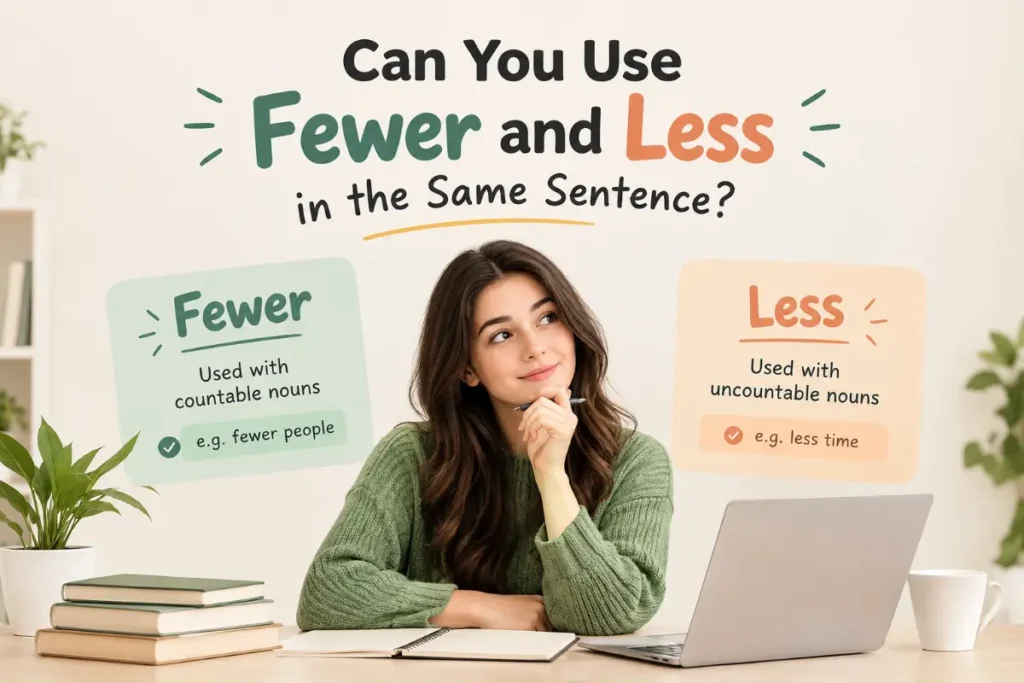
Can You Use Fewer and Less in the Same Sentence
Yes. Sometimes a sentence needs both words because it compares different kinds of quantities.
For example:
“Fewer employees worked overtime, and the company spent less money on labor.”
Employees are countable, so fewer is appropriate. Money is treated as an amount, so less is the natural choice.
Another example is “We bought fewer bottles of water and used less plastic.”
Bottles are countable objects. Plastic is treated as a material.
Using both words in one sentence can make your writing more precise because each word describes the right kind of quantity.
Need another quick comparison? Read Prescribe vs Proscribe: The Difference Explained (2026 Guide).
Why People Confuse Fewer and Less
The confusion isn’t surprising. Both words express reduction, and everyday speech doesn’t always follow the traditional grammar rule.
Several factors make the distinction harder than it first appears.
Both Words Express a Smaller Quantity
The main reason for confusion is that fewer and less share a similar meaning. Both describe a reduction.
For example:
- We need fewer chairs.
- We need less space.
In both cases, the speaker wants a smaller quantity. The difference lies in how English treats the noun.
Chairs are separate countable objects. Space is treated as an overall amount.
Measurements Blur the Distinction
Time, money, weight, and distance can be measured using numbers. This makes them seem countable, even though English often treats them as overall quantities.
For example, a person can count five minutes, but “less than five minutes” is still the usual expression.
Similarly, people commonly say “less than ten dollars” when referring to a total price. These established patterns can make the general rule seem inconsistent.
The rule is still useful. You simply need to recognize that measurements often follow a familiar convention.
Everyday Speech Favors Simplicity
In casual conversation, people often choose the shorter or more familiar expression without thinking about grammar.
“Ten items or less” is a well known example. Many people recognize it immediately from store signs and checkout lanes.
That doesn’t make fewer than ten items wrong. In fact, fewer than ten items follows the traditional rule for countable nouns.
Language develops through repeated use, so common expressions sometimes survive even when they don’t match a simplified grammar rule.
Nouns Can Change Meaning
Words such as chicken, paper, coffee, and experience can be countable or uncountable depending on their meaning.
For example:
- Fewer coffees were ordered today.
- Less coffee was wasted today.
The first sentence counts servings. The second describes an amount of coffee.
This flexibility makes English expressive, but it also means you can’t always choose fewer or less by looking at a noun in isolation.
Grammar Advice Can Be Too Rigid
A basic lesson may tell you to use fewer with countable nouns and less with uncountable nouns. That’s a useful starting point, but it doesn’t cover every common expression.
If you treat the rule as absolute, you may question natural phrases such as less than an hour or less than five miles.
The better approach is to learn the standard rule first and then understand the established exceptions.
That way, you can write accurately without second guessing every sentence.
Fewer vs Less in American British Canadian and Australian English
The basic difference between fewer and less applies across major varieties of English. American, British, Canadian, and Australian English all use fewer with ordinary plural countable nouns and less with uncountable amounts.
However, everyday expressions and editorial preferences can vary.
American English
In the United States, fewer is the standard choice for countable items in careful writing.
For example:
- Fewer people attended the event.
- Fewer than ten items are allowed.
- We need less time to finish the project.
You will also see less used in familiar expressions such as “10 items or less” at supermarkets and retail stores.
Although this wording is widely understood, many American editors prefer “10 items or fewer” when the goal is to follow the traditional grammatical distinction.
British English
British English follows the same basic rule.
For example:
- Fewer students enrolled in the course.
- We used less energy this year.
- Fewer than twenty guests arrived.
British speakers also use less with measurements, including time, distance, and money.
The distinction isn’t a simple difference between American and British spelling. Both words are standard in both varieties.
Canadian English
Canadian English generally follows the same conventions as American and British English.
For example:
- Fewer vehicles entered the parking lot.
- The new building uses less electricity.
- We received fewer applications this year.
For formal Canadian writing, the countability rule remains a reliable guide.
Australian English
Australian English also distinguishes fewer from less according to countability.
Examples include:
- Fewer students missed class.
- We need less water during the dry season.
- The new policy created fewer delays.
In all four varieties, the main difference concerns meaning and grammar rather than regional spelling.
Common Mistakes With Fewer and Less
Even experienced writers sometimes confuse these words. The following mistakes are worth watching for when editing your own work.
Using Less With Ordinary Plural Countable Nouns
Incorrect in standard edited English: “There are less cars on the road.”
Better: “There are fewer cars on the road.”
Cars are separate countable objects, so fewer is the standard choice.
Another example:
Incorrect: “We received less complaints this month.”
Better: “We received fewer complaints this month.”
Complaints can be counted individually, so fewer fits the sentence.
Using Fewer With Uncountable Nouns
Incorrect: “I need fewer information before making a decision.”
Correct: “I need less information before making a decision.”
Information is uncountable in standard English. If you want to count individual pieces, you can say “I need fewer facts” or “I need fewer pieces of information.”
This is a useful distinction because changing the noun can make fewer correct.
Assuming Less Is Always Wrong With Numbers
Incorrect assumption: Any sentence containing a number must use fewer.
Natural examples include:
- Less than five minutes remain.
- The package weighs less than ten pounds.
- The ticket costs less than $40.
These sentences refer to duration, weight, and price. Less is the conventional choice.
Changing a Natural Expression Unnecessarily
Writers sometimes replace less with fewer without considering the sentence’s meaning.
For example, “The journey took less than two hours” is perfectly natural. Changing it to “The journey took fewer than two hours” may sound awkward to many speakers.
The important point is to distinguish a count of separate items from a measurement of an overall quantity.
Using Less Instead of Fewer in Formal Reports
A report might say, “Less participants completed the survey.”
In careful writing, revise it to “Fewer participants completed the survey.”
Participants are countable people, so fewer makes the sentence clearer and follows standard editorial practice.
Confusing Less With Lesser
Less and lesser have related meanings, but they don’t always serve the same purpose.
Less usually describes a smaller amount or degree.
- We need less time.
- This option is less expensive.
Lesser often means lower in rank, importance, or degree.
- The lesser of two evils.
- A lesser role in the organization.
Don’t replace lesser with fewer or assume that all three words work interchangeably.
Thinking That Every Grammar Rule Has No Exceptions
The rule about countability is a strong guide, not a complete description of every English expression.
Established phrases such as less than an hour and less than five miles are natural and widely accepted. Likewise, less is standard when comparing degrees, as in less useful or less reliable.
Good editing requires both grammatical knowledge and an understanding of normal usage.
Memory Tricks for Fewer vs Less
You don’t need to memorize dozens of separate rules. A few simple techniques can help you choose the right word quickly.
Use the How Many or How Much Test
Ask yourself one question.
- How many? Usually choose fewer.
- How much? Usually choose less.
For example, how many books? Fewer books.
How much water? Less water.
This test works well for ordinary nouns, although measurements such as time, distance, and money often use less.
Remember the Fewer Items Rule
Think of fewer as the word for separate items.
Fewer books. Fewer people. Fewer mistakes. Fewer emails.
Picture each item as a separate object you could point to or count.
Remember Less as a Whole Amount
Think of less as reducing a quantity rather than counting separate objects.
Less sugar. Less noise. Less stress. Less traffic.
You can still measure these things, but the sentence focuses on the amount or degree.
Learn Common Phrases as Complete Units
Some expressions are easier to remember as a whole.
For example:
- Fewer than ten people.
- Less than an hour.
- Fewer mistakes.
- Less money.
- Fewer appointments.
- Less time.
Learning natural word combinations helps you write faster and avoid awkward sentences.
Try a Quick Practice Test
Test Your Knowledge
0 of 5 answered
1. We need ___ chairs for the meeting.fewerless
2. I have ___ patience today.fewerless
3. The trip took ___ than three hours.fewerless
4. She made ___ mistakes on the second test.fewerless
5. We used ___ electricity this month.fewerless
Try AgainMore Practice
Related Words and Expressions
Understanding fewer and less becomes easier when you compare them with related words.
Few vs Little
Few and little follow a similar distinction.
Few describes a small number of countable things.
- Few people understood the instructions.
- Few opportunities were available.
Little describes a small amount of something uncountable.
- We have little time left.
- There is little evidence to support the claim.
Fewer and less are comparative forms. Few and little usually describe a small number or amount without directly comparing it with another one.
Few vs A Few
Few and a few have slightly different meanings.
“Few people attended” suggests that the number was small and may imply disappointment.
“A few people attended” means some people attended. The tone is often more positive or neutral.
For example:
- Few customers complained. This emphasizes that complaints were rare.
- A few customers complained. This confirms that some customers complained.
The same distinction appears in expressions such as few opportunities and a few opportunities.
Little vs A Little
Little often suggests that an amount is insufficient or smaller than expected.
A little usually means some amount, often enough for a particular purpose.
For example:
- We have little time left. This suggests a shortage.
- We have a little time left. This suggests that some time remains.
The difference is subtle but useful in everyday communication.
More vs Fewer and Less
More is the comparative word that works with both countable and uncountable nouns.
- More books.
- More water.
- More time.
- More people.
Fewer and less describe a reduction in number or amount. More describes an increase.
For example, “We need fewer meetings but more time to work” contrasts the number of meetings with the amount of available time.
Lesser vs Less
Less usually refers to amount or degree, while lesser often refers to lower importance, rank, or value.
For example, “We need less effort” discusses the amount of effort. “A lesser concern” describes something of lower importance.
The words overlap in some contexts, but they aren’t interchangeable in every sentence.
Expert Editor’s Note
As an editor, I’d recommend following the countability rule first, then checking the sentence for an established expression.
Use fewer for ordinary plural countable nouns such as people, books, errors, applications, and meetings. Use less for uncountable nouns such as information, water, traffic, and patience.
However, don’t automatically change every instance of less that appears before a number. Expressions such as less than an hour, less than five miles, and less than $50 are standard and natural.
Dictionaries document both the traditional distinction and the broader uses of less. Major editorial references generally favor fewer with countable nouns in careful writing, while recognizing conventional uses of less with measurements and quantities.
For a professional article, school assignment, or business report, I would usually change “less customers” to “fewer customers.” I would leave “less than ten minutes” as it is.
My practical recommendation is to prioritize clear meaning and established usage rather than treating grammar as a mechanical substitution exercise. Good editing means knowing the rule and knowing how English speakers actually use it.
Frequently Asked Questions
Is fewer or less grammatically correct
Both words are grammatically correct, but they serve different purposes. Fewer normally modifies plural countable nouns, such as books, people, and mistakes. Less normally modifies uncountable nouns, such as water, time, and information. Less also appears naturally in expressions involving measurements, degrees, and prices.
Is it 10 items or less or 10 items or fewer
“10 items or fewer” follows the traditional grammar rule because items are countable. However, “10 items or less” is widely used on store signs and in everyday speech. For formal writing, fewer is the safer choice when referring to a number of separate items.
Should I say fewer people or less people
Use fewer people in standard edited English. People refers to individual human beings, so it is a plural countable noun. Although less people appears in casual conversation, fewer people is the preferred form for professional writing, academic work, and careful editing.
Is it less time or fewer time
Less time is correct because time is usually treated as an uncountable quantity in this expression. For example, “We need less time to finish the project” is natural English. You can use fewer with countable units such as hours, minutes, or appointments, depending on the intended meaning.
Is it fewer money or less money
Less money is correct in standard English because money is uncountable. You can say “We spent less money this month” or “The project requires less money.” Use fewer when counting separate financial items, such as fewer payments, fewer coins, or fewer bills.
Is it fewer than or less than
Both expressions are correct. Use fewer than with countable nouns, as in “fewer than twenty students.” Use less than with amounts and measurements, as in “less than an hour” or “less than five miles.” The noun and the meaning determine the appropriate expression.
Can less be used with countable nouns
Yes, in established expressions involving measurements, time, money, and distance. For example, “less than ten minutes” and “less than $20” are natural. However, fewer remains the preferred choice with ordinary plural countable nouns such as students, books, and customers.
Why do people say less people
People often use less people because both fewer and less communicate the idea of reduction. The phrase is common in informal speech, but fewer people follows the traditional countability rule. In formal or edited writing, choose fewer people to keep the sentence clear and grammatically standard.
Is less better than fewer
No. Neither word is generally better than the other. Less works with uncountable amounts and degrees, while fewer works with ordinary plural countable nouns. The correct choice depends on the sentence. Replacing one with the other without considering the noun can make a sentence sound unnatural.
What is the easiest way to remember fewer vs less
Use the how many or how much test. If you’re counting separate items, choose fewer. If you’re describing an amount or degree, choose less. Remember common measurement expressions such as less than an hour, too. This simple approach handles most everyday writing situations.
Many readers also check Take Affect Vs Take Effect Which One Is Correct 2026.
Conclusion
The difference between fewer vs less comes down to how English treats the noun you’re describing.
Use fewer for ordinary plural countable nouns, such as books, people, meetings, and mistakes. Use less for uncountable amounts, such as water, money, time, and information, as well as for degrees of qualities and many measurements.
Remember that expressions such as less than an hour and less than $50 are natural English. You don’t need to replace less with fewer every time a number appears.
When you’re unsure, look at the noun and ask yourself if you’re counting separate items or describing an overall amount. That small habit will help you write more clearly, edit with confidence, and avoid one of English’s most common usage mistakes.
Count the items with fewer. Measure the amount with less.

Editorial Reviewer & Proofreader
Grace Mitchell reviews Gramlify’s articles for clarity, consistency, and readability. She is passionate about creating accurate, approachable content that helps English learners build confidence.