
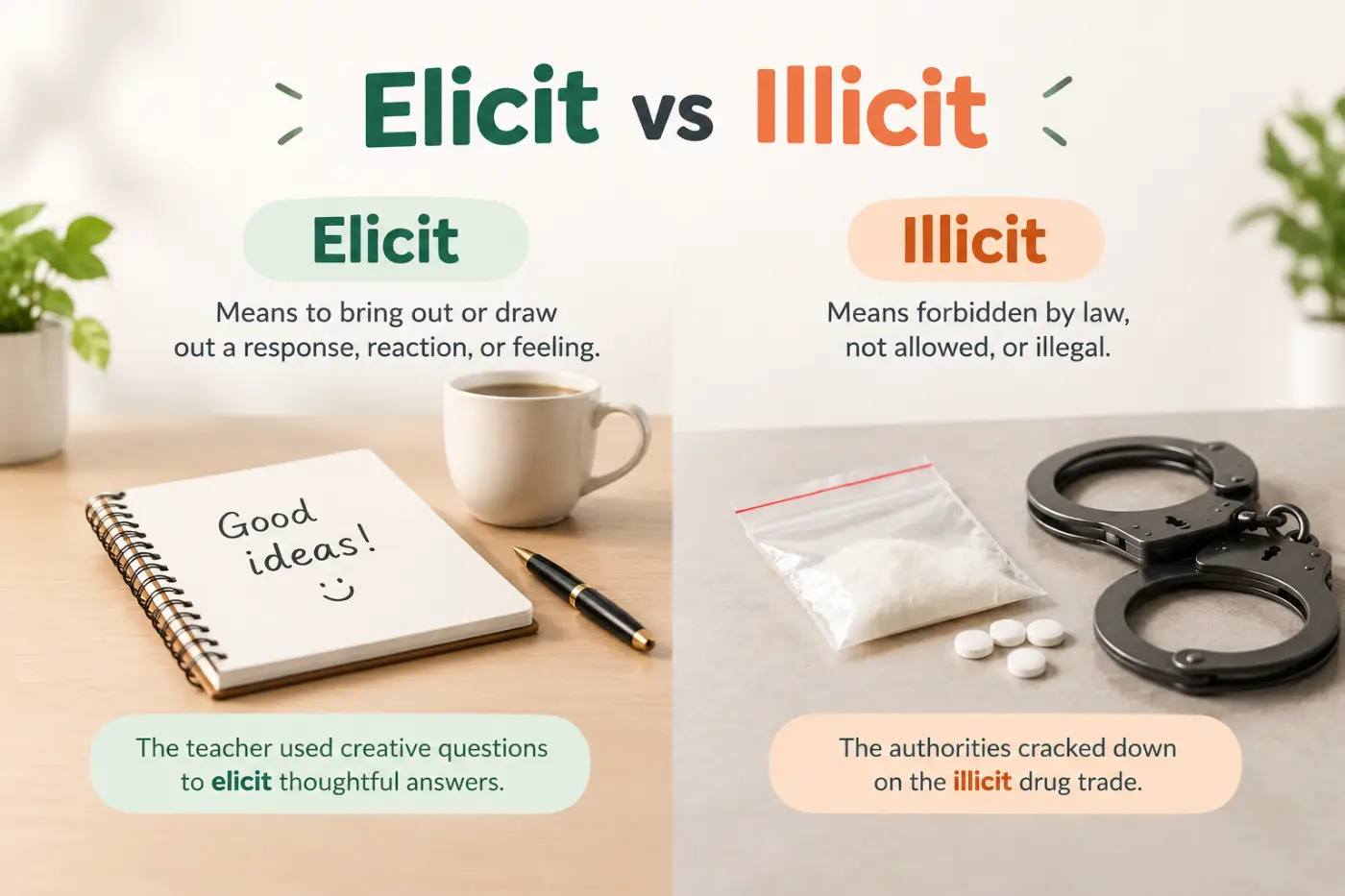
The words elicit and illicit look almost identical, but they have very different meanings. If you’ve ever paused while writing an email, an essay, or a professional report because you weren’t sure which word to use, you’re not alone. Understanding elicit vs illicit comes down to one simple distinction. Elicit means to draw out a response or reaction, while illicit means illegal or forbidden.
Although these words sound similar, they serve different purposes in a sentence. You might elicit a smile from a friend, elicit an honest answer during an interview, or elicit useful feedback from a customer. By contrast, illicit describes something that breaks a law, violates a rule, or involves forbidden activity, such as illicit trade or illicit drugs.
The confusion often comes from their similar spelling and pronunciation. Both words contain the same ending sound, and the first syllable sounds alike to many English speakers. However, replacing one with the other can change a sentence’s meaning completely.
This guide explains the definitions, pronunciation, grammar, word origins, and practical differences between elicit and illicit. You’ll also find natural examples, common mistakes, memory tricks, and answers to frequently asked questions. By the end, you’ll know exactly which word to choose in everyday conversation, academic writing, and professional communication.
Related reading idea: Link to an article about [commonly confused English words] after this introduction.
For another common grammar confusion, see Serpent Vs Snake Difference Meaning And Correct 2026.
Quick Answer
Elicit is a verb meaning to draw out a response, answer, feeling, or reaction. Illicit is an adjective meaning illegal, unlawful, or forbidden. For example, a teacher may elicit answers from students, while police may investigate illicit activity. Remember that elicit describes an action, while illicit describes something prohibited.
Elicit vs Illicit Comparison Table
| Feature | Elicit | Illicit |
|---|---|---|
| Correct spelling | Elicit | Illicit |
| Part of speech | Verb | Adjective |
| Main meaning | To draw out a response | Illegal or forbidden |
| Pronunciation | ih LIS it | ih LIS it |
| Syllables | Three | Three |
| Stress | Second syllable | Second syllable |
| Common use | Questions and reactions | Crime and prohibited activity |
| Example | The question elicited a laugh. | They investigated illicit trade. |
| Related word | Elicitation | Illicitly |
| Opposite idea | Suppress or discourage a response | Lawful or permitted |
The key difference is grammatical as well as semantic. Elicit describes what someone does, while illicit describes the nature of something.
What Elicit Means
Elicit is a verb that means to draw out, obtain, or bring forth a response, reaction, piece of information, or feeling from someone or something.
The response might come from a person, a group, a situation, or even a physical object. For instance, a teacher can elicit an answer from a student, a joke can elicit laughter, and a survey can elicit useful feedback.
How to use elicit in a sentence
Elicit usually takes a direct object. The direct object tells readers what response, information, or reaction someone draws out.
Examples include:
- The interviewer tried to elicit an honest answer.
- Her speech elicited strong emotions from the audience.
- The teacher asked a question to elicit different opinions.
- The new policy elicited complaints from employees.
- The experiment elicited an unexpected reaction.
In each example, something causes or draws out a response.
You can also use elicit when describing an effort to obtain information. A researcher might elicit details about a person’s experience through careful questions. A manager might elicit suggestions from employees during a meeting.
Common contexts for elicit
Elicit appears in several areas of English, especially when people want to describe how a response or information emerges.
Education. Teachers elicit answers, ideas, and opinions to encourage students to think rather than simply repeat information.
Psychology. Researchers may study the emotions or behaviors that certain situations elicit.
Journalism. An interviewer may ask follow up questions to elicit more detailed answers.
Business. Companies may elicit customer feedback to understand complaints and improve their services.
Everyday conversation. A funny story can elicit laughter, while an unexpected comment can elicit surprise.
The word often sounds slightly more formal than get, draw out, or bring out. However, it remains natural in professional conversations and clear everyday writing.
Elicit in different verb forms
Elicit is a regular verb. Its forms follow the usual pattern for verbs ending in a consonant followed by t.
| Verb form | Example |
|---|---|
| Base form | elicit |
| Third person singular | elicits |
| Past tense | elicited |
| Past participle | elicited |
| Present participle | eliciting |
Examples:
- The question elicits honest answers.
- The survey elicited useful feedback.
- The interview has elicited several new details.
- The speaker is eliciting reactions from the audience.
Notice the spelling of elicited and eliciting. The past tense adds ed, while the present participle adds ing. The final t remains in both forms.
What Illicit Means
Illicit is an adjective that describes something illegal, unlawful, unauthorized, or forbidden by a rule or accepted standard.
The word often appears in discussions of crime, drugs, trade, money, relationships, and other activities that violate laws or established rules. Its exact meaning depends on the context.
For example, illicit trade refers to trade that breaks applicable laws or regulations. Illicit payments are payments that are unlawful or improper in the relevant context.
How to use illicit in a sentence
Illicit generally comes before a noun or after a linking verb.
Examples include:
- Police uncovered an illicit drug operation.
- The investigation focused on illicit financial transactions.
- The company was accused of making illicit payments.
- Officials worked to stop illicit wildlife trafficking.
- The report described an illicit network operating across borders.
In these sentences, illicit describes the activity or thing under discussion. It doesn’t describe an action performed to obtain an answer.
Common contexts for illicit
Law enforcement. Police and investigators may refer to illicit activity when discussing conduct that violates the law.
Finance. Reports may describe illicit financial flows, unlawful payments, or money connected to criminal activity.
Trade. Illicit trade includes prohibited transactions, such as the illegal sale of protected wildlife.
Public health. The phrase illicit drugs often refers to drugs produced, sold, or used in violation of applicable laws. The legal status of particular substances can vary by jurisdiction and circumstances.
News reporting. Journalists may use illicit to describe alleged illegal activity, provided the wording accurately reflects the available evidence.
Illicit and its related forms
Illicit is primarily an adjective. Its related adverb is illicitly, which means in an illicit or unlawful manner.
For example:
- The goods were imported illicitly.
- The organization allegedly operated an illicit network.
- Investigators examined the illicit payments.
Unlike elicit, illicit doesn’t have ordinary verb forms such as illicited or illiciting. Those forms are incorrect for standard English.
Which One Is Correct
Both elicit and illicit are correct English words. The right choice depends on the meaning of your sentence.
Use elicit when someone or something draws out a response, reaction, answer, or piece of information. Use illicit when describing something illegal, unauthorized, or forbidden.
Consider these examples:
- Correct: The question elicited an interesting response.
- Incorrect for this meaning: The question illicited an interesting response.
- Correct: Investigators discovered illicit payments.
- Incorrect for this meaning: Investigators discovered elicit payments.
The incorrect versions fail because they use a word with the wrong meaning or grammatical function.
A simple rule for choosing the right word
Ask yourself one question. Am I describing an action that brings out a response, or am I describing something prohibited?
If you’re describing an action, choose elicit.
If you’re describing something illegal or forbidden, choose illicit.
For example, a journalist might elicit information from a source about illicit financial activity. Both words are correct in that sentence because they perform different jobs.

Why People Confuse Elicit and Illicit
The confusion makes sense. These words look similar, sound almost identical, and contain the same number of syllables. However, their meanings and grammatical roles are distinct.
Their spelling differs by one letter
Elicit begins with e, while illicit begins with i. The remaining letters are identical.
That small difference is easy to overlook when reading quickly or typing under pressure. It becomes especially tricky in longer sentences where the surrounding words don’t immediately reveal the intended meaning.
For example, a writer discussing an investigation might accidentally type elicit activity instead of illicit activity. Since both words are real English words, a spellchecker may not flag the mistake.
Their pronunciation is almost identical
In common English pronunciation, both words are pronounced ih LIS it. Their first vowels may vary slightly across accents, but the difference isn’t reliable enough to distinguish them in every conversation.
As a result, context does most of the work. If someone says that an interview elicited a response, the surrounding words point to the verb. If someone refers to illicit trade, the adjective clearly fits the meaning.
They perform different grammatical jobs
This is one of the most important distinctions.
Elicit is a verb. It describes an action.
Illicit is an adjective. It describes a noun.
Compare these sentences:
- The speech elicited applause.
- The speech exposed illicit conduct.
In the first sentence, elicited tells us what the speech did. In the second, illicit describes the conduct.
Learning this difference is more useful than memorizing the spellings alone because it helps you catch mistakes before you finish a sentence.
Spellcheck may not catch the mistake
Most basic spellcheckers look for words that are misspelled. They don’t always recognize a correctly spelled word used in the wrong context.
For example, both elicit information and illicit information are possible combinations of English words, but they mean different things. The second phrase could describe information obtained or handled unlawfully, depending on context.
This is why proofreading requires more than running a spelling check. You also need to confirm that the word communicates the meaning you intend.
Internet searches can reinforce the confusion
People often search for phrases such as elicit or illicit, elicit vs illicit meaning, and illicit vs elicit examples because they know the words are similar but can’t recall the distinction.
Online discussions may repeat incorrect examples or oversimplified explanations. The safest approach is to focus on each word’s definition, grammatical role, and use in a complete sentence.
Key Differences Between Elicit and Illicit
The easiest way to understand these words is to compare their meaning, grammar, sentence patterns, and common contexts.
Meaning and function
Elicit refers to the act of bringing something out or drawing something from a source. The result may be a response, feeling, answer, or reaction.
Illicit refers to something that violates a law, rule, or accepted restriction.
Compare:
- The comedian elicited laughter from the crowd.
- The police investigated an illicit gambling operation.
The comedian caused a reaction. The gambling operation involved activity described as prohibited or unlawful.
Part of speech
Elicit functions as a verb, so it can change according to tense and subject.
- I elicit.
- She elicits.
- They elicited.
- We are eliciting.
Illicit functions as an adjective. It describes a noun rather than naming an action.
- Illicit activity.
- Illicit trade.
- Illicit payments.
- The activity was illicit.
A practical proofreading trick is to check the word’s position. If the sentence needs a verb to express what someone did, elicit may fit. If it needs an adjective to describe a noun, illicit may fit.
Tone and formality
Both words appear in formal and professional English, but their tones differ because their meanings differ.
Elicit often sounds analytical or precise. Writers use it to describe interviews, experiments, questions, and efforts to gather information.
Illicit often appears in legal, financial, political, and news contexts. It can carry a serious or negative tone because it refers to prohibited or unlawful conduct.
Neither word is inherently better for formal writing. The correct choice depends on the intended meaning.
Common word combinations
Learning common word combinations makes both words easier to remember.
| Elicit | Illicit |
|---|---|
| Elicit a response | Illicit activity |
| Elicit an answer | Illicit trade |
| Elicit laughter | Illicit drugs |
| Elicit information | Illicit payments |
| Elicit sympathy | Illicit financial flows |
| Elicit feedback | Illicit trafficking |
| Elicit a reaction | Illicit market |
| Elicit an explanation | Illicit transactions |
These combinations are useful patterns rather than fixed rules. Always consider the meaning of the complete sentence.

Pronunciation Guide for Elicit and Illicit
Elicit and illicit are usually pronounced the same way in standard American English. This makes them homophones for many speakers, although vowel quality can vary across accents.
Elicit
IPA: /ɪˈlɪsɪt/
Pronunciation guide: ih LIS it.
Syllables: e · lic · it.
Stress: The second syllable.
Illicit
IPA: /ɪˈlɪsɪt/
Pronunciation guide: ih LIS it.
Syllables: il · lic · it.
Stress: The second syllable.
How to pronounce both words correctly
Break each word into three spoken parts.
- Start with a short ih sound.
- Stress the middle syllable, LIS.
- Finish with a short it sound.
Say the words slowly, then at a natural speed. The goal is to place the stress on the middle syllable without stretching the other sounds.
Common pronunciation mistakes
One mistake is stressing the first syllable instead of the second. Another is pronouncing the ending as ite rather than the short it sound.
However, pronunciation alone usually won’t help you choose between these words. Since they sound alike for many American English speakers, focus on spelling, grammar, and context.
For another common grammar confusion, see Propose Vs Purpose Which Word Should You Use.
Elicit vs Illicit Word Origins
Understanding the origins of these words can help explain their different meanings. Both have roots in Latin, but they developed along separate paths.
The origin of elicit
Elicit comes from Latin elicere, meaning to draw out or entice forth. The Latin verb combines a prefix associated with drawing out and a root related to calling or bringing forth.
English adopted elicit with a similar sense. Today, it commonly describes bringing out a response, feeling, answer, or piece of information.
That history connects directly to modern expressions such as elicit a response and elicit information. The central idea remains the same: something is drawn out from a person or situation.
The origin of illicit
Illicit comes from Latin illicitus, meaning unlawful or not permitted. The word developed from a negative prefix and a form related to permission or what is allowed.
That origin explains why illicit describes conduct or things that aren’t permitted under the relevant law or rule.
Modern expressions such as illicit trade and illicit payments preserve this idea of prohibited conduct.
Does their shared Latin background explain the confusion
Their origins help explain their meanings, but they don’t make the words interchangeable. Elicit developed around drawing something out, while illicit developed around the idea of something not being permitted.
Their similar modern spelling and sound are the main reasons people mix them up. Remembering their separate meanings is more useful than assuming that words with similar endings must be related in meaning.
Spelling Rules and Word Forms
Neither word presents a difficult spelling pattern once you learn the difference between them. The challenge is choosing the correct word, not memorizing an unusual spelling rule.
How to spell elicit
The correct spelling is e l i c i t, written as one word: elicit.
Its common forms are:
- Elicit.
- Elicits.
- Elicited.
- Eliciting.
The spelling stays recognizable as the verb changes form.
Examples:
- The question elicits a detailed answer.
- Her comment elicited a strong reaction.
- The interviewer is eliciting more information.
Avoid invented forms such as ellic it or ellicit. Standard English uses one l in elicit.
How to spell illicit
The correct spelling is i l l i c i t, written as one word: illicit.
Notice that it contains two consecutive l letters. That is the most visible spelling difference between the two words.
Its common form is the adverb illicitly.
Examples:
- Officials investigated illicit trade.
- The goods were moved illicitly.
- The report described an illicit transaction.
Avoid spelling illicit with one l when you mean illegal or forbidden.
Is there a British and American spelling difference
No. Elicit and illicit have the same standard spellings in American, British, Canadian, and Australian English.
Unlike words such as color and colour, these two words don’t have separate regional spellings. The distinction between them is about meaning and grammar, not geography.
Grammar Explanation With Sentence Patterns
The best way to use these words correctly is to understand the sentence patterns they commonly follow.
The usual pattern for elicit
A common structure is:
Subject + elicit + object.
The subject causes or draws out the object.
Examples:
- The question elicited an answer.
- The film elicited strong emotions.
- The survey elicited customer feedback.
- Her apology elicited forgiveness.
In each sentence, the object identifies the response or result that emerged.
You can add more detail to explain how or from whom the response was obtained.
For example, The interviewer elicited a detailed account from the witness. The object is a detailed account, while from the witness identifies the source.
Can elicit be used without a direct object
Elicit usually takes an object because it describes drawing something out. In some contexts, the object may be understood from earlier sentences, but clear writing generally names the response or information being elicited.
For example, The question failed to elicit a response is clearer than The question failed to elicit when the reader doesn’t already know what response is being discussed.
The usual pattern for illicit
Illicit typically appears before a noun or after a linking verb.
Pattern one: Illicit + noun.
- Illicit trade.
- Illicit payments.
- Illicit activity.
Pattern two: Noun + linking verb + illicit.
- The transaction was illicit.
- The activity appeared illicit.
- The arrangement was considered illicit.
These structures show how an adjective describes a thing or situation.
Can illicit describe a person
Illicit generally describes an activity, transaction, relationship, substance, or other thing. It can appear in a phrase referring to a person indirectly, but writers should avoid confusing a person’s identity with the legality of a particular action.
For example, The company investigated an employee’s involvement in illicit transactions is more precise than using illicit as a broad label for the employee.
Can illicit become a verb
No. Illicit is not a standard English verb.
You cannot use illicited to mean that someone broke the law. Instead, choose a verb that describes the actual action, such as violated, broke, prohibited, or conducted illegally, depending on the sentence.
Compare:
- Incorrect: The group illicit ed the rules.
- Correct: The group violated the rules.
- Correct: The group engaged in illicit activity.
The second example uses a verb. The third uses illicit as an adjective.

Real Life Examples of Elicit vs Illicit
These examples show how the two words work in different situations. Pay attention to the surrounding words because context often makes the correct choice clear.
Everyday conversation
- Her cheerful greeting elicited a smile from the cashier.
- That surprising question elicited an awkward silence.
- The children’s funny story elicited laughter from everyone.
- His apology elicited sympathy from his friends.
- The documentary elicited strong emotions from viewers.
In these examples, elicit describes a response caused by a person, question, or event.
Workplace and business
- The manager asked questions to elicit employee feedback.
- The presentation elicited several useful suggestions.
- The customer survey elicited complaints about delivery times.
- Investigators examined the company’s alleged illicit payments.
- The audit uncovered an illicit arrangement between two suppliers.
The first three examples concern obtaining reactions or information. The last two describe conduct suspected of being unlawful or prohibited.
Emails and professional communication
- I hope this question will elicit a clear explanation.
- The meeting elicited several concerns about the new schedule.
- Please share any suggestions that might elicit better results.
- The compliance team reviewed reports of illicit transactions.
- The company updated its policies to prevent illicit financial activity.
In formal emails, elicit is useful when discussing feedback or responses. Illicit is appropriate when the subject involves prohibited or unlawful activity.
Academic writing and education
- The teacher used open ended questions to elicit thoughtful answers.
- The research team designed an interview to elicit participants’ views.
- The experiment elicited a measurable change in behavior.
- The paper examines the effects of illicit drug markets.
- The researchers discussed the risks associated with illicit data collection.
Academic writers should use elicit when describing how information or a response was obtained. They should use illicit only when the relevant activity is unlawful or prohibited under the rules being discussed.
Journalism and literature
- The reporter’s question elicited a detailed response from the official.
- The announcement elicited mixed reactions from the public.
- The investigation exposed an alleged illicit trading network.
- The novel portrays a character involved in illicit affairs.
- The article explores efforts to stop illicit wildlife trafficking.
News writers should take special care with illicit because it can imply wrongdoing. When a case remains unresolved, terms such as alleged illicit activity may be more accurate than stating that unlawful conduct has been proven.
Social media and informal writing
- That video elicited thousands of laughing reactions.
- Her honest post elicited supportive comments.
- The question elicited a lively debate in the comments.
- The post discussed the risks of illicit online sales.
- The report raised concerns about illicit access to private accounts.
Even in informal writing, the distinction stays the same. Elicit describes a response, while illicit describes prohibited activity.
Common Mistakes With Elicit and Illicit
Even experienced writers can confuse these words because both are valid English words and their pronunciation is nearly identical. The best way to avoid errors is to check the meaning and grammatical role of each word.
Using illicit when you mean elicit
Incorrect: The teacher tried to illicit an answer from the student.
Correct: The teacher tried to elicit an answer from the student.
The teacher wants to draw out an answer. The sentence needs a verb, so elicit is the correct choice.
Using elicit when you mean illicit
Incorrect: The police investigated elicit drug sales.
Correct: The police investigated illicit drug sales.
The sentence describes drug sales that violate applicable laws. It needs an adjective to describe the sales.
Assuming one word is a misspelling of the other
Both words are spelled correctly. Neither is a variation of the other, and neither replaces the other in standard English.
This distinction matters because a writer might spend time checking the spelling when the real problem is word choice. If a sentence sounds wrong, check its meaning before assuming the spelling is incorrect.
Treating illicit as a synonym for immoral
Illicit often refers to illegal or forbidden activity, but the word doesn’t automatically mean immoral in every context.
An activity might violate a particular rule without being universally considered immoral. Similarly, a behavior might be viewed as immoral by some people without being illegal.
Use illicit when the context supports the idea of unlawful, unauthorized, or prohibited conduct. If you mean morally wrong, words such as unethical or immoral may be more precise.
Assuming illicit always means criminal
Illicit often appears in discussions of crime, but its meaning can extend to activities forbidden by a rule or restriction. The exact meaning depends on the context.
For example, a relationship may be described as illicit when it violates accepted rules or expectations. In a legal report, however, the word should not replace a precise description of the actual offense.
Writing invented verb forms
Because illicit looks like a word that could function as a verb, some writers mistakenly create forms such as illicited or illiciting.
Standard English doesn’t use those forms as verbs. Use elicit when you mean to draw out a response, and choose a suitable verb such as prohibit, violate, or conduct illegally when discussing unlawful conduct.
Memory Tricks to Remember the Difference
A short memory trick can help you choose the right word when you’re writing quickly.
Remember the E in elicit
Think of Elicit = Extract a response.
Both elicit and extract begin with E. This connection reminds you that elicit means to draw out an answer, reaction, feeling, or piece of information.
For example, an interviewer elicits information by asking questions.
Remember the double L in illicit
Think of Illicit = Illegal.
Both words contain the letters ill at the beginning when written out as illicit and illegal. The shared letters give you a quick visual reminder that illicit relates to prohibited or unlawful activity.
For example, illicit trade involves trade that breaks applicable laws or restrictions.
Use the verb and adjective test
When a memory trick isn’t enough, check the grammar.
- If you need a verb that describes drawing out a response, use elicit.
- If you need an adjective that describes prohibited conduct, use illicit.
Try this simple pair:
- The question will elicit a response.
- The investigation concerns illicit activity.
Read both sentences aloud. Their different meanings become clear when you focus on the action in the first sentence and the description in the second.
Related Words and Expressions
Learning related words can improve your vocabulary and make the difference easier to remember.
Words related to elicit
These words describe obtaining, drawing out, or producing a response. They aren’t exact synonyms in every context.
| Related word | Meaning | Example |
|---|---|---|
| Extract | Remove or obtain something | The researcher extracted useful details from the report. |
| Evoke | Bring a feeling or memory to mind | The song evoked childhood memories. |
| Provoke | Cause a reaction or response | The remark provoked a heated discussion. |
| Obtain | Get something | The team obtained feedback from customers. |
| Draw out | Encourage someone to reveal information | The interviewer drew out a detailed answer. |
| Elicitation | The act of drawing out information or a response | The interview focused on elicitation of feedback. |
These words overlap with elicit, but they aren’t interchangeable in every sentence.
For example, evoke a memory is natural English, while obtain a memory usually doesn’t express the same idea. Choose a synonym based on the exact response or action you want to describe.
Words related to illicit
These words describe conduct that breaks laws, rules, or accepted standards.
| Related word | Meaning | Example |
|---|---|---|
| Illegal | Against the law | The company was accused of illegal activity. |
| Unlawful | Not permitted by law | The court reviewed the alleged unlawful conduct. |
| Forbidden | Not allowed | The rules prohibit forbidden transactions. |
| Prohibited | Officially not allowed | The policy lists prohibited activities. |
| Unauthorized | Not approved by the proper authority | The employee accessed an unauthorized account. |
| Illicitly | In an unlawful or prohibited manner | The goods were imported illicitly. |
The words differ in tone and meaning. Illegal and unlawful usually focus on the law, while unauthorized can refer to actions performed without proper permission. Forbidden and prohibited can apply to rules beyond criminal law.
Elicit vs evoke vs provoke
These three verbs can appear in similar contexts, but each has a different emphasis.
Elicit means to draw out a response or information.
Example: The interviewer elicited an honest answer.
Evoke means to bring a feeling, memory, or image to mind.
Example: The photograph evoked memories of childhood.
Provoke means to cause a reaction, often a strong or negative one.
Example: The comment provoked an angry response.
The distinctions are useful in essays, reports, and creative writing. Elicit often emphasizes obtaining a response, evoke emphasizes bringing something to mind, and provoke emphasizes causing a reaction.
Illicit vs illegal vs unethical
These adjectives also overlap, but they aren’t exact substitutes.
Illicit describes something unlawful or prohibited.
Illegal specifically means against the law.
Unethical means contrary to accepted moral or professional standards.
For example, an illicit payment may violate the law. An illegal transaction breaks the law. An unethical decision violates accepted standards of conduct, even if it isn’t illegal.
The right choice depends on the evidence and the point you’re making. In legal or professional writing, precise language matters more than using a stronger sounding word.

Elicit vs Illicit in British American Canadian and Australian English
The spelling distinction remains the same across major English varieties. American, British, Canadian, and Australian English all use elicit for drawing out a response and illicit for something unlawful or forbidden.
There is no standard regional spelling that changes one word into the other.
| English variety | Verb meaning to draw out | Adjective meaning unlawful |
|---|---|---|
| American English | Elicit | Illicit |
| British English | Elicit | Illicit |
| Canadian English | Elicit | Illicit |
| Australian English | Elicit | Illicit |
Regional differences may affect pronunciation slightly, but the intended meaning and standard spelling stay consistent.
For example, an American journalist might write that a question elicited a response, while an Australian journalist might describe an illicit trading operation. Both use the same spellings and meanings.
If you’re editing content for a specific country, you don’t need to change either word to match the local spelling system. Focus on grammar, context, and accuracy.
Expert Editor’s Note
From an editor’s perspective, elicit and illicit are a classic example of a word choice error that spellcheck alone cannot reliably catch.
Both are established English words. The problem occurs when a writer selects the wrong one for the sentence.
Professional dictionaries distinguish elicit as a verb meaning to draw out a response or information from illicit as an adjective meaning unlawful or forbidden. That distinction should guide every editorial decision.
When proofreading, I recommend three quick checks.
- Check the intended meaning. If the sentence describes drawing out a response, use elicit. If it describes prohibited activity, use illicit.
- Check the grammar. Elicit generally functions as a verb, while illicit modifies a noun or follows a linking verb.
- Check the context. A sentence about an investigation may need illicit, while a sentence about an interview may need elicit.
I would also review the surrounding sentence when the word appears in legal, academic, or journalistic writing. Describing an activity as illicit can imply that it violates a law or rule. If the facts remain uncertain, use careful wording such as alleged illicit activity or explain the specific restriction involved.
The most natural choice is the one that expresses the intended meaning accurately. You don’t need to make the sentence more complicated to sound professional.
Frequently Asked Questions
1. What is the main difference between elicit and illicit
Elicit is a verb meaning to draw out a response, answer, feeling, or piece of information. Illicit is an adjective meaning illegal, unlawful, or forbidden. For example, a question can elicit a response, while a business may be investigated for illicit activity. Their similar spelling doesn’t make them interchangeable.
2. Is elicit a real word
Yes. Elicit is a standard English verb used in everyday, academic, and professional writing. It describes bringing out a response, reaction, or piece of information. For example, a teacher may elicit answers from students, and a survey may elicit customer feedback. Its common forms include elicits, elicited, and eliciting.
3. Is illicit a real word
Yes. Illicit is a standard English adjective that describes something unlawful, illegal, unauthorized, or forbidden. Common expressions include illicit trade, illicit payments, and illicit activity. The exact meaning depends on the situation and the applicable laws or rules. Its adverb form is illicitly.
4. Are elicit and illicit homophones
They are homophones for many English speakers because both are commonly pronounced /ɪˈlɪsɪt/. This means they sound alike even though they have different spellings and meanings. Some accents may produce slight differences in vowel quality, but pronunciation usually isn’t a reliable way to distinguish them.
5. How do you use elicit in a sentence
Use elicit when someone or something draws out a response, answer, feeling, or piece of information. For example, The teacher asked an open ended question to elicit thoughtful answers. You can also write The speech elicited laughter from the audience. The verb usually takes an object that identifies the response obtained.
6. How do you use illicit in a sentence
Use illicit to describe something illegal or forbidden. For example, Investigators uncovered an illicit trading network. You can also write The company reviewed reports of illicit payments. The word generally modifies a noun, although it can follow a linking verb, as in The transaction was illicit.
7. Is illicit the same as illegal
The meanings overlap, but they aren’t always identical in emphasis. Illegal specifically means against the law, while illicit can describe something unlawful or prohibited under a law or other relevant restriction. In formal writing, choose the word that accurately reflects the situation. Avoid calling an activity illegal without a sound basis for that claim.
8. Can you write elicited or illicitly
Yes, but the words belong to different grammatical families. Elicited is the past tense and past participle of elicit, as in The question elicited a response. Illicitly is the adverb form of illicit, as in The goods were imported illicitly. Their forms reflect their different meanings and grammatical roles.
9. Why does spellcheck miss elicit and illicit mistakes
Spellcheckers often recognize individual words without fully understanding their intended meaning. Since elicit and illicit are both correctly spelled words, a basic checker may accept either one even when the sentence uses the wrong word. To catch this error, reread the sentence and check its meaning, grammar, and surrounding context.
10. Is there a difference between British and American spelling
No. Both British and American English use elicit as a verb meaning to draw out a response and illicit as an adjective meaning unlawful or forbidden. Canadian and Australian English follow the same distinction. You don’t need to change the spelling for a regional audience.
11. What is an easy way to remember elicit vs illicit
Remember elicit equals extract a response and illicit equals illegal or forbidden. Elicit is a verb that describes an action, while illicit is an adjective that describes something prohibited. This memory trick works well in school assignments, professional emails, essays, and everyday writing.
12. Which word should I use in formal writing
Choose the word that matches the meaning of your sentence. Use elicit when discussing interviews, feedback, research, or reactions. Use illicit when describing unlawful or prohibited activity. In legal and academic writing, be especially precise with illicit because it can imply wrongdoing. If the facts are uncertain, qualify the claim appropriately.bulary while strengthening your site’s topical coverage.
For another common grammar confusion, see It Is Must vs It Is a Must: Which One Is Correct in 2026?.
Conclusion
The difference between elicit vs illicit is simple once you connect each word to its purpose. Elicit is a verb that means to draw out a response, reaction, or piece of information. Illicit is an adjective that describes something illegal, unlawful, or forbidden.
Remember the two quick associations. Elicit means to extract a response. Illicit relates to illegal activity.
When you’re unsure, check the sentence’s meaning and grammatical structure rather than relying on sound alone. Both words are correct, but only one will express your intended message.
Choose the right word, and your meaning will come through clearly.

Editorial Reviewer & Proofreader
Grace Mitchell reviews Gramlify’s articles for clarity, consistency, and readability. She is passionate about creating accurate, approachable content that helps English learners build confidence.