
You typed prescribe vs proscribe into a search bar because something felt off. Maybe you read a sentence where “proscribed” showed up and it looked like a typo for “prescribed.” Maybe your doctor’s office used one word and a legal document used the other, and now you are not sure which one means what. You are not alone, and you are not bad at English. These two words are one letter apart, they came from the same Latin root, and they somehow ended up meaning almost opposite things.
This guide clears it up for good. No jargon, no dictionary-speak, just a straight explanation with real examples you can actually use.
A related grammar guide is Receipt Vs Recipe Which Word Is Correct 2026 Guide.
Quick Answer: Prescribe vs Proscribe
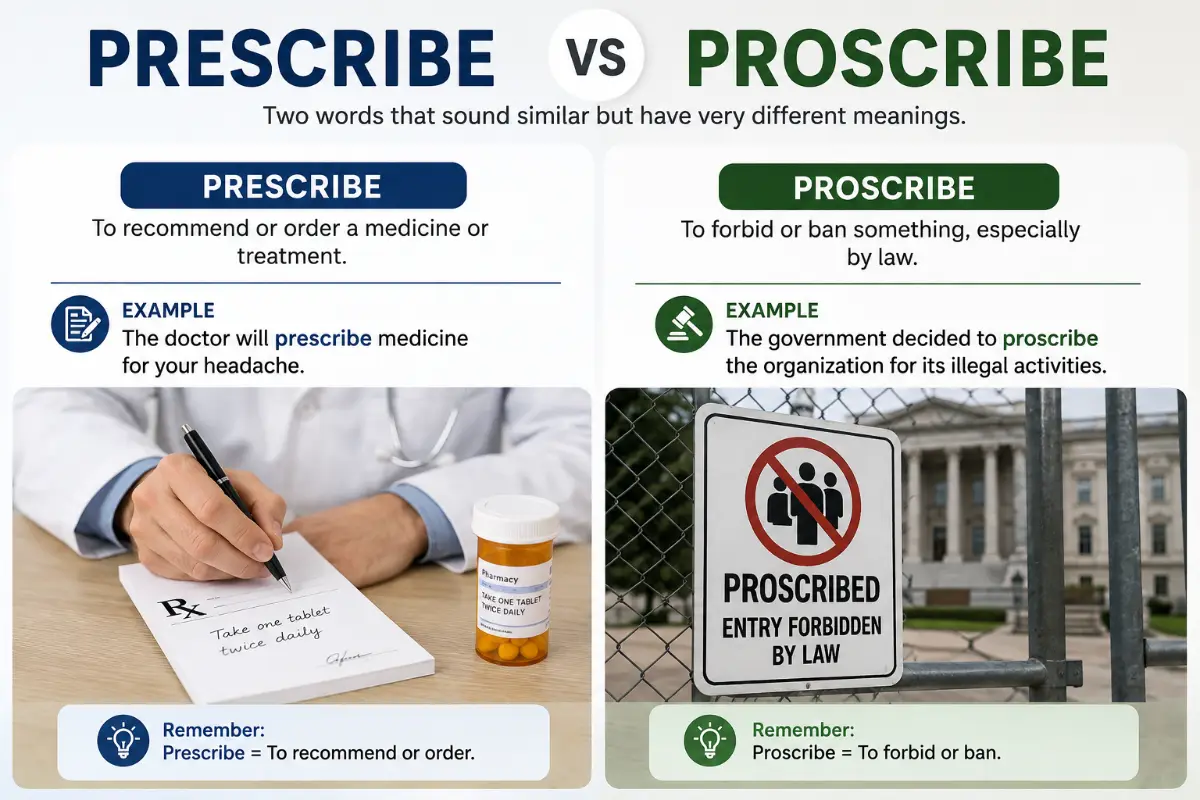
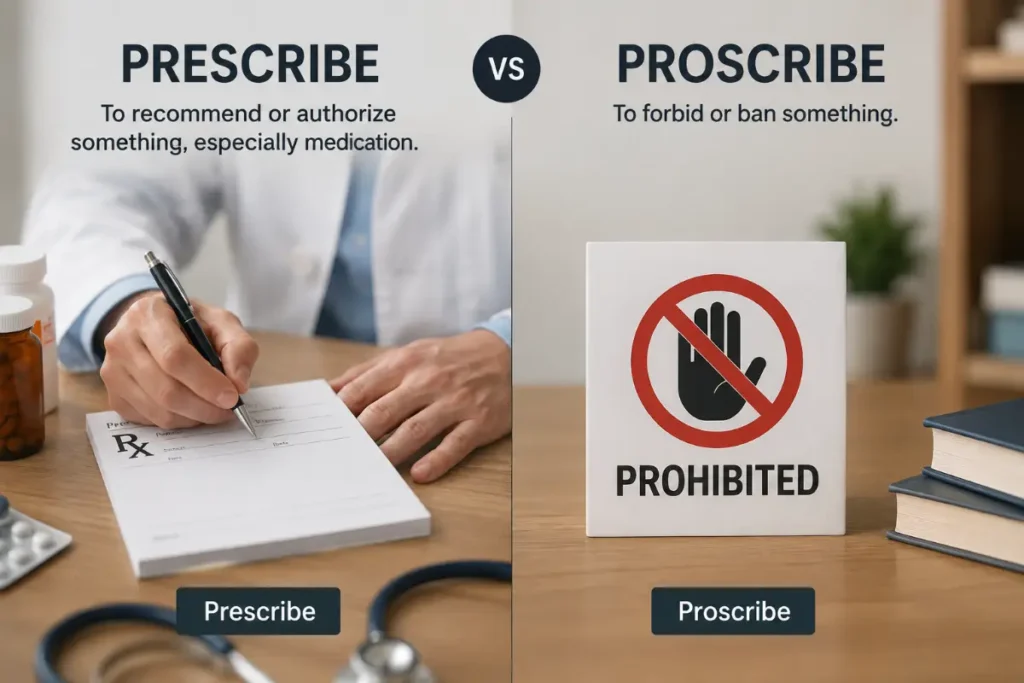
Prescribe means to recommend, authorize, or officially set something as the correct course of action. A doctor prescribes medicine. A rulebook prescribes a procedure.
Proscribe means to forbid or ban something, usually by law, rule, or official authority. A government proscribes a banned substance. A workplace policy proscribes certain behavior.
Think of it this way: prescribe hands you a green light, proscribe puts up a stop sign. One says “do this,” the other says “never do this.”
| Word | Core Meaning | One-Word Substitute | Common Field |
|---|---|---|---|
| Prescribe | To recommend or officially require | Authorize | Medicine, law, education |
| Proscribe | To forbid or ban | Prohibit | Law, policy, ethics |
That table is the whole answer in one glance. Everything below explains why these two words split apart, how to use each one correctly, and how to stop mixing them up for good.
Why These Two Words Get Confused So Often
The confusion is not random. It comes from three things happening at once.
First, both words share a Latin root: scribere, meaning “to write.” Ancient Rome ran on written orders, written laws, and written decrees, so a huge chunk of English vocabulary about rules and authority traces back to that one verb. Prescribe and proscribe are cousins in the truest sense. They grew from the same root but branched in opposite directions depending on the prefix attached to them.
Second, the words look nearly identical on the page. Swap a single letter, “pr-e-scribe” versus “pr-o-scribe,” and your eye can slide right past the difference, especially when you are reading fast or skimming a legal document.
Third, both words deal with rules, authority, and official language. You will run into “prescribe” and “proscribe” in medicine, law, religion, and workplace policy, which are exactly the contexts where precision matters most. Getting this wrong in a contract or a compliance memo is not a small mistake.
Once you understand the prefixes, the confusion mostly disappears.
The Prefix Trick That Fixes This Forever
Latin prefixes carry direction, almost like arrows.
Pre- means “before.” To prescribe something is to lay it down beforehand, to set the rule in advance. Think of “predict,” “prepare,” or “preview.” All of those point forward, toward something established ahead of time.
Pro- in this word functions closer to “forward” or “away,” but the useful memory hack is different. Picture proscribe and prohibit side by side. Both start with pro, both involve banning something, and both carry that same forward-push energy of pushing something away or out. If you remember that “proscribe” rhymes conceptually with “prohibit,” you will never mix it up again.
Here is the cleanest memory trick people use: Prescribe starts like “prepare,” meaning it sets something up as correct. Proscribe starts like “prohibit,” meaning it shuts something down. Say both pairs out loud a few times and the pattern locks in.
Prescribe: Full Meaning and Usage
To prescribe is to officially recommend, authorize, or lay down a rule, method, or course of action as the one to follow. It always carries a sense of authority telling you what should happen.
Where You See Prescribe Most Often
Medicine. This is the most common context by far. A physician examines a patient, decides on a treatment, and prescribes medication, a dosage, or a therapy. The prescription itself, the paper or digital order a pharmacist fills, takes its name directly from this verb.
Law and regulation. Statutes prescribe procedures. A building code prescribes the minimum width of a stairwell. A court prescribes a sentence within a set legal range.
Religion and tradition. Many faiths prescribe specific rituals, prayers, or practices that followers are expected to observe.
Education and standards. A curriculum prescribes which topics a course must cover. A style guide prescribes formatting rules for a document.
General authority. Any time a person or body with recognized authority sets an official method, that authority prescribes it.
Prescribe in a Sentence
- The cardiologist decided to prescribe a lower dose after reviewing the patient’s blood pressure readings.
- State law prescribes a thirty-day waiting period before the divorce becomes final.
- The employee handbook prescribes a specific format for submitting expense reports.
- Her doctor will prescribe physical therapy instead of surgery for the knee injury.
- The building inspector confirmed the contractor followed every measurement prescribed in the safety code.
Notice the pattern across all five sentences: someone with authority (a doctor, a law, a handbook, a code) is setting the correct path forward. That is the fingerprint of prescribe every single time.
Common Synonyms for Prescribe
If you want a substitute word, reach for one of these depending on context: authorize, recommend, direct, mandate, ordain, stipulate, dictate, or specify. “Mandate” and “stipulate” work especially well in legal or contractual writing. “Recommend” works better in medical or advisory contexts where the tone is softer.
Proscribe: Full Meaning and Usage
To proscribe is to forbid, ban, or condemn something, typically through official, legal, or authoritative action. Where prescribe opens a door, proscribe locks one.
Where You See Proscribe Most Often
Law and government. Governments proscribe organizations they classify as extremist or dangerous. Legislatures proscribe certain weapons, substances, or activities.
Workplace and institutional policy. A company’s code of conduct proscribes harassment, discrimination, or conflicts of interest. A university proscribes plagiarism.
Medical and pharmaceutical regulation. Health authorities proscribe unsafe drugs or dangerous drug combinations, banning them outright rather than recommending them.
Ethics and social norms. Certain behaviors are proscribed by cultural or professional codes of ethics, even without a formal law behind them.
Proscribe in a Sentence
- The government moved to proscribe the organization after evidence linked it to violent activity.
- Company policy proscribes any employee from accepting gifts over fifty dollars from a vendor.
- Ancient Roman law proscribed several political opponents, stripping them of property and citizenship.
- The medical board proscribed the combination of those two drugs due to a dangerous interaction.
- Many professional codes of ethics proscribe conflicts of interest among board members.
In every one of these, something is being shut down, banned, or officially condemned. That is the signature move of proscribe.
Common Synonyms for Proscribe
Reach for: forbid, ban, prohibit, outlaw, condemn, bar, or denounce. “Prohibit” is the closest one-to-one match and the easiest to remember because of the shared “pro” sound discussed earlier. “Outlaw” works well in casual or journalistic writing, while “condemn” leans more toward moral or ethical disapproval than strict legal banning.
Prescribe vs Proscribe: Side-by-Side Comparison
| Feature | Prescribe | Proscribe |
|---|---|---|
| Meaning | Recommend, authorize, set as correct | Forbid, ban, officially condemn |
| Direction | Points toward action | Points away from action |
| Related noun | Prescription | Proscription |
| Related adjective | Prescribed, prescriptive | Proscribed, proscriptive |
| Typical authority figure | Doctor, lawmaker, institution | Government, regulator, policy body |
| Emotional tone | Guiding, corrective | Restrictive, punitive |
| Memory anchor | Sounds like “prepare” | Sounds like “prohibit” |
This comparison table is worth bookmarking. Whenever the two words blur together in your head, come back to that “prepare versus prohibit” anchor and the rest falls into place.
Still confused? Compare Loot Vs Lute Which Word Should You Use 2026.
Prescribed or Proscribed by Law: A Legal Deep Dive
Legal writing is where mixing these two up causes the most damage, because a single swapped word can flip the meaning of a clause entirely.
When something is prescribed by law, the law is setting a required standard, procedure, or timeline. A statute of limitations, for example, prescribes how long someone has to file a lawsuit. Building codes prescribe structural requirements. Tax law prescribes filing deadlines and required documentation. In every case, the law is telling you what you must do or what standard applies.
When something is proscribed by law, the law is banning it outright. Certain drugs are proscribed. Specific weapons are proscribed in many jurisdictions. Discriminatory hiring practices are proscribed under employment law. Here, the law is telling you what you cannot do under any circumstance.
A contract clause that reads “the procedure prescribed in Section 4” is describing a required process. A clause that reads “conduct proscribed under this agreement” is describing banned behavior. Confusing the two in a legal draft is not a stylistic slip. It can change whether a clause requires an action or forbids one, which matters enormously if that document ever ends up in front of a judge.
If you draft contracts, policies, or compliance documents for a living, it is worth reading every instance of “prescribe” and “proscribe” in your document out loud before final submission, just to confirm each one lands where you meant it to.
Prescribed vs Proscribed: Adjective Forms
Once you understand the verbs, the adjective forms follow the same logic without adding new complexity.
Prescribed describes something that has been officially set, required, or recommended. A prescribed medication, a prescribed format, a prescribed method. All of these describe things that are expected or required as the correct approach.
Proscribed describes something that has been officially banned or forbidden. A proscribed substance, a proscribed organization, a proscribed activity. All of these describe things that are off-limits.
You can test which one you need with a simple substitution trick. If “required” or “recommended” fits naturally in the sentence, you want prescribed. If “banned” or “forbidden” fits naturally, you want proscribed. Try it: “the prescribed dosage” becomes “the required dosage,” which works. “The proscribed dosage” would mean “the banned dosage,” which is a completely different and much stranger sentence. That substitution test alone resolves most confusion in seconds.
A Related Mix-Up: “Prescribe to the Idea”
Here is a related trap worth flagging separately, because it shows up constantly in casual writing and even in professional emails. You may have seen or written the phrase “prescribe to the idea,” as in “I don’t prescribe to that theory.” That phrase is actually incorrect. The correct word there is subscribe, not prescribe.
To subscribe to an idea means to agree with it or support it, the same way you subscribe to a magazine or a newsletter. Prescribe never means “to agree with.” It means to authorize or recommend a course of action, not to endorse a belief. So “I don’t subscribe to that theory” is correct, while “I don’t prescribe to that theory” is a common but genuine error, likely born from the same sound-alike confusion that mixes up prescribe and proscribe in the first place.
Keep these three words separate in your mental filing cabinet: prescribe means to recommend or require, proscribe means to forbid, and subscribe means to agree with or sign up for. Three different roots, three different jobs, and one shared habit of tripping people up because they sound alike.
Real Examples From Everyday Life
Seeing these words in natural, everyday contexts helps the difference stick far better than definitions alone.
Medical scenario. A doctor examines a patient with a persistent cough. After ruling out anything serious, she decides to prescribe a course of antibiotics and tells the patient to avoid a particular over-the-counter cough suppressant that interacts badly with the antibiotic, effectively proscribing that combination for the two-week treatment window. Notice how naturally both words show up in the same medical conversation, each doing a completely different job.
Workplace scenario. A company handbook prescribes the steps an employee must follow to request time off, while a separate section proscribes retaliation against anyone who files a harassment complaint. The first section builds a required process. The second section bans a specific behavior.
Historical scenario. During periods of political upheaval, governments have proscribed entire political parties, banning their existence and criminalizing membership, while simultaneously prescribing new loyalty oaths that citizens were required to take. History is full of these two forces moving together: banning the old, requiring the new.
Sports scenario. A league’s rulebook prescribes the exact dimensions of the playing field and the required equipment, while a separate section proscribes performance-enhancing substances, banning athletes who test positive from competition.
These examples show something important: prescribe and proscribe are not rare, obscure words reserved for legal scholars. They show up constantly in ordinary professional life, just quietly enough that most people never stop to notice which one they are using.
What People Are Actually Asking Online
A look at forums, comment threads, and community discussion boards shows the same handful of questions coming up again and again. People want a fast, reliable way to remember the difference, they want confirmation they are not the only ones who mix these words up, and they want real sentence examples rather than dry dictionary definitions. That pattern is exactly why the prefix trick and the comparison table above exist in this guide: the goal is a resource you can actually use, not just skim past.
Frequently Asked Questions
What is the simplest way to remember prescribe vs proscribe? Prescribe sounds like “prepare,” pointing toward an action that is required or recommended. Proscribe sounds like “prohibit,” pointing away from an action that is banned. If you only remember one trick, remember that pairing.
Is proscribe the opposite of prescribe? Functionally, yes, in most everyday usage. Prescribe authorizes or requires something, while proscribe bans it. They are not true grammatical antonyms, but in practical use they point in opposite directions.
What is a proscription in simple terms? A proscription is an official ban or prohibition, usually issued by a government, institution, or authority. It is the noun form of proscribe, just as prescription is the noun form of prescribe.
Can a doctor proscribe a medication? Yes, though the more common phrasing is that a medical board or regulatory authority proscribes a drug, meaning it bans that drug from use. An individual doctor typically prescribes medication for a patient rather than proscribing it, unless she is specifically advising against a particular drug or combination.
Is “prescribe to the idea” correct? No. The correct phrase is “subscribe to the idea,” meaning to agree with or support that idea. Prescribe never means to agree with something.
What part of speech are prescribe and proscribe? Both are verbs. Their related forms include prescription and proscription as nouns, and prescribed and proscribed as adjectives or past-tense verbs.
Do prescribe and proscribe share the same Latin root? Yes. Both trace back to the Latin verb scribere, meaning “to write.” The prefixes pre- and pro- are what send the two words in opposite directions.
You may also want to read Afterward Vs Afterword Which Word Is Correct 2026.
The Bottom Line
Prescribe and proscribe will always look similar on the page because they come from the same linguistic family. But their meanings sit at opposite ends of the same spectrum: one authorizes, the other forbids. Once the prefix trick clicks, “pre-” like prepare, “pro-” like prohibit, the confusion tends to disappear for good.
Next time you are drafting a contract, writing a policy, or just want to sound sharp in an email, run the quick substitution test. Swap in “required” or “recommended” for prescribe, and swap in “banned” or “forbidden” for proscribe. If the sentence still makes sense, you picked the right word.

Vocabulary & Language Research Writer
Ethan Parker researches English vocabulary, word meanings, slang, idioms, and commonly confused words. His goal is to help readers understand how English is actually used in everyday conversations and writing.